
“In My Life”: Loving Queerly and Singing Across Generations
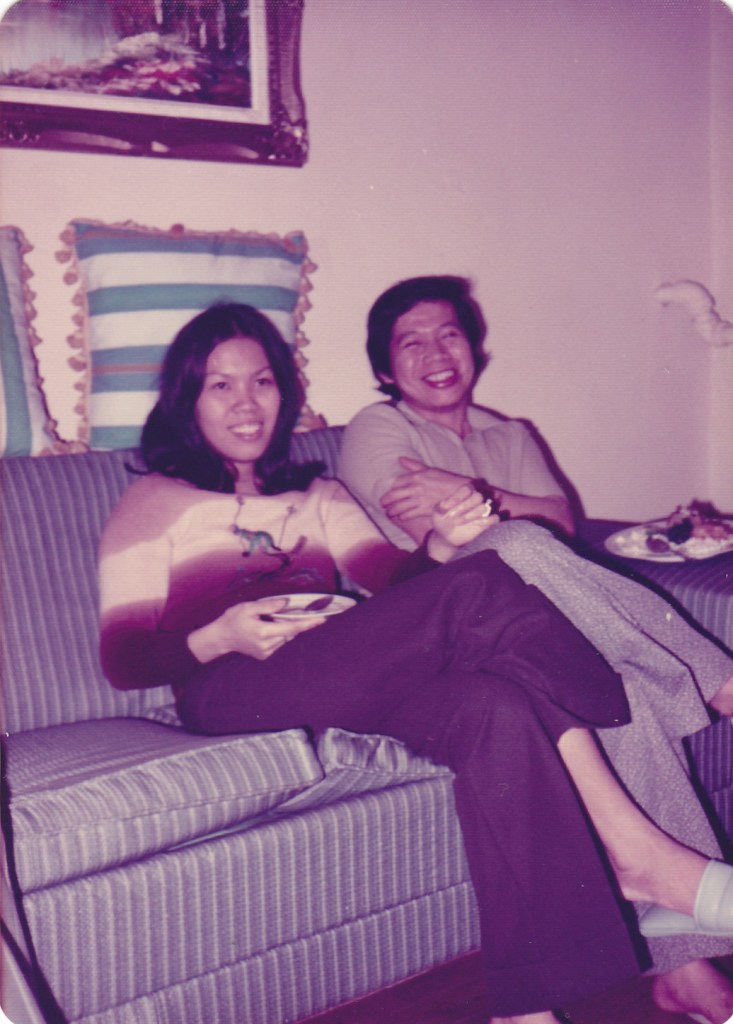
December 1975.
The cold winds staked their claim over Toronto, where my parents had recently arrived from the Philippines. They were underdressed and making their way down Parliament Street. Despite being warned of a shift in temperature, they were not expecting the brutal intensities of Canadian winter. I’m not sure how anyone anticipates the sharp sting of negative temperatures when they are arrivants used to tropical climates. Undeterred, my mother and father headed to a small Filipino grocer, hoping to encounter a semblance of domestic familiarity. Pressed against the biting winds, my mother abruptly stopped, looked at my father and said, “Tumutolo ang sipon” – you have a runny nose. To which my father replied, “Ikaw din” – you do too! They both started laughing and laughed again when they retold me this story 48 years later. When faced with the challenges of migrating to a new and very cold country, they managed to mine humour from a deep well of difficult circumstances. We had been listening to the song “In My Life” by the Beatles (Lennon & McCartney 1965). Something in its expression, melody, and feeling caused my parents to be transported to this small but important moment.
In her conversation with Christine Bacareza Balance, “‘Revolutions in Sound’: Keynote Duet” (2022) Alexandra T. Vazquez writes: “The popular…leaves so much room for engagement with sound artists (musicians without the gallery). None of them need theorists to argue for them, to argue for their mattering because to so many, they already do. How do they instead invite theorists to take part in something alongside them?” (12). I was never a big fan of the Beatles, but regardless of my opinions, they were popular. As a relentlessly oppositional teenager, I was put off by their mass popularity. As Vazquez suggests, despite one’s musical taste, songs are invitations, not scholarly conquests. The memory re-opened by my parents’ connection to “In My Life” was an invitation for me to take stock of the song’s affective and, for them, diasporic trajectories. As Balance (2022) suggests songs request us to “listen long so we hear where another is coming from” (15). For her, “long” describes temporality and commitment. To “listen long” implies that duration and attention are the pretext for empathic relations.
“In My Life” was released in 1965. My mother was fifteen years old when she first heard the song on the radio in a boarding house in Marbel, Philippines. One year later, on July 16, 1966 the Philippine Free Press would announce, “The Beatles Are Coming” (de Manila as cited by Robert Nery in “The Hero Takes a Walk” 2018). At that time, Ferdinand Marcos was the newly elected president of the Philippines, and Imelda Marcos was his First Lady. The Marcoses would later unleash an era of violent dictatorial power and impose Martial Law in 1972, escalating political suppression (Burns 2013). My mother recalls that the band’s first and only appearance in the Philippines was remembered by many less for their two scheduled concerts and more for their “snub” of Imelda. The Beatles were noticeably absent at a lunch reception they were expected to attend with the First Lady at the Presidential Palace. Their absence, attributed to a communication error between the concert promoter and the band’s manager, incited public disapproval and resulted in the sudden disappearance of their security escort and hotel and porter service. Unlike in other cities, the band was refused room service and was forced to carry their own luggage (Nery 2018).
What is striking about this moment is that it breaks from preoccupations with Filipinx desires for assimilation and mimicry of Western imperial projects. In Video Night in Kathmandu and Other Reports from the Not-So-Far East, British travel writer Pico Iyer (1988) famously stated that Filipinx people are the “[m]aster of every American gesture, conversant with every western song…the Filipino plays minstrel to the entire continent (153)” Turning against imperial scripts and the band’s documented disdain of “Mosquito City” and even worse, John Lennon’s comment that a return to the Philippines would require “an H-bomb,” the soured residues of their visit marks a queer rupture in Beatlemania. The public decried that Filipinx people deserved better from the band, capturing what Balance describes in Tropical Renditions: Making Musical Scenes in Filipino America (2016), as “disobedience” in that “disavows a belief in the promises of assimilation” (5). For me, Filipinx non-compliance textures the sonic substance of “In My Life.” While the shadow of the Marcoses cronyism and corruption is an inescapable footnote, it is the defiant voices of hotel employees, dismayed fans, and airport workers that insisted on the “ordinariness” (Wofner & Smeaton, 2003) of the Beatles that holds the song’s queer decibels.
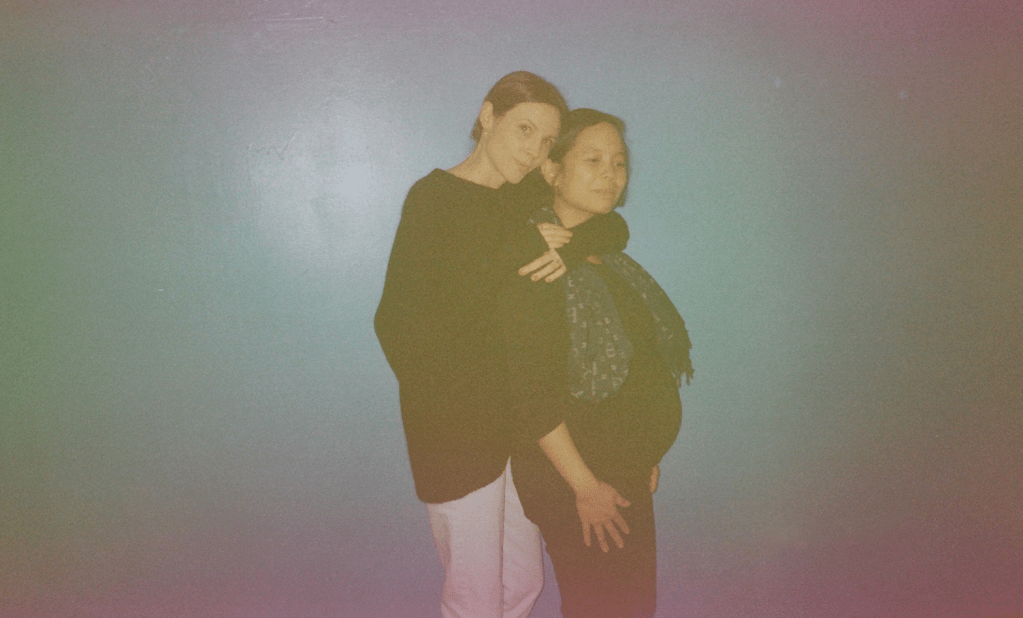
There are places I’ll remember all my life, though some have changed. Some forever, not for better. Some have gone, and some remain.
“In My Life” (Lennon & McCartney 1965).
January 2018.
I am sitting on my couch watching a Toronto Raptors game. The television emits light that flickers through a large window that frames a bright winter moon. I am 41 weeks pregnant at this point (feeling similarly shaped and sized as the moon outside). My stubborn queer resistance to the Beatles somehow dissipated during my pregnancy, and the song “In My Life” made its way to me. I would quietly sing the song to my pregnant belly. Then, that January night, I felt a snap inside my body and a rush of water down my legs. I won’t go into much gratuitous detail other than to say that at 12:49 pm the next day, Asa Cy Dyer-Mecija was born at home.
And these memories lose their meaning when I think of love as something new.
“In My Life” (Lennon & McCartney 1965)
Sometimes, I needed to couch the queerness of pregnancy in words that were not mine. The distance between these words and the ones I had yet to find would help to structure my unfolding love for Asa. Here, queerness presented a modality of encounter with uncensored desires. Queerness is often theorized as a utopian impulse; the queerness of my pregnancy jostled both the hopes and fears brought up by the unknown terrain of parenting amidst heteronormativity. For me, “In My Life” is riven by sentimentality and nostalgia, but it also gave melody to a tender relationship with myself and my new role in the world. This was the sonic throughline to my parents, a queer inheritance of tension made from the hopes for kinder contexts amidst the limitations of harsh realities.
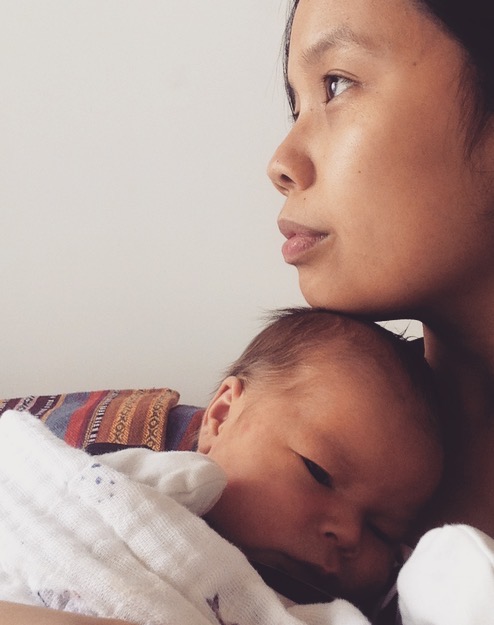
December 2022.
I was invited to perform as part of the Queer Songbook Orchestra’s holiday fundraiser. The Queer Songbook Orchestra is a chamber pop ensemble that hosts an annual concert focused on songs and stories about “chosen family and queer joy” (Queer Songbook n.d.). At that time, Asa was four years old. He is a child of the pandemic. He’s a kid with two moms, a present and kind donor, and is dearly loved by his Lolo and Lola, his grandparents, aunts, titas, uncles, cousins, kuya, ate, and his beautiful chosen family. My partner, Hannah, and I sometimes worry about how his world will be affected by reactions to the makeup of our family, but mostly, we know he’ll be sure he’s loved by many.
To me, the song “In My Life” offers a useful sonic response to homophobia. As a baby, after Asa’s baths, I would often wrap him in a towel, and while rocking him back and forth, I would sing these lyrics from the song: “Though I know I’ll never lose affection for people and things that went before, I know I’ll often stop and think about them. In my life, I love you more” (Lennon & McCartney 1965). To me, this statement is a queer ethos. We know that 2SLGBTQ+ people have necessarily and creatively reworked and reimagined the organization and expression of kinship. When family is so often bounded by what Julianne Pidduck calls “constraints of relationality” in “Queer Kinship and Ambivalence”(2008: 441), the lyrics “In my life, I love you more” are a call to action. More is a word used comparatively to insist that there is something greater, something more exists, something more is possible. I embrace the challenge to love more. My queerness urges me to love more, and parenting Asa does, too. On the evening of the performance, indexed by my parents’ struggles and our shared disdain for the chill of winter, Asa and I performed “In My Life” together. The video of our performance will remain a treasured sonic archive that I will return to often, and as Asa gets older, I hope it reminds him of how beautiful he’s always been.
—
Casey Mecija is an Assistant Professor in the Department of Communication & Media Studies at York University. Her current research examines sound as a mode of affective, psychic, and social representation, specifically in relation to diasporic experience. Drawing on sound studies, queer diaspora studies and Filipinx Studies, her research considers how sensorial encounters are enmeshed and disciplined by social and psychic conditions. In this work, she theorizes sounds made in and beyond Filipinx diaspora to make an argument about a “queer sound” that permeates diasporic sensibilities. She is also a musician and filmmaker whose work has received several accolades and has been presented internationally.
—

REWIND!…If you liked this post, you may also dig:
Blank Space and “Asymmetries of Childhood Innocence” –Casey Mecija
The Sound of What Becomes Possible: Language Politics and Jesse Chun’s 술래 SULLAE (2020) –Casey Mecija
The Cyborg’s Prosody, or Speech AI and the Displacement of Feeling–Dorothy Santos
Tape Hiss, Compression, and the Stubborn Materiality of Sonic Diaspora–Chris Chien
Xicanacimiento, Life-giving Sonics of Critical Consciousness—Esther Díaz Martín and Kristian E. Vasquez
Moonlight’s Orchestral Manoeuvers: A duet by Shakira Holt and Christopher Chien
Enacting Queer Listening, or When Anzaldúa Laughs–Maria Chaves Daza
Echoes in Transit: Loudly Waiting at the Paso del Norte Border Region—José Manuel Flores & Dolores Inés Casillas
The Queerness of Wham’s “Last Christmas”–Justin Burton
Could I Be Chicana Without Carlos Santana?–Wanda Alarcón
Share this:

Ronca Realness: Voices that Sound the Sucia Body

This series listens to the political, gendered, queer(ed), racial engagements and class entanglements involved in proclaiming out loud: La-TIN-x. ChI-ca-NA. La-TI-ne. ChI-ca-n-@. Xi-can-x. Funded by an Andrew W. Mellon Foundation as part of the Crossing Latinidades Humanities Research Initiative, the Latinx Sound Cultures Studies Working Group critically considers the role of sound and listening in our formation as political subjects. Through both a comparative and cross-regional lens, we invite Latinx Sound Scholars to join us as we dialogue about our place within the larger fields of Chicanx/Latinx Studies and Sound Studies. We are delighted to publish our initial musings with Sounding Out!, a forum that has long prioritized sound from a queered, racial, working-class and “always-from-below” epistemological standpoint. —Ed. Dolores Inés Casillas
—
My Puerto Rican grandmother used to sing Pedro Infante’s “Las mañanitas” to all the women in the family on their birthdays, so naturally I grew up thinking this was a Puerto Rican song. Not quite – it’s Mexican. When my family came to New York City from Puerto Rico in the 1950s, they were starved of warm waters, mountains, and family members, but they were not starved of Spanish-language music and media thanks in large part to Mexico’s Golden Age of Cinema. In the Bronx, Puerto Ricans would go the theaters to watch movies like Nosotros los Pobres (1948),which popularized boleros like “Las Mañanitas.” This movie-going ritual in the wake of relocation and diaspora has provided the birthday soundtrack to my life.
My mother grew up listening to her father sing boleros, and she would later sing with the Florida Grand Opera Chorus when I was a child. My early knowledge of opera came from her. Growing up in Miami Beach, I would also listen to reggaetón and hip-hop in afterschool programs. The Parks & Recreation department would host dances for us, and that was where I first learned to dance perreo. My early musical surroundings represent what it means to be a colonial subject, to hear the Italianate vocal legacies of opera mixed with the Afro-Diasporic and Indigenous rhythms of reggaetón. This post contextualizes my experience within bolero’s colonial history and legacy particularly its operatic disciplining of brown and Black bodies and voices. Reggaetóneras provide models for sonic subversion by being ronca, raspy, or breathy, and thus overriding internalized Eurocentric dichotomies of feminine and masculine vocal timbres.
When I began my own operatic training in college, I was constantly told to “purify” my voice, to resist vocal “fry,” and to handle my acid reflux by avoiding spicy foods. I was steered away from singing the pop songs I had grown up with, and kept many musical activities secret, like when I soloed for the tango ensemble and my a cappella group. In graduate school, thanks to my Latina roommates, I began listening to reggaetón again. I reunited with the voices that raised me and was reassured that their teachings of resistance would always present themselves when I needed them.
After 20 years of listening to Ivy, I have located the descriptor that most closely encapsulates the way her voice sounds to me: ronca. This is Spanish for hoarse, and in my experience, it’s been used colloquially, mostly by women, to describe moments when their throats might feel sore, and their voices sound raspy, or masculine, even. Ronca has been articulated as an epistemology of vocal sounding in the artistry of lower-class Black reggaetón creators like Don Omar and more recently, Ozuna. Sounding ronca is a signifier of realness, of truly knowing the struggle of race and class oppression. It is a vocalization of full-body rage fueled by poverty and colonization.
Ivy’s voice is so special to me because she sounds like my aunt when she’s had a long day, my mom when she’s yelling, and my grandma after years of having long days and yelling at people. She sounds like the raw, unfiltered power that comes from exhaustion. She sounds like inner will and justified fury. She sounds like yelling at landlords and ex-husbands for hot water and child support. She sounds like age. And she always has, even when she was “young.” And this sound is even more beautiful and life-giving to me after 4+ years in a classical voice program that told me it was bad to sound hoarse or raspy, surveilled my eating, and perpetuated the colonization of Native and Black peoples through musical subjugation.

Operatic training utilizes mechanisms that are opposite of what is “natural” for me as a poor Latina from the barrio. It asks me to lift my voice, clarify it, and feminize it. This, to me, is antithetical to the girl who laughs really loudly, gets raspy often from yelling and eating too many Takis, and loves to sing from her chest. Ivy’s voice empowers my place as the antithesis. Even as I sang classically in college, my voice was still often described as “soulful,” “hoarse,” “raspy,” “throaty.” My voice, although in a moment of attempted cleanup in college, was read as having previously engaged in genres that disrupt colonial dichotomies of “art” and “noise.” The sonic Blackness– in particular the exoticized and tropicalized Blackness of Latinidad in the U.S.- of my timbre was legible, and perhaps even hyper-audible, in moments when I was trying to adapt to European art forms. Raquel Z. Rivera asserts in New York Ricans from the Hip Hop Zone (2003) that Latinidad doesn’t take away from Blackness but adds an element of exoticism to the Blackness. Thus, I have come to understand ronca voices as representative of a Latina/e liberatory sonic and embodied praxis that resists the derogatory discourse around racialized voices predicated on European ideals of cleanliness.
The ronca voice is negotiating suciedad, Deborah Vargas’ analytic for how queers of color may reclaim their abject bodies and social spaces. Readings of my voice in predominantly white spaces were contextualized by my queer ambiguously-brown body, which in direct opposition to whitening regimes, was sounding suciedad. This is what ronca voices do, and what I conceptualize as “ronca realness”: the tendency of Latinas/es to not hide behind the voice but rather keep it real with the audience via their vocal timbre. Ronca voices sound another option to Barthes’ hegemonic article “The Grain of the Voice,” which has been applied to Ivy Queen and Don Omar in Jennifer Domino Rudolph’s “‘Roncamos Porque Podemos,’” and Dara Goldman’s “Walk like a Woman, Talk like a Man: Ivy Queen’s Troubling of Gender.” I intend ronca realness to be understood as a queer of color vocal analytic born from community and lived experience.

Ronca voices reflect emotional states, flip colonial gendered vocal scripts, reveal if the singer had coffee that morning and Hot Cheetos the night before, and navigate tough musical contours with strain and stress; most importantly, they refuse to be white(ned). In college, my ronca realness was not always a choice. Keeping it real, in general, is sometimes undecided upon prior to the act of realness; it is an additional and deeply engrained responsibility that queer people of color have in white spaces to sound their dissent, or else face the continued exploitation of their communities. Further, these acts of realness may not even be legible as such but are often coded as bad behavior or an attitude problem.
Within communities of color and (im)migrant communities, it’s important to recognize that Ivy Queen’s ronca timbre was permissible because she was light-skinned, thin, and usually took on the masculine role of the rapper, rather than the feminine role of the dancer, in several of her videos. These privileges have left Afro-Latina ronca reggaetóneras like La Sista in the shadows.
La Sista has veered away from sounding ronca in recent years, but in her debut album, Majestad Negroide (2006), she praised Yoruba goddess Yemaya and Taino cacique Anacaona with a hoarse, raspy, bold sound. She is the Afro-Indigenous Latina many of us needed growing up, and her absence speaks to the ways in which Black ronca voices are policed and erased within Latinx culture and elsewhere. Let us praise her now.
—
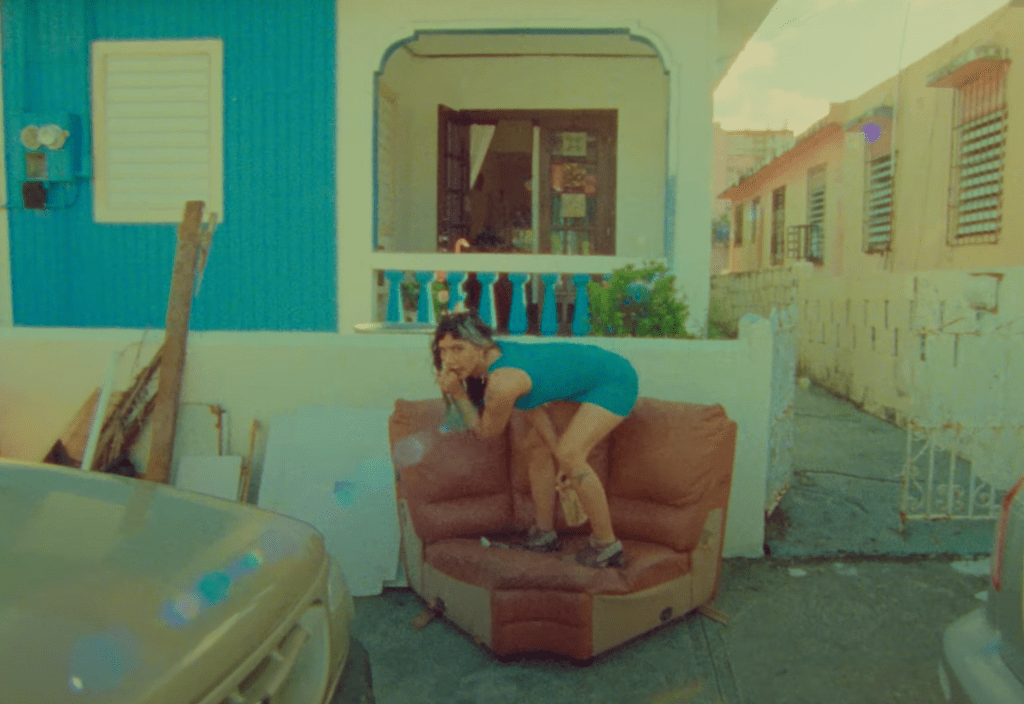
Featured Image: Still image by SO! from RaiNao’s “Tentretiene”
—
Cloe Gentile Reyes (she/her) is a queer Boricua scholar, poet, and performer from Miami Beach. She is a soon-to-be Faculty Fellow in NYU’s Department of Music and earned her PhD in Musicology from UC Santa Barbara. Her writing explores how Caribbean femmes navigate intergenerational trauma and healing through decolonial sound, fashion, and dance. Cloe’s poems have been featured in the womanist magazine, Brown Sugar Lit, and she has presented and performed at PopCon, Society for American Music, International Association for the Study of Popular Music-US Branch, among several others.
—
REWIND!…If you liked this post, you may also dig:
Contra La Pared: Reggaetón and Dissonance in Naarm, Melbourne—Lucreccia Quintanilla
“How Many Latinos are in this Motherfucking House?”: DJ Irene, Sonic Interpellations of Dissent and Queer Latinidad in ’90s Los Angeles—Eddy Francisco Alvarez Jr.
Unapologetic Paisa Chingona-ness: Listening to Fans’ Sonic Identities–Yessica Garcia Hernandez
SO! Podcast #74: Bonus Track for Spanish Rap & Sound Studies Forum
Cardi B: Bringing the Cold and Sexy to Hip Hop—Ashley Luthers
Share this:


Current Top Posts





April 2021

January 2020

November 2019

October 2019

August 2019

April 2014

November 2017

March 2015

December 2017

October 2015
 Sounding Out!
Recent Comments