
Karaoke and Ventriloquism: Echoes and Divergences
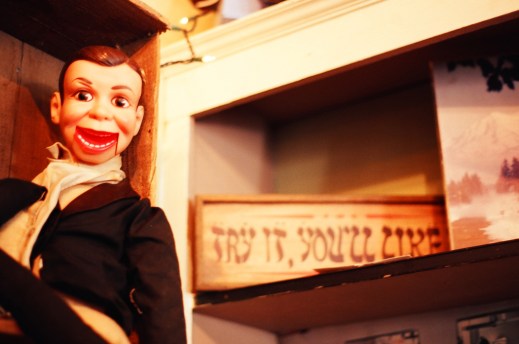
This piece is co-authored by Sarah Kessler and Karen Tongson.
Scholarship rarely happens in isolation, despite quantitative demands in the humanities for “single-authored” works. Instead, intimacies of different shapes and configurations, transpiring in spaces as variegated as “the institution,” cocktail bars, cars, and even boudoirs, have profound effects on how we think, and on what we eventually write. However, academics have very few forms beyond the citation, the footnote, or even the acknowledgment, through which to admit our debts, recognize our inspirations, and lay bare the narcissisms of our small differences.
Our current areas of research—karaoke for Karen, ventriloquism for Sarah—traverse what may appear to be a narrow terrain of sound studies currently focused on “voice” or “the voice.” And yet the strains of sound studies that draw us to these topics do not exclusively concern themselves with the tropes or techniques of voice and vocalization that karaoke and ventriloquism conjure. Though voice presents itself as the most basic and fundamental connection between these two concepts and practices, we are each more invested in exploring karaoke and ventriloquism as actual sound technologies, as well as technologies of power. As you will read below, ventriloquism, for all its associations with archaism and mysticism in certain historical contexts, is also depicted as a technology and technique of deception, statecraft, and power. Meanwhile, karaoke, for all its associations with the expressive and participatory potential of amateur vocalization is also, crucially, a technological apparatus, whose media archaeology bears the traces of intercolonial conflicts, negotiations, and aftermaths. Finally, we are also both interested in the ways in which these sound technologies and techniques have been transformed into critical, intellectual, and affective methodologies, especially since they’ve both been harnessed as broader cultural metaphors for judgments at once moral and aesthetic.
 .
.
Over an obscenely caloric breakfast, we devised several questions touching upon some keywords and concepts we believe are applicable to both karaoke and ventriloquism, two topics that undermine notions of authorship, source, and origin. In our respective writing about these two subjects, we’ve both occasionally (or more than occasionally) been besieged by the anxiety that our work is melding together into some indeterminate blob. To put it another way: like any other lesbionic duo resisting the “urge to merge” (as so many other queers have warned against), we’ve arrived at that moment in our intimate and intellectual relationship where we’ve decided to sort out whose socks are whose. Somewhat ironically, then, we wrote this post together to establish some of the crucial differences between karaoke and ventriloquism.
The following “ventrilokeal” dialogue shows, from a conceptual standpoint, where some of the boundaries between karaoke and ventriloquism harden, while others remain porous.
We each provide separate answers, engaging the other person’s answer when appropriate. Feel free to supplement some of our questions in the comments section, addressing either or both of us. And thanks for indulging.
***
1) How do both karaoke and ventriloquism—as terms, metaphors, and practices—conjure and/or reframe our understandings of originality and derivation?
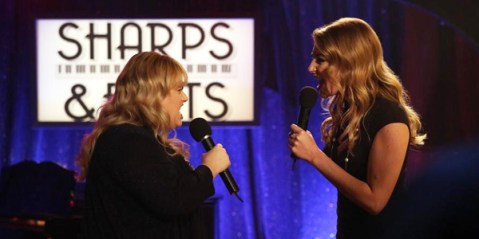
 KT: Karaoke, at least in my mind, has become the prevailing metaphor for derivation in the contemporary moment. Whenever the term is tossed about casually as a cultural metaphor, with little regard to the geographical contexts, modes of performance or the technologies that underlie its current practice, “karaoke” functions as a kind of shorthand for “the unoriginal,” the debased copy, the amateur reenactment. Novelist Dubravka Ugresic’s long essay on “Karaoke Culture” (2011) provides a perfect example of these applications of “karaoke.” And yet, karaoke in the U.S. in the last 15 years or so has also been construed as something that unlocks the creative and expressive potential of beleaguered, repressed or emotionally stunted individuals, usually men (see Lost in Translation, the forgotten Huey Lewis and Gwyneth Paltrow vehicle, Duets, and a recent pair of books I actually quite like, Brian Raftery’s Don’t Stop Believin’: How Karaoke Conquered the World and Changed My Life and Rob Sheffield’s Turn Around Bright Eyes: The Rituals of Love and Karaoke). Of course, it will take all of Empty Orchestra (my working book title), to answer this question properly, but one of the principles guiding my own account of karaoke as a metaphor for copies and reenactments (in addition to my exploration of its material practices and technological history), is that derivation and mimicry have always been a key concern of—and a point of intersection between—queer theory, aesthetics, critical race studies, and (post)-colonial studies.
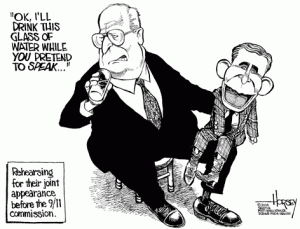 SK: When ventriloquism is employed as a metaphor in popular cultural contexts, it’s also often used to connote a lack of originality. The term tends to describe (and to fantasize) a situation in which one individual acts as the communications medium—usually the speaking or singing vessel—for words, songs, and other ideological formulations that originate or originated with someone else. So, in contrast to the mass copying and amateurism invoked by “karaoke,” “ventriloquism” suggests an unoriginality that can, and that must, be traced back to a discrete body and distinct point of origin. Think, for example, of George “Dubya” Bush and Dick Cheney, who were often represented as a ventriloquial duo. Political cartoons depicted Dubya as Cheney’s open-mouthed dummy, perched on the knee of his puppet master, the “actual” leader of the free world. Here, ventriloquism was used to image a scenario wherein the man who seemed to be in power was both secretly and openly manipulated by another man, who was the true source of power. In this case, unoriginality on Bush’s part connoted originality on Cheney’s, whereas in the case of the Beyoncé lip-synch scandal (more on this below), unoriginality signified very differently. Generally speaking, however, “ventriloquism” implies that a deceptive act has occurred, one that masks the origin of its own workings. It signals the veiling and subsequent exposure of a powerful apparatus. This apparatus is usually vocal in nature, the voice’s historical connections to power being well documented. In his Western cultural history of ventriloquism, Dumbstruck (2001), for example, Steven Connor traces the form back to Greco-Roman oracular myths in which divine prophecy is primarily accessible as a voice, transmitted through the mediating body of a priestess.
 Contemporary ventriloquists like the British performer Nina Conti often claim to be surprised by what their dummies say, which suggests that, far from being an omnipotent machinator, the ventriloquist is a bifurcated entity—one whose practice places her beside herself, in conversation with herself (or, as others have noted, with her unconscious). My recent work argues for bifurcation as a workable antidote to the tired, either/or question of originality vs. derivation to which popular cultural forms are repetitively subjected.
2) The terms “karaoke” and “ventriloquism” are both frequently employed in adjudicatory ways. As Karen has pointed out elsewhere, “karaoke” is often used in reality TV contexts (American Idol, The Voice) as a negative judgment of performance quality, i.e. “that performance was shit—mere karaoke.” “Ventriloquism,” for its part, is often used to connote a deviousness or deception that disqualifies a performance (think folks condemning Beyoncé post-lip-synched inauguration performance). What are the differences between “karaoke” and “ventriloquism” as judgments?
 KT: I actually think that one of the primary differences between these two terms as judgments, and perhaps more simply as just terms, is that “karaoke” condemns the person performing it, or performing something in “the style of” karaoke (i.e. derivatively, as a copycat, as a mere echo of the “original”), as a lightweight. Pulling off a feat of ventriloquism seems like a heavier, more sinister, and more complex operation of power, at least as I’ve heard you explain it, and as you describe it viz. Bush/Cheney above. Karaoke as a performance practice also lacks ventriloquism’s gravitas and requisite skill, insofar as ventriloquism is an archaic-seeming art form. Karaoke is the opposite of serious or sinister: it’s laughable, buffoonish, and absurd. It’s all surface and no depth. Ventriloquism, at least as I’ve heard you describe it to me on many occasions, in different situations, seems more layered. This is not to say, however, that I actually believe that karaoke is lightweight, or only about surfaces, but as a term of adjudication, it can’t really break free from those associations to mean anything more.
SK: Yes, as you say above, “karaoke” as judgment indicates amateurism and insubstantiality, whereas “ventriloquism” suggests a more menacing, or at least a more complicated, operation. And when one actually does karaoke, one can’t even conceal one’s appropriation—it’s part and parcel of the practice. A ventriloquist, on the other hand, hides herself in plain sight: the greater the attention focused on her dummy, the less it matters that—as the audience well knows—she’s the one talking. This is called “misdirection”: if the eyes are on the dummy, the ears will follow, and the dummy will appear to speak even if he doesn’t have his own microphone.
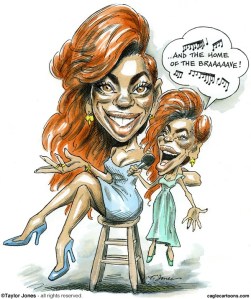 The interesting thing about the liberal accusation that Bush was Cheney’s ventriloquist dummy was that, though the image of Cheney as evil puppetmaster was sinister, it still served a reassuring function, in that it allowed for the continuation of the idea that there was a source, or origin, of power, period. As opposed, let’s say, to a more Foucauldian understanding of power as dispersed, not traceable to an isolated sovereign body. In contrast, when Beyoncé allegedly lip-synced, but in fact sang over, her own recording of the National Anthem at the 2013 presidential inauguration, her performance—which, as many have pointed out, was not unusual by pop industry standards—was framed as ventriloquism in order to cast doubt on her legitimacy as a live performer, i.e. as a performer whose voice could “stand up” in non-studio conditions (which are still, and ironically, just as much mediated as studio conditions). These ventriloquial scenarios are, it should go without saying, gendered and racialized: Bush-Cheney as ventriloquism emasculated Bush while restoring power to Cheney’s white, male, visibly disabled body; Beyoncé-Beyoncé as ventriloquism rather unsuccessfully attempted to pit Bey against herself (mediated, recorded Beyoncé vs. live Beyoncé) in order to devalue her corporeal body and frame her as unworthy of (national) subjectivity.
3) Both karaoke and ventriloquism are mass, but not mainstream, cultural practices. Karaoke is a mass cultural activity, but one that still carries with it the frisson of doing something slightly risqué (hence its frequent overlap with inebriation). Ventriloquism, while not being a cultural activity practiced by the masses, is a mass-mediated and mass-consumed cultural form, despite the aura of Vaudevillian anachronism (and/or pathology) it persistently conveys. How might we account for the “mass but not mainstream” quality of both practices?
 KT: I actually have to credit Zhou Xun and Francesca Tarocco, co-authors of an ambitious book, Karaoke: The Global Phenomenon (2007) with the “mass vs. mainstream” formulation. At this point, karaoke is globally ubiquitous, thanks to the many delivery systems that have evolved from the first karaoke and sing-along machines from Japan and the Philippines. There’s actually a popular app called Sing!, which enables you to perform karaoke and compete against anyone in the world. Meanwhile, YouTube is replete with karaoke videos to perform and practice with (some KJs, or “karaoke jockeys,” use YouTube as their primary interface), as well as with videos of people from all walks of life performing karaoke in various bars or at family functions in the home or elsewhere. These days, practically every sitcom on primetime TV stages a requisite “karaoke outing,” that usually leads to disastrous, if hilarious consequences for its characters.
 And yet karaoke as a mass practice can’t quite broach the mainstream, because of its various “abject” associations with immigrant communities, aspirational everymen longing to be idols, isolate geeks who only interact with the outside world through their computers, drunkards, gaggles of girls group-singing to Madonna, queens bereft of the piano bar’s liveness, slumming with an electronic delivery system for their show tunes, and other such “sad” spectacles. Once someone excels at karaoke—at singing someone else’s song so well that they transform it in some way—we are apt to think they actually exceed karaoke, and leave behind the form, much in the same way that, as you suggest in your opening comments, a good dummy eclipses its ventriloquist. When (in the words of many an Idol judge), someone makes someone else’s song “their own,” we enter into the territory of the cover, the reboot, the repurposed. The failure of the form to transcend its own limitations, even if it serves as the vehicle for many to otherwise achieve transcendence in myriad ways, is what keeps karaoke abject and not quite ready for mainstream acceptance.
SK: In the U.S., there’s a genre of white, masculine ventriloquism that’s currently extremely popular. This genre is typified by U.S. ventriloquism’s two biggest guns, Terry Fator and Jeff Dunham, who, following in the footsteps of Edgar Bergen, brought their ventriloquism to television to increase the art’s spread. Fator won America’s Got Talent in 2007 and now gives nightly performances at The Mirage in Vegas, where he has a theater named after him. He’s made hundreds of millions this way. Dunham has a strong presence on Comedy Central and is also one of the top-grossing U.S. standup acts. Both vents are especially popular with “Heartland” audiences, and both have casts of gendered and racialized puppets to whom they, as white male ventriloquists, play the straight man. Dunham, in particular, takes an unapologetic stance towards his own redneck identity, which permits him to criticize and recuperate this identity in one fell swoop. For instance, Dunham’s “white-trash trailer-park” dummy Bubba J drinks a surfeit of beer and is of low, if any, intelligence, but he remains benign in comparison to the rest of Dunham’s cast of characters, which includes Achmed the Dead Terrorist (a bin Laden caricature) and José Jalapeño on a Stick (use your imagination). Fator and Dunham’s ventriloquism evokes the practice’s historical connections and overlaps with minstrelsy, consolidating a fragile white masculinity in the process.
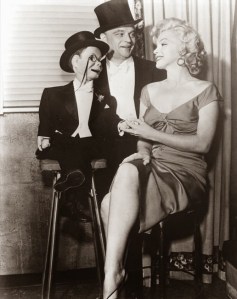 This culturally bounded reading of contemporary ventriloquism’s mass popularity directly resonates with your reading of karaoke as a practice with “abject” associations that is accordingly repurposed to “unlock the creative and expressive potential of beleaguered, repressed or emotionally stunted individuals, usually men.” While ventriloquism is difficult to perform well, vent instruction manuals always stress that, with practice, anyone can ventriloquize. One of the reasons that the practice isn’t mainstream is that it’s associated with a perverse desire, even a need, to speak through someone else in lieu of being able to speak “for oneself.” Edgar Bergen was always said to be shy with women, and to woo them through his brash, confident alterego Charlie McCarthy. And in his autobiography, Who’s the Dummy Now? (2008), Terry Fator (or his ghostwriter) writes about how his father found his ventriloquism perverse, and how he literally closeted his dummy as a result. Ventriloquism is too blatant a form of triangulation to be normal, and is thus coded as deviant, a perversion of heterosexuality’s direct, unmediated operation. Hence Fator’s book title, which aggressively restores authority to the formerly emasculated ventriloquist.

4) As the previous question suggests, and as prominent scholars of ventriloquism have also suggested, ventriloquism is ever anachronistic. Karaoke, too, is suffused by a sense of belatedness, reflected in nostalgic, hits-driven karaoke song choices and/or by the practice’s enduring connection to seemingly obsolete technological forms like laser discs. In what ways is each form out of time, or behind the times, and, alternatively, why do these forms appear as such even as they continue to exist in time?
 KT: As I mentioned above, karaoke’s purported abjection in the U.S. is, in many ways, a consequence of its association with the immigrant communities from Asia who imported the practice, as well as karaoke technologies, to the west coast as early as the mid-1970s. In that sense, karaoke functioned as a vehicle of nostalgia for those in the diaspora who longed to connect with memories of “home” through certain musical repertoires, even if some of those repertoires were actually already comprised of American pop hits folks grew to love when they were still “back home” (e.g. songs by the Carpenters, or any of the Johns—Elton, Olivia Newton, Denver). I haven’t quite worked it all out yet, but there is a certain circular temporality to karaoke. I have a hunch that the form is Romantic insofar as it is, at once, about the moment and its “spontaneous overflow of powerful feelings,” yet prone to saturating those powerful feelings with the “passionate recollection of youth.” There’s also something anticipatory and performative about karaoke, insofar as it has the capacity to do what it purports to articulate. I wrote something about this from a personal perspective in a piece about my favorite L.A. karaoke bar, the Smog Cutter. As the question above remarks, karaoke also feels belated, or emblematic of a particular era, because of the visual peripherals that accompany some song catalogues, especially those released on laser disc in the late 1980s and early-to-mid-1990s (i.e. the videos comprised of b-roll, and oblique narrative re-imaginings of certain songs). I can’t get into all of it here, but my plan is to devote a chapter to the karaoke video—from its production history (of which Brian Raftery offers an excellent preliminary account), to its repurposing in contemporary queer performance art.
 SK: I’m still working on understanding ventriloquism’s anachronism—why it continues to appear, or to feel, outmoded despite its present popularity—besides the obvious fact that its contemporary iterations evoke Vaudevillian performance. Nina Conti, who has, like Fator and Dunham, distributed her ventriloquism across multiple media platforms, makes many jokes about this. Her puppet Monk, who sounds like a muffled Sean Connery trapped in a fuzzy, simian body, will often deride her for practicing such a “dead art,” and Conti’s documentary, Her Master’s Voice (2012), theorizes the ventriloquist dummy as a “bereaved object” that loses its voice repeatedly, and finally for good. Conti’s film, however, argues with its own assertion by reanimating the dummies of a dead ventriloquist with new voices, a process that could theoretically continue ad infinitum. Steven Connor argues that present-day “revivals” of ventriloquism like Conti’s are always “necromantic,” conjuring the form’s prehistory while at the same time referencing “newer” media like film (which, according to Rick Altman (c. 1980) and Michel Chion (c. 1982) is itself a form of ventriloquism). Writes Connor, “Whether because it is scandalously or mysteriously archaic, or uncannily premonitory, ventriloquism is always anachronistic, never quite on time.” And Mladen Dolar tells us that the voice itself is ventriloquial, leading to the extrapolation that ventriloquism literalizes or visualizes what the voice has always already done.
I tend to think of ventriloquism as temporally bifurcated. A ventriloquist has to exist in both the future and the past to make her practice work. She has to anticipate what’s going to be said next while remembering what’s just been said, and she has to keep her lips still while moving her tongue—acts that circumvent linearity and synchronization. In saying this I’m not arguing for ventriloquism as a “resistant cultural practice”; rather, I’m simply pointing out the temporal perversion to which the art lends itself.
***

Reflecting upon this conversation on karaoke and ventriloquism—a conversation that is, of course, ongoing—it has become even more apparent to us that both forms are sound technologies struggling against obsolescence, even as they are so frequently imagined as possible gateways to some human “truth” or “essence” precisely because of their associations with the voice. Though vocalization and vocality are reflexively associated with both forms, we hope we’ve been able to underscore some of the ways in which their powerful associations with “voice” naturalize, and to a certain extent also neutralize, the technical elements of each practice. We appreciate the opportunity to make some key distinctions, and to sound some of these issues out, here on the SO! Blog. Many thanks to Jennifer Stoever and Liana M. Silva for their generous editorial input. Like Conti’s bereaved puppets, who lose their voices only to be invested with new ones, we now relinquish ours—for the time being.
SK & KT
—
Featured Image by Flickr User Sam Grover
—
Sarah Kessler is a Ph.D. candidate in Comparative Literature at the University of California, Irvine, where she is writing a dissertation on ventriloquism in contemporary British and U.S. popular culture. She received an M.A. in Modern Studies from the University of Wisconsin-Milwaukee in 2008. Kessler’s writing on art, film, and media has appeared in artforum.com, the Brooklyn Rail, In These Times, and Public Books, among other publications, and she has held editorial positions at Triple Canopy and Afterall: A Journal of Art, Context and Enquiry. She is currently completing an article on the documentary work of ventriloquist Nina Conti.
Karen Tongson is Associate Professor of English and Gender Studies at the University of Southern California, and the author of Relocations: Queer Suburban Imaginaries (NYU Press, 2011). Her work has appeared in numerous venues in print and online, including Social Text, GLQ, Nineteenth-Century Literature, and Novel: A Forum on Fiction. She is currently the series editor for Postmillennial Pop at NYU Press, and just completed a multi-year term as co-editor-in-chief of the Journal of Popular Music Studies. Her current book project, Empty Orchestra: Karaoke. Critical. Apparatus. critiques prevailing paradigms of imitation in contemporary aesthetics and critical theory, while offering a genealogy of karaoke technologies, techniques, and desires.
—
 REWIND!…If you liked this post, you may also dig:
“Hearing Queerly: NBC’s ‘The Voice’”-Karen Tongson
“Head Games?: The Strategic View of Liveness and Performance”-Andreas Duus Pape
“New Wave Saved My Life*”-Wanda Alarcon
Share this:

SO! Reads: Isaac Weiner’s Religion Out Loud: Religious Sound, Public Space, and American Pluralism

 Calling devotees to prayer, preaching on the subway, broadcasted pre-recorded sermons from a moving car, organizing drum circles in the park, resounding church bells through the city – expressions of faith to some, a nuisance, or even a personal offense (or outright danger), to others. Must religion be so noisy? Must it also be so publicly noisy?
 Religious studies scholar Isaac Weiner portrays public loudness as but one of many exigencies of the religious worldview in his recent publication, Religion Out Loud: Religious Sound, Public Space, and American Pluralism (New York: New York University Press: 2014). Weiner argues that the substantive content of religious doctrine – moral claims, theological arguments, etc. – both constitutes and is constituted by how its ideas are given expression. This might seem unremarkable. However, the claim allows Weiner to re-frame religious pluralism as not only a “matter of competing values, truth claims, or moral doctrines, but of different styles of public practice, of fundamentally different ways of using body and space.” (200)
So, according to Weiner, yes: Some religious groups must be so noisy, and must be noisy publicly. If they weren’t, their religious beliefs and doctrines would be deprived of the expressive forms that imbue them with significance.

“Street Preacher” by Flickr user Tabitha Kaylee Hawk, CC BY-NC-ND 2.0
Weiner is Assistant Professor of Religious Studies in the Department of Comparative Studies at The Ohio State University. Weiner is not a card-carrying sound studies specialist. Nonetheless, his output is representative of a quickly accelerating interest about religion and spirituality within studies of sound and culture. Religion Out Loud is his first book, and builds from themes explored in his previous publications, including articles such as “Sound” (Material Religion 7, no. 1 [2011]: 108-115), “Sound and American Religions” (Religion Compass 3, no. 5 [September 2009]: 897-908), and “Displacement and Re-placement: The International Friendship Bell as a Translocative Technology of Memory” (Material Religion 5, no. 2 [July 2009]: 180-205). Forthcoming are several chapters and articles that closely relate to topics investigated in Religion Out Loud.
The text ranges from America’s colonial period through the early 2000s. It largely attends to legislative efforts seeking to circumscribe the practicing of what Weiner calls “religion out loud” – public, and perceivably exorbitant displays of sonic religiosity. On the other hand, Weiner also details the various ways in which religious practitioners have resisted legal containment. Weiner thus adds to an already copious literature about how contestations over sonic space reflect broader contestations over meaning and power, that includes texts such as Brandon Labelle’s Acoustic Territories: Sound Culture and Everyday Life (New York: Continuum, 2010), Karen Bijsterveld’s Mechanical Sound: Technology, Culture, and Public Problems of Noise in the Twentieth Century (Cambridge, MA: MIT Press, 2008), and other religion-related work like Philip V. Bohlman’s “Music Inside Out: Sounding Public Religion in a Post-Secular Europe” (in Music, Sound and Space, ed. Georgina Born, Cambridge: Cambridge University Press, 2013). This tension between the embodied practice and legal-discursive regulation of sonic spaces throws into relief what Weiner calls a “politics of religious sensation.” However, readers with an interest in the experiential dimensions of the “religious sensorium” should look elsewhere, perhaps the recent volume, Senses and Citizenship: Embodying Political Life, edited by Susanna Trnka (New York: Routledge, 2013). Religion Out Loud appeals more to readers with an interest in the political histories of religious rights and noise abatement policy, and the ways in which “religious sensation” has been regulated according to unstable conceptions of liberalism and pluralism in American jurisprudence.

“Preaching” by Flickr user Boston Public Library, CC BY 2.0
In order to span such a long temporal trajectory (essentially the history of the United States!), Weiner anchors Religion Out Loud in three historically disparate case studies. Each is preceded by a chapter of historical and theoretical contextualization. This forces Weiner to rapidly chronicle decades of developments in noise abatement policy. Yet he does so with both scrupulousness and concision, leaving remarkably few holes left unfilled. This gives the reader the benefit of charting the long-term effects of the policy changes that Weiner more focusedly interrogates. His approach thus differs quite markedly from some other important sound/religious studies literature, such as Leigh Schmidt’s Hearing Things: Religion, Illusion, and the American Enlightenment (Cambridge, MA: Harvard University Press, 2002), which investigates a single historical period in more concentrated fashion.
From chapter one’s onset, I was struck by the impressive depth of archival research Weiner has infused into his arguments. As a result, Weiner’s more speculative conclusions – generally modest in scope – have no shortage of evidence, and are altogether convincing. In chapter one, for instance, Weiner details shifting perceptions of church bells in colonial and postbellum America, an area well tilled in sound studies by the likes of Alain Corbin (Village Bells: Sound and Meaning in the Nineteenth-Century French Countryside, trans. Martin Thom, New York: Columbia University Press, 1998) and Richard Cullen Rath (How Early America Sounded, Ithaca and London: Cornell University Press, 2003). Weiner furthers this conversation by revealing how religious sounds such as church bells – what had receded to the background of what R. Murray Schafer called the “historical soundscape” – faced unprecedented scrutiny as the symbolic status of noise began to change. Likewise, city governments challenged congregants’ rights to occupy acoustic territory. In the burgeoning clamor of the modern city, noise meant progress and prosperity, for some listeners, but, for others, the stylized noise of religion practiced “out loud” signified a kind of regressive primitivism. Noise thus occupied both sides of the evolutionist coin that Weiner suggests ideologically underpinned religious self-understandings of the time.

“St. Mark’s Church Philadelphia” by Flickr user Library Company of Philadelphia
Weiner further explores the progressive/primitive duality in his first case study – Harrison v. St. Marks of 1877– in which Weiner quite brilliantly unravels how both perspectives were articulated in legal discourse. According to Weiner, complainants challenged the long-presumed public-acoustic prerogatives of Philadelphia’s fashionable St. Mark’s Protestant Episcopal Church. The main takeaway from the chapter is that St. Marks’s complainants voiced a formulation of suitable, modern, and thus normative religious practice as “properly disentangled from various forms of materiality and mediation, carefully circumscribed and respectful of its bounds, interiorized and intellectualized, invisible and inaudible.” (60) From the complainants’ perspective, noisy religion signified backward, immature religion. The court sided with this position, treating church bells as it would any other “extraneous” public noise. Yet in so doing, it ironically reinforced the cultural dominance of Protestantism. That is to say, by silencing St. Mark’s bells, the ostensibly secularized legal system set a precedent that legitimated the “subjugation” of all forms of religious practice to “proper modes of acceptable piety” – including “religious ‘others’” who lacked the pervasive influence that Protestantism could exercise in the public and political spheres, including the courts. (74)
In the second section, Weiner shifts his focus from acoustic territorialization to noisy religiosity as a form of dissent. He details how noise abatement legislation in the early twentieth century harkened a “new regulatory regime” that suppressed the activities of religious practitioners for whom “making noise was not merely incidental to their work; it was their work” (80). The Salvation and Army and the Jehovah’s Witnesses, Weiner shows, aggressively challenged norms of community outreach through provocative exhibitions of religious devotion in public spaces. However, while exercising freedoms of speech, religion, and public assembly, such groups turned unsuspecting citizens into “captive audiences,” and thus infringed upon rights to privacy. The style of practicing some liberties, as many scholars and critics have suggested, has throughout history limited the enjoyment of liberties by other parties.

“The Watchtower” by Flickr user Scott Kellum, CC BY-NC 2.0
Moreover, as Weiner rightly suggests in his second case study, Saia v. New York of 1946, civil liberties have always been carefully regulated by the state. Samuel Saia, a Jehovah’s Witness, drove around the city of Lockhart, NY, and used loudspeakers to broadcast inflammatory sermons from his car. He loudly exercised his first amendment rights through what Weiner calls “sound car religion.” Yet the city managed to treat the sermons’ noisiness as extraneous to Saia’s religion, rather than acknowledging the practice as partially constitutive of it. Lockhart’s noise abatement ordinance thus infringed upon his right to religious free exercise. To that end, Weiner repositions McLuhan’s famous “the medium is the message,” framing religion as media, as opposed to religion and media as separable concepts. Saia spread God’s word, and in doing so loudly fulfilled a core tenet of the Witness creed.
Throughout the case study, Weiner critiques the “liberal inclusionary ideology” that has come to characterize the Judeo-Christian tradition of American jurisprudence. But he curiously softens his otherwise pointed critique at the end of the chapter. Saia ultimately won the case, yet the Witnesses’ devotional style gradually became unmarked in the ensuing years, as they seemed to assimilate voluntarily to normative expectations of religious devotion. As such, Weiner suggests that dissenters in general often find that they can “afford to quiet down once they feel that their voices have been heard.” (135) While it is “important not to exaggerate the coercive effects of American law,” I would have nonetheless appreciated a more critical take on how the legal system had its cake and ate it too – that is, how it satisfied the demands of the Witnesses and also managed to keep them quiet. Indeed, Weiner’s mild conclusion may unsettle those readers who enjoyed the previous three chapters of incisive and nuanced analysis.

“Carillon of Peter And Paul Cathedral in Saint-Petersburg” by Wikimedia user RuED, CC BY-SA 3.0
In the last section, Weiner shows how a controversial 1990 Supreme Court decision – Employment Division v. Smith, spearheaded by Justice Antonin Scalia – enacted into law a conception of religiosity as interiorized, intellectualized, and privatized. It favored majoritarian notions of religious free exercise such that dissenting – or noisy – religious practice by minority religious subjects risked criminalization. As a result, the granting of religious exemption from preclusive noise ordinances was left not to the courts to decide, but rather to the political arena. Potentially disruptive religious free exercise was no longer constitutionally protected. It now required approval from a political body. The last case study, then, does not deal with legal proceedings. Rather, it examines the public debates and media spectacles that surrounded al-Islāh Islamic Center’s petition to broadcast the call to prayer in Hamtramck, MI, in 2004. Al-Islāh was ultimately granted exemption from the local noise ordinance. But over the course of an exasperating six months of debate, Weiner demonstrates, formerly unvoiced identity politics that residents invested into the city’s sonic territories were brought to light in highly contentious ways.
Weiner identifies three rhetorical-discursive tropes that various parties used to debate changing the city’s noise ordinance to accommodate the call to prayer. One of them, pluralism, will likely be of most interest to readers (the others are exclusivism and privatism). The pluralist debaters envisioned the public sphere as a neutral space in which the particularities of religious difference were accommodated, but only according to an ideal of “agonistic respect.” Against this idealistic backdrop, pluralists interpreted the call to prayer not as broadcasters intended it to be heard, but rather as a symbol for the “potential for interfaith harmony.” (186) Weiner argues that the hearings refigured – effaced, even – the call’s meaning, since the Muslim community’s political recognition was achievable only by way of the discourse of pluralist forms of tolerance. In other words, if pluralist discourse takes the form by which Muslim faith can express itself, then Muslim faith itself risks effacement as a result of such “accommodation.”

“Muezzin” by Flickr user colin, CC BY-NC-SA 2.0
Surprisingly, Weiner largely omits Muslim perspectives from the chapter. How did pluralist assimilation change the meanings of religious practice as the Muslim community saw it? How did the Muslims feel they had to modify their rhetoric of self-representation? Moreover, how did Muslims perceive – or perhaps even challenge – displays of Judeo-Christian devotion? Perhaps pursuing such questions exceeds the scope of Weiner’s project, as could the inclusion of many other issues that readers might think warrant consideration. For instance, Weiner gestures toward the sonic interpellation of Muslim and Christian subjectivity, but does not pursue the topic. Further analysis could productively complement recent work on religious acoustemology such as Charles Hirschkind’s The Ethical Soundscape: Cassette Sermons and Islamic Counterpublics (New York: Columbia University Press, 2006), Andrew J. Eisenberg’s, “Islam, Sound and Space: Acoustemology and Muslim Citizenship on the Kenyan Coast” (in Music, Sound and Space, ed. Georgina Born, Cambridge: Cambridge University Press, 2013), Jeanette S. Jouli’s “Beat-ification: British Muslim Hip Hop and Ethical Listening Practices,” and Ashon Crawley’s “Pentecostal Song, Sound, and Authentic Voices.” Additionally, Weiner glosses over counterculture in the 1960s. How might a treatment of the Nation of Islam, for but one example, complicate his conclusions about the accommodation of religion practiced “out loud” in the period?
That notwithstanding, Weiner accomplishes his proposed task with great nuance, insight, and lucidity. Religion Out Loud skillfully unites archival research with ethnographic methods, a history of sound with a history of ideas. It will appeal to those with an interest in the “politics of sensation,” as Weiner suggests, and even more so to readers with interests in the contradictions of noise abatement policy, the legal history of religious rights, and ways in which they have contributed to religious soundscapes in the United States. And of course, it provides an emphatic—and important—affirmative to that longstanding question “must religion be so noisy?”
—
Jordan Musser is a graduate student in the musicology program at Cornell University. He has a primary interest in the social practice of musical aesthetics, with a focus on roles of the avant-garde in popular culture. Using theoretical frameworks from media, performance, and cultural studies, his recent projects have investigated virtuosity in 19th-century Europe, musical reenactment, the sonic imaginary, and politics of musical mythologization. In 2012, Jordan earned the M.A. in the Humanities from the University of Chicago. Before arriving at Cornell, he was an editorial assistant with Grove Music Online, and held teaching positions from the early childhood to high school levels.
—
Featured image: “Microphone inside Al-Azhar Mosque” by Flickr user John Kannenberg, CC BY-NC-ND 2.0
—
REWIND!…If you liked this post, you may also dig:
“Listen to the Word: Deafness and Participation in Spiritual Community”-Liana Silva-Ford
“I Love to Praise His Name: Shouting as Feminine Disruption, Public Ecstasy, and Audio-Visual Pleasure”-Shakira Holt
“Sounding Out! Podcast Episode #5: Sound and Spirit on the Highway”-David B. Greenberg
Share this:


Current Top Posts





April 2021

January 2020

November 2019

October 2019

August 2019

April 2014

November 2017

March 2015

December 2017

October 2015
 Sounding Out!
Recent Comments