
SO! Amplifies: Radio Coyote’s #DIASPORADICAL Sound

SO! Amplifies. . .a highly-curated, rolling mini-post series by which we editors hip you to cultural makers and organizations doing work we really really dig. You’re welcome!
—
DOI: https://doi.org/10.59350/k2907-nt881
This whole world’s wild at heart and weird on top —Wild at Heart
Por tu amor. . . — Buyepongo
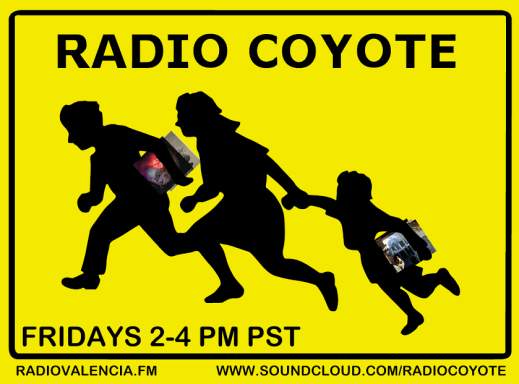
Radio Coyote is a San Francisco-based web radio program & podcast I co-host with my friend Jesus Varela, aka Sweet Jesus. Radio Coyote is our effort at amplifying expression which is #DIASPORADICAL – acknowledging movement and humanity in a world alive with ART; most especially of those on the margins who in the current structure, have become the invisible inspiration for the priviliged, hardly benefiting from the soul they emit.
Recently, Jesus and I recorded with Los Angeles’s own future-rooted band of immigrant brothers – Buyepongo – live from the scrappy but charming Radio Valencia studios in the Mission District. Some topics we talked about included connections between the Bay Area and Los Angeles, the hip-hop influence of Wu-tang Clan & Madlib on the group, and, importantly, the burgeoning yet connected #DIASPORADICAL network building alternatives and manifesting the visceral spirit of our ancestors through drumming.
This particular episode’s conversation is emblematic of how we use sound and voice on Radio Coyote to bring energies together to counter the hegemonic corporate $tandard currently funding the arts and culture industries—live music and entertainment but also tech and media, not to mention the spaces where they intersect—all reflective of a standard which is essentially: THE STRIVE FOR MONETARY SUCCESS MARKED AS WHITE ACHIEVEMENT A/K/A the land of the “Free” where the inspired benefit from those on the margins.
Nahhhhh, FUCK THAT. – emcee Nani Castle in To The People
The type of capitalist cultural extraction we challenge on Radio Coyote can be heard and seen everywhere. Justin Bieber, for example, has a #1 record right now (produced by Skrillex) that is clearly influenced by Caribbean dembow. I’m still waking up from that dream where Macklemore wins a Grammy award over the 2014 jazz griot giant that is Kendrick Lamar. The FADER, like so many media outlets, assigns white writers to cover emerging Latin culture in the US: Exhibit A on contemporary cuban music & Exhibit B on J. Balvin and reggaton. And, I could go on. But because it is so pervasive, we need to keep asking, “Who benefits?”
It don’t make you right cause you majority.- Bree Newsome, South Carolina-based activist & artist who removed the Confederate Flag earlier this past Summer from SC’s capital
Mamacita, pass me a beer-a – Will Smith on Bomba Estereo’s “Fiesta” (Remix) for SONY
Because all around the world – or the worldwild, I like to say, people are waking up and acknowledging themselves, their neighbors, and the stories of their movement, exploring what those moves truly meant and what they will mean for a humanity needing to be increasingly inter-reliant in our crumbling late-Capitalist era. Radio Coyote is a product, a revelation, and a confluence of these worldwild movements, amplifying the true vibration and rhythms of a very specific history and examining how they will mutate in the future.

Our voices and spirits have always been dangerous. During the conquest in what is now Mexico, for example, the Spansh conquistadors killed the ceremonial drummers first. In Chile, when Augosto Pinochet seized power in 1973, he ordered revolutionary singer Victor Jara executed, and his soldiers kidnapped Jara, smashed his hands and wrists and shot him 44 times. But what was once dangerous has been disempowered and I predict, increasingly exploited. Now Canadian DJ A-Trak calls himself “Plantain Papi,” Roots drummer Questlove goes by “Questlove Gomez,” and Kendrick raps in Spanish. Bieber just dropped that dembow-influenced pop record while dembow legacy artists, Los Rakas (via Panama & Oakland) switched to Latin pop.
Cause I just need one more shot at second chances – Justin Bieber in “Sorry“
I get a lot of success because I’m white. – Diplo in YourEDM.com
Radio Coyote is our chance to explore these ideas and who benefits from the global flows of culture . To empower me. To empower us. To get back to the place where this expression was dangerous . We are smuggling these sounds to you over what was once pirate radio – now, online – because the boundaries between u$ are quite pronounced. Radio Coyote is my moment of love in a land$cape of domination and hate. We are powerful. It’s clarity through the confusion. Radio Coyote simply must be. It’s an effort at radically witnessing the expressions all over the world of people who’ve had access to Internet these last 10 – 15 years, but who also seek to honor, understand & feel a past which we are indisputably products of!

Though I am fiercely frightened to get on the mic every Friday from 2 – 4 PM PST, I like to think I’m reversing the common programming Latinas go through, constantly told to shush in this world. I also feel a true duty. We simply need to step up and be ourselves! We need to acknowledge and be proud of our own particular story of being human in a world with the same level of equality as the other, together, with immense respect for the planet we live on and all the resources she provides (another topic I like to think about, but more on #PACHAMAMAISM at another time…).
There is nothing else we should be doing but seeing ourselves in each other and being very adamant about that. So this is my love force to you and I hope you continue to enjoy/share it. Lift your voice in love, too, in any way you feel is important out in the worldwild! And, then, tell me about it so we can have you call in and talk to us on Radio Coyote: radiocoyotesf@gmail.com! 😀
Tune-in to #RadioCoyote: Smuggling #DIASPORADICAL Sounds Across Borders Every Friday From 2 – 4 Pm PST With DJ Nipslip aka Naticonrazon and Jesucio aka Sweet Jesus: www.radiovalencia.fm. Archives:www.soundcloud.com/radiocoyote
—
all images courtesy of the author
—
Nati Linares aka Nati Conrazon is an artist advocate and cultural lobbyist rebalancing the world who was raised in New York City, but is currently living a #Bicoastalidad lifestyle which is rooted in Oakland, California. Her womanagement clients include Brazil-via-Brooklyn’s Vocalista Making Interracial Music Babies, Zuzuka Poderosa & Powerfully Raw Chilean/Irish Emcee, Nani Castle. Check out all her current projects: www.conrazon.me/projects/current-projects and follow her on Twitter: @conrazon, Instagram: naticonrazon and beyond! Embrace the hybrid!
—
—

REWIND!…If you liked this post, you may also dig:
SO! Amplifies: Sounding Board Curated by Leonardo Cardoso–Jay Loomis
SO! Amplifies: Shizu Saldamando’s OUROBOROS–J.L. Stoever
—
Share this:

Of Resilience and Men: How Bieber, Skrillex, and Diplo Play with Gender in “Where Are Ü Now”

DOI: https://doi.org/10.59350/bt0ja-9ey61
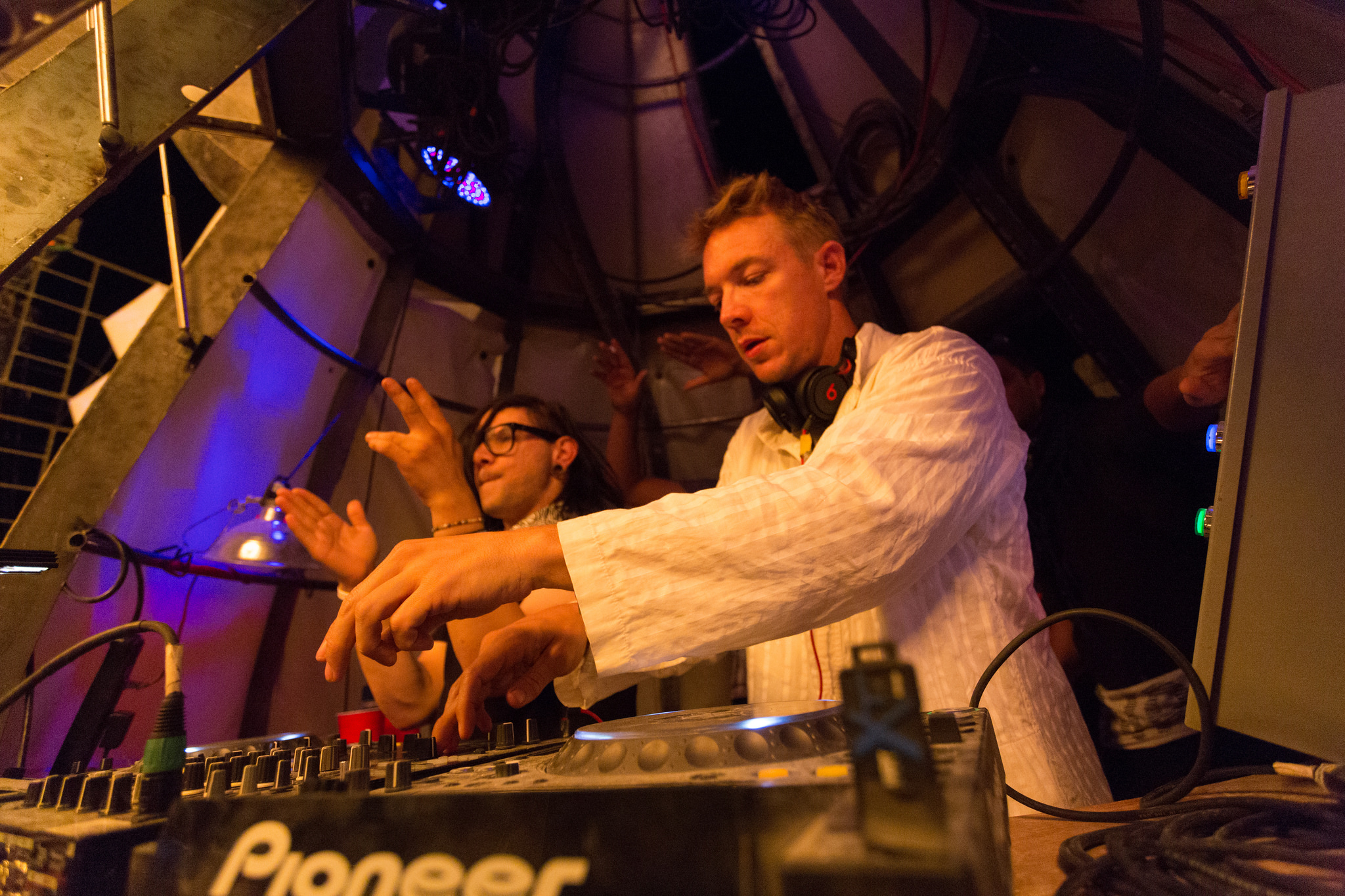
Justin Bieber caught me off guard last year. There I was, minding my own business, listening to a pop station, and this breathy little thing, this delicate vocal wrapped in a halo of shimmering effects starts piping through my car. I didn’t even realize it was him at first; it had been so long since I’d heard a new Bieber song. And I had no clue the production was from Skrillex and Diplo (from their 2015 Skrillex and Diplo Present Jack Ü), which is why I was probably also not ready for the drop, that moment when the song’s tension releases and I’m suddenly gliding across a syncopated bass synth while Bieber’s vocals are pinched into a dolphin call. Somehow, two of the most notoriously unsubtle producers and the posterboy for “too much, too soon” had snuck up on me with “Where Are Ü Now” (WAÜN).

WAÜN’s drop from nowhere isn’t brand new. Subtle soars and understated drops are officially A Thing. More importantly, they do work beyond the sonic aesthetic. In this case, I want to listen to WAÜN in the context of Bieber’s performance of gender, specifically with an ear toward the way Skrillex and Diplo mix elements from dancepop’s 2015 toolkit to produce a track that plays on feminine tropes, which articulate a kind of masculinity. Listening to WAÜN alongside Robin James’s Resilience & Melancholy (2015) amplifies the male privilege at play in WAÜN. James calls attention to the way drops can sonify feminine resilience, and WAÜN’s surprise drop toys with that resilience in a thoroughly heteromasculine way. I’ll first set up how drops usually work, then read James in the context of Bieber’s gender performance as heard in WAÜN.
Drops, at their most basic, are climactic moments when a song’s full instrumental measure hits (hence “drop”), often after some key elements of the instrumental have been removed so that the climax can sound more intense. At that broad level, any genre can employ a drop of some sort. EDM and dancepop drops—the kind that most directly inform the music of Skrillex, Diplo, and Bieber—are bass-heavy and typically follow a soar that intensifies volume, texture, rhythm, and/or pitch: you soar to a sonic plateau or a cliff, and with a “YEEEEEES!!!!!” coast on some wobbly goodness to the next verse.
The pre-chorus soar in the Messengers/Sir Nolan/Kuk Harrell-produced “All Around the World” from Bieber’s 2012 Believe is a solid example. In the video below, the soar starts at 0:45, the chorus enters at 1:00, and the drop lands at 1:15. It’s textbook: the instrumental is stripped back and filtered, and in the opening moments, we hear a descending bass glide. A filter does what its name suggests–it filters out a prescribed set of frequencies so that we only hear a certain range, and in this case it’s the low end that comes through. The effect makes the synths sound like they’re pulsating through water, and the higher frequency overtones take on a shimmery quality. Over the course of the 8-measure soar, the higher frequency range is brought into earshot, and then, on the second half of the eighth measure…nothing. This nothingness is integral to James’s central argument in Resilience & Melancholy: nothingness intensifies what follows. In these eight measures, we’ve glided down to the low end only to soar up up up until all that’s left is Bieber’s voice, confident, nasally, with just a touch of autotune as he sings the titular line that will take us to the chorus. That chorus bangs harder because of the soar to oblivion before it.
WAÜN’s drop lands at 1:09. For full context, start from the beginning and listen for the soar. (If you also need to stare dreamily into Bieber’s eyes, then by all means.)
There’s not really a soar there. No intensifying volume, texture, rhythm, pitch. The not-soar (starting at 0:48) is even a weird length, clocking in at 12 measures after an 8-measure intro and 16-measure verse have established a multiples-of-8 structural rhythm; even if we were expecting a drop, it comes four measures early. The clearest sign we get that a drop is imminent is that moment where the instrumental reduces to a quiet hiss for two measures as Bieber sings “Where are you now?” That hiss is the structural equivalent of the nothingness we hear just before “All Around the World”’s chorus, and with no traditional soar before it, we have just enough time to think “Oh shit, are they gonna….?” before we’re off, clutching tight to Justin Bieber as we ride a dolphin through the more tender parts of Skrillex’s and Diplo’s musical oceans.
Until that nothingness, this could just as easily be one of those heartfelt Bieber tunes where he reaches to the high end of his range for a chorus full of feels. That Bieber? He’s incredibly self-assured, bearing his soul because he’s certain you’ll love him. The bait-and-switch of WAÜN’s soarless drop highlights Bieber’s insecurity in this song—he’s just dolphin calls and “Where are you now”s—by creating expectations for a different persona.
So what we have here is an atypical drop, a drop that calls attention to itself by behaving differently than we expect it to, a drop that’s a study in understatement–all courtesy of three of dancepop’s resident maximalists.
Atypical soars and drops aren’t new, as producers will always toy with musical conventions as a way to disrupt expectations. Skrillex’s own “Scary Monsters and Nice Sprites” (2010) includes a pre-drop that doesn’t soar at all. In 2015, two big acts in the dance scene, Disclosure and The Chemical Brothers, released singles that don’t soar right, either. Disclosure, whose big 2013 hit “Latch” soared rather traditionally into Sam Smith’s chorus, is coyer on “Bang That” and “Jaded.” “Bang That” includes three separate 8-measure phrases (at 0:30, 0:45, and 1:01, respectively, in the linked video) that never take off, finally settling into a descending bass line (starting at 1:09) that just repeats a rhythmic motif, running out the clock on the final four measures before the chorus. “Jaded,” at the other end of the spectrum, includes only a 4-measure pre-chorus (1:18-1:27) that seems to be sweeping upward like a traditional soar, then roller coasters down and back up over the final two measures. The instability of this soar/not-soar is punctuated with an additional eighth note tacked onto the end of the fourth measure, throwing the chorus off-kilter. The Chemical Brothers employ a similar roller coaster sweep in “Sometimes I Feel So Deserted” that marks out an even eight measures (0:58-1:13) without either intensifying rhythmically or pushing to a pitch ceiling at the drop.
These soars and drops stand out precisely because, like WAÜN’s, they aren’t the norm. To help theorize WAÜN’s not-soar, I want to think with Robin James, whose Resilience & Melancholy hears soars and drops in the context of contemporary race and gender politics. James situates soars and drops as the sonic equivalent of resilience–a performance of feminine overcoming that ultimately only strengthens the white supremacist capitalist patriarchy that inflicts the damage that is being surmounted. In other words, women can only attempt to overcome through the damage that white supremacist capitalist patriarchy inflicts upon them. Sonically, the soar is an accrual of damage that is spectacularly (and profitably) overcome in the drop, the music that resiliently endures on the other side of nothingness. Melancholy, on the other hand, is failed resilience, a handling of damage that does not directly profit white supremacist patriarchy and that could sound any number of ways, including like a non-traditional soar. While admittedly these soars and drops aren’t always about gender politics, R&M opens space for us to think about gender and soars/drops together.
I don’t think WAÜN’s non-soar/drop is resilient or melancholic, but I do think it’s helpful to think of it as being about resilience and melancholy. This is where Bieber’s performance of masculinity comes into play. From his earliest poofy-headed, babyfaced performances, Biebs has done a modified bro thing: his heart’s on his sleeve, but mostly as a strategy for sexual conquest. “All Around the World,” again, is exemplary. In the lyrics, Bieber uses his worldly experiences to woo a potential lover, who he also negs, keeping himself in a position of power as someone who knows more, has seen more, and is willing to accept this woman despite her obvious flaws.

In WAÜN, though, I hear his performance of masculinity complicated further, as he tries out a number of more feminized tropes all at once. Lyrically, Bieber is the scorned lover who claims to have done all the care work in his relationship. Visually, he’s the pop icon whose body is ogled, scrutinized, and marked. Vocally, he receives the pitch-shift treatment that has most recently been associated with DJ Snake’s production of diva vocals (think “You Know You Like It” and “Lean On”). He also sings in a breathy style that James has elsewhere noted mimics Ellie Goulding’s vocals. Musically, Skrillex and Diplo give him the soar/drop construction to undergird his pain, a musical technique that most often signifies feminine resilience.
What bubbles up is a heteromasculine play on resilience and melancholy. Skrillex and Diplo liquidate the soar until all that’s left is a nothing-hiss before the drop. In the context of the other feminized tropes Bieber is messing with in WAÜN, this failed soar could feel melancholic, a refusal to spectacularly overcome. Overcome what, though? Bieber gets to sound resilient or melancholic without ever experiencing damage. That’s his male privilege. James points out that one of the most violent outcomes of resilience discourse is the re-enforcement of damage. If resilience is the way women become legible and profitable, then the damage inflicted by ablist white cisheteropatriarchy becomes a necessity, something that must be endured to gain access to power and resources. This is the lynchpin of James’s critique: resilience is a harmful discourse because it ultimately benefits the system it purports to overcome. Melancholy turns resilience logic on its head by refusing to treat damage as something an individual is responsible for overcoming. WAÜN, though, erases damage altogether in its initial drop. WAÜN’s feminized tropes ultimately highlight instead of unsettle Bieber’s performance of hetero-masculinity: what’s more man-ly than accessing power and resources without the threat of institutional violence?
Importantly, these feminized tropes don’t undermine Bieber’s heteromasculine performance; rather, they only seem to add nuance to the slightly bro-ier [that’s a word] Bieber performance we’ve become accustomed to. That’s what I mean when I say WAÜN is about resilience and melancholy; Skrillex and Diplo use the markers of queer or feminine overcoming and failed overcoming to re-construct Bieber’s masculinity, to toss some more ingredients into his manly mix, and the not-soar is a big component of that. Skrillex and Diplo tap into this soar experimentation, then drop it into the middle of a slightly more gender-fluid Bieber.

WAÜN’s high water mark is a few months behind us at this point, but Bieber remains hotter than ever, with “What Do You Mean?,” “Sorry” (another Skrillex production credit), and “Love Yourself” still dominating US and UK charts. Several more singles from Purpose (including two more Skrillex collaborations) are poised to do the same in 2016. Each of these singles extends some of the same tropes Bieber, Skrillex, and Diplo explore in WAÜN—breathy vocals, misunderstood and mistreated pop icon, resilience and contrition and care in the face of a failed relationship—and I hear WAÜN’s initial drop as the sonic moment that preps Bieber’s return to the pop charts. He wades back into the mainstream with a more complex performance of heteromasculinity and reaps the profits that come with it.
—
Justin D Burton is Assistant Professor of Music at Rider University, and a regular writer at Sounding Out!. His research revolves around critical race and gender theory in hip hop and pop, and his current book project is called Posthuman Pop. He is co-editor with Ali Colleen Neff of the Journal of Popular Music Studies 27:4, “Sounding Global Southernness,” and with Jason Lee Oakes of the Oxford Handbook of Hip Hop Music Studies (2017). You can catch him at justindburton.com and on Twitter @justindburton. His favorite rapper is Right Said Fred.
—
REWIND!…If you liked this post, you may also dig:
Vocal Gender and the Gendered Soundscape: At the Intersection of Gender Studies and Sound Studies — Christine Ehrick
They Do Not All Sound Alike: Sampling Kathleen Cleaver, Assata Shakur, and Angela Davis — Tara Betts
Tomahawk Chopped and Screwed: The Indeterminacy of Listening–Justin Burton
—
Share this:




Current Top Posts





April 2021

January 2020

November 2019

October 2019

August 2019

April 2014

November 2017

March 2015

December 2017

October 2015


Recent Comments