
Moonlight’s Orchestral Manoeuvers: A duet by Shakira Holt and Christopher Chien

On January 10th, 2017, A24 + AFROPUNK + Wordless Music + Spaceland presented Moonlight at the historic Million Dollar Theater in Downtown Los Angeles with the Wordless Music orchestra as live accompaniment. The oldest and once-largest theater in LA, The Million Dollar has a capacity of around 2000 people. Reviewers Shakira Holt and Chris Chien attended separately, but were brought together on Facebook via SO! editorial magic for a discussion on the sonic valences of the film and the entire event experience.
Shakira Holt is a Southern Cali-based high school lit teacher with a doctorate in English from the University of Southern California. She’s deeply interested in the intersections of race, religion, sexuality, class, and politics. This is her second piece for SO!; Her first, “‘I Love to Praise His Name’: Shouting as Feminine Disruption, Public Ecstasy, and Audio-Visual Pleasure,” was published five years ago. Moonlight was on her winter break to-do list in December 2016, but the SO! call for a reviewer of the LA showing intrigued and excited her. Jenkins’s film was taking critics and general audiences by storm and already meant so much to so many people. She approached the screening with a healthy respect and desire to do it justice, walking into the Million Dollar Theatre the night of January 10th completely “fresh,” with scarcely more than trailers and the film’s sponsored social media posts as background.
Chris Chien is an American Studies and Ethnicity graduate student at the University of Southern California, and is doing research on early Asian gay and lesbian organizing in North America, and these social movements’ place within contemporary transpacific, diasporic narratives of a liberalizing Asia, particularly Hong Kong. He has previously written on Sounding Out! about the sonic materiality of diasporic feeling through the relic of the cassette tape, and has an upcoming article on righteous white violence in the music of trans-hardcore band G.L.O.S.S. He hadn’t seen Moonlight or even a trailer before this screening, but heard from many people he respects that it was magical. When SO! ed-in-chief JS reached out after seeing him post about attending on FB, he immediately embraced the idea of a conversation with Shakira.
***
The special screening of Moonlight in Los Angeles was an enjoyable and important, though mixed, experience. The live music, engineered to perfection, formed a seamless auditory union with the film’s other music; the live orchestra was much more of a visual cue for those attendees who could see the pit than a sonic one. However, the exclusion from live performance of non-orchestral music, especially those genres hailing from African American and Latin American creative spheres, detracted from the event, setting it somewhat amiss. Certainly, the screening paid fitting tribute to classical musicians who make those lush swells and accents happen in film. In truth, however, the screening succeeded most where it would have in a typical screening—in the story itself and in its manifold deep and broad significances.
Chris Chien: Just to start off: this was an event. It was drizzling that day, which, let’s be real, felt a little magical in Los Angeles. Seeing the lineup that snaked around the block full of stylish folks dressed in their finest, freshest outfits made it seem like postmodern opera. I had never watched a film in the presence of so many other people but I can say that a collective viewing experience of that scale contributed to the filmic magic.
Shakira Holt: Agreed. Walking through that soft Los Angeles rain up to and then through the crowds made the screening feel momentous and special.
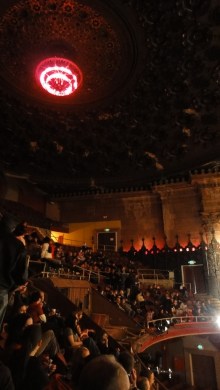
Interior of LA’s Million Dollar Theater, by Flickr user Omar Bárcena (CC BY-NC 2.0)
CC: Inside, it was thrilling to soak in the collective affect: ecstatic applause that filled the cavernous space as well as sniffles, sobs, and laughter during certain scenes but looking back, I would’ve preferred a more intimate viewing experience. The attendees around us came in late, talked, and checked their social media throughout the movie (yes, actually). Director Barry Jenkins did say during the Q&A afterwards that it was the largest viewing audience in North America, so perhaps a little chaos is to be expected! Of course, the major selling point of the event for my group was the live orchestral accompaniment to the film. We were up in the nose-bleeds, though, so we struggled to notice when the orchestra kicked in. We also couldn’t see the pit from our seats, and tended to just assume they were playing when there were strings in the film score. So to us, the orchestra was a bit of a non-event.
SH: I was down on the floor with the orchestra and could see the pit fairly well, but I completely get your point. Taken with a scene, I would often forget about the live music until movement in the pit would attract my eye, which was always slightly jarring in a really meaningful way. We forget about the work of folks whose labor provides the musical idiom of film we simply expect to be there. Frankly, it was always with a bit of guilt that I would be brought to remembrance of the presence of the musicians who were that critical contribution to the experience I was having.
CC: You’re so right! It’s interesting that to get the effect, there had to be a visual accompaniment, which speaks to both our ocular-centrism and how we’ve been conditioned to take (sound) labor in film for granted. I also recall Jenkins giving a shoutout to the sound engineer for rigging a custom sound system in the theater space in order for the film sound and orchestral sound to work together properly. He was really gracious in pointing out the unseen labor that you mentioned.
SH: So I’d like your thoughts on that opening scene which features extended Liberty City street dialect.
CC: KPCC’s John Horn, the host of the post-screening discussion with the cast and crew (Barry Jenkins, Nicholas Britell, Mahershala Ali, Naomie Harris, Ashton Sanders, and Trevante Rhodes), asked a question about the “Liberty City dialect” in the opening scene of the film. His question assumed that “we” couldn’t understand the dialect of that scene, when clearly, his use of “we” assumes a lot about the audience—I’m sure there were folks in the crowd that could understand perfectly what was going on!

Two young boys from Umojaa Village, Liberty City, Miami, 2003, image by Flicker User danny.hammontree, (CC BY-NC-ND 2.0)
I wasn’t one of them, unfortunately, but I was drawn to the politics of that move. The refusal to translate, and the insistence on the authenticity of that voice, which necessarily separates a particular portion of the audience because of knowledge they don’t have, and often are comfortable having. Jenkins also talked at length about the specificity of time and place too. He insisted on representing Liberty City in all its particularities and refused the notion of Moonlight’s wide or universal intelligibility or relatability.
SH: Right. He was very clear about his determination to tell one specific story. Now, on one level, I see it, I get it, and I applaud it. However, on another level, I know that narratives are successful only to the degree that they mine a set of specifics to unearth truths that are universal. I think I’d be hard put to find anyone who would argue against the statement that even in the specificity which Jenkins rightly champions, Moonlight is deeply informed by a powerful universal quality.

Ashton Sanders as Chiron, screen capture from Moonlight trailer by JS
CC: And both Ali and Sanders said during the discussion that they felt their embodiment of their respective characters was meant to be relatable to a wide audience. At the same time, Jenkins added that he hoped his method of narrative specificity would inspire other marginalized people to go out and do the same for their own stories, so perhaps he’s more concerned with universal methods than narrative details.
I’m only realizing now that the film just does so damn much, based on how the actors and director imagine their art reaching out to various audiences. One of the most immediate ways is through the use of diverse musical signposts. Others have commented on the gorgeous Barbara Lewis track “Hello Stranger” that Kevin plays on the diner jukebox, (and we could certainly spend all day jumping into the rabbit holes that all the disparate songs on the soundtrack take us to), but I wanted to ask if you had any thoughts on the use of the classic Mexican huapango song “Cucurrucucú Paloma.”
SH: Yes, I did. In a rather convoluted way, I connected that song to the character of Juan, so I’ll back my way into my thinking. The character of Juan is a very special character for me. I don’t think I’ve come across another like him; in fact, I see him as a new type: a trans-American father figure of the African diaspora. Juan is a Cuban native and thus functions as a reach-out to–a gesture towards, a signifier of—Cuba, of course, and, by extension, the rest of the Caribbean, which are American locations not typically identified by their Americanness. I see that Mexican track, “Cucurrucucu Paloma,” as an extension, not of Juan precisely, but of his function. This song is a reach-out to Mexico as another American location that is typically not acknowledged as American. In all truth, it is often imagined and imaged as distinctly anti-American. Through these reach-outs, both characterological and musical, this film initiates a conversation between the U.S. and other parts of the Americas which have been figuratively lopped off from their American identities simply because they fall outside of the United States, which is now almost singularly synonymous with America.
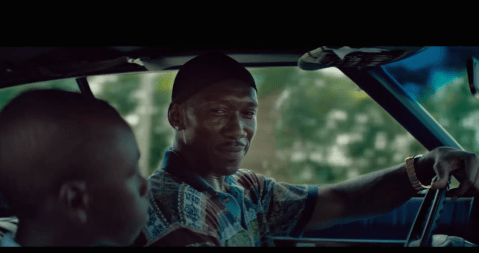
(l-r) Alex Hibbert as Little and Mahershala Ali as Juan, screen capture of Moonlight trailer by JS
Another layer to this, of course, is that the film makes these reach-outs to different parts of the Americas in the specific context of New World blackness, which automatically invokes the slavery which once covered the Americas and produced the enduringly racist economic and social structures from which Juan, Black, and entire communities like Liberty City are largely excluded.
CC: The film is definitely able to telescope some of most intimate and specific concerns into the widest transnational frames. It’s also interesting that we took different things from Jenkins’ use of that song. I didn’t recognize it during the film, but there was a familiarity to the subdued arrangement. My friend mentioned after that it was the same version by the Brazilian composer and singer Caetano Veloso that Wong Kar-Wai uses in Happy Together (1997) (Jenkins has elsewhere talked at length about the influence of Wong), a film about the fraught relationship between two gay Hong Kong Chinese men living in Argentina.
For Wong, the song, mixed with the sound of crashing water from Iguazu Falls in Argentina, signals characters in the midst of a crumbling relationship reaching back to happier times. In Moonlight, it works in a parallel manner, as an affective and sonic cue that envelops Black and Kevin in the very moment of living a future happy memory: the act of reuniting as adults and cruising around their hometown. The sonic touchstone of “Cucurrucucú Paloma” injects a sense of cosmopolitanism in Happy Together, which opens with shots of the lovers’ passports, but does so referentially in Moonlight through its gesture to global cinema.
SH: Precisely. The reach-outs, as we’re calling them, add such depth and such complex meaning to this film in so many different directions. They are in large measure directly responsible for this film’s richness and importance and intellectual and emotional heft. The film redounds with the boundary-shattering cosmopolitanism you mention because it is obsessed with the ways in which entities and forms which don’t typically speak to one another can be placed in conversation with one another and thus enabled to reach conversance with one of another.
Cinematically, as you mention, this U.S. film, overarching in its Americanness, speaks directly to those of Wong Kar-wai musically, visually, thematically, narratively. This thread of conversation and conversance, operative in so many ways and on so many levels, cannot be overstated.
Characterologically, this happens in all of the film’s main relationships but most significantly between Black and Kevin, whose relationship is always characterized by both speech and silence, which serve as conduits for the conversance, or intimacy, they share.
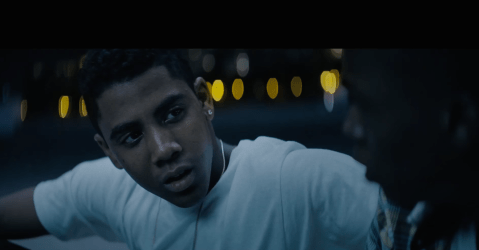
(l-r) Jharrel Jerome as Kevin and Ashton Sanders as Chiron, Screen capture from Moonlight trailer by SO! ed JS
CC: Yes! I love your reading of silence as a form of intimate conversance. It’s such a great way to think about how both people and cultures, putatively “worlds apart,” are in fact always talking to one another. I’ve also seen some writing on the prominent use of classical music, some of which suggested its “incongruousness” to the story, which I’m sure are based in part on problematic assumptions and associations.
SH: Right. There is a decidedly poignant conversation between this black, male, gay, urban narrative and orchestral music, which is a noteworthy choice. And yes, there are other musical genres represented in the film, but Jenkins seems especially to venerate orchestral music above the other genres. I mean, he did single it out for the live music screening, which necessarily raises its profile above the hip-hop, the R&B, the huapango.
In fact, in the wake of the special screening, those other genres, though important, might be interpreted as intervening on or interrupting the ongoing, and seemingly more important, conversation underway between the black, male, gay, urban narrative and orchestral music. In this context, we might see the prominence of the classical music as a rhetorical bid for the inclusion of this black, male, gay story in a distinctly white, Western cultural canon—not as a quest for whiteness per se but rather as a quest for the ontological normativity which whiteness has long enjoyed.
Perfectly supporting, perhaps even enabling, this conversation between this narrative and classical music is the very telling–quite political, really–application of the “chopped-and- screwed” mixing technique to the classical music in the score. That orchestral music, which is generally perceived as the music of the white elite classes–music, which, even when it is composed and produced in the US, still reads as distinctly European in origin and orientation–should be handled in the same way as the chopped-and-screwed masterpieces of people such as DJ Screw, OG Ron C, and Swishahouse, is more than just a little funny. It is deliciously subversive and, given the political moment, downright democratic and egalitarian.
In a piece for SO, Kemi Adeyemi discusses how the technique was created in Houston by the late DJ Screw in the latter years of the 20th century as a sonic representation of the “loosened, detached body-feeling” of the (black male) body under the influence of the substance lean. Adeyemi explains how lean, a mixture of codeine and sweet soda or juice, has become a chief coping mechanism especially of hip-hop-identified black males trapped in their unrelenting contention with aggressive racist assault that is usually directly responsible for their premature deaths via what Adeyemi identifies as the “discursive entanglements of race, labor, and drugs…in the neoliberal state.”
The “chop” part of chopping and screwing involves adding rhythmic breaks of repetition into a song, hearkening back to the turntable mixing of classic hip-hop. Playing off of Adeyemi’s analysis, I read this chopping as auditory representation of the inescapability of the pace of modern life, particularly the beat of life in a lethally racist context that will not be denied. The “screw” aspect involves the slowing of the song’s overall tempo, which transmogrifies the original track into a plea for more time just to be and for more space to be unmoored from all the dangers poised to assail the black body.
Dave Tomkins, in a piece for mtv.com, quotes composer Nicholas Britell who wonders at the seeming magic of chopping and screwing to “open up all these new harmonics and textures…[and also to] stretch and widen out” phrases and words, enabling the listener to “marinate in the words more.” Britell notes that chopping and screwing the orchestral music of Moonlight’s score produced similar effects, explaining, “The same thing happens for the music, when it goes into those lower-frequency ranges. The sound becomes a feeling.” Tomkins points out that the “feeling” is often one of dread or coming doom that is distinctly black, male and urban, which dovetails Adeyimi’s discussion of chopping and screwing’s origins and cultural context. The film, then, forces the Eurocentric elite into conversance with blackness that is also gay, urban, Southern, hip-hop-identified, and beset by a range of lethal pressures.
Moreover, the orchestral music, in its chopped-and-screwed state, becomes a critical conveyance of deep meaning of the narrative. In the January 10th post-screening discussion, Britell emphasized how chopping and screwing produced “those lower-frequency ranges” by dropping the pitches of each instrument so that each was made to sound like another, deeper, more resonant one. This sonic masking speaks directly to the film’s central issues of voice, true identity, and intimacy.
Discussion between director Barry Jenkins and composer Nicholas Britell discussing “chopping and screwing” the score of Moonlight (starts at 4:10).
CC: The selection and transformation of music in Moonlight is definitely doing something to challenge all sorts of normative assumptions. And not just cultural assumptions either but our understanding of the experience of music and film altogether. Jenkins said in a separate discussion that the insertion of silence/music reflects Chiron’s consciousness, what he calls the “cogno-dissonance” of being Chiron. The idea of turning inward in the face of trauma was important to Jenkins. He and the sound crew apparently used surround sound and played with mixing to unbalance the audience’s sonic perception as a way to simulate this experience of trauma, which I think may have been less apparent in this particular theater setup. The thoughtful play on the phenomenology of sound shows us that music, at least in the Moonlight universe, is the substance of life.
SH: Yes. Music in this film is of the utmost importance, making direct and often very strong comment on every aspect of modern life, even to the point of marking trauma by speaking the unspeakable. As we’ve discussed before, various musical genres are put to the task of translating, interpreting, expressing life and its traumas.
However, there is one genre that is quite noticeably absent from this film. The absolute avoidance of the black church and its music is striking and lands a deft blow to a site within African American culture that has been stridently anti-gay despite its own embrace of rich, abundant LGBTQ artistic and cultural contribution. The reproach is so fierce, the black church is not allowed to exist in the film even on the plane of the lamest obligatory church tropes with which we are all too familiar. There is no Sunday service, no booming, looming vestmented preacher, no hymn-humming, Scripture-quoting grandma—not even a religious crisis set to a chopped-and-screwed Mahalia Jackson or Clara Ward track. The closest we get to religion is the swimming lesson as Juan, the trans-American father of the African diaspora, baptizes Little in the waters of the Middle Passage and teaches him how to survive in them. The context here is much more cultural and historical than it is religious. This thoroughgoing circumvention of the black church and gospel music in a film that traffics in reach-outs connotes nothing less than obdurate, unreprievable censure.

Hibbert as Little and Ali as Juan, Screen capture from Moonlight trailer by SO! ed JS
CC: This avoidance is especially interesting in light of the long history of gospel influence in the artistry of founding Black queer artists like Little Richard and Sister Rosetta Tharpe. And the exclusion of the Black church and its sonic registers interacts provocatively with the foregrounding of hip hop in Black’s arc since that genre has been characterized in some quarters as homophobic (though that critique can be reductive and itself plagued by racialized stereotyping).
SH: And in some instances, it has been homophobic, though that seems to be changing with the times and their increasing embrace of both the black secularism and the openness towards diverse black sexualities which Moonlight celebrates.
CC: So, what do you think you will remember most about this night, and this singular performance?
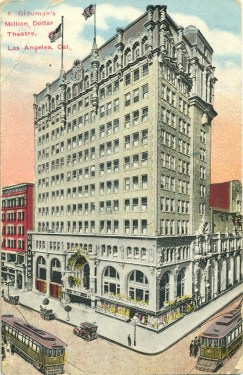
Vintage Postcard of Grauman’s Million Dollar Theatre, Downtown Los Angeles, which opened in 1918.
SH: This night is one that I think I’ll always love and remember for many reasons–the moody weather, the dinner beforehand with my old friend, Dr. Ruth Blandon, the buzzing excitement of the crowds, our spotting the amazing Mahershala Ali seated just across the aisle from us, the tour de force film, the panel discussion afterwards–but perhaps one of the greatest reasons will be that sense of overwhelming connection I felt that night. It was simply electric. I don’t know about you, but I felt deeply connected to the city itself that night, to Los Angeles–especially old, historic, LA, the LA that my grandmother moved to as a five-year old back in 1940. My grandmother will be 82 this coming September, so she’s still very much here in the flesh, but I felt especially close to her, or really, to what I imagine was her five-year old self. Thinking about her precipitated a connection to that old theatre. I wondered how many times she had been there, or knowing her penchant for mischief, how many times she had snuck in.
And then, in a more diffuse but not less important way, I felt a kinship with all the strangers in the theatre, gathered there that evening for a single purpose. So it is fitting to me that an event celebrating a film which devotes itself so thoroughly to “reach-outs,” as we’ve called them here, to these critical, radical conversations in pursuit of conversance, would have also so generously provided me an opportunity to experience my own, very personal reach-outs and connections. What about you?
CC: Absolutely agreed. I don’t have as much of a connection to this city as you, being part of the dreaded transplant-class, but it speaks to the power of events such as this that I feel it more. There’s something to our exchange, too, that speaks not only to the importance of the film, but also, in this time of threatened funding to the arts, the critical nature of collective enjoyment and, indeed, production of daring new art by queer people of color.
The film reaches out and touches folks who don’t often get that experience and there’s no better example of this than the closing sequence. The film ends with Black talking to Kevin about the absence of intimate touch in his life and then a moment of the beautiful silent conversance that you pointed out earlier. The parting shot is of the most tender contact, over which we hear the sound of crashing waves. This visual-sonic collage suggests that the act of gay black men touching is elemental, almost tectonic—at once basal but also a force of nature; at once deeply individual (the actual final image is a dive inward, of young Chiron looking back at us from a darkened beach), but also an image of ceaseless, living tenderness, like the rolling waves on the Liberty City shores. I think the two thousand people in the room that night, both of us included, however differently we may all have perceived it, felt that touch.

Miami Beach, Image by Flickr User Beaster 725, (CC BY-NC-ND 2.0)
—
Featured Image: Screen capture of Alex Hibbert as Little from Moonlight Trailer by JS
—
 REWIND!…If you liked this post, you may also dig:
Fade to Black, Old Sport: How Hip Hop Amplifies Baz Luhrmann’s The Great Gatsby– Regina Bradley
Quiet on the Set?: The Artist and the Sound of a Silent Resurgence– April Miller
Sonic Connections: Listening for Indigenous Landscapes in Kent Mackenzie’s The Exiles–Laura Sachiko Fujikawa
Enacting Queer Listening, or When Anzaldúa Laughs–Maria Chaves Daza
Share this:

(Dis)orienting the Bell: Aural Assault from A Game of Thrones to Richard Coer de Lyon


series co-editors Dorothy Kim and Christopher Roman
Hear YE! Below is the introduction to the latest installment of Medieval Sound, Aural Ecology, by series co-editors Dorothy Kim and Christopher Roman. To read their previous introduction, click here. To read the first run of the series in 2016, click here.
Aural Ecology
What is considered music, noise, or harmony is historically and culturally contingent. For example, some medieval musical theory, or musica speculative, such as Jan Herlinger’s “Music Theory of the Fourteenth and Early Fifteenth Centuries” in Music as Concept and Practice in the Late Middle Ages, defined music as “contemplation that serves the moral edification of the mind” (293). Influenced by the work of Boethius’s De Musica, music is not just everyday music but “connotes harmony conceived broadly enough to encompass the relationships obtaining in the human body and psyche and governing the motions of planets” (293). This kind of ecological harmony is explored in the work of Boethius, especially in his discussion of abstract qualities in the prelude to the De Musica, The Book of Arithmetic (as translated by Calvin Martin Bower) “Indeed these things themselves are incorporeal in nature and thrive by reason of their immutable substance, but they suffer radical change through participation in the corporeal, and through contact with variable things they change in veritable consistency” (24). For Boethius these “essences” are concordant with mathematical properties expressed in music. Thus, music was both speculative and moral, and these intertwining purposes derived from music’s phenomenological pleasures derived in the environment, “for nothing is more consistent with human nature than to be soothed by sweet modes and disturbed by their opposites” (Bower 32).
Boethius also comments on the psychological effects experienced in hearing music as they “affect and remold the mind into their own character” (Bower 34). Boethius gives examples of how certain groups of peoples, such as the Thracians or Lacedaemonians, delight in different kinds of music that harmonizes with their natures. For Boethius, music is transcendent in that it exists as a kind of eternal sound, but also an immanent sound, in that it appeals to various peoples depending on their nature and environment. Boethius’ speculations lead him to think about harmony and sound as available to reason and sensory perception. Thus the notion of harmony itself is “the faculty of considering the difference between high and low sounds using the reason and senses. For the senses and reasons are considered instruments of this faculty of harmony” (Bower 295). Harmony (and disharmony in the form of noise) became a marker of the aural ecology for an individual or group.
The essays in “Aural Ecologies” also address the issue of unharmonious sounds, sounds that often mark dissonant critical identities—related to race, religion, material—that reverberate across different soundscapes/landscapes. In this way, this group of essays begins to open up the stakes of Medieval Sound in relation to what contemporary sound studies has begun to address in relation to cultural studies, architectural and environmental soundscapes, and the marking of race through the vibrations of the body. —Dorothy Kim and Christopher Roman
In the neo-medieval A Game of Thrones (2011), the medieval Saracen-inspired and violent Dothraki utilize bells as a symbol of victories in battle. Each time a leader or khal defeats a foe, he incorporates the bells from his foe’s shorn black braid into his own braid. Khal Drogo, khal of the most powerful khalasar in Essos, sports an uncut braid sensuously described by George R. R. Martin as “black as midnight . . . hung with tiny bells that rang softly as he moved. It swung well past his belt, below even his buttocks” (37).
Dothraki bells serve both a hypermasculine and deterritorializing function: esteem and prowess for Eastern men comes from the symbolic castration of their enemies and the eradication of civilizations. For the Dothraki, sexualized and territorial conquest is centralized around amplitude of noise made by an aggregate of bells adorning a phallic braid. Drogo is frightening because of his noise: he wears “[b]ells so his enemies w[ill] hear him coming and grow weak with fear” (802). In the pilot episode of Season 1 of HBO’s Game of Thrones, writers David Benioff and D. B. Weiss and director Tim Van Patten emphasized the contrast in noise between the copper-skinned Dothraki and the white Valyrians of the Free Cities:
East disrupts West in this scene through a racialized auditory disruption of white silence.
The association of the Middle East with noise pervades Western culture. One need only recall juxtapositions of quietly carefully groomed news anchors in sterile American news sets conversing with correspondents struggling to be heard in earsplitting raucous streets embroiled in Middle Eastern crises in countries like Iraq and Syria. See Aron Brown of CNN announcing the U.S. War on Iraq in 2003, for example:
However, this association of the Arab world with noise is not a new one. In medieval literature, noise played a crucial role in distinguishing Saracen East from Christian West. Bells and particularly the cacophonous noise they cumulatively make came to be associated with a violent imagining of the East in literature of the medieval period. The late medieval crusading romance Richard Coer de Lyon, centered on the exploits of the twelfth-century crusading king, Richard the Lionheart, situates the pealing bell as its central object. [Note: Richard Coer de Lyon is cited by line number. All quotations come from the widely-used complete modern version, Richard Löwenherz, ed. Karl Brunner, Wiener Beiträge zur Englischen Philologie (Vienna and Leipzig, 1913)].
As in Dothraki warrior culture in A Game of Thrones, bells gain symbolic power in the romance through replication and accumulation. Richard Coer de Lyon features pealing bells in two crucial episodes concerned with the East and a maternal rather than phallic male body: 1) the exorcism of Richard’s demonic Eastern mother at Mass with a sacring bell (l.221-34); and 2) the appearance of Saladin’s demonic mare arrayed in clamorous bells attached to her crupper at the climactic battle of Acre (l.5532-49, 5753-8). Drawing on both medieval treatises on the function of bells and Gilles Deleuze and Felix Guattari’s theory of the refrain, I argue that the bell—initially a symbol of Christian order, the West, and patriarchy—becomes a disorienting aural force associated with chaos, the East, and maternity.
Early on in the romance, the king’s men try the piety of Richard’s mother, Cassodorien of Antioch, a bewitching foreigner whose only apparent fault is that she cannot remain in church to hear Mass, by physically restraining her during a service. To the shock of the English parishioners, at the ringing of the sacring bell, Cassodorien breaks free of her male captors, seizes two of her children, and flies through the church roof never to be seen again:
And whene þe belle began to ryng,
And when the bell began to ring,
The preest scholde make þe sakeryng,
And the priest was about to do the sacring,
Out off þe kyrke sche wolde away…
Out of the church she tried to go away…
Out of the rofe she gan her dyght,
Out of the roof she began to make her way/transform,
Openly before all theyr syght…
Openly before all of their sight…
— Richard Coer de Lyon, 221-5.
At this striking moment of contact between queen and masculine material object, the bell is forever altered, (re)oriented on a trajectory that transmogrifies it from a symbol of priestly power to a chaotic symbol of maternity and the East.

Sacring Bells in Aberdeen, Scotland. Image by Flickr User rethought (CC BY-NC 2.0)
Medieval thinkers conceptualized the church bell as an agent for revealing both foreign and demonic threats from within the community. In The Rationale Divinorum Officiarum of William Durand of Mende thirteenth-century French liturgical writer and bishop, William Durand,xplains the significance of the pealing of bells– “when the bell rings . . . the people are unified with the unity of faith and charity” (51) –but also expounds on this exorcising function of the church bell:
[T]he bells are rung in processions so that the demons who fear them will flee . . . They are so fearful when they hear the trumpets of the Church militant, that is the bells, that they are like some tyrant who is fearful when he hears in his own country the trumpets of some powerful king who is his enemy (51).
Durand conflates the demonic with the East, both qualities embodied by Cassodorien who hails from Antioch (near the border of Syria and Turkey). He also imbues the bell with an emasculating quality; it renders even a tyrant fearful. The measured sounding of the church bells forms a tonal refrain, an aural sequence to familiarize Christian space.
The purpose of the aural refrain, for Gilles Deleuze and Felix Guattari, is to deterritorialize and then reterritorialize unfamiliar space. In A Thousand Plateaus, they explain the refrain/‘ritournelle’ as a threefold place of disorientation, the familiar, and escape:
They are three aspects of a single thing, the Refrain (ritournelle)…. Sometimes chaos is an immense black hole in which one endeavors to fix a fragile point as a center. Sometimes one organizes around that point a calm and stable “pace” (rather than a form): the black hole has become a home. Sometimes one grafts onto that pace a breakaway from the black hole (312).
The bell was arguably the most important and pervasive aural symbol in medieval Europe, one whose refrain regularly demarcated Christian spaces in times of chaos. Sound theorist R. Murray Schafer has called the medieval church bell “the most salient sound signal in the Christian community” in The Tuning of the World (53), and a unifying force “acoustically demarking the civilization of the parish from the wilderness beyond its earshot” (55). Yet, as the bell multiplies through contact with Cassodorien and Richard wanders into the wilderness or black hole of the East, its sound is layered and its signification coopted by the East and transformed into a disorienting force that decenters Saladin’s enemies.

Richard battles Saladin, Luttrell Psalter, BL42130, 4v
The bell resurfaces once more as Richard prepares for his epic battle against Saladin at the gates of Babylon. In this climactic battle with a second pairing of mother and son, reimagined in the form of a demonic belled “mere” and her “colt” summoned by Saladin’s necromancer, bells occupy a central place of prominence on the mare’s accoutrements. In 1192, Saladin reportedly sent two new horses to Richard after his horse was slain in battle (For an overview of this event, see page 73 of Sir Steven Runciman’s A History of the Crusades, Vol.3: The Kingdom of Acre and the Later Crusades). The mare, as one of only two mothers in the romance, uses the same aural symbol to assault the English Christians that they had used to exorcise Cassodorien. As Saladin’s mare proudly strides onto the battlefield, the poet emphasizes the deterritorializing effect of her cacophonous bells:
þerffore, as þe book vs telles,
Therefore, as the book tells,
Hys crouper heeng al ful off belles,
The mare’s crupper hung all full of bells;
And hys peytrel, and his arsoun.
From the armor, too, and the saddlebow,
þree myle men my3ten here þe soun.
For three miles men could hear the sound.
Þe mere gan ny3e, here belles to ryng,
His mare began to neigh, her bells she rang
Ffor gret pryde, wiþouten lesyng.
With great pride, it is no lie.
–Richard Coer de Lyon, 5753-8.
Fascinatingly, Brunner again diverges in this passage from Caius 175, and changes “þe mere” to “his mere,” further stripping the demonic mare of her agency.
Whereas the church bell is a singular symbol of order, symmetrical and “acoustically demarking” space with its meted refrain, the bells of the mare are multiple, discordant, chaotic, and cacophonous, designed to disorient rather than to unify (see Schafer 55). The medieval illuminator of the Luttrell Psalter (c.1325-1335) similarly emphasizes the clamorous quality of the belled mare, and distinguishes Saladin’s mount from Richard’s by the vast array of bells attached to its crupper and the noise these bells suggest.
The noise, suggested in the Luttrell Psalter by the movement and detail given to the crupper bells, can be heard on a smaller scale in the following video clip of a horse merely walking noisily with a smaller bell-laden crupper:
One can easily infer the discordant sound a running mare might make with a crupper “hung all full of bells.” The poet suggests that the noise encompassed an aural disturbance of three-miles and disrupted the Christian crusaders. The bells also serve an insidious maternal purpose: they serve as a trap to lure her colt to abandon Richard and “knele adoun, and souke hys dame” (kneel down and suck his dame)” (Richard Coer de Lyon, 5547). In A Thousand Plateaus, Deleuze and Guattari suggest the layering of sounds, particularly maternal sounds, can disrupt and deterritorialize space. In their discussion of the reterritorializing effects of layered song, Deleuze and Guattari provide the strikingly maternal example of Debussy’s Sirens, which, they posit, integrates voice with orchestra to make the voices of child and woman inextricable from “the sea and the water molecule” (340). In much the same way in Richard Coer de Lyon, the mare’s imbrication of voice over bells seeks to make the dichotomies of the romance—mother and son, east and west, chaos and order, demonic and angelic—implode as the demarcated boundaries between them are dissolved in her cacophonous demonic lullaby.

Daenerys, Created in ArtRage Studio by Flickr User Happy Snapper 80 (CC BY-NC 2.0)
While A Game of Thrones and its HBO counterpart pick up on the resonances of medieval noise to differentiate between East and West, noise is gendered differently. In RCL the threat signaled by the sound of bells is that Richard will be emasculated by his inability to cut ties with the specter of his mother’s influence and disambiguate himself from the Eastern Saracens she represents. However, in Martin’s series, the Dothraki bells, like much of Dothraki culture, exist only to be subsumed under Daenerys’ imperial ambitions for an Iron Throne the Dothraki neither care about nor want. Daenerys’ bell, affixed to her hair after the death of Drogo and the dissolution of his khalasar, becomes a symbol of cultural and racial appropriation Martin stages under the guise of (white) feminism. That is, the issues noise signals have changed from the challenge of excising Christian West from Islamic East (a fear literalized in Richard’s cannibalistic consumption of Saracen flesh) to cultural appropriation (the devouring of Dothraki culture for the benefit of white colonialism).
—
Featured Image: Proceso Khal Drogo by Flickr User Orgita Sucubita, (CC BY-NC-ND 2.0)
—
Thomas Blake is Assistant Professor of English at Austin College.
—
REWIND!…If you liked this post, you may also dig:
Sounding Out! Podcast #54: The Sound of Magic-K.A. Laity
Mouthing the Passion: Richard Rolle’s Soundscapes–Christopher Roman
Playing with the Past in the Imagined Middle Ages: Music and Soundscape in Video Game–James Cook
Share this:


Current Top Posts





April 2021

January 2020

November 2019

October 2019

August 2019

April 2014

November 2017

March 2015

December 2017

October 2015
 Sounding Out!
Recent Comments