
“Oh how so East L.A.”: The Sound of 80s Flashbacks in Chicana Literature

 For the full intro to the forum by Michelle Habell-Pallan, click here. For the first installment by Yessica Garcia Hernandez click here. For the second post by Susana Sepulveda click here.
The forum’s inspiring research by scholars/practioners Wanda Alarcón, Yessica Garcia Hernandez, Marlen Rios-Hernandez, Susana Sepulveda, and Iris C. Viveros Avendaño, understands music in its local, translocal and transnational context; and insists upon open new scholarly imaginaries. . .
Current times require us to bridge intersectional, decolonial, and gender analysis. Music, and our relationship to it, has much to reveal about how power operates within a context of inequality. And it will teach us how to get through this moment. –MHP
—
A new generation of Chicana authors are writing about the 1980s. An ‘80s kid myself, I recognize the decade’s telling details—the styles and fashions, the cityscapes and geo-politics, and especially the sounds and the music. Reading Chicana literature through the soundscape of the 80s is exciting to me as a listener and it reveals how listening becomes a critical tool for remembering. Through the literary soundscapes created by a new generation of Chicana authors such as Estella Gonzalez, Verónica Reyes, and Raquel Gutiérrez, the 1980s becomes an important site for hearing new Chicana voices, stories, histories, representations, in particular of Chicana lesbians.
Reading across Gonzalez’s short story, “Chola Salvation,” Reyes’s Chopper! Chopper! Poetry from Bordered Lives; and Gutiérrez’s play, “The Barber of East L.A,” this post activates the concept of the “flashback” to frame the 1980s as a musical decade important for exploring Chicana cultural imaginaries beyond its ten years. In Gonzalez’s “Chola Salvation,” for example, Frida Kahlo and La Virgen de Guadalupe appear dressed as East Los cholas speaking Pachuca caló and dispensing valuable advice to a teen girl in danger. The language of taboo and criminality is transformed in their speech and a new decolonial feminist poetics can be heard. In Reyes’s Chopper! Chopper!, Chicana lesbians – malfloras, marimachas, jotas, y butch dykes – strut down Whittier Boulevard, fight for their barrio, take over open mic night and incite a joyous “Panocha Power” riot, and make out at the movies with their femme girlfriends. Gutiérrez’’s “Barber of East L.A” recovers forgotten butch Chicana histories in the epic tale of a character called Chonch Fonseca, inspired by Nancy Valverde, the original barber of East Los Angeles. A carefully curated soundtrack amplifies her particular form of butch masculinity. These decolonial feminist ‘80s narratives signal a break from 1960s and ‘70s representations of Chicanas/os and introduce new aesthetics and Chicana/x poetics for reading and hearing Chicanas in literature, putting East L.A. on the literary map.

East LA Valley, 2010, by Flickr User James (CC BY 2.0)
Gonzalez, Reyes, and Gutiérrez’s work also use innovative sonic methods to demonstrate themes of feminist of color coalition and solidarity and represent major characters whose desires and actions transgress normative gender and sexuality. All three contain so many mentions of music that operate beyond established notions of intertextuality, referencing oldies, boleros, and alternative 80s music as a soundtrack that actually transform these works into unexpected sonic archives. Through the 80s soundscapes that music activates, these authors’ work shifts established historical contexts for reading and listening: there was a time before punk, and after punk, and this temporality sounds in Chicana literature.
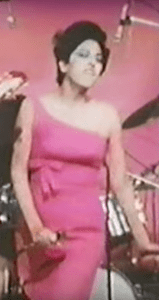
Alice Bag in The Decline of Western Civilization (1981). Still by Jennifer Stoever
If the classic documentary film The Decline of Western Civilization by Penelope Spheeris was meant to give coverage to the Los Angeles neglected by mainstream music journalists, it also performs an important omission that leaves Chicano viewers searching for a mere glimpse of “a few brown Mexican faces,” as Reyes writes in her poem “Torcidaness.” Among the bands featured–most male fronted–the film captures an electric performance by Chicana punk singer Alice Bag, née Alicia Armendariz. In contrast to the other musicians in jeans, bare torsos, and, combat boots, Bag is visually stunning and glamorous. She dressed in a fitted pink dress reminiscent of the 1940s pachuca style; she wears white pointed toe pumps, her hair is short and dark, her eye and lip makeup is strong and impeccable. In the four brief minutes the band is on camera Bag sings in a commandingly deep voice, slowly growling out the words to the song “Gluttony” and before the tempo picks up speed, she lets out a long visceral yell on the “y” that is high pitched, powerful, and thoroughly punk. It’s a superb performance, yet Bag is not interviewed in this film.
Reyes’s poem draws attention to that omission as the narrator searches for a mere glimpse of “a few brown Mexican faces.” This speaks to the longing and the difficulty for Chicanas to see themselves reflected in the very same spaces that offer the possibility of belonging. Over thirty years since the film, Bag is now experiencing a surge in her career and has sparked renewed interest in histories of Chicanas in punk. She has written two books including the memoir: Violence Girl: From East L.A. Rage to L.A. Stage – A Chicana Punk Story (2011) and is sought out for speaking engagements on university campuses. Bag is able to tell her story now through writing, something a film dedicated to documenting punk music was not able to do. In retrospect, thirty-five years later, Bag’s current visibility emphasizes the further marginalization of Chicanas in punk the film produces by silencing her speaking voice against the audible power of her singing voice. Recovering Chicana histories in music may not happen through film, I propose that it is happening in the soundscapes of new Chicana literature. Importantly, new characters emerge and representations that are minor, marginalized, or non-existent in the dominant literary landscape of Aztlán are rendered legibly and audibly.

Barber of East LA-era Butchlális de Panochtítlan, (l-r) Claudia Rodriguez, Mari Garcia, Raquel Gutiérrez, Image by Hector Silva
***
Theorizing the flashback in Chicana literature raises new questions about temporality that invite and innovate ways to trace the social through aesthetics, politics, music, sound, place and memory. Is flashback 80s night at the local dance club or 80s hour on the radio always retrospective? Also, who do we envision in the sonic and cultural imaginary of “the 80s”? As a dominant population in Los Angeles and California, it is outrageous to presume that Chicanas/os or Mexican-Americans were not a significant part of alternative music scenes in Los Angeles. This post turns up the volume on the ’80s soundscapes of Chicana literature via Verónica Reyes’s poem “Torcidaness: Tortillas and Me,” to argue that one cannot nostalgically remember the 80s in a flashback radio hour or 80s night at the club and forget East L.A.
“Torcidaness” (Twistedness) speaks in an intimate voice homegirl-to-homegirl: “Tú sabes, homes how it is in—el barrio.” Through this address the narrator describes the sense of knowing herself as different and “a little off to the side on the edge” much like a hand formed tortilla. In the opening stanza, Reyes introduces the metaphor for queerness that runs through the poem in the image of the homemade corn tortilla, “crooked, lopsided and torcida.” Part of Reyes’s queer aesthetics prefers a slightly imperfect shape to her metaphorical tortillas rather than one perfectly “round and curved like a pelota.” As a tongue-in-cheek stand-in for Mexicanness, the narrator privileges the homemade quality of “torcidaness” versus a perfect uniformity to her queerness.

homemade corn tortillas, image by flikr user hnau, (CC BY-NC 2.0)
Importantly, the narrator locates her queer story that begins in childhood as “a little chamaca” in the Mexican barrios of East Los Angeles. “Torcidaness” names the cross streets to an old corner store hangout and brings East L.A. more into relief:
Back then on Sydney Drive and Floral in Belvedere District
Oscar’s store at the esquina near the alley was the place to be
We’d hang out and play: Centipede Asteroids Pac Man
or Ms. Pac Man (Oh yeah, like she really needed a man)
and even Galaga… Can you hear it? Tu, tu, tu… (very Mexican ?que no?)
Tú, tú, tú (Can you hear Eydie Gorme? Oh how so East L.A.) Tú, tú, tú…”
Coming at you … faster faster—Oh, shit. Blast! You’re dead (22).
This aurally rich stanza rings with the names of classic video games of the early 1980s. Reyes reminds us that video games are not strictly visual, they’re characterized by distinct noises, quirky blips and beeps, and catchy “chiptunes,” electronic synthesizer songs recorded on 8-bit sound chips. The speaker riffs off the playful noises in the space game Galaga, asking the reader to remember it through sound: “Can you hear it?” Capturing the shooting sounds of the game in the percussive phrase, “tú, tú, tú” prompts a bilingual homophonic listening that translates “tú” into “you.” The phrase is only a brief quote, a sample you could say, and the poem seems to argue that you’d have to be a homegirl to know where it comes from. The full verse of its source goes like this: “Me importas tú, y tú, y tú / y solamente tú / Me importas tú, y tú, y tú / y nadie mas que tú” as sung by the American singer Eydie Gorme with the Trio Los Panchos in their 1964 recording of “Piel Canela.”
To some extent the poem is not overly concerned with offering full translations, linguistic or cultural, but the reader is invited to corporeally join in the game of “Name That Tune.” The assumption is that Gorme’s Spanish language recordings of boleros with Los Panchos are important to many U.S. Mexicans and they remain meaningful across generations. And importantly, this “flashback” moment is not an anachronistic reference, rather it says something about the enduring status of boleros and the musical knowledge expected of a homegirl. Reyes’s temporal juxtaposition of the electronic sounds of the video game with the Spanish language sounds of a classic Mexican love song—and their easy, everyday coexistence in a Chicana’s soundscape–is part of what the narrator means by, “Oh how so East L.A.”
As a map, this poem locates the ’80s in part through plentiful references to the new electronic toys that became immensely popular in the US, yet Reyes does not fetishize the technology nor does she abstract Mexican experiences from these innovations as the American popular imaginary does all too often. Rather, she situates the experience of playing these new toys in a corner neighborhood store among other Mexican kids. The deft English-Spanish code switching audible in lines such as, “Oscar’s store at the esquina near the alley was the place to be,” is also part of the poem’s grammatically resistant bilingual soundscape. In these ways the poem makes claims about belonging and puts pressure on how we remember. There is danger in remembering only the game as a nostalgic collective memory and not the gamers themselves.
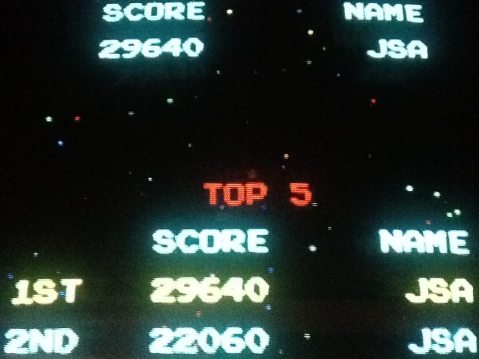
Galaga High Scores, image by Jenny Stoever
As a soundtrack, Reyes’s poem remembers the 80s through extensive references to the alternative rock music and androgynous and flamboyant artists of the MTV generation. This musical lineage becomes the soundtrack to the queer story in the poem. Through the music, the narrator produces a temporally complex “flashback” where queer connections, generational turf marking, and Mexicanness all come together.
No more pinball shit for us. That was 1970-something mierda
We were the generation of Atari—the beginning of digital games (22)
[. . .]
This was Siouxsie and the Banshees’ era with deep black mascara
The gothic singer who hung out with Robert Smith and Morrissey
The Smiths who dominated airwaves of Mexican Impala cars (23)
In these lines the narrator shows no nostalgia for the 1970s and boasts intense pride for all things new ushered in with the new decade. She brags about a new generation defined by new cultural icons like video games and synthesizer driven music. And while this music’s sound discernibly breaks from the 70s, its alternative sensibility isn’t just about sound, it’s about a look where “deep black mascara” and dark “goth” aesthetics – for girls and boys – are all the rage and help fans find each other. Simply dropping a band’s or artist’s name like “Siouxsie” or “Morrissey” or quoting part of a song conjures entire musical genres, bringing into relief a new kind of gender ambiguity and queer visibility that flourished in the 1980s. The poem is dotted with names like Boy George, Cyndi Lauper, Wham!, Elvis Costello, X, Pretenders, all musicians one might hear now during a “flashback 80s” radio hour radio or club theme night.

Sandy and Siouxsie, 2007, Shizu Saldamando, Los Angeles. Courtesy of the artist. See Shizu’s work through January 8, 2018 at the Pacific Standard Time show “My Barrio: Emigdio Vasquez and Chicana/o Identity in Orange County” at Chapman University.
The complex sense of time-space of the “flashback” as a theoretical concept is part of what links seemingly discrete flashback events: club nights, radio hours, musical intertexts. What is new about the “flashback” in this context is the unexpected site (literature) and literature’s unexpected Chicana subjects who frame readers’ listenings. Reyes’s poem represents and reminds me that the reason I go to dance clubs has always been for the love of music, all music, a feeling shared passionately among my stylish and musically eclectic friends (read more in my SO! post “New Wave Saved My Life.”). The last 80s night I went to was earlier this summer at Club Elysium in Austin, Texas, with my partner Cindy and our friend Max, who says he loves it because everyone there is his age – and for the love of new wave and fashion! The DJ played requests all night which made some of the transitions unexpected. But there we were, three Chicanos, less than ten years apart in age, enjoying a soundscape any 80s kid – from SoCal or Texas — would be proud of. When I got home I added four new songs we heard and danced to that night to my oldest Spotify list titled, “Before I Forget the 80s.” Although the purpose of this list is to stretch my memory of the music as a living pulsing archive, it also recovers the memory of this great night out with friends that extends beyond the physical dance floor.
.
Spotify Playlist for “Torcidaness” by Wanda Alarcon
Yet, in “Torcidaness,” remembering this music is mediated by the Chicana lesbian storyteller’s perspective who keenly tunes into these sounds and signs of alternative music and gender from East Los Angeles. The line, “The Smiths who dominated airwaves of Mexican Impala cars,” has implications that she was not alone in these queer listenings, as Reyes casually juxtaposes the image of lowrider car culture associated with Chicano hypermasculinity with the ambiguous sexuality of the Manchester based band’s enigmatic singer, Morrissey. Morrissey and lead guitarist Johnny Marr captivated generations of music listeners with their bold guitar driven sound, infectious melodies, and neo-Wildean homoerotic lyrics in the albums The Smiths (1983), Meat is Murder (1985), and The Queen is Dead (1986).
Recalling the song, “This Charming Man” against the poem’s reference to an Impala lowrider complicates how I hear the lyric: “Why pamper life’s complexities when the leather runs smooth on the passenger seat?” In a flash(back), the gap between the UK and East L.A. is somehow bridged in this queer musical mediation echoing what Karen Tongson calls “remote intimacies across time.” Although the poem reads like a celebration, there is a critique here in lines such as these. Chicanos and people of color are never at the forefront of who is imagined to be “alternative” in histories of alternative rock music. A vexing exception can be found in the Morrissey fandom. Mozlandia, Melissa Mora Hidalgo’s study in “transcultural fandom” is partly a response to troubling misrepresentations of Chicano fans of Morrissey. In the important work of Chicana representation where audibility is as needed as visibility, this poem not only remembers but it documents queer Chicana/o presence in these alternative 80s music scenes.

“Embrace Series: Morrissey Night” by Shizu Saldamando, LA 2009, Ballpoint pen on fabric, 72 x 120 inches. Image courtesy of the artist. See Shizu’s work at the LA Japanese American National Museum’s Transpacific Borderlands show through 25 February 2018.
By poem’s end, “torcidaness,” a Spanglish term, comes to mean lesbian, working class, and Chicana of the eighties generation all at once. Tuning into the poem’s soundscape enables the possibility of hearing all of these queer meanings simultaneously as well as the possibility of hearing Aztlán, vis-a-vis Eydie Gorme, in a video game. In these ways, Verónica Reyes’s sonically rich poem renders East Los Angeles and the 1980s as an important nexus for recovering Chicana histories and Chicana lesbian representation.
Ultimately “Torcidaness and Me” captures the joy and the struggle of queer Chicana belonging in this new narrative of what Cherrie Moraga calls, “Queer Aztlán.” Reyes writes, “Yep, this was the eighties and I was learning my crookedness.” At the same time, the compatibility of the term “queer” to tell Chicana stories is challenged by the presence of alternative ways to indicate ambiguity of gender and sexuality. In this poem, “crookedness,” “torcidaness,” “my torcida days to come,” and “marimacha” all convey “queerness” in forms more audible and meaningful to a homegirl from East L.A. If there is a sound to gender—to marimachas, malfloras, jotas, butches/femmes, what does using the word “queer” do to how we hear them? Some meanings are lost in translation, yet I don’t believe that translation should always be the goal.
Theorizing the concept of the flashback in the soundscapes of this generation of Chicana authors rejects the abstract and diffuse notion of 80s themed events deployed in mainstream American culture and resists the erasure of Chicanos and Latinos in the ways we remember this important musical decade. The stakes involved in representing and remembering such histories are high. Yet Chicana histories, experiences, sexualities, subjectivities, intimacies, language, style, desires cannot be understood without a deep recognition of Chicana lesbians and butch/femme as subjects of literature and the communities we live in. As part of a decolonial feminist listening praxis, the flashback becomes an important tool linking listening with remembering as more diverse Chicana worlds emerge.
—
Featured Image: Shizu Saldamando’s Pee Chee LA 2004, courtesy of the artist. See Shizu’s work at the LA Pacific Standard Time Show Día de los Muertos: A Cultural Legacy, Past, Present & Future at Self Help Graphics opening September 17th, 2018.
—
Wanda Alarcón is a lecturer in the Department of Feminist Studies at UC Santa Cruz. She is a recipient of the Carlos E. Castañeda Postdoctoral Fellowship in the Center for Mexican American Studies at the University of Texas at Austin (2016 –2017). She received her Ph.D. in Ethnic Studies with a Designated Emphasis in Women, Gender, and Sexuality from UC Berkeley in 2016, and earned an M.A. in English & American Literature from Binghamton University. Her research interests lie at the intersections of decolonial feminism, sound studies, popular music, eighties studies, and Chicana/o and Latinx cultural studies. Her interdisciplinary research theorizes “listening” as a decolonial feminist praxis with which to remember alternate histories of Chicana/o belonging within and out of national limits. In particular, her research argues that queer Chicana/x and Latina/x sonics become more audible in the soundscapes of Greater Mexico. At home Wanda plays piano almost every day, tinkers with bass guitar, and enjoys singing in her car. She listens to The Style Council and The Libertines in equal measure and is active on Spotify where she makes playlists for work, play, and sharing with friends.
—
 REWIND! . . .If you liked this post, you may also dig:
Listening to Punk’s Spirit in its Pre-, Proto- and Post- Formations – Yetta Howard
Could I Be Chicana Without Carlos Santana?–Wanda Alarcon
If La Llorona Was a Punk Rocker: Detonguing The Off-Key Caos and Screams of Alice Bag--Marlén Rios
Share this:

Spaces of Sounds: The Peoples of the African Diaspora and Protest in the United States

The slaves who were ourselves had known terror intimately, confused sunrise with pain, & accepted indifference as kindness. – Ntozake Shange, Sassafrass, Cypress & Indigo
Sanford. Baltimore. Chicago. Staten Island. Charlotte. Cleveland. Oakland. Austin. Los Angeles. The Bronx.
Despair in the United States is nothing new. It is neither an emotion confined to the neatly-drawn borders of this land nor is it experienced more acutely by any one group of people. The vast discrepancy between the results of the popular vote and the electoral college’s selection of Donald Trump as forty-fifth president of the United States amply reveals despair to be an sentiment viscerally experienced by a wide swath of people in this country, irrespective of race, ethnicity, gender, class, or sexuality.
Such despair has been ignored, however, by those who have caused and who continue causing the suffering of peoples of both indigenous and, later, African descent. We are taught that men from what we now recognize as Europe arrived in this hemisphere in the late fifteenth century, settling initially on a strip of earth in the Caribbean Sea that would become the first site of massacre and genocide, acts which unleashed, if one lends credence to the narrator of Junot Díaz’s The Brief Wondrous Life of Oscar Wao, the fukú, the “Curse and the Doom of the New World.” The narrating voice himself characterizes the curse not in the actions of death, but in the “screams of the enslaved, [..] the death bane of the Tainos, uttered just as one world perished and another began […]” (1). The fukú resonated through the sounds that these human beings made.

Image of the People’s History of Telegraph Avenue mural, designed by Osha Neumann, painted in 1976, restored and enlarged in 1999, at the corner of Haste and Telegraph in Berkeley. Image by Flickr user nursenicole329 (CC BY-NC-ND 2.0).
.
Not a house in the country ain’t packed to its rafters with some dead Negro’s grief. – Toni Morrison, Beloved
The State’s unwillingness to hold George Zimmerman responsible for the murder of Trayvon Martin–and its subsequent refusal to hold any police officer accountable for the hundreds of deaths they have caused–has galvanized the United States in the last four years. Hundreds of thousands of men, women, and children alike have taken to the streets, as #BlackLivesMatter, a true and succinct sentence, has roused ghosts of the past who have never left us, who have always been present, accompanying us on this journey.
This post is not a reflection of the music that has served as a soundtrack to these protests, though there are articles that have done so, such as this one, this one, and this one. These pieces do not include the extensive list of articles that address perhaps the most widely-viewed piece of protest music thus far, Beyoncé’s “Formation” video, a scarce offering of which can be found here, here, and here. Instead, it is an essay inspired by the sounds of the protesters themselves, the noises made by the minds, bodies, and spirits of the men, women and children who have taken to public spaces and sometimes commercial zones in order to confront and object to the protections applied to those who kill men, women, and children, often of African descent.
Listen to Los Angeles in 2013. . .
. . .to Houston in 2014. . .
. . .to New York City in 2014. . .
. . .and to Charleston in 2015. . .
. . .
 In his pivotal Cities of the Dead: Circum-Atlantic Performance (1996), Joseph Roach characterized New Orleans and London as urban centers marked by two simultaneous, consistent acts: appropriation by white people and white power structures of the cultures of the peoples they have violently marginalized, and then, at the same time, a clear distancing from those very cultures and peoples. Although now in its twentieth year of publication, Roach’s theorization of the circum-Atlantic world remains vastly underutilized in scholarly circles—particularly in sound studies, where it should have special resonance– and has become increasingly critical to our understanding of this historical moment, as it “insists on the centrality of the diasporic and genocidal histories of Africa and the Americas, North and South, in the creation of the culture of modernity” (4). With this configuration, Roach accomplishes two feats simultaneously: first, he decentralizes the United States as the focal point of studies about the so-called New World, instead, placing on equal footing all of the histories and cultures of the Americas. For this scholar of the literatures of the Americas, particularly those written by men and women of African descent, Roach’s is a critical gesture that facilitates comparative work across national boundaries.
Second, and most importantly, Roach emphasizes the role of murder, rape and the destruction of whole cultures indigenous to the American and African continents in the foundation of the nations of this hemisphere. Ta-Nehisi Coates is perhaps the most recent writer to remind us that the most potent legacy of such modernity, racism, “is a visceral experience, that is dislodges brains, blocks airways, rips muscle, extracts organs, cracks bones, breaks teeth” (Between the World and Me, 10). That which we know as “modernity,” itself a deeply flawed construct that remains in need of serious revision, was born of broken backs, mutilated limbs, hushed middle-of-the-night tears of indigenous and African peoples. Moans and sighs, whispers and wails, cries and screams, they are the musical score of this hemisphere’s American experiment.
The slaves who were ourselves aided Indigo’s mission, connecting soul & song, experience & unremembered rhythms –Ntozake Shange

Harriet Tubman Memorial Monument, Harlem, Image by Flickr User John Mannion (CC BY-NC-ND 2.0).
In the face of a populace accustomed to ignoring the wailing of mothers who have buried their children, who have disregarded their dignity and the weight and shape and taste of their loss, men, women, and children have mobilized. They have made manifest that which communities of peoples of African descent have spoken of and have documented since the founding of this nation. As Roach has utilized the term performance, the literal rituals of mourning by communities of African heritage not only commemorate those who have recently passed but they also invoke the spirits of those who have long borne witness to such violence. Throughout his study, Roach distinguishes between a European heritage that begins to segregate the living from the dead during the Enlightenment (50), and more traditional cultures, particularly African ones, where spirits mingle with their human counterparts. While written texts may not, and often do not, adequately commemorate the loss of lives deemed marginal to the larger society, performance itself – chants, wails, songs – serve not only to memorialize but also as gestures of restoration.
Protesters and activists are no longer satisfied with the well-established decree that we should wait for a distant moment for a more perfect realization of the United States’s many promises. No, instead, they have identified this as the historical moment in which those oaths are to be fulfilled. They have walked, marched, and stomped through streets, on sidewalks, parks, churches, filling malls and transportation hubs with their bodies as testimony. They have repossessed and redefined spaces once thought of as simply neutral, transparent space as Katherine McKittrick refers to it in Demonic Grounds, revealing the fault-lines of difference based on class, race, gender, and sexuality in this society (xv). They have done so manipulating sound, both recycling chants used through the decades to protest injustice and, at times, simply occupying space, without a word uttered.
The silence waged in the 2014 protest in Grand Central Terminal after the non-indictment of Daniel Pantaleo in the murder of Eric Garner does not represent erasure, but rather a purposeful demonstration of the willful humanity of those unwilling to forget.
They quiet themselves. They replace the sounds of unfettered pain and grief with its absence, until all that you hear is the mechanized announcement of train schedules. The contrast is stark: the moment highlights what Claudia Rankine has identified as the condition of black life in Citizen, that of mourning (145), against a backdrop of technological advancement, that which has been built on the backs of and through the physical, emotional, and intellectual labor of black life. Here, the members of this community enact what has been called a “die-in”: simulating the physical positioning of bodies in caskets, they force onlookers to confront an uncomfortable truth about the history of this country and of the nations of this hemisphere.
All of us walk on land soaked in the blood of those who have made our lives easier and more convenient. The men and women at Grand Central make manifest what Roach terms surrogation: in the chasm left by death, they offer a replacement, one that both evokes those who have died and disturbs the complacency of survivors themselves (2). The performance serves to confront those who dare say that the violence of genocide and enslavement of past generations should remain in the past; no, these men and women and the spirits they invoke respond. Time is not linear, as we have been taught. For past, present, and future are temporal constructs used to service oppression and domination; this will no longer do.

From Kara Walker’s 2014 exhibit, “A Subtlety,” at the Domino Sugar Factory in Brooklyn (CC BY-NC 2.0)
Here, in this here place, we flesh; flesh that weeps, laughs; flesh that dances on bare feet in grass. Love it. Love it hard. – Toni Morrison
We bear witness to the reclamation of grief, of lives cut short at the hand of a government charged with protecting those human beings who inhabit its borders, at least theoretically. While, as Roach surmises, “memory [may be] a process that depends crucially on forgetting” (2), we hold space to those dedicated to not forget, to instead excavate the silences, breathe life into those histories, remembering that the stories we have heard, the pages we have read, were once human beings. We create “counter-memories” as challenge and testimony, as a sacred pledge to those who are no longer present physically in this realm (Roach 26). We recall the cultures and practices of those who lived before the written form was a tool of exclusion, when remembrance was a practice of community.
American culture, in the hemispheric sense, incorporates all such rituals, across generations; as Roach notes, it is performance that “works on behalf of living memory, by bringing the parties together as often as necessary” (138). No longer consigned to the past, the spirits of those killed by the state are revived, their existences in the human plain celebrated. They are not defined by how they died but instead by how they lived. While literacy of the written form can separate, sound and gesture more effectively bypass the fictions of difference based on race, ethnicity, gender, class, and sexuality. Cities of the Dead amplifies how “performance can articulate what otherwise may not be properly communicated” (161).
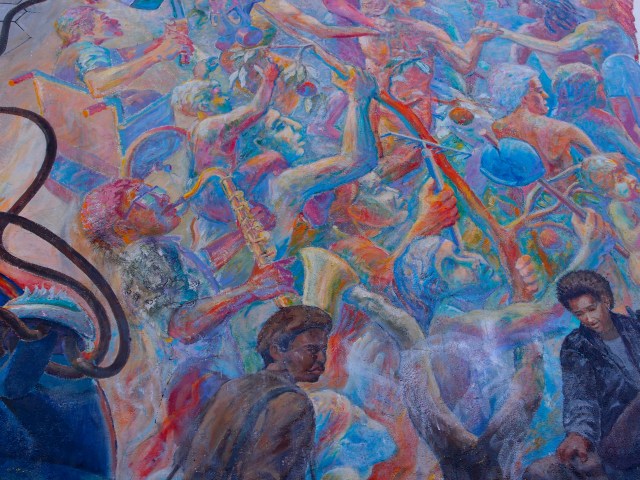
Image of the People’s History of Telegraph Avenue mural, designed by Osha Neumann, painted in 1976, restored and enlarged in 1999, at the corner of Haste and Telegraph in Berkeley. Image by Flickr user nursenicole329 (CC BY-NC-ND 2.0).
It’s so magic folks feel their own ancestors coming up out of the earth to be in the realms of their descendants – Ntozake Shange
We say their names. We say their names: Eleanor Bumpers. Anthony Báez. Sean Bell. Aiyana Stanley-Jones. Tyisha Miller. Oscar Grant. Rekia Boyd. Trayvon Martin. Tanisha Anderson. Renisha McBride. Eric Garner. Yvette Smith. Tamir Rice. Sandra Bland. Freddie Gray. Korryn Gaines. Akia Gurley. Alton Sterling. Philando Castile. Micah Jester. Deborah Danner. Walter Scott. Michelle Lee Shirley.
The list, tragically, grows, and still we say their names. We do so as an act of remembrance. As an offering. As peoples of African descent around the world do in times of ceremony, in the name of ritual. We remember those who have come before us, who have birthed this current historical moment of awakening here in the United States. We say their names.
And, as the sounds of their names said aloud echoes, we pray. Ashé.
—
Vanessa K. Valdés is associate professor of Spanish and Portuguese at The City College of New York; she is the editor of Let Spirit Speak! Cultural Journeys through the African Diaspora (2012) and The Future Is Now: A New Look at African Diaspora Studies (2012) and the book review editor of sx salon. She is the author of Oshun’s Daughters: The Search for Womanhood in the Americas (2014). The title of this essay is inspired by Josh Kun’s Audiotopia: Music, Race, and America, where he writes that his book is “focusing on the spaces of music, the spaces of songs, and the spaces of sounds” (25).
—
Featured Image “Freedom Marchers” by Flickr User Keoni Cabral, Photoshop processed digital image from the Martin Luther King Center in Atlanta, Georgia (CC BY 2.0).
—
REWIND! . . .If you liked this post, you may also dig:
SO! Reads: Shana Redmond’s Anthem: Social Movements and the Sound of Solidarity in the African Diaspora—Ashon Crawley
Music Meant to Make You Move: Considering the Aural Kinesthetic–Imani Kai Johnson
Black Mourning, Black Movement(s): Savion Glover’s Dance for Amiri Baraka–Kristin Moriah
Something’s Got a Hold on Me: ‘Lingering Whispers’ of the Atlantic Slave Trade in Ghana–Sionne Neely
Share this:


Current Top Posts





April 2021

January 2020

November 2019

October 2019

August 2019

April 2014

November 2017

March 2015

December 2017

October 2015
 Sounding Out!
Recent Comments