
The Sounds of Anti-Anti-Essentialism: Listening to Black Consciousness in the Classroom

Image by Flickr User Pere Ubu
 In teaching the many interrelated and complicated aspects of the Civil Rights movement, Black Power, and the Black Arts Movement, the challenge for me is to help students understand the “facts” of this period, and to simultaneously destabilize the teleological historical narrative these “facts” seem to suggest. In a pedagogical context, sound helps fill in the gaps that fall outside of the knowledge produced–and contained within–certain archival accounts of black cultural and political history. While crucial, having students listen to the gaps, can be daunting, especially in our current historical moment, as the decades-long push against identity politics has been solidified by the recent (re)election of the nation’s first black president, Barack Obama. This point demands more elaboration than I can provide here, but the critical pedagogical issue it raises within the province of black studies, is that it is becoming increasingly difficult to consider black political culture outside of the sedimented lines of American pluralism and black radical thought.
I use sound as a pedagogical tool to help outline a middle ground–what Frantz Fanon refers to in The Wretched of the Earth as “zone of hidden fluctuation” (166)–based upon articulations of resistance and identity that refuse to be frozen in time. Building on Paul Gilroy’s conceptualization of anti-anti-essentialism in The Black Atlantic, an idea of black consciousness that is flexible and moves between the insufficient terms of “essentialist” and “anti-essentialist,” I use specific pedagogical examples to suggest that teaching about race and sound is a rich, evolving, and productively interactive continuum. The auditory sense opens up new terrains of knowledge and dynamically expands the possibilities for students to think through the intricate and multifaceted formations of black consciousness during the volatile years of the 1960s and the resonance of those years in our present.
The recorded presence of Martin Luther King, Jr., for example, represents an important aural site for engaging in reflexive pedagogy, because King’s tonality–the resonance of his voice–creates a certain familiarity and is pivotal to the construction of the American myth of the radical transformation of the civil rights movement and the idea of post-civil rights racial equality. For many students, King’s sound signals the dream of, and the pathway towards, a unified America. Conscious of how this idea of King reflects a linear understanding of civil rights as simply a desire for inclusion, I direct students’ attention to the sound of King’s last recorded speech in Memphis on April 3, 1968. Given the evening before his assassination, this speech resounds with King’s deepening critical perspective on black struggle through its haunting concluding notes. I point out to my classes that King’s final years (1965-1968) were marked by his increasing focus on ideas of black resistance outside of the Civil Rights mainstream, including his critique of U.S. involvement in the Vietnam War, and his radical rethinking of the possibilities for black economic and political self-determination.

Martin Luther King in 1968, Image courtesy of UIC Digital Collections
Centered on the economic injustice and dehumanization of Memphis’s striking black sanitation workers, King’s speech details the need for the Memphis black community do more than simply boycott municipal entities, but rather articulate their resistance by boycotting prominent national brands such as Wonder Bread and Coca-Cola. Against this background, I play segments (particularly the final minutes) of King’s speech, entitled, “I’ve Been to the Mountaintop.”
The acoustic dimensions of King’s final speech resonate with a social and political complexity that troubles the sonic memories many students have of King’s “I Have a Dream” speech, delivered on the steps of the Lincoln Memorial in 1963. The much more intimate and less overtly majestic soundscape of Memphis’ Mason Temple underlines King’s shift from national icon back to local, community activist. The frequent audience shifts–applause, extemporaneous interjections, and silence–create a reverberating sonic energy that accumulates throughout the speech. Rather than relying strictly on a call-and-response interpretation of the interactive exchanges between King’s voice and the audience’s response, I have students consider the non-linear ebbs and flows in King’s sound in this latest of moments (as Fred Moten would say, the totality of King’s tonality). For example, as King’s audience considers the weight of his analyses and what it means to articulate black resistance as “a dangerous unselfishness” that “puts pressure where it really hurts,” I identify moments of uncertainty, hesitation, and contemplative reflection that mark a non-linear interactive sonority between King and his audience.
Listening to King’s final thoughts offers a disturbing and disruptive emphasis on the stakes of breaking with entrenched modes of activist thinking. He concludes the speech with a series of prophetic thoughts on mortality as a cost of making a stand against “our sick white brothers.” Set within the historical and ideological context I have sketched above, the delivery distinguishes the sound of King’s words. As we listen I draw attention to King’s expression of a lack of fear in anything, any man, as King seems to convey an eerie foreknowledge of his murder and his irreverence in its face.
“I’ve Been to the Mountaintop” –Listen to the concluding two minutes
The apocalyptic sound of King’s concluding notes to this political sermon leaves much to contemplate. From the mention of the potential threat posed to his life by “our sick white brothers,” through the speech’s last line, there is a tonal, timbral shift in his voice and demeanor. Through sound and posture, and the reaction of the audience to those factors, King’s affect seems to convey something more momentous occurring beneath the event’s surface dynamics. King projects a confrontational edge through the sound of fearlessness in the face of mortality. Did he know he was going to be killed shortly after giving this speech? It’s a question that the peculiar tonality of his concluding lines raises for students. If so, what does it mean to use the sermon as a site of prophetic, aural documentation of the fact that a force of transformation exists beyond the flesh and blood of leadership, a force that assassination can’t kill? In the speech’s final synesthetic moment, I have the students listen and watch the shift that occurs in King’s demeanor as he closes, and the way that this shift culminates in an almost ecstatic moment as he delivers the final line: “Mine eyes have seen the glory of the coming of the Lord.” His defiant turning away from the microphone is crucial as it amplifies the meaning of the voice, letting those watching know that, much like an emcee, King has just “served” white power with a delivery that will outlast the sniper’s bullet the following evening.

Nina Simone, Image courtesy of Flickr User GlingG
I want to briefly point to two other examples that show additional ways in which sound complicates ideas of racial identity and expression during the 1960s. When I teach Nina Simone’s composition, “Mississippi Goddamn,” (recorded live at Carnegie Hall in 1964), I ask students to consider the relationship between the distinctive sound of her voice and the ironic and critical elements of her lyrical meaning as this interaction creates a complex idea of radical black consciousness. Composed in the aftermath of the murder of Medgar Evers and the bombing of the 16th Street Baptist Church in Birmingham, Alabama, Simone offers a musical, and more broadly sonic meditation on white supremacy.
Most students find the timbre of Simone’s voice, its grain (as Roland Barthes would say) and depth, immediately striking. Her unique sonority and its context, greatly influence attempts by students to understand her reference to the song as simply a tune: “The name of this tune is Mississippi Goddamn” she says, and “This is a show tune, but the show for it hasn’t been written yet.” Clearly it isn’t simply a tune, and the caustic quality of lines such as, “Oh but this country is full of lies/ You’re all gonna die and die like flies,” creates a critical depth through the sound of Simone’s commitment to a black radical perspective. What does it mean, for instance, that Simone projects such sarcasm and biting critique to a predominately white audience at Carnegie Hall? How might we hear the specific grain of her voice in this setting? How does Simone’s projection of critical black sonic resistance, emerge at the conjuncture of anti-black racism and the beginning of legislative efforts under the Johnson administration to rectify racial inequality through civil rights bills? What can be taken from the simultaneity and contrast that Simone projects her sound within? I pose such questions to my students as a way of considering what it means to be committed to critical thought and social transformation that falls outside of the dominant lines of American national consciousness, and how the sound of such commitment, heard in the pitch and tenor of Simone’s voice, matters as a different kind of historical documentation.
In considering how the sound of music can offer an intervention within the formation of black political consciousness in the Black Arts Movement, I often use the 1966 recording of Amiri Baraka’s signal poem, “Black Art,” as it set to the experimental musical sounds of Sonny Murray’s ensemble (Murray-drums, Albert Ayler-tenor saxophone, Don Cherry-trumpet, Henry Grimes, Lewis Worrell-bass). Having first read the poem, students then are able to hear it set to– and against–the unconventional instrumentation of Murray’s ensemble.
The musicians create an unconventional sonic context for Baraka’s reading that de-emphasizes and re-situates the apparent dimensions of black rage that seem to arise from verse that can “shoot guns,” through an almost carnivalesque, comedic, and off-kilter sound that troubles the linear expectations one might have of instrumentation amplifying the words on the page. The dissonance between page and sound allows for useful pedagogical opening, in that it underlines the non-conformist, avant-garde aspects of the movement, and the fine line that artists such as Baraka were imagining between the intensity of black radical consciousness and the ability to articulate that standpoint outside of the expected forms of black cultural nationalism.

Image Courtesy of UIC Digital Collections
As these examples have shown, I incorporate sound into my pedagogical framings of black cultural and political identity as an opening through which students may expand their understandings of black consciousness and black political culture well beyond stagnant ideas of racial authenticity, while still preserving an understanding of the transformative and often radical possibilities that have been projected through black expression during the period. It is the open space of sound that invests the project of black radical thought with the uncanny spontaneity of experimentation. Having students understand ideas of expansiveness, asymmetry, and non-linearity as central to black cultural expression and critique–even as artists refuse to sacrifice an expressed political commitment to black resistance–begins to suggest ways for students to contemplate the intersection of identity politics with the unexpected, fantastic elements of expression that lie outside of more recent flattened diagnoses of black nationalism. Teaching at the intersections of race and sound opens up new terrains of knowledge, dynamically expanding students’ abilities to think through the intricate and multifaceted formations of black consciousness during the volatile years of the 1960s and the resonance of those years in our present.
—
Carter Mathes is an assistant professor of English at Rutgers University. He has completed a book manuscript entitled, Imagine the Sound: Experimental Form in Post-Civil Rights African American Literature, that focuses on the relationship between sound and literary innovation during the 1960s and 1970s. He is co-editing a volume of essays on Black Arts Movement writer and critic Larry Neal; and also has essays in print or forthcoming on Toni Cade Bambara, Peter Tosh, and James Baldwin. At Rutgers, he regularly teaches classes focusing on African American literature, Twentieth-century literature, music and literature, and experimental writing.
—
 REWIND! . . .If you liked this post, you may also dig:
Audio Culture Studies: Scaffolding a Sequence of Assignments–Jentery Sayers
They Do Not All Sound Alike: Sampling Kathleen Cleaver, Assata Shakur, and Angela Davis–Tara Betts
Freedom Back: Sounding Black Feminist History, Courtesy the Artists–Tavia Nyong’o
Share this:

“I Love to Praise His Name”: Shouting as Feminine Disruption, Public Ecstasy, and Audio-Visual Pleasure
Well, if you don’t believe in shouting,
That’s alright with me
Some folk don’t believe in shouting,
That’s alright with me…
Doubt and ignore it,
But I belong to the Lord’s crew.
David said rejoice in the Lord,
And that’s the way we Christians do.
If you don’t believe in shouting,
That’s alright with me.
–Dorothy Love Coates & the Gospel Harmonettes, “That’s Alright with Me”
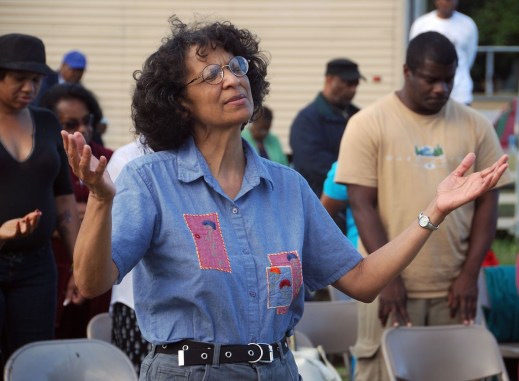
A handy catch-all term, “shouting” is actually a euphemism encompassing a range of ecstatic worship behaviors. These can include clapping, dancing, pacing, running, rocking, fainting, as well as using the voice in speaking, singing, laughing, weeping, yelling, and moaning. Certainly, there were men who shouted in the days of my childhood in church; there are men who shout today. The only shouts I can recall and even imitate to this day, however, are those of the women.
There is, in fact, a longstanding association between women and shouting. Perhaps because of the pronounced emotionality involved in the practice, the shouting sphere tends to be prefigured as feminine and in this bears great relevance to women. I am interested in the significances of shouting among black Christian women of struggling populations. In my view, shouting is not only a religious practice for these women, but is also a binary-breaking performance which confounds—if only fleetingly—the divisions which have so often oppressed, menaced, and harmed them. I argue that shouting has worked to codify the disruption of male-dominated services by women who have so often faced sharp sanctions by black church patriarchy. I also contend that shouting places its female practitioners and their observers within a sphere of public ecstasy and visual and auditory pleasure, which makes mischief for notions of what is proper for Christian women and for the entire church community.
.
The Shout, the Sound, and the Shriek: Black Feminine Disruption
In a 2011 post for Sounding Out! entitled “Pentecostal Song, Sound, and Authentic Voices,” Ashon Crawley posits the existence of a black church “public zone,” which serves as the conceptual, holy ground upon which “sound, song, and subject [function] as conduits for the exchange of ecstasy and ecstatics.” I’d like to track Crawley’s public zone into the shouting sphere, the very heart of ecstasy within the black worship experience.
Although culturally codified—even expected and welcomed—within the church community, the shout functions primarily as a disruption. The faces, bodies, and voices of shouting black women disrupt the flow of the service. A shout takes time and has the power to alter the program. Regarding such moments, worshippers—most often women and gay men—often proclaim in retrospect, “Baby, there was no more order!” This disruption of order through the use of the body and the voice has a distinct place within the Christian black feminine tradition of resistance to oppression.

Image by Flickr User Steve Schwartz
In the essay, “The Restorative Power of Sound,” womanist Roxanne Reed has examined the function of gendered sound within black Christianity. For Reed, the feminine “wordless cry, holler, moan, or wail” achieves “primacy over the written text,” “suggests a historical time with relying on a defined chronology,” and is legitimated by an African “ancestral heritage” which presages black musical forms (2). This distinctly feminine worship sound claims space from “patriarchal privilege,” which has often extended to black folk preaching, a tradition which excluded most black women for decades after slavery.
The sound of the black feminine in worship is thus a symbol for black women’s triumph over historically masculine arenas of writing, history, and form. The shout and the gendered worship sound can be placed in critical triangulation with Fred Moten’s “shriek,” as theorized in In the Break (2003) An expression of the distinct suffering of the black female, the shriek is a primal “phono-photo-porno-graphic disruption” of spirit and matter, and other binaries (14). The shout, the feminine worship sound, and the shriek all take center stage as black female performances which disrupt oppressive categories and assert the black woman’s voice as triumphant.
Shouting as Public Ecstasy, Scopophilia, and Sonophilia
Many observers have noted the shout’s resemblance to sexual ecstasy. The shout is often expressed through the sounds, movements, and facial expressions commonly associated with sex. Some shouters close their eyes and moan. Some hug themselves around the waist or bend over the pew in front of them, rubbing their own shoulders, bellies, or thighs. Some roll about the floor, hollering or speaking in tongues. Some whisper His Name, as in closest intimacy to a lover. Some dance with abandon before the altar or in the aisles before collapsing, spent and panting. Some quiver quietly in deepest distraction.
Shouters in the throes of their ecstasy are closely observed by all within the church community. Members of church communities often mark shared remembrances by who shouted, when, and how. Even young children can be called upon to reproduce the shouts of various church members. The conspicuousness of the shout provides reason to consider it as spectacle containing pleasure for both the shouter and those who gaze upon her.
.
Laura Mulvey’s “Visual Pleasure and Narrative Cinema” discusses “scopophilia” as a phenomenon occurring in “circumstances in which looking itself is a source of pleasure, just as, in the reverse formation, there is pleasure in being looked at” (587). In the moment in which a shout goes forth, those shouters who are aware of being watched—not all are—and their gazers may be said to enter into mutual pleasure from being watched and from watching. For the observer, the pleasure arising from the sight-based stimulation is often compounded by the narcissism of the ego which seeks to identify with its source. This may explain why in highly charged church moments, shouts become highly communicable—“thriving in concert,” as Zora Neale Hurston once phrased it. Looking upon another in worship ecstasy can be understood to reinforce one’s own relation to the Holy and to stir desire to engage that relation through shouting.
There is sufficient cause to assign what I call a “sonophilic”aspect to shouting as well, as shouting never fails to take place but within a context of sound. This sonophilic component should be understood as the means by which the sounds of ecstasy coming from a shouter provide stimulation and identification in the listener, who may in turn become a shouter. It must be noted, however, that the sonophilia can emanate from sources other than the shouter. Shouts are often roused by a complex network of sounds. Within a service, preaching and verbal exhortations, prayers, congregational chants and songs, and instrumental music designed to buoy sermonic delivery or to capitalize on swells of emotion often work in tandem to provide the sound-based pleasure essential to shouting.
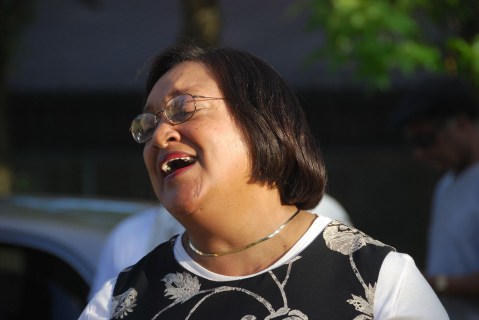
Image by Flickr User Steve Schwartz
A Final Shout-Out to Shouting
From West Africa to North America, from slavery to emancipation, from the eighteenth century into the present day, the black ecstatic in the form of shouting has served several important purposes for black women. Black women’s general and persistent preoccupation with the relationship between the spiritual and the sensual, the cornerstone of black female intellectualism in my view, was first and foremost expressed in the practice of shouting. The shout can be understood as the primary site upon which black women made the spiritual physical and rendered the sensual holy.
.
Furthermore, in eras in which black women were customarily denied the right to preach and were granted but limited authority within church communities, the shout communicated a woman’s ability to engage the Holy. This proven ability undoubtedly helped to open doors for the thousands of black women who now preach and pastor all over the country. Shouting has also provided much needed relief for the unique pressures of the black female in North America, absorbing and transforming her hurts and frustrations and replacing them, down through the centuries, with the hope and strength vital to her survival.
—
Featured Image Credit: Flickr User Steve Schwartz
—
Shakira Holt is a thirteen-year classroom veteran and currently teaches high school English in Los Angeles County. She earned a doctorate degree in English from the University of Southern California, and works primarily in the area of black women’s literature and culture. She is deeply concerned about the intersections of race, religion, gender, sexuality, class, and politics in the public sphere. She is a lazy poet, a latent novelist, an intermittent blogger, a retired songwriter, and a reluctant karaoke singer. A licensed Baptist minister, she is but slowly working her way back to the pulpit. “I Love to Praise His Name” is her first published piece.
Share this:


Current Top Posts





April 2021

January 2020

November 2019

October 2019

August 2019

April 2014

November 2017

March 2015

December 2017

October 2015
 Sounding Out!
Recent Comments