
The Noisiest City on Earth? or, What Can the 2012 Manhattan Noise Complaint Maps Really Tell Us?

“It’s a city, not a cemetery. You can’t tell everybody to go around wearing earplugs.”
Ex-New York City Parks Commissioner Henry J. Stern, quoted in “Many Pleas for Quiet, but City Still Thunders”
In 1905, a New York Times article declared New York City “the noisiest city on Earth.” More than a century later—this summer, to be exact—The New York Times ran a series on noise in New York City titled “What? The Long War on Loud” that proved that this city is still trying to figure out its relationship to sound. (One of the gems of that series? “New York’s War on Noise” timeline.) As a displaced New Yorker, some of my most vivid memories of the city are aural. Although New York City isn’t the only loud city out there, there are many reasons it’s called “The City That Never Sleeps”—and sound has a lot to do with it, depending on which neighborhood you call home.
Now you can see what neighborhoods are allegedly noisiest, and where all that noise comes from. Brooklyn designer Karl Sluis created the 2012 Manhattan Noise Complaints maps (click for full image), in which Sluis correlated the data on 311 noise complaints made during the year 2012 (40, 412 complaints, to be exact) that he obtained from the NYC Open Source site with Manhattan’s geographical coordinates. He used circles of various sizes to a) create an aural tracing of the island of Manhattan, sitting in a sea of turquoise blue b) showcase the number of complaints in an area. The bigger the circle, the larger the number of complaints.

Screen Capture of Karl Sluis’s 2012 Manhattan Noise Complaints maps (click for interactive image)
The maps Sluis has created are helpful for visualizing the complaints on a broad scale, but they paint an incomplete picture of what noise means in New York City. The demographics of each neighborhood are absent from each map, a slight that can perhaps be traced to the 311 data available, but in order to better understand how New Yorkers define “noise” those stats must be included. Both Sluis and John Metcalfe from The Atlantic Cities discuss notable findings, but neither takes into account the fact that some of the areas with a higher concentration of noise complaints are not just densely populated but densely populated with racial and ethnic minorities. Indeed, comparing the maps’ noisy hotspots to a map of Manhattan racial demographics reveal how urban racial dynamics intersect with ideas about sound and power: who can make sound, who must be chastised for making noise, who can complain and whose complaints are actually being heard.

“Unnecessary noise prohibited” by Flickr user Ricky Leong, CC BY-NC-SA 2.0
Mapping noise complaints gives a spatial dimension to noise, and it renders noise palpable, in a way. Sluis points out, “Noise complaints reveal the concentration of activity in the city as well as many smaller stories, such as the construction of the Second Avenue subway line, idling buses on the Upper East Side, and the homes of the loudest dogs (or the least patient neighbors).” He reminds us that the data comes from complaints and not necessarily decibels; in other words, it represents local ideas of what counts as sound and what counts as noise.
While Metcalfe correctly describes the thousands of 311 complaints about noise from 2012 as “the entire year’s expression of mass annoyance,” Sluis’s map does not go far enough toward figuring out whose annoyance, exactly. We must remember that annoyance oftentimes stems not just from physical reactions to noise but rather one’s perceptions about noise, what Jennifer Stoever-Ackerman deems “the listening ear.” How we hear others, Stoever-Ackerman argues, is not as natural as it seems. For example, whom we deem as noisy may stem from our community, our parents, and/or social conditioning. Accounting for race/ethnicity in noise maps will show how the listening ear conditions neighbors to categorize and react to certain sounds.
For the purpose of this analytic exercise, I compared Sluis’s maps and the Center for Urban Research, CUNY Graduate Center’s 2010 map of block-by-block demographic changes in New York City, in order to illustrate how population density and racial/ethnic demographics play a role in concentrated pockets of noise complaints. Drawn from 2010 census data, the CUNY map clearly delineates neighborhoods and color-codes the groups in each neighborhood per block: blue for whites, green for Latino, orange for black, purple for Asian, and grey for “Other.” Although the Center for Urban Research, CUNY Graduate Center’s maps cannot be superimposed on Sluis’s maps, they help give a general idea as to where neighborhoods are located in addition to racial demographics.
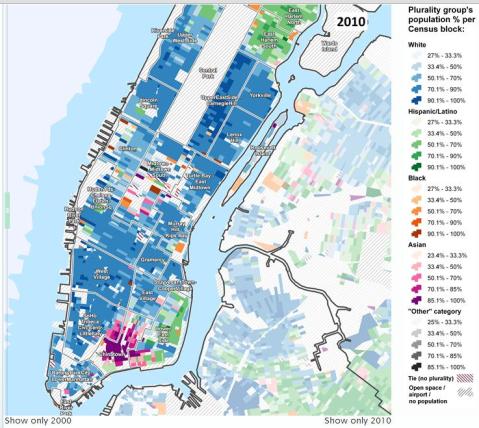
Manhattan below 110th Street in 2010, courtesy of the Center for Urban Research, CUNY Graduate Center

Manhattan above 110th Street 2010. Courtesy of the Center for Urban Research, CUNY Graduate Center
From the maps illustrating changing race/ethnicity patterns, I gathered what neighborhoods were predominantly white (West Village, Lincoln Square, Yorkville, Upper West Side), predominantly Latino (Washington Heights, East Harlem) predominantly black (Central Harlem, parts of Hamilton Heights), and predominantly Asian (Chinatown, blocks of the Lower East Side). When one compares Sluis’s overall noise map of Manhattan to the racial demographic maps of Manhattan, what stands out is that the major circles of noise complaints are also places where there are different racial and ethnic groups mingling (for example, Times Square) or places that are populated by mostly minorities (Hamilton Heights). Whereas Sluis flattens out the noise complaints, demographic stats point to the racial/ethnic contours of each neighborhood. Sluis’s maps focus on number of complaints; unfortunately this assumes everyone complaining is the same and that everyone making the noise is the same—a level aural playing field if you will. Bringing demographics into the equation underscores how not all complainers are equal and how not all complaints carry the same heft.
The city may be noisy, but “noisy” is relative. Sluis’s map shows some predictably noisy areas for those of us familiar with Manhattan’s soundscape (Union Square, Times Square) but it also draws attention to other areas not as predictable in the mainstream imagination (East Harlem South, Hamilton Heights). However, the maps by the Center for Urban Research, CUNY Graduate Center help us better understand the context for the high or low number of complaints in certain areas. For example, one of the biggest circles on Sluis’s general map of Manhattan is located in the Hamilton Heights/Washington Heights area; the Center for Urban Research, CUNY Graduate Center’s map of Manhattan above 110th Street show that these areas are densely populated by blacks and Latinos/as. This is key information because it reminds viewers that this neighborhood is a lot more ethnically diverse than other neighborhoods with a smaller number of complaints. It brings to mind: what role does race play in these complaints, in terms of those who complain and those who are the focus of the complaints? Although more people might mean more complaints, the prevalence of complaints like “loud talk” in East Harlem (Spanish Harlem) are nevertheless connected racialized ideas about people of color being “loud.” This doesn’t assume that the people complaining are white, but that they are complaining about groups that are characterized as loud, noisy, rowdy.

“Classic New York: noise, smoke” by Flickr user Will, CC BY-NC-ND 2.0
These noise maps, when put into conversation with demographic data, also indicate what areas are priorities in urban planning—the sounds of gentrification. The visualizations of the complaints by section (under the main map), combined with CUNY’s maps, are even more telling because they break down the number of complaints by category. The aforementioned northern tip of Manhattan, for example, is also where many of the complaints are concentrated. At a glance, loud parties, loud people, and loud car stereos seem to be the major complaints in those areas, according to Sluis’s visualizations. Meanwhile, noises of “urban growth,” such as construction and jackhammers, are less prevalent in these areas, whereas they are more prevalent below Central Park North, in now mostly-white neighborhoods.
Sluis’s maps of the 311 noise complaints data allow readers to see differences in terms of neighborhoods: who complains the most? what do they complain about? However, one thing to keep in mind is that first question: who makes the complaints. This is where the data falls short. Can it be assumed that those who are calling about the noise are mostly people who live in the neighborhood? Are Upper Manhattan neighbors less or more tolerant of noise? The answers to these questions, although they’re not found in Sluis’s map, point to how ideas of who is noisy or who can make noise are at play here.
I do not mean to downplay the usefulness of Sluis’s map. I instead call for the necessary addition of key missing factors to future noise maps in order to give us a more complex picture of noise complaints in Manhattan and elsewhere. Although it may not be possible to gather who the 311 callers are, including factors such as race and class may lead to very different noise maps. For example, what would a noise map of Manhattan look like if researchers brought income into the equation? Income inequality, especially in Manhattan where that imbalance is starkly on display, matters for the purpose of sound mapping. The more affluent neighborhoods are also the ones with less complaints and are the ones that are mostly inhabited by whites. Wealthier communities are more spread out and have more ability to couch themselves from noise, not to mention that it probably takes fewer complaints to get a response.

“Marcus Garvey Park Drum Circle, Harlem, NYC” by Flickr user j-No, CC BY-NC-ND 2.0
Gentrification is another factor: what kind of analysis could we do if we considered what neighborhoods have been gentrified in the past ten years? It is possible that as whites move into neighborhoods where people of color have historically lived, suddenly they find them noisy—hence, complaints. It is fitting to consider, for example, the tension between an established group of drummers in Marcus Garvey Park in Harlem and the inhabitants of a new highrise (characterized as “young white professionals”) who wanted the 30-years and running drum circle shut down, as reported in The New York Times in 2008. Moreover, if we accounted for the history of zoning in the neighborhoods that have the most or the least complaints it would add another layer of analysis to the data. Are some of these neighborhoods used as entertainment zones, for example? Is it easier to open up bars there than elsewhere in the city?
With these questions in mind, the maps go from beautiful renditions of data, to opening up a bigger conversation about the arbitrariness of noise. The demographical and sociological context of these noise complaints must accompany the raw data, especially when it comes to sound. The analysis also points to the source of the data: 311 calls. I wonder if this is the only way that people in Manhattan (and New York City at large) are dealing with noise. I’m sure that after a century of being “the noisiest city on Earth,” folks have gotten creative about it.
—
Featured image: ” Stranger 10/100 Johano” by Flickr user MichaelTapp, CC BY-ND 2.0
—
Liana M. Silva-Ford is co-founder and Managing Editor of Sounding Out! She is also known professionally as the Writer Whisperer.
—
 REWIND! . . .If you liked this post, you may also dig:
“I’m on my New York s**t”: Jean Grae’s Sonic Claims on the City -Liana Silva
The Noise You Make Should Be Your Own–Scott Poulson-Bryant
Sounding Out! Podcast Mini-Series (#16): Listening to The Tuned City of Brussels, Day 1: “Noise”
Share this:

Blog-o-Versary 4.0: Sounding Out!‘s Solid Gold Summer Countdown!

Click here to download our free Blog-O-Versary 4.0 Mix!
Happy SO! Blog-o-Versary 4.0 to readers, writers, and supporters! Before I once again have the privilege of counting down some of the blog’s many blessings, I want to extend a big welcome to our new readers and a hearty thank you to those who have been down from day one. In our four years of publication, we have never forgotten that SO! is here because y’all are here, and this Blog-o-Versary is as much about commemorating the solid gold vibrancy of Sound Studies—a state we have all helped to bring about—as it is celebrating another year of our Monday morning offerings.
This year I, Editor-in-Chief Jennifer Stoever-Ackerman, dare to fill the glittering stilettos left by Dionne Warwick as your host for Sounding Out!’s Solid Gold Summer-themed countdown, along with co-hosts Liana Silva-Ford (Managing Editor) and Aaron Trammell (Multimedia Editor). As the beat of our latest Blog-o-Versary mix drops—don’t forget to download it here—I will count down the site’s top ten greatest hits of this past year, with some glimmers of how SO! will continue to thrive in year five! If you feel like bringing it like a Solid Gold Dancer, don’t worry, no one here will look askance; in fact, just try to stop us from catching that groove.
10. “On a Mission” (New Mission Statements!): You want to know what Sounding Out! is all about? Peep our new mission statement, hot off the presses by Editor-in-Chief Jennifer Stoever-Ackerman and our new podcast editorial statement by Multimedia Editor Aaron Trammell.
9. “Suite Thursday” (Monthly Podcasts!): As of January 2013, Sounding Out! has moved to a monthly podcast format, coming to you on the last Thursday of every month. This year, we have brought you sonic dispatches ranging from ethnographic research on noise policing in Brasil, interviews with leading acoustic ecologists and Theremin masters, to audio documentaries of digital humanities sound projects such as #Tweetasound (Soundbox, Duke University). In addition to downloading from our site or subscribing via iTunes, you can now stream us on Stitcher!
8. “Thursday’s Child” (Sound Off! // Comment Klatsch!): Also as of January 2013, Sounding Out! has provided readers with an open, active comment forum in real time, where we discuss a range of topics such as 2012’s most memorable sound, the connection between sound and cinema, and the racial politics of listening. The Sound Off! // Comment Klatsch (or SOCK, as it is affectionately called around the editorial table), begins with a deceptively simple question penned by writers and editors, and lasts as long as the comments do. Whether you are a regular or are new to the scene, we’d love for you to join in this upcoming Thursday, August 1, 2013, when regular writer and Portugal-based multimedia artist Maile Colbert will incite discussion on psychological responses to sound. To peruse prior Comment Klatsches, click here.
7. “Celebrate” (Reception at ASA!): This year, SO!, was honored to co-host the first annual “Meet and Greet” of the Sound Studies Caucus at the annual American Studies Association meeting in San Juan, Puerto Rico. It was amazing to bring our virtual community into “meat space”—making new colleagues while keeping the old well-fed with happy hour snacks, drink specials, and excellent conversation. Look for more of these events at conferences with a sound studies presence in year five! For photos of the ASA meet and greet, click here.

ASA Meet and Greet, San Juan, Puerto Rico, 2012 (from l to r) Marci McMahon, Eric Weisbard, Bill Boyer, Deb Vargas, and (far right) Sherrie Tucker
6. “Get it Together” (More CFPS/forums/series): This year Sounding Out! has brought you even more themed programming, integrating our wide variety of sound studies inquiry with Calls for Posts, seasonal series, and month-long forums that focus our content on key issues in the field. In year four alone, we brought you a summer series on radio auteur Norman Corwin, two forums on Sound and Pedagogy full of great ideas, examples, and syllabi, and a “virtual panel” with IASPM-US on the “sonic borders” in/between sound studies and popular music studies. We just wrapped up our annual July “World Listening Month” observance—which featured an exclusive podcast series from the 2013 Tuned City Brussels event—and we are still in the throes of our summer series on “Sound and Sport”—next up on June 29th, a post and a podcast by Josh Ottum on Sound in skate parks! On deck for Fall/Winter 2013, Aaron Trammell will curate a forum on sound and play (featuring the work of Cornell ludomisicologist Roger Moseley), Neil Verma will edit an ongoing series on Orson Welles (more details below) and I will launch a CFP for an upcoming forum on sound and the 19th century that will feature a post from Voxtap’s Caitlin Marshall.
5. “Come Together” (IASPM-US Joint Feature): Thanks to the collaborative super group of Justin Burton at IASPM-US and Liana Silva and myself at Sounding Out!, we brought you a six-week long interchange on “sonic borders” within and between popular music studies and sound studies. Featuring new scholarship from heavy hitters such as Devon Powers, Marcus Boon, Shana Redmond, Barry Shank, and Tavia Nyong’o and number-one-with-a-bullet newcomers such as Regina Bradley, Tara Betts, Airek Beauchamp, Theo Cafetoris, and Liana Silva, this joint “virtual panel” was listed in the program of the annual IASPM-US conference in Austin, Texas and posted simultaneously on both IASPM and Sounding Out!. Not to mention, it was a hell of a lot of fun. If you missed the series, click here for a rewind.

4. “New Kid in Town”: (Our first official Guest Editor!): As Sounding Out! continues to expand its reach and publication schedule, we will be calling on the intellectual and curatorial expertise of our colleagues. I am proud to announce that radio and sound studies scholar Neil Verma, professor at the University of Chicago and recipient of the 2013 SCMS First Book Prize for Theater of the Mind: Imagination, Aesthetics, and Radio Drama—will be our first official guest editor, curating an exciting series on Orson Welles called From Mercury to Mars: Orson Welles on Radio After 75 years. The commemorative series begins on August 4th, 2013 and will continue once a month through January 2014. It will feature new and exciting research from the likes of Tom McEnaney (Cornell), Debra Rae Cohen (University of South Carolina), Jacob Smith (Northwestern), and Murray Pomerance (Ryerson and York Universities), as well as a broadcast on the 75th anniversary of “War of the Worlds” on October 30th, 2013.
3. “Turn My Swag On” (Logos, Buttons, and Stickers!): Thanks to Riverside, CA artist Dan Torres, Jersey’s finest Jimmy Buttons , and the good people at Los Angeles’s Blackstar Printing, Sounding Out! got visible, tangible, and walk-around-able this year with limited edition buttons and stickers. If you already have yours, wear and stick them proudly—and don’t forget to send us a photo to add to our growing “SO! around the way collection.” If you are in need of a little SO! swag in your life, there are three ways to come up on some: join our mailing list, network with one of our editors at a conference, or participate in the next SO! Comment Klatsch on August 1st.
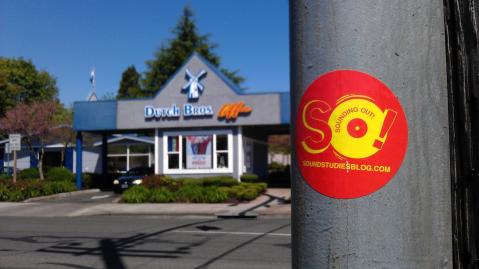
SO! swag in Eugene, OR
2. “Everybody, Everybody” (Global coverage and audience grows!): As of Blog-o-Versary 4.0, Sounding Out! is being read in over 182 countries worldwide, a number that only continues to grow with our increasingly international focus. This year, we published pieces exploring youth street party culture in São Paulo, Brazil, chants of “Allah-oh-Akbar” from rooftops in Iran, post-liberation radio broadcasts in Africa, sonic legacies of the slave castles in Ghana, sonic artistic practices in rural Portugal, the “Tuned City” festival in Brussels, how South Korean students sound Shakespeare in Seoul, Canadian public school curriculum that enables students to remix recordings of political struggle and “media capitalism” in turn-of-the-twentieth century Egypt. Our world will only get wider in year five!
and,
 1. “We are Family” (Advisory Board, Guest Writers and Podcasters): This year the Sounding Out! family continued to grow, adding an all-star advisory board, three new regular writers—a solid gold Sounding Out! shout out to Regina Bradley, Maile Colbert, and Primus Luta—and a talented cadre of over 30 new guest writers! And, as so many of you know, once a writer joins the SO! team, their number never gets retired. Because Sounding Out! is as devoted to producing community as it is content, we keep our guest writers connected, fostering their input, seeking their participation (SO! Tumblr correspondent, anyone? Contact Aaron Trammell at aht@soundingoutblog.com), and publicly celebrating their graduations, promotions—congratulations to newly-minted Ph.D.s Regina Bradley, Steph Ceraso, Ashon Crawley, Mack Hagood, and Nicolas Knouf and new Associate Professors Ziad Fahmy, Damien Keane and Samantha Pinto—publications, and other milestones! For more of what our talented and productive guests have been up to this year please read on below this post. As always, check in with our SO! Media page to keep up with Team Sounding Out! as our work spreads beyond our own .com to infiltrate websites, syllabi, reading lists, and print journals near you.
 And most importantly, Stay gold, Team Sounding Out!, stay gold.
–JSA, Editor-in-Chief
—
Jennifer Stoever-Ackerman is co-founder, Editor-in-Chief and Guest Posts Editor for Sounding Out! She is also Assistant Professor of English at Binghamton University and a 2011-2012 Fellow at the Society for the Humanities at Cornell University.
—
Click here for Sounding Out!‘s Blog-O-Versary 4.0 mix with track listing
(Just in case you missed last year’s 3.0 celebration–and mix– click here; for year two, click here; and for our first Blog-O-Versary party mix click here)
—-
Team SOUNDING OUT! Highlights Reel:
In addition to publishing THE GREATEST!: An Homage to Muhammad Ali with Winged City Press in 2013, Tara Betts wrote for the character Maddy James in the multimedia dance show Any Resemblance that was presented as part of the La Mama Moves! Festival in NYC in June 2013. Tara is slated to present at Feminisms & Rhetorics at Stanford, SAMLA 2013 in Atlanta, and MLA 2014 in Chicago. “They Do Not All Sound Alike: Sampling Kathleen Cleaver, Assata Shakur, and Angela Davis” will be reprinted in About Place for their upcoming issue “1963-2013: A Retrospective of the Civil Rights Movement” edited by Black Earth Institute Fellow Richard Cambridge.
Regina Bradley completed PhD at Florida State University in African American Literature. Her dissertation is titled “Race to Post: White Hegemonic Capitalism and Black Empowerment in 21st Century Black Popular Culture and Literature.”
In addition to contributing “Sounding Shakespeare’s S(e)oul” this spring, Brooke Carlson is leaving Seoul, Korea, for Chaminade University of Honolulu in Hawaii, and is working on an article in progress: “Jonson, Sprezzatura, and the (Un)Doing of Nobility.”
Steph Ceraso defended her dissertation, “Sounding Composition, Composing Sound: Multimodal Listening, Bodily Pedagogies, and Everyday Experience,” and finished her PhD at the University of Pittsburgh. She will be teaching at Georgetown University in Fall 2013. Ceraso was a guest co-editor with Jon Stone for Harlot’s latest special themed “Sonic Rhetorics” issue. Her digital audio piece, “A Tale of Two Soundscapes: The Story of My Listening Body” will appear in SoundBox’s forthcoming open access multimodal book, Provocare: A New Collection of Sonically Inspiring Projects. She will also be presenting a paper entitled “Sonic Rhetorics: Teaching Listening in the Multimodal Composition Classroom” at the 2013 Feminisms & Rhetorics conference at Stanford University in September. You can find out more about her work and upcoming projects at www.stephceraso.com
Maile Colbert had a residency at the iAir (International Artist Residency) at RMIT University. (Reel of the work created and synopsis: https://vimeo.com/66574320). She also completed the sound design and composition for the feature length documentary by director Irene Lusztig “The Motherhood Archives.” Maile presented “Wayback Sound Machine” at Musique et Écologies du Son/Music and Ecologies of Sound: Theoretical and Paractical Projects for the Listening of the World, Universitê Paris 8. She performed “Come Kingdom Come” at Sintoma: Performance, Investigation, and Experimentation, University of Porto, Fine Arts, Portugal. She performed with a new “field-recording” instrument with Andrea Neumann, Sabine Ercklentz, Marcelo Dos Reis, Angelica Salvi, Susana Santos Silva at Serralves em Festa.
Robert Ford was hired in February 2013 as the new play-by-play broadcaster for the Houston Astros major league baseball team.
Julia Grella O’Connell‘s book, Sound, Sin, and Victorian Religious Conversion, will be published by Ashgate in 2014. She recently made her debut with Syracuse Opera as Barbarina in The Marriage of Figaro.
In August Amanda Keeler will begin a new position as an Assistant Professor of Digital Media in the College of Communication at Marquette University.
Damien Keane completed his book Ireland and the Problem of Information, which will be published as part of the Refiguring Modernism series from Penn State University Press. In addition, his essay “Poetry, Music, and Reproduced Sound” appeared in The Oxford Handbook of Modern Irish Poetry, edited by Fran Brearton and Alan Gillis. Also, Keane came through to the other side of the tenure process at SUNY-Buffalo!
Roshanak Kheshti performed as Bluebeard (guitars and voice) at the UCSD Professor Unscripted event on June 5, 2013 narrating a biography through songs from concerts she has attended throughout her life. Some highlights included “Sweetest Taboo” by Sade, “Better Things” by Massive Attack, and “For Today I am a Boy” by Antony and the Johnsons.
Bill Kirkpatrick‘s essay, “Voices Made For Print”: Crip Voices on the Radio” appeared in Radio’s New Wave: Global Sound in the Digital Era. In addition, he and Alex Russo started the Radio Studies Special Interest Group within the Society for Cinema and Media Studies over the past year.
The 20th anniversary edition of Eric Lott’s Love and Theft is on its way this summer, with a new foreword by Greil Marcus. He will be speaking at CUNY Grad Center’s 20th celebration of Paul Gilroy’s Black Atlantic this fall.
Primus Luta has been working on reshaping the breadth of Concrète Sound System, which grew from a live set to a label, but is coming to embody almost a philosophical approach to sound. The label saw several 2013 releases, including the Services Rendered project for which Luta did the art and music. Additionally, in 2013 he has taken to performing live again, specifically live free jazz with the group Odon which is fronted by Daniel Carter. He remains on the Rhythm Incursions podcast team, and is particularly proud of the “IDM is a MILF” episode from earlier this year. He was also given the opportunity to do a mix for Hank Shocklee at the end of 2012 which will likely get a follow-up before 2013 is done.
This year, Andreas Duus Pape had the agent he used in “Experiments in Agent-based Music Composition” and in “Further Experiments in Agent-based Music Composition” accepted for publication in Games and Economic Behavior (in joint work with Kenneth J Kurtz). A version of the paper can be read here. SUNY Binghamton is now offering Advanced Graduate Certificates in Complex Systems Science and Engineering, which is a program Pape helped found.
D. Travers Scott will publish “Refining Intertextuality as Resonance: Pet Shop Boys Score Battleship Potemkin” in the upcoming issue of Music, Sound and Moving Image. “Intimacy Threats and Intersubjective Users: Telephone Training Films, 1927–1962” was published in Sound Clash: Listening to American Studies in 2012. His book on technology and disease is currently under review. He is also the new Co-Chair of the Gay, Lesbian, Bisexual and Transgender Studies Special Interest Group of the International Communication Association.
Aram Sinnreich’s new book, The Piracy Crusade, will be published in December. The book’s first draft is freely available to read at http://piracycrusade.com, and the final edition can be preordered via Amazon here: http://j.mp/TPC-AMZ
Jonathan Sterne released in 2012 MP3: The Meaning of a Format and The Sound Studies Reader. In 2013 he published “What the Mind’s Ear Doesn’t Hear” in Music, Sound and Space: Transformation of Public and Private Experience, and “Escape from Soundscape” in Soundscapes of the Urban Past: Staged Sound as Mediated Cultural Heritage.
Share this:


Current Top Posts





April 2021

January 2020

November 2019

October 2019

August 2019

April 2014

November 2017

March 2015

December 2017

October 2015
 Sounding Out!
Recent Comments