
Gendered Sonic Violence, from the Waiting Room to the Locker Room

This past August 2016, professional “pick-up artist” Dan Bacon caused a stir with his article “How to Talk to a Woman Who is Wearing Headphones.” The article was published on TheModernMan, a site pledging to “make [a woman] want to have sex with you ASAP.” Bacon offers step-by-step “instructions” for pick-up artists to overcome the obstacle of being rendered inaudible by the music a woman might be listening to:
She will most likely take off her headphones to talk to you when you say, ‘Hey, how’s it going?’, but if she doesn’t, just smile, point to her headphones and confidently ask, ‘Can you take off your headphones for a minute?’ as you pretend to be taking headphones off your head, so she fully understands what you mean.
His article was criticized in articles that appeared in The Guardian, Washington Post, Slate, and other news sites, which pointed out that Bacon and his followers advocated ignoring a clear visual signifier of privacy in pursuit of sex. Not only did Bacon feel entitled to a woman’s time, they suggested, but also to an audience. What Bacon insists is “two, [sic] normal human beings having a conversation” is in fact a belief in his unilateral right to be heard.
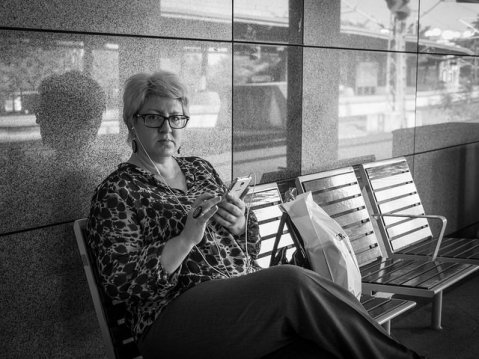
Image by Flickr User Chris Wolcott, Attribution 2.0 Generic (CC BY 2.0)
I witness a similar gendered dynamic of forced listening each week outside of a women’s health clinic in New York, where I volunteer as a clinic escort. Evangelical protesters from a handful of churches line the sidewalks outside the clinic every Saturday morning during the hours that they know abortions have been scheduled (in addition to pap smears, screenings for sexually transmitted infection, prenatal care, transgender services, etc.). Escorts walk with patients down the block to the front door. The sidewalk becomes a space of physical and emotional risk as protesters block the pathway with large, gruesome signs and their flailing limbs (at times physically assaulting volunteers and patients), as well as filming and photographing patients in the hopes of inducing shame.
Among their most intrusive weapons is the scream, which male protestors direct at patients, nurses, doctors, volunteers, security guards, and passersby. While women are abortion protestors, too, they generally get relegated to note-taking, sign holding, and pamphlet distribution, almost never given the authority to “sidewalk preach” or scream. In my experience of listening to this masculine screaming, words lose all sense and become pure sensation. Some patients wince, most speed up their pace, a few burst into nervous laughter, and almost all are stunned into speechlessness as they experience what one volunteer calls “the ripping apart of silence.”
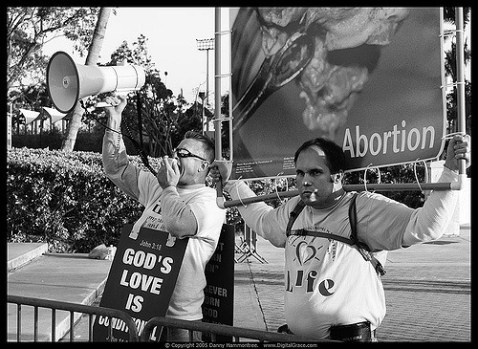
Anti-Abortion protest in Miami, 2006, Image by Flickr User Danny Hammontree, Attribution-NonCommercial-NoDerivs 2.0 Generic (CC BY-NC-ND 2.0)
During otherwise quiet moments, when nobody is walking down the sidewalk, a handful of men including a pastor and a high school science teacher pace the strip of sidewalk directly in front of the clinic entrance, preaching about sexual immorality and the “black genocide” taking place behind its soundproof walls. When a woman turns the corner down the sidewalk, they immediately begin to raise their voices. The men shout loudly as they attempt to chase women away from the door: “You don’t have to do this”; “Don’t be a murderer”; “You should have kept your legs closed.” The women and children accompanying these men plead in tones of pure desperation: “Your baby has a heartbeat at three weeks”; “You will regret it”; “Let us help you.” Volunteers chatter to the patients, trying to babble over the cacophony; the clinic has been forbidden from broadcasting amplified sound, though Janis Joplin and other artists used to play from speakers at the entrance.
A sample of anti-abortion protestors’ sonic technique, by Youtube user ehipassiko
At other clinics in the United States, protesters use amplified sound in violation of city sound permit requirements. In Tulsa, Oklahoma, the Catholic Church purchased the land across the street from the reproductive services clinic. Every weekday morning protesters gather there to sing, pray, and yell at cars and the patients getting out of them. Sitting in the midst of signs declaring “ALL LIVES MATTER” and “TULSA’S AUSCHWITZ,” a boombox faces the front door of the clinic and blasts Christian rock music. A clinic escort in Tulsa, who is also a Unitarian priest, described her experience with amplified sound in a sermon titled “A Womb of One’s Own”:
I stood near the driveway entrance where the protestors had placed a CD player blaring Christian music (which I happened to know) and so I stood near it and sang softly while they continued to shout. After about 20 minutes of shouting from afar, while I stood singing to the music, one of the protesters came near the CD player and began to pray for me—loudly. I stood quietly as he yelled a prayer for my misdirection, for my false prophethood, for my broken soul.
In Charlotte, North Carolina, volunteers track decibel levels on their phones in the hopes of getting the local police to issue a citation.
Cities4Life breaking the sound permit laws. CMPD won’t write a ticket. pic.twitter.com/40wLCnkx6V
— QC Clinic Escorts (@QCClinicEscorts) October 22, 2016
.
If, as Jonathan Sterne states in The Audible Past, “listening is a directed, learned activity” (19), then women and gender-nonconforming people must learn the art of hearing but actively not listening, of learning to direct one’s attention elsewhere to ignore catcalls and shouts of abuse. Christine Ehrick points out that vocal sound is not only a signifier of gender, it’s also a signifier of power. To ignore a male voice yelling over one’s own, or over one’s headphones, requires a stamina that contradicts the expectation of female receptivity and submission; Bacon asserts that “most women are polite” and will take off their headphones when asked. Even as patients overcome their shock and put up a wall against the shouting, protesters and volunteers must perfect the act of directed listening, focusing on the commentary to take note of periodic death threats, bomb threats, and any other unusual comments in spite of the repetition of the preaching and aural abuse. They must also speak and listen guardedly to each other, as protesters eavesdrop on conversations between volunteers, hoping to discover their identities so as to shame and harass them in the public and professional sphere.
Anti-abortion protesters push their agenda through their conflation of the public and private, the internal and external, the oral and aural. They continue to yell even once the patients have made their way into the clinic, despite the fact that the waiting room is soundproof—silent except for the occasional murmured conversation, soft piano music, or cartoons. In his essay “Broadcasting the body: the ‘private’ made ‘public’ in hospital soundscapes” in Georgina Born’s 2013 collection Music, Sound and Space, Tom Rice discusses the blurring of the internal and external in hospital environments, where patients must put on “mental headphones” as a form of “studied unawareness” (174). Despite the private, internal nature of illness, in hospitals there exist “threats to bodily boundaries and bodily control” (184). The right-to-life movement has capitalized on this blurring of boundaries since its 1984 film The Silent Scream. If their posters of mangled fetuses bring the unseen into the realm of the visible, their shouting brings the unheard into the realm of the audible as they give voice to these silent fetuses: “Mommy, mommy, don’t kill me!”
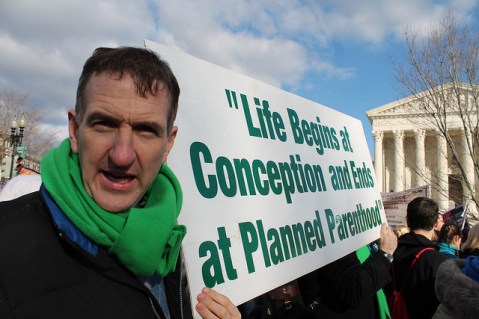
41st MARCH FOR LIFE RALLY in front of the US Supreme Court on 1st Street between Maryland Avenue and East Capitol Street, NE, Washington DC on Thursday afternoon, 22 January 2015 by Elvert Barnes Protest Photography, Attribution-ShareAlike 2.0 Generic (CC BY-SA 2.0)
When anti-abortion protesters gather in public spaces such as sidewalks, they affirm Judith Butler’s claim in Notes Toward a Performative Theory of Assembly that “if there is a body in the public sphere, it is presumptively masculine and unsupported, presumptively free to create, but not itself created. And the body in the private sphere is female, ageing, foreign, or childish, and always prepolitical” (75). The loudest protesters use their male bodies and male voices to assert their right to create sound and to be listened to by female ears. The masculine voices emanating from these presumptively male bodies stridently invade, interrupt, and attempt to shape private and prepolitical spaces, extending even to the uterus—what one would think would be the most private and prepolitical of spaces. At its most troubling, the loud, relentless insistence by the right to an audience translates to the desired ownership of non-male bodies. This desire for control–and its performative rhetoric enacted in the public sphere–originates in the absence of female bodies and voices, in the exclusively male private sphere of “locker room talk.”
***
This was locker room talk. This was locker room talk. I’m not proud of it . . . This was locker roomtalk. Yes, I’m very embarrassed by it, and I hate it, but it’s locker room talk. –Donald Trump in the third presidential debate, 19 October 2016
The stridency of the 2016 election cycle has revealed the gendered nature of public space and sonically blurred the boundaries between the theoretically public space of streets and the metaphoric masculine privacy of the metaphorical “locker room.”
“Locker room talk” has been the term used by right-wing pundits–and the candidate himself– to excuse the recently re-played 2005 recording of US presidential candidate Donald Trump bragging to radio and TV host Billy Bush about various sexual conquests: “I moved on her like a bitch”; “Grab them by the pussy”; “You can do anything.” Trump’s statement following the release of the tape in October 2016 emphasized a patriarchal delineation of space, in which male bodies are always safe and non-male bodies almost never are: “This was locker-room banter, a private conversation that took place many years ago.”
Trump’s insistence on a private space, in which men can talk amongst themselves with no consequences, reverses the dynamic outside of the hospital, in which the private is made public. It also further demonstrates the blurrability—and even portability—of private space, which white males arm themselves with and freely replicate in public spaces. Not only does such private “banter” affirm the assumption of the superiority of the male voice and the stigmatization of the female voice, it silences the voices of the women affected by Trump’s actions, while objectifying women-writ-large into currency exchanged between men. And indeed, women’s prior allegations were all but ignored by the press and the public until the release of Bush tapes.
We had to hear it from Trump’s own mouth to believe it.
***
In Modernity’s Ear, Roshanak Kheshti discusses the “feminization of listening” via sound reproduction and particularly the world music industry, which mythologizes the sound of the “other” in service of white female ears (27). Constructed in terms of a male heteronormative fantasy, the ear has come to resemble a vagina, “an organ to be penetrated by an active sonic force” (67). In this construction not even headphones–which ideally afford a visual signal calling for privacy and the gendered privilege of uninterrupted listening–are enough to shield non-male ears from the average scheming pick-up artist.
Kheshti’s arguments can be fittingly applied to gender-specific spaces of both the locker room and the abortion clinic. Male-asserted power dynamics of speaking and listening work to create spaces spaces that silence female needs, voices, and agency. In the public space outside the clinic, such practices deem women an ear for hearing patriarchal arguments against abortion, and in the private space of the locker room, objectify them as a vagina for “grabbing.”
The spatializing of power dynamics via sound has forced women to become versed in aural refusal, to keep our ears closed the same way we are encouraged to “keep our legs closed.” This aural refusal, however, all too often renders women silent in public, patriarchal spaces. Feminist initiatives like “Shout Your Abortion” and “Hollaback,” a movement to end street harassment, have given women voice within these structures of gendered sonic violence. The initial criticism faced by Hollaback, regarding racism in their viral video, alongside the targeting of non-white women and couples outside the clinic, suggests that the intersectional dimension of listening in public needs further examination in hopes of reaching an understanding of what equitable public space would sound like. Ultimately, however, with these and other movements, women are asserting not only our right to harassment-free public and private space, but our right to create sound, to speak, and to be heard.
—
Featured Image: “Yell!” by Flickr User Vetustense Photorogue, Attribution-NonCommercial 2.0 Generic (CC BY-NC 2.0)
—
Rebecca Lentjes is an NYC-based writer and gender equality activist with plans to pursue graduate studies in ethnomusicology at Stony Brook University. Her work has appeared in VAN Magazine, Music & Literature, TEMPO Quarterly Review of New Music, Bachtrack, and I Care If You Listen. By day she works as an editor and translator at RILM Abstracts of Music Literature; by night she hatches schemes to dismantle the patriarchy.
—
 REWIND!…If you liked this post, check out:
I Can’t Hear You Now, I’m Too Busy Listening: Social Conventions and Isolated Listening–Osvaldo Oyola
Gendered Voices and Social Harmony–Robin James
Vocal Gender and the Gendered Soundscape: At the Intersection of Gender Studies and Sound Studies—Christine Ehrick
Share this:

One Nation Under a Groove?: Music, Sonic Borders, and the Politics of Vibration
 Welcome to week three of our February Forum on “Sonic Borders,” a collaboration with the IASPM-US blog in connection with this year’s IASPM-US conference on Liminality and Borderlands, held in Austin, Texas from February 28 to March 3, 2013. The “Sonic Borders” forum is a Virtual Roundtable cross-blog entity that will feature six Sounding Out! writers posting on Mondays through February 25, and four writers from IASPM-US, posting on Wednesdays starting February 6th and ending February 27th. For an encore of weeks one and two of the forum, click here. And now, get up and get ready for Marcus Boon, because there’s no parking on the dance floor at Sounding Out!–JSA
—
What borders remain when it comes to thinking about sound today? The field of sound studies has exploded in so many far-flung directions in the last few years. However, I argue that what is still somewhat off limits in the field is a consideration of the ontological status of sound: in other words, what it means to understand our own being in the world as a sonic phenomenon. Out of attempts to approach this sonic ontology, comes the realization that there are prohibitions, perhaps universal ones, on thinking about sound in this way, and from that emerges what I call the politics of vibration.
For those, such as myself, who have grown up as a part of sonic subcultures, it is not difficult to ponder sonic ontologies, for the simple reason that many of the most intense and powerful experiences we have had have occurred on dance floors or at clubs, as DJs, musicians, clubbers and/or listeners. I still remember the moment of first hearing Funkadelic’s “One Nation Under a Groove” blasting through the speakers at a Pop Group gig at the Electric Ballroom in London in the late 1970s: tumbling polyrhythms, polyphony, polysexuality, polyeverything. The feeling was: “wow, the universe contains this! And it contains other people who know what it is!” And contrary to the warnings of Slavoj Zizek concerning the “autistic jouissance” to be found at the limits of language, here we all were: high; the histories of Afrodiasporic displacement and solidarity echoing off the walls; our own implication in those histories illuminated; flickering between utopia and shame.
To quote Eric Satie: “When I was young they told me: You’ll see when you’re fifty. I’m fifty. I’ve seen nothing.” Me too. But I’ve heard a lot and I still experience that same power of sound in more or less the same way. If anything, sound’s power is more intense and surprising, each time it appears. Partly because I have learned how to be a social being through sound—how to love and be loved—enabling me to be more open to its impact than I was as an awkward youth. It makes me sad the way in Canada and elsewhere in el Norte people seem to lessen their involvement in the more intense aspects of sound cultures as they hit 30 or 40. It makes me sad that my four-year-old son rarely gets to hear a real sound system. I look for music at carnivals, weddings, community centers, on the beach. . .anywhere that those age barriers are ignored. Even as a DJ, I increasingly look for new or different kinds of publicness than that of club or dancehall.
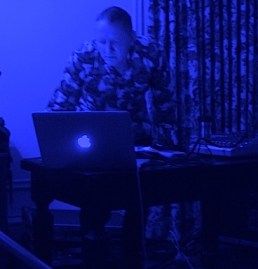
Marcus Boon DJ-ing, image by JSA
Still, I do wonder. Was the movement into sonic subcultures that my generation (and those that followed) made–especially in the UK where music (and intoxicants, and immigration) were one of the few escape routes from the brutalities of Thatcherism–a mistake, precisely because we accepted as ontological, a structure that in fact was smoothly integrated into the operations of late capitalism? From the Factory and Paradise Garage to Berghain or Ministry of Sound. . . how will history look on the era of the mega-club?
Although one could argue that the Internet put an end to the idea of subculture, since it breaks down the locality and secrecy around which particular subcultural communities grow, in fact what seems to be happening is an acceleration in the generation and dissolution of subcultural formations. Hip-hop has adapted very quickly to the internet. The cassettes or CD-Rs sold out of DJ Screw’s record store in Houston, Texas, for example, morph into the world of online mixtapes, Youtube clips and Twitter battles; the gray market availability of samples sounds a lacuna of time, appearing for a day on a hosting site rather than flying below the radar in some particular geographical location. At the same time, sonic subcultures are expanding around the world. If Jacques Attali was right that sound is prophetic, then #idlenomore was announced by Ottawa Native dubstep crew A Tribe Called Red; Tahrir Square by Chaabi and North African hip-hop.
In his book 1989, Joshua Clover describes popular music in the period of neo-liberal globalization as the sound of ideological containment. It’s true that popular music is full of ontological claims about sound, of music that celebrates setting us free. . .but which fails to actually do so. A quote from Ray Brassier just came up on my Twitter feed:

If true, this would suggest that the intensity of moments of sonic jouissance does not necessarily mean anything in terms of ontology or the truth about what’s Real. It could be entirely delusional.
All of which might be true. We might come to realize that, to put it in Heideggerian terms, we’ve been thrown into this, and that maybe there’s not much difference between being thrown and being played. But somehow I think people on dancefloors already know this. The dramas of seduction, commitment and loss are at the core of disco, and many other kinds of popular music too. To quote the disco classic “Lost in Music” by Sister Sledge (later covered by post-punks The Fall):
We’re lost in music; caught in a trap.
No turning back. We’re lost in music.
We’re lost in music. Feel so alive.
I quit my nine-to-five. We’re lost in music.
Other examples are not lacking.
Perhaps sound and music border on a vibrational ontology, rather than being truly the core of one. This is why, as Michael Taussig, Jayna Brown, and others have suggested, they can be concerned with healing. Perhaps any practice that is meaningful — and sonic subcultures are certainly a matter of practice, as Julian Henriques indicates in his book Sonic Bodies — must necessarily work at the boundary of a space that it can never entirely inhabit as a practice, but which it can push one towards, and also receive one from. The anticipation, fear, desire before one goes out, for example, but also the blinding daylight, the sensation of cool air on exposed skin when one leaves a dancehall or a party.

Lasers in a dance club, image by flickr user gabriel.jorby
Sound studies has not truly begin to explore these moments of exposure to and abjection from the vibrational core of sound. No doubt, Steve Goodman performed heroic work in Sonic Warfare—which sets out a proposal for a vibrational ontology in the midst of the commodification and militarization of the sonic —as have various explorations of the phenomenology of sound, such as those in Salome Voegelin‘s Listening to Noise and Silence. Yet in both cases, a full consideration of sonic ontology is in the end foreclosed. In Goodman’s case by Sonic Warfare’s emphasis on the militaristic applications of sound and vibration that are appropriated by sonic art and subcultures, which gives the violence of sound and vibration something like ontological status, while the aesthetic and cultural “uses” of the same have only a secondary, somewhat parasitic status. Conversely, in Voegelin’s work, an emphasis on the phenomenological rendering of the moment or event of sonic relationship forecloses a broader investigation of sonic ontology, because it “brackets” (to use Husserl‘s term) considerations beyond that of the subject-object relationship. In both cases, the sonic thing in itself, or indeed an ontology of vibration, risks being lost.
The recent turn to the speculative and to realism in philosophy has yet to make an impact in sound studies, despite the fact that the object of sound presents a provocative and very intimate entry point to that problematic. One of the more intriguing and improbable hypotheses emerging from the speculative realist movement is that of Quentin Meillassoux, who, in After Finitude, makes an argument that speculative knowledge of the real, unmediated by correlation with the Kantian subject, is possible through mathematics. It is roughly Alain Badiou‘s thesis in Being and Event too. As much as music is clearly about the contingency of sonic experience, there are strong arguments, going back to Pythagoras and beyond, about the relation of music to mathematics. Natural harmonics, rhythm: the elements of music express mathematical relationships. I am not interested in reducing music to a kind of vulgar scientism. But what if when we listen to music, we are exposed to a mathematical ontology and at the same time, the contingency of an unprecedented event? What if music is speculatively real? The word “speculative” here would refer not to philosophical propositions, but to the uncanny movement across subject/object individual/collective borders that the sonic matrix offers when “we” listen to “it.” Music not as the source of a speculative discourse on the real, but a speculative practice in which order and contingency meet.

A cymatic image, made by sound vibrations on a visible medium by flickr user evan grant
Genres, styles form around places of cohesion, of transport, of passage. Not an instrumental mathematics (though it can be that too), but a speculative one that seeks out locations of collective affect, of resonance between micro and macro spheres. It matters little whether a specific knowledge of mathematics is invoked here, since many traditional musics find their way to structures that, according to scholars such Alain Danielou, already express mathematical relationships. And in this way, music and musicians can be said to participate in a sonic ontology.
Reluctantly perhaps. Ready or not. The question remains: how many institutional, historical, disciplinary, intellectual, social and political barriers remain in order that a cultural artifact like “One Nation Under a Groove” can be considered to have ontological significance? That is what I mean by the politics of vibration, and in terms of borders, it’s an important set of borders for researchers in sound studies to consider.

Tyler, the Creator crowdsurfing, image by flicker user choe.brandon
Much of my current work focuses on tropes of abjection in recent hip-hop and RnB music, notably that of Odd Future members Tyler, the Creator and Frank Ocean, artists like Azealia Banks, and a new generation of queer rap MCs emerging out of New York City such as Zebra Katz, Le1f and Cakes Da Killa. All of their work is bracingly obscene, funny, violent. . .a tumbling deck of cards of performances of gender, race, sexuality, class and more. Of course, cursing to a beat is nothing particularly new, but the way in which these artists multiply and collapse identities to an ever more minimal, humming beat perhaps is.
Katz’s remarkable “Ima Read” and its equally remarkable video is a case in point. Although Katz occasionally claims dryly that the song is “pro education,” the “reading” in question mostly refers to the drag queen balls of the Harlem ballroom/voguing scene of the late 1980s/early 1990s, where to read meant to verbally trash, i.e. abject, someone at a ball. The song is rapped by male and female voices, crisply denouncing a “bitch” who they are going to “take to college.” The violence of the song is ironic, as much a marker of queer community and Eros as of sexual difference, of racial and trans-racial solidarity as much as racialized violence. It is performed over a minimal beat with a humming, in-your-face bass drum that is the only recognizable tonal element.
Why make the leap to talking about ontology in discussing this admittedly awesome Youtube clip? Both Judith Butler’s famous elaboration of the performativity of gender, one of the bases of queer theory, and Katz and friends play with taboos concerning gender, sexuality and race in contemporary hip-hop emerge from that moment of the ballroom scene.
But what if Butler’s emphasis on performance actually covered up or abjected the ontological nature of experiments at the balls? Perhaps we need to rethink why the ultimate ball anthem is Cheryl Lynn’s “Got To Be Real.” What is sonic ‘realness’? In restoring the sonic dimension to the ballroom scene, and learning, from Zebra Katz, to face that constitutive abjection that Kristeva amongst others has pointed us towards, we can begin to feel for ourselves what a vibrational ontology is.
—
My thanks to Catherine Christer Hennix, Steven Shaviro, Kevin Rogers and Ken McLeod for conversations that helped me in thinking this through, and to Jennifer Stoever-Ackerman for luminous remix skills.
—
Featured Image by Flickr User depinniped
—
Marcus Boon is associate professor of English at York University in Toronto, and was a Fellow at Cornell’s Society for the Humanities in 2011-12. He is the author of The Road of Excess: A History of Writers on Drugs (Harvard UP, 2002) and In Praise of Copying (Harvard UP, 2010). He writes about contemporary music for The Wire. He is currently co-editing a book on Buddhism and critical theory, and a new edition of William S. Burroughs and Brion Gysin’s The Third Mind. He is also working on a book entitled The Politics of Vibration.
Share this:


Current Top Posts





April 2021

January 2020

November 2019

October 2019

August 2019

April 2014

November 2017

March 2015

December 2017

October 2015
 Sounding Out!
Recent Comments