
Radio Ambulante: A Radio that Listens

 Welcome back to the final article in our three-part series, Radio de Acción. Special thanks to you, our readers, and to editors Jennifer Stoever and Neil Verma at Sounding Out! for hosting this addition to a burgeoning field of Latin American critics and producers who are changing the way we hear radio as history, as theory, and in practice.
Over the past several weeks we have tried to bring you into the multiple worlds made possible by radio in Latin America. If you missed our previous posts, please find Alejandra Bronfman’s stunning history of radio in the Caribbean here, and Karl Swinehart’s fascinating study of Aymaran-Spanish radio here.
Both of these critical approaches set the stage for Carolina Guerrero’s extraordinary work with radio in the Americas. An executive director and co-founder of Radio Ambulante—a program that fellow co-founder and novelist Daniel Alarcón calls “This American Life, but in Spanish, and transnational”—Guerrero’s post takes us behind the scenes of her show to consider how the sounds on radio come to life for us as listeners, and the significance of hearing someone’s words in her or his own voice and language. For more Radio Ambulante after you finish reading and listening to Carolina’s post, please visit their website and download their podcasts.
–Guest editor Tom McEnaney
—
In late 2007, novelist Daniel Alarcón was hired by the BBC to produce a radio documentary about Andean migration in his native Peru. He spent 10 days traveling around the country, from the highlands to Lima, conducting interviews in both English and Spanish, talking to a wide range of people with very personal stories about migration. But when Daniel received the final mix from London, he was disappointed to find that the editor had privileged the English language voices, and left out many of the most compelling Spanish language storytellers. Daniel was left with a question: what if there was a space for those voices on the radio waves? What would it sound like?
Over coffee in San Francisco in January 2011, Alarcón and I decided to create that space, inspired by US public radio shows like This American Life and Radiolab, which had no Spanish counterpart. We knew that poignant, fun, surprising, unique, sometimes sordid, sometimes romantic, absurd and incredible stories we often heard in Latin America were out there, just waiting to be reported. We knew that they would make great radio. And we knew there was an audience—in Latin America and the US—that wanted to hear it. The result became Radio Ambulante.
 .
.
FIRST STEPS
We began by asking many of our print journalist friends in Latin America to share stories with us. We sent them links to stories from some of our favorite American radio programs, and then contacted a few bilingual independent radio producers here in the US, and asked them for advice on the basics of radio production. Many directed us to Transom.org, which was an absolutely essential resource.
In March of 2012, we launched a Kickstarter campaign. All we had was an idea and a sampler with less than 45 minutes of audio—and still, we managed to raise $46,000 with the support of 600 backers. The success of this campaign was a huge confidence boost, and we knew we were on to something. We used this money to produce our pilot season.
.
Since then, we’ve worked with more than twenty different producers in more than a dozen countries. These are the characters that emerge from Radio Ambulante stories: a transgender Nicaraguan woman living with her Mexican wife in San Francisco’s Mission District; a Peruvian stowaway telling his harrowing tale of coming to New York in 1959, hidden in the hold of a tanker ship; the Chilean soccer player who dared challenge the authority of General Pinochet; a young Argentine immigrant to North Carolina, trying to find his way through the racially charged environment of an American high school. Taken together these voices create a nuanced portrait of Latino and Latin American life:
.
PERSONAL STORIES FOR ALL EARS
Now in our third season, we’ve been working hard to create a group of trusted producers and editors across Latin America; people we can turn to with an idea, people we know we can trust with our limited time and resources; reporters we can send to Cuba, send to Honduras, send to Venezuela, and be certain they’ll come back with usable tape, and a good story. We want these first time producers to become long-term contributors.
That’s the case of Camila Segura, Radio Ambulante’s current Senior Editor. She had no prior experience as a radio producer when she reported her first story for us in 2012. That piece, El otro, el mismo (The Other, The Same) is about two men, one Colombian, one Argentinian, who not only share the same name, but who look almost identical. From this coincidence, the story becomes something much stranger, funnier, more subtle, and ultimately quite moving:
.
We want the listener to be able to relate and identify with the characters, to feel what they feel. A good Radio Ambulante story should be universal and shouldn’t have an expiration date.
One story from our first season captures this universal quality. In 2011, River Plate, one of the most famous soccer clubs in South America, was relegated to the Argentine Second Division. This event shook the entire nation, and anyone who listens to this story could relate to the sadness and pain that the protagonist is feeling. Two years later, the story still has that raw power:
 .
.
HOW WE SOUND
Martina Castro, Senior Producer, has designed most of Radio Ambulante’s sound, finding the balance between music and sound effects in order to support the voice of the main characters. As she explains,
There are many kinds of pieces that make it to Radio Ambulante. Sometimes the story is focused on one person and their experience: something that happened long ago. Like with Mayer Olórtegui in Polizones (The Stowaways), and the story of how he and his friend Mario jumped aboard a ship headed to the United States. There is no substitute for a dynamic storyteller like Mayer. He not only recreates moments, sometimes even imitating the sounds of what he heard, but he remembers the emotion of what happened, and really feels deeply what he is talking about, like when his voice breaks up at the mention of saying goodbye to his friend Mario.
.
Other, more symphonic, multi-voiced pieces provide a different kind of production challenge. The script must showcase the many characters, while giving the listener enough grounding so as not to get lost. A particularly successful example is our award-winning piece “N.N.”, about Puerto Berrio, Colombia, by reporter Nadja Drost. Nadja gathered recordings of this river town, and conducted interviews with many locals, always focused on the issue of the floating, anonymous dead and the town’s strange relationship with these bodies. The music in a piece like this is only meant to support those real-life sounds and characters, and a repeated melody serves as a ghost-like echo of the dead, those voices we never hear.
We use music carefully to shift the mood, to mark the end of a section, and to alert the listener that something new is coming. The music is also meant to break up chapters of a story, give us a moment to reflect on what we just heard, or to indicate when something is about to change. There are examples in Yuri Herrera’s “Postcard from Juárez,” produced by Daniel Alarcón. It tells the story of Diana la Cazadora, or Diana the Hunter, a vigilante who set about killing bus drivers in one of the world’s most violent cities, allegedly as revenge for years of misogyny and sexism.
.
In this particular story, we were able to do something that the English version (produced for This American Life) could not: read in the original Spanish the letter that the supposed killer sent the local Ciudad Juárez newspaper explaining her actions. We had this read by Lizzy Cantú, a Mexican journalist who’d worked with us before, and then distorted her voice, to give it that dark ambience. The listener is supposed to feel the grim violence in those words: the desperation.
 THE STORY IS KEY
In three seasons producing the show, we’ve learned that the craft of radio comes from listening, and that the most challenging aspect of producing radio is not in the technical details of recording those voices or sounds, but in the story itself.
The most basic building block of a good radio story is a good interview. The technical aspects of gathering sound are less important than phrasing the questions to get vivid, almost filmic answers, full of details that set the scene.. As Executive Producer Daniel Alarcón explains,
We ask our reporters to push interviewees to describe scenes in great detail, to unpack moments. Our interviews can last two hours or more, and many are surprised that we go so in depth. We like our reporters to circle back, and then circle back again, so that we’re sure we’re getting the most vivid version possible of a given story’s crucial moments.
We ask our reporters to write colloquially, to imagine they’re telling the story to a friend at a bar. It’s important to have immediacy in the language, an expressive tone that can seem almost improvised, even when it isn’t. The emotional impact of radio is that it feels as though a secret is being shared. The script and the production should always be in service of this intimacy.
Before a script is final, it’s shared with other editors on the team around the globe (California, Colombia, Puerto Rico, Chile), mixed, edited, soundtracked, and refined through hours of collective work online.
 .
.
ONWARD
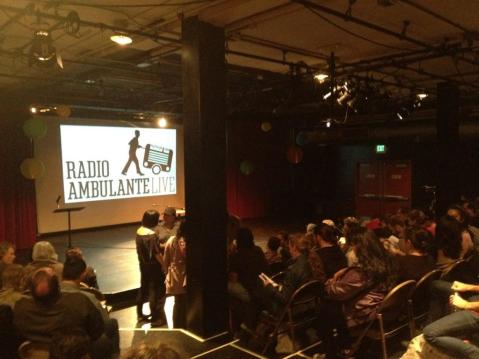
While creating our own sound and storytelling style, Radio Ambulante is constantly experiment with different formats and looking for new ways to interact with our listeners. We’ve done three live radio shows, in Los Angeles, San Francisco, and New York. In addition, we’ve produced two English Language specials, and partnered with writers and animators on hybrid multimedia storytelling. With our partners at PRI, we’re developing a new interview series, and are working with Latin American universities and media outlets to teach more journalists to use radio. Our hope is that Radio Ambulante’s success will mean more innovative radio work in Spanish, and more experiments in the possibilities of bilingual radio.
—
Carolina Guerrero is the Executive Director of Radio Ambulante. Before getting into journalism, she was a promoter for cultural and social projects, creating a bridge between organizations in three different continents. She has worked with public and private institutions in several countries, for which she has designed and overseen festivals, art exhibits, teaching workshops and fundraising events. Carolina is a John S. Knight Journalism Fellow at Stanford University 2014-15. She is the proud mother of León and Eliseo. (@nuncaduermo)
All images courtesy @radioambulante on Twitter
—
 REWIND!…If you liked this post, you may also dig:
“We wanted to tell stories about sound: Opening Ears Through the Everything Sounds Podcast”-Craig Shank
“Chicana Radio Activists and the Sounds of Chicana Feminisms”-Monica De La Torre
“Óyeme Voz: U.S. Latin@ & Immigrant Communities Re-Sound Citizenship and Belonging”-Nancy Morales
Share this:

Soundscapes of Narco Silence
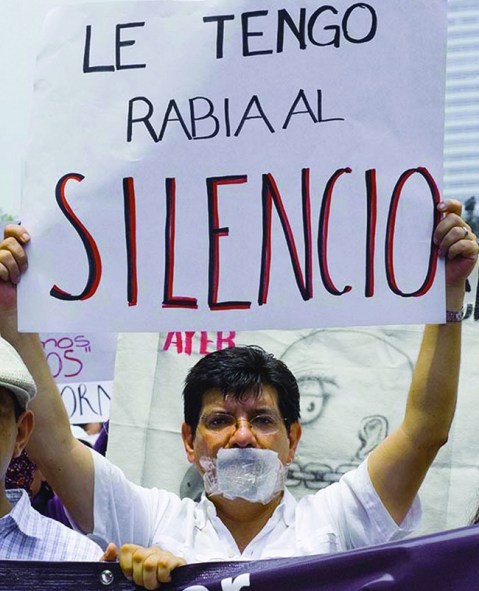
Journalists protest in silent march in Mexico City, Courtesy of the Knight Foundation
Since the drug war began, the lives of approximately 95,000 people have been claimed, with an estimated total of 26,000 disappearances (“Continued Humanitarian Crisis at the Border” June 2013 Report). At the University of Texas, Pan American – an institution located 25 miles north of Reynosa, Mexico (a Mexican city that has been hard hit by drug violence in recent years) – I teach students who have been dramatically impacted by drug war violence. Many have close relatives affected or hear horrific stories of those who have been kidnapped by the cartels; many fear traveling to Mexico to visit loved ones as a result and, in some cases, they report having relatives involved in the drug cartel business. Dinorah Guerra, psychotherapist and head of the Red Cross in Reynosa, describes the devastating psychological and physical toll: “There is a huge risk for people’s self esteem. They cannot speak about what they have seen or what they have heard. [They] lose [themselves] and lose [their] identity” (qtd. in Pehhaul 2010).
I name the space of the drug war and its resulting terror in the U.S.-Mexico border the “soundscape of narco silence.” This soundscape includes death and intimidation, from the brutal killings of news reporters by cartel members to the decapitation of citizen-activists who use online media to alert communities of narco checkpoints. It also consists of those powerful acts that call attention to silence as a tactic of terror. The Movement for Peace with Justice and Dignity, for instance, brought together tens of thousands of people in Mexico to speak out against drug violence through silent marches. Cultural productions, such as narcocorridos, or contemporary drug ballads that document the cross-border drug economy, also become part of the soundscape. The narcocorridos function as a powerful critical response to silence and fear because they enable those in Mexican society, as Jorge Castañeda, author of El Narco: La Guerra Falllida, explains, “to come to terms with the world around them, and drug violence is a big part of that world. The songs are born out of a traditional Mexican cynicism: This is our reality, we’ve gotten used to it” (Qtd. in Josh Kun 2010).
In this blog post, I focus on the role of U.S. Latina/o theater produced in the South Texas border region as it responds to the soundscape of narco silence. Building on David W. Samuels, Louis Meintjes, Ana Maria Ochoa, and Thomas Porcello’s definition of “soundscapes” in “Soundscapes: Towards a Sounded Anthropology” as “the material spaces of performance and ceremony that are used or constructed for the purpose of propagating sound” (330), I suggest that soundscapes of silence in theater function as material spaces of performance that focus the public’s attention on silence – with the intent of intervening in acts that propagate silence and fear. Soundscapes of narco silence are characterized not only by violence and terror, but by cultural productions that function as forms of critical resistance – those works that focus the publics’ attention on the economy of silence and fear that fuels the drug war, and in the process, enable communities to cope with narco violence.
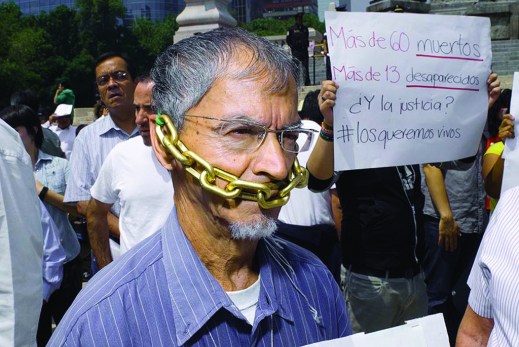
Journalists protest in silent march in Mexico City, Courtesy of the Knight Foundation
To closely listen to the soundscape of narco silence, I engage with the play script and production of Tanya Saracho’s play El Nogalar at South Texas College Theatre (STC) under the direction of Joel Jason Rodriguez in McAllen, Texas in June 2013. The play was first produced at the Goodman Theater in Chicago in April 2011, with a West Coast premiere at the Fountain Theater in Los Angeles in January 2012. I critically analyze the STC Theatre production’s incorporation of a multi-genre soundtrack that included narcocorridos, rancheras, and nortec (norteño + techno). I argue that this soundtrack focused audiences’ attention not only on the devastating effects of silence, but also the function of silence as a form of capital for those most excluded in society. I also offer a brief critical listening of the script’s rendering of silence through character dialogue and stage directions.
El Nogalar tells the story of an upper-class Mexican family comprised of three generations of women (Maité, Valeria, and Anita) whose land and home in the fictionalized estate of Los Nogales in Nuevo Leon, Mexico, and its adjacent nogalar (pecan orchard), are under threat by the maña (drug cartels) moving into the region. The play focuses on the women’s responses to the drug war economy as a result of their different relationships to home (both their estate and the space of Mexico). It also centers the experiences of Dunia, their maid, and López, a former field worker who now works for the maña.
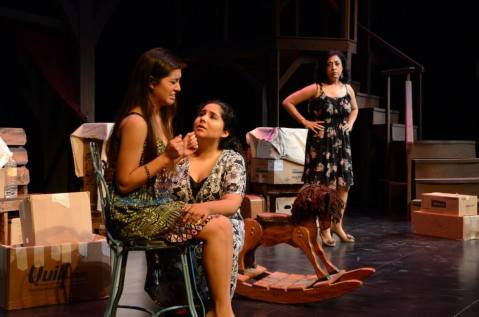
STC Theater Production of El Nogalar. Photo Credit: Miguel Salazar
Cecilia Ballí, in her article “Calderón’s War: The Gruesome Legacy of Mexico’s Antidrug Campaign,” explains the particular circumstances of marginalized men in this society: “The worst casualties of this ‘civil war’ were the estimated 7 million young men to whom society had closed all doors, leaving them the options of joining a drug gang or of enlisting in the military, both of which assured imprisonment of death” (January 2012, 48). With the characters López and Dunia, the play asks audiences then to listen to the impact of the drug war on the most vulnerable populations in Mexico and the US-Mexico border region.
The play script conveys how “narco silence” can be used by those who either seek to preserve traditional class hierarchies (the story of the matriarch Maité) or to survive and profit in the new drug economy (the story of López). “Narco silence,” a term coined by reporter Jonathan Gibler in his book To Die in Mexico, refers to “not the mere absence of talking, but rather the practice of not saying anything. You may talk as much as you like, as long as you avoid the facts. Newspaper headlines announce the daily death toll, but the articles will not tell you anything about who the dead were, who might have killed them or why. No detailed descriptions based on witness testimony. No investigation” (2011, 23). In an early exchange between López and Dunia, López defends “narco silence” as a strategy of survival:
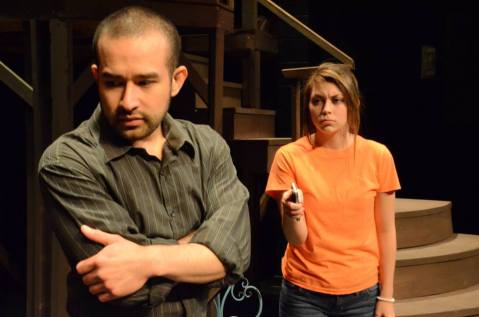
STC Theater Production of El Nogalar. Photo Credit: Miguel Salazar
DUNIA: Why are you the only one they leave alone, Memo?
LÓPEZ:….
DUNIA: All the men your age. Killed. Why Memo? (Beat).
LÓPEZ: Because I know when to keep my mouth shut which is not something I can say for you….
DUNIA: So that’s all it takes to be best of friends with the Maña? That doesn’t seem so hard to do? (American Theatre Magazine July/August 2011, 74).
Later in the play, Dunia, heeding López’s advice, offers a powerful observation of how “narco silence” enables her community to cope with death: “We all just walk around like we’re a movie on mute. You can see people’s mouths moving but all you hear is the static (my italics)” (American Theatre Magazine July/August 2011, 73-74).
The STC Theatre production enhanced the script’s soundscape of narco silence through its sound design, with a soundtrack that included rancheras, narcocorridos, norteño and nortec. This music provided audiences with a connection to the world of Los Nogales and captured each character’s process of coping with narco violence. For example, Maité’s soundtrack consists of several rancheras, such as Lola Beltran singing “Los Laureles” and Chavela Vargas’s powerful rendition of “Que te vaya Bonito.” Beltran’s “Los Laureles” – a cancion ranchera that includes Beltran’s powerful female vocals and mariachi orchestra instrumentation – invites audiences to hear Maité’s nostalgia and desire for an idealized Mexican society and her wish to preserve traditional class hierarchies.
.
Vargas’s powerful rendition of “Que te vaya Bonito” captures Maite’s pain and suffering as she loses her home to the cartels. In Vargas’s version of “Que te Vaya Bonito” – a song about love and abandonment – audiences hear Vargas’s choking and sobbing voice, accompanied by a single guitar.
.
Vargas’s voice conveys, what Lorena Alvarado powerfully argues, is “the body’s dilemma between the hysteria of sobbing and the intelligibility of words, between resignation and retribution” (2010, 4). Vargas’s powerful singing also conveys, as Alvarado further describes, “un nudo en la garganta,” a common expression in Spanish that describes “the knot in the throat, when one cannot speak because words will not come out, but the desperate, or quiet, breath of tears” (Alvarado 2010, 5).
To sonically register the drug cartel economy and lifestyle underlying the “new” Los Nogales, the soundtrack also included narcocorridos. The first sounds we hear in the play are from the narcocorrido “El Carril Número Tres” – which includes two acoustic guitars and an electric bass – by Los Cuates de Sinaloa.
.
“El Carril Número Tres” – tells the story of a secret “lane number three” that allows a Mexican drug lord to freely go back and forth between the US and Mexico because he makes a deal with the CIA and DEA. With this focus on the US government’s involvement in the drug trade, the song centers how silences north of the US-Mexico border have perpetuated drug violence.
The music also included nortec, with songs by the Mexican Institute of Sound, particularly the track “Mexico,” which is a critique of the Mexican government’s complicity with the narcos.
.
With “Mexico,” audiences hear a fusion of norteño, electronic, and hip-hop with lyrics that use the symbols of Mexican national identity and culture to focus the public’s attention on violence and terror. With the lyrics “green like weed, white like cocaine, red your blood” (referencing the Mexican flag) and “at the sound of the roar of the cannon” (alluding to the national anthem), the song powerfully invokes the visual and sonic soundscape of violence that terrorize Mexican residents. With this charged critique of government corruption, “Mexico” momentarily interrupts the soundscape of narco silence rendered in the play script and rest of the soundtrack.
Ultimately, the production’s combination of rancheras, narcocorridos, and nortec captured the class tensions in Mexican society and emphasized the play’s critique of class structures that have enabled drug war violence to persist. With this range of music, the director explains he wanted to “maneuver between the [various] aspects of [the story]: the nostalgia, the corridos, the narcocorridos, and also this fusion of saying ‘we want something more,’ and so that was the whole aspect of it; the blending of the old, the new, and what the present is” (Interview with author July 2013).
The production also deliberately incorporated the sound of silence, particularly in the final scene. By the end, López buys the Los Nogales estate, thereby increasing his class status and social power. Saracho’s stage directions in this final moment indicate “an interpretive sound of trees falling. Now don’t go cueing chainsaws because it’s not literal. Just make me feel trees are falling. Along with the upper class” (87). The play’s reference to the staging of “an interpretive sound of trees falling” brings to mind the philosophical question: “If a tree falls in a forest and no one is around to hear it, does it make a sound?” We might then interpret the final sounds of El Nogalar as inviting audiences to listen attentively to the soundscape of narco silence, implicating audiences as social actors in the politics of the drug war that continue to devastate Mexican society.
—
Featured Image: Journalists Protest against rising violence during march in Mexico, Courtesy of the Knight Foundation
—
Marci R. McMahon received her Ph.D. from the University of Southern California with affiliations in the Department of American Studies and Ethnicity. She is an assistant professor at the University of Texas, Pan American, where she teaches Chicana/o literature and cultural studies, gender studies, and theater and performance in the Departments of English and Mexican American Studies. She is the author of Domestic Negotiations: Gender, Nation, and Self-Fashioning in US Mexicana and Chicana Literature and Art published by Rutgers University Press’ Series Latinidad: Transnational Cultures in the United States (May 2013). Her essays on Chicana literature and cultural studies have been published in Aztlán: A Journal of Chicano Studies; Chicana/Latina Studies: The Journal of MALCS; and Frontiers: A Journal of Women’s Studies. Her second book project, Sounding Latina/o Studies: Staging Listening in US Latina/o Theater explores how contemporary Latina/o drama uses vocal bodies and sound to engage audiences with recurring debates about nationhood, immigration, and gender.
—

REWIND! . . .If you liked this post, you may also dig:
Listening to the Border: “’2487’: Giving Voice in Diaspora” and the Sound Art of Luz María Sánchez–D. Ines Casillas
Quebec’s #casseroles: on participation, percussion and protest–Jonathan Sterne
Deejaying her Listening: Learning through Life Stories of Human Rights Violations— Emmanuelle Sonntag and Bronwen Low
Share this:


Current Top Posts





April 2021

January 2020

November 2019

October 2019

August 2019

April 2014

November 2017

March 2015

December 2017

October 2015
 Sounding Out!
Recent Comments