
Listening to Sounds in Post-Feminist Pop Music
Some of the most popular early 21st century feminist approaches to pop culture are rooted in a collapse of visual and aural representations. For example, though Disney princesses have become visibly more diverse and realistic, linguists Carmen Fought and Karen Eisenhauer have compiled data showing that women characters in Disney princess films speak less in films released between 1989-1999 than they did in films released in the 1930s-1950s. Writing in Noisey in 2015, Emma Garland wonders whether we “have created an environment in which female artists are being judged only on their feminism.” Both in her own analysis and in the thinkpieces she references, that judgment addresses the verbal content of song lyrics or artists’ public statements and the visual content of music videos. Noting that “a lengthy Google search will drag up hundreds of editorial pieces about the [Rihanna’s] ‘BBHMM’ video” (The Guardian alone hosts six), but barely any reviews of the actual song, Garland illustrates just how much feminist analysis of pop music skews to the visual and away from sound and music. Popular post-feminist analysis focuses on the visual and verbal because of the influence of law and legal theory on 20th century American feminism. However, in post-feminist pop, the sound lets in the very same problems the lyrics and visuals claim to have solved.
“filming of the HTML music video” by Flickr user MadLab Manchester Digital Laboratory, CC BY-SA 2.0
In her article “Liberal Feminism From Law To Art,” L. Ryan Musgrave argues, “many early feminist accounts of how art is political depend largely on a distinctly liberal version of politics” (214). This is a classical contractarian liberalism where “equality meant equality before the law…[and] democratic representation in a state” (214). Legally, these principles inform foundational liberal values like freedom of speech (e.g., the First Amendment to the US Constitution) and equality of opportunity (e.g., the Fourteenth Amendment to the US Constitution). 20th century feminist artists and art scholars translated these legal principles into ideas about how art should be made and interpreted. According to Musgrave, the political principle of free speech is translated into an aesthetic principle of “free expression…we should celebrate in order to be inclusive, straightforward expressions of either one’s individual experience or one’s identity as a member of an historically disenfranchised group” (223). This type of feminist aesthetics sought to counter the tendency to silence, ignore, trivialize, and censor women’s art.
In pop music, liberal feminism informs discussions of the marginalization of women artists in a particular genre, or celebrations of women’s self-expression, like ‘90s “girl power” and “revolution girl style now” aesthetics. As an aesthetic principle, equality of opportunity manifests as a two-pronged commitment to non-exploitative modes of production and to representational accuracy: women should not be objectified by or excluded from artistic practice, and they should be truthfully, realistically depicted in art (Musgrave 220). Pop and hip hop feminisms often appeal to this type of feminism, generally in discussions of women’s bodies: were women objectified in the video-making process? Do they appear on screen only as objects? Do the images of women accurately depict “real” women, or are they unrealistic images of too-thin, too-blonde ideals?
With its commitments to free speech and equality of opportunity, mainstream Anglo-American feminist aesthetics translates liberalism’s concept of political representation into a concept of aesthetic representation. The outcome of this translation is a “realism focused on the content of artworks” (Musgrave 223; emphasis mine) and “the conviction that it is the job of art or creative work to get it right, to show how it ‘really’ is, to come clean of previously incorrect and ideologically weighted images” (226). A feminist aesthetics focused primarily on the representational content of artworks and the subjectivity (or objectification) of artists translates classical liberalism’s ideas of what politics, injustice, and equality are into artistic terms.
Meghan Trainor’s infamous “All About That Bass” and “Dear Future Husband,” Lilly Allen’s “Hard Out Here,” and even Usher’s “I Don’t Mind” are recent examples of songs that trade in equality of opportunity-style liberal feminism. For example, “All About That Bass” and “Hard Out Here” address a disjoint between how women are portrayed in the media and how they “really” look. “Dear Future Husband” and “I Don’t Mind” are about (partnered, heterosexual) women’s entitlement to work, even sex work. Both of these approaches share the underlying assumption, drawn from liberalism, that art re-presents reality in the same way a vote re-presents a citizen’s will or an elected representative re-presents the will of their constituents: accurately and truthfully, in the sense of truth as correspondence between statement and fact, signifier and signified.

“In Her World” by Flickr user Nana B Agyei, CC BY 2.0
Within a liberal feminist framework, sound can only be political if it has a representational content that depicts or expresses a subject’s voice or identity. This is why post-feminist approaches to pop music overlook sound and music: requiring attention to things like formal relationships, pattern repetition and development, the interaction among voices and timbres, and, well, structure, they don’t fit into liberalism’s understanding of what politics is and how it works. But because the music part of Anglo-American pop music always does more than this, it has political effects that this liberal feminist framework can’t perceive as political, or as having to do with gender (or race).
This can be both a good thing and a bad thing. On the one hand, this emphasis on the visual to the exclusion of sound opens a space for radical and subcultural politics within the mainstream. For example, as Regina Bradley has argued here at Sounding Out!, Beyoncé uses sound to move outside the politics of respectability that her visual image often reinforces. On the other hand, it creates a back door through which white supremacist patriarchy can sneak in. This is the same back door that all liberalisms have, the back door that lets substantive inequality pass as equality before the law and/or the market (Falguni Sheth, Charles Mills, and Carole Pateman talk extensively about this).
Popular post-feminist pop refers back to liberal aesthetics in order to establish its “post-”ness, that is, to show that the problems liberal feminism identified are things in its and our past. For example, inaccurate representation and objectification or silencing are precisely the things that the contemporary pop examples I cited claim to have fixed: Trainor and Allen accurately represent “real” women, and Usher’s song talks about a stripper as an empowered (near) equal rather than an object. However, the sounds in these songs tell different stories; they make white supremacist patriarchy entirely present.
Usher’s “I Don’t Mind” uses sound to straighten out some of the ratchetness in hip hop sexuaility. L.H. Stallings’s “Hip Hop & the Black Ratchet Imagination” argues that
the strip club genre and the hip hop strip club also develop as a result of the unacknowledged presence of black women with various gender performances and sexual identities within the club, on stage and off, whose bodies and actions elicit new performances of black masculinity. Moreover, when woman is undone in this way, we note the potential for such undoing to temporarily queer men.” (138)
Though it’s conventional to see women strippers and their male rapper audience in terms of heterosexual desire and normativity, the dancers’ use of black dance performance traditions and aesthetics displace scripts of femininity and put their bodily gender performance in transition. And because “this is what rappers get caught up in–the fantasy of woman whose origin is in the female dancers’ undoing of woman,” (138), this fantasy also undoes them as “men.” The dancers’ performances are a type of “corporeal orature” (138) that puts outwardly heteropatriarchal gender and sexuality in transition, bending it away from respectability (the reproduction and transmission of wealth, property, and non-deviance qua whiteness) and toward ratchet.
The booty clap synth patch is one way this corporeal orature gets translated into sounds. It’s a particular variation on the hand-clap drum machine sound, and it translates the “booty clap” dance move and the rhythm of twerking into music. Following the dancers’ rhythm, the patch is usually used in a four-on-the-floor pattern, as for example in Juicy J’s “Bandz A Make Her Dance.” Featuring Juicy J as the misogynist foil to Usher’s progressive nice guy, “I Don’t Mind” is easy to hear as a direct response to “Bandz.” Like “Bandz,” “I Don’t Mind” is a song about men’s desire for strippers. However, “I Don’t Mind” straightens that desire out and classes it up by rewriting–indeed, erasing–the corporeal orature translated into the 4/4 booty-clap synth rhythm. Throughout “I Don’t Mind” that same synth patch is used on beats 2 and 4; it takes a “ratchet” sound and translates it into very respectable, traditional R&B rhythmic terms. Sound is the back door that lets very traditional gender and sexual politics sneak in to undermine some nominally progressive, feminist lyrics.
Sound plays a similar role in much of Meghan Trainor’s work. In “Dear Future Husband,” she sings apparently feminist lyrics about economic and sexual empowerment over do-wop, a backing track that sounds straight out of an episode of Happy Days (a 1970s TV program about 1950s nostalgia). Similarly, “All About That Bass” puts lyrics about positive body image over a very retro bassline that has more in common with the bassline in the theme song to David Simon’s New Orleans series Treme than it does with the bass in either Iggy Azalea’s “Black Widow” or Jessie J’s “Bang Bang”—two of the other singles consistently in the top five slots during “All About That Bass’s” weeks-long dominance of the Billboard Hot 100 in fall 2014.
Especially after the success of 2014’s “Uptown Funk” by Mark Ronson and Bruno Mars, this retromania isn’t unusual. But few pop songs look back as far as these post-feminist songs do, to the 1950s and even earlier. Appealing to pre-Civil Rights era sounds, these songs double down on the racialized sexual normalcy of white women’s performances of post-feminist empowerment. “Dear Future Husband,” “All About That Bass,” and “Marvin Gaye” (Trainor’s collaboration with Charlie Puth) all take rhythms, timbres, and genre conventions appropriated from black pop music, but which have, over half a century, been assimilated to bourgeois respectability. They recall Grease more so than Little Richard.

“Vintage Sindy Record Player” by Flickr user
Tai O’Leary, CC BY 2.0
For example, James Shotwell describes “Marvin Gaye” as taking “an innocent approach to talking about sex, with accompaniment that is straight out of your grandma’s favorite sock hop memories…Just like how Mark Ronson and Bruno Mars have made a mint in recent years with a revitalization of funk ethos, Meghan Trainor and Charlie Puth are now doing the same for pop, only with less risk.” “Marvin Gaye” sounds less sexually risky because it recalls what, for whites, was a more racially “innocent” time, a pre-Civil Rights era when white ears could more easily avoid the sounds of black radical politics in either James Brown’s funk or Gaye’s soul. In “Marvin Gaye,” old-school sounds evoke a time when society was organized by the same sort of comparatively simple racial politics that organize the song itself. For example, its bridge follows the trap convention of using a male-chorus “Hey!” on the 2 and 4 of every measure. Its verses, however, put that same “Hey!” patch only on 4. Sounds evoke racial non-whiteness to generate tension, but then resolve that tension sonically. Definitive sonic resolution shuts down the transitional effect ratchet sounds, like those heard in the bridge, can have on sexuality and gender.
In “Marvin Gaye” and the other retromanical post-feminist pop songs, sounds do the white supremacist patriarchal work the lyrics and videos claim to have progressed past. Even though these women’s speech and appearance are outside the bounds of traditional femininity, the sounds reassure us that this newfangled gender performance isn’t racially and sexually deviant, that it isn’t “ratchet” in Stallings’ sense. Using liberalism to define the paramaters of political (in)justice, contemporary post-feminist aesthetics focus our attention and effort on verbal content and visual mimesis; this creates an opening for sound and music to either destabilize or double down on normative gender, sexual, and racial performance. As the “Marvin Gaye” example shows, this opening is an essential component of neoliberal post-feminism: sound recodes white women’s transgressions of traditional femininity as racially and sexually normal.
—
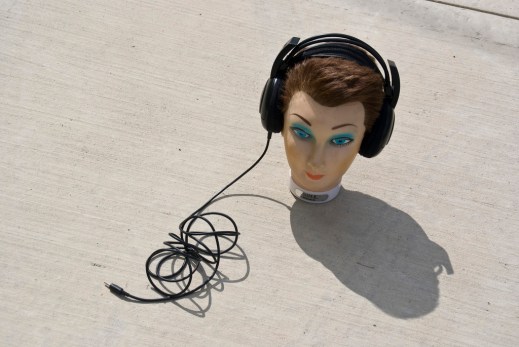
Featured image: “mannequin head on concrete with headphones” from Flickr user J E Theriot, (CC BY 2.0)
—
Robin James is Associate Professor of Philosophy at UNC Charlotte. She is author of two books: Resilience & Melancholy: pop music, feminism, and neoliberalism, published by Zer0 books last year, and The Conjectural Body: gender, race and the philosophy of music was published by Lexington Books in 2010. Her work on feminism, race, contemporary continental philosophy, pop music, and sound studies has appeared in The New Inquiry, Hypatia, differences, Contemporary Aesthetics, and the Journal of Popular Music Studies. She is also a digital sound artist and musician. She blogs at its-her-factory.com and is a regular contributor to Cyborgology.
—
 REWIND! . . .If you liked this post, you may also dig:
Love and Hip Hop: (Re)Gendering The Debate Over Hip Hop Studies–Travis Gosa
SO! Amplifies: Mega Ran and Sammus, The Rappers With Arm Cannons Tour–
Share this:

SANDRA BLAND: #SayHerName Loud or Not at All
It is customary that whenever I go to my Nana’s house I turn the car speakers as low as possible. She has super hearing. Sometimes I forget, and the following conversation takes place:
“What’s up Nana Boo?”
“I heard you before you got the house, girl. I told you about playing your music too loud.”
“It wasn’t too loud.”
“I heard you before I saw you.”
“Yes ma’am. I’m sorry.”
“Don’t bring attention to yourself.”
Don’t bring attention to yourself.

Picture from The Feminist Wire.
Physically this is impossible. I am a black woman over six feet tall. My laugh sounds like an exploding mouse. I squeak loudly and speak quickly when I get excited. I like knock in my trunk and bass in my music. Don’t bring attention to yourself. I frequently heard this warning as a girl and well into my adult life. I rarely take it as a slight on my grandmother’s account – though she is the master of throwing parasol shade. She spoke to me with a quiet urgency in her warning. In the wake of the murders of Jordan Davis, Sandra Bland, and other black lives that vigilantes and mainstream media deemed irrelevant, I understand her warning better from the perspective of sound.
As a loud, squeaky black woman I am especially attuned to how my sonic footprint plays into how I live and if I should die. As a black woman, the bulk of my threat is associated with my loudness. My blackness sonically and culturally codes me as threatening due to the volume of my voice. This is amplified, as a southern black woman. I exist and dare to thrive in a country that historically and socially tries to deflate my agency and urgency. The clarity of my sentiments, the establishment of my frustration, and the worth of my social and cultural interventions are connected to how others hear my voice. It is not what I say but how I say it.

A woman waits at the Fulton Street subway stop in New York City on February 20, 2010.
Black women navigate multiple codes of sonic respectability on a daily basis. Their sonic presence is seldom recognized as acceptable by society. Classrooms, homesites, corporate spaces, kitchen tables, and social media require a different tone and volume level in order to gain access and establish one’s credibility. Like other facets of their existence, the way(s) black women are expected to sound in public and private spaces is blurry. What connects these spaces together is a patriarchal and racially condescending paradigm of black women’s believed inferiority. A black women’s successful assimilation into American society is grounded in her ability to master varying degrees of quiet and silence. For black women, any type of disruptive pushback against cultural norms is largely sonic in nature. A grunt, shout, sigh, or sucking teeth instigates some type of resistance. Toning these sonic forms of pushback—basically, silencing themselves—is seen as the way to assimilate into mainstream American society.
In what follows I look at the tape of Sandra Bland’s arrest from this past summer to consider what happens when black women speak up and speak out, when they dare to be heard. As the #SayherName movement attests, black women cannot express sonically major and minor touchstones of black womanhood – joy, pleasure, anger, grief – without being deemed threatening. These sonic expressions force awareness of the complexity of black women’s experiences. In the case of Sandra Bland, I posit that the video of her arrest is not a video of her disrespecting authority but rather shows her sonic response to officer Brian Encinia’s inferred authority as a police officer. I read her loud and open interrogation of Encinia’s actions as an example of what I deem sonic disrespectability: the use of sound and volume to contest oppression in the shape of dictating how black women should or should not act.
The sonic altercation in the video (see full-length version here) sets the stage for Encinia’s physical reprimand of Bland, a college graduate from Prairie View A&M who hailed from Chicago. Bland is not physically threatening—i.e. she emphatically states she’s wearing a maxi dress—but her escalating voice startles and even intimidates Encinia. Bland is angry and frustrated at Encinia’s refusal and to answer her questions about why she was pulled over. Encinia’s responses to Bland’s sonic hostility are telling of his inability to recognize and cope with her anger. In fact, he refuses to answer her questions, and she repeats them over and over again while he barks orders. Encinia states later in the dashboard camera that Bland kicks him and thus forces him to physically restrain her. However, Bland’s vocal assertion of her agency is more jarring than her physical response to Encinia’s misuse of power.
The dashboard camera footage is indicative of their vocal sparring match. Encinia’s voice starts calm and even. He explains to Bland he pulled her over for failure to indicate a lane change. Bland’s responses are initially low and nearly inaudible. However, after Encinia asks Bland if she is “okay,” her responses are much louder. She does not just follow orders but expresses her displeasure in sonic ways, while she stays in the car. His tone shifts when Bland refuses to extinguish her cigarette. Encinia then threatens to pull her out of the car for disobedience. He begins to yell at her. Bland then voices her pleasure in taking Encinia and his complaint to court. “Let’s take this to court. . .I can’t wait! Ooooh I can’t wait!” Bland’s pleasure in taking Encinia to court is an expression of her belief in her own agency. The act of voicing that pleasure is particularly striking because it challenges an understanding of courts and the justice system as hyperwhite and incapable of recognizing her need for justice. Her voice is clear, loud, and recognizably angry.

Picture from The New York Times
Her voice crescendos throughout the video, signifying her growing anxiety, tension at the situation, and anger for being under arrest. However, Bland’s voice begins to crack. Her sighs and grunts signify upon her disapproval of Encinia’s treatment of her physical body and rights. Once handcuffed, Bland’s voice is very high-pitched and pained, a sonic signifier of submission and Encinia’s re-affirmation of authority. She then is quiet and a conversation between Encinia and another officer is heard across the footage.
Many critiques of Bland center around her ‘distasteful’ use of language. One critic in particular described the altercation as “an African American woman had too much mouth with the wrong person and at the wrong time.” The assumption in those critiques is that she was not properly angry. Instead of a blind obedience of Enicnia’s inferred authority (read: superiority), she questions him and his inability to justify his actions. Sandra Bland’s sonic dis-respectability (dare I say, ratchet), is a direct pushback against the cultural and social norms of not only rural Southern society but the mainstream American (inferred) belief of southern black folks’ blind respectability of white authority and law enforcement.
Although Bland was a graduate of a southern HBCU, I do not want to assume that Bland possessed the social sensibilities that upheld this unstated social practice of blindly obeying white authority. Her death runs parallel to those of Emmett Till and Mary Turner. The circumstances of Till’s death swirled around his alleged whistling at a white woman – read as a sonic signifier of Till’s black masculine sexuality instead of boyhood – and disregard for white femininity, a protected asset of white men’s authority. Till, from Illinois like Bland, allegedly ignored his cousins’ warnings about the ‘proper protocol’ of interacting with white folks. Mary Turner, a black woman from Valdosta, Georgia, spoke out publicly against the lynching of her husband in 1918. She and her unborn child were also lynched in response to her sonic audacity. Before her death, members of the mob cut open her belly and her unborn baby fell on the ground; it was stomped to death after it gave out a cry. Turner’s voice disrupted white supremacy. Her baby’s lone cry re-emphasized it. Sound grounds much of the racial and gendered violence in the South.

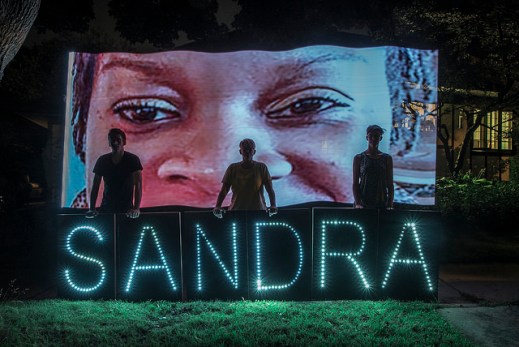
“Sandra Bland mural” by Flickr user Robert Fairchild, CC BY-NC 2.0.
The Southern U.S. emphasizes listening practices as part of social norms and cultural traditions. Listening was an act of survival more so than vocalizing the challenges facing black folks. (Jennifer Stoever’s upcoming book on the sonic color line addresses how advertisements for runaway slaves, for example, mentioned whether they were good listeners, as a way to codify whether they were compliant slaves.). Consider my grandmother’s warning about not bringing attention to myself. In her eyes, by not bringing attention to myself I’m able to remain invisible enough to successfully navigate society’s expectations of my blackness and my womanhood. Silence and listening are tools of survival. Contrarily, Bland’s loud disapproval and emphatic use of curse words registered her blackness and womanhood as threatening. She was coded as less feminine and therefore threatening because of her direct verbal confrontation with Encinia. She was not quiet or polite, especially in the south where quiet is the ultimate and sole form of women’s politeness and respectability. The combination of these multiple representations of black women’s anger invoked Encinia’s hyper-authoritative response to regain control of the situation.
Black folks are increasingly pushing back against “being in their place.” Sandra Bland’s death is rooted in an unnecessarily escalated fear of black women literally speaking their truth to power. In a moment where black women are speaking on multiple wavelengths and levels of volume, it is imperative to single out instances and then implode outdated cultural and social practices of listening.
—
Featured image:”Sandra Bland is Her Name” by Flickr user Light Brigading, CC BY-NC 2.0
—
Regina Bradley is a writer, scholar, and researcher of African American Life and Culture. She is a recipient of the Nasir Jones HipHop Fellowship at Harvard University (Spring 2016) and an Assistant Professor of African American Literature at Armstrong State University. Dr. Bradley’s expertise and research interests include hip hop culture, race and the contemporary U.S. South, and sound studies. Dr. Bradley’s current book project, Chronicling Stankonia: Recognizing America’s Hip Hop South (under contract, UNC Press), explores how hip hop (with emphasis on the southern hip hop duo Outkast) and popular culture update conversations about the American South to include the post-Civil Rights era. Also known as Red Clay Scholar, a nod to her Georgia upbringing, Regina maintains a critically acclaimed blog and personal website – http://www.redclayscholar.com. She is a regular writer for Sounding Out!
—
REWIND! . . .If you liked this post, you may also dig:
I Been On: BaddieBey and Beyoncé’s Sonic Masculinity — Regina Bradley
“President Obama: All Over But the Shouting?” — Jennifer Stoever
Óyeme Voz: U.S. Latin@ & Immigrant Communities Re-Sound Citizenship and Belonging-Nancy Morales
Share this:


Current Top Posts





April 2021

January 2020

November 2019

October 2019

August 2019

April 2014

November 2017

March 2015

December 2017

October 2015
 Sounding Out!
Recent Comments