
Clapping Back: Responses from Sound Studies to Censorship & Silencing


SO! Amplifies. . . a highly-curated, rolling mini-post series showcasing cultural makers and organizations doing work we really dig —
The MS Sound Forum invites papers for a guaranteed session at the Modern Language Association’s annual conference in Toronto, Canada in January 2026. The session responds in part to the MLA Executive Council’s refusal to allow debate or a vote on Resolution 2025-1, which supported the international “Boycott, Divest, and Sanction” (BDS) Movement for Palestinian rights against the ongoing genocide in Gaza. In light of the Council’s suppression of debate, some of the Sound Forum Executive Committee members decided to resign in protest while others remained to hold the MLA accountable for its undemocratic procedures. To acknowledge and respect the decision of those who left, the remaining members chose not to immediately fill the vacancies to let the parting members’ silence speak.
At MLA 2026, the Sound Forum seeks to provide a space for dialogue and meditation on silencing, censorship, and the role of organizations like the MLA in systemic violence and suppressing academic freedom. Sound studies scholars have long articulated listening as a practice for critical interventions, especially in the face of oppression. For example, Sonali Chakravarti’s Sing the Rage—written in the wake of the South African Truth and Reconciliation Commission—argues for an engaged and good faith reception of anger in the aftermath of colonial and institutional violence like apartheid and genocide. Chakravarti posits listening as the ground of recognition and a key path for attaining justice in the aftermath of mass violence (123). Drawing on Chakravarti, Naomi Waltham-Smith in Free Listening insists that listening “isn’t restricted to a power of relief but is precisely what enables catharsis to transform into a vehicle for justice because it promotes trust” (67).
To entrust MLA with the task of upholding one of its core values—the commitment to champion intellectual freedom—does not come easy. Indeed, Waltham-Smith reminds us that “Rage—and especially Black rage—is figured as an excrescence to the European rational logos. It’s too loud or too dissonant for the ears to parse” (55-56). The MLA Executive Council’s justification for their pre-emptive silencing of debate on Resolution 2501-1—as chronicled by our colleagues Anthony Alessandrini, Raj Chetty, Cynthia Franklin, Hannah Manshel, David Palumbo-Liu, Neelofer Qadir, S. Shankar, Rebecca Colesworthy, Chris Newfield, and others—remits to this noise-logos dichotomy, appealing to legalistic and fiduciary logic as a rationale for denying debate.

Waltham-Smith develops this argument in dialogue with Black feminist thinkers like bell hooks and Audre Lorde, asserting: “Rage is also connected with aurality in that a lack of listening—a feeling of going unheard—is itself a spur to anger, which is further compounded when the expression of that anger and, hence, its legitimacy is denied through silencing of one kind of another. It is this double injury that Jean-François Lyotard articulates in The Differend with his notion of the différend, whereby the original damage is compounded by the fact that it cannot be brought to the attention of or recognized by others. […] The assumption here is that listening has always already softened the blow” (63). This double injury occurs when one’s rage is discredited, deemed to be out of proportion to the weight of the wrong, or simply unheard, thus compounding the rage and shutting down avenues for multiracial collectivity when “white people remain unable to hear black rage, if it is the sound of that rage which must always remain repressed, contained, trapped in the realm of the unspeakable” (hooks, Killing Rage 12).
It is no accident that we are invoking studies of Black rage when discussing the plea of our Palestinian colleagues. Indeed, one of the seminal sound studies monographs, The Sonic Color Line, was written by Jennifer Lynn Stoever in part to historicize the state and police violence Black Americans were subjected to in the 2010s by positioning these instances of brutality—often triggered by disputes or disagreements over what a soundscape of the public space ought to be—within a larger history of the racialized listening practices. Those of us who experienced the Ferguson uprising in 2014 witnessed Palestinian allies sharing—over Twitter and in solidarity against the state violence—their first aid strategies when assaulted by the police tear gas for standing up for the dignity of Black and brown lives.

It is within this context of the MLA’s refusal to listen that we organize this panel. Beyond the immediate confines of the MLA, we also bear witness to contemporary practices of silencing, such as CEO Elon Musk tweaking X’s algorithm to penalize posts he deems to be “negative”; the Trump administration’s defunding of research on marginalized communities on the basis of flagged terms like “historically” and “female” (Palmer); and anthropocentric disregard for the more-than-human in enacting environmental policies, among others. At this juncture, resisting the erosion of democratic decision-making procedures and the freedom of expression is imperative.
While the panel theme is motivated by our collective desire to hold the MLA to account for its undemocratic procedures and to improve the Association’s processes from below, we also invite proposals thinking capaciously about questions of silencing, censorship, or free expression—as well as the role of listening and sound in these dynamics—through a sound studies framework. Topics might include: silencing of the more-than-human; AI and social media censorship (algorithmic black boxes); scholasticide and epistemological imperialism; ableism as silencing; authoritarianism and political censorship, etc.

Please submit your 200-word abstract and 50-word bio by March 20, 2025 to:
- John Melillo, johnmelillo@arizona.edu
- Setsuko Yokoyama, setsuko_yokoyama@sutd.edu.sg
- Tamara Mitchell, tamara.mitchell@ubc.ca
Please note that all speakers must update their MLA membership by April 7th, 2025 to participate in the conference. We look forward to receiving your proposals.
While the MS Sound Forum has decided to hold this guaranteed session at MLA 2026, we acknowledge and respect the decision of many of our colleagues to resign from their MLA-affiliated positions and withhold their membership, financial contributions, and labor in protest.
The MLA Sound Forum Executive Committee
John Melillo, Tamara Mitchell, Julie Beth Napolin, Setsuko Yokoyama
—
Featured Image: Photo by Photo by Jon Tyson on Unsplash
—

REWIND! . . .If you liked this post, you may also dig:
My Music and My Message is Powerful: It Shouldn’t be Florence Price or “Nothing” –Samantha Ege
The Sound of Feminist Snap, or Why I Interrupted the 2018 SEM Business Meeting–Alex W. Rodriguez
Spaces of Sounds: The Peoples of the African Diaspora and Protest in the United States–Vanessa Valdes
EPISODE 61: Ni Le Pen, ni Macron: Parisian Soundscapes of Resistance–Naomi Waltham-Smith
Share this:

“In My Life”: Loving Queerly and Singing Across Generations
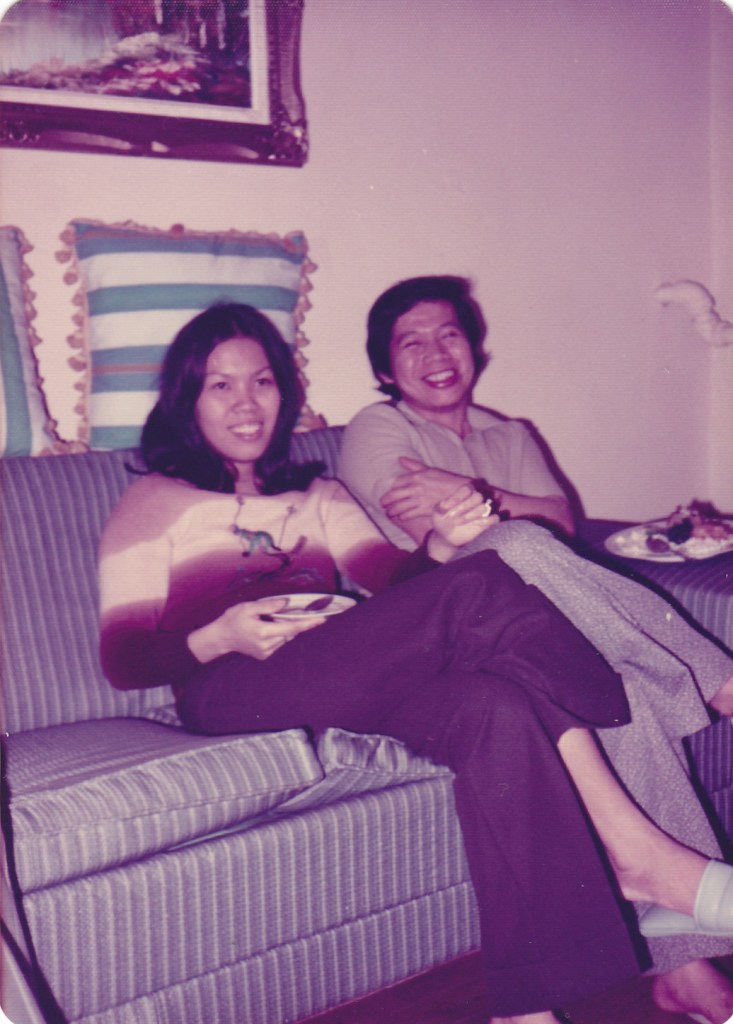
December 1975.
The cold winds staked their claim over Toronto, where my parents had recently arrived from the Philippines. They were underdressed and making their way down Parliament Street. Despite being warned of a shift in temperature, they were not expecting the brutal intensities of Canadian winter. I’m not sure how anyone anticipates the sharp sting of negative temperatures when they are arrivants used to tropical climates. Undeterred, my mother and father headed to a small Filipino grocer, hoping to encounter a semblance of domestic familiarity. Pressed against the biting winds, my mother abruptly stopped, looked at my father and said, “Tumutolo ang sipon” – you have a runny nose. To which my father replied, “Ikaw din” – you do too! They both started laughing and laughed again when they retold me this story 48 years later. When faced with the challenges of migrating to a new and very cold country, they managed to mine humour from a deep well of difficult circumstances. We had been listening to the song “In My Life” by the Beatles (Lennon & McCartney 1965). Something in its expression, melody, and feeling caused my parents to be transported to this small but important moment.
In her conversation with Christine Bacareza Balance, “‘Revolutions in Sound’: Keynote Duet” (2022) Alexandra T. Vazquez writes: “The popular…leaves so much room for engagement with sound artists (musicians without the gallery). None of them need theorists to argue for them, to argue for their mattering because to so many, they already do. How do they instead invite theorists to take part in something alongside them?” (12). I was never a big fan of the Beatles, but regardless of my opinions, they were popular. As a relentlessly oppositional teenager, I was put off by their mass popularity. As Vazquez suggests, despite one’s musical taste, songs are invitations, not scholarly conquests. The memory re-opened by my parents’ connection to “In My Life” was an invitation for me to take stock of the song’s affective and, for them, diasporic trajectories. As Balance (2022) suggests songs request us to “listen long so we hear where another is coming from” (15). For her, “long” describes temporality and commitment. To “listen long” implies that duration and attention are the pretext for empathic relations.
“In My Life” was released in 1965. My mother was fifteen years old when she first heard the song on the radio in a boarding house in Marbel, Philippines. One year later, on July 16, 1966 the Philippine Free Press would announce, “The Beatles Are Coming” (de Manila as cited by Robert Nery in “The Hero Takes a Walk” 2018). At that time, Ferdinand Marcos was the newly elected president of the Philippines, and Imelda Marcos was his First Lady. The Marcoses would later unleash an era of violent dictatorial power and impose Martial Law in 1972, escalating political suppression (Burns 2013). My mother recalls that the band’s first and only appearance in the Philippines was remembered by many less for their two scheduled concerts and more for their “snub” of Imelda. The Beatles were noticeably absent at a lunch reception they were expected to attend with the First Lady at the Presidential Palace. Their absence, attributed to a communication error between the concert promoter and the band’s manager, incited public disapproval and resulted in the sudden disappearance of their security escort and hotel and porter service. Unlike in other cities, the band was refused room service and was forced to carry their own luggage (Nery 2018).
What is striking about this moment is that it breaks from preoccupations with Filipinx desires for assimilation and mimicry of Western imperial projects. In Video Night in Kathmandu and Other Reports from the Not-So-Far East, British travel writer Pico Iyer (1988) famously stated that Filipinx people are the “[m]aster of every American gesture, conversant with every western song…the Filipino plays minstrel to the entire continent (153)” Turning against imperial scripts and the band’s documented disdain of “Mosquito City” and even worse, John Lennon’s comment that a return to the Philippines would require “an H-bomb,” the soured residues of their visit marks a queer rupture in Beatlemania. The public decried that Filipinx people deserved better from the band, capturing what Balance describes in Tropical Renditions: Making Musical Scenes in Filipino America (2016), as “disobedience” in that “disavows a belief in the promises of assimilation” (5). For me, Filipinx non-compliance textures the sonic substance of “In My Life.” While the shadow of the Marcoses cronyism and corruption is an inescapable footnote, it is the defiant voices of hotel employees, dismayed fans, and airport workers that insisted on the “ordinariness” (Wofner & Smeaton, 2003) of the Beatles that holds the song’s queer decibels.
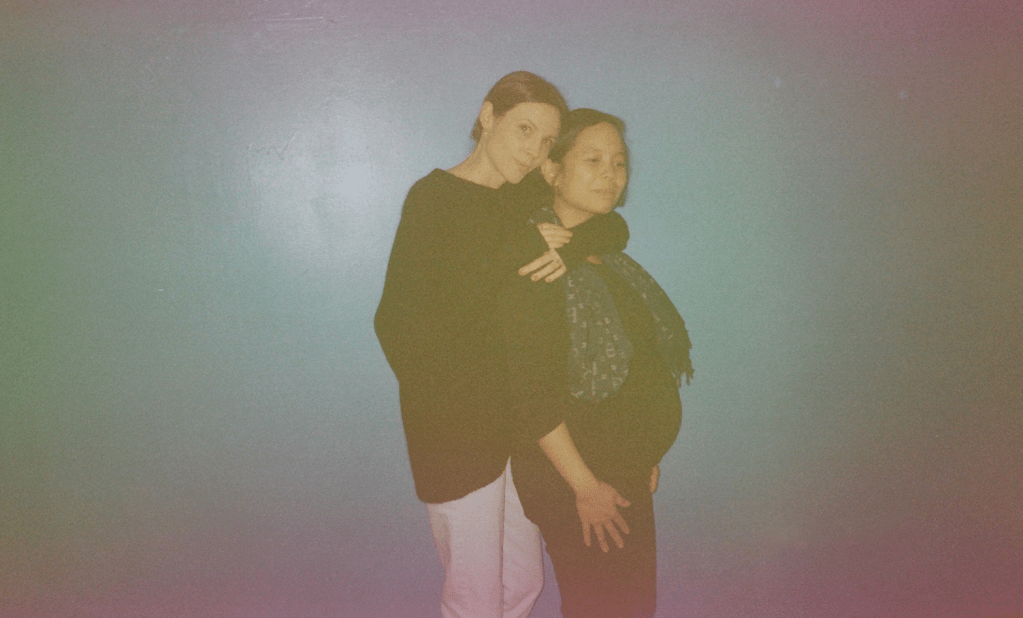
There are places I’ll remember all my life, though some have changed. Some forever, not for better. Some have gone, and some remain.
“In My Life” (Lennon & McCartney 1965).
January 2018.
I am sitting on my couch watching a Toronto Raptors game. The television emits light that flickers through a large window that frames a bright winter moon. I am 41 weeks pregnant at this point (feeling similarly shaped and sized as the moon outside). My stubborn queer resistance to the Beatles somehow dissipated during my pregnancy, and the song “In My Life” made its way to me. I would quietly sing the song to my pregnant belly. Then, that January night, I felt a snap inside my body and a rush of water down my legs. I won’t go into much gratuitous detail other than to say that at 12:49 pm the next day, Asa Cy Dyer-Mecija was born at home.
And these memories lose their meaning when I think of love as something new.
“In My Life” (Lennon & McCartney 1965)
Sometimes, I needed to couch the queerness of pregnancy in words that were not mine. The distance between these words and the ones I had yet to find would help to structure my unfolding love for Asa. Here, queerness presented a modality of encounter with uncensored desires. Queerness is often theorized as a utopian impulse; the queerness of my pregnancy jostled both the hopes and fears brought up by the unknown terrain of parenting amidst heteronormativity. For me, “In My Life” is riven by sentimentality and nostalgia, but it also gave melody to a tender relationship with myself and my new role in the world. This was the sonic throughline to my parents, a queer inheritance of tension made from the hopes for kinder contexts amidst the limitations of harsh realities.
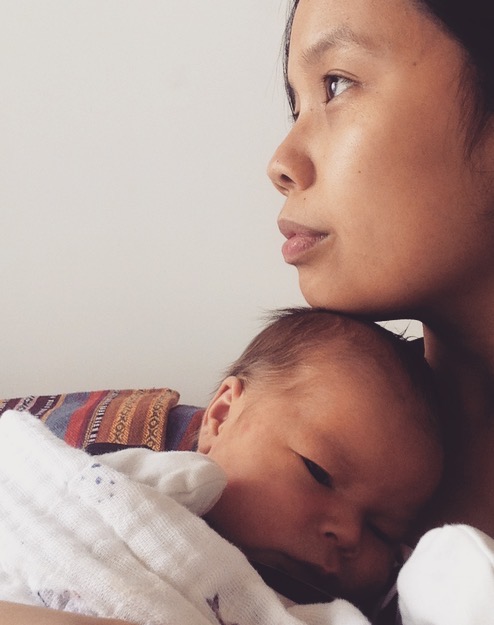
December 2022.
I was invited to perform as part of the Queer Songbook Orchestra’s holiday fundraiser. The Queer Songbook Orchestra is a chamber pop ensemble that hosts an annual concert focused on songs and stories about “chosen family and queer joy” (Queer Songbook n.d.). At that time, Asa was four years old. He is a child of the pandemic. He’s a kid with two moms, a present and kind donor, and is dearly loved by his Lolo and Lola, his grandparents, aunts, titas, uncles, cousins, kuya, ate, and his beautiful chosen family. My partner, Hannah, and I sometimes worry about how his world will be affected by reactions to the makeup of our family, but mostly, we know he’ll be sure he’s loved by many.
To me, the song “In My Life” offers a useful sonic response to homophobia. As a baby, after Asa’s baths, I would often wrap him in a towel, and while rocking him back and forth, I would sing these lyrics from the song: “Though I know I’ll never lose affection for people and things that went before, I know I’ll often stop and think about them. In my life, I love you more” (Lennon & McCartney 1965). To me, this statement is a queer ethos. We know that 2SLGBTQ+ people have necessarily and creatively reworked and reimagined the organization and expression of kinship. When family is so often bounded by what Julianne Pidduck calls “constraints of relationality” in “Queer Kinship and Ambivalence”(2008: 441), the lyrics “In my life, I love you more” are a call to action. More is a word used comparatively to insist that there is something greater, something more exists, something more is possible. I embrace the challenge to love more. My queerness urges me to love more, and parenting Asa does, too. On the evening of the performance, indexed by my parents’ struggles and our shared disdain for the chill of winter, Asa and I performed “In My Life” together. The video of our performance will remain a treasured sonic archive that I will return to often, and as Asa gets older, I hope it reminds him of how beautiful he’s always been.
—
Casey Mecija is an Assistant Professor in the Department of Communication & Media Studies at York University. Her current research examines sound as a mode of affective, psychic, and social representation, specifically in relation to diasporic experience. Drawing on sound studies, queer diaspora studies and Filipinx Studies, her research considers how sensorial encounters are enmeshed and disciplined by social and psychic conditions. In this work, she theorizes sounds made in and beyond Filipinx diaspora to make an argument about a “queer sound” that permeates diasporic sensibilities. She is also a musician and filmmaker whose work has received several accolades and has been presented internationally.
—

REWIND!…If you liked this post, you may also dig:
Blank Space and “Asymmetries of Childhood Innocence” –Casey Mecija
The Sound of What Becomes Possible: Language Politics and Jesse Chun’s 술래 SULLAE (2020) –Casey Mecija
The Cyborg’s Prosody, or Speech AI and the Displacement of Feeling–Dorothy Santos
Tape Hiss, Compression, and the Stubborn Materiality of Sonic Diaspora–Chris Chien
Xicanacimiento, Life-giving Sonics of Critical Consciousness—Esther Díaz Martín and Kristian E. Vasquez
Moonlight’s Orchestral Manoeuvers: A duet by Shakira Holt and Christopher Chien
Enacting Queer Listening, or When Anzaldúa Laughs–Maria Chaves Daza
Echoes in Transit: Loudly Waiting at the Paso del Norte Border Region—José Manuel Flores & Dolores Inés Casillas
The Queerness of Wham’s “Last Christmas”–Justin Burton
Could I Be Chicana Without Carlos Santana?–Wanda Alarcón
Share this:


Current Top Posts





April 2021

January 2020

November 2019

October 2019

August 2019

April 2014

November 2017

March 2015

December 2017

October 2015
 Sounding Out!
Recent Comments