
A Tribe Called Red Remixes Sonic Stereotypes


Welcome back to “The Wobble Continuum,” a three part series here on Sounding Out!. When we last left you, Mike D’Errico had brought us to the intersection of patriarchal cultural norms, music production practices and aesthetics, and the Military Entertainment Complex. His particular focus was on the sounds and practices of brostep (be sure to check out D’Errico’s SO! Comment Klatsch from last week on gendered sounds, too), and some of those sounds leak through to today’s post from Christina Giacona. Giacona turns her ear to the group A Tribe Called Red in order to hear how they reappropriate and redress the sounds of colonization and racism.
As the series’ title suggests, her essay entails another journey to the low end, where things will once again get wobbly.
Guest Editor Justin D. Burton
—
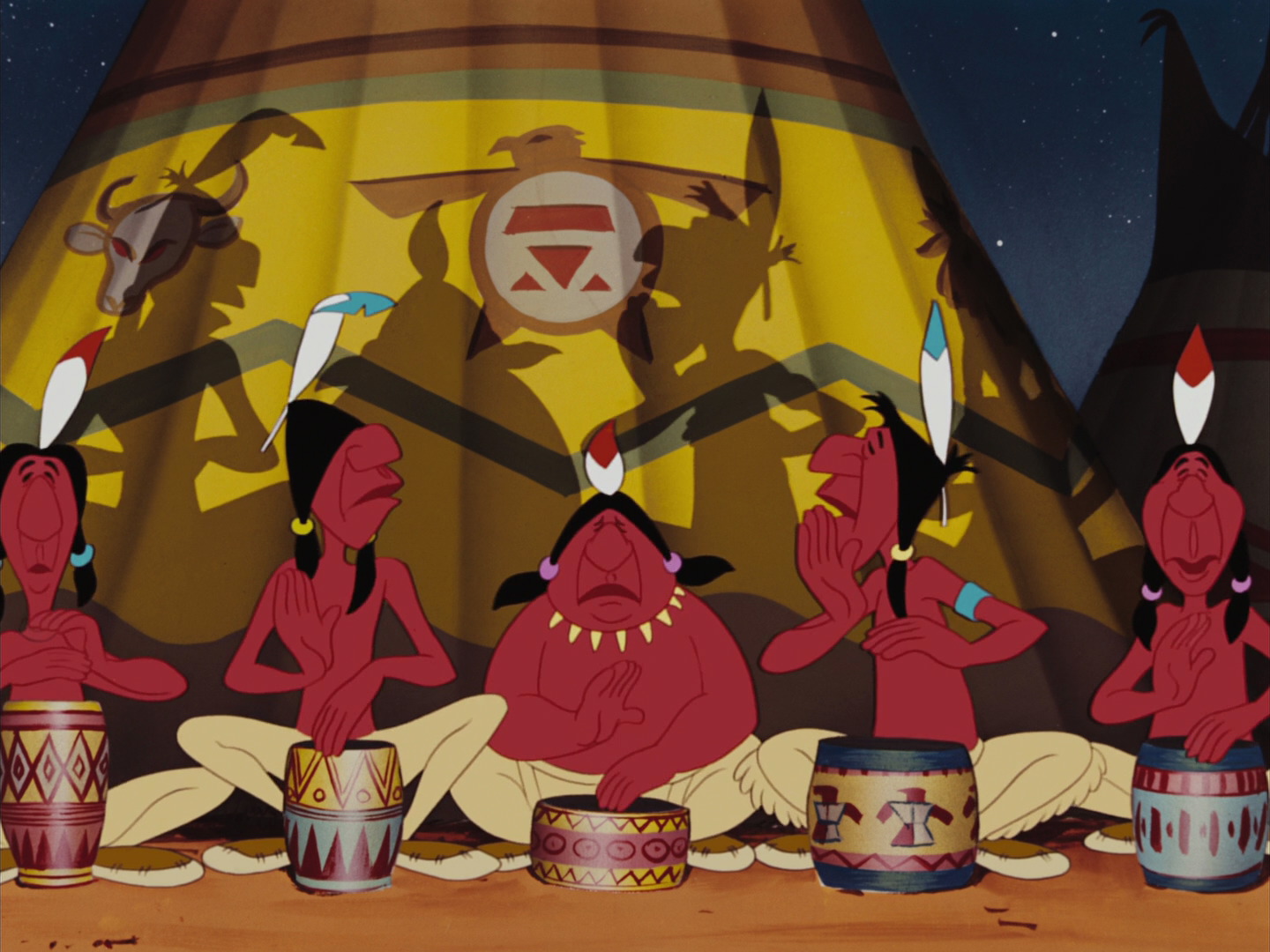
Since first contact, Native Americans have consistently needed to combat the European stereotypes that portray them as inferior and uncivilized. Barraged with echoes of the same handful of Native tropes since Buffalo Bill’s Wild West Shows, contemporary American society often treats the stereotypical Native American princess, chief, and savage as historical truths, represented recently in Johnny Depp’s portrayal of Tonto in The Lone Ranger. But it is not just the visual image of the Native American that has been stereotyped, so has their sonic sensibility. As documented in the film Reel Injun, Native languages and musics have consistently been “faked” by Hollywood with tricks like backwards English, pig-Latin, and Westernized imaginings of a ubiquitous Native music based on a pan-Indian society that never actually existed. Hollywood often uses Native American music to show a “primitive” society where music’s sole function is to prepare for war. However, the “Indian” drumbeat that accents the first beat of a group of four cannot be found in any traditional Native American or Aboriginal music.
While Native American-directed motion pictures such as Smoke Signals, Powwow Highway, and Atanarjuat: The Fast Runner finally gave agency to Natives in film, it was the all-Native DJ collective A Tribe Called Red’s self-released album and popularization of the Electric Powwow that directly challenges the perception of Native American music in modern society. In this post, I analyze the sonic composition of ATCR’s song “Braves,” exploring how A Tribe Called Red challenges North American stereotypes of Native Americans through the cultural re-appropriation of racist sounds.

“A Tribe Called Red – Hall 4 (1)” by Flickr user Trans Musicales, CC BY-NC 2.0
After World War I, intertribal powwow gatherings served as a place to celebrate newfound unity among Native Nations returning home from the war. By the 1950s intertribal powwows had spread throughout North America. With the continued strength and importance of the powwow in contemporary Native society, urban Natives in locations like New York City and Ottawa, Canada, have begun to search for ways to create the same sense of unity in urban venues. In 2008, DJs NDN and Bear Witness formed the DJ collective “A Tribe Called Red” and began curating performances in Ottawa the second Saturday of every month called the Electric Powwow: a “wild party” focused on showcasing native talent and aboriginal culture. ATCR’s website describe the music as “ the soundtrack to the contemporary evolution of the powwow.“ Bear elaborates in an interview with NOW magazine, “[the Electric Powwow] was also about creating a space for our community within the club environment.” Hip-hop DJ and turntable champ DJ Shub was invited to join the group in 2010, and the trio spent the next two years evolving the sound of the Electric Powwow into a mash-up of powwow and First Nations music with contemporary club sounds including hip-hop, dubstep, and dance hall.

“Tribe Called Red” by Flickr user Dav Yaginuma, CC BY-NC-SA 2.0
Much like Fela Kuti’s popularization of Afrobeat in the 1970s, made up of a combination of traditional Nigerian Yoruba polyrhythms with a blend of Western jazz and funk, and Reggaeton’s fusion of Caribbean rhythms with the aesthetics of American hip-hop in the 1990s, the Electric Powwow merges a historically traditional and non-syncretic music with popular and cosmopolitan music in a way that both honors cultural heritage and makes it relevant to a new generation. As NDN points out on Noisey, even their name follows this trend, simultaneously referencing the introduction of Nations at powwows and famous Afrocentric hip-hop group A Tribe Called Quest. The Electric Powwow events are not just about the creation of a new genre of music, but they also serve as a site for ATCR to speak publicly about aboriginal issues and represent themselves as a contemporary face for the urban Native youth renaissance. ATCR’s music videos and live-show projections extensively sample racist imagery from movies and cartoons including old westerns, Back to the Future III, Bugs Bunny, and Disney’s Peter Pan. As a result of their audio-visual activism, the group has become the unofficial soundtrack for the Idle No More movement, which is attempting to reassert Indigenous sovereignty rights and previously signed treaties in Canada.
By taking both visual and sonic symbols that depict racist stereotypes out of their cultural contexts, ATCR draws attention to both the specific racism of each individual image and the ubiquity of racist stereotypes. In their track “Braves,” A Tribe Called Red takes on the U.S. baseball team the Atlanta Braves by remixing the baseball organization’s Tomahawk Chop anthem, itself adopted from Florida State University.
ATCR’s version transforms the innocuous-sounding chant by showcasing its core as a Hollywood-esque stereotype of Native American song. By re-contextualizing the anthem, “Braves” prompts listeners to reinterpret this facet of American sports culture as a racist pageantry of “savage violence.”
The association of the “war chant,” the motion of the Tomahawk Chop, and the fact that these actions call for one team to attack all make it clear that American sports culture appropriates Native Culture as an example of “savagery” and “uncivilized” behavior. The Tomahawk Chop also forgoes the use of a language-based text entirely and instead chooses to use vocables that cannot be attributed to any particular Native nation, ceremony, or meaning. Like Hollywood’s use of backwards English and the war drumbeat to represent “Indians,” the Tomahawk Chop bears no resemblance to any real Native Nation’s music, acting as yet another imagined primitive stereotype that marginalizes actual Native American music.
On A Tribe Called Red’s SoundCloud page, “Braves”’s description reads, “We wanted to make a song for all the racist and culturally inappropriate sports teams that are still used today!” The group accomplishes this by creating dissonance between contemporary electronic drumbeats and the “traditional” paramilitary marching band arrangement of the “Tomahawk Chop.” “Braves” utilizes a standard dubstep song structure in 4/4 at 140 beats per minute that includes an intro, two main sections that include melodic materials, a breakdown/buildup section, a vocal “drop” which announces and is followed by the climax of the piece, and an outro that brings the track to a close. However, “Braves” does differ from other dubstep songs in the marked separation and interaction between the Tomahawk Chop samples performed by voices and marching band and the composed elements of the song performed as the Wub—a deep, wobbly synthesized sound—and accompanied by a HiHat cymbal pecking away at syncopated rhythms. Even though all the melodic content of “Braves” is based on variations of the Tomahawk Chop melody, ATCR never fully integrates actual samples of the Tomahawk Chop into the composition. The marching band and chant samples are treated as an unwanted and unexpected visitor to a party; they seem important at the entrance, but they are given an increasingly diminished role until they finally exit with a whimper.
Written as a protest against racist sports organizations to help convince them to stop using characterized ceremonies and mascots, “Braves” contains that struggle within the composition itself: dubstep, sounded as the Wub and HiHat, eventually renders the Tomahawk Chop sonically impotent. The “Tribe” drop, when ATCR marks the song by saying “tribe,” acts as the turning point in “Braves.” After this point the Wub and HiHat consistently overwhelm the sampled material. In a standard dubstep song, the tribe drop would be followed by the climax: the strongest, most complex musical section of the piece. However, the Tomahawk Chop sample that follows this drop is immediately swallowed up by a low-pass filter that rubs out the tune, starting with the highest pitched sounds, over the course of sixteen measures, heightening the lower end of the sonic spectrum. Only then does the true climax occur. The Wub and HiHat appear here for the first time without the sample band or vocalizations. After the “Tribe” drop, the samples of the Tomahawk Chop are either dominated by the Wub or swallowed up by low-pass filters and fades.

“Tomahawk” by Flickr user Lorianne DiSabato, CC BY-NC-ND 2.0
In this way, “Braves” acts as a three-minute sonic story of reappropriation. The marching band arrangement and vocables represent the common stereotypes of Native American music perpetuated by Western Culture. The Wub and HiHat act as disapproving commentary on these stereotypes. “Tribe,” the only word used in the entire song, not only sounds ATCR as a group, but also marks the point in the song when ATCR begins to create their own image of Native music while simultaneously disempowering the strength of the marching band.
Just like the rebel American marching band’s reappropriation of the song Yankee Doodle in the Revolutionary War, A Tribe Called Red employs irony: in order to get the song the audience has to understand the racism, and while that sort of understanding seems to represent a steep learning curve for a culture so saturated in racist stereotypes, it is also exactly the sort of understanding a multicultural nation needs in order to thrive. Like Afrobeat, Reggaeton, and the more recent alternative hip-hop group Das Racist, ATCR is an underground voice within American popular culture that speaks with reverence for its own traditions while challenging the popular perception of race relations and breaking new ground in contemporary art. “Braves” proves that the reappropriation of sonic space is a powerful tool in the fight for cultural agency.
—
Featured image: “ATCR 4” by Flickr user MadameChoCho, CC BY-NC-SA 2.0
—
Christina Giacona is the Director of the Los Angeles New Music Ensemble and Instructor of Music at the University of Oklahoma. Dedicated to performing and researching the music of her generation, Christina teaches courses in Native American, World, and Popular Music. Since founding the Los Angeles New Music Ensemble in 2007, Christina has commissioned and premiered over twenty new works for the ensemble; run an international composers competition, recorded three albums, and collaborated with DJs, MCs, animators, choreographers, projectionists, and film producers.
—
 REWIND!…If you liked this post, you may also dig:
“One Nation Under a Groove?: Music, Sonic Borders, and the Politics of Vibration”-Marcus Boon
“Live Electronic Performance: Theory and Practice”-Primus Luta
“Remixing Girl Talk: The Poetics and Aesthetics of Mashups”-Aram Sinnreich
Share this:

(Sound)Walking Through Smithfield Square in Dublin

 Editor’s Note: This month Sounding Out! is thrilled to bring you a collection of posts that will change the way you hear cities. The Sounds of the City series will prompt readers to think through ideas about urban space and sound. Are cities as noisy as we think they are? Why are cities described as “loud”? Who makes these decisions about nomenclature and why?
We kicked things off last week with my critical reading of sound in Lorraine Hansberry’s A Raisin in the Sun, a play about African Americans in Chicago that still rings/stings true today. Regular writer Regina Bradley will discuss the dichotomy of urban and suburban in the context of sound (noisy versus quiet, respectively), and CFP winner Lilian Radovac will share with us a photoessay on the sound installation Megaphóne in Montreal. Today, guest writer Linda O’ Keeffe takes readers on a soundwalk of Smithfield Square in Dublin, Ireland and specifically of the Smithfield Horse Fair, in order to illustrate how urban renewal disrupts city soundscapes and how sound reclaims those spaces.–Managing Editor Liana M. Silva-Ford
—
Since 2010, as part of my PhD research, I have conducted over two dozen sound walks through the Smithfield Square and its environs, in Dublin’s North Inner city; with teenagers, by myself and through organising deep listening group walks as part of World Listening Day. These walks were designed to encourage the participating walkers to listen intently to this space and compare it to other spaces on the north side of Dublin city. The walks were also designed to examine the changing use and design of the Smithfield space over the past four years. This essay is drawn from the findings of this research, which explored the co-production of space and soundscapes with 84 teenagers (43 girls and 41 boys) from Dublin, Ireland. I include some of their observations of Smithfield Square here.
The Smithfield Square’s redesign began in 1996 as part of an urban regeneration project, and was completed in May of 2013. Smithfield is a traditional working class area, historically connected to wholesale markets, and in recent years it has gone through many iterations. In a push towards gentrification, the Smithfield Square space was ripped up, rebuilt, re-imagined and ripped up again because each iteration of its design proved unattractive to potential visitors/users of this space. According to the Royal Institute of the Architects of Ireland (1991), Dublin City Council considered these users were tourists and new middle class urbanites, not the locals.
Large-scale apartment complexes with business premises on the ground floor, tourist facilities, and an art house cinema were situated alongside smaller, older social housing, flat complexes and wholesale markets within the area. This reshaping of architecture impacts the diffusion of sound in space. It changes what Brandon LaBelle (2010) calls the acoustic territories that demarcate space where sound is no longer attributable to specific spaces or communities. Additionally, since the early 1990s, sounds within Smithfield began to change with the removal or downsizing of certain productive practices, such as the fish and fruit markets. This reduced the kind of traffic, both pedestrian and commercial, which would have moved and sounded through the area. The Smithfield Horse Fair disrupts the area’s soundscape and opens up the possibilities of the space of Smithfield Square for the broader community.
The design of the square, its restaurants, boutique shops and cafes, suggest that the soundscape designed for this space was meant to be a quiet and calm, recreating in the square what Karin Bijsterveld has defined in Mechanical Sound (2008) as the quiet of the middle classes. The sounds produced by the fair are then seen as counter to the types of sensory experiences that, Monica Montserrat Degen argues in her book Sensing Cities: Regenerating Public Life in Barcelona and Manchester (2008), are acceptable to the middle classes, who purchase a type of sensory/sonic experience. However, the soundwalks I describe contest what “quiet” means in the context of the square.
Listening to the Square
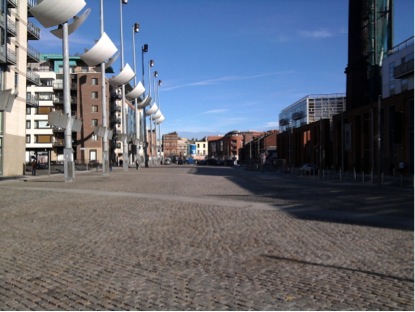
The Smithfield square in 2009. All pictures in this post come courtesy of the author, who holds the rights.

The Smithfield Square in 2009
In 2009 the Smithfield Square, which is laid with thousands of cobblestones, had placed around one side twelve 26.5 metre gas lighting masts, at one end of the square two lines of trees were planted with seating placed among them, and at the other end some large concrete plant pots. The seating located within the trees, attracted groups of homeless people and addicts. As a result, the dominant soundscape during the day was the sounds of men and women shouting obscenities at each other, with the susurration of trees rarely heard over this dominant sound. One of my teenage participants noted, “you always hear people screaming in the background” (Participant 2).

The Smithfield square in 2009
Aside from the shouting voices and loud reflections from singular sound sources within the Square such as the clatter of suitcase wheels across the cobblestones, seagulls screeching overhead, the beeping of trucks reversing and even the sounds of people talking at a distance, the teenagers who participated in the soundwalks defined the space as silent. Their use of the word silent did not mean the absence of sound, but rather an absence of activities, life, general sounds of community, consumption and production.
One sound that dominates the soundscape of Smithfield and its surroundings is the sound of the Luas tramline. The Luas line sits at one end of the Square and the sounds produced are distinctive: there is the whoosh as it passes, the ding a ling of its bells and the sounds of the doors opening and closing. The sound of the Luas echoes around the area from 6 in the morning till midnight. The sounds have become synonymous with that part of the city. The teenage participants defined these sounds as rhythmic, musical, “like a ballet.” For the teenager participants, the sounds of the Luas has been the only constant sound within Smithfield.

Public housing areas surrounding Smithfield
The sounds of children and teenagers were absent, even with the vast housing areas that surround Smithfield Square—some dating back to the 1940s. Within five minutes of the square are two primary schools and one all-boy’s secondary school. During the day, I would hear the children playing in the school grounds, and in flat complexes close to the Smithfield Square. Each of these spaces were gated and enclosed. Most of the teenage participants lived within such housing areas, and would often refer to the level of noise made by the children within their immediate housing areas. Yet, none of the teenagers, and no young children, used the Smithfield Square for “hanging out” or playing.

A primary school in Smithfield. The play area is on the school roof
The teenagers argued that the Smithfield Square had no point; it was too wide open and too quiet.
Group 11b: Although, there probably was sound for somebody who listened to it but because we were all coming down from the city, the space seemed to be nothing… it just seemed real quiet, empty.
Because of that, the teenagers felt they could not group together to chat. For them, it would be like situating themselves in the middle of a stage. Their sounds were amplified or reverberated, ironically creating a feeling of being surveilled. They felt more comfortable and safer in confined areas, such as street corners, laneways, and the archways of large buildings. Within these smaller spaces, the sounds produced have closer reflections. Teenagers often surround themselves with sounds by shouting, playing music, etc., creating what Barry Blesser and Linda-Ruth Salter in Spaces Speak, Are You Listening? (2009) call a sonic bubble. These “territorial bubbles appear as if by magic around a group of individuals if they begin to interact, and the group quickly acquires rights to the arena” (2009:34) thus creating a temporal space. They did not feel they could do so in such an open area.
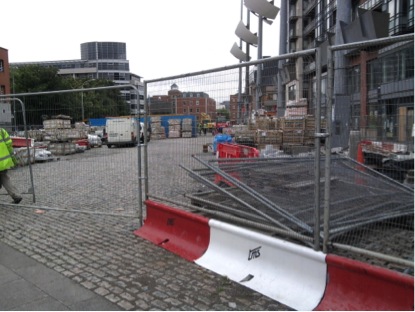
Smithfield Square by the summer of 2010

The Smithfield Square in 2011
Because of the poor planning and design of the Smithfield area, there are vast empty spaces surrounded by fencing or construction hoarding, numerous derelict buildings, and closed-down shops and restaurants. The Smithfield Square is no different, with numerous buildings left empty as a result of foreclosures or bankruptcy. The silence in this space is indicative of the loss of the social and economic processes. The vast square then takes on another level of silence, the loss of productive meaning, the presence of poverty, homelessness and unemployment.
On one walk with the teenagers I noted that they would group together in the square, even when they were told to walk around and record sounds within the space independently. Later, they said there were no sounds to record, so they just walked towards the closest sound source, a small shopping market in the square. I had noted numerous individual sounds, but they would have required standing in the middle of the square to record them. During focus group sessions after the soundwalks, the teenagers defined positive soundscapes as places with numerous loud sounds, the voices of hundreds within busy shopping streets, music coming from stores and traffic in the distance. These sounds defined a city, and made the teenagers feel safe and enclosed. Smithfield contained none of these kinds of sounds.
Soundwalking the Smithfield Horse Fair

Displaying horse carriages
There are a few events held regularly within the square since it re-opened in 2013. Some of these events are part of the Dublin City Council’s efforts to invigorate the space, such as food and art markets, as well as fairs for various seasons and holidays. One of the few public events that take place in Smithfield Square is the Smithfield Horse Fair, which happens on the first Sunday of every month. Having walked through this space repeatedly over a period of 3 years, it was only when I attended the horse fair that the space came alive, it had a purpose.
The horse fair has been a contentious event for both locals and city managers for the past two decades, with the horse dealers arguing that there is either a historical precedence for the horse fair or with the Dublin city councillors arguing that the land was historically used for the selling of cattle for market. The appearance within the Smithfield Square once a month of the horse fair brings with it a vast and lively, and sometimes, as defined by the media and Dublin City Council, a threatening soundscape/environment.
Some sounds defined as threatening are the loud whinnying of horses as they are jostled around the fair. The media has also reported, on several occasions, large-scale fights, which have broken out during the fair, leading to the presence of riot police. This eventually led to the gating of the fair and an extreme police presence as if these measures might reduce such sounds through the threat of arrest. For those living in the new apartment complexes, the sounds produced at the fair are amplified because of the design of the space, and possibly sound more threatening as a result.
During one walk of the Smithfield horse fair that I did in April 2013, some of the audible sounds were horses neighing and whinnying in panic, horse shoes on the cobblestones, traders shouting out their wares of horse paraphernalia, seats, stirrups etc., the voices of old men, which was the dominant background sound, and the sounds of traditional Irish music.
Outside of the gated fair were the sounds of large groups of teenagers, shouting and calling to each other. The space was alive with sound; the voices of teenagers merged with, or were lost within, the chaos of other sounds, becoming part of a larger soundscape. Because the space was busy with people, activities, music and even security there was a reason to use the square, even if you were not actively taking part in the event. The fair created a space for teenagers to engage with, and perhaps feel safe within the boundaries of its soundscape. Suddenly the square was as busy and as loud as the city centre.

Security at the horse fair
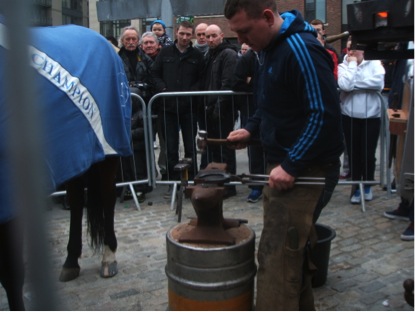
Smith hammering horse shoes at the horse fair
While walking through this soundscape, I encountered different kinds of soundmarks. For example, the banging of horseshoes was quite distinctive because it is, as Schafer would define, an archetypal sound, one that no longer belongs in the city. It felt like hearing a sound from the past. Yet this kind of sound creates a kind of historic continuity with the past (Barry Truax, Acoustic Communication, 2000). When discussing the cobblestones within Smithfield Square, most of the young female participants stated that it was not so much the look of the cobblestones that gave the space a sense of history but rather the sounds made when something moved over them. The lack of people and activities within the square meant that these sounds were rarely activated. The soundscape of the fair on those days transformed Smithfield, lifting it out of its everyday silences, which seemed to invite young people to participate. It was reactivated with life.
What was noticeable about the two fairs I visited was that by the second event in 2013, there were far fewer horses than at previous fairs. There were about 8 or 10 horses being paraded around the space by what looked like homeless people or addicts. There seemed to be no real horse-trading; the soundscape lacked the sounds of horses. Instead, the space had become a gathering space, with groups of tourists wandering around taking pictures of anything and everything.

Teenage boys outside the gates of the horse fair 2013

Teenage girls at the fair
Conclusion
This fair does not fit within the cultural ethos of regenerated urban spaces like Smithfield, where culture is defined as a consumerist process or part of the arts. However, the space takes on new potentialities as a result of the presence of people, sounds and activities, allowing the teenagers to view the possibilities of spatial use. Sounds can distinguish a space, as identified during the Smithfield horse fair. These sounds also remove focus from teenagers’ voices audible within the space, and transfer it to other sounds. The space was no longer a large fishbowl viewable from any angle; instead it had become a busy vibrant immersive soundscape.
—
Featured Image: “Smithfield Horse Fair, Dublin” by Flickr user Admanchester, CC BY-NC-ND 2.0
—
Linda O Keeffe is secretary to the Irish Sound Science and Technology Association and editor of the Interference Journal. Her practice is concerned with an exploration, both academic and creative, of the ways in which sound alters our experience of different spaces. Her art training was within the sculpture department of IADT under the tutelage of Finola Jones. She completed a Masters in Virtual Reality in NCAD with Kevin Atherton, and just finished a PhD in sociology in NUIM. Her research examined the urban of Dublin city soundscape as socially and technologically co-constructed. She has composed for dance, theatre, quartets, and new instrument performers, installed sound installations for commissions in Ireland, China and Holland, and has had radio works performed both nationally and internationally. In 2008 she was mentored under Eric Leonardson in Chicago, a sound artist and performer. More recently, she was commissioned by Resonance FM to create a work for radio for the 2013 Derry city of culture event. Current projects include a solo exhibition in November 2014 for the Limerick Sculpture Centre, which will be a creative realization of her PhD research. You can find her at www.lindaokeeffe.com.
—
 REWIND!…If you liked this post, you may also dig:
“Heard Any Good Games Lately?: Listening to the Sportscape”-Kaj Ahlsved
“Park Sounds: A Kansas City Soundwalk for Fall”-Liana Silva-Ford
“Sounding Out! Podcast Episode #7: Celebrate World Listening Day with the World Listening Project”
Share this:


Current Top Posts





April 2021

January 2020

November 2019

October 2019

August 2019

April 2014

November 2017

March 2015

December 2017

October 2015
 Sounding Out!


Recent Comments