
À qui la rue?: On Mégaphone and Montreal’s Noisy Public Sphere
 Editor’s Note: This month Sounding Out! is thrilled to bring you a collection of posts that will change the way you hear cities. The Sounds of the City series will prompt readers to think through ideas about urban space and sound. Are cities as noisy as we think they are? Why are cities described as “loud”? Who makes these decisions about nomenclature and why?
We kicked things off three weeks ago with my critical reading of sound in Lorraine Hansberry’s A Raisin in the Sun, a play about African Americans in Chicago that still rings/stings true today. Two weeks ago, guest writer Linda O’ Keeffe took readers on a soundwalk of Smithfield Square in Dublin, Ireland and specifically of the Smithfield Horse Fair, in order to illustrate how urban renewal disrupts city soundscapes and how sound reclaims those spaces. Last week, regular SO! writer Regina Bradley discussed the dichotomy of urban and suburban in the context of sound (noisy versus quiet) and hip hop.
Today’s post comes from CFP winner Lilian Radovac, who shares with us a critical photoessay on the sound installation Megaphóne in Montreal.–Managing Editor Liana M. Silva-Ford
Updated with edits as of 12:28 pm EST
***
October, 2013. I’m waiting for the 80. It’s already dark and bitterly cold for fall, and the bus is predictably late. As the line of people waiting lengthens, traffic rushes past on President-Kennedy and north along Jeanne-Mance, punctuating the larger roar of rush hour in Montreal.
Suddenly, a woman’s voice lifts up out of the din. It’s hard to make out what she’s saying at first, but then a single phrase escapes from the thrum of traffic: “…freedom and democracy…” I look around, trying to place the sound. It’s gone. Several minutes later, the voice rises again: “Tell us again about freedom and democracy!” This time, my ears get a lock on the words and I leave my place in the line to follow them to their source.
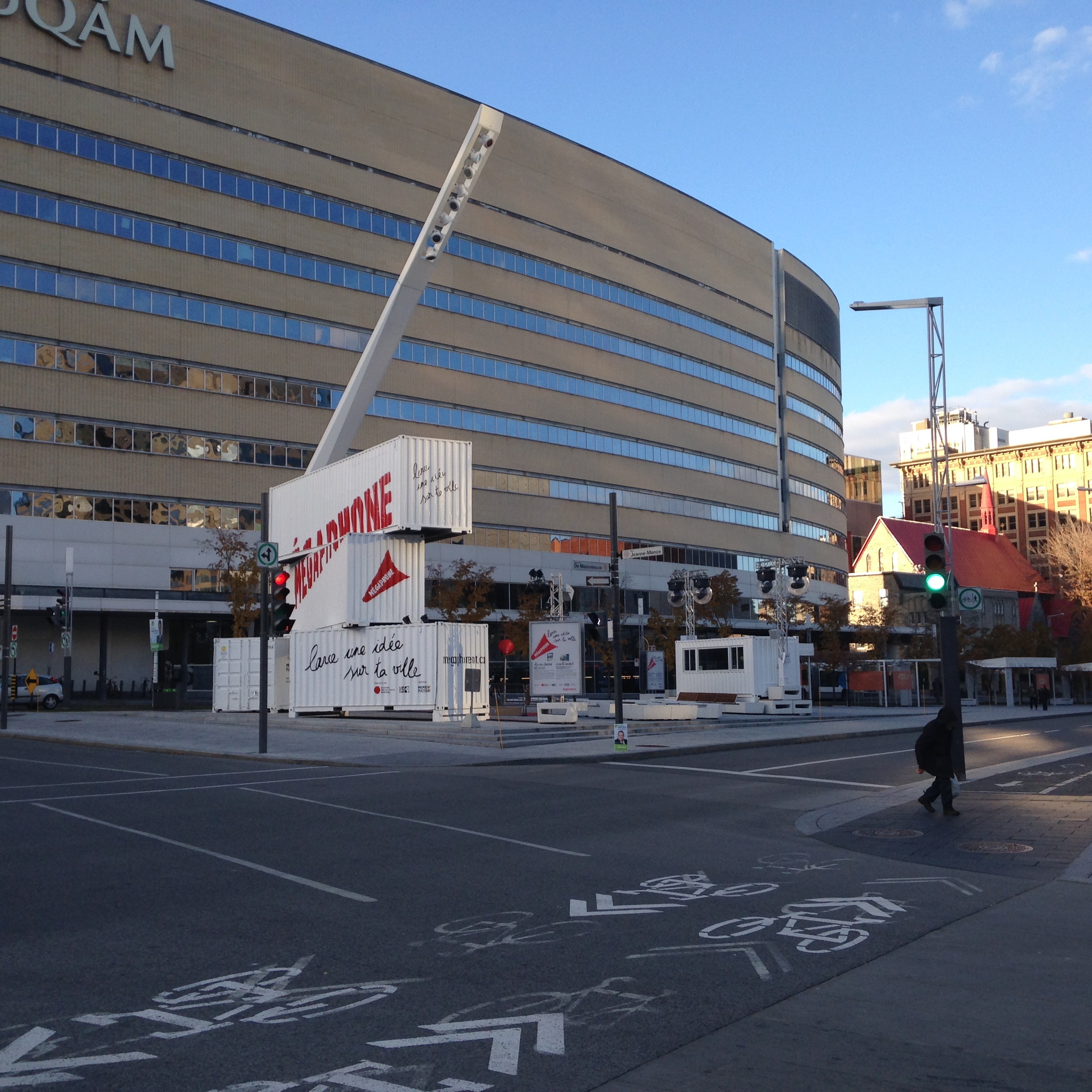
“Promenade des artistes”
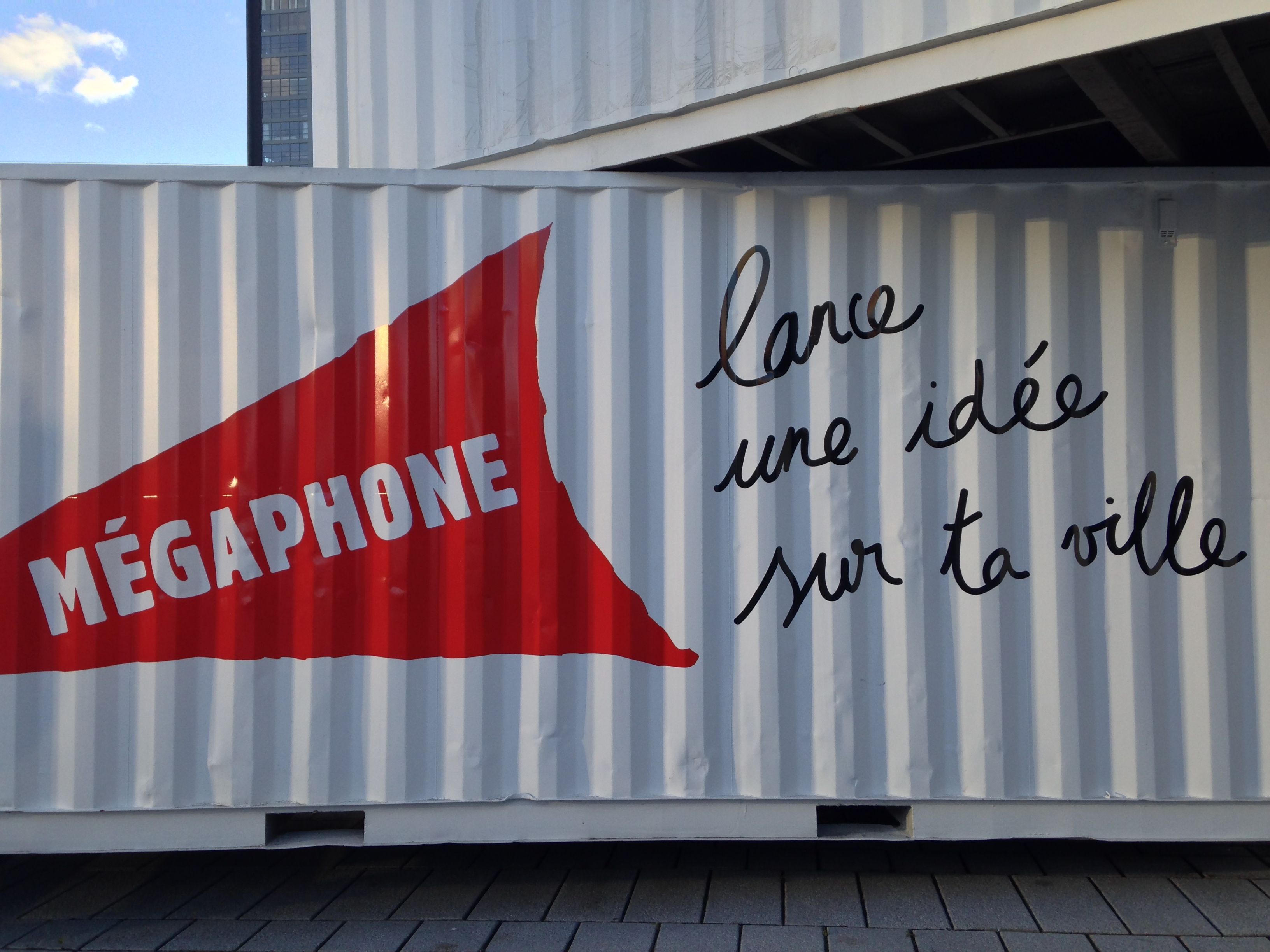
“Light up the city with your idea”
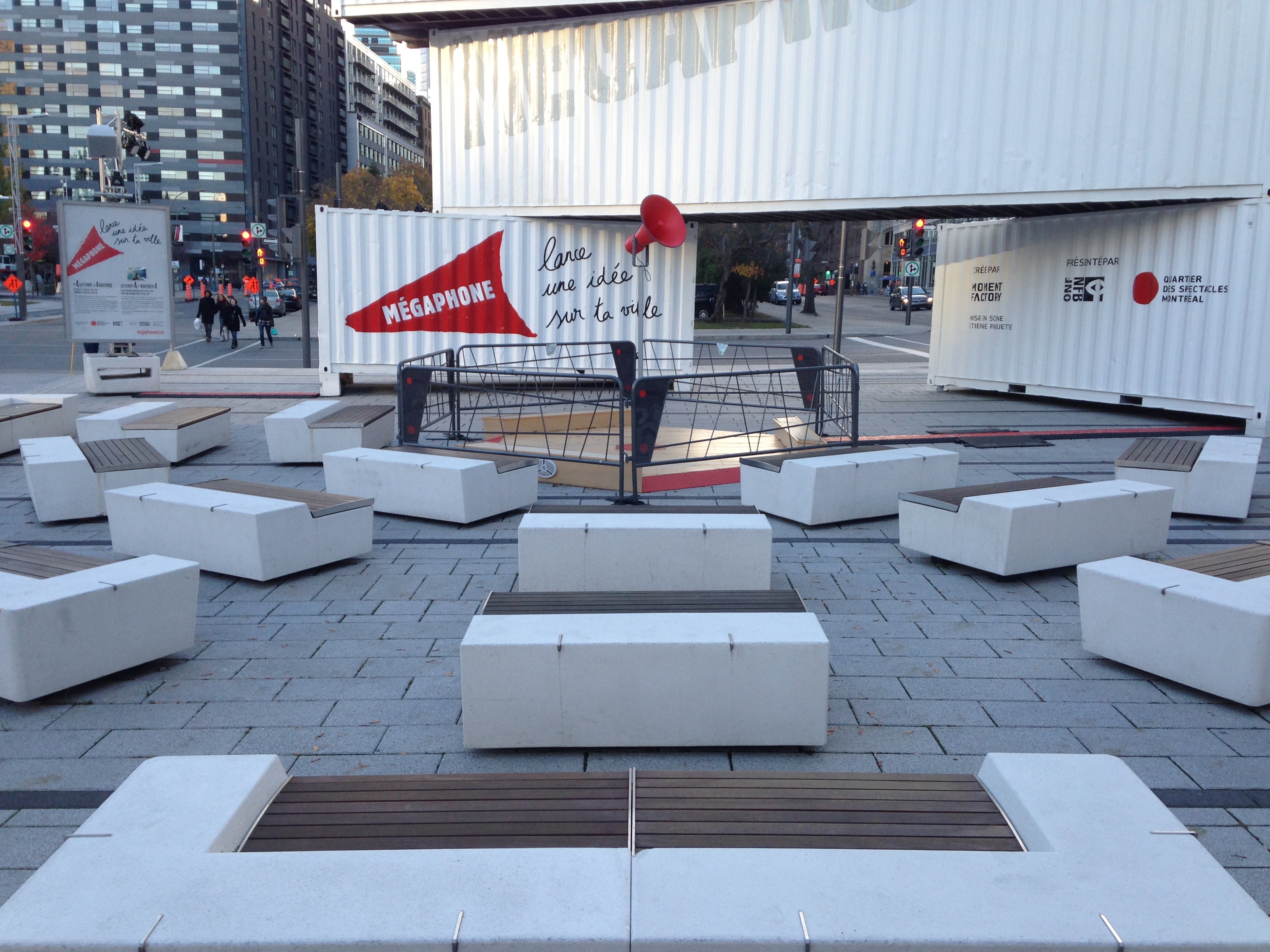
The amphitheater
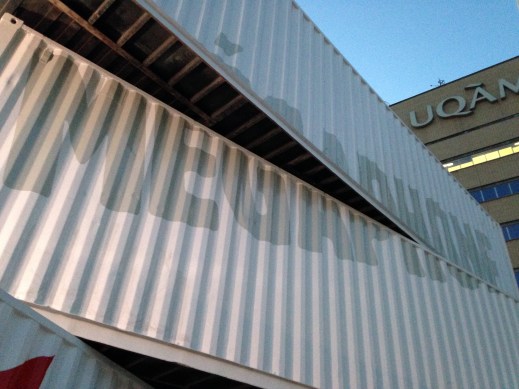
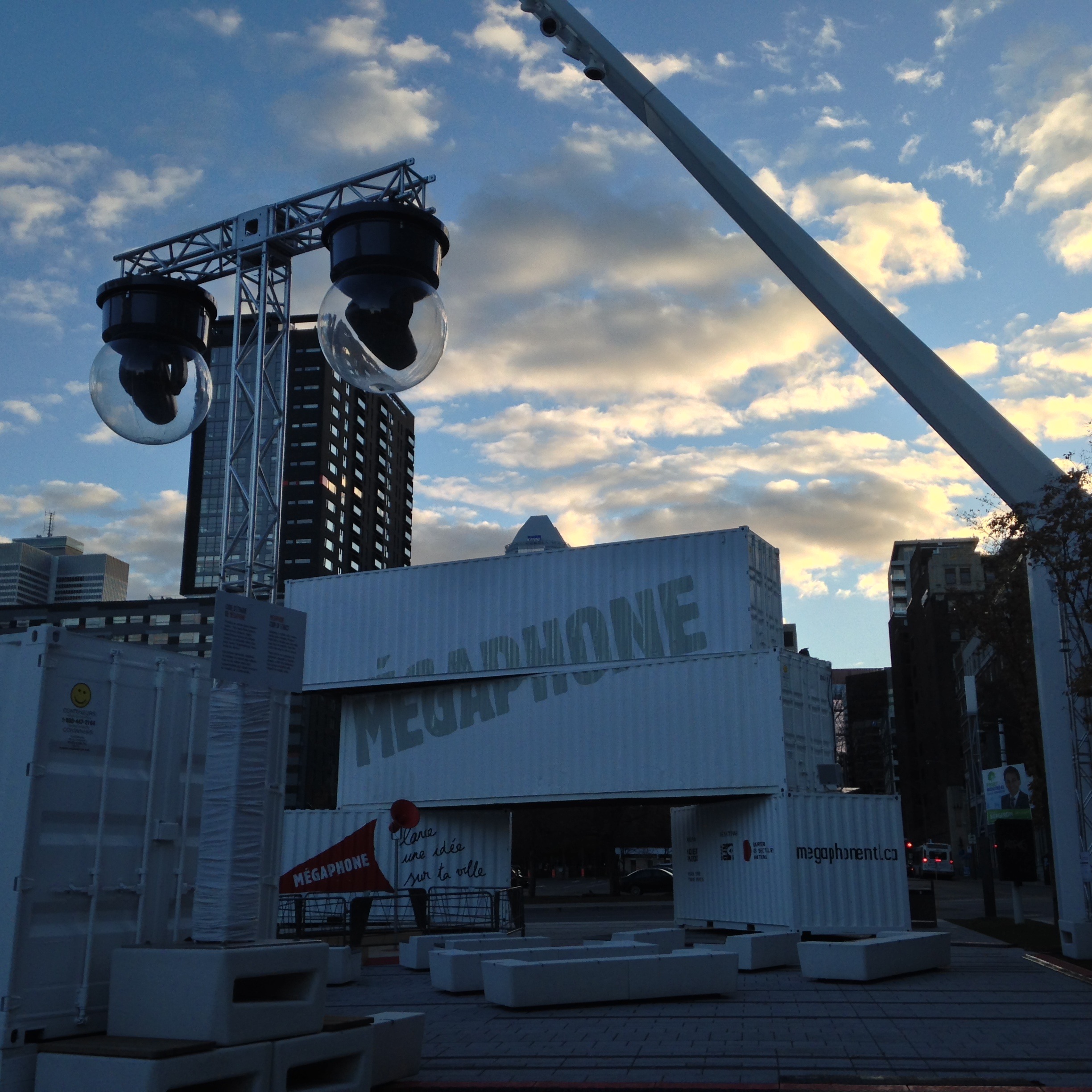
My feet bring me to the Promenade des artistes, a slim triangle of concrete that separates President Kennedy Avenue from De Maisonneuve Boulevard, and the sounds of Mégaphone. The promenade is the temporary home of the audiovisual installation produced by the multimedia studio Moment Factory, co-sponsored by the National Film Board of Canada and the Quartier des spectacles partnership. The installation is composed of three zones: to the west, a small outdoor amphitheater arranged around a large red megaphone; across the street, the University of Quebec at Montreal’s science pavilion, which doubles as a projection screen; and to the east, housed in a series of “event vitrines,” an audio exhibition of recordings by notable Quebec speakers who have “shaped public space in Montreal with their words.”
According to the accompanying press kit, Mégaphone is inspired by London’s Speaker’s Corner and Montreal’s interwar tradition of popular assemblies. Its stated goal is to “bring the art of public speaking back into the city.” It’s designed as an interactive experience, which encourages visitors to take to the stage during designated open mic periods and, by speaking into the megaphone, to “light up the city” with their ideas. Their speeches are first acoustically amplified, then processed by voice recognition software and projected onto the façade of the science building, which becomes a canvas for randomly generated keywords. Mégaphone is also timed to coincide with the run-up to Montreal’s November 4th municipal election, and features a program of scheduled speakers that includes an appearance by the city’s mayoral candidates.
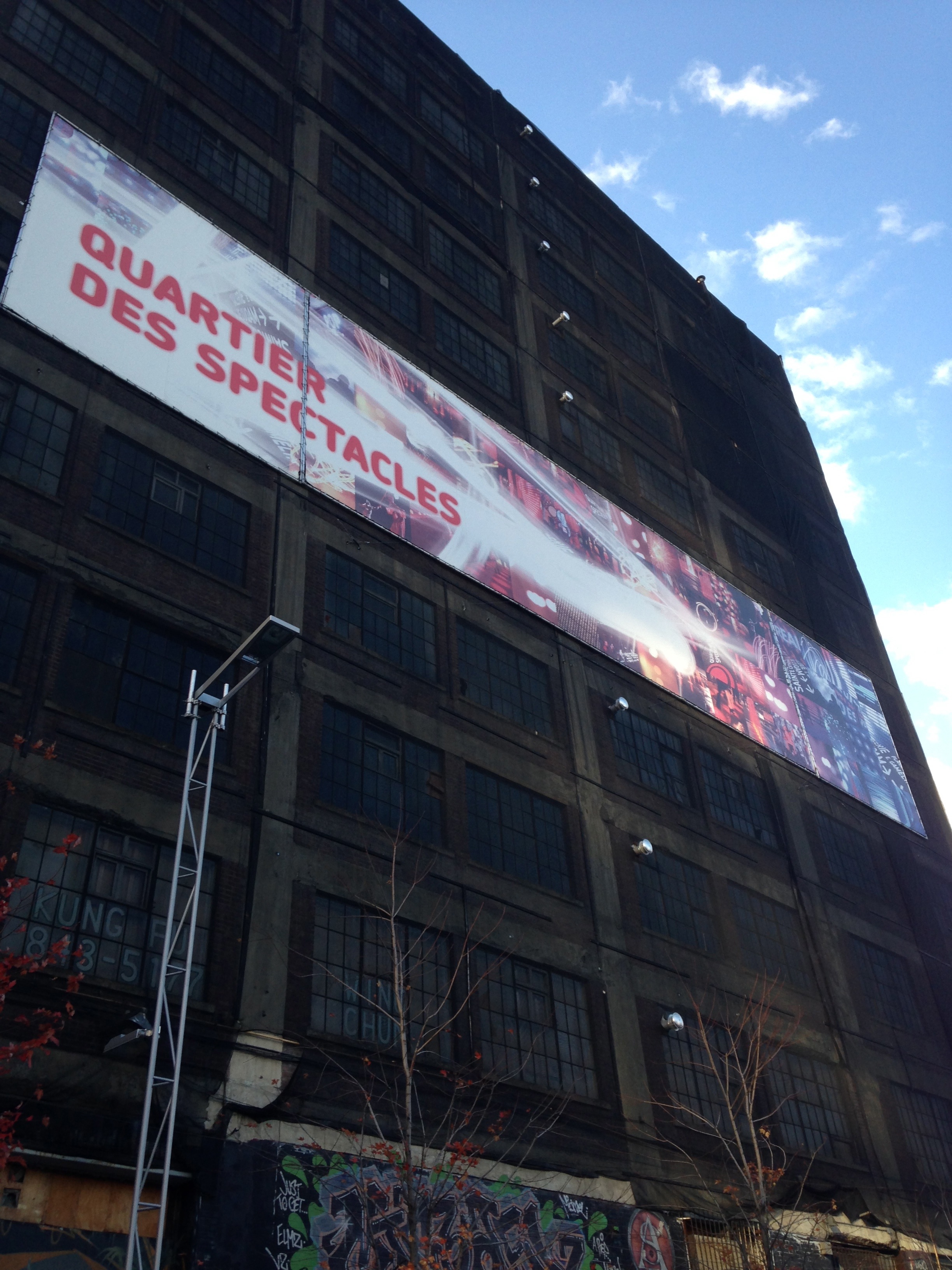
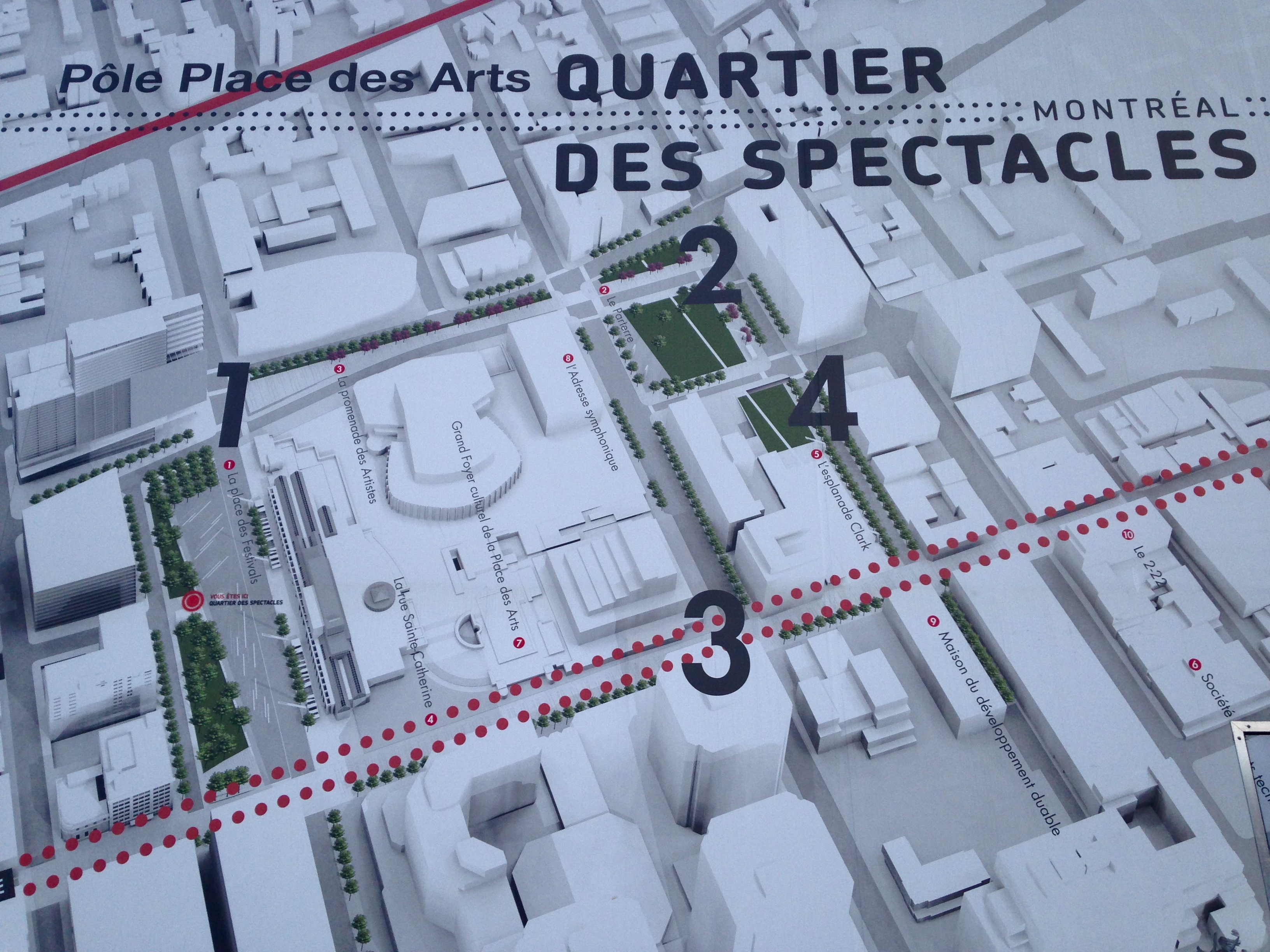
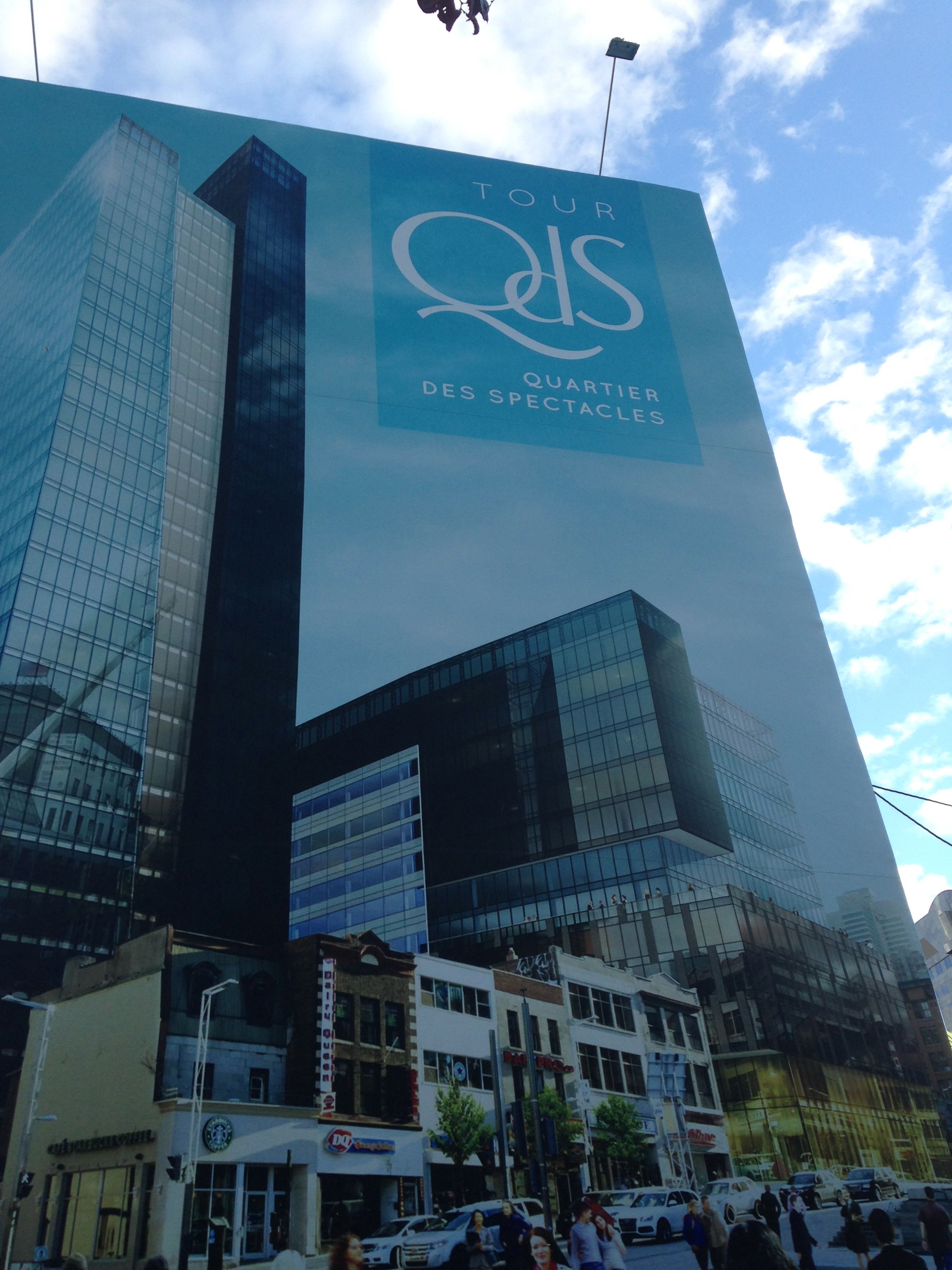
As I wander through the empty amphitheater, I find myself thinking that it’s a strange place for a sound installation. The Promenade des artistes is sandwiched between UQAM’s science campus and the northern border of Place des Arts, a Lincoln Center-style performing arts complex that occupies several city blocks. Jane Jacobs would have called this a “dead place,” lost as it is between a set of bicycle lanes and the science building’s indoor food court, which draws pedestrian traffic away from the open space of the street. On the day of my visit, I’m the only person there. Beyond the Promenade des artistes lies the larger Quartier des spectacles, an ongoing culture-led regeneration project which, in an effort to cement the city’s “brand” as a creative city, has concentrated Montreal’s outdoor cultural activities into a single, sprawling site. Traces of the working-class neighborhood it displaced peek out from behind construction fences, quietly attesting to the area’s industrial past.
Still following the voice, I walk towards the line of event vitrines, where seven audio exhibits map the aural contours of an imagined community made real. The speeches on display tell a story of Quebec’s emergence from its colonial past, when the province’s French-speaking majority was dominated by the Catholic church and a minority Anglophone elite. Each voice, in its way, speaks to a period of enormous social transformation fuelled by the dream of Quebec’s independence: Irving Layton delivers a lecture from an amplified podium; Gilles Vigneault sings “Gen du pays” from a stage at Parc Mont-Royal; Pierre Bourgault gives a firebrand speech at the Third Congress of the Parti Québécois. Only the seventeenth century Wendat Chief Kondiaronk remains eerily mute, his voice buried in the memoirs of his colonial French counterparts.
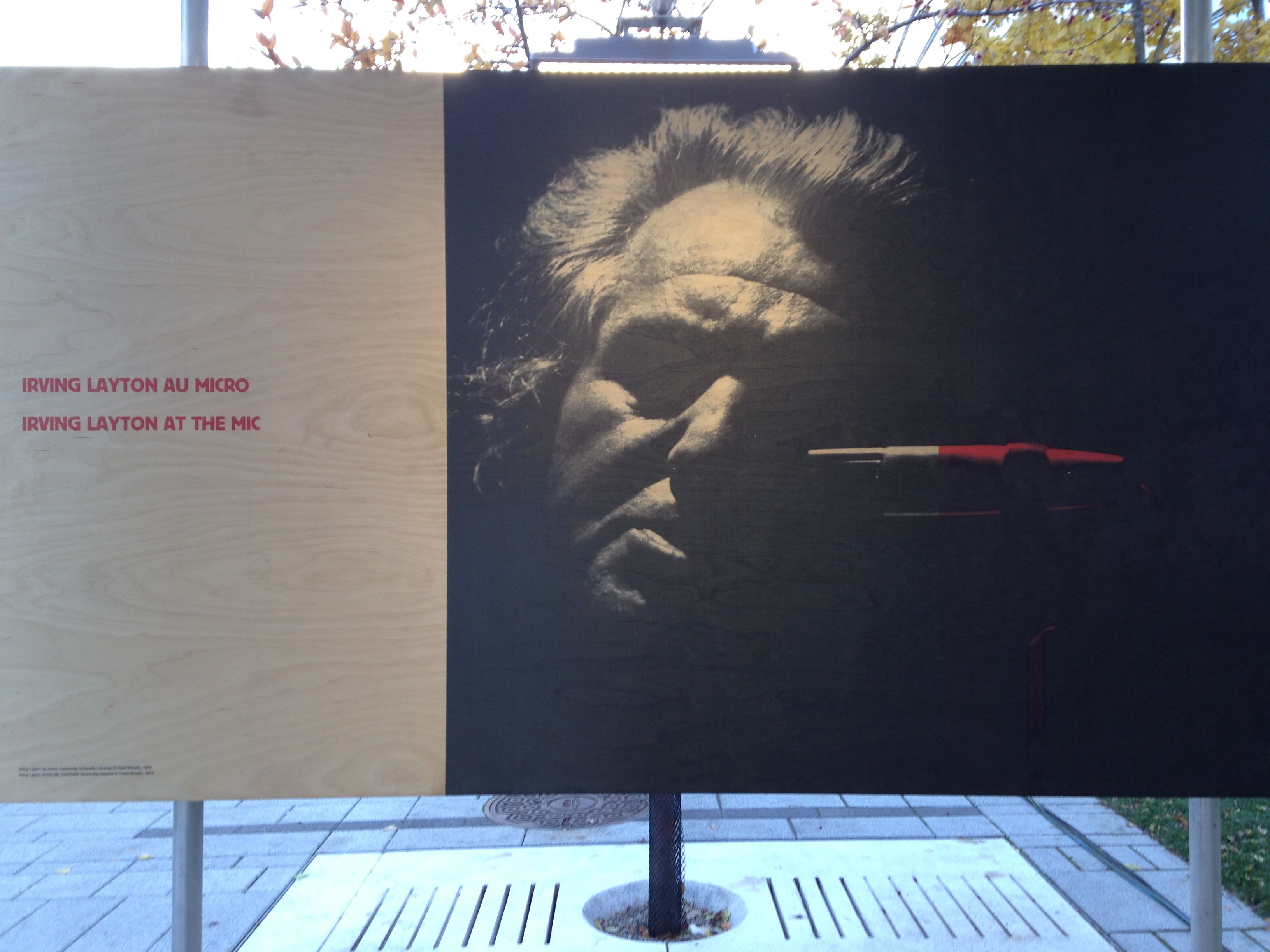
Irving Layton exhibit
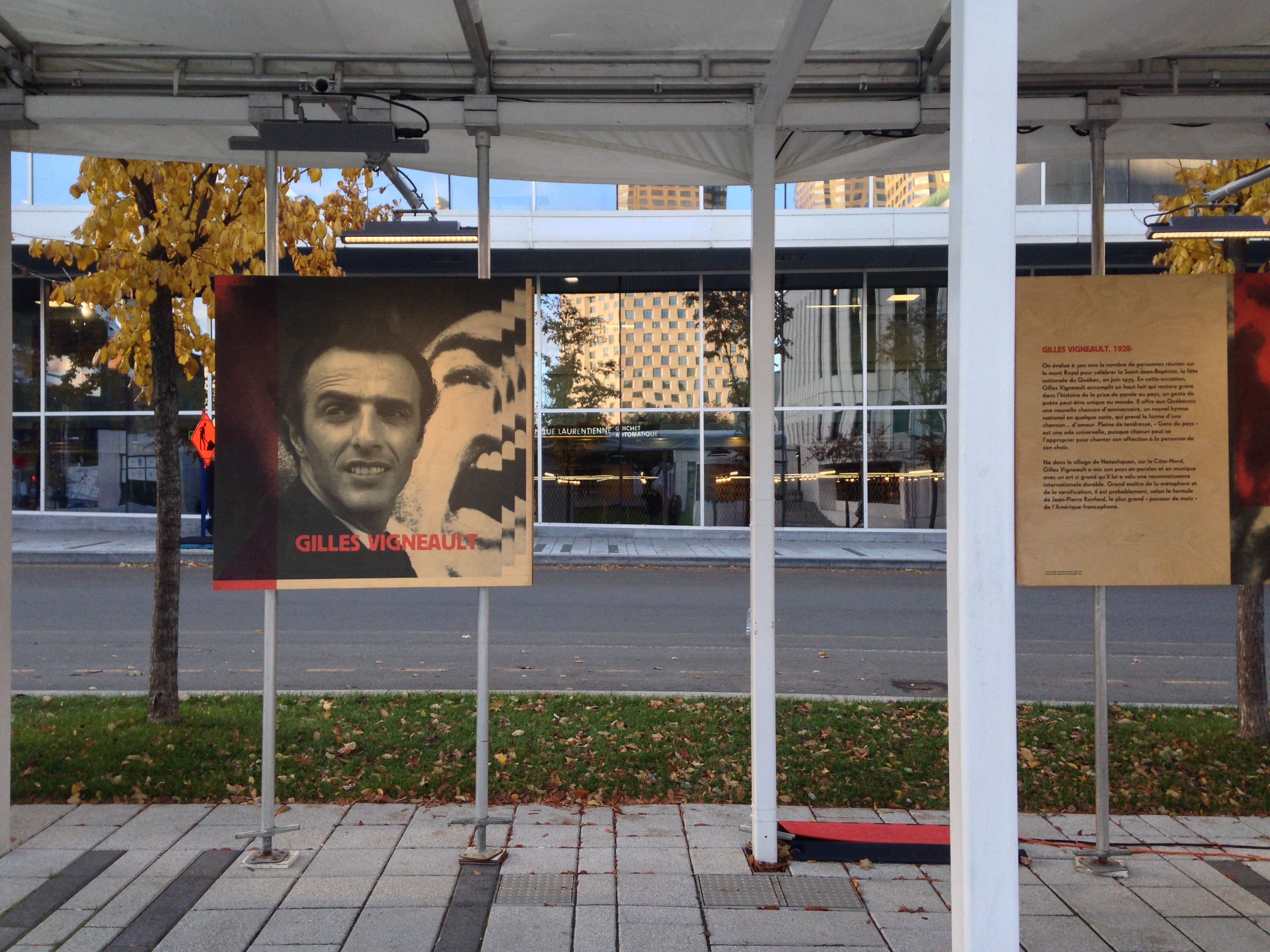
Gilles Vigneault exhibit
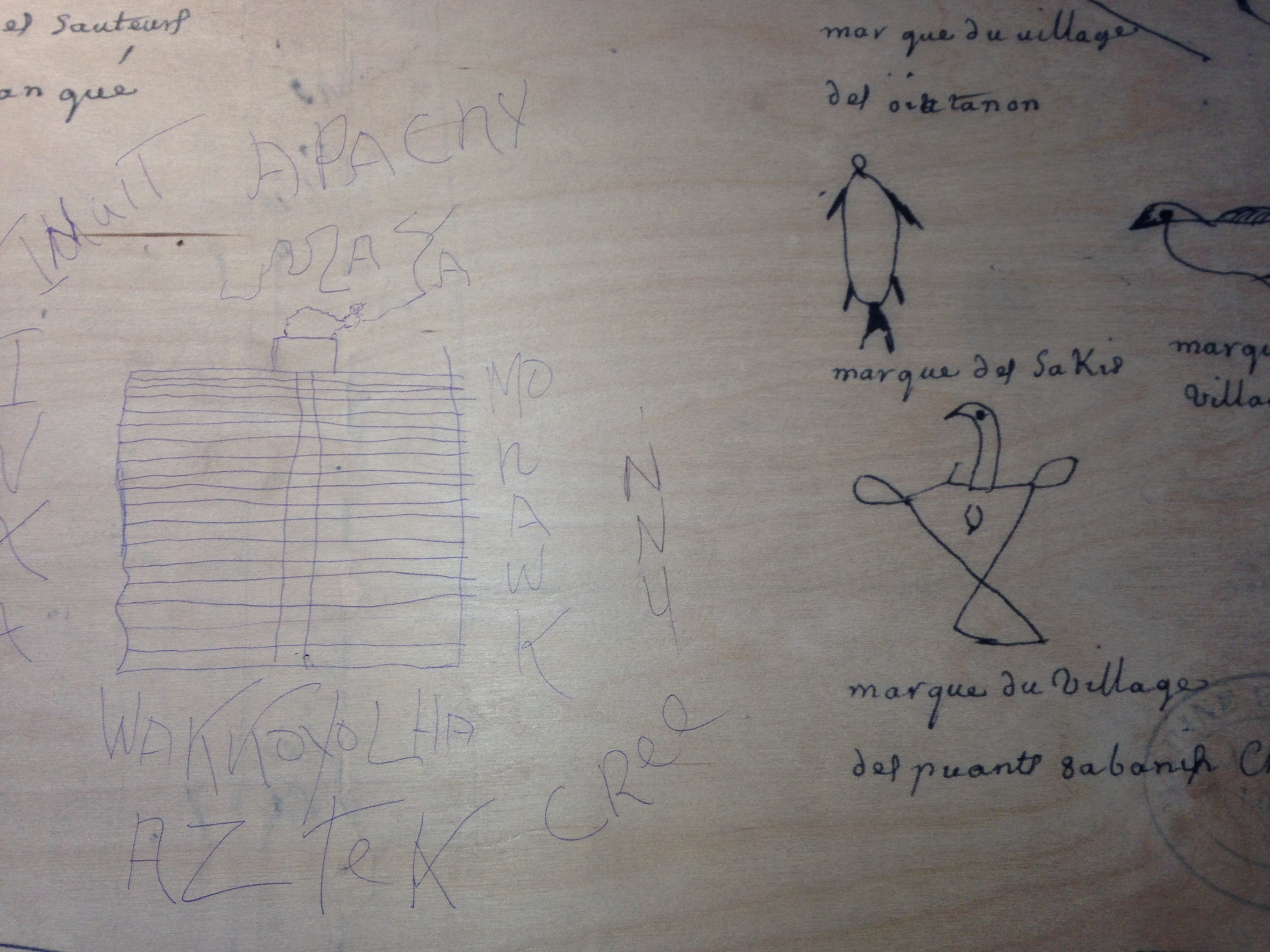
Kondiaronk exhibit, with graffiti
Poet Michèle Lalonde’s voice, however, dominates the space of the exhibit. It’s noticeably higher in pitch than the drone of traffic, and when it rises to meet the words “freedom and democracy” it pierces the low rumble of passing buses and trucks, filling the husk of the surrounding streets. The poem she reads is well known in Quebec, and the version on display here is central to the province’s history and identity as a nation. Recorded at La nuit de la poésie in 1970, the poem was first read at a 1968 benefit performance to support imprisoned members of the Front de libération du Québec, one of whom was Pierre Vallières, the author of Nègres blancs d’Amérique.
Inspired by Vallières’ memoir, “Speak White” is a double appropriation: of the English admonition to Francophones to abandon their mother tongue and, simultaneously, of the revolutionary potential of the Black Power movement of the 1960s, with which the most militant factions of the Quebec independence movement aligned themselves. It is, as Sean Mills has observed, an uncomfortable alliance in a province that struggles to recognize its own racism and status as a settler colony, but in the poetic space of Lalonde’s recitation the words still shudder with subaltern rage.
[Read English translation]
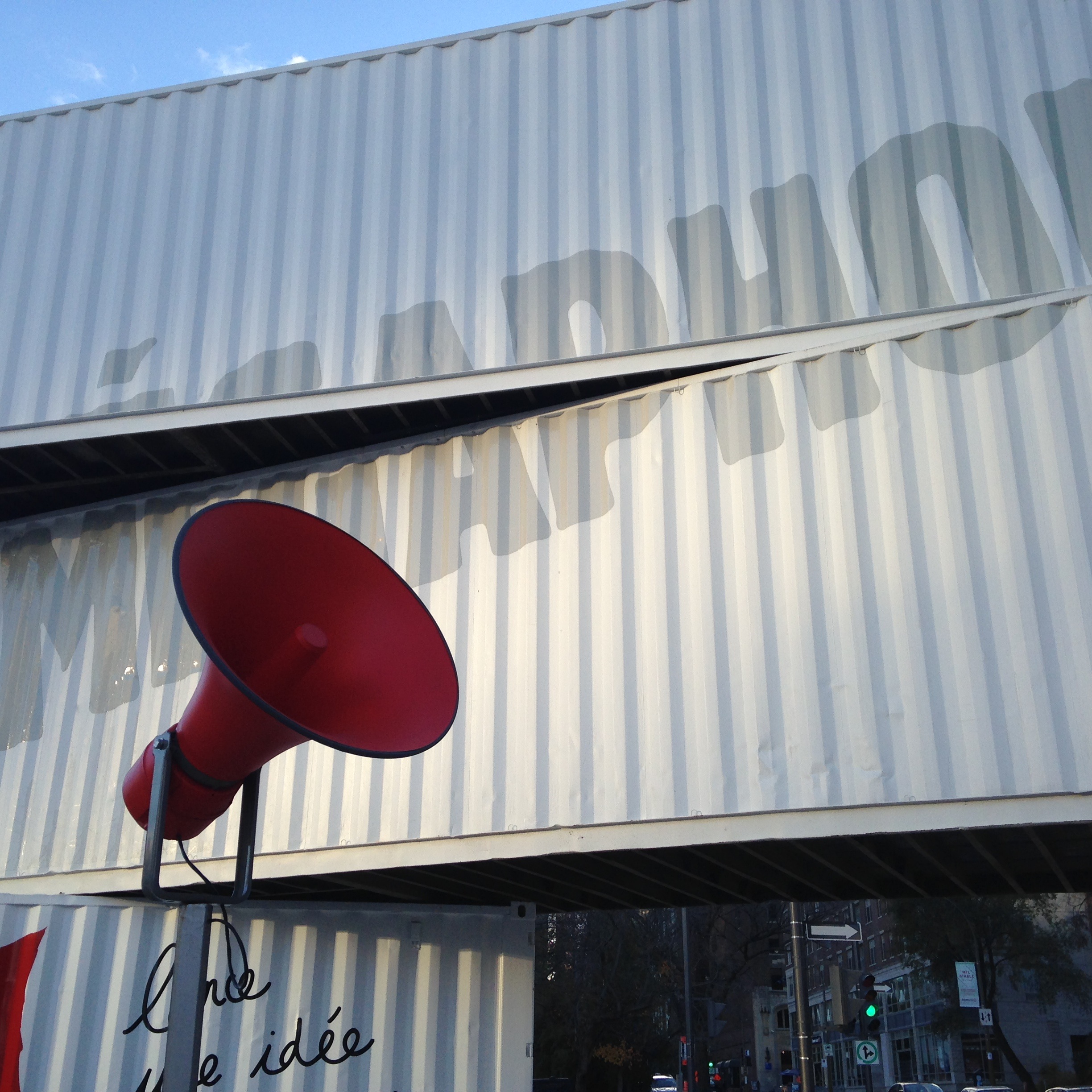
The term “megaphone” is something of a misnomer. The voices of participating speakers are amplified using a hand-held microphone that is connected to a stationary loudspeaker, which actually makes the megaphone more of a rudimentary public address system. It’s an important distinction, since the aural uses of the megaphone are shaped above all by its portability. Megaphones are a mobile audio technology and therefore a nomadic one; like boomboxes and iPods, they’re designed to be easy to carry and to be used while moving from place to place. The public address system, by contrast, is rooted in space: the speaking subject is anchored to the microphone and to the apparatus of amplification, which is composed not only of cables and loudspeakers but also the architectural elements (podium, stage, seating) of the auditorium.
More importantly, the portable megaphone is intended to be used outdoors and in crowds. Thomas Edison’s acoustic megaphone, which he patented in 1878, was soon used at sporting events and to magnify the voices of political leaders at outdoor public events. By 1900, street hawkers began selling makeshift megaphones to the politicians’ audiences, and their wares contributed to a new and noisy public sphere. When the megaphone was married to the transistor and to battery power in the 1950s, the technology was seized by social movements around the world, which used it to appropriate and disperse the power of the individual public speaker. Among them were the student and labor unions that flourished in the wake of Quebec’s Quiet Revolution, which had opened up a space for the province’s democratization.
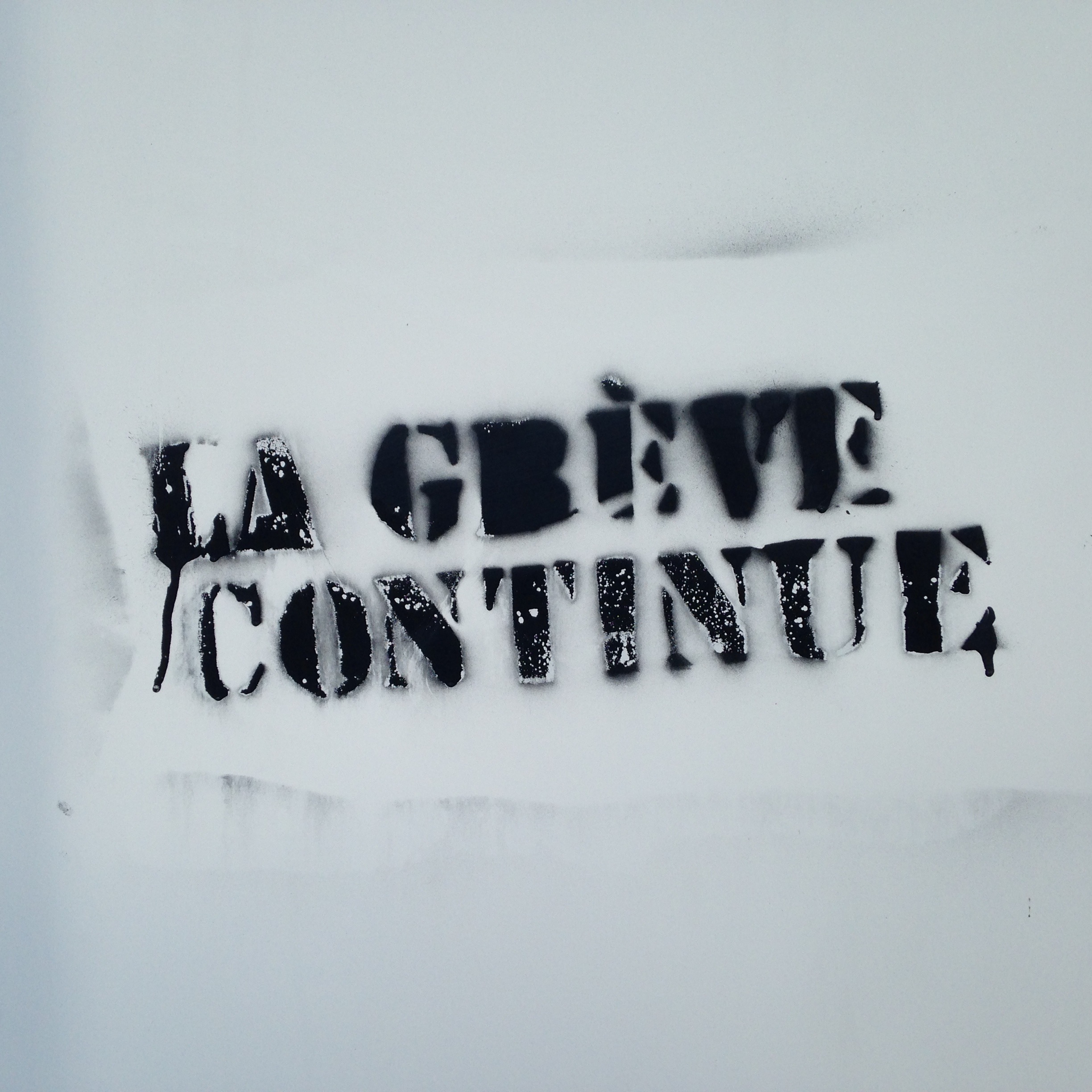
Strike graffiti
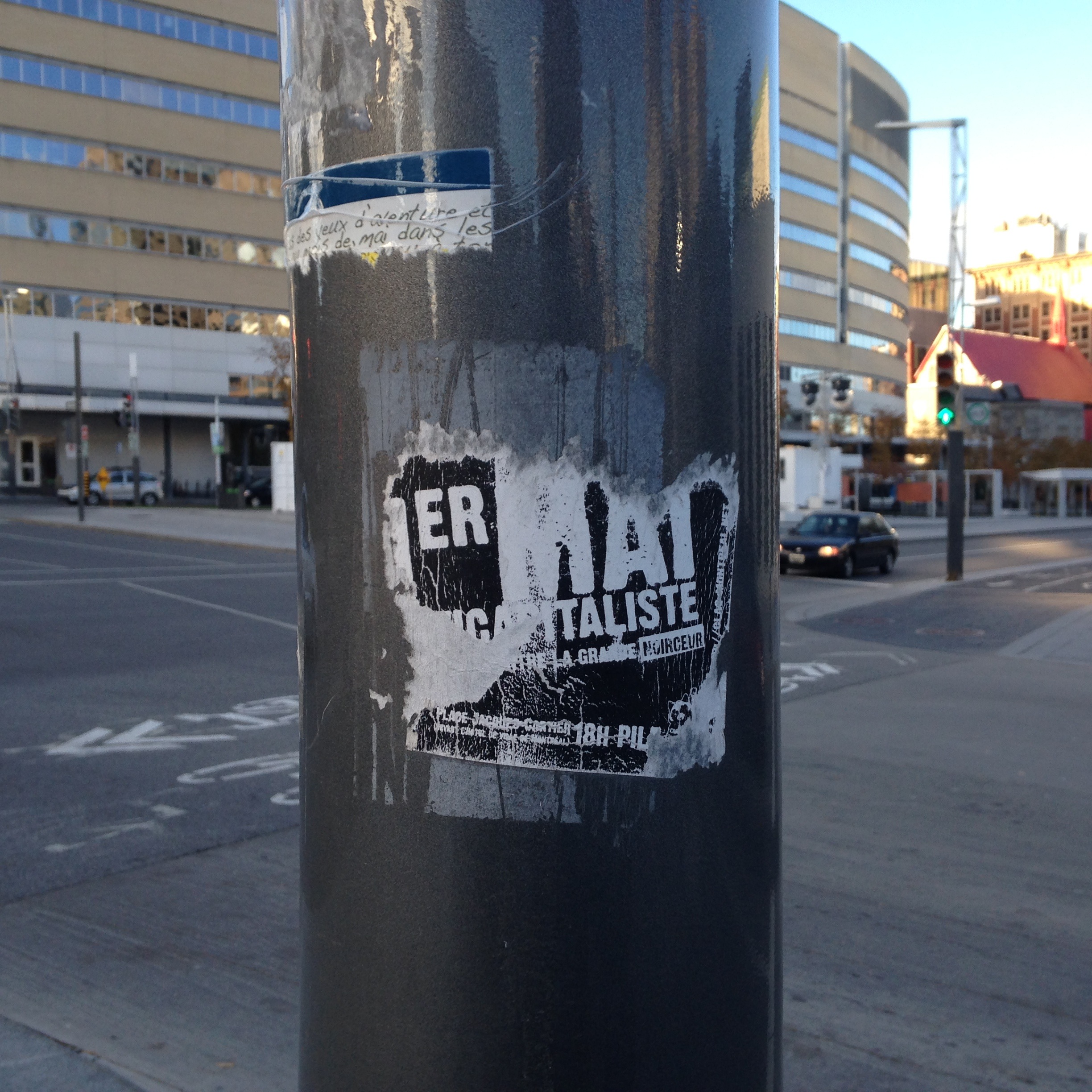
May Day poster
The year before Mégaphone opened, the promenades of the Quartiers des spectacles were crossed by hundreds and sometimes thousands of bodies that spilled out of Parc Émilie-Gamelin, where students and their supporters gathered for the nighttime demonstrations that became a hallmark of the Quebec student strike, or printemps érable. Each night at about 8:30 pm, we set off on marches that had no planned route and no final destination, walking for hours along streets that we claimed with nothing but our voices and the feet that carried them along. If you arrived late you could find the #manifencours on Twitter, or you could listen for the sounds of the crowd’s chants and the police helicopters that hovered constantly overhead, keeping large swaths of the downtown core awake until the early morning hours.
When the Liberal government attempted to break the strike with the reviled Bill 78, which required protest organizers to submit itineraries to the authorities in advance, the night marches dovetailed with a sudden explosion of casserole protests, which coalesced around autonomous popular assemblies organized at the neighborhood level. Within days, demonstrators fanned out across the city as roving bands of casserolières set off from Villeray, Mile End, Hochelaga, St-Henri and even staid, sleepy Outremont, erupting into cacophonous clangs and cheers as we found each other at the borders of our quartiers and merged into ever larger assemblages. If a city can light up with sound, then that is what happened here in Montreal.
These echoes of the printemp érable form the acoustic backdrop of Mégaphone, and the sounds of the installation are designed to bleed into listeners’ memories of the strike. But Mégaphone is as much about the management of acoustic space as a celebration of its potential. Walking through the Promenade des artistes, I’m struck by a palpable but unintended theme: containment. The voices on display, already tethered to their microphones, are further limited by a series of overlapping spatial and temporal boundaries. The stage is accessible only on certain days and during designated hours, and then only when not reserved for previously scheduled speakers. Like the Quartier des spectacles that surrounds it, the installation is segregated from the lived spaces of the city, out of earshot of most residents and removed from the rhythms of their everyday. As if to belabor the point, speakers are bound by the Mégaphone “code of ethics,” which permits “no tolerance for aggressive, obscene or hateful speech, or for any behavior that is not consistent with respect for public order [emphasis mine].” Presumably, the code does not apply to the Quebeckers whose commitment to radical politics earned them a place in Mégaphone’s pantheon of speakers.
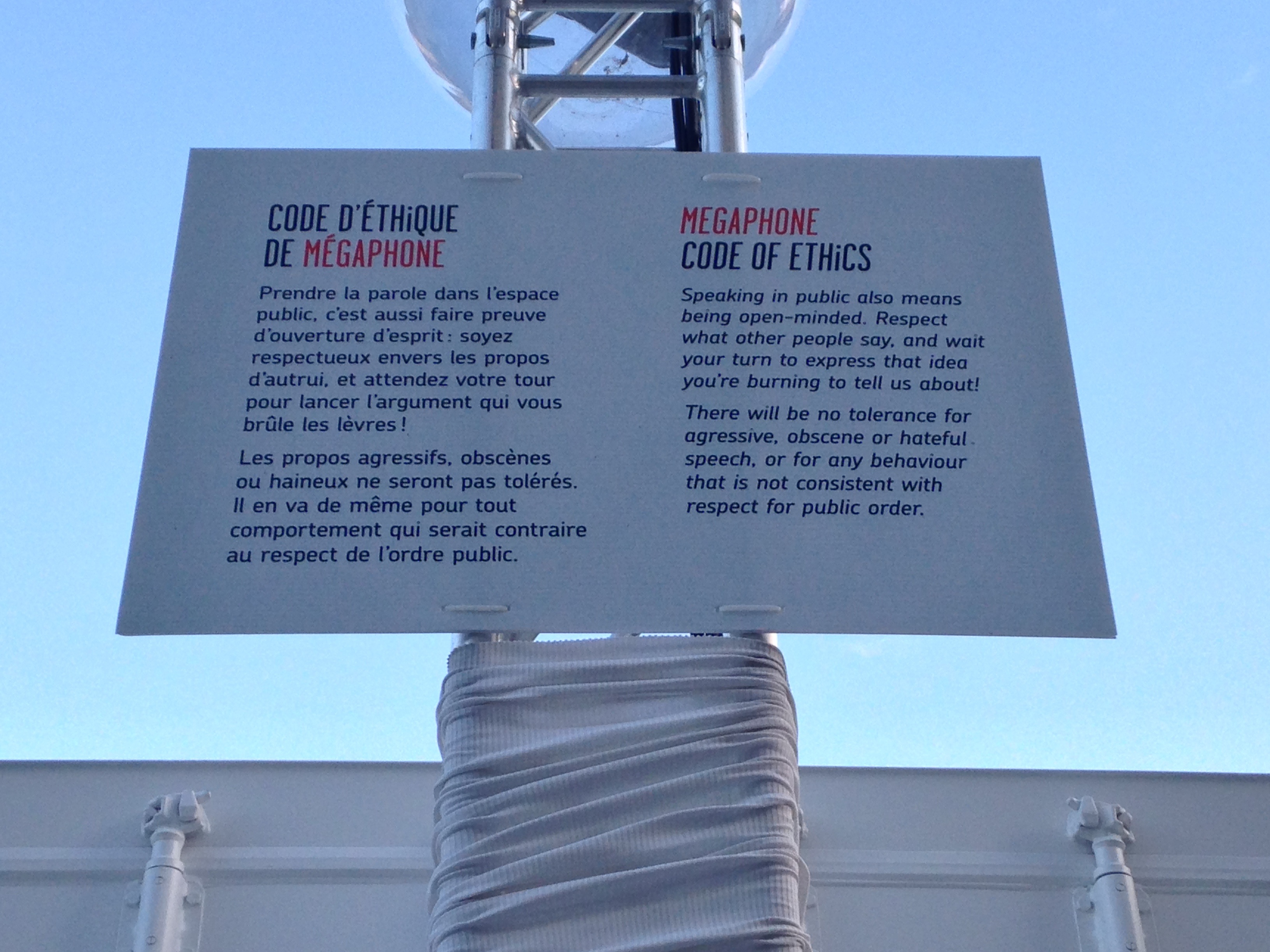
Code of Ethics
With its endlessly wandering marches and casseroles, the printemps érables was willfully inconsistent with respect for public order and its tactics reflected the anti-authoritarian impulses of the Quebec student movement. Simply by walking together, noisily and spontaneously, we recreated our city as a utopian space in which citizens, not governments, would chart their own course. By contrast, Mégaphone constrains the mobility of political speech, fencing it off in time and space and stripping it of its collective character. In doing so, it subjects the auditory space of the public sphere to what Don Mitchell terms a process of liberalization, drawing it away from the field of autonomous action and back under the stewardship of the state.
Philosophy professor Julien Villeneuve (better known as Anarchopanda) made this connection explicit when he and a group of fellow activists took to the Mégaphone stage to denounce municipal bylaw P-6, which, like Bill 78, requires protesters to inform the police of their activities under threat of arrest and massive fines. While Bill 78 (later Law 12) was repealed after a national outcry, P-6 remains in effect and its enforcement is in large part responsible for ending the strike and for the continuing suppression of public protest in Montreal.
As I walk back towards the bus stop, my fingers numb inside my mittens, I consider how much Mégaphone feels like a memorial to the city’s noisy public sphere, which, for the moment at least, is safely confined to the past.
—
Acknowledgements:
Sincere thanks to Jonathan Sterne, Erika Biddle, Magdalena Olszanowski, Ted Rutland, Liz Miller and the Tapas Gals for the conversations that contributed to this post.
—
Featured image: by Lilian Radovac
—
Lilian Radovac is a writer, organizer and doctoral candidate in communication studies at McGill University. She is currently finishing her dissertation on the cultural history of noise control in New York City, a chapter of which, “The ‘War on Noise’: Sound and Space in La Guardia’s New York,” was published in Sound Clash: Listening to American Studies (John Hopkins, 2012). Her work has also appeared in Times Higher Education, The Chronicle of Higher Education, TOPIA: Canadian Journal of Cultural Studies, and Communication and Critical/Cultural Studies.
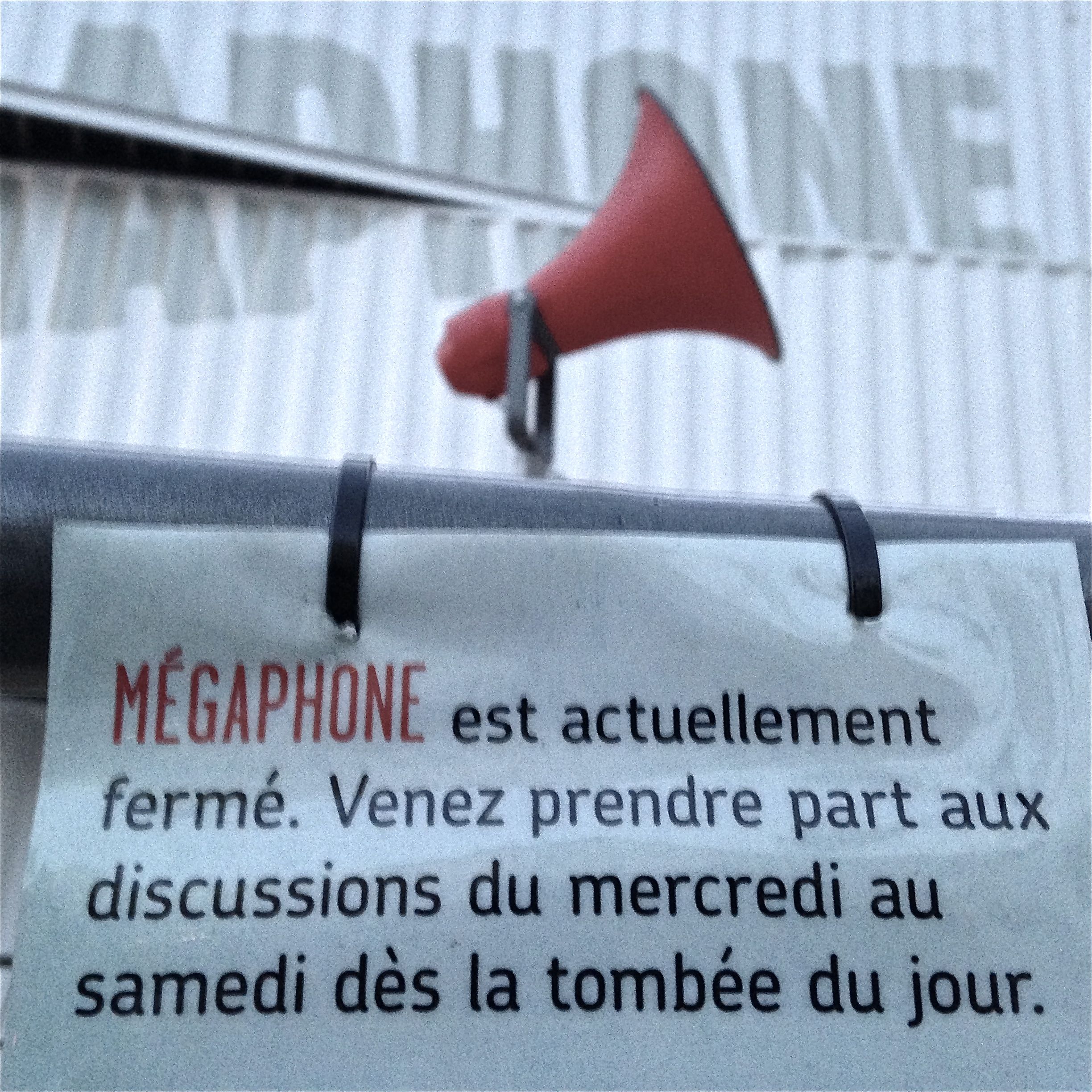
Fermé
—
 REWIND!…If you liked this post, you may also dig:
“Quebec’s #casseroles: on participation, percussion and protest”-Jonathan Sterne
“Deejaying her Listening: Learning through Life Stories of Human Rights Violations”-Emmanuelle Sonntag and Bronwen Low
“Listening to the Border: ‘”2487″: Giving Voice in Diaspora’ and the Sound Art of Luz María Sánchez”-D. Ines Casillas
Share this:

Deejaying her Listening: Learning through Life Stories of Human Rights Violations

 **Co-authored by Emmanuelle Sonntag and Bronwen Low
Are you listening?
Because sound specialist Julian Treasure argues, “We are losing our listening” due to the invention of multiple methods of recording and with the world being “so noisy . . . with this cacophony going on visually and auditorily, it’s just hard to listen, it’s tiring to listen.” In response, Treasure claims that we need to improve our conscious listening skills; he suggests teaching the skill of listening in school.
As co-directors of the “Education and Life Stories” working group of a large oral history project, we have been thinking a good deal about listening and pedagogy. The project is entitled “Life Stories of Montrealers Displaced by War, Genocide, and other Human Rights Violations,” shortened here as “Montreal Life Stories project.” From 2007 to 2012, a team of university and community-based researchers in the frame of the Canadian Community-University Research Alliances (CURA) Program recorded life story interviews with approximately 500 Montrealers who experienced mass violence and displacement. Members of the survivor communities (Tutsi, Haitian, Cambodian, and Holocaust) were key partners in both the research and the diffusion of the project, fundamentally shaping the project’s philosophy, activities and outcomes.
One of the Education Working Group’s principle accomplishments was developing an educational package called We Are Here, containing five Learning and Evaluation Situations (LES), the curricular units in the Quebec Education Program. The units are designed for “cycle two” secondary school, where the students are generally 14 to 16 years old. As of yet, these have not yet been piloted, but we plan to do so.
 Our goal while designing “We Are Here” was to have teachers and students engage with the life stories of human rights violations, in order to foster a more inclusive cultural memory that would develop “le vivre-ensemble,” our capacity to live well together. Featuring the stories of immigrants and refugees to the province, the curriculum offers students a more complex understanding of human rights violations. First-person accounts bring world history and politics to life, helping us to understand the processes and human costs of violence and war, and expand our awareness of our fellow residents and citizens. At the same time, we recognized that the difficult stories of human rights violations make particular demands upon their listeners. We needed to consider how to ethically support students and teachers in engaging with the stories of people who have survived traumatic experience—while, importantly, respecting the interviewees themselves.
We sensed from the beginning that these goals and commitments would require us to develop our own “pedagogy of listening” to support teaching and learning from the life stories, and we foregrounded listening in all of the materials. For instance, each unit begins with the students listening to one or more project interviews, in the form of digital stories edited collaboratively by the interviewees and the editor. These digital stories tend to be under 10 minutes and bring together video, images, sound, and text (see for example, Bracha Rosenblum’s digital story). They are much more accessible than the original video interviews, which can be many hours long.
There is an irony in building a case for listening in schools. Students are commanded daily to “be quiet and listen to the teacher.” Despite the long history in educational theory of critiquing this model, the student-who-listens-in-silence versus the teacher-who-speaks-loudly is still regularly invoked in practice as an ideal relation. The demand for silence is in part a pragmatic response to the inherent noisiness of schools filled with people. At the same time, the listening imperative is also a key tool in the establishment of teacher authority and power.

Image by Flickr User I Am Rudy
We wanted to rethink the process of listening in our curricular design beyond these traditional power dynamics. Our pedagogy of listening draws on concepts of testimony, communities of memory, dialogue, and the principle of shared authority in oral history, which we describe in detail elsewhere (forthcoming in the Journal of Curriculum Studies). In this blog post, we explore our pedagogy’s indebtedness to philosopher and musicologist Peter Szendy’s work on listening and its potential in the public school classroom.
Listening begins with the desire to be signed and addressed
The address is a central notion in Peter Szendy’s Listen: A History of Our Ears. The early 2000s, as Szendy explains, saw the birth of the peer-to-peer file sharing service Napster (created by Shawn Fanning in 1999), where listeners exchanged and circulated music. Through the lens of file sharing, Szendy began reflecting on the rights of listeners and the nature of musical listening more generally. He argues that sharing shapes the listening act: while listening can be passive–I am listening to you, receiving what you are saying–we also offer up what we are listening to. Rather than envisioning listening as a two-way engagement, Szendy triangulates it, structuring listening around a listening subject, the sonorous object the subject is listening to, and the addressee (le destinataire) of the subject’s listening. In Szendy’s theory of address, as we listen to somebody or something, we also address our listening to an “other” (who might be another beside me, or in myself).
That students would address and engage with “an other” through their listening appeased, in part, our concerns about having students listen to difficult stories of mass violence. If listening is akin to a peer-to-peer sharing system, students were somehow not “alone” anymore in the experience; listening is a building of relation.
Closely related to the concept of listening as address is Szendy’s idea of signature, especially through the digitalization of sound where “listeners become authors” (136) naming, tagging, and classifying the files that they share with others. Szendy describes this process in terms of the singularity of listening:
It is more simply as a listener that I want to sign my listening: I would like to point out, to identify, and to share such-and-such sonorous event that no one besides me, I am certain of it, has ever heard as I have (3).
While all listening necessarily involves an appropriation of what has been listened to, we wanted to amplify the process of students “signing” or marking their listening, and so making it their own. We would deepen students’ engagement with the video interview and the “other” by having them actively edit, rework, even remix, and so adapt the original. We gave students the right to enter into the difficult stories from the survivors interviewed in the Montreal Life Stories project, responding as individuals and as members of a classroom community. While the dynamic of students listening to and making something in response to the life stories takes many forms in our curricular units (including timelines, maps, and audio-tours), we here share the unit which most explicitly embodies the remixing in Szendy’s notion of listening.
What a Story!
What a story!: Life stories and digital storytelling, is designed for senior students in the English Language Arts, and asks students to work in groups to create their own digital story version of a segment from one of the life story interviews.
In the preparation phase, the students listen to a 5 minute digital story of a Holocaust survivor living in Montreal that enables them to discover the multimedia elements and narrative structure of a digital story.

In the production phase, students approach their main task: producing a 5 minute digital story from a 34 minute life story interview with another Holocaust survivor. The phase begins with “deep listening” exercises where students work in groups to summarize the story and decide which parts of the larger interview they would like to keep in their edited versions. In doing this, they reflect on their experience as “listener“ vs. ”reader” and their responsibilities as listeners of difficult stories.
While the expression “deep listening” recalls the work of the composer Pauline Oliveros, in the Montreal Life Stories project the concept stems more directly from the notion of “shared authority,” a phrase coined by oral historian Michael Frisch (1990) to describe the process of co-creating an interview. The community-university model was collaborative at all levels, and researchers and the researched were partners in dialogue. In turn, we frequently used “deep listening” (as in the profound listening between interviewers and interviewees) as an expression during our working sessions. The concept also draws on the work of oral historian Martha Norkunas on interview techniques and deep listening exercices; her visit to the project shaped our curriculum design process, and students are encouraged to engage in dialogue and sharing, and to “Listen with close attention and deeply, in an empathetic and respectful manner.“(13). These appeared, to our eyes, to be consistent with Szendy’s notion of listening as address and signature.

The production phase continues with the creation of the digital story, the editing and the montage. Students then reflect on the ethics of the process of cutting and reworking another’s story, exploring the way narratives can be modified, the meaning built into the digital story vs. the meaning of the interview, and the question of narrative form.
Peter Szendy chooses the deejay, or of the musical arranger, as a figure for the contemporary listener. Indeed, we imagined the students in groups, headphones on, in front of computers, slowing down the cadence, augmenting the sound, rewinding or fast-forwarding, cutting, pasting, annotating. We thought of them as highly skilled listeners, intervening in what they were listening to and interpreting their listening for the “other” ( in the manner of composition theory in which students are asked to write for real audiences for real purposes). As deejays of their listening!
Having students edit the life stories of others, especially stories of violence and war, brings with it risks of misinterpretation and manipulation. However, the unit asks students to think carefully about these risks, and unlike projects which use testimonies in the service of someone else’s argument, this editing assignment has students select from the larger interview in order to craft a narrative that respects the original. As Norkunas says, “When Michael Frisch coined his now famous phrase, “a shared authority,” he wrote of the shared responsibility of listener and narrator for creating the interview document, for interpreting it and for sharing the knowledge created.”(2) If editing and interpreting are critical to the process, adds Norkunas, “the first moment of creation takes place in the interview, in the act of listening.” Hence, the ethical issues raised by the editing assignment–and more generally by having students and teachers engage with personal stories of human rights violation–are addressed by considerable attention to the act of listening (13), and by the cultivation of trust, dialogue and sharing. In short, an attention to the “other.”
Rather than deciding that this content is too challenging for students or reproducing a passive listening dynamic in which students listen to the interviews in reverential silence, we work to support student engagement — as both an attention and response — with these stories as part of a community of listeners. And while listening to these stories can be difficult work, we hope that through our pedagogy of listening, students will gain a greater awareness of the lives of those Quebecois who are not often part of the national narrative, and grapple with some of the difficult knowledge of human pain and survival.
—
Bronwen Low is an Associate Professor in the Department of Integrated Studies in Education at McGill University. She researches the implications of popular culture for education, curriculum theory, and adolescent (multi)literacy practices. Areas of interest include hip-hop and spoken word culture; informal, arts-based and participatory education with youth; and community media and participatory video programs.
Emmanuelle Sonntag defines herself as a “knowledge organizer.” She offers consultancy services in communication, education, curriculum design, information management and knowledge mobilization while pursuing her PhD in Sociology on… Listening at Université du Québec à Montréal. She tweets on listening, sounds, stories and other noises @lvrdg.
—
 REWIND! . . .If you liked this post, you may also dig:
Audio Culture Studies: Scaffolding a Sequence of Assignments–Jentery Sayers
The Sounds of Writing and Learning— Liana Silva
Listening to #Occupy in the Classroom–– Travers Scott
Share this:


Current Top Posts





April 2021

January 2020

November 2019

October 2019

August 2019

April 2014

November 2017

March 2015

December 2017

October 2015
 Sounding Out!
Recent Comments