
An Ear-splitting Cry: Gender, Performance, and Representations of Zaghareet in the U.S.

At the opening of a recent annual “Under a Desert Moon” concert presented by Sahara Dance, a belly dance studio located in Washington, DC, one of the teachers began by telling the audience that the dancers would appreciate vocal feedback during the show. Holding a microphone with one hand and the other in front of her mouth, she demonstrated the practice known in Arabic as zaghareet, asking audience members to imitate her sound. This pedagogical interaction with an ethnically and generationally diverse audience on the campus of American University illustrates some of the complexities of translating sonic practices across cultural and economic divides. Zaghareet carries very different weight in a Palestinian wedding in the West Bank, where it is one piece of a larger formation of celebratory experience, than it does in a belly dance performance in Washington, DC, where it is used in part to generate authenticity in a tradition both geographically and culturally removed from the Middle East.
Located somewhere between singing and yelling, ululation occupies a unique position in the spectrum of human vocality. The sound is created by touching the tongue either to the sides of the mouth or the teeth in rapid succession, and it is characterized by a piercing sound quality enacted in the upper vocal register.
Having taken belly dance classes in the U.S. and seen a number of performances, I thought I had a sense of what ululation was and what it represented. The more I ran across it in the course of my dissertation research, however, the more I wanted to know about its historical background and affective meanings across contexts. In other words, what are the cultural genealogies of zaghareet in the Middle East, and how has the sound been perceived and represented in the U.S.? Although ululation is performed in a range of locations in South Asia, the Middle East and North Africa (MENA), my research is on U.S.-Middle East sonic encounters, and thus I will focus primarily on that context in this post. In particular, I became interested in why female voices typically perform zaghareet, and how its circulation in U.S. media and pop culture fit into larger narratives about the Middle East before and after 9/11.
Zaghareet is auditorally conspicuous, and in U.S. during the postwar decades before 9/11, it was often framed as a sonic encapsulation of an Arab exotic. The sound itself came to invoke elements that constitute classic Western stereotypes about the region known as the Middle East: veiling, gender oppression, desert wandering, and pre-modern ritual. Its status as a primarily female practice made it appealing as a sign of difference, since the West has been notoriously preoccupied with the status of women in the Middle East (see Chandra T. Mohanty, “Under Western Eyes: Feminist Scholarship and Colonial Discourses;” Lila Abu-Lughod, ed., Remaking Women: Feminism and Modernity in the Middle East; Leila Ahmed, Women and Gender in Islam: Historical Roots of a Modern Debate, among others). Zaghareet poses a contradiction to this orientalizing logic, as it works against the image of the oppressed Arab woman “silenced” by her surroundings. Instead, her voice takes on an uncanny resonance, indicating the tantalizing alienness of Arab culture. In a post-9/11 U.S. context, zaghareet become directly correlated with premodern barbarity, taking on more menacing anti-American associations. By taking a critical approach to the practice of zaghareet and its representations I hope to deflate some of these prevalent views and help to develop a new framework for thinking about aural exoticism.

Celebration of Egyptian revolution in DC, 2011, Image by Flicker user Collin David Anderson
Zaghareet’s combination of high pitch, loud volume, vibrato, and tongue oscillation contributes to its prominent, distinctive sound. In Jennifer Jacobs’ dissertation on ululation in the Levantine context (the term Levant refers to a region made up of Syria, Lebanon, Jordan, Palestine/Israel, and other areas in the Eastern Mediterranean), “Ululation in Levantine Society: The cultural reproduction of an affective vocalization” she points out that zaghareet typically last approximately 3 1/3 seconds, which is longer than the articulation of most words in speech, but not beyond the length of a typical speech phrase (111). Thus, though it is not speech or singing, zaghareet is related to these vocalizations in the sense that it lasts approximately the length of one breath. The practice is most often performed by women, and its acoustic intensity is remarkable considering that in an indoor setting with the performer near the microphone it can reach 85 dB, a level that can cause hearing damage with prolonged exposure. These components highlight the significance of zaghareet as a primarily female performance, making the practitioners audible at a level that isimpossible to ignore.

Woman at pro-Palestinian rally in France, Image by Flickr user lookingforpetry
Zaghareet takes place within a unique set of circumstances with a range of other sounds occurring simultaneously, and therefore should be conceptualized as part of a web of social meanings and practices, not as a discrete element to be observed on its own. The history of zaghareet (and ululation more generally) reaches back to ancient Greece, where the practice was referred to as ololuge, an onomatopoetic reference to the sound. In the 21st century Levant, zaghareet is often part of social gatherings where live music and dancing are also present. While most often situated in celebratory social settings, zaghareet can also take place in a variety of everyday circumstances, but in almost all cases it connotes farah, or joy. Performers generally do zaghareet to express their excitement, delight, and/or encouragement to others present. The practice tends to be contagious in that after hearing it others tend to join in, but the exact origins of the sound can remain mysterious due to the fact that most practitioners cover their mouths with their hands or clothing. This produces an omnipresent effect that both dislocates the listener and develops shared experience, and the collectivity of the performance magnifies its affective power. Jacobs writes, “When one person begins performing zaghareet, another person might join in; then, a third person might also join just as the first vocalist is dropping off. This overlapping of performances creates a perceptual experience of zaghareet as something layered, continuous, and emanating from different spatial locations, a haunting bodily experience, especially for a first-time listener” (75). This is complicated by broader soundscapes in which it is performed, which may include music, clapping, firing of guns, traffic, and other sounds.
In addition to performance setting, gender is a key component of zaghareet. While it is performed more often by women than men, in certain contexts and communities, men do participate. Jacobs describes one case in which men had demonstrated that they could skillfully perform zaghareet, but only minutes later jokingly denied that they knew how to do it when she asked. This emphasis on modesty is also apparent in the way that most female practitioners cover their mouths while doing zaghareet to hide the movement of the tongue, which tends to be considered immodest or impolite. In this Youtube clip, for example, the zaghareet performer covers her mouth with her hijab:
.
And as is shown in the clip, zaghareet often takes place in homosocial environments where men are not immediately present, providing space for playful exchange between women in ways that heterosocial settings may not. The homosociality of the sonic practice is related to its affective reverberations, as the sound is used to convey bonds of attachment, conviviality and mutual appreciation between women. In this sense zaghareet embodies these interpersonal connections, and also reinforces them through its aural intensity.
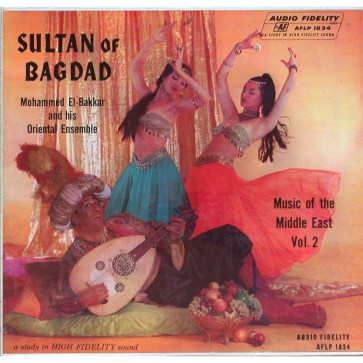
In American and European popular culture, zaghareet has played a notable role in framing depictions of the Middle East, particularly through the female body. In the years following World War II, zaghareet samples often marked the Middle East as wild and exciting. Lebanese-born singer Mohammed El Bakkar, for example, used the sound of zaghareet on his song “Yalla-Yalla” from the 1958 album The Sultan of Bagdad, one of several albums he recorded for the Audio Fidelity label in the late-1950s marketed to a mainstream American audience.
.
“Yalla-Yalla,” which translates loosely as “Come with me,” features finger cymbals, clapping, and female zaghareet, along with jovial calls from El Bakkar at the ends of phrases, conjuring a celebratory setting. All of these elements–along with the album cover photo that shows El Bakkar lounging on a cushion with two beautiful dancers standing over him–combine to create a quintessential exotic scene for many American listeners.
Although unintentionally kitschy at times, the 1962 British epic Lawrence of Arabia—a film which has the dubious distinction of having no spoken lines by a woman in its 3 1/2 hour running time—represents zaghareet quite seriously. The ululations first appear about half of the way through the film, where Lawrence and the Arab forces set off to fight the Turkish at Aqaba, and women provide blessings and encouragement.
.
Lawrence of Arabia is a classically orientalist film about the scope of British empire, and in this instance, zaghareet accentuates the majesty of the scene where Lawrence rides beside his Arab counterparts through the desert with veiled women calling from the cliffs above. Like the previous example, the women here constitute part of a foreign landscape, and their cries of encouragement serve along with the visuals to construct a multi-sensory experience of otherness.
Zaghareet has taken on more explicitly violent associations in a post-9/11 American context, where it is often coupled with Arab depravity and linked to terrorism. Zaghareet was demonstrated in a newsclip aired on CNN, Fox, and several other news networks displaying Palestinians in the West Bank “celebrating after 9/11.” One woman in the clip briefly ululates in front of the camera, connecting the sound to perceived Arab hatred for Americans.
.
The video went viral, and reactions to it exemplify the extent to which zaghareet has come to symbolize a new stereotype in the post-9/11 era: the depraved Middle Eastern Other. This formula collapses and combines the categories of “Arab” and “Muslim,” and, although it complicates the figure of the terrorist as male, since it is a woman who is shown celebrating after 9/11, it also reveals western anxieties about the power that Lawrence of Arabia represented as harnessed by colonial forces.
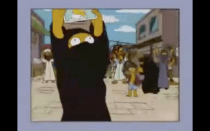
Screen shot by author
A parody of the viral news clip appeared on a 2004 The Simpsons episode entitled “Bart-Mangled Banner” in which Bart accidentally moons the American flag at a basketball game, and subsequently faces a public outcry from critics calling him anti-American. The nightly news shows the “overseas” response, in which a woman wearing niqab holds up a photo of Homer and says “Simpsons be praised! Praise be to Springfield!” and then performs zaghareet against a backdrop of celebratory gunfire. This satire hints at the absurdity of controversies over such displays, but it also reinscribes the idea of the Arab/Muslim female as a source of danger, a new element of anti-American hostility that became associated with the sound after 9/11.
Unlike previous impressions of zaghareet, which focused on the sound as part of an exotic terrain, post-9/11 visions tend to locate practitioners in a distinctly antagonistic matrix. The distinctive sonicity of zaghareet makes it particularly susceptible to portrayals that frame it as a sign of Arab barbarity. For certain performers, however, such as belly dance students in Washington, DC, zaghareet is not subject to this type of racialized logic, and is instead treated as an ethnic novelty. In American film, TV, music, and a range of other contexts, zaghareet is becoming increasingly audible, and it is a phenomenon that deserves thoughtful and critical attention.
—
Meghan Drury is a fifth-year Ph.D. candidate in the Department of American Studies at the George Washington University. She received an MA in ethnomusicology from UC Riverside in 2006. She is currently working on a dissertation tentatively titled “Aural Exotics: The Middle East in American Popular Music 1950-2011.” This project examines the interplay between popular music and American cultural representations of the Middle East from the mid-20th century to the present, illustrating how music and sound acted a means of consolidating and disseminating a range of ideas about Middle Eastern culture in the American mainstream. She is particularly interested in the way that sound increased the visibility of Arab Americans both before and after 9/11, offering a space for negotiations of identity. More broadly, Meghan’s interests include sound studies, U.S.-Middle East cultural relations, and Arab American cultural performance.
—
 REWIND! . . .If you liked this post, you may also dig:
Rallying Cries as Suffering Sounds: “Allah-O-Akbar” and the Aurality of Feminized Iranian Suffering–Roshanak Kheshti
Aurally Other: Rita Moreno and the Articulation of “Latina-ness”–Priscilla Peña Ovalle
Beat-ification: British Muslim Hip Hop and Ethical Listening Practices–Jeanette Jouili
Share this:

The Sounds of Anti-Anti-Essentialism: Listening to Black Consciousness in the Classroom

Image by Flickr User Pere Ubu
 In teaching the many interrelated and complicated aspects of the Civil Rights movement, Black Power, and the Black Arts Movement, the challenge for me is to help students understand the “facts” of this period, and to simultaneously destabilize the teleological historical narrative these “facts” seem to suggest. In a pedagogical context, sound helps fill in the gaps that fall outside of the knowledge produced–and contained within–certain archival accounts of black cultural and political history. While crucial, having students listen to the gaps, can be daunting, especially in our current historical moment, as the decades-long push against identity politics has been solidified by the recent (re)election of the nation’s first black president, Barack Obama. This point demands more elaboration than I can provide here, but the critical pedagogical issue it raises within the province of black studies, is that it is becoming increasingly difficult to consider black political culture outside of the sedimented lines of American pluralism and black radical thought.
I use sound as a pedagogical tool to help outline a middle ground–what Frantz Fanon refers to in The Wretched of the Earth as “zone of hidden fluctuation” (166)–based upon articulations of resistance and identity that refuse to be frozen in time. Building on Paul Gilroy’s conceptualization of anti-anti-essentialism in The Black Atlantic, an idea of black consciousness that is flexible and moves between the insufficient terms of “essentialist” and “anti-essentialist,” I use specific pedagogical examples to suggest that teaching about race and sound is a rich, evolving, and productively interactive continuum. The auditory sense opens up new terrains of knowledge and dynamically expands the possibilities for students to think through the intricate and multifaceted formations of black consciousness during the volatile years of the 1960s and the resonance of those years in our present.
The recorded presence of Martin Luther King, Jr., for example, represents an important aural site for engaging in reflexive pedagogy, because King’s tonality–the resonance of his voice–creates a certain familiarity and is pivotal to the construction of the American myth of the radical transformation of the civil rights movement and the idea of post-civil rights racial equality. For many students, King’s sound signals the dream of, and the pathway towards, a unified America. Conscious of how this idea of King reflects a linear understanding of civil rights as simply a desire for inclusion, I direct students’ attention to the sound of King’s last recorded speech in Memphis on April 3, 1968. Given the evening before his assassination, this speech resounds with King’s deepening critical perspective on black struggle through its haunting concluding notes. I point out to my classes that King’s final years (1965-1968) were marked by his increasing focus on ideas of black resistance outside of the Civil Rights mainstream, including his critique of U.S. involvement in the Vietnam War, and his radical rethinking of the possibilities for black economic and political self-determination.

Martin Luther King in 1968, Image courtesy of UIC Digital Collections
Centered on the economic injustice and dehumanization of Memphis’s striking black sanitation workers, King’s speech details the need for the Memphis black community do more than simply boycott municipal entities, but rather articulate their resistance by boycotting prominent national brands such as Wonder Bread and Coca-Cola. Against this background, I play segments (particularly the final minutes) of King’s speech, entitled, “I’ve Been to the Mountaintop.”
The acoustic dimensions of King’s final speech resonate with a social and political complexity that troubles the sonic memories many students have of King’s “I Have a Dream” speech, delivered on the steps of the Lincoln Memorial in 1963. The much more intimate and less overtly majestic soundscape of Memphis’ Mason Temple underlines King’s shift from national icon back to local, community activist. The frequent audience shifts–applause, extemporaneous interjections, and silence–create a reverberating sonic energy that accumulates throughout the speech. Rather than relying strictly on a call-and-response interpretation of the interactive exchanges between King’s voice and the audience’s response, I have students consider the non-linear ebbs and flows in King’s sound in this latest of moments (as Fred Moten would say, the totality of King’s tonality). For example, as King’s audience considers the weight of his analyses and what it means to articulate black resistance as “a dangerous unselfishness” that “puts pressure where it really hurts,” I identify moments of uncertainty, hesitation, and contemplative reflection that mark a non-linear interactive sonority between King and his audience.
Listening to King’s final thoughts offers a disturbing and disruptive emphasis on the stakes of breaking with entrenched modes of activist thinking. He concludes the speech with a series of prophetic thoughts on mortality as a cost of making a stand against “our sick white brothers.” Set within the historical and ideological context I have sketched above, the delivery distinguishes the sound of King’s words. As we listen I draw attention to King’s expression of a lack of fear in anything, any man, as King seems to convey an eerie foreknowledge of his murder and his irreverence in its face.
“I’ve Been to the Mountaintop” –Listen to the concluding two minutes
The apocalyptic sound of King’s concluding notes to this political sermon leaves much to contemplate. From the mention of the potential threat posed to his life by “our sick white brothers,” through the speech’s last line, there is a tonal, timbral shift in his voice and demeanor. Through sound and posture, and the reaction of the audience to those factors, King’s affect seems to convey something more momentous occurring beneath the event’s surface dynamics. King projects a confrontational edge through the sound of fearlessness in the face of mortality. Did he know he was going to be killed shortly after giving this speech? It’s a question that the peculiar tonality of his concluding lines raises for students. If so, what does it mean to use the sermon as a site of prophetic, aural documentation of the fact that a force of transformation exists beyond the flesh and blood of leadership, a force that assassination can’t kill? In the speech’s final synesthetic moment, I have the students listen and watch the shift that occurs in King’s demeanor as he closes, and the way that this shift culminates in an almost ecstatic moment as he delivers the final line: “Mine eyes have seen the glory of the coming of the Lord.” His defiant turning away from the microphone is crucial as it amplifies the meaning of the voice, letting those watching know that, much like an emcee, King has just “served” white power with a delivery that will outlast the sniper’s bullet the following evening.

Nina Simone, Image courtesy of Flickr User GlingG
I want to briefly point to two other examples that show additional ways in which sound complicates ideas of racial identity and expression during the 1960s. When I teach Nina Simone’s composition, “Mississippi Goddamn,” (recorded live at Carnegie Hall in 1964), I ask students to consider the relationship between the distinctive sound of her voice and the ironic and critical elements of her lyrical meaning as this interaction creates a complex idea of radical black consciousness. Composed in the aftermath of the murder of Medgar Evers and the bombing of the 16th Street Baptist Church in Birmingham, Alabama, Simone offers a musical, and more broadly sonic meditation on white supremacy.
Most students find the timbre of Simone’s voice, its grain (as Roland Barthes would say) and depth, immediately striking. Her unique sonority and its context, greatly influence attempts by students to understand her reference to the song as simply a tune: “The name of this tune is Mississippi Goddamn” she says, and “This is a show tune, but the show for it hasn’t been written yet.” Clearly it isn’t simply a tune, and the caustic quality of lines such as, “Oh but this country is full of lies/ You’re all gonna die and die like flies,” creates a critical depth through the sound of Simone’s commitment to a black radical perspective. What does it mean, for instance, that Simone projects such sarcasm and biting critique to a predominately white audience at Carnegie Hall? How might we hear the specific grain of her voice in this setting? How does Simone’s projection of critical black sonic resistance, emerge at the conjuncture of anti-black racism and the beginning of legislative efforts under the Johnson administration to rectify racial inequality through civil rights bills? What can be taken from the simultaneity and contrast that Simone projects her sound within? I pose such questions to my students as a way of considering what it means to be committed to critical thought and social transformation that falls outside of the dominant lines of American national consciousness, and how the sound of such commitment, heard in the pitch and tenor of Simone’s voice, matters as a different kind of historical documentation.
In considering how the sound of music can offer an intervention within the formation of black political consciousness in the Black Arts Movement, I often use the 1966 recording of Amiri Baraka’s signal poem, “Black Art,” as it set to the experimental musical sounds of Sonny Murray’s ensemble (Murray-drums, Albert Ayler-tenor saxophone, Don Cherry-trumpet, Henry Grimes, Lewis Worrell-bass). Having first read the poem, students then are able to hear it set to– and against–the unconventional instrumentation of Murray’s ensemble.
The musicians create an unconventional sonic context for Baraka’s reading that de-emphasizes and re-situates the apparent dimensions of black rage that seem to arise from verse that can “shoot guns,” through an almost carnivalesque, comedic, and off-kilter sound that troubles the linear expectations one might have of instrumentation amplifying the words on the page. The dissonance between page and sound allows for useful pedagogical opening, in that it underlines the non-conformist, avant-garde aspects of the movement, and the fine line that artists such as Baraka were imagining between the intensity of black radical consciousness and the ability to articulate that standpoint outside of the expected forms of black cultural nationalism.

Image Courtesy of UIC Digital Collections
As these examples have shown, I incorporate sound into my pedagogical framings of black cultural and political identity as an opening through which students may expand their understandings of black consciousness and black political culture well beyond stagnant ideas of racial authenticity, while still preserving an understanding of the transformative and often radical possibilities that have been projected through black expression during the period. It is the open space of sound that invests the project of black radical thought with the uncanny spontaneity of experimentation. Having students understand ideas of expansiveness, asymmetry, and non-linearity as central to black cultural expression and critique–even as artists refuse to sacrifice an expressed political commitment to black resistance–begins to suggest ways for students to contemplate the intersection of identity politics with the unexpected, fantastic elements of expression that lie outside of more recent flattened diagnoses of black nationalism. Teaching at the intersections of race and sound opens up new terrains of knowledge, dynamically expanding students’ abilities to think through the intricate and multifaceted formations of black consciousness during the volatile years of the 1960s and the resonance of those years in our present.
—
Carter Mathes is an assistant professor of English at Rutgers University. He has completed a book manuscript entitled, Imagine the Sound: Experimental Form in Post-Civil Rights African American Literature, that focuses on the relationship between sound and literary innovation during the 1960s and 1970s. He is co-editing a volume of essays on Black Arts Movement writer and critic Larry Neal; and also has essays in print or forthcoming on Toni Cade Bambara, Peter Tosh, and James Baldwin. At Rutgers, he regularly teaches classes focusing on African American literature, Twentieth-century literature, music and literature, and experimental writing.
—
REWIND! . . .If you liked this post, you may also dig:
Audio Culture Studies: Scaffolding a Sequence of Assignments–Jentery Sayers
They Do Not All Sound Alike: Sampling Kathleen Cleaver, Assata Shakur, and Angela Davis–Tara Betts
Freedom Back: Sounding Black Feminist History, Courtesy the Artists–Tavia Nyong’o
Share this:


Current Top Posts





April 2021

January 2020

November 2019

October 2019

August 2019

April 2014

November 2017

March 2015

December 2017

October 2015
 Sounding Out!
Recent Comments