
“You’re. . .#noangel. . . either”: Uneasy Politics and Dissonant Sonics in Beyoncé’s “No Angel”

DOI: https://doi.org/10.59350/f068n-0zw14
This September, Sounding Out! challenged a #flawless group of scholars and critics to give Beyoncé Knowles-Carter a close listen, re-examining the complex relationship between her audio and visuals and amplifying what goes unheard, even as her every move–whether on MTV or in that damn elevator–faces intense scrutiny. In the coming Mondays, you will hear from Priscilla Peña Ovalle (English, University of Oregon), Liana Silva (Editor, Women in Higher Education, Managing Editor, Sounding Out!), Regina Bradley (writer, scholar, and freelance researcher of African American Life and Culture), and Madison Moore (Research Associate in the Department of English at King’s College, University of London and author of How to Be Beyoncé). Today, we #wakeuplikethis with Kevin Allred (Women and Gender Studies, Rutgers), who refuses to let us fast forward past the understated and discomfiting video track “No Angel.”–Editor-in-Chief Jennifer Stoever
—
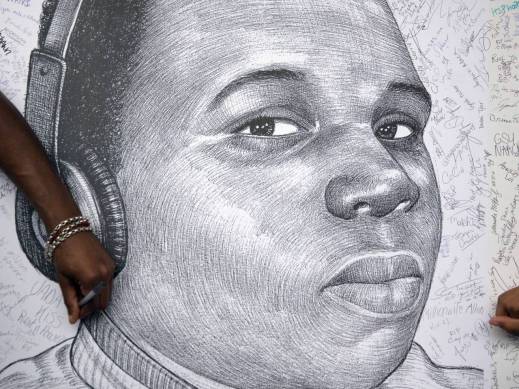
Michael Brown, an unarmed black teenager, was shot to death by white police officer Darren Wilson in Ferguson, Missouri on August 9, 2014, for no apparent reason [see author’s note below]. While the fact that the death of unarmed black men (and women and trans people) at the hands of those in power is, sadly, no unique occurrence, as Melissa Harris-Perry – among countless others – have pointed out, Brown’s death has sparked nation-wide outrage and protests about police brutality, racial injustice, and severely decreased resources for impoverished communities.
In the New York Times’ reportage on Brown’s death, reporter John Eligon found it appropriate to characterize the teenager as “no angel,” as if any amount of alleged wrongdoing or possible character flaws on Brown’s part somehow justified his murder. Both Eligon and the Times were called out on social media and in traditional publications such as the Atlantic, and, while the press quickly apologized, the phrase’s familiar interpellation of victims – especially when they are people of color – as “no angels” lingered: a journalistic gaze born of sympathy with white authority that invalidates an individual’s life, tarnishes their memory, and even rewrites histories.

A powerful counter discourse challenges these racist narratives, however; one we can hear in the dissonant sonics of Beyoncé Knowles-Carter’s “No Angel,” a song that anticipates–and adamantly refutes–the racist notion that people who live, and quite possibly die as Michael Brown did, are anything but valuable.
Released almost 9 months before Brown was killed, Beyoncé’s “No Angel” cannot explicitly be called a response, but the ghosts of black men–living and dead, unfairly judged and mistreated–haunt the entire song. “No Angel” begins with a slow-burning 4-count beat; a low, synthesized, slightly off-kilter kick drum sets the tone for the song while an eerily-lilting high-pitched synthetic warbling noise simultaneously pours out of the speakers. The sound, reminiscent of feedback, drifts between pitches for four painstakingly slow measures before Beyoncé’s vocals kick in. When they do, what we hear is unusual. Her voice reverberates in a breathy, almost too-high falsetto that sounds nothing like the soaring powerhouse vocals of “Halo” or “I Was Here;” nothing like the precise, punctuated staccato of “Single Ladies” or “Run The World (Girls);” and certainly nothing like any of the other songs on BEYONCÉ. Sonic and musical contradictions abound. Neither the kind of impressive falsetto showing a wide range, nor necessarily immediately pleasing to the ear, Beyoncé’s voice is forced. . .and it haunts. Further, the vocals seem to cut the time signature of the song in half, effectively doubling its pace. Its tempo, cadence and vocal dynamics signal “No Angel” as a very different kind of Beyoncé song, one forwarding a sonic and political statement over radio-readiness.
Admittedly, “No Angel” was not initially one of my favorite songs on Beyoncé’s new album. In fact, when teaching this song, most of my students – even the hardcore Beyoncé fans – admit sheepishly to skipping through it because of a feeling of discomfort mainly related to Beyoncé’s vocal delivery. But after a few listens, something clicks: “No Angel” is not supposed to be pleasant, easy listening, but rather it jars and unsettles, just like the impact of news of another unarmed black person killed by white police. We are neither supposed to immediately identify with the audio of “No Angel,” nor possibly even like it.
All about dissonance, the song’s innovation fuels itself with inconsistency and contradiction. Vocally speaking, there are incongruities between the highs and the lows (the bass and the treble or the bass and the soprano), and the abrupt shifts in pacing—the slow pace both in opposition to and contained within the faster pace of the song. Even the stretched and breathy falsetto Beyoncé puts on for most of the song strikes a dissonant chord. Simply put, dissonance is tension, and neither the sonic nor the political tension ends here.
.
Here’s the thing: we know Beyoncé’s voice doesn’t usually sound like it does on “No Angel.” It is a conscious manipulation. And when coupled with the refrain:
You’re no angel either baby
her voice even becomes a kind of accusation. If Michael Brown is “no angel;” if Beyoncé herself, as the singer and also as a black woman in a racist U.S. society, is also initially “no angel” then, Eligon in the NYT as Brown’s accuser and, by extension, we as the listeners, become “no angel either.” What’s more, Beyoncé ‘s delivery is so deliberately overdone that she can be heard taking deep breaths in between each word of the chorus – something most singers would attempt to hide. Beyoncé chooses instead to push it to the forefront of the recording, audibly projecting each word toward the listener; in effect, slapping us in the face with each syllable, driving that message/accusation straight home.
However, while this forum may be dedicated to the sonic qualities of Beyoncé’s work, I don’t believe we can completely divorce the sonic from the visual for “No Angel,” or anything on BEYONCÉ, as it was specifically marketed and publicized as audio and visual album. BEYONCÉ visual music experience is nothing knew to Beyoncé herself. As far back as Dangerously In Love, Beyoncé forwarded her belief “that harmonies are colors” on an interlude toward the end of the album. For her latest album, she went so far as to strike an exclusive deal with iTunes in which the album was only available as a complete package for the first week of its release – singles could not be purchased separately nor without videos (and vice versa). It would be a disservice to ignore the visual depiction of “No Angel,” directed by @LilInternet and its synaesthetic fusion of sound and sight.
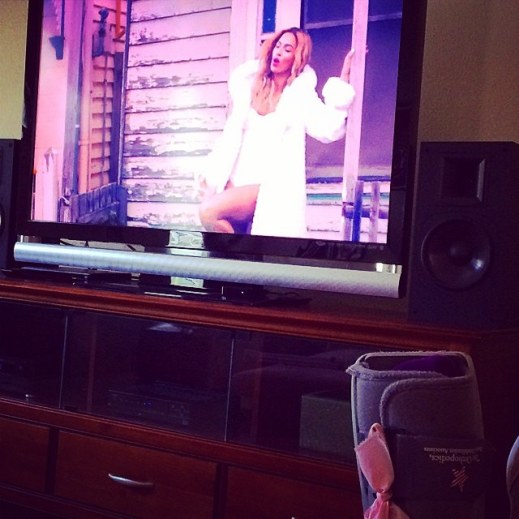
Just as the sonic qualities of the song provoke discomfort, unexpected imagery confronts the eye. First, the video is quite simply not about Beyoncé. She is rarely shown. Instead, Houston street culture and its struggles and poverty, represented largely through the faces of people of color, takes center stage. The video features mainly black men, although there are some images of black women throughout; a stark moment showing black women– raced and sexualized as “no angels”–working as strippers reveals an industry driven not by the agency/desire of the strippers themselves, but rather by the failures of capitalism that often offer few profitable choices to poor women other than sex work (as evidenced in the highlighting money shots/literal shots of money). But the video celebrates the lives of all theses alleged non-angels by showing small moments of happiness – a father smiling with his son; young boys flashing the peace sign with their fingers; sweet glances between lovers, community members proud to show off their jewelry and cars for the camera–redirecting the viewer’s attention to the structural inequality framing many of the images, provoking more voyeuristic viewers to reflect on their own responsibility and complicity in the systems that create poverty and segregation in the first place. Simultaneously, members of the Houston community–as well as diasporic Houstonians–can see themselves represented, even celebrated in the video, as opposed to the usual cinematic vilification and denigration of these very same bodies as “no angels.” Many Houston hop-hop legends appear in the video as well: Bun B, Scarface, Willie D, Z-Ro, and of course Beyoncé herself.
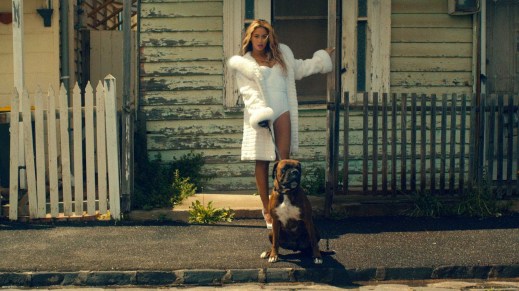
When the camera does linger on Beyoncé, it juxtaposes her iconic image–associated with the wealth and power of her celebrity status–with everyday people of her Houston hometown, including its most impoverished. Beyoncé, the residents, and the city itself stare the viewer down – actively challenging us to see both life and death, both living people and memorials to those, such as Michael Brown, who have died too young. The dissonant tension between life and death, encapsulated in Beyoncé’s voice and the video’s mirroring visuals: the high and the low; the rich and the poor; and the fraught gap in between.
Beyoncé tries to bridge this gap, both visually, through her self-representation in Houston, and sonically, particularly the moment when the refrain “you’re no angel, either. . .baby” finishes and she swings her voice down out of falsetto, into her more powerful full-out throat voice. It is assuredly no coincidence that during those moments she repeats the word “no,” over and over again. With that “no,” she objects to mainstream news vilification, anticipating and objecting to Michael Brown’s characterization as “no angel.” Her voice shifts from the high-falsetto – a sound serving the dual purpose of exposing the above dissonance AND acting as a caress to black communities in Houston, and Ferguson, and on and on – and moves into the heavy throat-voiced complaint and objection. “No, you will not treat my people this way. No, you will not treat ANY people this way,” her sound testifies. And, for viewers not represented in the video, that “you” is them–and she means that realization to feel uncomfortable. Beyoncé’s vocal dissonance and visual images force a confrontation with this accusation: it is not Michael Brown and those represented and celebrated in the video who are “no angels,” but the rest of us who fall short.
So, if we are “no angels, either” what do we do about it? Do we skip the track? Do we sit in front of our computer with the visual evidence of the failure of the American Dream staring us down as we groove to Beyoncé’s vocals? Do we turn off the news coverage in Ferguson, MO and pretend it’s not happening? Beyoncé’s voice provokes these uncomfortable questions and more: What does inequality sound like? What does hope and/or resolution/reparation sound like? Are they the same sound? This is a Beyoncé more in line with artists such as Nina Simone, who famously used her voice to express political critique, and not always in the most “pleasant” ways. “No Angel” is Beyoncé’s audio-visual “Strange Fruit,” positioning her alongside some of the most political and innovative protest singers of our time.
—
Author’s Note: At the time of Brown’s death, I had already been submitted this article. Due to the eerie coincidence between Beyoncé’s song “No Angel” and Eligon’s characterization of Michael Brown in the New York Times noted during the review process, I reworked the article to bring the two into conversation – which, in fact, they always were, even though I didn’t know it at the time.
—
Kevin Allred is a musician, activist, and teacher, currently at Rutgers University, where he teaches a signature course he created: “Politicizing Beyoncé.” He lives in Brooklyn, NY with his boyfriend and two elderly dachshunds. Join the Politicizing Beyoncé community at www.facebook.com/politicizingbeyonce. You can also find Kevin at www.kevinallredmusic.com and www.politicizingbeyonce.com.
—
REWIND!…If you liked this post, check out:
The (Magic) Upper Room: Sonic Pleasure Politics in Southern Hip Hop–Regina Bradley
Freedom Back: Sounding Black Feminist History, Courtesy the Artists–Tavia Nyong’o
“HOW YOU SOUND??”: The Poet’s Voice, Aura, and the Challenge of Listening to Poetry— John Hyland
—
Share this:

Sounding Out! Podcast #31: Game Audio Notes III: The Nature of Sound in Vessel

DOI: https://doi.org/10.59350/5vfyy-01a89
This post continues our summer Sound and Pleasure series, as the third and final podcast in a three part series by Leonard J. Paul. What is the connection between sound and enjoyment, and how are pleasing sounds designed? Pleasure is, after all, what brings y’all back to Sounding Out! weekly, is it not?
Part of the goal of this series of podcasts has been to reveal the interesting and invisible labor practices which are involved in sound design. In this final entry Leonard J. Paul breaks down his process in designing living sounds for the game Vessel. How does one design empathetic or aggressive sounds? If you need to catch up read Leonard’s last entry where he breaks down the vintage sounds of Retro City Rampage. Also, be sure to be sure to check out last week’s edition where Leonard breaks down his process in designing sound for Sim Cell. But first, listen to this! -AT, Multimedia Editor
–
CLICK HERE TO DOWNLOAD: Game Audio Notes III: The Nature of Sound in Vessel
SUBSCRIBE TO THE SERIES VIA ITUNES
ADD OUR PODCASTS TO YOUR STITCHER FAVORITES PLAYLIST
–
Game Audio Notes III: The Nature of Sound in Vessel
Strange Loop Game’s Vessel is set in an alternate world history where a servant class of liquid automatons (called fluros) has gone out of control. The player explores the world and solves puzzles in an effort to restore order. While working on Vessel, I personally recorded all of the sounds so that I could have full control over the soundscape. I recorded all of the game’s samples with a Zoom H4n portable recorder. My emphasis on real sounds was intended to focus the player’s experience of immersion in the game.
This realistic soundscape was supplemented with a variety of techniques that produced sounds that dynamically responded to the changes in the physics engine. Water and other fluids in the game were difficult to model with both the physics engine and the audio engine (FMOD Designer). Because fluids are fundamentally connected to the game’s physics engine, they takes on a variety of different dynamic forms as players interact with the fluid in different ways. In order to address this Kieran Lord, the audio coder, and I considered factors like the amount of liquid in a collision with anything, the hardness of the surface that it was colliding with, the type of liquid in motion, whether the player is experiencing an extreme form of that sound because it is colliding with their head, and, of course, how fast the liquid is travelling.
Although there was a musical score, I designed the effects to be played without music. Each element of the game, for instance a lava fluro’s (one of the game’s rebellious automatons) footsteps, entailed required layers of sound. The footsteps were composed of water sizzling on a hot pan, a gloopy slap of oatmeal and a wet rag hitting the ground. Finding the correct emotional balance to support the game’s story was fundamental to my work as a sound designer. The game’s sound effects were constantly competing with the adaptive music (which is also contingent on player action) that plays throughout the game, so it was important to provide an informative quality to them. The sound effects inform you about the environment while the music sets the emotional underscore of the gameplay and helps guide you in the puzzles.
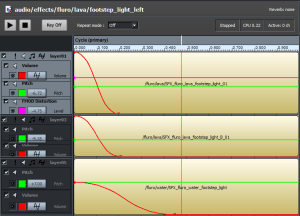
Defining the character of the fluros was difficult because I wanted players to have empathy for them. This was important to me because there is often no way to avoid destroying them when solving the game’s puzzles. While recording sounds in the back of an antique shop, I came across a vintage Dick Tracey gun that made a fantastic clanking sound when making a siren sound. Since the gun allowed me to control how quickly the siren rose and fell, it was a great way to produce vocalizations for the fluros. I simply recorded the gun’s siren sound, chopped the recording into smaller pieces, and then played back different segments randomly. The metal clanking gave a mechanical feel and the siren’s tone gave a vocal quality to the resulting sound that was perfect for the fluros. I could make the fluros sound excited by choosing a higher pitch range from the sample grains and inform the player when they approached their goal.
I wanted a fluid-based scream to announce a fluro’s death. I tried screaming underwater, screaming into a glass of water, and a few other things, but nothing worked. Eventually, when recording a rubber ear syringe, I found squeezing the water out quickly lent a real shriek while it spit out the last of the water. Not only did this sound really cut through the din of the gears clanking in the mix, but it also bonded a watery yell with the sense of being crushed and running out of breath.
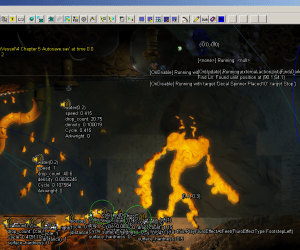
For the final boss, I tried many combinations of glurpy sounds to signify its lava form. Eventually I recorded a nail in a board being dragged across a large rusty metal sheet. Though it was quite excruciating to listen to, I pitched down the recording and combined it with a pitched down and granulated recording of myself growling into a cup of water. This sound perfectly captured the emotion I wanted to feel when encountering a final boss. Although it can take a long time to arrive at the “obvious” sound, simplicity is often the key.
Anticipation is fundamental to a player’s sense of immersion. It carves a larger space for tension to build, for instance a small crescendo of a creaking sound can develop a tension that builds to a sudden and large impact. A whoosh before a punch lands adds extra weight to the force of the punch. These cues are often naturally present in real-world sounds, such as a rush of air sweeping in before a door slams. A small pause might be included just for added suspense and helps to intensify the effect of the door slamming. Dreading the impact is half of the emotion of a large hit .
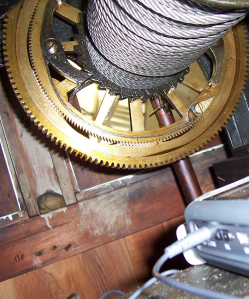
Recording all of the sounds for Vessel was a large undertaking but since I viewed each recording as a performance, I was able to make the feeling of the world very cohesive. Each sound was designed to immerse the player in the soundscape, but also to allow players enough time to solve puzzles without becoming annoyed with the audio. All sounds have a life of their own and a resonance of memory and time that stays with the them during each playthrough of a game. In Retro City Rampage I left a sonic space for the player to wax nostalgic. In Sim Cell, I worked to breathe life into a set of sterile and synthesized sounds. Each recorded sound in Vessel is alive in comparison, telling stories of time, place and recording with them, that are all their own.
The common theme of my audio work on Retro City Rampage, Sim Cell and Vessel, is that I enjoy putting constraints on myself to inspire my creativity. I focus on what works and removing non-essential elements. Exploring the limits of constraints often provokes interesting and unpredictable results. I like “sculpting” sounds and will often proceed from a rough sketch, polishing and reducing elements until I like what I hear. Typically I remove layers that don’t add an emotive aspect to the sound design. In games there are often many sounds that can play at once, so clarity and focus are necessary when preventing sounds from getting lost in a sonic goo.
In this post I have shown how play and experimentation are fundamental to my creative process. For an aspiring sound artist, spending time with Pure Data, FMOD Studio or Wwise and a personal recorder is a great way to improve their skill with game audio. This series of articles has aimed to reveal the tacit decisions behind the production of game audio that get obscured by the fun of the creative process. Plus, I hope they offer a bit of inspiration to those creating their own sounds in the future.
Additional Resources:
- My GDC 2012 talk – My site includes an MP3 recording of the talk and the full powerpoint presentation. A full video of the talk is in the GDC Vault but requires membership
- See the Jon Hopkins Soundtrack in the Video Game Vessel video game soundtrack video by me on YouTube – shows use of Lua with music in the custom level editor : https://www.youtube.com/watch?v=KOyjMPPvaY4
–
Leonard J. Paul attained his Honours degree in Computer Science at Simon Fraser University in BC, Canada with an Extended Minor in Music concentrating in Electroacoustics. He began his work in video games on the Sega Genesis and Super Nintendo Entertainment System and has a twenty year history in composing, sound design and coding for games. He has worked on over twenty major game titles totalling over 6.4 million units sold since 1994, including award-winning AAA titles such as EA’s NBA Jam 2010, NHL11, Need for Speed: Hot Pursuit 2, NBA Live ’95 as well as the indie award-winning title Retro City Rampage.
He is the co-founder of the School of Video Game Audio and has taught game audio students from over thirty different countries online since 2012. His new media works has been exhibited in cities including Surrey, Banff, Victoria, São Paulo, Zürich and San Jose. As a documentary film composer, he had the good fortune of scoring the original music for multi-awarding winning documentary The Corporation which remains the highest-grossing Canadian documentary in history to date. He has performed live electronic music in cities such as Osaka, Berlin, San Francisco, Brooklyn and Amsterdam under the name Freaky DNA.
He is an internationally renowned speaker on the topic of video game audio and has been invited to speak in Vancouver, Lyon, Berlin, Bogotá, London, Banff, San Francisco, San Jose, Porto, Angoulême and other locations around the world.
His writings and presentations are available at http://VideoGameAudio.com
—
Featured image: Courtesy of Vblank Entertainment (c)2014 – Artwork by Maxime Trépanier.
—

REWIND! . . .If you liked this post, you may also dig:
Sounding Out! Podcast #30: Game Audio Notes I: Growing Sounds for Sim Cell- Leonard J. Paul
Sounding Out! Podcast #31: Hand Made Music in Retro City Rampage– Leonard J. Paul
Papa Sangre and the Construction of Immersion in Audio Games- Enongo Lumumba-Kasongo
—
Share this:




Current Top Posts





April 2021

January 2020

November 2019

October 2019

August 2019

April 2014

November 2017

March 2015

December 2017

October 2015


Recent Comments