
“Oh how so East L.A.”: The Sound of 80s Flashbacks in Chicana Literature

 For the full intro to the forum by Michelle Habell-Pallan, click here. For the first installment by Yessica Garcia Hernandez click here. For the second post by Susana Sepulveda click here.
The forum’s inspiring research by scholars/practioners Wanda Alarcón, Yessica Garcia Hernandez, Marlen Rios-Hernandez, Susana Sepulveda, and Iris C. Viveros Avendaño, understands music in its local, translocal and transnational context; and insists upon open new scholarly imaginaries. . .
Current times require us to bridge intersectional, decolonial, and gender analysis. Music, and our relationship to it, has much to reveal about how power operates within a context of inequality. And it will teach us how to get through this moment. –MHP
—
A new generation of Chicana authors are writing about the 1980s. An ‘80s kid myself, I recognize the decade’s telling details—the styles and fashions, the cityscapes and geo-politics, and especially the sounds and the music. Reading Chicana literature through the soundscape of the 80s is exciting to me as a listener and it reveals how listening becomes a critical tool for remembering. Through the literary soundscapes created by a new generation of Chicana authors such as Estella Gonzalez, Verónica Reyes, and Raquel Gutiérrez, the 1980s becomes an important site for hearing new Chicana voices, stories, histories, representations, in particular of Chicana lesbians.
Reading across Gonzalez’s short story, “Chola Salvation,” Reyes’s Chopper! Chopper! Poetry from Bordered Lives; and Gutiérrez’s play, “The Barber of East L.A,” this post activates the concept of the “flashback” to frame the 1980s as a musical decade important for exploring Chicana cultural imaginaries beyond its ten years. In Gonzalez’s “Chola Salvation,” for example, Frida Kahlo and La Virgen de Guadalupe appear dressed as East Los cholas speaking Pachuca caló and dispensing valuable advice to a teen girl in danger. The language of taboo and criminality is transformed in their speech and a new decolonial feminist poetics can be heard. In Reyes’s Chopper! Chopper!, Chicana lesbians – malfloras, marimachas, jotas, y butch dykes – strut down Whittier Boulevard, fight for their barrio, take over open mic night and incite a joyous “Panocha Power” riot, and make out at the movies with their femme girlfriends. Gutiérrez’’s “Barber of East L.A” recovers forgotten butch Chicana histories in the epic tale of a character called Chonch Fonseca, inspired by Nancy Valverde, the original barber of East Los Angeles. A carefully curated soundtrack amplifies her particular form of butch masculinity. These decolonial feminist ‘80s narratives signal a break from 1960s and ‘70s representations of Chicanas/os and introduce new aesthetics and Chicana/x poetics for reading and hearing Chicanas in literature, putting East L.A. on the literary map.

East LA Valley, 2010, by Flickr User James (CC BY 2.0)
Gonzalez, Reyes, and Gutiérrez’s work also use innovative sonic methods to demonstrate themes of feminist of color coalition and solidarity and represent major characters whose desires and actions transgress normative gender and sexuality. All three contain so many mentions of music that operate beyond established notions of intertextuality, referencing oldies, boleros, and alternative 80s music as a soundtrack that actually transform these works into unexpected sonic archives. Through the 80s soundscapes that music activates, these authors’ work shifts established historical contexts for reading and listening: there was a time before punk, and after punk, and this temporality sounds in Chicana literature.
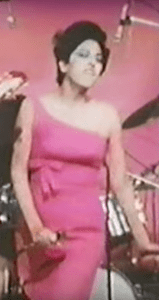
Alice Bag in The Decline of Western Civilization (1981). Still by Jennifer Stoever
If the classic documentary film The Decline of Western Civilization by Penelope Spheeris was meant to give coverage to the Los Angeles neglected by mainstream music journalists, it also performs an important omission that leaves Chicano viewers searching for a mere glimpse of “a few brown Mexican faces,” as Reyes writes in her poem “Torcidaness.” Among the bands featured–most male fronted–the film captures an electric performance by Chicana punk singer Alice Bag, née Alicia Armendariz. In contrast to the other musicians in jeans, bare torsos, and, combat boots, Bag is visually stunning and glamorous. She dressed in a fitted pink dress reminiscent of the 1940s pachuca style; she wears white pointed toe pumps, her hair is short and dark, her eye and lip makeup is strong and impeccable. In the four brief minutes the band is on camera Bag sings in a commandingly deep voice, slowly growling out the words to the song “Gluttony” and before the tempo picks up speed, she lets out a long visceral yell on the “y” that is high pitched, powerful, and thoroughly punk. It’s a superb performance, yet Bag is not interviewed in this film.
Reyes’s poem draws attention to that omission as the narrator searches for a mere glimpse of “a few brown Mexican faces.” This speaks to the longing and the difficulty for Chicanas to see themselves reflected in the very same spaces that offer the possibility of belonging. Over thirty years since the film, Bag is now experiencing a surge in her career and has sparked renewed interest in histories of Chicanas in punk. She has written two books including the memoir: Violence Girl: From East L.A. Rage to L.A. Stage – A Chicana Punk Story (2011) and is sought out for speaking engagements on university campuses. Bag is able to tell her story now through writing, something a film dedicated to documenting punk music was not able to do. In retrospect, thirty-five years later, Bag’s current visibility emphasizes the further marginalization of Chicanas in punk the film produces by silencing her speaking voice against the audible power of her singing voice. Recovering Chicana histories in music may not happen through film, I propose that it is happening in the soundscapes of new Chicana literature. Importantly, new characters emerge and representations that are minor, marginalized, or non-existent in the dominant literary landscape of Aztlán are rendered legibly and audibly.

Barber of East LA-era Butchlális de Panochtítlan, (l-r) Claudia Rodriguez, Mari Garcia, Raquel Gutiérrez, Image by Hector Silva
***
Theorizing the flashback in Chicana literature raises new questions about temporality that invite and innovate ways to trace the social through aesthetics, politics, music, sound, place and memory. Is flashback 80s night at the local dance club or 80s hour on the radio always retrospective? Also, who do we envision in the sonic and cultural imaginary of “the 80s”? As a dominant population in Los Angeles and California, it is outrageous to presume that Chicanas/os or Mexican-Americans were not a significant part of alternative music scenes in Los Angeles. This post turns up the volume on the ’80s soundscapes of Chicana literature via Verónica Reyes’s poem “Torcidaness: Tortillas and Me,” to argue that one cannot nostalgically remember the 80s in a flashback radio hour or 80s night at the club and forget East L.A.
“Torcidaness” (Twistedness) speaks in an intimate voice homegirl-to-homegirl: “Tú sabes, homes how it is in—el barrio.” Through this address the narrator describes the sense of knowing herself as different and “a little off to the side on the edge” much like a hand formed tortilla. In the opening stanza, Reyes introduces the metaphor for queerness that runs through the poem in the image of the homemade corn tortilla, “crooked, lopsided and torcida.” Part of Reyes’s queer aesthetics prefers a slightly imperfect shape to her metaphorical tortillas rather than one perfectly “round and curved like a pelota.” As a tongue-in-cheek stand-in for Mexicanness, the narrator privileges the homemade quality of “torcidaness” versus a perfect uniformity to her queerness.

homemade corn tortillas, image by flikr user hnau, (CC BY-NC 2.0)
Importantly, the narrator locates her queer story that begins in childhood as “a little chamaca” in the Mexican barrios of East Los Angeles. “Torcidaness” names the cross streets to an old corner store hangout and brings East L.A. more into relief:
Back then on Sydney Drive and Floral in Belvedere District
Oscar’s store at the esquina near the alley was the place to be
We’d hang out and play: Centipede Asteroids Pac Man
or Ms. Pac Man (Oh yeah, like she really needed a man)
and even Galaga… Can you hear it? Tu, tu, tu… (very Mexican ?que no?)
Tú, tú, tú (Can you hear Eydie Gorme? Oh how so East L.A.) Tú, tú, tú…”
Coming at you … faster faster—Oh, shit. Blast! You’re dead (22).
This aurally rich stanza rings with the names of classic video games of the early 1980s. Reyes reminds us that video games are not strictly visual, they’re characterized by distinct noises, quirky blips and beeps, and catchy “chiptunes,” electronic synthesizer songs recorded on 8-bit sound chips. The speaker riffs off the playful noises in the space game Galaga, asking the reader to remember it through sound: “Can you hear it?” Capturing the shooting sounds of the game in the percussive phrase, “tú, tú, tú” prompts a bilingual homophonic listening that translates “tú” into “you.” The phrase is only a brief quote, a sample you could say, and the poem seems to argue that you’d have to be a homegirl to know where it comes from. The full verse of its source goes like this: “Me importas tú, y tú, y tú / y solamente tú / Me importas tú, y tú, y tú / y nadie mas que tú” as sung by the American singer Eydie Gorme with the Trio Los Panchos in their 1964 recording of “Piel Canela.”
To some extent the poem is not overly concerned with offering full translations, linguistic or cultural, but the reader is invited to corporeally join in the game of “Name That Tune.” The assumption is that Gorme’s Spanish language recordings of boleros with Los Panchos are important to many U.S. Mexicans and they remain meaningful across generations. And importantly, this “flashback” moment is not an anachronistic reference, rather it says something about the enduring status of boleros and the musical knowledge expected of a homegirl. Reyes’s temporal juxtaposition of the electronic sounds of the video game with the Spanish language sounds of a classic Mexican love song—and their easy, everyday coexistence in a Chicana’s soundscape–is part of what the narrator means by, “Oh how so East L.A.”
As a map, this poem locates the ’80s in part through plentiful references to the new electronic toys that became immensely popular in the US, yet Reyes does not fetishize the technology nor does she abstract Mexican experiences from these innovations as the American popular imaginary does all too often. Rather, she situates the experience of playing these new toys in a corner neighborhood store among other Mexican kids. The deft English-Spanish code switching audible in lines such as, “Oscar’s store at the esquina near the alley was the place to be,” is also part of the poem’s grammatically resistant bilingual soundscape. In these ways the poem makes claims about belonging and puts pressure on how we remember. There is danger in remembering only the game as a nostalgic collective memory and not the gamers themselves.
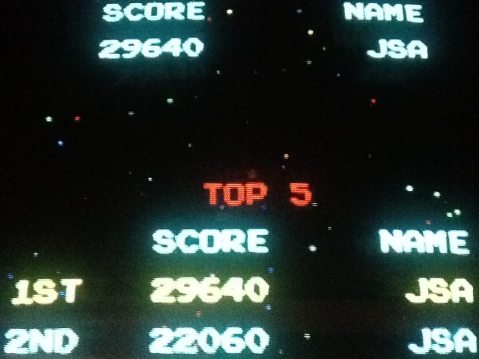
Galaga High Scores, image by Jenny Stoever
As a soundtrack, Reyes’s poem remembers the 80s through extensive references to the alternative rock music and androgynous and flamboyant artists of the MTV generation. This musical lineage becomes the soundtrack to the queer story in the poem. Through the music, the narrator produces a temporally complex “flashback” where queer connections, generational turf marking, and Mexicanness all come together.
No more pinball shit for us. That was 1970-something mierda
We were the generation of Atari—the beginning of digital games (22)
[. . .]
This was Siouxsie and the Banshees’ era with deep black mascara
The gothic singer who hung out with Robert Smith and Morrissey
The Smiths who dominated airwaves of Mexican Impala cars (23)
In these lines the narrator shows no nostalgia for the 1970s and boasts intense pride for all things new ushered in with the new decade. She brags about a new generation defined by new cultural icons like video games and synthesizer driven music. And while this music’s sound discernibly breaks from the 70s, its alternative sensibility isn’t just about sound, it’s about a look where “deep black mascara” and dark “goth” aesthetics – for girls and boys – are all the rage and help fans find each other. Simply dropping a band’s or artist’s name like “Siouxsie” or “Morrissey” or quoting part of a song conjures entire musical genres, bringing into relief a new kind of gender ambiguity and queer visibility that flourished in the 1980s. The poem is dotted with names like Boy George, Cyndi Lauper, Wham!, Elvis Costello, X, Pretenders, all musicians one might hear now during a “flashback 80s” radio hour radio or club theme night.

Sandy and Siouxsie, 2007, Shizu Saldamando, Los Angeles. Courtesy of the artist. See Shizu’s work through January 8, 2018 at the Pacific Standard Time show “My Barrio: Emigdio Vasquez and Chicana/o Identity in Orange County” at Chapman University.
The complex sense of time-space of the “flashback” as a theoretical concept is part of what links seemingly discrete flashback events: club nights, radio hours, musical intertexts. What is new about the “flashback” in this context is the unexpected site (literature) and literature’s unexpected Chicana subjects who frame readers’ listenings. Reyes’s poem represents and reminds me that the reason I go to dance clubs has always been for the love of music, all music, a feeling shared passionately among my stylish and musically eclectic friends (read more in my SO! post “New Wave Saved My Life.”). The last 80s night I went to was earlier this summer at Club Elysium in Austin, Texas, with my partner Cindy and our friend Max, who says he loves it because everyone there is his age – and for the love of new wave and fashion! The DJ played requests all night which made some of the transitions unexpected. But there we were, three Chicanos, less than ten years apart in age, enjoying a soundscape any 80s kid – from SoCal or Texas — would be proud of. When I got home I added four new songs we heard and danced to that night to my oldest Spotify list titled, “Before I Forget the 80s.” Although the purpose of this list is to stretch my memory of the music as a living pulsing archive, it also recovers the memory of this great night out with friends that extends beyond the physical dance floor.
.
Spotify Playlist for “Torcidaness” by Wanda Alarcon
Yet, in “Torcidaness,” remembering this music is mediated by the Chicana lesbian storyteller’s perspective who keenly tunes into these sounds and signs of alternative music and gender from East Los Angeles. The line, “The Smiths who dominated airwaves of Mexican Impala cars,” has implications that she was not alone in these queer listenings, as Reyes casually juxtaposes the image of lowrider car culture associated with Chicano hypermasculinity with the ambiguous sexuality of the Manchester based band’s enigmatic singer, Morrissey. Morrissey and lead guitarist Johnny Marr captivated generations of music listeners with their bold guitar driven sound, infectious melodies, and neo-Wildean homoerotic lyrics in the albums The Smiths (1983), Meat is Murder (1985), and The Queen is Dead (1986).
Recalling the song, “This Charming Man” against the poem’s reference to an Impala lowrider complicates how I hear the lyric: “Why pamper life’s complexities when the leather runs smooth on the passenger seat?” In a flash(back), the gap between the UK and East L.A. is somehow bridged in this queer musical mediation echoing what Karen Tongson calls “remote intimacies across time.” Although the poem reads like a celebration, there is a critique here in lines such as these. Chicanos and people of color are never at the forefront of who is imagined to be “alternative” in histories of alternative rock music. A vexing exception can be found in the Morrissey fandom. Mozlandia, Melissa Mora Hidalgo’s study in “transcultural fandom” is partly a response to troubling misrepresentations of Chicano fans of Morrissey. In the important work of Chicana representation where audibility is as needed as visibility, this poem not only remembers but it documents queer Chicana/o presence in these alternative 80s music scenes.

“Embrace Series: Morrissey Night” by Shizu Saldamando, LA 2009, Ballpoint pen on fabric, 72 x 120 inches. Image courtesy of the artist. See Shizu’s work at the LA Japanese American National Museum’s Transpacific Borderlands show through 25 February 2018.
By poem’s end, “torcidaness,” a Spanglish term, comes to mean lesbian, working class, and Chicana of the eighties generation all at once. Tuning into the poem’s soundscape enables the possibility of hearing all of these queer meanings simultaneously as well as the possibility of hearing Aztlán, vis-a-vis Eydie Gorme, in a video game. In these ways, Verónica Reyes’s sonically rich poem renders East Los Angeles and the 1980s as an important nexus for recovering Chicana histories and Chicana lesbian representation.
Ultimately “Torcidaness and Me” captures the joy and the struggle of queer Chicana belonging in this new narrative of what Cherrie Moraga calls, “Queer Aztlán.” Reyes writes, “Yep, this was the eighties and I was learning my crookedness.” At the same time, the compatibility of the term “queer” to tell Chicana stories is challenged by the presence of alternative ways to indicate ambiguity of gender and sexuality. In this poem, “crookedness,” “torcidaness,” “my torcida days to come,” and “marimacha” all convey “queerness” in forms more audible and meaningful to a homegirl from East L.A. If there is a sound to gender—to marimachas, malfloras, jotas, butches/femmes, what does using the word “queer” do to how we hear them? Some meanings are lost in translation, yet I don’t believe that translation should always be the goal.
Theorizing the concept of the flashback in the soundscapes of this generation of Chicana authors rejects the abstract and diffuse notion of 80s themed events deployed in mainstream American culture and resists the erasure of Chicanos and Latinos in the ways we remember this important musical decade. The stakes involved in representing and remembering such histories are high. Yet Chicana histories, experiences, sexualities, subjectivities, intimacies, language, style, desires cannot be understood without a deep recognition of Chicana lesbians and butch/femme as subjects of literature and the communities we live in. As part of a decolonial feminist listening praxis, the flashback becomes an important tool linking listening with remembering as more diverse Chicana worlds emerge.
—
Featured Image: Shizu Saldamando’s Pee Chee LA 2004, courtesy of the artist. See Shizu’s work at the LA Pacific Standard Time Show Día de los Muertos: A Cultural Legacy, Past, Present & Future at Self Help Graphics opening September 17th, 2018.
—
Wanda Alarcón is a lecturer in the Department of Feminist Studies at UC Santa Cruz. She is a recipient of the Carlos E. Castañeda Postdoctoral Fellowship in the Center for Mexican American Studies at the University of Texas at Austin (2016 –2017). She received her Ph.D. in Ethnic Studies with a Designated Emphasis in Women, Gender, and Sexuality from UC Berkeley in 2016, and earned an M.A. in English & American Literature from Binghamton University. Her research interests lie at the intersections of decolonial feminism, sound studies, popular music, eighties studies, and Chicana/o and Latinx cultural studies. Her interdisciplinary research theorizes “listening” as a decolonial feminist praxis with which to remember alternate histories of Chicana/o belonging within and out of national limits. In particular, her research argues that queer Chicana/x and Latina/x sonics become more audible in the soundscapes of Greater Mexico. At home Wanda plays piano almost every day, tinkers with bass guitar, and enjoys singing in her car. She listens to The Style Council and The Libertines in equal measure and is active on Spotify where she makes playlists for work, play, and sharing with friends.
—
 REWIND! . . .If you liked this post, you may also dig:
Listening to Punk’s Spirit in its Pre-, Proto- and Post- Formations – Yetta Howard
Could I Be Chicana Without Carlos Santana?–Wanda Alarcon
If La Llorona Was a Punk Rocker: Detonguing The Off-Key Caos and Screams of Alice Bag--Marlén Rios
Share this:

Voices at Work: Listening to and for Elsewhere at Public Gatherings in Toronto, Canada (at So-called 150)

“Decolonization,” Eve Tuck and K. Wayne Yang propose in “Decolonization is Not a Metaphor,” “is not an ‘and.’ It is an elsewhere.”
Elsewhere, not here, not now. Not here. Not now. Enough!
In the context of decolonization, elsewhere is a refusal to accept the conditions of life as is in the here and now.
Elsewhere is that place that already is, that place that used to be, that place that might just be.
Elsewhere, an endeavor to enact otherwise.
Elsewhere, a commitment to perform the work to create, memorialize, and sustain some place else because the here and now are not enough.
This essay listens to and for elsewhere in the voices performing decolonial efforts at some public gatherings—rallies, protests, marches, and memorials—in Toronto between March 2016 and June 2017. These gatherings took place in the lead-up to Canada (at so-called) 150, the federally funded, almost countrywide commemoration of Canadian Confederacy. At these public gatherings, the dissenting sounds of elsewhere reverberate to break the silence tantamount to Canada as a white settler colonial nation-state. It is by disrupting this silence that elsewhere takes form; “a break of something,” writes Sara Ahmed in her latest book, Living a Feminist Life, is also “the start of something” (200). This essay is about listening to the voice as a social prism of sound that disperses and reflects power. Thus by listening to and for elsewhere at public gatherings, we hear voices at work—in formation—producing an elsewhere by refusing to comply with the sonic demands of a Canadianness based on white settler colonialism, dependent on state-sanctioned multiculturalism, and rendered as silence.
Canadian Multiculturalism as Silent Visibility,
or the Visible Silence of White Settler Colonialism as Canada
Silence is often a condition of belonging that nation-states attach to citizenship. Indeed in Canada, visibility begets silence. Canadian Prime Minister Pierre Elliott Trudeau (1968–1979; 1980–1984) adopted Multiculturalism within a Bilingual Framework as official policy in 1971. This would subsequently catalyze the appearance of the figure of the visible minority, a demographic designation for anyone who is non-white and non-Indigenous but used as an umbrella term to denote “person of color.” The visible minority has been central to the discourse of diversity as multiculturalism; and diversity continues to be an enduring tenet of Canadian nationalism.
However, according to Eva Mackey’s The House of Difference: Cultural Politics and National Identity in Canada, the policy of multiculturalism is “primarily concerned with mobilising diversity for the project of nation-building, as well as limiting that diversity to symbolic rather than political forms” (80). To be understood as Canadian, one must ascribe to its multicultural terms, namely accepting white settler colonialism—and the sonic politics of whiteness—as norm; and typically, whiteness is thought to be unmarked and inaudible, silent.
It is in this way that in Canada silence is understood as harmony. Another way to put this: social harmony is believed to derive from silence. Any person or group or form of sound that breaks this social contract, what Audra Simpson refers to in “The State is a Man: Theresa Spence, Loretta Saunders and the Gender of Settler Sovereignty” as “Canadian silence,” is categorized as noise or noisy. Thus in the context of the US, and yet very much applicable to Canada, Jennifer Lynn Stoever writes in her book The Sonic Color Line, “As dominant listening practices discipline us to process white male ways of sounding as default, natural, normal, and desirable…they deem alternate ways of listening and sounding aberrant” (12).
Social censorship in Canada of what can and cannot be said in public is a distinguishing feature of everyday life. Silence is a sonic means by which white settler colonialism thrives. Stay quiet. Be quiet. Or, else; where the threat becomes a dare to live a life unrestrained by what Lesley Belleau describes as “the false safety of silence” in The Winter We Danced (181).
This else though. What are the possibilities of this else? Where might it lead?
Elsewhere.
Black Lives Matter Toronto Rally /// #BLMTOblackOUT
#BLMTOtentcity /// Toronto Police Service Headquarters
Saturday, March 26, 2016
It was a blustery, cold, spring day. Black Lives Matter Toronto (BLMTO) had organized a rally, #BLMTOblackOUT, to commemorate the then one-week anniversary of #BLMTOtentcity—their occupation of Toronto Police Service Headquarters’ outdoor plaza. On Sunday, March 20, 2016 outside Toronto City Hall in Nathan Phillips Square, BLMTO held a rally against anti-black racism—police brutality (in particular the killing of Andrew Loku and Jermaine Carby by the police), carding, and the defunding of black cultural programs, Afrofest namely. By evening’s end, the rally had moved to Toronto Police Service Headquarters where it became an occupation that lasted two weeks.
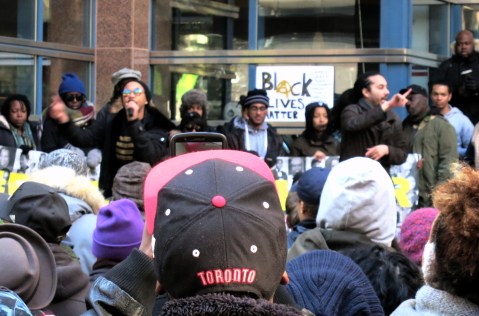
#BLMTOblackOUT, Toronto Police Service Headquarters, Toronto, Saturday, March 26, 2016, image by author
BLACK LIVES THEY MATTER HERE,” a BLMTO member shouted into a microphone; a call and declaration of a black elsewhere affirmed by the audience’s response: “BLACK LIVES THEY MATTER HERE.”
#BLMTOblackOUT, Toronto Police Service Headquarters, Toronto, Saturday, March 26, 2016, recording by author
She reiterated, “BLACK LIVES THEY MATTER HERE,” as Rhythms of Resistance Toronto, a band that performs at social justice events across the city, began to accompany her with a samba groove; this was elsewhere as a black diasporic space. “BLACK LIVES THEY MATTER HERE,” confirmed the audience in response who were now clapping along to the beat. A back-and-forth ensued where repetition and the obstinacy of the leader’s voice marked what Daphne Brooks has identified in “All That You Can’t Leave behind”: Black Female Soul Singing and the Politics of Surrogation in the Age of Catastrophe” as “urgency and excess.” This urgency and excess were further compounded by the start of another chant, which interlocked with the one she was leading. Another member of BLMTO then exclaimed into a microphone, “NO JUSTICE, NO PEACE. NO RACIST POLICE.” Some of the audience members began to heed her call. “BLACK LIVES THEY MATTER HERE / NO JUSTICE, NO PEACE. NO RACIST POLICE.” Together, the two chants, loud and overpowering, created a tension that paralleled the social pressures wrought by a Canadian silence that takes the form of anti-black racism.
After a few rounds of the layered chant were exhausted, the second leader stopped to catch her breath. By bringing the chant to a halt, she demonstrated not only the toll that shouting takes on a person but also the labor, power, and duress needed, according to Kelley Tatro, “to express personal and collective rage.” “I can’t breathe,” said Eric Garner eleven times while the police officers holding him down against the pavement disavowed him of his personhood. In the US and Canada, breathing and shouting are presumed antithetical to life within the realms of white settler colonialism.
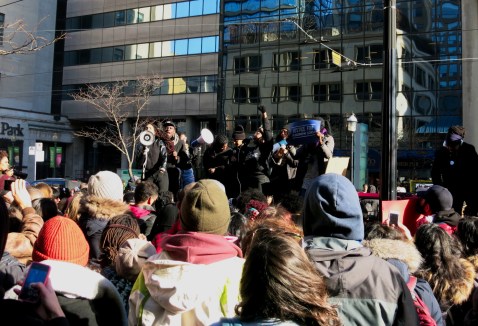
#BLMTOblackOUT, Toronto Police Service Headquarters, Toronto, Saturday, March 26, 2016, image by author
Shouting, performing anger and defiance via sound in public, is considered noise under the logics of whiteness. Thus, as Jack Halberstam writes in the introduction to Stefano Harney and Fred Moten’s The Undercommons, “In order to bring colonialism to an end then, one does not speak truth to power, one has to inhabit the crazy nonsensical, ranting language of the other, the other who has been rendered a nonentity by colonialism” (8). What both BLMTO members leading chants indicated at #BLMTOblackOUT is that shouting, in this case in the form of chanting, is another way of breathing elsewhere into existence.
#NoDAPL Solidarity March with Standing Rock
Queens Park to Nathan Phillips Square
Saturday, November 5, 2016
It began where many politically motivated public gatherings in Toronto do: outside Queen’s Park, which houses the Government of Ontario offices. Participants made speeches, chanted, cheered, jeered, and sang songs. The crowd then headed south on University Avenue sounding their discontent in front of the US Consulate building, which coincidentally is on the way to Nathan Phillips Square.
The march had been organized by and alongside Indigenous groups to show support for protesters at Standing Rock. In solidarity with the Water Protectors holding camp at Sacred Stone Camp, marchers in Toronto were expressing their disapproval of the US government’s efforts to construct an oil pipeline through Indigenous territory, a project that endangers clean water resources and violates treaties.
Once at Nathan Phillips Square, Indigenous people led participants in a pan-tribal round dance. Most strongly since Idle No More, or #IdleNoMore, in the winter of 2012/2013, round dances became emblems of Indigenous self-determination across what is typically referred to as Canada. Taking place in public venues, notably malls, as part of Idle No More actions, round dances served as communal claims not to Canada and Canadianness but rather to Turtle Island and Indigeneity.
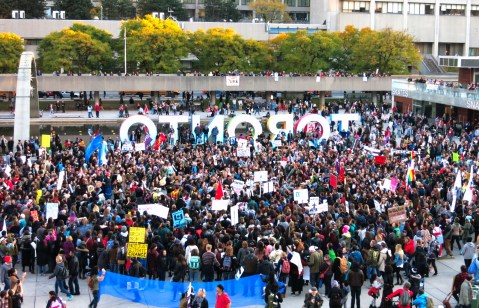
Round Dance, Nathan Phillips Square, Toronto, Saturday, November 5, 2016, image by author
Along with drumming, singing makes up the sonic elements of a round dance all the while those participants not playing a drum in the middle of the circle hold hands and move in a clockwise direction to the music. The high-pitched singing voice invites and welcomes those who have passed to join. In this way, the singing voice is an understanding that life and kinship do not cease at death. As such, the high-pitched singing voice is also a reach towards something else, a nameless elsewhere describable, graspable, through vocables. These vocables, these sonic registers of possibility, cannot be contained by the limitations of any official language. As part of round dances, then, vocables announce that while this elsewhere has yet to be legitimized through language, it exists in sound. And elsewhere’s existence is celebrated by what Anna Hoefnagels writes in “Northern Style Powwow Music: Musical Features and Meanings” are the improvised “whoops, shouts, yelps or ululations by singers” (14).
Through round dances, Indigenous people recognize that according to treaties signed by Indigenous groups and European settlers the land and its resources are to be shared. Round dances are a means to assert that Turtle Island is not another name for North America but rather a place that exists alongside North America.
Women’s March on Washington: Toronto
Queen’s Park to Nathan Phillips Square
Saturday, January 21, 2017
The labor, the creativity, of women of color is largely to thank for the organizing and mobilizing efforts that led to the Women’s March on Washington. Toronto’s “sister march” made evident the ways in which the work that women of color, particularly black women, perform in producing elsewhere has and continues to go unrecognized. The use of songs with black female vocals to lead Toronto’s Women’s March is an example of how audibility accompanies invisibility in Canada.
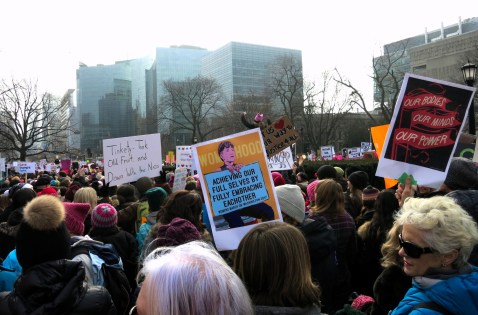
Women’s March on Washington: Toronto, Queen’s Park, Toronto, Saturday, January 21, 2017, image by author
he joyous tenor of the march was introduced partially through disco and disco-inflected songs like Sister Sledge’s “We Are Family” (1979) and the Eurythmics’ and Aretha Franklin’s duet “Sisters Are Doin’ It for Themselves” (1985). March organizers wanted participants to feel that this march was a celebration of sisterhood, of women, like Aretha Franklin and Annie Lennox, coming together harmoniously as kin. Intersectionality need not apply—maybe as a catchword but definitely not in practice.
Women’s March on Washington: Toronto, Queen’s Park, Toronto, Saturday, January 21, 2017, recording by author
.
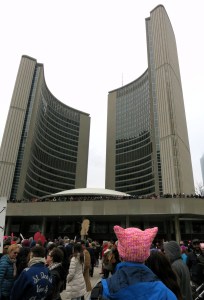
Women’s March on Washington: Toronto, Nathan Phillips Square, Toronto, Saturday, January 21, 2017, image by author
The emotional labor that Debbie, Joni, Kim, and Kathy Sledge of Sister Sledge and Aretha Franklin perform in these songs was not meant to be heard as women belaboring a black feminist, or womanist or queer, elsewhere; instead, marchers—like much of white feminism historically—enjoyed the benefits, without the risks, of an elsewhere made possible by the emotional labor that black female singers perform in dance music. In the voices of Sister Sledge and Aretha Franklin, some marchers did not recognize the invisible labor required to flourish in white settler heteropatriarchal nation-states; at the march, the power of black female voices was misappropriated to signal thriving because of white settler colonialism, paternalism, and blanket sisterhood.
Women’s March on Washington: Toronto, Queen’s Park, Toronto, Saturday, January 21, 2017, recording by author
.
Pulse Memorial
Barbara Hall Park
Monday, June 12, 2017
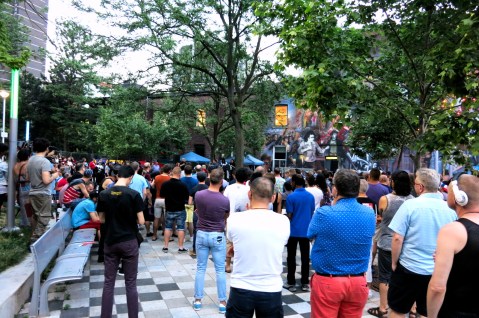
Pulse Memorial Event, Barbara Hall Park, Toronto, Monday, June 12, 2017, image by author
Adjacent to Toronto’s AIDS Memorial in Barbara Hall Park, attendees gathered to remember the forty-nine victims of the shooting at Pulse Nightclub in Orlando, Florida. The event commemorated the one-year anniversary of the shooting with a short film screening, a DJ set, musical performances, poems, short speeches, and food. Surrounded and sustained by the light of candles, the names of the forty-nine primarily Latinx victims were read by the event’s three MCs against the flickering screen of the lit wicks.
Pulse Memorial Event, Barbara Hall Park, Toronto, Monday, June 12, 2017, image by author
| Stanley Almodovar III, age 23
Amanda Alvear, 25 Oscar A. Aracena-Montero, 26 Rodolfo Ayala-Ayala, 33 Alejandro Barrios Martinez, 21 Martin Benitez Torres, 33 Antonio D. Brown, 30 Darryl R. Burt II, 29 Jonathan A. Camuy Vega, 24 Angel L. Candelario-Padro, 28 Simon A. Carrillo Fernandez, 31 Juan Chevez-Martinez, 25 Luis D. Conde, 39 Cory J. Connell, 21 Tevin E. Crosby, 25 Franky J. Dejesus Velazquez, 50 |
Deonka D. Drayton, 32
Mercedez M. Flores, 26 Peter O. Gonzalez-Cruz, 22 Juan R. Guerrero, 22 Paul T. Henry, 41 Frank Hernandez, 27 Miguel A. Honorato, 30 Javier Jorge-Reyes, 40 Jason B. Josaphat, 19 Eddie J. Justice, 30 Anthony L. Laureano Disla, 25 Christopher A. Leinonen, 32 Brenda L. Marquez McCool, 49 Jean C. Mendez Perez, 35 Akyra Monet Murray, 18 Kimberly Morris, 37 Jean C. Nieves Rodriguez, 27 |
Luis O. Ocasio-Capo, 20
Geraldo A. Ortiz-Jimenez, 25 Eric I. Ortiz-Rivera, 36 Joel Rayon Paniagua, 32 Enrique L. Rios Jr., 25 Juan P. Rivera Velazquez, 37 Yilmary Rodriguez Solivan, 24 Christopher J. Sanfeliz, 24 Xavier E. Serrano Rosado, 35 Gilberto R. Silva Menendez, 25 Edward Sotomayor Jr., 34 Shane E. Tomlinson, 33 Leroy Valentin Fernandez, 25 Luis S. Vielma, 22 Luis D. Wilson-Leon, 37 Jerald A. Wright, 31 |
The reading of their names was an incantation of forty-nine lives lost and an invocation of an elsewhere maintained through remembrance. The vocalization of their names was thus a commitment to an understanding of intimacy that refuses the state’s limited definitions of what and whom constitutes a (grievable) life; and concurrently, their names were sonic acknowledgments of the violence that is basic to life for many under white settler colonialism, what Christina Sharpe calls “being in the wake.” Their names, too, were evocations of the queer of color dancefloor. It us under and around the disco ball, after all, that many queers of color enact an elsewhere, love light in flight. Therefore, the reading of the forty-nine names was an assertion that life and intimacy are sonic demands and collective endeavors.
Night March
George Hislop Park to Old City Hall
Wednesday, June 21, 2017
Annually, some queer Canadians take it upon themselves to organize a Night March, an unofficial (by choice) Pride event that insists that Pride has been and will continue to remain political. Night March is a refusal to abide by the respectability politics attached to the visibility and corporatism that Pride garners across Toronto. “LET’S GET CRITICAL, OUR PRIDE IS POLITICAL,” one of the chants goes. Participants meet at a predetermined location, announced through posters and social media, somewhere near or in the Church and Wellesley Neighborhood—Toronto’s “gayborhood.” Before setting out to march, participants listen to a small set of speakers who share information on some of the issues that are not being discussed at Toronto’s official Pride events: the defunding of organizations working on HIV/AIDS and the housing discrimination faced by trans women and sex workers, for example.
The gathering at George Hislop Park this year also made evident a particular rift among LGBTQ+ people, groups, and institutions surrounding this year’s Pride festivities: whether to support BLMTO’s actions and demands at last year’s Pride Parade, namely the removal of uniform police from partaking in future parades. On Sunday, June 26, 2016 and in their role as honored guests of the parade, members of BLMTO halted Toronto’s Pride Parade at the intersection of Yonge and College Streets for thirty minutes—to the dismay of some and the approval of others. It was then that BLMTO served Pride Toronto, the organization that runs Pride in the city, with a list of demands. Pride Toronto’s Executive Director at time Mathieu Chantelois hastily signed BLMTO’s list of demands only to retract his approval shortly thereafter. Following months of heated debate and backlash against BLMTO, the Pride Toronto membership formally agreed to adopt all of BLMTO’s demands at its Annual General Meeting (AGM) on January 27, 2017—uniformed police would not march at this year’s Pride parade.
At George Hislop Park, Night March participants were unequivocal in their support of BLMTO. The mostly millennial and predominantly white gathering’s chants, which they shouted as they made their way down Church Street, included “BLACK LIVES MATTER” and “NO JUSTICE, NO PEACE. NO RACIST POLICE.”
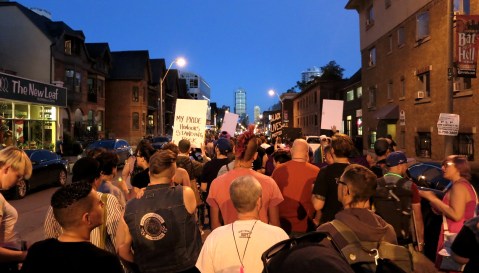
Night March, Church Street, Toronto, Wednesday, June 21, 2017, image by author
Night March participants even halted traffic on College Street as they briefly occupied the traffic lanes in front of Toronto Police Service Headquarters. Accompanied by Rhythms of Resistance Toronto, a few participants called out “BLACK LIVES THEY MATTER HERE.” The rest of the gathering responded, “BLACK LIVES THEY MATTER HERE.”
Night March, Toronto Police Service Headquarters, Toronto, June 21, 2017, image by author
.

Night March, Toronto Police Service Headquarters, Toronto, June 21, 2017, image by author
Police officers who were following the marchers on bicycles sounded out a short siren, a sound of disapproval and a warning to disperse. The marchers continued chanting. They then switched chants and began shouting in unison, “NO JUSTICE, NO PEACE. NO RACIST POLICE.” After a few rounds of this chant, one participant led the gathering into another chant:
WHEN BLACK LIVES ARE UNDER ATTACK, WE REVOLT, UNITE, FIGHT BACK. x9
WHEN TRANS LIVES ARE UNDER ATTACK, WE REVOLT, UNITE, FIGHT BACK. x3
WHEN INDIGENOUS LIVES ARE UNDER ATTACK, WE REVOLT, UNITE, FIGHT BACK. x3
WHEN WOMEN’S LIVES ARE UNDER ATTACK, WE REVOLT, UNITE, FIGHT BACK. x3
WHEN QUEER LIVES ARE UNDER ATTACK, WE REVOLT, UNITE, FIGHT BACK. x3
The chants at Night March were sonic testaments of an elsewhere impossible to imagine and enact without the collective labor of BLMTO’s membership since its formation in 2014, which has included but has not been limited to #BLMTOtentcity and their protests at Toronto’s 2016 Pride Parade. The chants were also a compilation and validation of noisy political activity—a loud elsewhere—in a city and in a nation-state that prefers, promotes, and is predicated on the silence, the violence, that is white settler colonialism.
Conclusion
“Only together,” argues Gloria Anzaldúa in Borderlands/La Frontera, “can we be a force” (209).
Together, these voices at public gatherings say NO to Toronto, Canada at so-called 150; NO is a refusal to be complicit, to stay silent, to death. These are voices that do not consent to white settler colonialism. A NO to police brutality, the disappearance and murders of Indigenous women and girls, the conditions that drive Indigenous youth to suicide, lack of clean drinking water, carding, anti-semitic and Islamophobic hate crimes, the different forms of violence LGBTQ+ people, particularly trans women, face, the municipal, provincial, and federal governments defunding and unfunding of public housing and healthcare programs. It is by amplifying and listening to these NOs that we actually hear the workings of a YES, to an affirmation of elsewhere in the here and now that is always already attuned to the past and future, to lives—black, trans, Indigenous, feminine, queer—that matter, to life otherwise.
—
Featured Image: Round Dance, Nathan Phillips Square, Toronto, Saturday, November 5, 2016, photo by author
—
Gabriela Jimenez defended her PhD dissertation in ethnomusicology at the University of Toronto this spring. Her dissertation is on the ways in which nonnormatively gendered and sexually oriented persons in Mexico City use musical performances to alter their surroundings. Her writing has been featured in Black Music Research Journal and The Fader.
—
 REWIND!…If you liked this post, you may also dig:
“Quebec’s #casseroles: on participation, percussion and protest”-Jonathan Sterne
“Deejaying her Listening: Learning through Life Stories of Human Rights Violations”-Emmanuelle Sonntag and Bronwen Low
“Listening to the Border: ‘”2487″: Giving Voice in Diaspora’ and the Sound Art of Luz María Sánchez”-D. Ines Casillas
Share this:


Current Top Posts





April 2021

January 2020

November 2019

October 2019

August 2019

April 2014

November 2017

March 2015

December 2017

October 2015
 Sounding Out!
Recent Comments