
Sounding Visibility in Anglo-Latin Prose


series co-editors Dorothy Kim and Christopher Roman
Here is a distilled introduction to the latest installment of Medieval Sound, Aural Ecology, by series co-editors Dorothy Kim and Christopher Roman. To read their previous introduction, click here. To read the first run of the series in 2016, click here. To read the full introduction to “Aural Ecology” and to read last week’s post by Thomas Blake, click here.
Aural Ecology
What is considered music, noise, or harmony is historically and culturally contingent. [. . .] The essays in “Aural Ecologies” address the issue of unharmonious sounds, sounds that often mark dissonant critical identities—related to race, religion, material—that reverberate across different soundscapes/landscapes. In this way, this group of essays begins to open up the stakes of Medieval Sound in relation to what contemporary sound studies has begun to address in relation to cultural studies, architectural and environmental soundscapes, and the marking of race through the vibrations of the body. —Dorothy Kim and Christopher Roman
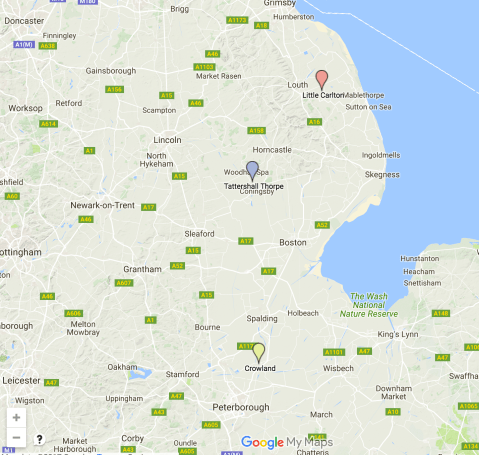
While the raucous rancor of last year’s Super Tuesday was dominating network news and social networks—which, sadly, seems so long ago now—a quieter news story emerged from the tranquil fields of Lincolnshire: an Anglo-Saxon island has been discovered. Its artifacts are some of the most remarkable to have been found in recent decades; among these finds are writing utensils, game pieces, butchered animal bones, and other indicators of a sustained trading community.
The Guardian reported that surveys and software enabled the archaeologists to model the island in its contemporary landscape and seascape, revealing that it had once rested “between a basin and a ditch.”
This placement, the lead archaeologist continued, suggests that the site “was a focal point in the Lincolnshire area, connected to the outside world through water courses.” So if these reimagined waterways can show us how people saw the site, can they tell us how people heard it, as well?
I think so, especially because of the recent work on ancient acoustics in early churches. In February, The Atlantic published an article on the recent scholarly collaboration among an art historian-archaeologist, a music producer-engineer, and the founder of the USC Immersive Audio Laboratory (yes, it’s a real thing). This super-interdisciplinary team was able to “map the acoustic fingerprint of several [Byzantine] churches,” which were shown to have been deliberately “designed to shift a person’s sensory experience.” Now, the USC member explains, they can record a chant, “process it … and all of the sudden we have performances happening in medieval structures.” They can actually rebuild the sounds of our ancient past. [By the way, Allison Meier of hyperallergic reported on this story as well; her article provides links to the Escape Velocity podcast on Acoustic Museums, which is well worth a listen].

Interior of Lincoln Cathedral, Image by Flickr User Gary Ullah, (CC BY 2.0)
If they can recreate the lost sounds of ancient structures, and archaeologists can recreate early medieval topographies, then it stands to reason that the recreation of past landscapes, and even seascapes, might not be far behind.
But was sound different across the cooler, wetter climate of the early Middle Ages? Were the hearers’ auditory contexts drastically different in a pre-modern world? To what effect?
To me, what’s tantalizing about the Lincolnshire island is that it was on the border of the early medieval fenland—an area described by the 8th-century monk Felix as dense and undulating, “now consisting of marshes, now of bogs, sometimes of black waters overhung by fog, sometimes studded with wooded islands and traversed by the windings of tortuous streams” (Ch XXIV, trans Colgrave p 87). In such an aqueous environment, sound would have travelled well, staying close to the cool, dense air hovering over the waters.

Dark skies over fenlands, near Spilsby, Lincolnshire. Taken by Lutmans on Flickr, (CC BY 2.0).
In his prose hagiography, the Life of St Guthlac, Felix enshrines certain sounds in the wetland ecology of Guthlac’s surroundings. He does so most explicitly at the landing-place, where visitors must “sound a signal” to alert the hermit that they’ve arrived. But what was this signal, and why would Felix bother to emphasize such a mundane practice of alerting your host when you’ve arrived?
In monastic communities bells were used to sound the Daily Office to calling each member together in prayer. As moderns, we should remember that these bells—frequent, sonic interventions of everyday life—were rung on the shore, or in a church, or on monastic grounds rather than from the larger towers of later belfries (an exception to this is the early Irish Round Tower). These small hand-held bells “of hammered sheets or cast metal” which “would presumably have clanged or tinkled, rather than tolled sonorously across a distance” (Resounding Community, 103).

Bell-shrine; bronze and silver parcel-gilt; made for the bell of St Conall Cael.
Bells were spiritual and supernatural; they could cleanse or curse, and were kept by clerics and lay people alike. They were sometimes sworn on, as if they were relics. Sometimes, they were made into relics. For more about early Irish bell traditions, click here and or/ here.
In Northwest Europe in the Early Middle Ages, Christopher Loveluck describes David Hinton’s work on a seventh-century smith found buried alone, “next to the marshland and waterways to the sea, with his tools, a bell, a fine seax and a silk-wrapped amulet” and therefore “emblematic of the transition from such ‘outsider’ itinerant artisan/merchants to the vibrant artisan and trading communities of the emporia ports.” Still, the“[p]erception of threat from itinerant ‘outsiders’ is emphasized in the late seventh-century Anglo-Saxon law code of Wihtred, by the obligation on non-local travellers and foreigners to announce themselves with bells or horns, prior to leaving principal roads or trackways to approach settlements.”
For seventh-and eighth century people, then, bells sounded time, community, and stillness as well as place, strangeness, and travel. In either instance, the aural intrusion always betokened a human presence. And of course, these were some of the only sounds that weren’t naturally occurring; this might have been as close as they got to manmade sound pollution.
For Guthlac, sound was especially important because he could not see far from his earthen hermitage. Not having any need for a bell to sound the Daily Office, he nevertheless depended on some kind of signal for approaching visitors.
In one episode, distraught parents bring their once-possessed, now very ill son to Crowland in the hope that he might be cured. This is quite different from an earlier visitation from Wilfrid and Æthelbald, whom Guthlac knew personally, and with whom he might have traded correspondence. To me, this is the real test of Guthlac’s grace: will he help the neediest? The stranger? The tired, desperate parents? Does the bell, or whatever the signal is, proclaim their sameness or difference?
We can sense the tension in the passage, during their sounding of the signal and speaking to Guthlac:
Then when the sun rose in its splendour, they approached the landing place of this said island, and having struck the signal they begged for a talk with the great man. But he, as was his custom, burning with the flame of most excellent charity, presented himself before them…[and after hearing their story] immediately seized the hand of the tormented boy and led him into his oratory, and there prayed on bended knees, fasting continually for three days…(XLI, Colgrave 131).
The parents had expected to wait; they expected to plead on their son’s behalf. They expected a struggle to be heard. But—and I do think that’s a rather crucial autem in the Latin—Guthlac is eager to listen; the sound on the shore was enough.
What’s more, his cure is a series of utterances. He prays (aloud) for three days straight, without pausing to eat. And after ritually rinsing and breathing the “breath of healing” on the boy, the child, “like one who is brought into port out of the billows and the boiling waves, heaved some deep sighs from the depth of his bosom and realized that he had been restored to health”(XLI, Colgrave 131).

Image from National Museum of Ireland
I’m a mom to an asthmatic toddler, so I find myself quite moved by this scene. I can imagine ringing the bell—the thing I might have heard in church, or had in my home; the signal by which monks were called to prayer and children inside for curfew—to make a sound for myself. I can imagine traveling with my husband to a strange place far from home, not knowing what would happen. I can imagine using something everyday for something extraordinary, and having the sound of my arrival echo with anticipation. If I were this mother, I would hear it bounce off the marshes and off the low-lying islands. The dawn would be warming the air above us, amplifying our sound. And I would be standing there, with my child wrapped in my arms, hoping to see someone emerge from a barrow; a man of God whose isolation and entrenchment was supposed to be part of his holiness.
The sound travels outwards to the hermitage and back with the hermit—the echo of her hope, meeting them at the shore. This is a soundscape and a landscape in which time seems still on the shore, but sped through in the oratory. Felix joins both sites, and both temporalities, with the simile of the boy as one rescued from shipwreck catching his breath as he washes ashore. The image recalls the sound of their arrival, and that first bell still seems to ring through this narrative of hope against all odds.
Wouldn’t it be great to hear that again?
—
Featured Image: Guthlac sailing to Crowland with Tatwin. © British Library, Harley Roll, Y 6, roundel 4, from Medieval Histories.com
—
Rebecca Shores is a Ph.D. candidate in English Literature at the University of North Carolina at Chapel Hill. Her Dissertation is entitled “Bringing Saints to the Sea: Ships in Old English and Anglo-Latin Hagiography.”
—
REWIND!…If you liked this post, you may also dig:
(Sound)Walking Through Smithfield Square in Dublin–Linda O’Keeffe
Wayback Sound Machine: Sound Through Time, Space, and Place–Maile Colbert
Audiotactility & the Medieval Soundscape of Parchment–Michelle M. Sauer
Share this:

SO! Reads: Jace Clayton’s Uproot

 “Music has always confounded value,” writes interdisciplinary artist and writer Jace Clayton in Uproot: Travels in 21st-Century Music and Digital Culture (FSG Originals, 2016, 22). Recounting his extensive international travels performing as DJ /rupture, Clayton presents a flow of cosmopolitan musical experiences that illustrate complex collisions between music and value around the world. Whether writing about homemade sound-systems in tropical clubs in Brooklyn, or about shellac preservation at the Arab Music Archiving and Research Foundation in Beirut, Clayton considers the technologies by which we make — and place value on — musical sounds in “a world where worth is created in radically different ways from what the market teaches us” (24).
Uproot is a narrative about the ways working musicians experience globalization. “Our music seems to sound the way global capital is — liquid, international, porous, and sped up,” the author writes (16). This homology between sound and economic processes echoes the theories of sociologists like Anthony Giddens and the late Zygmunt Bauman, both of whom argue that modern life is characterized by fluidity and fragmentation: employment is precarious, experience is mediated, and ethical decisions are full of ambiguity. These ideas clearly inspire Clayton’s narrative; that said, Uproot is not an academic publication. As Atossa Araxia Abrahamian writes at the Nation, the book evades genre, “at once travelogue and cultural ethnography, pop philosophy and memoir, a guide to contemporary music and a fanzine.”
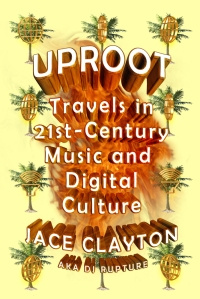 The book begins with a discussion of the history of Auto-Tune. While Clayton’s claim that Auto-Tune was the “first truly new sound effect of the internet era” might be overstated, his distinction between “corrective Auto-Tune” and “cosmetic Auto-Tune” is useful, the first of many moments of clarity in parsing the ways we use and mis-use musical media today. “The robot voice signifies differently everywhere you go,” he writes, an observation that becomes central to the book (49). By refusing to take a deterministic stance toward technology, Clayton empowers the musicians he writes about, acknowledging the ways in which artists mold trends to their own regional and local purposes. Of collaboration with a violinist in Morocco, Clayton writes: “We may have thought similarly, yet our ‘default settings’ were so far apart as to be almost incompatible” (185).
Uproot offers intimate insights into a range of tools and techniques of production, such as compression artifacts, “refixes,” and dozens of music-making interfaces, including Clayton’s own “music software-as-art project,” Sufi Plug Ins.
.
Even language itself is conceived as a form of technological mediation, as when Clayton compares Arabizi — a phonetic spelling of colloquial Arabic — to the hybrid sounds of mahraganat music that the language is used to describe. Of these “wandering genealogies” that emerge from international conversations, Clayton suggests that any hybrid genre we can imagine likely already exists: “Accordions and African techno? It’s called funaná” (102). The book describes at least a dozen other music traditions and microgenres–some very old, some just coalesced–from dabke to zar, each the product of a unique fusion of vocabularies.
Clayton on Mazaher (182): “Umm Sameh, Umm Hassan, and Nour el Sabah: these three women are some of the only people in Egypt keeping zar alive.”
Clayton’s own prose style, replete with metaphor and fluent in informal language, mirrors the ethos of music production he explores in the book: eclectic, energetic, and bursting with detail. What better way to describe Auto-Tune’s effect than as liquification of sound into a “bright neon stream, as if a dial-up modem and a river have fallen in love” (53)? Clayton’s technological travelogue extends beyond aural sensation alone. This is a story of “sidewalk vendors, radios, mosque loudspeakers,” (106) but it is just as much about “jerk chicken, fish tea, goatskin soup” (73). When Clayton describes his surroundings, we can touch the orange blossoms and smell the cigarettes.
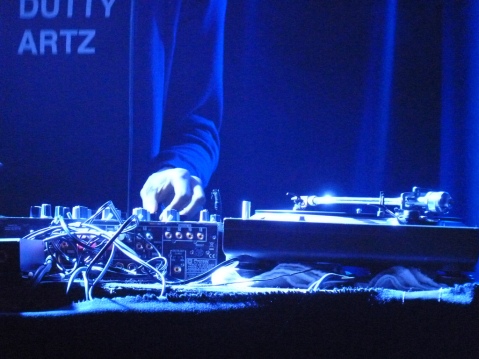
Dj /rupture performs in Minefield UK, 2010, image by Flickr User Paul Narvaez Attribution-NonCommercial 2.0 Generic (CC BY-NC 2.0)
The book’s recurrent question is how DJ practices in different locations are both constrained and inspired by financial flows. In any context, Clayton argues, “[m]oney runs to the people with the least imagination” (24). Early on, he establishes this view that musical experience is priceless, more valuable than any profit derived from rhythms of supply and demand, which reward the wrong people. That said, Clayton isn’t naive about musicians’ inevitable need for income, and throughout the text, readers are asked to inhabit ethical dilemmas that artists encounter throughout the world. At one point, Clayton describes his own moral quandary when asked to perform in front of a giant Red Bull logo, a “glowing lump of techno-fascist DJ furniture.” Later, Clayton critiques the hegemony of “Red Bull patronage” and similar systems of support for artists who are desperate for funding (121). He makes clear his disdain for corporate sponsors, companies that “appear generous as they let us know that our music is literally worthless to them” (123).
A tradeoff emerges between pragmatism and idealism. Clayton pokes holes in the empty rhetoric of “authenticity” that marketers encourage and exploit, even as we sense that he hasn’t yet relinquished his belief in something essentially good about the human spirit. Listening is a powerful social practice that, in Clayton’s view, gives true meaning to music in a global economy that otherwise undervalues it. “The heavier the workaday grind to escape from, the more a party transports us” (73), he writes, suggesting that listeners extract their own surplus value.
At times, Clayton’s observations could benefit from an engagement with ethnographic methods that can help mitigate fieldwork biases. For example, although the book does involve open discussions of gendered inequalities, they are limited in scope. At one point Clayton calls attention to “macho wrangling over propriety and womanhood” among managers and producers in Agadir, Morocco (52); he describes his own futile attempt to acquire a frank interview with female singers amid the patriarchal structure there. But despite Clayton’s awareness of gendered power dynamics, he does not critique the male musicians and producers who propagate such imbalances.
When female figures do appear, they are often treated as side characters. Rihanna, for example, is presented as exemplary of the business model of “singer as mouthpiece” (50), a person for whom others do the work. Clayton isn’t wrong to call attention to the large networks of employees that work behind any celebrity brand, but it is risky to do so at the expense of female workers, especially in the midst of a book that elsewhere describes women as decoration for the musical environments in which men perform what are presumably more important tasks. “Naked girls on pedestals [who] got their bodies painted” (19), “photoshopped young women” (49) and “demure girls” (49) all set scenes for tales of male creativity. This is not to critique how some women may choose to participate in music scenes, but rather to point out that women’s concerns and perspectives are not Clayton’s focus in these passages, nor in much of the book.
On Berber Auto-tune star Saadia Tihihit (49-50): “Like Justin Beiber or any child groomed to be a media star, Saadia Tihihit occupies a place at least initially defined more by the commercial strategies of those around her than by any desire for artistic autonomy.”
Comparably, Clayton’s conception of music and global inequality is sometimes uneven. Drawing stark divisions between the “civilized” and otherwise, he resorts to clichéd language when he writes of “backwater Uzbekistan” (31) and “war-torn Africa” (81). When he describes towns and villages near Casablanca where “ancient rhythms of life still hold sway” (33), he reproduces exoticizing tropes of African music. Elsewhere in the book, Clayton addresses musical accusations of fetishism, stating: “I know that Africans and blacks have been fetishized for centuries now, perhaps millennia. Who cares? You simply exist in all your complexity and let them deal with it. Fetishism is so vague” (84). He also critiques what he calls the “spectacle of a so-called ancient culture” (99) that is often at the heart of “world music” scenes, but then describes Appalachian musical performance as “the old-timey way with banjos and fiddles and washtub percussion” (32), opposing these practices against technological advancement, a false dichotomy that ethnomusicologists work to complicate, if not avoid.
Clayton brings these issues to a head during the book’s extensive discussion of “world music” as a marketing category. His commentary on the conundrums of appropriation surrounding figures such as Paul Simon, M.I.A., and Moby feels familiar, but he surpasses the usual analysis of these common case studies with more personal insights into “world music,” beginning with crate-digging excursions at record shops with deep international selections, such as the now-defunct RRRecords in Lowell, Massachusetts. Clayton contrasts his own on-foot exploration of foreign sounds with what he calls “World Music 2.0,” an internet-driven network of musical discovery based around the commodification of information and attention, in which middlemen reign supreme. His ambivalence is exemplified by this claim: “At its worst, World Music 2.0 offers the clubland equivalent of a package vacation. At its best, it propels some of the most exciting music in the world” (104-105).
The book’s ideas occasionally undermine themselves, but there is no question that the author ultimately intends to advocate for people on the margins. As Max Pearl has noted at the LA Times, Clayton consistently defends lo-fi, lo-tech, and lo-res sonic expression — that which is “distorted, homespun, libidinous” (80) — as valuable in its own right. Further, Sukhdev Sandhu has suggested at the Guardian that the book’s attention to homologies between “the movement of sounds and of migrant bodies” serves to recognize the struggles of global refugees and affirm their humanity.
Among Uproot’s many mentions of transport, readers never receive a clear statement about what, precisely, the relationship between music and motion is, or how exactly value emerges from that pairing. Rather than a weakness of the book, however, maybe such equivocation should be taken as an accurate reflection of the nebulous circumstances in which many of us find ourselves — creators and listeners who are regularly uprooted, usually at the mercy of those whom the money follows. Faced with this precarity, let Clayton’s enthusiasm for all sounds ground you.
Uproot is accompanied by an online Listening Guide that includes audio and visual examples of music from the book: http://www.uprootbook.com.
—
Featured Image: DJ /rupture performing at the Fórum Eletronika de Mídias Expandidas 2005 by Flickr user Brayhan Hawryliszyn (Attribution-NonCommercial 2.0 Generic (CC BY-NC 2.0)
—
Elizabeth Newton is a doctoral candidate in musicology. She has written for The New Inquiry, Tiny Mix Tapes, Real Life Magazine, the Quietus, and Leonardo Music Journal. Her research interests include musico-poetics, fidelity and reproduction, and affective histories of musical media. Her dissertation, in progress, is about “affective fidelity” in audio and print culture of the 1990s.
—
REWIND!…If you liked this post, you may also dig:
SO! Reads: Dolores Inés Casillas’s ¡Sounds of Belonging!–Monica De La Torre
SO! Reads: Roshanak Khesti’s Modernity’s Ear–Shayna Silverstein
Lokananta: Sounds of Crisis and Recovery from Indonesia’s National Record Company — Ian Coss
Share this:




Current Top Posts





April 2021

January 2020

November 2019

October 2019

August 2019

April 2014

November 2017

March 2015

December 2017

October 2015
 Sounding Out!
Recent Comments