
“To Unprotect and Subserve”: King Britt Samples the Sonic Archive of Police Violence
Author’s note: In line with the ethics of listening considered below, I’ve chosen not to embed the videos of police violence that I discuss. But I’ve linked to them when available for readers who’d like to see/hear their content.–Alex Werth
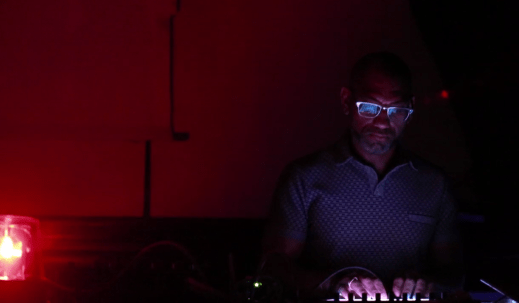
“I’m scared to death of these police.” Dave Chappelle’s voice—pitched down, but nonetheless recognizable—calls from the speakers, cutting through the darkness of Oakland, CA’s Starline Social Club. It’s closing night of the 2016 Matatu Festival of Stories, an annual celebration of Black diasporic narratives, technologies, and futures routed through the San Francisco Bay Area. King Britt—an eclectic electronic pioneer and producer, and former DJ for Digable Planets—has landed with the third version of “To Unprotect and Subserve: A Sonic Response.” (It was first performed after a march for Mike Brown in Ferguson in 2014.) I can barely see Britt, his solemn look bathed in the dim glow of electronic consoles and the red-and-blue pulse of police lights. “First money I got,” Chappelle continues, “I went out and bought me a police scanner. I just listen to these mothafuckas before I go out, just to make sure everything’s cool. ‘Cause you hear shit on there: ‘Calling all cars, calling all cars. Be on the lookout for a Black male between 4’7” and 6’8”.’” With this double invocation, Britt invites us to listen. Specifically, à la Chappelle, he invites us to listen back—to attune to the agents of a racialized security state that, from ShotSpotter to CIA surveillance, profile and police the world’s sonic landscapes.
This essay considers the ethical effects/affects in King Britt’s work of sampling what I call the sonic archive of police violence. From Oakland to Ferguson, the Movement for Black Lives has raised critical questions about the mass surveillance of Black and Brown communities, the undemocratic control of data in cases of police misconduct, and the use of smart phones and other recording devices as means to hold the state accountable. But the failure to indict or even discipline cops in police killings where audio/video evidence was not only available but overwhelming, from Eric Garner to Tamir Rice, casts doubt upon the emancipatory power of simply recording our race-based system of criminal (in)justice. And when re-presented ad nauseum on the news and social media, these recordings can retraumatize those most vulnerable to racist state violence. Indeed, at a discussion among Black artists at Matatu, each panelist admitted to limiting their exposure to what poet Amir Sulaiman called “e-lynching.”
What, then, can we learn from Britt about the praxis and politics of listening back when the circulation of what KRS One dubbed the “sound of da police” is now daily, digital, and ubiquitous? How can we make sense of audio recording when it’s come to signal repression, resistance, and painful reprisal all at the same time?
Back in the darkness of the club, Chappelle’s voice dissolves into a conversation between Darrin Wilson and a dispatcher from the Ferguson Police, who sends him to find the body of Mike Brown—a “Black male in a white t-shirt,” reportedly “running toward QuikTrip” with a stolen box of Swishers. The optimistic waves of sound that open the piece resolve into a throbbing pulse of 1/32nd notes that sounds like a helicopter. Britt begins to loop in other elements: a low bass tone, a syncopated stab. With kicks and reverb-heavy snares, he builds a slow, head-nodding beat (60 bpm) that coalesces around the vocal sample—swaddling, softening, and ultimately subsuming it with high-pitched legato tones. The synths are sorrowful. But the mesmerizing beat embraces listeners in their mourning.
This act of listening to the state differs from the one parodied at the start. Chappelle attends to the police scanner as a form of precaution, checking whether it’s safe for him to enter a realm where he can be marked as criminal (“Staying in the crib tonight! Fuck that!” he concludes). But Britt’s sonic bricolage is more therapeutic than protective. He uses repetition, reverb, and improvised melody to score a sonic altar—to open space, rather than control time—where we can meditate on the archive of police violence with the intention to heal. “Sometimes to push through the trauma we need to experience it in a different context,” he tells me over email. “There is room for healing within the chords and sounds that are carefully curated.” Britt thus reactivates the pathos buried inside this archive—reclaiming what Susan Sontag, in “On Photography,” recognizes as an “ethical content” of representational form that can fade from careless repetition (21).
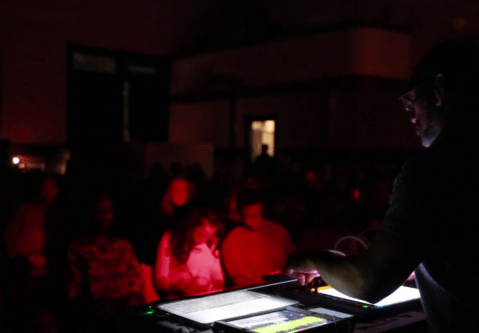
Picture of King Britt courtesy of Eli Jacobs-Fantauzzi for the Matatu Festival of Stories.
After removing the loops one-by-one, until the helicopter sound is all that remains, Britt releases a new sample into the mix. It’s audio from a cell-phone video taken in 2013 by two Black men as they’re harassed by White cops during a stop-and-frisk in Philadelphia (Britt’s hometown). He scores the somber scene with dissonant organs and an offbeat percussive note that reminds me of stress-induced arrhythmia—a heartbeat out-of-place, aggravated, precarious . Vibrating with anxiety, the soundscape temporarily snatches listeners from mourning, demanding that we listen in witness, instead.
The video reveals that the police tear the two men apart, pinning them to the cruiser. But the violence of the encounter is verbal as much as physical. The cops’ language and tone become increasingly abusive as the men contest their treatment in a sounding of agency that Regina Bradley, writing about Black women, calls “sonic disrespectability.” Philip Nace, the more audible of the officers, embodies a double bind built into what Jennifer Lynn Stoever calls the “sonic color line.” He threatens one of the men when he speaks out (“You’re gonna be in violation if you keep running your mouth when I split your wig open.”). But he turns around and ridicules him when, instead, the man refuses to speak (“You don’t know what we know…Right? Right?! What, you don’t hear now?”). As Stoever notes, the demand that African Americans speak when spoken to, but in a way that sounds their submission to Whites, is a feature of anti-Black oppression stemming from the “racial etiquette” of slavery (30-32).
Britt’s manipulation of vocals speaks to the centrality of sampling in hip-hop. According to Tricia Rose, hip-hop artists have long prioritized the sample as a way to recognize and renovate a communal repertoire of songs and sounds (79). And given the realities of anti-Black oppression in the U.S., this repertoire has often entailed the “sound(s) of da police.” From sirens to skits to verses, rappers and producers have remixed the sounds of the state to characterize, caricature, and critique the country’s criminal justice system. But Britt’s trespass on the state’s sonic sovereignty differs from classics like “Fuck tha Police,” in which N.W.A. conducts a mock trial of “the system.” Whereas N.W.A. reappropriates the rituals of legal testimony and judgment to condemn the police (“The jury has found you guilty of being a redneck, white-bread, chicken-shit mothafucka.”), Britt’s musical re-mediation of police violence favors grief over moralizing, dirge over indictment.
In this vein, the musical/ethical demand to witness waxes but then wanes. The soundscape becomes more and more dissonant until the vocals are consumed by a thunderous sound. Suddenly, the storm clears. Britt hits a pre-loaded drum track (136 bpm) with driving double-time congas and chimes over a steady sway of half-time kicks. He starts to improvise on the synth in an angelic register, revealing the impact of his early encounters with Sun Ra on his aesthetic. The catharsis of the scene is accentuated by the sporadic sound of exhalation. This sense of freedom dissolves when the beat runs out of gas…or is pulled over. In its stead, Britt introduces audio from the dashboard camera of Brian Encinia, the Texas State Trooper who arrested Sandra Bland. Encinia and Bland’s voices are pitched down and filtered through an echo delay, lending an intense sense of dread to his enraged orders (“Get out of the car! I will light you up!”).
Here, I sense the affective resonance of dub. Like the musicians on rotation in Michael Veal’s Dub, Britt manipulates the timbre and texture of voices in a way that demands a different sort of attention from listeners who, like me, may be desensitized to the sonic violence of the racialized security state as it’s vocalized and circulated in and between Ferguson, Philly, and Prairie View. Britt reworks the character and context of the vocals into a looping soundscape, and that soundscape sends me into a meditative space—one in which the vibes of humiliation and malice “speak” to me more than Encinia’s individual utterances as an agent of the state. According to Veal, the pioneers of dub developed a sound that, while reverberating with the severity of the Jamaican postcolony, “transport[ed] their listeners to dancefloor nirvana” and “the far reaches of the cultural and political imagination” (13). Now, conducting our Matatu, Britt is both an engineer and a medicine man. Rather than simply diagnose the state of anti-Black police violence in the American (post)colony, he summons a space where we can reconnect with the voices (and lives) lost to the archives of police violence amid what Veal refers to as dub’s Afro-sonic repertoire of “reverb, remembrance, and reverie” (198).
What Sontag once wrote about war photography no doubt holds for viral videos (and the less-recognized soundscapes that animate them). Namely, when used carelessly or even for gain, the documentary-style reproduction of the sonic archive of police violence can work to inure or even injure listeners. But in Britt’s care-full bricolage, sampling serves to literally re-mediate the violence of racialized policing and its reverberations throughout our everyday landscapes of listening. It’s not the fact of repetition, then, but the modality, that matters. And Britt draws upon deep traditions of scoring, hip-hop, and dub to sonically construct what he calls a “space to breathe.”
—
Featured image of King Britt’s performance courtesy of Eli Jacobs-Fantauzzi for the Matatu Festival of Stories.
—
Alex Werth is a doctoral candidate in the Department of Geography at UC Berkeley. His research looks at the routine regulation of expressive culture, especially music and dance, within the apparatuses of public nuisance and safety as a driver of cultural foreclosure in Oakland, CA. It also considers how some of those same cultural practices enable forms of coordination and collectivity that run counter to the notions of “the public” written into law, plan, and property. In 2016, he was a member of the curatorial cohort for the Matatu Festival of Stories and is currently a Public Imagination Fellow at Yerba Buena Center for the Arts in San Francisco. He lives in Oakland, where he dances samba and DJs as Wild Man.
—
 REWIND!…If you liked this post, you may also dig:
Music to Grieve and Music to Celebrate: A Dirge for Muñoz— Johannes Brandis
Singing The Resistance: January 2017’s Anti-Trump Music Videos–Holger Schulze
Black Mourning, Black Movement(s): Savion Glover’s Dance for Amiri Baraka –Kristin Moriah
Share this:

SO! Reads: Jace Clayton’s Uproot

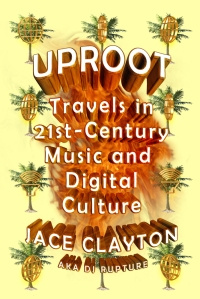
 “Music has always confounded value,” writes interdisciplinary artist and writer Jace Clayton in Uproot: Travels in 21st-Century Music and Digital Culture (FSG Originals, 2016, 22). Recounting his extensive international travels performing as DJ /rupture, Clayton presents a flow of cosmopolitan musical experiences that illustrate complex collisions between music and value around the world. Whether writing about homemade sound-systems in tropical clubs in Brooklyn, or about shellac preservation at the Arab Music Archiving and Research Foundation in Beirut, Clayton considers the technologies by which we make — and place value on — musical sounds in “a world where worth is created in radically different ways from what the market teaches us” (24).
Uproot is a narrative about the ways working musicians experience globalization. “Our music seems to sound the way global capital is — liquid, international, porous, and sped up,” the author writes (16). This homology between sound and economic processes echoes the theories of sociologists like Anthony Giddens and the late Zygmunt Bauman, both of whom argue that modern life is characterized by fluidity and fragmentation: employment is precarious, experience is mediated, and ethical decisions are full of ambiguity. These ideas clearly inspire Clayton’s narrative; that said, Uproot is not an academic publication. As Atossa Araxia Abrahamian writes at the Nation, the book evades genre, “at once travelogue and cultural ethnography, pop philosophy and memoir, a guide to contemporary music and a fanzine.”
 The book begins with a discussion of the history of Auto-Tune. While Clayton’s claim that Auto-Tune was the “first truly new sound effect of the internet era” might be overstated, his distinction between “corrective Auto-Tune” and “cosmetic Auto-Tune” is useful, the first of many moments of clarity in parsing the ways we use and mis-use musical media today. “The robot voice signifies differently everywhere you go,” he writes, an observation that becomes central to the book (49). By refusing to take a deterministic stance toward technology, Clayton empowers the musicians he writes about, acknowledging the ways in which artists mold trends to their own regional and local purposes. Of collaboration with a violinist in Morocco, Clayton writes: “We may have thought similarly, yet our ‘default settings’ were so far apart as to be almost incompatible” (185).
Uproot offers intimate insights into a range of tools and techniques of production, such as compression artifacts, “refixes,” and dozens of music-making interfaces, including Clayton’s own “music software-as-art project,” Sufi Plug Ins.
.
Even language itself is conceived as a form of technological mediation, as when Clayton compares Arabizi — a phonetic spelling of colloquial Arabic — to the hybrid sounds of mahraganat music that the language is used to describe. Of these “wandering genealogies” that emerge from international conversations, Clayton suggests that any hybrid genre we can imagine likely already exists: “Accordions and African techno? It’s called funaná” (102). The book describes at least a dozen other music traditions and microgenres–some very old, some just coalesced–from dabke to zar, each the product of a unique fusion of vocabularies.
Clayton on Mazaher (182): “Umm Sameh, Umm Hassan, and Nour el Sabah: these three women are some of the only people in Egypt keeping zar alive.”
Clayton’s own prose style, replete with metaphor and fluent in informal language, mirrors the ethos of music production he explores in the book: eclectic, energetic, and bursting with detail. What better way to describe Auto-Tune’s effect than as liquification of sound into a “bright neon stream, as if a dial-up modem and a river have fallen in love” (53)? Clayton’s technological travelogue extends beyond aural sensation alone. This is a story of “sidewalk vendors, radios, mosque loudspeakers,” (106) but it is just as much about “jerk chicken, fish tea, goatskin soup” (73). When Clayton describes his surroundings, we can touch the orange blossoms and smell the cigarettes.
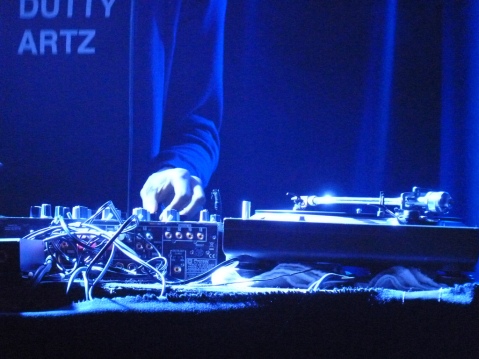
Dj /rupture performs in Minefield UK, 2010, image by Flickr User Paul Narvaez Attribution-NonCommercial 2.0 Generic (CC BY-NC 2.0)
The book’s recurrent question is how DJ practices in different locations are both constrained and inspired by financial flows. In any context, Clayton argues, “[m]oney runs to the people with the least imagination” (24). Early on, he establishes this view that musical experience is priceless, more valuable than any profit derived from rhythms of supply and demand, which reward the wrong people. That said, Clayton isn’t naive about musicians’ inevitable need for income, and throughout the text, readers are asked to inhabit ethical dilemmas that artists encounter throughout the world. At one point, Clayton describes his own moral quandary when asked to perform in front of a giant Red Bull logo, a “glowing lump of techno-fascist DJ furniture.” Later, Clayton critiques the hegemony of “Red Bull patronage” and similar systems of support for artists who are desperate for funding (121). He makes clear his disdain for corporate sponsors, companies that “appear generous as they let us know that our music is literally worthless to them” (123).
A tradeoff emerges between pragmatism and idealism. Clayton pokes holes in the empty rhetoric of “authenticity” that marketers encourage and exploit, even as we sense that he hasn’t yet relinquished his belief in something essentially good about the human spirit. Listening is a powerful social practice that, in Clayton’s view, gives true meaning to music in a global economy that otherwise undervalues it. “The heavier the workaday grind to escape from, the more a party transports us” (73), he writes, suggesting that listeners extract their own surplus value.
At times, Clayton’s observations could benefit from an engagement with ethnographic methods that can help mitigate fieldwork biases. For example, although the book does involve open discussions of gendered inequalities, they are limited in scope. At one point Clayton calls attention to “macho wrangling over propriety and womanhood” among managers and producers in Agadir, Morocco (52); he describes his own futile attempt to acquire a frank interview with female singers amid the patriarchal structure there. But despite Clayton’s awareness of gendered power dynamics, he does not critique the male musicians and producers who propagate such imbalances.
When female figures do appear, they are often treated as side characters. Rihanna, for example, is presented as exemplary of the business model of “singer as mouthpiece” (50), a person for whom others do the work. Clayton isn’t wrong to call attention to the large networks of employees that work behind any celebrity brand, but it is risky to do so at the expense of female workers, especially in the midst of a book that elsewhere describes women as decoration for the musical environments in which men perform what are presumably more important tasks. “Naked girls on pedestals [who] got their bodies painted” (19), “photoshopped young women” (49) and “demure girls” (49) all set scenes for tales of male creativity. This is not to critique how some women may choose to participate in music scenes, but rather to point out that women’s concerns and perspectives are not Clayton’s focus in these passages, nor in much of the book.
On Berber Auto-tune star Saadia Tihihit (49-50): “Like Justin Beiber or any child groomed to be a media star, Saadia Tihihit occupies a place at least initially defined more by the commercial strategies of those around her than by any desire for artistic autonomy.”
Comparably, Clayton’s conception of music and global inequality is sometimes uneven. Drawing stark divisions between the “civilized” and otherwise, he resorts to clichéd language when he writes of “backwater Uzbekistan” (31) and “war-torn Africa” (81). When he describes towns and villages near Casablanca where “ancient rhythms of life still hold sway” (33), he reproduces exoticizing tropes of African music. Elsewhere in the book, Clayton addresses musical accusations of fetishism, stating: “I know that Africans and blacks have been fetishized for centuries now, perhaps millennia. Who cares? You simply exist in all your complexity and let them deal with it. Fetishism is so vague” (84). He also critiques what he calls the “spectacle of a so-called ancient culture” (99) that is often at the heart of “world music” scenes, but then describes Appalachian musical performance as “the old-timey way with banjos and fiddles and washtub percussion” (32), opposing these practices against technological advancement, a false dichotomy that ethnomusicologists work to complicate, if not avoid.
Clayton brings these issues to a head during the book’s extensive discussion of “world music” as a marketing category. His commentary on the conundrums of appropriation surrounding figures such as Paul Simon, M.I.A., and Moby feels familiar, but he surpasses the usual analysis of these common case studies with more personal insights into “world music,” beginning with crate-digging excursions at record shops with deep international selections, such as the now-defunct RRRecords in Lowell, Massachusetts. Clayton contrasts his own on-foot exploration of foreign sounds with what he calls “World Music 2.0,” an internet-driven network of musical discovery based around the commodification of information and attention, in which middlemen reign supreme. His ambivalence is exemplified by this claim: “At its worst, World Music 2.0 offers the clubland equivalent of a package vacation. At its best, it propels some of the most exciting music in the world” (104-105).
The book’s ideas occasionally undermine themselves, but there is no question that the author ultimately intends to advocate for people on the margins. As Max Pearl has noted at the LA Times, Clayton consistently defends lo-fi, lo-tech, and lo-res sonic expression — that which is “distorted, homespun, libidinous” (80) — as valuable in its own right. Further, Sukhdev Sandhu has suggested at the Guardian that the book’s attention to homologies between “the movement of sounds and of migrant bodies” serves to recognize the struggles of global refugees and affirm their humanity.
Among Uproot’s many mentions of transport, readers never receive a clear statement about what, precisely, the relationship between music and motion is, or how exactly value emerges from that pairing. Rather than a weakness of the book, however, maybe such equivocation should be taken as an accurate reflection of the nebulous circumstances in which many of us find ourselves — creators and listeners who are regularly uprooted, usually at the mercy of those whom the money follows. Faced with this precarity, let Clayton’s enthusiasm for all sounds ground you.
Uproot is accompanied by an online Listening Guide that includes audio and visual examples of music from the book: http://www.uprootbook.com.
—
Featured Image: DJ /rupture performing at the Fórum Eletronika de Mídias Expandidas 2005 by Flickr user Brayhan Hawryliszyn (Attribution-NonCommercial 2.0 Generic (CC BY-NC 2.0)
—
Elizabeth Newton is a doctoral candidate in musicology. She has written for The New Inquiry, Tiny Mix Tapes, Real Life Magazine, the Quietus, and Leonardo Music Journal. Her research interests include musico-poetics, fidelity and reproduction, and affective histories of musical media. Her dissertation, in progress, is about “affective fidelity” in audio and print culture of the 1990s.
—
REWIND!…If you liked this post, you may also dig:
SO! Reads: Dolores Inés Casillas’s ¡Sounds of Belonging!–Monica De La Torre
SO! Reads: Roshanak Khesti’s Modernity’s Ear–Shayna Silverstein
Lokananta: Sounds of Crisis and Recovery from Indonesia’s National Record Company — Ian Coss
Share this:


Current Top Posts





April 2021

January 2020

November 2019

October 2019

August 2019

April 2014

November 2017

March 2015

December 2017

October 2015
 Sounding Out!
Recent Comments