
Sonic Salvation: A Story of How Listening Can Change Over A Lifetime

By the age of six, I could circumscribe my world in song. I was not particularly precocious — my world was just small. Ultimately, it would be fractured by its own rebellious genesis.
Two genres of folk music marked out the poles of my preciously tiny planet. Heaven’s jubilee rang in one ear: a cappella gospel, sturdily founded upon the biblical injunction to make melody in the heart. In the other ear, however, was the music of the devil himself: alcohol-drenched, two-stepping, hell-raising honky-tonk, enticing one to sin not just in the heart, but with the entire body. Together, they formed an eternally reciprocal refrain: Saturday night sin prompted Sunday morning renewal. There was little room for anything else, particularly dissent.
Sunday morning resounded with four-part harmony based on a shape-note system of musical notation, widely referred to as Sacred Harp. We sang again at our Sunday evening and mid-week services. Throughout the year, we also hosted regional “singings,” bringing together folks from other congregations, swelling our own sound by double. It was an easy form of music to learn by design, with its origins in early 19th-century America. Its strongest base was in the American South, and I inherited at least two generations’ worth of experience. It set the tone for my interactions with the world for the first three decades of my life.

Taken at the Sacred Harp Museum by Flickr user Lance McCord, CC BY 2.0
Musicologists have documented and analyzed Sacred Harp thoroughly, with Alan Lomax having had a particular fascination for it. He considered it as not only an extension of four-square Anglo forms but also as the crossroads where the Reformation met the Democratic Experiment. In Lomax’s view—expressed in a 1982 interview at the Sacred Harp Convention at Holly Spring, Georgia—European migration to colonize America broke the established authority of the church, leaving every person to forge a singular relationship with God. This supposition harmonizes perfectly with the views of the congregational church I attended. We had no hierarchy, no choir, no piano. Every man, woman, and child added their voice, as best they knew how, to raise an egalitarian song of praise. Songs such as “This World is Not My Home,” “The Glory Land Way,” and “Blessed Assurance” exemplify the form: simple rhyme schemes; closely-yoked shifts in harmony and rhythm; and southern gospel’s initial shunning of poly-rhythms or syncopation.
For me, Sacred Harp music created an immersive and experiential soundscape; emotionally and spiritually motivating, it was the sound of temporal and eternal life. Like our singing style, our church service presented a model for our lives outside the sanctuary. “Trust and Obey” was a frequently sung hymn—and it summed up our approach to life in all matters. Obedience was expected, deviation discouraged.
Worlds away from my sheltered existence, leaders of the Civil Rights Movement embraced a cappella singing as a powerful means to encourage, motivate, and activate. In the 2009 documentary Soundtrack for a Revolution, U.S. Representative and civil rights icon John Lewis said, “It was the music that created a sense of solidarity.” His a cappella community was connected to the church and the streets, challenging the status quo, and seeking greater brotherhood. Mine was by the book, increasingly authoritarian, very narrow in scope and population.
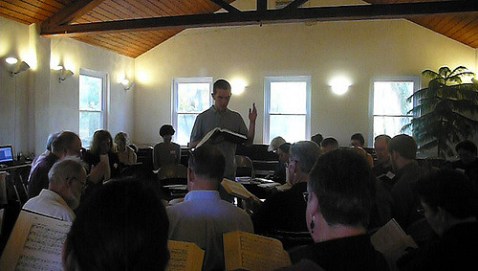
Sacred Harp Singing, Bloomington, Indiana, Image by Flickr User Jennifer Jamison (CC BY-NC-ND 2.0)
To us, the New Testament authorized one and only one instrument for offering songs to God: the unaccompanied human voice. The root of this belief was a concise motto coined in the early 1800s by Alexander Campbell, a leader in the Second Great Awakening: “Where the Scriptures speak, we speak; where the Scriptures are silent, we are silent.” Applying this principle, then, the apostle Paul, in his epistles to the Ephesians and the Colossians, encouraged Christians to sing. But nowhere did he or another New Testament writer suggest using an instrument. This silence equals prohibition. It sets its own reality, ignoring abundant biblical evidence to the contrary: the Old Testament presents many examples of instruments used in worship, as does the New Testament’s Book of Revelations.
Our a cappella song service was, therefore, more than a sound—it was a belief system, a worldview in which other sounds or ideas were alien. We applied Campbell’s principle across-the-board, backing ourselves into corners: slaves were to obey their masters; wives were to submit to their husbands; children were to be fully subject to their parents. Questioning authority, let alone defying it, was strongly condemned by Paul in his letter to Christians in Rome: “Let every soul be subject unto the higher powers. For there is no power but of God: the powers that be are ordained of God. Whosoever therefore resisteth the power, resisteth the ordinance of God: and they that resist shall receive to themselves damnation.”

“The One and Only Lefty Frizzell” by Flickr user Thomas Hawk, CC BY-NC 2.0
Alternately, classic honky-tonk’s twangy resistance seemed to defy the innovations and complexity of modern life. As I was growing up, the sinful songs of Ray Price, Lefty Frizzell, Webb Pierce, and George Jones flowed like wine from my family’s record collection and radio settings. Songs of murder, drunkenness, alienation, revenge, adultery, and the workingman’s blues are staples of the honky-tonk catalog. Its celebrated ethic of “three chords and the truth” favored a rural do-it-yourself ethic. My church’s music was both challenged and validated by this unlikely and unruly roommate; honky-tonk was a matched bookend for Sacred Harp.
For in the background of many of those honky-tonk sounds, whether they were about larceny, war, or revenge on the boss, I heard the same harmony that filled my church. In the 1950s or so, southern gospel groups such as the Jordanaires, Blackwood Brothers, and the Statler Brothers, began backing country music artists including Johnny Cash, George Jones, Tammy Wynette, and Gary Stewart. Their sonic presence lent an almost holy sanction to the commission of sin, as if Jesus and Satan met after-hours to share a drink and balance the books.
This sonic emulsification of sin and salvation formed my youthful identity and bracketed a very small existence. My world consisted of very gendered personal struggles: man vs. temptation; man vs. alcohol; man vs. boss; woman vs. womanizer. The solution provided for these struggles was always the same: the efficacious grace of God. All failings and victories were personal, not structural or systemic. The fight against personal sin was the only fight.
Southern gospel music and honky-tonk have enjoyed an institutional relationship since the founding of the Grand Ole Opry in 1920s, sanctioning the blending of reprobation and redemption. Though initially politically ambivalent, the Opry listed towards social conservatism during the 1960s—Johnny Cash’s nascent social awareness notwithstanding. In 1970, however, the Opry and the industry it represented found itself an unlikely accessory to Richard Nixon’s “southern strategy.” He declared October 1970 to be Country Music Month, and a few years later blessed the Grand Ole Opry with its first presidential visit.

Screen capture from Billboard’s “Roy Acuff Teaches President Nixon the Yo-Yo at the Grand Ole Opry” (1974)
Politically conservative messages had entered country airwaves during the late 1960s, epitomized, if not pioneered, by Bakersfield stalwart Merle Haggard. His “Okie From Muskogee” ridiculed hippies, dope smokers, draft dodgers, long-hairs, flag burners, and college activists, all within a 3-minute single format. Though ostensibly written as a joke, it struck a chord among conservative, Christian, country music fans. Sensing a market, Haggard followed up with the flag-waving “Fightin’ Side of Me,” wherein he further shames pacifists.
These songs contained the truth as I believed it in grammar school: protestors, adulterers, and dope smokers were all in defiance of God. Haggard’s refrain in “Fightin’ Side”—“if you don’t love it, leave it”—made sense to me, and was safely non-challenging. Conveniently, the religious body of which I was a member had, a generation prior to me, actively opposed pacifism.
A world composed only of personal demons, however, leaves little room for social issues. Being so long accustomed to seeing the sin in man left me unable to recognize the sin in the system. Sam Cooke’s great risk in recording “A Change is Gonna Come,” for example, was lost on me, even though we both shared a battle between religious and secular personas.
I never heard his call to address greater systemic problems such as racism, audibly or socially. Even as I entered my 20s, my white patriarchal religious sonic defense system kept the freedom struggles of people of color at bay. Even if dissenting sounds managed to sneak through–Marvin Gaye’s struggles in “Inner City Blues” for example—I quickly dismissed them as exaggeration or the natural outcome of personal sin. I could not process a sound which conflicted with my God-given world view. I saw only men and women avoiding their duty and surrendering to temptation.
My mother frequently said that the lives portrayed in honky-tonk songs were not her life. But in another sense, those desperate lives, and the more hopeful ones portrayed in gospel music, were our lives collectively. We were part of a greater social identity: Southern, white, Fundamentalist, change-averse, full of latent conflicts. Those sounds, rich with heritage and lived-in context, formed us. In other words, our vernacular limited our hearing. Our world was formed within a fixed sonic boundary, and we ignored, resisted and sometimes even combatted discordant sounds.
Within this soundscape, I had never heard of any march from Selma to Montgomery, not from church, family, the radio, or, sadly, even school. The larger movement of which it was a part—perhaps the biggest social movement of the 20th century—was inaudible and therefore irrelevant to me. When I did begin to hear of protests against white racial violence, I could only condemn anyone who defied authority. I did not know what to say about authority which abused the people. Raised to function in a law-and-order world, I could only repeat the Apostle Paul’s instruction that we all must obey authority or incur the wrath of God.

“Selma Protesters Met By Police: 1965” by Flickr user Washington Area Spark, CC BY-NC 2.0
But thankfully, sound travels in subversive ways, such as through the transmitters of listener-supported community radio.
I found Dallas’ KNON completely by chance. Commuting to work through the city’s legendary rush hour, I’d get fidgety. While searching the dial, I heard a familiar song in an unfamiliar arrangement. I don’t recall the song now, but do remember its force: a honky-tonk classic played through a stack of Marshall amps, turned up to the proverbial ’11.’ Perhaps it was Leon Payne’s Lost Highway as rendered by Jason and the Scorchers—anarchistic, upending, challenging, it still carried enough familiarity to keep me listening. I stayed tuned in for the next song, then another. When the DJ, Nancy “Shaggy” Moore, signed off her show, I gave a listen to the next show—at least until they said something a bit too dissonant.
 But the next day, I tuned in to Shaggy again. And I listened a bit longer when the next show came on. And even longer the day after that. Dallas at that time was wracked by racial strife, some of it focused on the politicized deaths of two police officers, one white and one black, in separate incidents. I had tuned out the duplicity, but KNON gave me reason to reconsider. City council member Diane Ragsdale, an African-American woman representing one of the city’s most trod-upon districts, refused to let the issue go. KNON provided the venue for her to express her outrage unmitigated, and to explain the inconsistencies in a way that an entitled white male suburbanite, such as I, could understand.
Tim Rice suggests that we are not free agents in the creation of our identities—but given the right stimuli, we will resist, to the point of rebellion, the personhood prepared for us. The latent heretical ethics of Sacred Harp and Honky-tonk finally responded to the sonic stimuli flowing through the breach, triggering an insatiable devil’s advocacy: “Prove yourself to me,” I said to everything I had once believed, religious faith included. St. John wrote in his First Epistle: “Beloved, believe not every spirit, but try the spirits whether they are of God.” This was to be the last biblical directive I would follow.
My radical shift in musical listening also greatly impacted my political, and cultural beliefs and listening practices, something which continued throughout my life. For example, I ended my professional career as well, having understood the devastating effects that high tech industries have on the environment and workforce. I traded a six-figure salary for minimum wage in foodservice. Not once have I looked back.

“Kitchen Music” by Flickr User David Blaine (CC BY 2.0)
Kitchen work comes with immersive sound: machines hum and sometimes roar; the radio blasts through the static; humans must shout to be heard. Working throughout the western US, in a variety of independent restaurants, I learned to understand and speak Spanish. I participated in defying a language ban placed on my colleagues by an overbearing owner: I noted that she forbade speaking in Spanish, but not singing in Spanish. So sing we did, about needing a potato peeler, taking out the trash, and what we were going to do over the weekend.
As I worked my way up the ranks and crossed the country from California to Manhattan, I listened to the stories told me by immigrants from Mexico, Guatemala, Dominica, Morocco, South Africa. They shared their music with me, via radio, iPod, cassette, or any object we could plug into an overcooked boom box. Every song and conversation has pulled me into greater participation in their lives and the systemic issues faced by most of the world around me.
Dismantling one’s identity, regardless of how deliberately it is done, happens amidst lots of noise: illusions shatter, idols crash to the ground, walls tumble into rubble. Dissent comes in myriad expressions, and for me, it has come via my own three-chords-and-the-truth and through a multimedia socially-progressive dining event which I call Peace Meal Supper Club. Its very raison d’etre is to illuminate dissonance on issues such as the right to sanctuary, our diminishing seed supply, the plight of the rural poor, and other devastating threads of intersectionality. Music is a critical component of each event, as Otis Taylor, Lila Downs, and Caetano Veloso share playlist space with Manecas Costa and Majida El Roumi Baradhy. Old favorites like “Sixteen Tons” get their say, as well—for behind that song’s well-earned swagger is a system of devastating intersectional oppression that demands our action.
_
Featured Image: Image of a Stained Glass Crosley Cathedral, Image by Tubular Bob
Kevin Archer is a multi-media artist who left corporate security for a DIY life as a farmer, activist, educator, and chef. He’s planted gardens coast-to-coast, and washed his own sauté pans from Denver to Mendocino, Santa Fe to NYC, and random locations in between. Kevin’s current project is Peace Meal Supper Club, a series of immersive dining events which explore ecojustice, human rights, the capitalistic conquest of the seed and soil, and the power of progressive movements. He has written for Civil Eats, No Depression, Secular Web, and the Museum of Animals & Society. He has spoken on the intersection of food and social issues at numerous conferences within the Eastern US.
_

REWIND! . . .If you liked this post, you may also dig:
What is a Voice? – Alexis Deighton MacIntyre
“HOW YOU SOUND??:” The Poet’s Voice, Aura, and the Challenge of Listening to Poetry – John Hyland
The Sounds of Anti-Anti-Essentialism: Listening to Black Consciousness in the Classroom – Carter Mathes
The Listening Body in Death – Denise Gill
Share this:

SO! Reads: Kirstie Dorr’s On Site, In Sound: Performance Geographies in América Latina
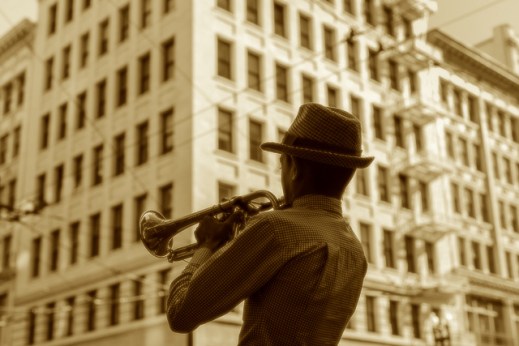
 “World Music,” both as a concept and as a convenient marketing label for the global music industry, has received a fair deal of deserved criticism over the last two decades, from scholars and musicians alike. In his famous 1999 op-ed, David Byrne wrote that the term is “a none too subtle way of reasserting the hegemony of Western pop culture. It ghettoizes most of the world’s music.” Ethnomusicologists have aldo challenged the othering power of this term, inviting us to listen to “worlds of music” and “soundscapes” as the culture of particular places and times, suggesting that these sonic encounters with difference might teach “us” (in “the West”) to consider how our own musical worlds are situated in social and historical processes.
While this has been an important move toward recognizing the multiplicity of musicking practices (rather than reinforcing a monolithic “Other” genre), the study of “musical cultures” runs the risk of territorializing musical “traditions.” Linking them to geographically delineated points of origin, nations or homelands that are made to seem natural, fixed, or timeless often overlooks the heterogeneity of places, essentializing the people who make and listen to music within, across, and in relation to their ever-changing borders. The challenge for music critics and scholars has been–and still is–to delegitimize the alienating broad brush of the “world music” label without resorting to a classification system that reifies music production and circulation into exotic genres or fetishized “local” traditions.
 In her 2018 book, On Site, In Sound: Performance Geographies in América Latina(Duke University Press), Kirstie A. Dorr demonstrates a method for conceptualizing relations between music and space while avoiding the pitfalls of colonial and capitalist definitions of “culture” and “identity.” She takes the term “performance geography” from Sonjah Stanley Niaah, whose discussion of Jamaican dancehall employs this analytic as “a mapping of the material and spatial conditions of performance: entertainment and ritual in specific sites/venues, types and systems of use, politics of their location in relations to other sites and other practices, the character of events/rituals in particular locations, and the manner in which different performances/performers relate to each other within and across different cultures” (Stanley Niaah 2008: 344). Dorr looks at “musical transits” rather than musical cultures, focusing on the politics and relations within sound and performance across South America and its diasporas; one particular relation serves as the central argument of the book: “that sonic production and spatial formation are mutually animating processes” (3).
Three conceptual frames help Dorr follow the musical flows that push against national and regional boundaries sounded by the global music industry: listening, a form of attention toward the interplay of sensory content, form, and context; musicking, or conceptualizations of music-making in terms of relationships and creative practices, rather than the musical “works” they produce and commodify; and performance as “a technique of action/embodiment that. . .potentially reshapes social texts, relationships, and environments” (14-16). Through close listenings to performances in Peru, San Francisco, and less emplaced sites such as YouTube and the “Andean Music Industry,” Dorr makes a strong case for performance geographies as creative decolonial strategies, both for participants in musical transits and for scholars who imagine and invent the boundaries and trajectories of musicking practices.
***
Nearly a century after Peru won its independence from Spain, limeño playwright Julio Baudouin debuted El Cóndor Pasa, a two-act play promoting national unity through a tale of indigenous miners in a struggle against their foreign bosses. The play’s score, composed by musician and folklorist Daniel Alomía Robles, weaves Peruvian highland music into Western-style arrangements and instrumentation, and was widely received by its 1913 audience as the sound of what Peru was to become: a modern nation firmly rooted in the cultures of its indigenous peoples.
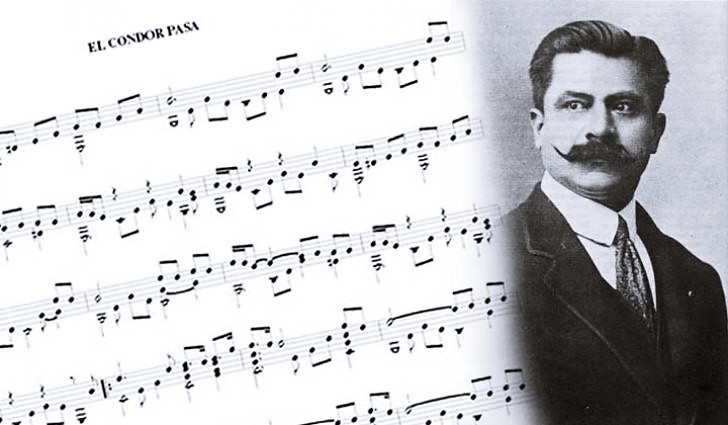
Daniel Alomía Robles
In the century that followed, the score’s homonymous ballad has been interpreted and recorded by countless artists around the world. Easily the most well-known rendition of this famous melody is Simon and Garfunkel’s “El Cóndor Pasa (If I Could),” (1970) which Dorr credits with catalyzing a Latin American music revival as well as spurring on a wave of Euro-American musicians and producers who collaborated with and brought into the international spotlight a number of groups who otherwise would have remained in relative obscurity. The tendency to see these projects as the work of (typically white) Westerners “discovering” and “saving” or paternalistically “curating” the dying musical cultures of the world, Dorr suggests, is part and parcel of a World Music concept that frames “primitive” traditions as fair game for extraction and appropriation into innovative sonic hybrids.
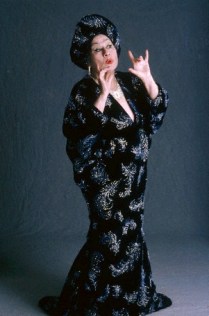
15 Nov 1991, Paris, France — Peruvian singer Yma Sumac
The “exotica” category follows the same logic, as the case of Yma Sumac illustrates. From the beginning of her career in the early 1940s with el Conjunto Folklórico Peruano to her 1971 psychedelic version of “El Cóndor Pasa,” Sumac’s vocal versatility and stylistic experimentations map out an experience of Andean indigeneity that Dorr hears in stark contrast to the narratives of the global music industry. While Capitol Records performed their own geography via their marketing of this sexualized “Incan princess,” the singer strategically composed her own sonic-spatial imaginary, not rejecting the difference suggested by “exotica,” but by synthesizing a “space-age” modern aesthetic with traditional songs. Dorr challenges us to listen to Sumac’s “El Cóndor Pasa” against Simon’s arrangement, thinking of her performative dissonances as disruptions of “the static geotemporal imaginaries of ‘authentic indigeneity’ that have most often informed the ballad’s deployment” (59).
If Chapter One makes a case for performance’s potential to shape notions of place and time, Chapter Two explores “spatial(ized) relations of musicking” (68) through a broader consideration of market strategies and the politics of sound in public space. Putumayo serves as another classic example of the global music industry’s pandering to multicultural idealism, promoting itself as “lifestyle company” that brings conscious capitalism into the curation of musical worlds. Dorr keeps her critique of Putumayo rather brief, but uses it as a convincing contrast for the focus of this chapter: the informal streams of economic activity and performance that she calls the “Andean music industry” (AMI). Among other examples from transnational and virtual “sites,” the Andean bands that performed in San Francisco’s Union Square throughout the 1990s demonstrate how performance geographies can challenge state and capitalist power while simultaneously running parallel to the marketing and distribution practices of the world music industry.
The AMI story is one of migration and the formation of a pan-Andean diaspora, of busking and bootlegging tactics that tested the boundaries of zoning and noise regulations as well as California’s immigration and labor policies, and of transposing music networks onto the internet when public performance became too precarious. It is also another case of dissonance, in which musicians willfully use their own cultural difference to their advantage, but not without consequences for poor musicians in South America; a telling example is the “Music of the Andes” CD, a mass-produced compilation used by various groups who, instead of having to record and press their own albums, could simply print their own covers for the Putumayoesque compilation and sell them to their none-the-wiser U.S. audiences (84).
But if the diasporic politics of the AMI came up short in challenging a monolithic representation of “Andean culture” or in highlighting the dynamic transits of Andean fusions such as chicha and Nueva Canción, the daily performances of street musicians in the race- and class-ordered Union Square support Dorr’s argument about the co-constitutive relationship between sound and space: “This unmediated display of embodied and sonic ‘otherness’ threatened the coherence of the square’s representational function by converting it into a spectacle of work and play for a population upon whose concealed labor the economic foundations of California’s wealth largely depend: undocumented migrant workers from the global South” (81).
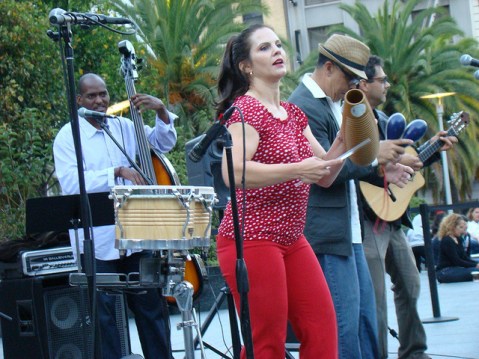
Busking in Union Square, 2013, Image by Flickr User Dr. Bob Hall
Elsewhere in 1990s San Francisco, musicians, artists, and activists formed a collective that, like the busking Andean groups, challenged dominant notions of public and private space while performing its own transnational and migratory experiences of Latinidad. In Chapter 4, Dorr relates the story of La Peña del Sur, a grassroots organization in the Mission District and, like the many anti-imperialist peñas popular throughout Latin America since the 1960s, a space for artists to perform or display their work for local audiences. While this peña provided a community for undocumented immigrants and local residents threatened by gentrification, it also served as an unsettling force against the sort of geographies that separate “queer space” from “heterosexual space” without regard for how these neighborhoods are also classed and racialized.
The founder and director of La Peña del Sur, Chilean exile Alejandro Stuart, was among several queer community members whose efforts constituted their shared space as a challenge to normative boundaries, a site for musicking that engendered dialogue among a wide range of people with divergent visions and motivations. Community organizers and students of cultural sustainability would do well to read Dorr’s account of this decade-long experiment that “enabled the exploration of sound-based solidarities rooted in the identification of common historical and political ground through improvisation and participatory performance” (168).

Victoria Santa Cruz, Image courtesy of Flickr User “Traveling Man”
Between these two compelling tales of the dynamic relationship of sound and space in San Francisco, Chapter 3 explores the significance of race, nation, gender, and sexuality within the performance geographies of several Afro-Peruvian artists. Dorr traces the movements of performers and activists who challenged the colonial boundaries that framed blackness as “antithetical to the emergent nation” (111); unlike the indigenous traditions that could be appropriated for an imagining of Peru as modern yet firmly rooted in history, Afro-Peruvian bodies and sounds were treated as contaminants within the postcolonial order.
Listening to Black feminist performance geographies, from Peru’s Black Arts Revival in the ’60s and ’70s to the recent hemispheric collaborations of “global diva” Susana Baca, one can hear the formation of not only such racially imagined communities as “the coastal” and the “Afro-Latinx diaspora,” but also of “the body.” A powerful case of this latter sort of performance is heard in the lyrics and experiences of Victoria Santa Cruz, who, in her choreographed, cajón- and chorus-accompanied poem, “Me Gritaron Negra,” contests the ways in which “[t]he physical contours of her body – her lips and skin and hair – become a geography inscribed with social meaning, an ideological imposition intended to enact and legitimate her ongoing displacement” (121).
Santa Cruz’s pedagogical and performative practices, in particular, reveal why Dorr has chosen sound – and not only broader analytics of performance and musicking – as a central theme to explore in terms of its relation to places and bodies. While this book might leave a few sound studies scholars wanting more elaborate description of particular sonic phenomena or ethnographic consideration of how sound is imagined among Dorr’s interlocutors, a few examples in particular are keys to thinking about how sound signifies, and is signified by, racially mapped bodies and places.
Most intriguing here is a discussion of Santa Cruz’s 1971 book, Discovery and Development of a Sense of Rhythm, which outlines the artist’s approach to “listen[ing] with the body” and tuning in to “rhythm’s Afro-diasporic logics” (116). A pedagogy and practice developed well in advance of Henri Lefebvre’s theory of rhythmanalysis, Santa Cruz’s concept of ritmo–internal rhythm— deserves consideration alongside the work of Amiri Baraka, Jon Michael Spencer, Fred Moten, and Daphne Brooks as crucial for thinking about how Black aesthetics and diasporic sensibilities are cultivated through sound and capable of mobilizing new mappings of bodies and their worlds.

Victoria Santa Cruz, still from el programa de La Chola Chabuca. (Video: América TV)
On Site, In Sound also calls for renewed thinking on sonic-spatial relations and the meanings that emerge from within them – how the sounds of particular Latin American voices and instruments come to be understood as masculine or feminine, indigenous or modern, exotic or local. Although “sound” as a specific performative or sensory medium might seem, at times, only one among many phenomena examined within the book’s threefold conceptual framing – listening, musicking, and performance – Dorr weaves it throughout her own performance geography where it takes on multiple forms and scales, challenging even the very boundaries defining what sound “is.” More importantly, this is a geography that scholars of “the sonic” or “music worlds” should read (and hear) as a reminder of sound’s unique ability to create and transcend boundaries – but rarely without a great deal of dissonance.
—
Featured Image: “Gabriel Angelo, Union Square,” by Flickr User Brandon Doran
—
Benjamin Bean is a PhD student in sociocultural anthropology at The University of California, Davis. His research interests include Afro-Caribbean music and sound, food and the senses, Puerto Rico, religion and secularism, and the Rastafari movement. During his undergraduate studies at Penn State Brandywine and graduate studies in cultural sustainability at Goucher College, Ben’s fieldwork focused on reggae music, the performativity of Blackness, and the Rastafari concepts of Word, Sound, and Power and I-an-I. His current fieldwork in Puerto Rico examines flavor, taste, and marketing in the island’s growing craft beer movement. Ben was formerly a vocalist and bass guitarist with the Philadelphia-based roots reggae band, Steppin’ Razor.
—
REWIND!…If you liked this post, you may also dig:
SO! Reads: Dolores Inés Casillas’s ¡Sounds of Belonging!–Monica De La Torre
SO! Reads: Roshanak Khesti’s Modernity’s Ear–Shayna Silverstein
SO! Reads: Licia Fiol-Matta’s The Great Woman Singer: Gender and Voice in Puerto Rican Music–Iván Ramos
Share this:


Current Top Posts





April 2021

January 2020

November 2019

October 2019

August 2019

April 2014

November 2017

March 2015

December 2017

October 2015
 Sounding Out!
Recent Comments