
Resounding Silence and Soundless Surveillance, From TMZ Elevator to Beyoncé and Back Again
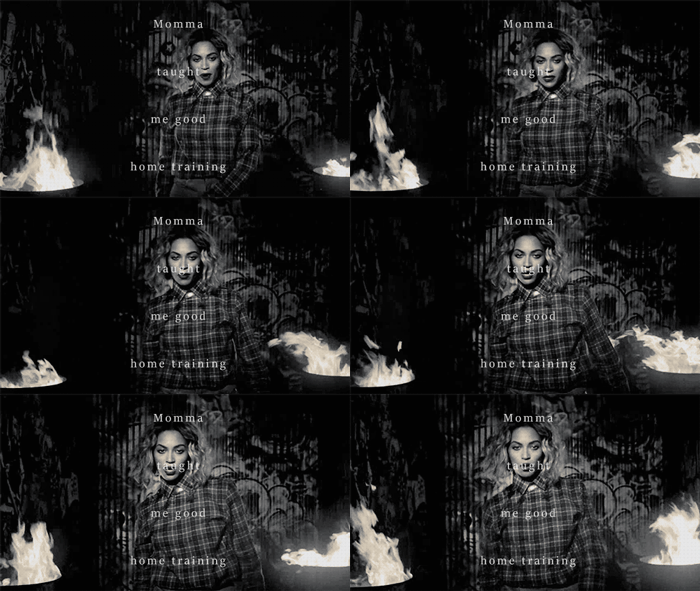
 This September, Sounding Out! challenged a #flawless group of scholars and critics to give Beyoncé Knowles-Carter a close listen, re-examining the complex relationship between her audio and visuals and amplifying what goes unheard, even as her every move–whether on MTV or in that damn elevator–faces intense scrutiny. Last Monday, you heard from Kevin Allred (Women and Gender Studies, Rutgers) who read Beyoncé’s track “No Angel” against the New York Times’ reference to Michael Brown as #noangel. You will also hear from Liana Silva (Editor, Women in Higher Education, Managing Editor, Sounding Out!), Regina Bradley (writer, scholar, and freelance researcher of African American Life and Culture), and Madison Moore (Research Associate in the Department of English at King’s College, University of London and author of How to Be Beyoncé). Today, Priscilla Peña Ovalle (English, University of Oregon) gives us full Beyoncé realness, from TMZ Elevator to Beyoncé and Back Again,–Editor-in-Chief Jennifer Stoever
—
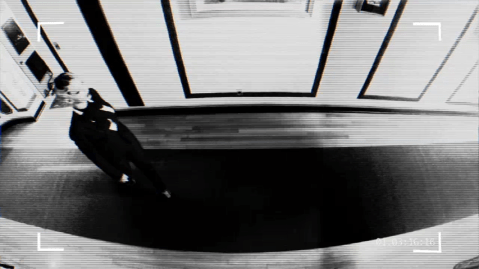
Less than six months after Beyoncé released Beyoncé, she was momentarily silenced on the small screen when the gossip site TMZ released silent elevator security footage of a fight between her famous husband and sister. Doubly framed by the black and white of a surveillance video screen surreptitiously captured on a security guard’s camera-phone, the video’s silence left plenty of room for speculation. But the footage also revealed a woman conscious that her life is on record: Beyoncé’s body seemed to elude the camera’s full view and she emerged from the elevator with a camera-ready smile.
Like Kevin Allred in his powerful reading of “No Angel,” I could not help but rethink Beyoncé in the wake of Michael Brown’s murder. I already read Beyoncé as a sophisticated response to the visual and aural policing of black female bodies, but the closed-circuit images of Beyoncé on TMZ (and in Beyoncé) made me reconsider silence as a damning convention of video surveillance; like Aaron Trammell in “Video Gaming and the Sonic Feedback of Surveillance,” I questioned (the lack of) sound as a technique of control. When the camera-phone recording of Kajieme Powell’s murder, photographed and narrated by a community member in real-time, was released with silent surveillance footage of the alleged theft, my appreciation of Beyoncé—as a response to those silent damnations—took a new turn.

“Resounding Silence and Surveillance” argues that Beyoncé returns the media’s visual-aural gaze. Because of its pop package, the album’s artistic composition and socio-cultural merit are often underestimated. Like the silence of surveillance footage, omitting any one sensory element from Beyoncé distorts the holistic meaning. To untangle this critically complex interplay of audio and video, I analyze the visualized song “Haunted” and briefly address the single “***Flawless” to show how the artist’s triple consciousness anchors Beyoncé. She is on to us: Beyoncé is the culmination of an artist who has spent her career watching us watch her. Temporarily silenced by footage that she could not control, Beyoncé resounds that “elevator incident”—and our sonic/optic perceptions of her feminism—with a flawless remix.
“I see music. It’s more than just what I hear,” declares Beyoncé. Her voiceover runs over the black screen that opens the promotional video “Self-Titled.” Released the same day Beyoncé premiered on iTunes, “Self-Titled” directs audiences to “see the whole vision of the album.” By design, Beyoncé is an immersive experience—like watching Michael Jackson’s “Thriller” as a television event on MTV.
Because Beyoncé was born the same year the cable music channel MTV premiered, she has never known a world without the ability to “see music.” In many ways, her visual album reinvigorates the early spirit of MTV: after Beyoncé, we will “never look at music the same way again.” Though music videos exacerbate the pop single obsession that Beyoncé explicitly resists with Beyoncé, they also produce a unique kinetic connection with the listener-viewer, whose experience of sound is visually registered by the body as it processes shots and edits. This is especially true when strong imagery, rhythmic editing, and dance movements are expertly employed, as in Beyoncé.
Beyoncé deftly critiques the beauty and music/media industries that have been central to her pop success. If taken piecemeal, these critiques can be easily dismissed: the sustained gloss of her image works all too well. There is much to say on a video-by-video basis, but I focus here on the specific aural elements of “Haunted” that articulate Beyoncé’s refusal of the music industry’s status quo. This visualized rejection reveals the layers of racism and sexism that nonwhite female artists (even Beyoncé, even today) must negotiate.
Because of my personal and professional interest in music videos, I consumed Beyoncé as she intended: a sequence of MPEG-4 videos rather than AAC audio files. But it was not until I solely listened to the album that I could discern Beyoncé’s maturation as a black female multimedia pop/culture artist. One refrain from “Haunted” was especially effective:
I know if I’m onto you, I’m onto you/ Onto you, you must be on to me
The song’s ethereal quality is amplified by Boots (Jordy Asher), one of Beyoncé’s (then-unknown) collaborators with whom she shares “Haunted”’s writing and producing credit. The track builds slowly, supporting Beyoncé’s “stream of consciousness” delivery with layers of reverberation and waves of synth sounds like “Soundtrack” or the Roland TR-808 kick drum. Punches of bass accelerate the beat until Beyoncé riffs her explicit desire to create something more than a product:
The music winds to a halt, but the song is not over. Breathy, reverberating vocals transition the track and a piano is delicately introduced:
It’s what you do, it’s what you see
I know if I’m haunting you, you must be haunting me
It’s where we go, it’s where we’ll be
I know if I’m onto you, I’m onto you
Onto you, you must be on to me
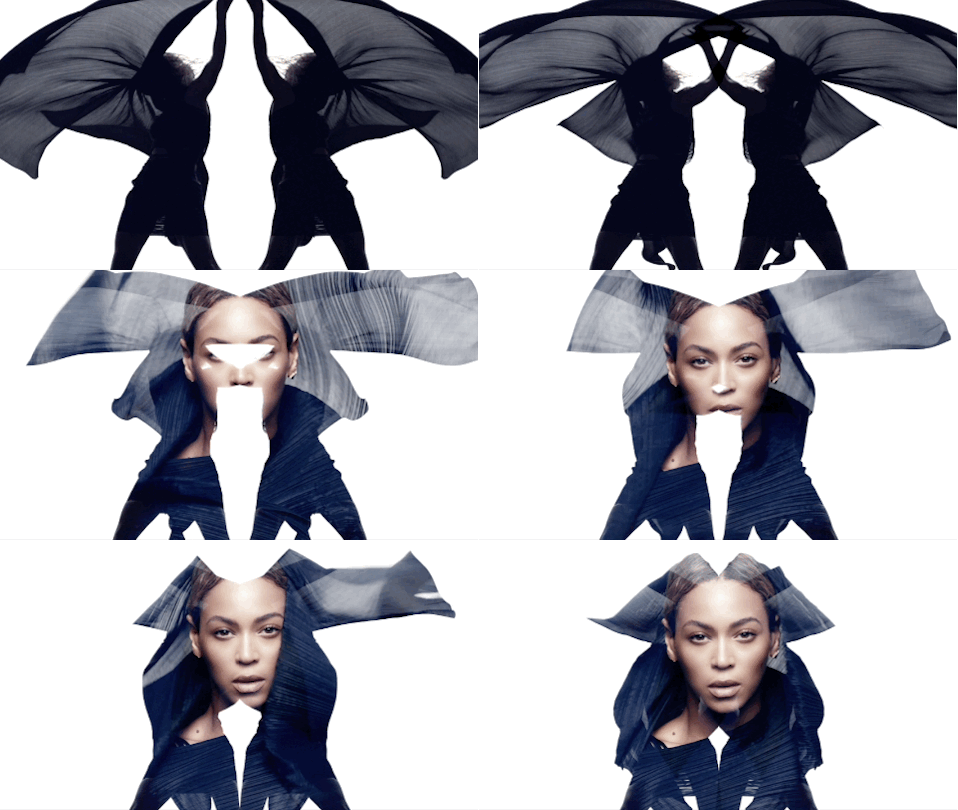
 At this point, the song “Haunted” is split into two videos: “Ghost” (directed by Pierre Debusschere) and “Haunted” (directed by Jonas Åkerlund). The videos’ visual differences exemplify the various points of view—from active subject to object of desire and back again—employed across Beyoncé. “Ghost”’s hypnotic visuals underscore the song’s sentiments: close-ups of Beyoncé’s immaculately lit visage soberly mouthing lyrics are intercut with medium shots of her still body swathed in floating fabric and wide shots of her athletic movements against sparse backgrounds. The ar/rhythmic cuts of “Ghost” enunciate an artistic dissatisfaction with the industry: visuals build against/with the synthetic beat, mixing Beyoncé’s kinetically intense movements with her deadpan delivery.
 The fiery agency of “Ghost” sets up the chill of “Haunted,” a voyeuristic tour in which Beyoncé watches and is watched. The “knowing-ness” of her breathy refrain (“I know if I’m haunting you”) is heightened when the tempo accelerates in the song’s second half. There is much to say about “Haunted”—from the interracial family of atomic bomb mannequins to Beyoncé’s writhing boudoir choreography. Most significantly, she is the video’s voyeur and object of surveillance: her face appears on multiple television screens and her voyeur-character is regularly captured on closed-circuit footage. The “Haunted” video soundtrack features the foley and stinger sounds of a horror film, but these surveillance shots feature the low whirr of a film projector rather than silence. The silence of a moving image is so jarring that it compels us to watch differently, so much so that “silent” film scenes utilize a recorded sound of “nothing” (“room tone”) to focus the audience.
When Beyoncé finally resounded the silence of the “elevator incident,” she chose to do it through “***Flawless,” her explicit response to anti-feminist accusations. While the multifaceted anthem gained attention because of Chimamanda Ngozi Adichie’s audio, the song is uniquely infused with a kind of docu-visuality thanks to Ed McMahon’s well-known voice and the Star Search jingle. These bookends cite a young Beyoncé losing to an all-male rock band, the kind heavily programmed during MTV’s early days. The clips reinforce the album’s critique of racial and gender hierarchies while questioning the double-edged “work ethic” required to surpass them. Of course, Beyoncé pre-emptively frames this discussion for us in “Self-Titled,” a necessary step that helps audiences appreciate the many moving parts of her tour de force, including her creative business mind.So when Beyoncé swapped the audio of Adichie and McMahon for Nicki Minaj, it was no less of a feminist move. Instead, Beyoncé silences TMZ gawkers:
Of course sometimes shit go down/
When it’s a billion dollars on an elevator
She then offers herself as a medium of empowerment. Beyoncé may be part of a billion-dollar empire, but she willingly shares that pleasure with us:
I wake up looking this good
And I wouldn’t change it if I could
(If I could, if I, if I, could)
And you can say what you want, I’m the shit
(What you want I’m the shit, I’m the shit)
(I’m the shit, I’m the shit, I’m the shit)
I want everyone to feel like this tonight
God damn, God damn, God damn!
Beyoncé’s last word is an image. She and her creative team remixed the visuals of the “elevator incident”: the remix single website features black and white photos of Beyoncé and Minaj, simultaneously evoking surveillance footage and the photo booth images of a girls’ night out. Beyoncé is the work of an artist who has spent her career watching us watch her: this minor moment exemplifies Beyoncé’s multimedia resonance as an artist whose power is visible and audible across iTunes and TMZ screens alike.

Beyoncé and Nicki Minaj mugging for the camera
Thanks to Elizabeth Peterson, Charise Cheney, Loren Kajikawa, André Sirois and Jennifer Stoever for providing research and intellectual support for this essay
Priscilla Peña Ovalle is the Associate Director of the Cinema Studies Program at the University of Oregon. After studying film and interactive media production at Emerson College, she received her PhD from the University of Southern California School of Cinema-Television while collaborating with the Labyrinth Project at the Annenberg Center for Communication. She has written on MTV, Jennifer Lopez, and Beyoncé. Her book, Dance and the Hollywood Latina: Race, Sex, and Stardom (Rutgers University Press, 2011), addresses the symbolic connection between dance and the racialized sexuality of Latinas in popular culture. Her next research project explores the historical, industrial, and cultural function of hair in mainstream film and television. You can find her work in American Quarterly, Theatre Journal, and Women & Performance.
—
 REWIND!…If you liked this post, check out:
Aurally Other: Rita Moreno and the Articulation of “Latina-ness”-Priscilla Peña Ovalle
Music Meant to Make You Move: Considering the Aural Kinesthetic–Imani Kai Johnson
Karaoke and Ventriloquism: Echoes and Divergences–Sarah Kessler and Karen Tongson
Share this:

Catastrophic Listening
 Welcome back to Hearing the UnHeard, Sounding Out‘s series on how the unheard world affects us, which started out with my post on the hearing ranges of animals, and now continues with this exciting piece by China Blue.
From recording the top of the Eiffel Tower to the depths of the rising waters around Venice, from building fields of robotic crickets in Tokyo to lofting 3D printed ears with binaural mics in a weather balloon, China Blue is as much an acoustic explorer as a sound artist. While she makes her works publicly accessible, shown in museums and galleries around the world, she searches for inspiration in acoustically inaccessible sources, sometimes turning sensory possibilities on their head and sonifying the visual or reformatting sounds to make the inaudible audible.
In this installment of Hearing the UnHeard, China Blue talks about cataclysmic sounds we might not survive hearing and her experiences recording simulated asteroid strikes at NASA’s Ames Vertical Gun Range.
— Guest Editor Seth Horowitz
—
Fundamentally speaking, sound is the result of something banging into something else. And since everything in the universe, from the slow recombination of chemicals to the hypervelocity impacts of asteroids smashing into planet surfaces, is ultimately the result of things banging into things, the entire universe has a sonic signature. But because of the huge difference in scale of these collisions, some things remain unheard without very specialized equipment. And others, you hope you never hear.
Unheard sounds can be hidden subtly beneath your feet like the microsounds of ants walking, or they can be unexpectedly harmonic like the seismic vibrations of a huge structure like the Eiffel Tower. These are sounds that we can explore safely, using audio editing tools to integrate them into new musical or artistic pieces.
Luckily, our experience with truly primal sounds, such as the explosive shock waves of asteroid impacts that shaped most of our solar system (including the Earth) is rarer. Those who have been near a small example of such an event, such as the residents of Chelyabinsk, Russia in 2013 were probably less interested in the sonic event and more interested in surviving the experience.
But there remains something seductive about being able to hear sounds such as the cosmic rain of fire and ice that shaped our planet billions of years ago. A few years ago, when I became fascinated with sounds “bigger” than humans normally hear, I was able to record simulations of these impacts in one of the few places on Earth where you can, at NASA Ames Vertical Gun Range.
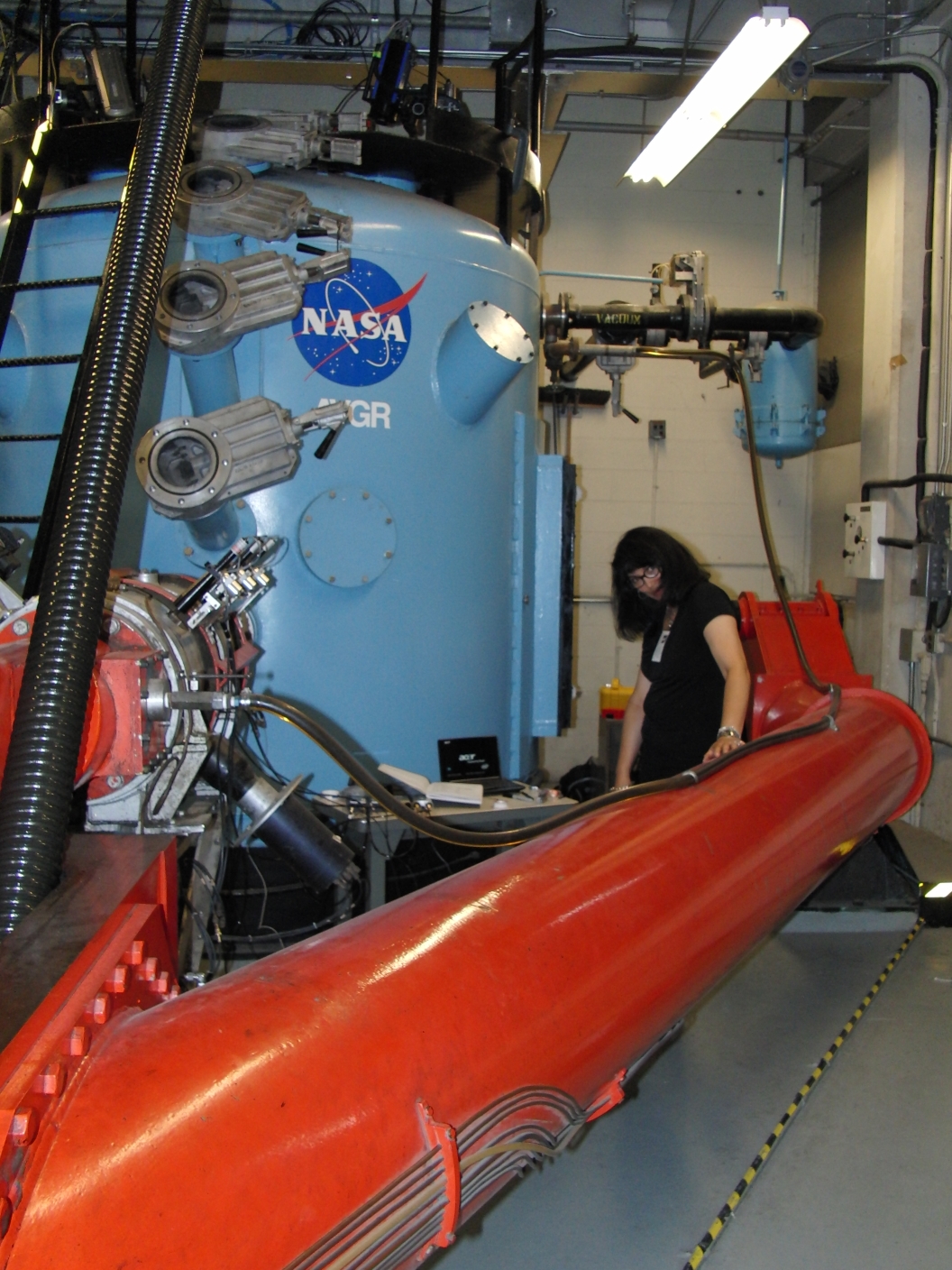
The artist at the AVGR
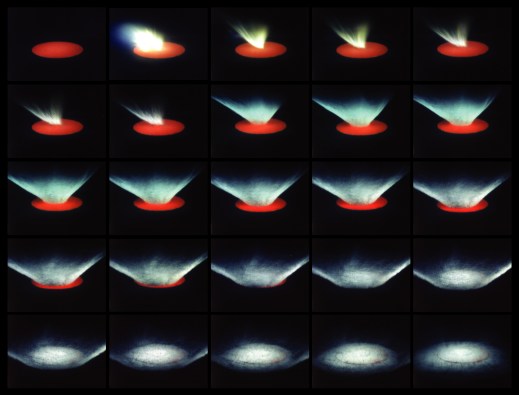
The Vertical Gun at Ames Research Center (AVGR) was designed to conduct scientific studies of lunar impacts. It consists of a 25 foot long gun barrel with a powder chamber at one end and a target chamber, painted bright blue, that looks like the nose of an upended submarine, about 8 feet in diameter and height at the other. The walls of the chamber are of thick steel strong enough to let its interior be pumped down to vacuum levels close to that of outer space, or back-filled with various gases to simulate different planetary atmospheres. Using hydrogen and/or up to half a pound of gun powder, the AVGR can launch projectiles at astonishing speeds of 500 to 7,000 m/s (1,100 to 16,000 mph). By varying the gun’s angle of elevation, projectiles can be shot into the target so that it simulates impacts from overhead or at skimming angles.
In other words, it’s a safe way to create cataclysmic impacts, and then analyze them using million frame-per-second video cameras without leaving the security of Earth.
My husband, Dr. Seth Horowitz who is an auditory neuroscientist and another devotee of sound, is close friends with one of the principal investigators of the Ames Vertical Gun, Professor Peter Schultz. Schultz is well known for his 2005 project to blow a hole in the comet Tempel 1 to analyze its composition, and for his involvement in the LCROSS mission that smashed into the south pole of the moon to look for evidence of water. During one conversation discussing the various analytical techniques they use to understand impacts, I asked, “I wonder what it sounds like.” As sound is the propagation of energy by matter banging into other matter, this seemed like the ultimate opportunity to record a “Big Bang” that wouldn’t actually get you killed by flying meteorite shards. Thankfully, my husband and I were invited to come to Ames to find out.
I had a feeling that the AVGR would produce fascinating new sounds that might provide us with different insights into impacts than the more common visual techniques. Because this was completely new research, we used a number of different microphones that were sensitive to different ranges and types of sound and vibrations to provide us with a selection of recording results. As an artist I found the research to be the dominant part of the work because the processes of capturing and analyzing the sounds were a feat unto themselves. As we prepared for the experiment, I thought about what I could do with these sounds. When I eventually create a work out of them, I anticipate using them in an installation that would trigger impact sounds when people enter the room, but I have not yet mounted this work since I suspect that this would be too frightening for most exhibition spaces to want.
Part of my love (and frustration) for sound work is figuring out how to best capture that fleeting moment in which the sound is just right, when the sound evokes a complex response from its listeners without having to even be explained. The sound of Mach 10 impacts and its effects on the environment had such possibilities. In pursuit of the “just right,” we wired up the gun and chamber with multiple calibrated acoustic and seismic microphones, then fed them into a single high speed multichannel recorder, pressed “record” and made for the “safe” room while the Big Red Button was pressed, launching the first impactor. We recorded throughout the day, changing the chamber’s conditions from vacuum to atmosphere.
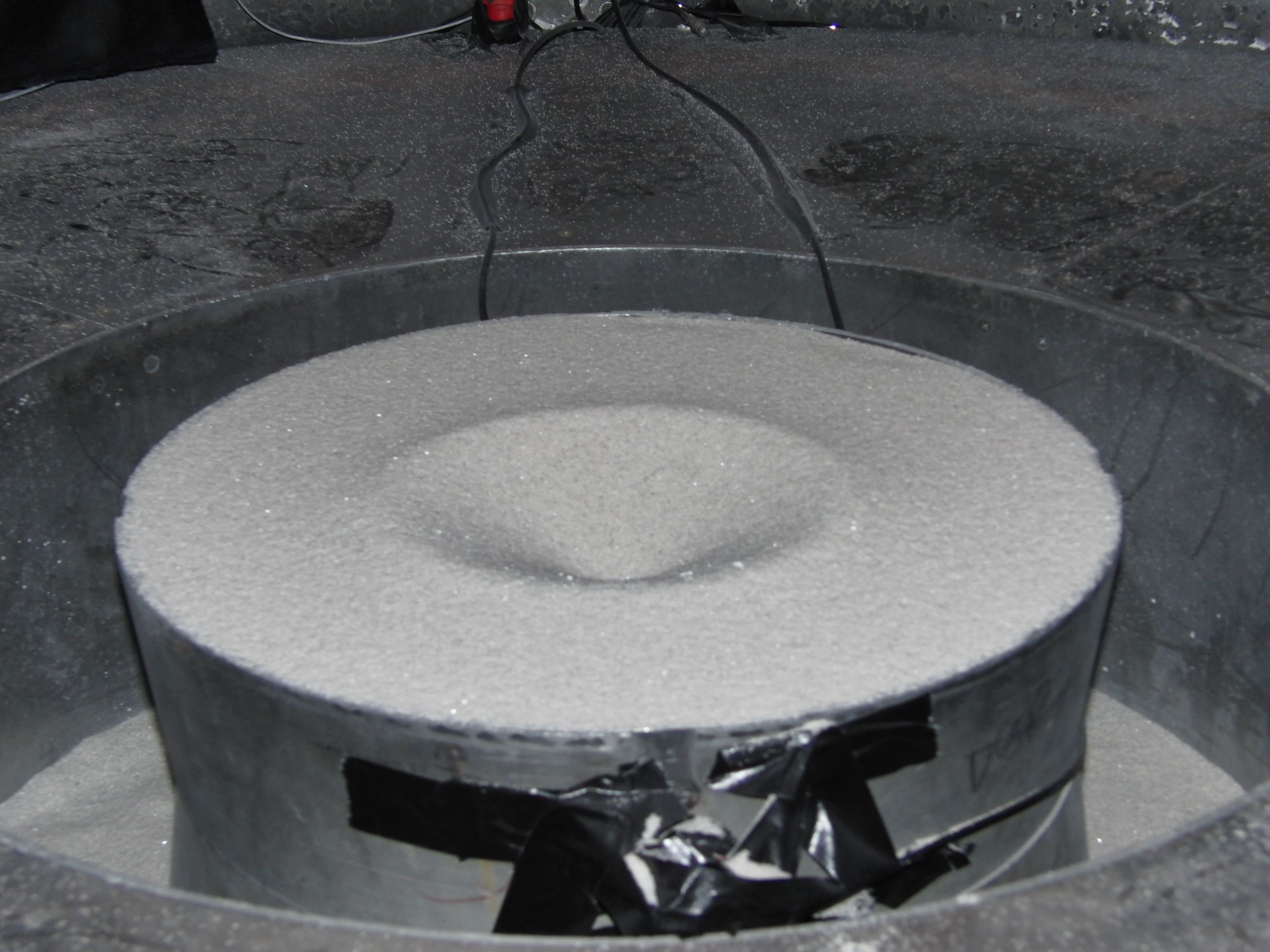
Simple impact on the AVGR sand target.
When we finally got to listen that afternoon, we heard things we never imagined. Initial shots in vacuum were surprisingly dull. The seismic microphones picked up the “thump” of the projectile hitting the sand target and a few pattering sounds as secondary particles struck the surfaces. There were of course no sounds from the boundary or ultrasonic mics due to the lack of air to propagate sound waves. While they were scientifically useful–they demonstrated that we could identify specific impact events launched from the target—they weren’t very acoustically dramatic.
When a little atmosphere was added, however, we began picking up subtle sounds, such as the impact and early spray of particles from the boundary mic and the fact that there was an air leak from the pitch shifted ultrasonic mic. But when the chamber was filled with an earthlike atmosphere and the target dish filled with tiny toothpicks to simulate trees, building the scenario for a tiny Tunguska event (a 1908 explosion of an interstellar object in Russia, the largest in recorded history), the sound was stunning:
.
After the initial explosion, there was a sandstorm as the particles of sand from the target flew about at Mach 5 (destroying one of the microphones in the process), and giving us a simulation of a major asteroid explosion.
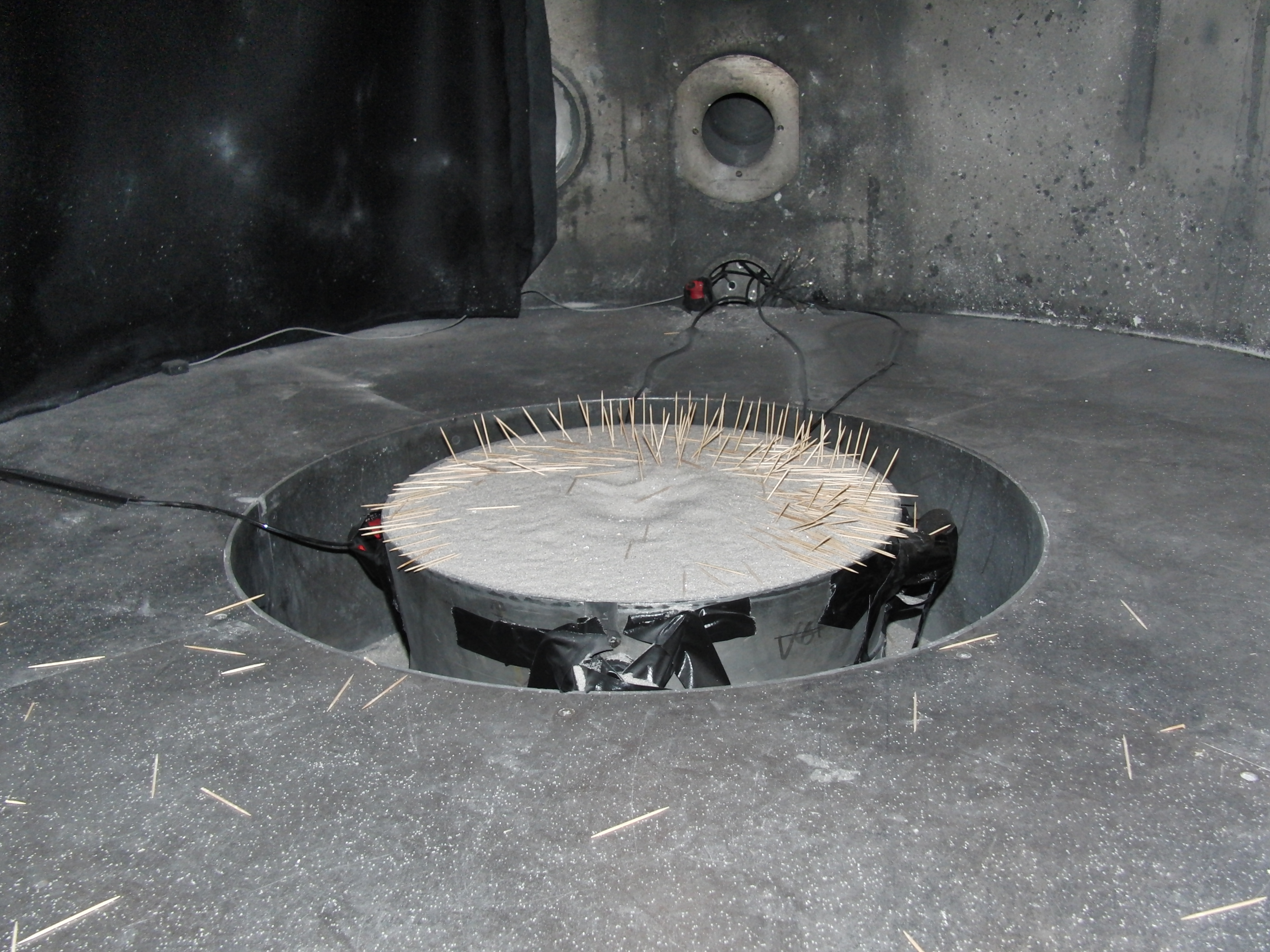
66 million years ago, in a swampy area by the Yucatan Penninsula, something like this probably occurred, when a six mile wide rock burned through the atmosphere to strike the water, ending the 135 million year reign of the dinosaurs. Perhaps it sounded a little like this simulation:
.
Any living thing that heard this – dinausaurs, birds, frogs insects – is long gone. By thinking about the event through new sounds, however, we can not only create new ways to analyze natural phenomena, but also extend the boundaries of our ability to listen across time and space and imagine what the sound of that impact might have been like, from an infrasonic rumble to a killing concussion.
It would probably terrify any listener to walk in to an art exhibition space filled with simply the sounds of simulated hypervelocity impacts, replete with loud, low frequency sounds and infrasonic vibrations. But there is something to that terror. Such sounds trigger ancient evolutionary pathways which are still with us because they were so good at helping us survive similar events by making us run, putting as much distance between us and the cataclysmic source, something that lingers even in safe reproductions, resynthesized from controlled, captured sources.
__
China Blue is a two time NASA/RI Space Grant recipient and an internationally exhibiting artist who was the first person to record the Eiffel Tower in Paris, France and NASA’s Vertical Gun. Her acoustic work has led her to be selected as the US representative at OPEN XI, Venice, Italy and at the Tokyo Experimental Art Festival in Tokyo, Japan, and was the featured artist for the 2006 annual meeting of the Acoustic Society of America. Reviews of her work have been published in the Wall Street Journal, New York Times, Art in America, Art Forum, artCritical and NY Arts, to name a few. She has been an invited speaker at Harvard, Yale, MIT, Berkelee School of Music, Reed College and Brown University. She is the Founder and Executive Director of The Engine Institute www.theengineinstitute.org.
__
Featured Image of a high-speed impact recorded by AVGR. Image by P. H. Schultz. Via Wikimedia Commons.
__

REWIND! If you liked this post, check out …
Cauldrons of Noise: Stadium Cheers and Boos at the 2012 London Olympics— David Hendy
Learning to Listen Beyond Our Ears– Owen Marshall
Living with Noise— Osvaldo Oyola
Share this:


Current Top Posts





April 2021

January 2020

November 2019

October 2019

August 2019

April 2014

November 2017

March 2015

December 2017

October 2015
 Sounding Out!
Recent Comments