
Shoo bop shoo bop, my baby, ooooo: W.E.B. Du Bois, Sigmund Freud & Barry Jenkins’ Moonlight
 Inspired by the recent Black Perspectives “W.E.B. Du Bois @ 150” Online Forum, SO!’s “W.E.B. Du Bois at 150” amplifies the commemoration of the occasion of the 150th anniversary of Du Bois’s birth in 2018 by examining his all-too-often and all-too-long unacknowledged role in developing, furthering, challenging, and shaping what we now know as “sound studies.”
It has been an abundant decade-plus (!!!) since Alexander Weheliye’s Phonographies “link[ed] the formal structure of W.E.B. Du Bois’s The Souls of Black Folk to the contemporary mixing practices of DJs” (13) and we want to know how folks have thought about and listened with Du Bois in their work in the intervening years. How does Du Bois as DJ remix both the historiography and the contemporary praxis of sound studies? How does attention to Du Bois’s theories of race and sound encourage us to challenge the ways in which white supremacy has historically shaped American institutions, sensory orientations, and fields of study? What new futures emerge when we listen to Du Bois as a thinker and agent of sound?
Over the next two months, we will be sharing work that reimagines sound studies with Du Bois at the center. Pieces by Phillip Luke Sinitiere, Kristin Moriah, Aaron Carter-Ényì, Austin Richey, Julie Beth Napolin, and Vanessa Valdés, move us toward a decolonized understanding and history of sound studies, showing us how has Du Bois been urging us to attune ourselves to it. To start the series from the beginning, click here.
Readers, today’s post by Julie Beth Napolin brings her trilogy to a close, exploring the echoes of black maternal sounding and listening she has amplified in Du Bois in Barry Jenkins’s Oscar-winning film Moonlight (2016).
Essay One: Listening to and as Contemporaries: W.E.B. Du Bois & Sigmund Freud
Essay Two: (T)racing Mother Listening: W.E.B. Du Bois & Sigmund Freud
–Jennifer Lynn Stoever and Liana Silva, Eds.
The theory of the acousmatic—the idea of a sound whose source is unseen, as it comes to us from Barthes, Chion, and Dolar—rests upon the mother tongue and the Oedipal scene, the dyad of mother and father. There is in “Do ba – na co – ba”–his great- great- grandmother’s song Du Bois remembers hearing passed down through his family–a transmission from the mother, but what kind of transmission? “There is no one extant autobiographical narrative of a female captive who survived the Middle Passage,” Hartman writes in “Venus in Two Acts” (3). History becomes, she continues, a project of “listening for the unsaid, translating misconstrued words” (3-4). The word-sounds “Do ba-na co-ba” are not the translation of a misconstrued word and they bolster a song of survival, of living on. But there is a silence there. “Do ba-na co-ba,” in a manner of speaking, survives the Middle Passage, and re-opens it as a primary channel of listening and receiving.
The Bantu woman was Du Bois’ grandfather’s grandmother, so many generations removed.
Returning to the vestiges of black motherhood in recent black cinema (including Jordan Peele’s Get Out and Barry Jenkin’s Moonlight), Rizvana Bradley argues that the loss of the mother “in black life more generally, as it repeats through cycles of material loss, … encapsulates racial slavery’s gendered social afterlife” (51). Bradley’s essay is crucial in retrieving the figure of the lost mother even in moments when the mother is absolutely elided as a character, not to appear visually. Horror more generally owes its immersive quality to the womb (enclosed spaces), but Bradley turns to black film form in particular to find in its mise-en-scène (such as in the gravitational field of the “sunken place”) maternal flesh and form.
In the compositional and formal strategies of The Souls of Black Folk, in the punctuated silences that open each chapter, there is a trace of the elided black maternal. The Bantu woman is lost not because Du Bois did not know her (he could not have), but because something of her song transmits a loss and theft that were not symbolic, but literal—a stolen and kidnapped maternal, rather than simply destroyed, as in the Oedipal mandate. It is crucial that the song that is at the core of Du Bois’ memory is transmitted along the maternal line. This maternal voicing is the unspoken wound of Du Bois’ text.

Spillers begins “Mama’s Baby, Papa’s Maybe” from the premise of non-Oedipal psycho-biographies, and these include not only the single mother, but the kidnapped mother. The quotation marks that surround the figure of the “black woman” for Spillers are “so loaded with mythical prepossession” that the agents it conceals cannot be clarified. Spillers takes particular aim at the infamous conclusions of the Moynihan report of 1965 that trace the roots of African American poverty to the figure of the single mother, the underachievement of lower class black males being linked in the report to black women.
In this way, black culture is thought to operate in a matriarchal pattern essentially out of step with a majority culture where a child’s identity and name, by definition, cannot be determined by the maternal line (66). As Lacan insists, it is the Father who gives a child both the Name and the symbolic Law (language). According to this configuration, Spillers argues, the child of the black mother can only be left in a haunting dis-identity. The implications for psychoanalysis are radical: Spillers begins the essay with a “stunning reversal of the castration thematic,” one that displaces its structure “to the territory of the Mother and Daughter, [and] becomes an aspect of the African-American female’s misnaming” (66). Among these misnamings is that black women are often not seen as “women,” omitted from the category and its political inflections. She is left castrated, politically impotent. For in this displacement, the subject positions of “male” and “female” lose—or fail to adhere to—their traditionally conceived symbolic integrity, and this loss begins with the historical experience aboard ship.

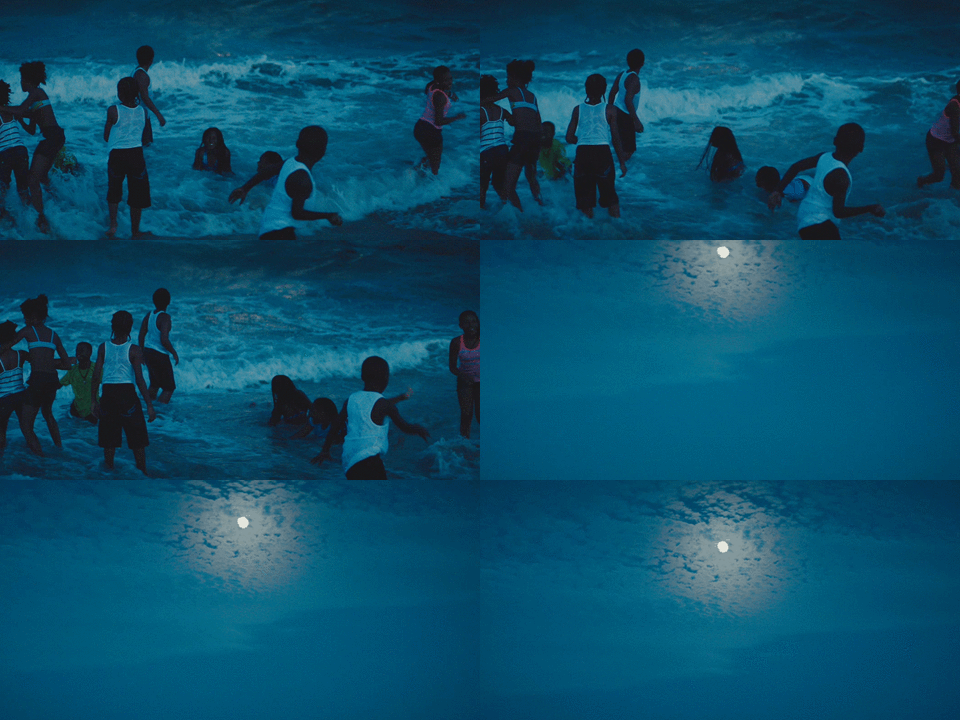
“waves and shadows,” image by Flickr User Albatrail
For Spillers, then, it is essential to trace this misnaming and undifferentiation of black women to the physical and psychic conditions of the Middle Passage. When Freud begins Civilization and Its Discontents, he notes an “oceanic feeling” engendered by religion. The oceanic is the longing for return to a pre-subjective state where one is united with all that is, before the cut that is birth and then language (indeed, the oceanic feeling is often attributed to song). Spillers’ move is to read the oceanic literally and structurally at once: there is the Atlantic Ocean and its Middle Passage. The oceanic, in this way, is de-subjectivating; it casts the subject out of itself in a terror of undifferentiation that does not cease with landfall.
But Spillers also implies that, in that (sexual) undifferentiation, a radical political potential can be retrieved. It is not that black feminism retrieves for her a sexual differentiation after becoming an ambiguous thing. It would not be “woman” in any traditional sense, for that New World category rests upon the violence Spillers seeks to describe. Above all, it would not be easy to name.
Du Bois certainly takes up the Father in his poetic epigraphs. But in ending with the Bantu woman’s song—as it seems to anatomize all of the other songs he describes—Du Bois upholds himself as being named by the maternal line. He is unable or perhaps unwilling to make a clarified place for a black female political agent. If we listen with ear’s pricked, we find that she is the submerged, oceanic condition for his speech.

By way of an open-ended conclusion, we can recall the sound of the ocean that punctuates Jenkin’s stunningly lyrical and psychologically complex coming-of-age film, Moonlight. The ocean provides the anchoring location for the psychological action, but also its aesthetic locus, the beginnings of its cinematic language. The sound of the ocean continually marks a desire for “return” to maternal undifferentiation and oneness, and yet, it provides the space for two embodied memories that cannot be compassed by traumatic separation. In the first, a father-like figure, Juan, embraces a young boy, Little, to allow him to float in a nearly baptismal scene of second birth, and in a second scene at the shore, Little experiences with his friend, Kevin, sexual gratification, a coming into his body as a site of pleasure.
The conclusion of the film posits these moments as being in the past. We had experienced them as contemporary, but only later realize they are a well of memory for a now-adult subject who does not know himself. I want to focus, then, on the film’s conclusion, after Kevin and Little (now named Black, his adult re-renaming), meet again after many years. Kevin calls Little/Black on the phone, a defining gesture of reaching out erotically and acousmatically with voices. We later learn that he calls because Kevin has heard an old song that reminded of him of his lost friend. By this voice or call, Black is brought somewhere back to his moment of break to become Little again, as if something in the past must be recuperated for the present. As he drives down the open road to find Kevin, the music of Caetano Veloso soars.
We can’t be sure if this is extra-diegetic or diegetic music. To be sure, Black would never listen to such a song on his stereo. And yet, the song seems to emanate directly from its affective space. In the language of literature, it is a “free-indirect style,” part character and part author; the film is hearing Black/Little feel. He’s in a space of haunting melody, drenched in personal memory, whose principle scene had been the Florida shore, the ocean lapping providing a (maternal) containing motif for the film, now transmuted into song.
The oceanic, Spillers might remind us, is violent, echoing the passages that made it possible for these two black boys to be there. But the sound is also amniotic, a space of maternal longing, particularly for a character who, in Bradley’s estimation, is positioned as pathological, injured by the missing mother who is, in turn, indicted by the film’s imaginary. To some extent, Moonlight participates in the mother’s misnaming: it cannot see the structures that ensure her lostness. But the film does also push towards some mode of melancholia that, as Michael B. Gillespie argues of Jenkins’ earlier work, would cease to be depressive. Jenkins’ aesthetic practice is transformative, Gillespie suggesting that we use Flatley’s term, “antidepressive melancholia,” as it’s with a stake in the personal past but turned towards the collective future (106).
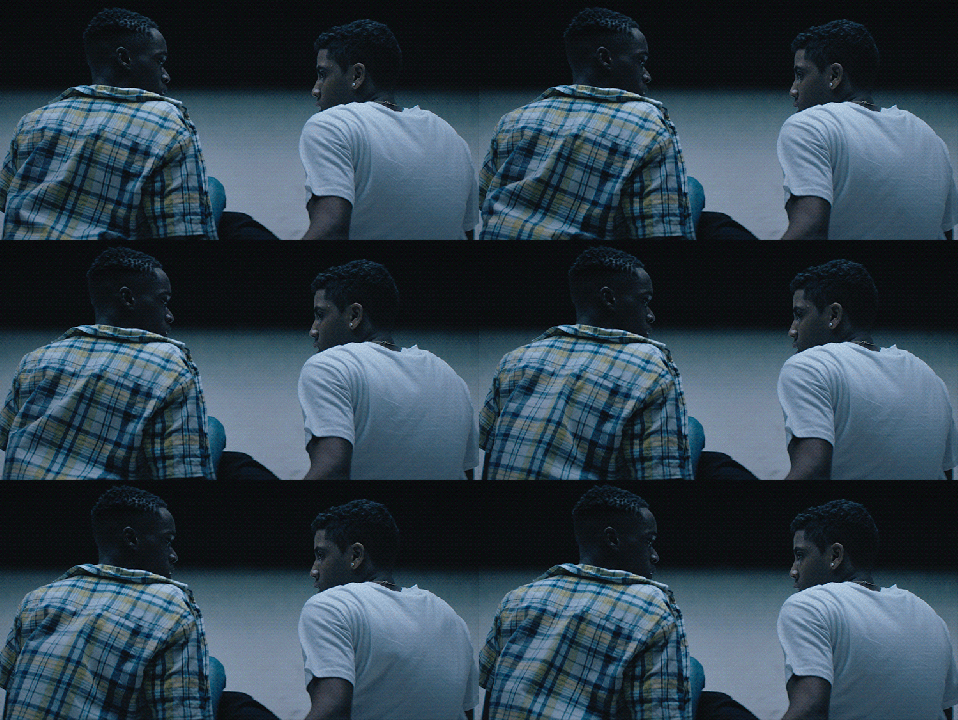
When the two boys, now men, meet again, several sounds punctuate the scene. They are not words or even phonemes, yet “speak” to provide a sonic geography of feeling that includes or “holds” the viewer, as Ashon Crawley might suggest. Among them is the sound of the bell on the door, which marks hello and goodbye, entry and exit, coming and going (or “fort-da” in Freud’s lexicon). When Black enters the diner, he is still “Black.” It is only when remembering what happened at the shore, then to say that no man has touched him since, that he becomes Little. He discloses this truth on behalf of a potential in present and a still-nascent future. Kevin cooks for Black, and Jenkins’ is careful to amplify the sound of the spoon stirring. He provides for Black, the film locating Kevin, a male, within the coordinates of maternal care. The sonic crux of the scene—no longer primal, no longer traumatic—is when Kevin plays the song on the jukebox that had drawn him to call to Little/Black in the first place. “Hello, stranger,” Barbara Lewis croons, “it seems like a mighty long time. Shoo bop shoo bop, my baby, ooooo.”
In listening to a song that is from our past, Newtonian time collapses, a shock running from past to present. The film never discloses whether these two had once heard this song together before. It is more likely that its affective map impacts Kevin, that he hears in its melancholic sound a nascence, and with it, a longing to retrieve his own past and repair. Lewis herself, singing in the sixties, is a recalling an already eclipsed fifties doo-wop. The phonemes circle back to their beginnings in “Do ba- na co-ba.” Such sounds are to be opposed to the shot of Little’s mother yelling at him (presumably a slur). There, the sound had cut out of the scene, which recurs for Little in a traumatic nightmare.
In contrast to that violent naming, the boys’ intimacy was defined by, to use Kevin Quashie’s term, “quiet,” a sense of interiority Michael Gillespie explores in his analysis of Jenkins’ first feature film, Medicine for Melancholy. Shakira Holt and Chris Chien called this dynamic in Chiron and Juan’s relationship “silence as a form of intimate conversance” in their 2017 post about Moonlight. There is a queer intimacy revived apart from trauma, triangulated by a black woman’s voice, paired with male harmonies, that resonate acousmatically from the jukebox to hold and contain the scene. For psychoanalytic theories of voice, containment is the essential maternal gesture of song.
We begin to wonder what might be possible for the feminine were it to be separated from the maternal dimension, a potential that Jenkins does not explore in this particular film in his oeuvre (as he does in Medicine for Melancholy, for example); each of the women in Moonlight “mother” to some extent. Nonetheless, he disperses the maternal function across male and female subjects, particularly in moments when the film resists depression. In listening with ears pricked, as with Du Bois’ epigraphs, the voices cease to belong to an individual, to be male voices or female voices, but become plural and pluralistic. It becomes possible to ground a politics of listening to the past for remaking in the present in that sound.

—
I would like to thank Michael B. Gillespie, Amanda Holmes, and Jennifer Stoever for their incredible scholarly assistance and comments in writing this essay trilogy.
—
Julie Beth Napolin is Assistant Professor of Literary Studies at The New School, a musician, and radio producer. She received a PhD in Rhetoric from the University of California, Berkeley. Her work participates in the fields of sound studies, literary modernism and aesthetic philosophy, asking what practices and philosophies of listening can tell us about the novel as form. She served as Associate Editor of Digital Yoknapatawpha and is writing a book manuscript on listening, race, and memory in the works of Conrad, Du Bois, and Faulkner titled The Fact of Resonance. Her work has appeared in qui parle, Fifty Years After Faulkner (ed. Jay Watson and Ann Abadie), and Vibratory Modernism (ed. Shelley Trower and Anthony Enns).
—
 REWIND! . . .If you liked this post, you may also dig:
Moonlight’s Orchestral Manoeuvers: A duet by Shakira Holt and Christopher Chien
“A Sinister Resonance”: Joseph Conrad’s Malay Ear and Auditory Cultural Studies–Julie Beth Napolin
“Scenes of Subjection: Women’s Voices Narrating Black Death“–Julie Beth Napolin
Share this:

My Time in the Bush of Drones: or, 24 Hours at Basilica Hudson
Ed. Note: We wanted to run this piece in advance of the Basilica Hudson’s SoundScape event taking place this Friday, September 14 – Sunday, September 16, 2018. Our Amplifying Du Bois at 150 forum will return next week.
—
“But why?”
Three weeks into a new semester and I am packing for another weekend of irresponsible travel. Irresponsible financially (because air travel on a graduate stipend is a decadence rarely rewarded) and irresponsibly professionally (because missing an annual department event, grading in a car, and sleeping on the ground for two days is a string of realities that stand sternly opposed to anything like good sense). I am doing all this in order to attend Basilica Hudson’s Soundscape: a wide and ranging line up of musicians and artists whose aesthetic commitments fall, shall we say, considerably aslant from the pop-cultural median. I am doing all this because of something that happened last year at this place, something I am still trying to work out. And this means, amongst concerned colleagues and family and friends, I’m again hearing that familiar, stuttering articulation of disbelief. Phrased, with equal parts confusion and concern, they rejoin:
Why?
This question first started popping up late last March. It came repeatedly, unblinkingly, and, I should add, not-unreasonably. What’s more, this was, in a very real way, my fault. For I had failed to develop a pithy ready-to-hand account of precisely why I was to travel from Chicago to New York City and New York City to Hudson, only to sleep on a thin mat on the concrete floor of a converted foundry while listening to loud, sustained bursts of noise (with varying degrees of harmonic familiarity) for an unbroken period of 24 hours.
Instead, I had only an intuition that failed to pass even the slightest of critical muster: Basillica Hudson’s 24-HOUR DRONE festival seemed weird and extreme and like something might happen there. On this basis, it seemed like a good thing to do.
I can now state with some clarity (though still lacking anything like critical poise) that something did in fact happen there, and it was indeed a good thing to do. Though what that “something” was remains frustratingly elusive.

24-Hour Drone, Image by Alt
This piece thus began as a review, but ended necessarily quite differently. The conventions of a review call for evaluation and normative judgement; they require statements regarding the quality of an event or object. I can offer very little in this vein. I’m still trying to wrest from memory something stubbornly mute and fleeting — still trying to figure out what it was, precisely, that happened there.
The drive up remains clear enough in memory. The usual crackle of reunited conversation between dear friends long-separated by geography; a decision not to listen to the then-new Grouper album (we would have enough heart-dragging ambient texture in the coming hours, we concluded); the sounds of Brooklyn passing into that hushed early-Spring upstate on Route 84. We at one point, for reasons that need not become articulate, listened to the Gin Blossoms. But as we pulled into the graveled parking lot a sense of anticipation and confusion returned. What was this thing?
To begin, we might reasonably call it an event.
Basilica Hudson — an upstate New York-based non-profit for the arts that puts on the event annually — admirably describes it thus:
An immersive event and all-encompassing experience, 24-HOUR DRONE is a roving, international series presented by Basilica Hudson and Le Guess Who?, featuring musicians and sound artists experimenting within the spectrum of drone to create 24 hours of unbroken, uninterrupted sound.
Through this expanded programming, 24-HOUR DRONE strives to break down barriers across borders, offering an opportunity to connect diverse musical communities and traditions, offering a localized snapshot of DRONE within the larger context of an imagined universal sound.
The language here should scan as familiar to anyone accustomed to reading music and arts press. Roving, experimental, barrier-breaking, border-crossing: these terms all call up a restless energy, the excitement of the wholly new, the different, the thoroughly non-normative. As it turns out, all these attributes turn out to be more-or-less (if uninterestingly) true.
24-Hour Drone, Image by Alt
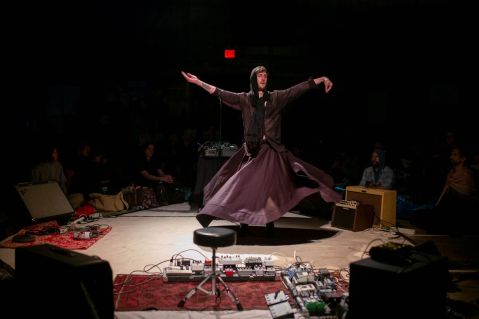
Over the course of the day and night, I heard the ethereal saxophone of PAUL, the whipping clangor of Pharmakon, and — I want to emphasize this — the absolutely breathless New Castrati, January Hunt’s exceptional and mournful work living up to her billing elsewhere as “synth, drones, and the annihilation of man.” A sentence above, though, still merits pause: “a localized snapshot of DRONE within the larger context of universal sound.” Roving energy and shattering experiment here take shape as a snapshot, the whirring and calamitous universal stalling for a moment in a discrete particular. 24-HOUR DRONE attempts to lends form to what was too diffuse to be seen.
So, modestly, in lieu of aesthetic judgement, a proposition: the value of Basilica Hudson’s 24-HOUR DRONE is to offer space to sound.
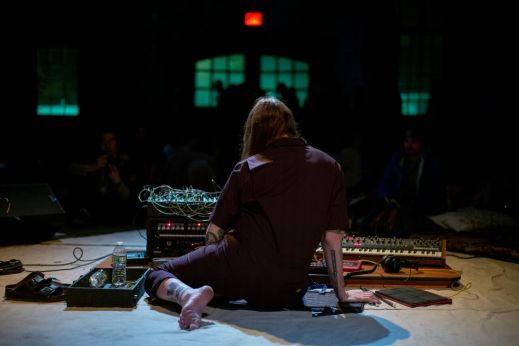
Indeed, for an event so centrally concerned with sound, 24-HOUR DRONE is as much about the Basilica — a converted nineteenth-century cathedral-esque foundry — as it is about sound. And for good reason: the Basilica has been beautifully repurposed — gutted of its original use and re-asserted as an malleable and improbably elegant arts space. Hundred-plus foot ceilings dwarf individual bodies, it’s begrimed upper windows modulate the midday sun into a speckled and hazy sepia, and the elaborate truss-work grids the scene in an industrial domework. The Basilica is a work of architecture meant to imagine and hold, however briefly, those fleeting shards and fragments of something yearning toward a “universal sound.”
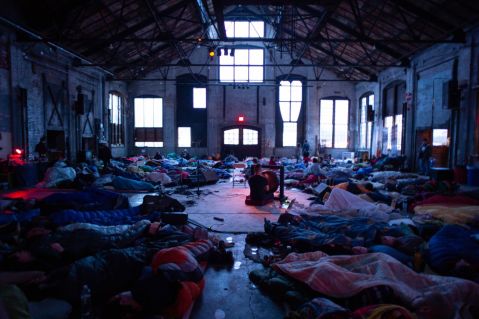
24-Hour Drone, Image by Alt
Though even as stunning a work of architecture as the Basilica can only ever confer a loose limit. These fragments are always clamoring for a more robust scene, always threatening to join the broader universal that awaits. Sound passes through walls, vibrates along concrete, penetrates skin and mingles among bodies. Spaces focalize sound’s capacities for the social and ethereal, by preserving and witnessing its constitutive ephemerality. Different spaces draw our attention to sound’s actually-existing materiality: a materiality that doesn’t quit, one that loosens our grip on our more ready-to-hand material worlds.
Grasping this materiality is not easy; it is maybe impossible. What possible cognitive torque will allows us to grasp at this overtopping universal? One option, it seems, is sheer brute force.
The term “endurance” rightly comes up repeatedly in press-documents and FAQs. For the event is knot of time and space (24 hours at the Basilica) which commands an attention to sound as a given, but sounding too as demanding an economy of attention wholly strange–a fidelity to sound that is without end. Limning out these ambitious parameters, to reign sound in, if for only a moment, requires something added.
Space, then.
Sonic spaces have a familiar, if knotty, history. Cathedrals invoke a beatific space, trussed by elaborate ornament and a spiritualized verticality. Music festivals inscribe traditions of sound and histories of capital — crowds and power, in Gina Arnold’s felicitous adaptation of Elias Canetti. Dwellings and offices, cafes and bars. Spaces arrange us in sound, and sound among us.
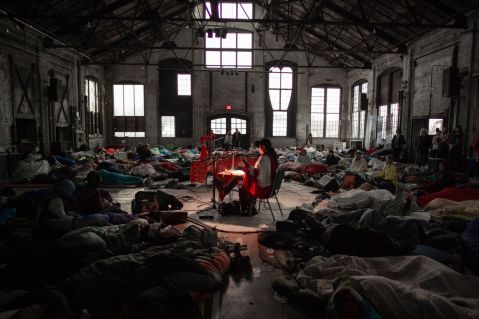
24-Hour Drone, Image by Alt
DRONE, then, is a provocation to think about sound — to think it over time, and to do so in a necessarily rarified space. This provocation worked; but I felt it only at an extreme limit.
At the twentieth hour (8 AM) I needed coffee. I had slept (kind of) through the night, rose to a bell ceremony, and walked immediately, groggily outside. As I passed through the door frame into the dewy and drizzly upstate morning, the sound — as if from a vacuum — muted and was voided of weight. I walked through the mostly empty streets.
These empty streets were, as it turned out, raucously loud. Distant cars motoring across country byways, the buzzing of a streetlight long past its prime; my tinnitus — a steadily pitched pulse acquired in those irresponsible salad days standing too-close to a crash cymbal — reminding me of all I may one day not hear. These sounds were, quite suddenly, clamoring for my attention, demanding my thought, straining for distinction. The espresso machine, the door hinges, the bathroom sink. Floorboards and rain and leaves and the Hudson and, and, and.
I walked back, not a little unsettled.
I had breakfast outside the venue among gravel-scraping shoes and overheard conversation.
Finally, I went back inside for what turned out to be the final act: Dronechoir Syllaba. The scene remains hauntingly clear.
A grouping of women entered, dressed entirely in white, each with one earbud in-ear, the other hanging loose. Some, if not all, had a length of yarn tied around their waist and dragging along the ground behind them a screw, nail, metal implement, which, as they walked produced a fragile, slender tone. They congregated in the center of the room and produced a careful and lush chord, its density piling up toward the far reaches of the ceiling. Slowly, the chord broke apart.
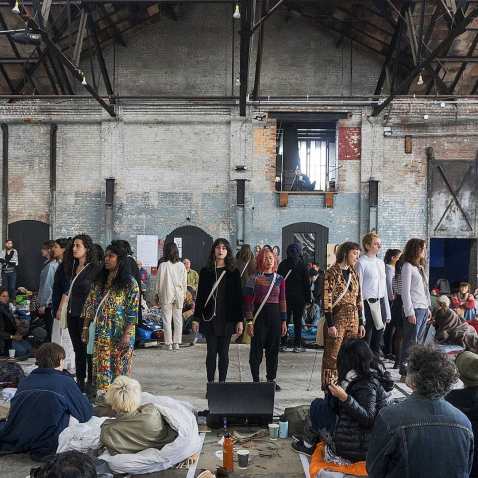
Dronechoir Syllaba, Basilica Hudson, 2018, Image by #noamplification
But, then, that’s not true.
I should say: slowly, the women moved apart, the chord remained, stretched and pitched against new and different coordinates, inhabiting the Basilica’s elastic space in a new configuration. Notes moved, their bearers slowly pacing around the exhausted and supine bodies of Droners along the floor.
A choir member approached me, holding out her free earbud. I shook my head, wearing a nervous grin. She insisted; I put it in. Playing quietly in that tinny bud was a reference tone for me to share. I looked at her as though I didn’t understand, and she smiled as if she did. Insisting. I managed a small hum, off-kilter and out of tune, before handing it back to her. Looking around, I saw the relationship I had repeated among others across the room. The chord kept mutating — dilating and contracting, swelling and receding, different tones calibrated along moving spatial coordinates. The choir returned to formation in center.
At noon, silence.
Everyone was smiling, dazed, like milkdrunk babies or punchdrunk lovers. We had slept amongst each other, passing a night in a shared space, while sound had enwrapped and enraptured us. We had borne witness to valences of sound hitherto under-noticed. We had joined a choir, if only for an offkilter moment in a space out-of-joint.
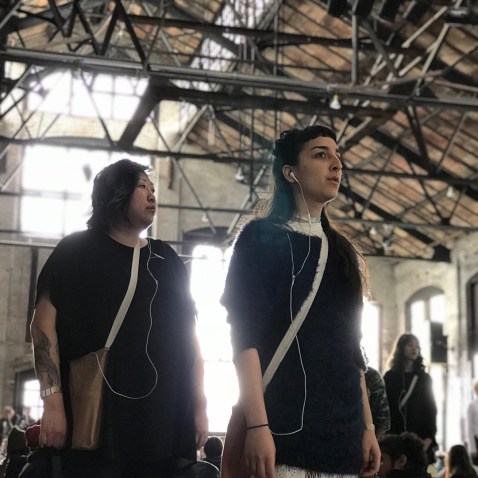
Dronechoir Syllaba, 24-Hour DRONE, Image by Andrew LaVallee via Instagram
***
We thought, my traveling companion and I, we thought the car ride back to the city would be for silence. For what else could you thirst after 24 such hours in the heart of sound? But this turned out to be deafening uncomfortable, weird. We were, in our own private ways, estranged from sound. Which is really another way of saying we were in different relation to sound and to the spaces it fills. There, a foundry. Here, a car. We put on, in lieu of silence, a little slice of magic, the condensation of all groove and beat, the most organized flash of pop brilliance this side of 1980. We of course put on Thriller.
As we roiled down the road to this joyous whispered desire — wanna be startin’ somethin’, got to be startin’ somethin’ — in a vehicle not made for dancing, the force of the Drone event began to take shape.
So, again: why?
To give attention to what we all already share — space and sound, history and music. To be adrift but not asleep in it all.
As for what happened?
I’ll try to grasp that next year.
—
Featured Image by Alt
—
Robert Cashin Ryan is a PhD candidate in the department of English at the University of Illinois-Chicago. He has written in various places about literary form and formalism, the relationship between Herman Melville and Charles Dickens, and Christmas as an intellectual problem. He curated and introduced a gathering of essays on music, sound, and noise for Post-digital forthcoming from Bloomsbury 2019.
—
REWIND!…If you liked this post, you may also dig:
This is Your Body on the Velvet Underground–Jacob Smith
Live Through This: Sonic Affect, Queerness, and the Trembling Body–Airek Beauchamp
Share this:


Current Top Posts





April 2021

January 2020

November 2019

October 2019

August 2019

April 2014

November 2017

March 2015

December 2017

October 2015
 Sounding Out!
Recent Comments