
Mr. and Mrs. Talking Machine: The Euphonia, the Phonograph, and the Gendering of Nineteenth Century Mechanical Speech
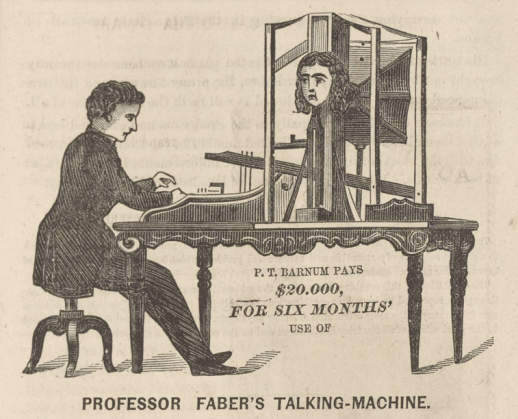
In the early 1870s a talking machine, contrived by the aptly-named Joseph Faber appeared before audiences in the United States. Dubbed the “euphonia” by its inventor, it did not merely record the spoken word and then reproduce it, but actually synthesized speech mechanically. It featured a fantastically complex pneumatic system in which air was pushed by a bellows through a replica of the human speech apparatus, which included a mouth cavity, tongue, palate, jaw and cheeks. To control the machine’s articulation, all of these components were hooked up to a keyboard with seventeen keys— sixteen for various phonemes and one to control the Euphonia’s artificial glottis. Interestingly, the machine’s handler had taken one more step in readying it for the stage, affixing to its front a mannequin. Its audiences in the 1870s found themselves in front of a machine disguised to look like a white European woman.

Unidentified image of Joseph Faber’s Euphonia, public domain. c. 1870
By the end of the decade, however, audiences in the United States and beyond crowded into auditoriums, churches and clubhouses to hear another kind of “talking machine” altogether. In late 1877 Thomas Edison announced his invention of the phonograph, a device capable of capturing the spoken words of subjects and then reproducing them at a later time. The next year the Edison Speaking Phonograph Company sent dozens of exhibitors out from their headquarters in New York to edify and amuse audiences with the new invention. Like Faber before them, the company and its exhibitors anthropomorphized their talking machines, and, while never giving their phonographs hair, clothing or faces, they did forge a remarkably concrete and unanimous understanding of “who” the phonograph was. It was “Mr. Phonograph.”
Why had the Euphonia become female and the phonograph male? In this post, I peel apart some of the entanglements of gender and speech that operated in the Faber Euphonia and the phonograph, paying particular attention to the technological and material circumstances of those entanglements. What I argue is that the materiality of these technologies must itself be taken into account in deciphering the gendered logics brought to bear on the problem of mechanical speech. Put another way, when Faber and Edison mechanically configured their talking machines, they also engineered their uses and their apparent relationships with users. By prescribing the types of relationships the machine would enact with users, they constructed its “ideal” gender in ways that also drew on and reinforced existing assumptions about race and class.
Of course, users could and did adapt talking machines to their own ends. They tinkered with its construction or simply disregarded manufacturers’ prescriptions. The physical design of talking machines as well as the weight of social-sanction threw up non-negligible obstacles to subversive tinkerers and imaginers.
Born in Freiburg, Germany around 1800, Joseph Faber worked as an astronomer at the Vienna Observatory until an infection damaged his eyesight. Forced to find other work, he settled on the unlikely occupation of “tinkerer” and sometime in the 1820s began his quest for perfected mechanical speech. The work was long and arduous, but by no later than 1843 Faber was exhibiting his talking machine on the continent. In 1844 he left Europe to exhibit it in the United States, but in 1846 headed back across the Atlantic for a run at London’s Egyptian Hall.
That Faber conceived of his invention in gendered terms from the outset is reflected in his name for it—“Euphonia”—a designation meaning “pleasant sounding” and whose Latin suffix conspicuously signals a female identity. Interestingly, however, the inventor had not originally designed the machine to look like a woman but, rather, as an exoticized male “Turk.”
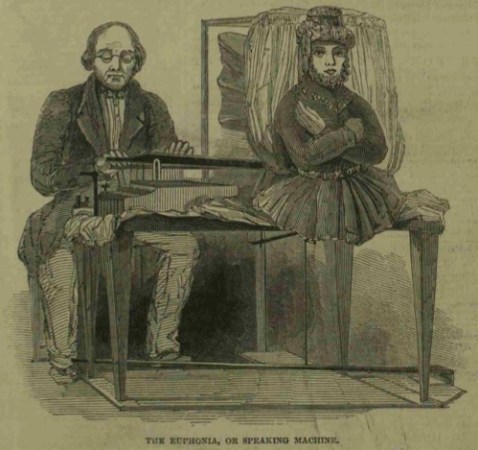
“The Euphonia,” August 8, 1846, Illustrated London News, 96.
A writer for Chambers Edinburgh Journal characterized the mannequin’s original appearance in September of 1846:
The half figure of a man, the size known to artists as kit kat, dressed in Turkish costume, is seen resting, upon the side of a table, surrounded by crimson drapery, with its arms crossed upon its bosom. The body of the figure is dressed in blue merino, its head is surmounted by a Turkish cap, and the lower part of the face is covered with a dense flowing beard, which hangs down so as to conceal some portion of the mechanism contained in the throat.
What to make of Faber’s decision to present his machine as a “Turk?” One answer, though an unsatisfying one is “convention.” One of the most famous automata in history had been the chess-playing Turk constructed by Wolfgang von Kempelen in the eighteenth century. A close student of von Kempelen’s work on talking machines, Faber would almost certainly have been aware of the precedent. In presenting their machines as “Turks,” however, both Faber and Von Kempelen likely sought to harness particular racialized tropes to generate public interest in their machines. Mystery. Magic. Exoticism. Europeans had long attributed these qualities to the lands and peoples of the Near East and it so happened that these racist representations were also highly appealing qualities in a staged spectacle—particularly ones that purported to push the boundaries of science and engineering.
Mysteriousness, however, constituted only one part of a much larger complex of racialized ideas. As Edward Said famously argued in Orientalism Westerners have generally mobilized representations of “the East” in the service of a very specific political-cultural project of self- and other-definition—one in which the exoticized orient invariably absorbs the undesirable second half of a litany of binaries: civilization/barbarism, modernity/backwardness, humanitarianism/cruelty, rationality/irrationality. Salient for present purposes, however is the west’s self-understanding as masculine, in contradistinction to—in Said’s words—the East’s “feminine penetrability, its supine malleability.”
One possible reading of the Faber machine and its mannequin “Turk,” then, would position it as an ersatz woman. A depiction of the Euphonia and its creator, which appeared in the August 8, 1846 Illustrated London News would appear to lend credence to this reading. In it, the Turk, though bearded, features stereotypically “feminine” traits, including soft facial features, smooth complexion and full lips. Similarly, his billowing blouse and turban lend to the Turk a decidedly “un-masculine” air from the standpoint of Victorian sartorial norms. The effect is heightened by the stereotypically “male” depiction of Faber himself in the same illustration. He sits at the Euphonia’s controls, eyes cast down in rapt attention to his task. His brow is wrinkled and his cheeks appear to be covered in stubble. He appears in shirt and jacket—the uniform of the respectable middle-class white European man.
Importantly, the Euphonia’s speech acts did not take place as part of a conversation, but might have been compared to another kind of vocalization altogether. Faber’s manipulation of the Euphonia entailed a strenuous set of activities behind the automaton (though, in truth, off to one side.) Its keyboard kept both of the inventor’s hands occupied at the machine’s “back,” while its foot-operated bellows had to steadily be pumped to produce airflow. Though requiring some imagination, one could imagine Faber and his creation having sex. At least one observer, it seems, did. In an article originally printed in the New York Paper, the author recounted how he “suggested to Mr. F[aber] that the costume and figure had better have been female.” This course of action offered practical mechanical-semiotic advantages “as the bustle would have given a well-placed and ample concealment for all the machinery now disenchantingly placed outside.” To the foregoing the writer added a clause: “—the performer sitting down naturally behind and playing her like a piano.”

Unidentified image of Faber’s Euphonia, public domain. c. 1870. The Euphonia was apparently sometimes exhibited with only the mannequin’s face in place, its body having been dispensed with.
Around 1870 the Euphonia was recast as a woman. By this time Herr Faber had been dead several years and his talking machine had passed on to a relative, also called Joseph, who outsourced the staged operation of the machine to his wife—Maria Faber. The transition from a male mannequin to a female mannequin (as well as the transition from a male operator to a female operator) throws into relief certain wrinkles in the gendered story of the Euphonia. Given that the Euphonia’s vocalizations could be read through the lens of sexualized domination, why had Faber himself not designed the mannequin as a woman in the first place? There are no pat answers. Perhaps the older, bookish, inventor believed the Turk could serve as an object of Western scientific domination without eliciting embarrassing and prurient commentary. Clearly, he underestimated the degree to which the idea of technological mastery already contained sexual overtones.
Little can be said about Joseph Faber’s life and work beyond 1846 though an entry for the inventor in the Biographisches Lexikon des Kaiserthums Österreich claimed that he took his life about 1850. Whatever the truth of Herr Faber’s fate, the Euphonia itself disappeared from public life around this same time and did not resurface for nearly two-and-a-half decades.
On the other hand, the idea of a female-presenting Euphonia, suggested by the New York Paper contributor in 1845, came to fruition as the machine was handed over to a female operator. If audiences imagined the spectacle of Euphonia-operation as a kind of erotic coupling, this new pairing would have been as troubling in its own way as Faber’s relationship to his Turk. What explains, then, the impulse to transition the Euphonia from androgyne to woman? Again, there are no pat answers. One solution to the enigma lies in the counter-factual: Whatever discomfiting sexual possibilities were broached in the Victorian mind by a woman’s mastery over a female automaton would have been greatly amplified by a woman’s mastery over a male one.
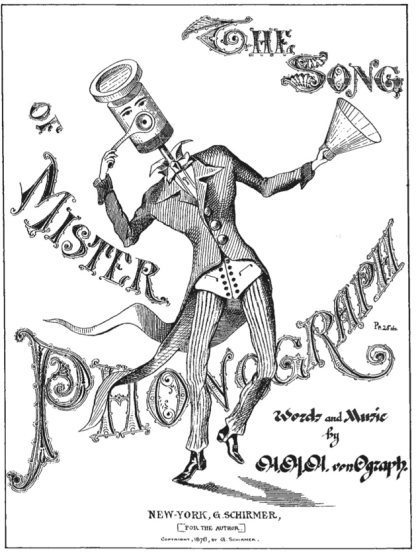
H.H.H. von Ograph “The Song of Mr. Phonograph” (New York: G Shirmer, 1878).
In these early exhibitions, the phonograph became “Mr. Phonograph.” In Chicago, for example, an exhibitor exclaimed “Halloa! Halloa!” into the apparatus before asking “Mr. Phonograph are you there?” “This salutation,” perspicaciously noted an attending Daily Tribune reporter “might have been addressed with great propriety to the ghosts at a spiritual seance…” In San Francisco, an exhibitor opened his demonstration by recording the message “Good morning, Mr. Phonograph.” Taking the bait, a Chronicle reporter described the subsequent playback: “‘Good morning, Mr. Phonograph,’ yelled Mr. Phonograph.”
In Atlanta, the phonograph was summoned “Mr. Phonograph, will you talk?” Mr. Phonograph obliged [“Wonder Agape!,” The Phonograph Puzzling Atlanta’s Citizens.” The Daily Constitution. June 22, 1878, 4]. At some point in 1878 the Edison Speaking Phonograph Company commissioned the printing of a piece of promotional sheet music “The Song of Mr. Phonograph.” The cover art for the song sheet featured a bizarrely anthropomorphized phonograph. The machine’s iron cylinder has been transformed into a head with eyes, while the mouthpiece and recording stylus have migrated outward and are grasped by two human hands. Mr. Phonograph’s attire, however, leaves no doubt as to his gender: He wears a collared shirt, vest, and jacket with long tails above; and stirrupped pants and dress boots below.
[Animal noises–cat, chicken, rooster, cow bird, followed by announcement by unidentified male voice, From UCSB Cylinder Archive]. Mr. Phonograph appealed not only to the professional exhibitors of the 1870s but to other members of the American public as well. One unnamed phonograph enthusiast recorded himself sometime before 1928 imitating the sounds of cats, hens, roosters and crows. Before signing off, he had his own conversation with “Mr. Phonograph.”
To understand the impulse to masculinize the phonograph, one must keep in mind the technology’s concrete mechanical capabilities. Unlike the Euphonia, the phonograph did not have a voice of its own, but could only repeat what was said to it. The men who exhibited the phonograph to a curious public were not able (like the Fabers before them) to sit in detached silence and manually prod their talking machines into talking. They were forced to speak to and with the phonograph. The machine faithfully addressed its handler with just as much (or as little) manly respect as that shown it, and the entire operation suggested to contemporaries the give-and-take of a conversation between equals. Not surprisingly, the phonograph became a man and a properly respectable one at that. Finally, the all-male contingent of exhibitors sent across the United States by the Edison Speaking Phonograph Company in 1878 invariably imparted to their phonographs their own male voices as they put the machine through its paces on stage. This, in itself, encouraged attribution of masculinity to the device.
The Euphonia and the phonograph both “talked.” The phonograph did so in a way mechanically-approximating the idealized bourgeois exchange of ideas and therefore “had” to be male. The Euphonia, on the other hand, spoke only as a function of its physical domination by its handler who wrung words from the instrument as if by torture. The Euphonia, then, “had” to be female.
The talking machines of the late nineteenth century as well as the media technologies that succeeded them emerged from a particular white, male, western and middle class culture.While changing in profound ways since the Victorian period, this culture has remained committed to the values of scientific mastery of nature; racial and gender hierarchies; and, especially, economic accumulation. But because the physical apparatus of talking machines has evolved so dramatically during this same period, it has been necessary to periodically renovate the ontology of mechanical speech in order to make it “safe” for the core values of the culture.
A fuller accounting of the politics of sound reproduction is possible but it depends on a more dynamic rendering of the interplay between practices, technologies and sonic understandings. It requires not only identifying speakers and listeners, but also placing them within the broader networks of people, things and ideas that impart to them moral content. It means attending—no less so than to texts and other representations—to the stories machines themselves tell when they enact the labor of speaking. We should listen to talking machines talking. But we should watch them as well.
—
Featured Image: from William C. Crum, ”Illustrated History of Wild Animals and Other Curiosities Contained in P.T. Barnum’s Great Travelling World’s Fair….” (New York: Wynkoop & Hallenbeck, 1874) 73. This image suggests that the later exhibitors of the Euphonia may have occasionally deviated from the gendered norms established by Joseph Faber, Sr. In image 4, a man—perhaps Joseph, Jr.— operates the Euphonia in its female form.
—
J. Martin Vest holds Bachelors and Masters degrees in History from Virginia Commonwealth University and a PhD in American History from the University of Michigan. His research interests range across the nineteenth and twentieth centuries, and are heavily influenced by the eclecticism and curiosity of working class storytelling. Past projects have explored Southside Virginia’s plank roads; the trope of insanity in American popular music; slavs in the American South; radical individualist “egoism;” twentieth century anarchists and modern “enchantment.” His dissertation, “Vox Machinae: Phonographs and the Birth of Sonic Modernity, 1870-1930,” charts the peculiar evolution of modern ideas about recorded sound, paying particular attention to the role of capitalism and mechanical technology in shaping the things said and believed about the stuff “in the grooves.”
 REWIND!…If you liked this post, you may also dig:
Only the Sound Itself?: Early Radio, Education, and Archives of “No-Sound”–Amanda Keeler
The Magical Post-Horn: A Trip to the BBC Archive Centre in Perivale–Leslie McMurtry
How Svengali Lost His Jewish Accent–Gayle Wald
Share this:

The Theremin’s Voice: Amplifying the Inaudibility of Whiteness through an Early Interracial Electronic Music Collaboration

On an October evening in 1934, Clara Rockmore made her debut performance with the theremin, a then-new electronic instrument played without touch, in New York City’s historic Town Hall. Attended by critics from every major newspaper in the city, the performance not only marked the beginning of Rockmore’s illustrious career as a thereminist, it also featured the first known interracial collaboration in electronic music history. A sextet of Black male vocalists from the famous Hall Johnson choir performed a group of spirituals arranged by Johnson with Rockmore, whom the press—apparently unaware of her Jewish heritage—considered white. The collaboration was an anomaly: no other record exists of Black musicians performing with Rockmore (she toured with Paul Robeson in the 1940s, but no evidence has surfaced showing the two ever on stage together).
Though the Johnson Sextet’s performance with Rockmore is of intense interest to me as a historian, at the time the white press mostly ignored the collaboration. This is surprising given Johnson’s fame: his choir and work were critically acclaimed in productions including the 1930 Pulitzer-Prize-winning play The Green Pastures and the 1933 musical Run Little Chillun’. The Sextet’s spirituals were prominently featured in Rockmore’s debut, with four songs closing the program (“Stan’ Still Jordan,” “Swing Low, Sweet Chariot,” “Water Boy,” and “O Lord Have Mercy On Me”) and “Old Man River” likely serving as an encore. Yet only two writers—one Black, one white—discussed the spirituals in any detail. Though brief, these two reviews can help us understand why most critics ignored the spirituals at Rockmore’s debut, and illuminate the role that race played in the reception of Rockmore’s career, the theremin, and electronic musical sound.
One of these reviews was by an anonymous critic writing for the New York Amsterdam News, the city’s highly influential weekly African-American newspaper. Though unidentified, the author was likely Black, given the source. The critic described Rockmore and the Sextet’s rendition of the song “Water Boy” as “particularly effective,” ascribing the theremin’s expressive power to its sonority: “the deep ’cello tone of the instrument was more than faintly reminiscent of the throaty humming of a Negro singer.” The white critic who wrote about the collaboration—Paul Harrison, in his syndicated column, “In New York,” that ran in several newspapers across New York State—seemed to corroborate the Amsterdam reviewer’s hearing, writing that the theremin had been “improved so that it now can be made to sound like the choral humming of a hundred Negro voices.” Remarkably, Harrison made the comparison without so much as mentioning the presence of the Johnson Sextet or the spirituals, erasing the very real presence of Black musicians in the performance.
These reviewers agreed that the theremin sounded like a Black voice during the spirituals. Yet Harrison used the comparison to disparage. His use of the word “improved” was clearly ironic, and the overall tone of his review was mocking (he described twenty-three-year-old Rockmore as “a lovely and graceful girl, but too serious about her new art”). The Amsterdam critic, meanwhile, compared the theremin’s tone to that of a Black voice to communicate the instrument’s expressivity—its beauty, emotion, and humanity. They validated their own hearing of the powerful performance by noting that the capacity crowd “hailed Miss Rockmore’s mastery of the theremin and demanded several encores.” Despite the contrasts, these pieces share something absent from nearly every contemporary theremin review: an explicit discussion of race and the theremin’s timbre. These seemingly anomalous takes, when understood in the context of the theremin’s broader contemporary reception history among (mostly white, mostly male) critics, can amplify what Jennifer Stoever identified in The Sonic Color Line as the “inaudibility of whiteness” in the history of the theremin and electronic musical sound (12).

Clara Rockmore playing the theremin (c. 1930s) by Renato Toppo, courtesy of The Nadia Reisenberg / Clara Rockmore Foundation
When Rockmore performed as a soloist, critics tended to describe the theremin’s timbre in the context of western art music sonorities, making comparisons to the cello, violin, and classical voices. Reviewers frequently remarked on the instrument’s expressive powers, describing its tone as warm and rich, and writing of its “vivid expressiveness” and “clear, singing, almost mournful” tone. Many attributed the instrument’s expressivity to Rockmore’s skill as a trained classical performer, praising her repertory choices, musicianship, and technique.

Close-Up of “Figure 1109,” Image by Flickr User Theremin Player
Alongside celebrations of the theremin’s emotionally charged sonority was an opposing rhetoric of noisiness, one that critics employed to mark the theremin as sonically obnoxious. Early critics often complained about the “excessive” use of vibrato and portamento employed by thereminists, most of whom, like Rockmore, were (at least perceived as) white women. There is a practical explanation for this: if you’ve ever played a theremin, you know that without the use of these techniques, it is nearly impossible to locate pitches, or create even the impression of accurate intonation. Critics turned to identity politics to signal their displeasure with the instrument’s slippery chromaticism, taking a cue from the long history of linking copious chromaticism with bodies deemed sexually, racially, or otherwise aberrant. They compared the theremin’s timbre variously to that of a “feline whine,” a fictional Wagnerian soprano one critic dubbed “Mme. Wobble-eena” and “fifty mothers all singing lullabies to their children at the same time.” Such reviews used bodies and instruments assumed to be white and female as points of comparison: sopranos, violins, mothers (who were racially unmarked and thus by default white). To critics, the theremin was objectionable, was “other,” in a specifically white, specifically feminine way.
Critics were especially concerned with the theremin’s timbre, projecting onto it their hopes and anxieties about the potential impact of technology on their musical world. Since the theremin’s 1929 arrival in New York, critics had been assessing the instrument’s potential, treating it as a bellwether for technology’s impact on the future of music. Rockmore stoked this interest by claiming that her debut would “prove that the [theremin] may be a medium for musical expression.” Critics centered their hopes and anxieties about the promise and threat of electronic music in analyses of the theremin’s timbre, where the instrument could either be exposed as a fraud—a poor substitute for “authentic” “living” music—or celebrated as a breakthrough.
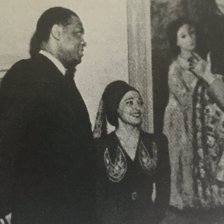
Paul Robeson and Clara Rockmore
Discussions among New York’s white critics about the theremin’s musical promise unfolded specifically and exclusively with regard to the white western classical tradition. Just as Toni Morrison noted in her book Playing in the Dark that “the readers of virtually all American fiction have been positioned as white,” whiteness was the default for writers and readers of music criticism on the theremin (xii). Though most white critics at Rockmore’s debut never mentioned race, their tacit dismissal of the spirituals she performed with the Johnson Sextet reveals that race was a central organizing force in their assessments of the instrument. The brief reception history of the spirituals Johnson arranged for voice and theremin, wherein writers—listening to the instrument perform with Black voices—clearly heard the theremin’s tone as Black, is the exception that proves the rule: white critics, by and large, heard the instrument as sounding white.
Just as Morrison asked: “how is ‘literary whiteness’ and ‘literary blackness’ made, and what is the consequence of that construction,” we must explore the ramifications of the assumptions we’ve made about whiteness and electronic musical sound (xii). For it is not only critics of the 1930s who heard the theremin’s sound as white: most current histories continue to focus on and reify a predominantly white academic and avant-garde electronic music history canon. The Amsterdam critic’s hearing opens new possibilities for understanding the history of electronic musical sound. While popular perceptions often frame electronic musical sound as “lifeless” or emotionally “flat,” the Amsterdam critic’s comparison of the theremin to the voice opens our ears to alternative hearings of electronic musical sound as expressive, affective, even human. When we hear this aspect of electronic music’s sound, we can begin to account for histories that go beyond the white western canon that dominates our understanding of electronic music history. We can populate such accountings with performers like Rockmore and composers like Johnson who worked and lived outside the boundaries we have traditionally drawn around electronic music history.
Dr. Madd Vibe (aka Angelo Moore) plays theremin in his band The Brand New Step, covering “Brothers Gonna Work it Out” Angelo Moore been playing theremin for over 20 years.
—
Featured Image: “Theremins are Dreamy” by Flickr User Gina Pina, (CC BY 2.0)
—
Kelly Hiser is co-founder and CEO of Rabble, a startup dedicated to empowering libraries to support and sustain their local creative communities. Kelly holds a Ph.D. in music history from the University of Wisconsin-Madison and embraces work at the intersections of arts, humanities, and the public good. She talks and writes regularly about music, technology, identity, and power.
—
Share this:


Current Top Posts





April 2021

January 2020

November 2019

October 2019

August 2019

April 2014

November 2017

March 2015

December 2017

October 2015
 Sounding Out!
Recent Comments