
Afecto Caribeño / Caribbean Affect in Desi Arnaz’s “Babalú Aye”

Recently, the new biopic and telenovela Celia, La Serie on the life of Celia Cruz reminded me of how her iconic call “Azucar!”(translated as sugar) engaged audiences to feel the sabrosura of her music. The soap-opera included documentary footage of the larger iconic events in Celia’s career that could not be recreated, scenes that captured how Cruz and the audience connected. The scenes that best captured this are when Celia performs with Fania at Yankee Stadium in 1973 and in Zaire in 1974. When she felt the audiences’ joy in her performance she’d share that expressive sentiment of the sweetness in the moment, taking audiences to a deeper ecstatic place.
I also felt and witnessed this myself when I saw Cruz perform at the Hollywood Bowl decades ago. It’s akin to what I sensed when also hearing Damaso Pérez Prado’s guttural “Maaam-bO” in his “Mambo No 5.” While watching Celia, La Serie, I asked my mom if she had ever watched Desi Arnaz on I Love Lucy. Her response included a dislike for Arnaz, while I remembered enjoying his performance of “Babalú Aye.” Our exchange raised the question: can Arnaz’s performance, like Cruz’s expressive phrasing or Pérez Prado’s musical cue, unify a Latinx and African diaspora through sound and affect?
 I posit that Arnaz’s televised performances of “Babalú Aye” like Celia’s “Azucar” or Prado’s “Mambo” exemplify what Alejandra T. Vazquez calls in Listening in Detail “vocal armament and ornament” (132), a sound that cultivates an afecto caribeño among Spanish-speaking diasporic migrants and their descents. My use of afecto here is a key sonic detail, playing upon the Spanish meaning to show tenderness and emotion. I also appreciate affect theory as it provides a framework by which to explore the emotionality and connection to experiences that have not been named. For example, in “Feeling, Emotion, Affect,” Eric Shouse writes about affect as “the body’s way of preparing itself for action in a given circumstance by adding a quantitative dimension of intensity to the quality of an experience. The body has a grammar of its own that cannot be fully captured in language.” I attempt here to cultivate a language that address how Arnaz’s physical and sonic articulation sets an entry to examine contributions by members of the Latinx Caribbean diaspora and its reach to those of us hearing and seeing them in a US context.
Growing up bilingual and bicultural in Los Angeles, I saw how my mom retained a bit of her homeland by watching a variety show called Siempre en Domingo. Many of the artists who performed were also heard on the local Spanish language station K-Love. The ritual gathering on Sunday nights as we watched the show metaphorically united my mom with her family.I believe that viewing and hearing her Mexico made the distance away from her family soften. For me, listening to the songs I heard on Siempre en Domingo then replayed on the radio helped codify something more than Mexican; it was pan-Latino. These moments of engaging with television shows mediate my experience of sound and affect, which I’ve named afecto caribeño (translated to “caribbean affect”).
 My fondness of Desi Arnaz stems from a familiarity of Spanglish when I saw my first episodes of I Love Lucy (1951-1957) on Saturdays on KTLA. Its stars, Lucille Ball and Desi Arnaz, played a married couple, and the comedy of errors would inevitably involve “Lucy Ricardo” trying to scheme something. In real life, Ball and Arnaz were a Hollywood power couple who produced their show, establishing a practice of syndication rights paid to the actors. Arnaz played “Ricky Ricardo,” the owner of the Tropicana nightclub where he was also the bandleader. When scenes featured him at the club he would always play the congas, thus creating a continuum of his earlier career as a musician to now television star.
Hearing Desi Arnaz speaking inglés with a Cuban accent was familiar to my ears. I knew that sound of English blended with español because it was what I heard from my parents and their acquaintances. In the show, misunderstandings happened because one could not decipher what “Ricky” meant or said. The mistranslations led to some comedic moments and the establishment of a long-running comedic television trope at the expense of Latino characters and actors, as explored by Dolores Inés Casillas and Sebastien Ferrada in “Listening to Modern Family’s Accent.” However, in Life on the Hyphen, Gustavo Pérez-Firmat describes Arnaz’s nilingüe–someone who speak neither Spanish nor English—and argues his nilingüe-ism was personified through “Ricky Ricardo” as “Spanish utterances shot through anglicisms so that the monolingual viewer can understand what he was saying” (43). But, Arnaz did not reach only “English-only’ ears. To my pocha ears Arnaz spoke a familiar—and not incorrect—spoken Spanish. As a young viewer, I had no reference for his mistakes. Sonically “Ricky’s” familiarity came through when he complained about “Lucy” in Spanish. Hearing the español I spoke at home on “I Love Lucy” is how I connected to the hyphened Americano via tv. Nowhere was this more pronounced than with Ricardo’s frequent performances of “Babalú”.
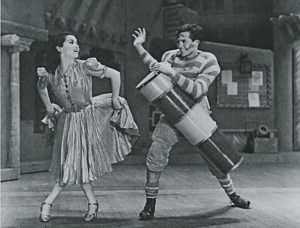
Diosa Costello and Desi Arnaz in Too Many Girls (1939)
Before his film career, Arnaz was known as the mambo king. Due to his lackluster rise as a “Latin Lover” in Hollywood, Arnaz returned to work as a musician and began singing his signature “Babalú” around 1943. The song is attributed to Margarita Lecuona and published in 1939. “Babalú” conflates the popular 1940s-50s big band sound with a Cuban folksong (or son) sung to the Orishas (deities or gods). Babalú is an Orisha deity who oversees health and is revered because of his power over life and death, and is also known as San Lázaro within the pantheon of Catholic saints. By the time Arnaz made the song popular in the United States, the song had also been associated with Miguelito Valdés, who was known as “Mr. Babalú.” Other musical contemporaries like Damaso Pérez Prado were also making a name for themselves by developing a new sound that Latinized dance music in the U.S. According to Ed Morales in Living in Spanglish, it is in the 1950s that Prado creates his signature sound in Mexico City by “mixing North American swing and bebop” known as mambo (152). However, it is Arnaz’s performance that I reference because of its reach to a multi-generational audience through syndication of the “I Love Lucy” show.
 Each time Arnaz performs “Babalú” it serves as an offering to the Orisha to heal the longing for a homeland he left long ago, as experienced by many musicians like Cruz who live in exile. With each performance on the “I Love Lucy Show,” Arnaz reconnects to his cultura. Performing this on national television it’s not about the Anglo viewer who only sees Arnaz as the “Rhumba Rhythm King” (sic) (Pérez-Firmat, 52) made famous in movies; rather it is about Arnaz creating a space of agency through a prayer and healing ritual in song, thus an expression of Afecto Caribeño connecting the Latinx diaspora to something beyond national borders and generations.
For example, in Season 2 episode 21 “Lucy Takes a Job at the Bank,” Arnaz (as Ricky Ricardo) brings out his son Ricky Jr. to play the congas alongside him. Ricky as proud father shares his joy in this moment. The camera pans out to Lucille Ball and her co-star Vivian Vance sitting at the table. Arnaz instructs his son to “say thanks” and he replies in Spanish “gracias.” This exchange is profound because it accentuates the bilingualism and bicultural exchanges that happen in the home space now introduced to many via television. Arnaz continues, “Even though Little Ricky was born in America, there’s lots of Cuban in his heart.” The Cuban in his heart plays out in sonic beats through a father-and-son performance on the congas and the calling upon “Babalú Aye.” Both Lucille Ball and Desi Arnaz are happy parents, not just stage parents, who revel in this moment. As Ricky Jr. plays, his mother bangs on the table too and Arnaz looks up to the sky as if in gratitude for this moment to the Orisha Babalú.
Upon reflection, I am aware of how television informed my childhood search for something that reflected how I spoke and heard the world. In these linguistic-sonic moments I reconnected to my mother’s homeland and sought to make sense of my pocha identity when I heard English spoken with a Spanish accent. In Relocations, Karen Tongson names these moments of connection that occur through a technological network as “remote intimacies” that can “account both technically and affectively, for the symbiosis that can happen between disparate subjects. . .I like to think that these imaginary correspondences sometimes have to happen across greater distances, both conceptually and topographically with other ethnicities, accents, nations (130)” The conceptual and topographical correspondence informs afecto caribeño as a means to enable critical connections to a Latinx diaspora centered en el Caribe highlighting the mestizaje of African and Spanish heritage, thus expanding upon Paul Gilroy’s notion of the “black Atlantic” on how the Atlantic slave trade also impacted culturally el Caribe. Upon singing “Babalú Aye” Arnaz’s performance not only is a disruption to Anglo American viewers, but also “disrupts the myth of Cuban whiteness” (Vasquez, Listening in Detail, 150).
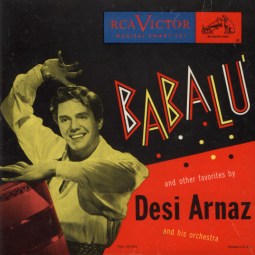 I am drawn to sonic experiences that can help unpack Latinidad and the multicultural roots that are informed by other migrations of Africans, Asians, and Spaniards to the Américas. I am a descendant of these mestizajes, as Gloria Anzaldúa writes in her canonical text Borderlands / La Frontera. A concept like afecto caribeño addresses the social and emotional exchanges that emanate from the complexity of these migrations and how they reveal themselves in momentary connections. When Arnaz performs as “Ricky,” he breaks that character upon playing the congas. Here he does not act as the nightclub owner; the reverberation of the conga mediates an embodiment of his true self exemplifying un afecto caribeño.
—
reina alejandra prado saldivar is an art historian, curator, and adjunct lecturer in the Women, Gender and Sexuality Studies Program and Liberal Studies Department at CSULA and in the Critical Studies Program at CALArts. As a cultural activist, she focused her earlier research on Chicano cultural production and the visual arts. Prado is also a poet and performance artist known for her interactive durational work Take a Piece of my Heart as the character Santa Perversa (www.santaperversa.com) and is currently working on her first solo performance entitled Whipped!
—
Featured Image: Desi Arnaz performing with Diosa Costello, 1948.
—

REWIND!…If you liked this post, you may also dig:
The Sweet Sounds of Havana: Space, Listening, and the Making of Sonic Citizenship – Vincent Andrisani
SO! Amplifies: Shizu Saldamando’s OUROBOROS–J.L. Stoever
SO! Reads: Dolores Inés Casillas’s ¡Sounds of Belonging! – Monica de la Torre
Share this:

Enacting Queer Listening, or When Anzaldúa Laughs

 Marginalized bodies produce marginalized sounds to communicate things that escape language. The queer body is the site of sounds that engage pleasure, repression, rage, isolation, always somehow outside of dominant language. Sound Studies tells us that we should trust our ears as much as our eyes, justifying our trust in sound, and of the resonating body. Affect Theory goes further, saying that all senses play into a body that processes input through levels of response, experience, and anticipation. Affect is the vibrational space that is both bodily memory and anticipation. So where do sound and affect meet in queer bodies? How do marginalized peoples use sound and the body to express liberation, objectification, joy, and struggle?
Our writers in Sound and Affect tackle these questions across a spectrum of the marginalized experience. I opened the series by offering the concept of the tremble, a sonic form of affect that is necessarily queer in its affective reach. Last week, Kemi Adeyemi, sloooooooowed thingggggggggs doooooooooownnnnn so to hear the capitalist connections between the work expected of black bodies and the struggle for escape from this reality through the sonic affects, temporal shifts, and corporeal elsewhere of purple drank. Next week, Justyna Stasiowska brings the noise in a discussion of the trans body and the performance work of Tara Transitory. Today, Maria P. Chaves Daza explores the connection between voice, listening, and queer Chicana community formation: through space, across time, and with laughter. —Guest Editor Airek Beauchamp
—

In October 1991 at the University of Arizona fall reading series, Gloria Anzaldúa read several poems and short stories–work now held at the UT-Austin Collection. Recently, I sat in my living room listening to the recording, feeling the buzz of her presence, the audible excitement in the Modern Languages Auditorium that Gloria Anzaldúa is about to speak. After some welcoming statements and a poem by Rita Magdaleno, inspired by Magdaleno’s reading of Borderlands, Anzaldúa takes the stage.
As part of her praxis, Anzaldúa makes space for queer people, both through her words and vocal tone. She begins with a joke about her relationship with mics and takes the time to thank the organizers, especially for her cozy writer’s cottage. Anzaldúa dedicates the reading to Yolanda Leyva, her old roommate, telling Leyva she hasn’t forgotten her. Then, she announces her involvement in Sinister Wisdom and encourages women of color in the audience to contribute to this all-lesbian journal. She proceeds to laugh as she says, “lesbians of color only, sorry. [laughs]” Similarly, as she announces a collection she is editing with Francisco Alarcon about Chicana dykes and Chicano gay men, she says, “so if anybody is a Chicana dyke or a Chicano gay man, sorry about the rest of you” [laughs]. In the future she will also edit a book called Chicana Theory “Chicanas only (laughs), sorry.” Last, she acknowledges Chuck Tatum for changing the title of his annual from “New Chicano Writings” to “New Chicana/o Writings” and for allowing for Spanish and Spanglish Tex-Mex when he first wanted pieces in English. Anzaldúa takes the opportunity to recognize and promote the work of Chicana/o lesbian and gay writers by demarcating several publications exclusive to their work. This exclusivity is softened with giggles and laughs, affects, which help work through the tension(s) of recognition and exclusion caused by this explicit circumscription.
Her nervous, silly laugh–echoed in the laughs of her audience–reaches out to bring me into that space, that time. Her smooth, slow and raspy voice–her vocalic body–touches me as I listen.

Gloria Andzaldúa Image from the Tumblr of BiRadical
In their introduction to The Affect Reader, Gregory J. Seigworth and Melissa Gregg assert affect’s “immanent capacity for extending […] both into and out of the interstices of the inorganic and non-living, intracellular divulgences of sinew, tissue and gut economies and the vaporous evanescenses of the incorporeal (events, atmospheres, feeling-tones)” (2).This sound recording of Anzaldúa’s poetry reading is an example of the immanent capacity this “incorporeal” event has to resonate and “sometimes stick to bodies and worlds” for listening audiences (1). Affect in its simplest form is “the name we give to those forces […] that serve to drive us to movement, towards thought and extension” and is “synonymous with force or forces of encounter (2).” My encounter with Anzaldúa’s (incorporeal) recording and the affect created through listening to her work lead me to ponder an answer to Seigworth and Gregg’s question:
How does a body marked in its duration by these various encounters with mixed forces, come to shift its affections (its being affected) into action (capacity to affect)? (2)
Toward an answer to this question, this post explores my relationship between Anzaldúa’s voice and my pedagogy, both her speaking voice as well as the interior voice she offers her audience, the way in which she opens spaces for queer women of color, and the resonances I find in both. As a queer woman of color who once felt isolated, Anzaldúa’s work has in many ways liberated me as a scholar, providing me with access to a voice for my own experiences. But Anzaldúa’s voice–its tactile material aspects and the way its sound builds affective connections between myself and other queers of color–strikes a chord in me that resonates without the need for language, across space and time. Her voice in the recording and in her writing sparks a recognition and validation of my being.

“Viva Gloria Anzaldúa,” acrylic on canvas, by Jake Prendez
Yvon Bonenfant’s theorization of “queer listening” highlights a practice of visibility and exclusivity that enables Anzaldúa’s vocalic body to reach out to the queer community, and for us to “listen out” in return. In “Queer Listening to Queer Vocal Timbres,” Bonenfant identifies the vocalic body as central to listening experience. He defines the vocalic body as an instrument producing vibrations that touch others, and a socially produced body positioned by environmental factors in a set of relations of power that produce identity. From these constitutive power relations the queer body listens for other queer bodies since “queer is a doing, not a being;” and listening is an active process of identifying the elements reaching out to queer people (78). Thus, Bonenfant, elaborates queer listening as
a listening out for, reach[ing] towards, the disoriented or differently oriented other […] listening out through the static produced by not-queer emanations of vocalic bodies. […] since hearing is feeling touch, this act of finding requires attunement to the touch of the vocalic bodies that caress queer. Sometimes, one has to listen very carefully to find them (78).
Queer listening then, takes seriously the power that bodies have to make sounds that reach out of the body to touch queer people and queer people’s ability to feel them.
***

CLICK on image of Gloria Andzaldúa to hear the recording I discuss from the University of Arizona, 10/23/91
On the University of Arizona’s recording, I can hear in Anzaldúa’s laugh a relish in her ability to take up space, to have before her an audience of more lesbian, gay and queer writers to contribute to her several anthology projects. Her voice is filled with a nervous excitement; after all, there is always a danger in being queer. Her laugh resonates as a physical instantiation of the risk of her own existence and of the other queers in the room. It is also a soothing mechanism; her laugh momentarily takes the edge off of some of her words as it reaches out, touches, and brings together queer people of color.
It is in this same way, that Anzaldúa’s work creates the space to speak and listen to queer people of color in many contexts. I was first introduced to Anzaldúa in the classroom, specifically a feminist theory class. It was the first time I had heard a Chicana speak about being queer (or anyone who was mestiza for that matter); the classroom can be fraught with danger for students like me. Cindy Cruz, in “Notes on Immigration, Youth and Ethnographic Silence,” argues that the classroom needs to be a space aware of the political climate that silences LGBTQ immigrant students (68). In the classroom, writers such as Anzaldúa, Cherrie Moraga, Audre Lorde, and bell hooks all contribute to the growing canon of “politically undesired” identities (68). Without these writers, the queer-identified person may never be given a reason or a chance to speak about their experience as brown/black transgressive sexual subject. For this reason, when I teach I always read Anzaldúa aloud or ask members of the class to do so. Her powerful language, when vocalized, creates what Bonenfant would call a somatic bond that inhabits the students themselves, the classroom, and demands that we discuss homophobia, sexism, misogyny, and racism from the perspective of the atravesadx: the immigrant queer person of color. Reading Anzaldúa aloud creates what Karen Tongson calls “remote intimacy: a way of imagining our own spaces in connection to others.” This is almost a pirate bond, a way of connecting the undesired and marginalized.
I have experienced this affective bond on multiple occasions, but one instance stands out.
In a Critical Race Theory class during my fifth year grad school, a fellow student, an immigrant woman of color, came out to the class by way of a seminar paper. As she read the paper she was shaking, her voice cracked, and tears rolled down her face. She was terrified of the consequences of “coming out,” however she found the courage to write and share her experiences. I remember how this reading touched me, the student’s voice interlaced with quotes explaining Anzaldúa’s concept of “homophobia”—the fear of going home– moved through the classroom and classmates: people leaned in, shifted in their seats, began doodling, some shook their heads in agreement in relation to coming out. I don’t think the student would have felt this was possible or appropriate if we hadn’t read Anzaldúa; the only lesbian writer on the syllabus.
The sound of Anzaldúa’s text creates a vocalic body for queer listening available to people who yearn for its touch. Bonenfant posits this idea of yearning as inherently queer. Queer, as a form of doing, requires performative activity, always looking to find our own likenesses in others. Recognizing sound as touching the vocalic body, “queer listeners can perhaps catch some of the subtle variations in timbre that indicate a resonant ‘identity’ that wants to touch someone like us” (78). Anzaldúa’s various texts speak of concrete experience but the timbre of her voice–and the voice(s) reading her work–speaks to much more, a certain trembling that I feel in my own experience and that I wish to not only receive but to share with other queers of color also reaching out while also always receptive to the timbre of likeness.
Affective phenomena do not rely on textual or linguistic acts to communicate but instead are networked intensities of impulse that connect the individual body-mind to the bodies-minds of others. As Gregg and Seigworth explain,
Affect arises in the midst of in-between-ness: in the capacities to act and be acted upon. […] That is, affect is found in the intensities that pass body to body. In fact, it is quite likely that affect more often transpires within and across the subtlest of shuttling intensities: all the minuscule or molecular events of the unnoticed (2).
Anzaldúa incites in me a sense of intensity as the unnamable but unmistakable realities of my own experience resonate when I listen, while also lighting in me a force, an exertion of a “politically undesirable” self that I must assert in the world and in the classroom as a space of in- between-ness. Anzaldúa’s writing and the timbre of her voice are, to me, intensities and forces that go unnoticed, except by those who are yearning for them. Listening to Anzaldúa in the classroom proliferates the possibility of queer listening encounters; listening to Anzaldúa at home, in my living room, regenerates my belief in the impossible, in our ability to be in intimate spaces without homophobia: the fear of going home.
—
Featured Image: Used with the generous permissions of artist Alma Lopez. See more of her work at: http://almalopez.net/
—
JS and AB are grateful for the the editorial work of Tara Betts on early drafts.
—
Maria P. Chaves Daza is a doctoral candidate in the English Department at SUNY Binghamton University studying testimonios of undocumented women. They are a McNair Scholar and a Clifford D. Clark Fellow. They hold a B.A in Women’s Studies form NEIU in Chicago and a Master’s in Philosophy from the Philosophy, Interpretation and Culture (PIC) Program (SUNY Binghamton).
REWIND!…If you liked this post, check out:
“Music to Grieve and Music to Celebrate: A Dirge for Muñoz”-Johannes Brandis
On Sound and Pleasure: Meditations on the Human Voice-Yvon Bonenfant
“Hearing Queerly: NBC’s ‘The Voice’”-Karen Tongson
Could I Be Chicana Without Carlos Santana?-Wanda Alarcón
Óyeme Voz: U.S. Latin@ & Immigrant Communities Re-Sound Citizenship and Belonging-Nancy Morales
Share this:


Current Top Posts





April 2021

January 2020

November 2019

October 2019

August 2019

April 2014

November 2017

March 2015

December 2017

October 2015
 Sounding Out!
Recent Comments