
Moonlight’s Orchestral Manoeuvers: A duet by Shakira Holt and Christopher Chien
On January 10th, 2017, A24 + AFROPUNK + Wordless Music + Spaceland presented Moonlight at the historic Million Dollar Theater in Downtown Los Angeles with the Wordless Music orchestra as live accompaniment. The oldest and once-largest theater in LA, The Million Dollar has a capacity of around 2000 people. Reviewers Shakira Holt and Chris Chien attended separately, but were brought together on Facebook via SO! editorial magic for a discussion on the sonic valences of the film and the entire event experience.
Shakira Holt is a Southern Cali-based high school lit teacher with a doctorate in English from the University of Southern California. She’s deeply interested in the intersections of race, religion, sexuality, class, and politics. This is her second piece for SO!; Her first, “‘I Love to Praise His Name’: Shouting as Feminine Disruption, Public Ecstasy, and Audio-Visual Pleasure,” was published five years ago. Moonlight was on her winter break to-do list in December 2016, but the SO! call for a reviewer of the LA showing intrigued and excited her. Jenkins’s film was taking critics and general audiences by storm and already meant so much to so many people. She approached the screening with a healthy respect and desire to do it justice, walking into the Million Dollar Theatre the night of January 10th completely “fresh,” with scarcely more than trailers and the film’s sponsored social media posts as background.
Chris Chien is an American Studies and Ethnicity graduate student at the University of Southern California, and is doing research on early Asian gay and lesbian organizing in North America, and these social movements’ place within contemporary transpacific, diasporic narratives of a liberalizing Asia, particularly Hong Kong. He has previously written on Sounding Out! about the sonic materiality of diasporic feeling through the relic of the cassette tape, and has an upcoming article on righteous white violence in the music of trans-hardcore band G.L.O.S.S. He hadn’t seen Moonlight or even a trailer before this screening, but heard from many people he respects that it was magical. When SO! ed-in-chief JS reached out after seeing him post about attending on FB, he immediately embraced the idea of a conversation with Shakira.
***
The special screening of Moonlight in Los Angeles was an enjoyable and important, though mixed, experience. The live music, engineered to perfection, formed a seamless auditory union with the film’s other music; the live orchestra was much more of a visual cue for those attendees who could see the pit than a sonic one. However, the exclusion from live performance of non-orchestral music, especially those genres hailing from African American and Latin American creative spheres, detracted from the event, setting it somewhat amiss. Certainly, the screening paid fitting tribute to classical musicians who make those lush swells and accents happen in film. In truth, however, the screening succeeded most where it would have in a typical screening—in the story itself and in its manifold deep and broad significances.
Chris Chien: Just to start off: this was an event. It was drizzling that day, which, let’s be real, felt a little magical in Los Angeles. Seeing the lineup that snaked around the block full of stylish folks dressed in their finest, freshest outfits made it seem like postmodern opera. I had never watched a film in the presence of so many other people but I can say that a collective viewing experience of that scale contributed to the filmic magic.
Shakira Holt: Agreed. Walking through that soft Los Angeles rain up to and then through the crowds made the screening feel momentous and special.
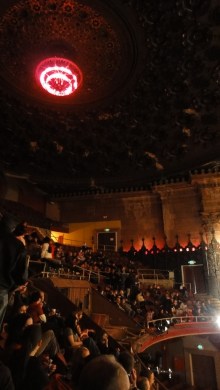
Interior of LA’s Million Dollar Theater, by Flickr user Omar Bárcena (CC BY-NC 2.0)
CC: Inside, it was thrilling to soak in the collective affect: ecstatic applause that filled the cavernous space as well as sniffles, sobs, and laughter during certain scenes but looking back, I would’ve preferred a more intimate viewing experience. The attendees around us came in late, talked, and checked their social media throughout the movie (yes, actually). Director Barry Jenkins did say during the Q&A afterwards that it was the largest viewing audience in North America, so perhaps a little chaos is to be expected! Of course, the major selling point of the event for my group was the live orchestral accompaniment to the film. We were up in the nose-bleeds, though, so we struggled to notice when the orchestra kicked in. We also couldn’t see the pit from our seats, and tended to just assume they were playing when there were strings in the film score. So to us, the orchestra was a bit of a non-event.
SH: I was down on the floor with the orchestra and could see the pit fairly well, but I completely get your point. Taken with a scene, I would often forget about the live music until movement in the pit would attract my eye, which was always slightly jarring in a really meaningful way. We forget about the work of folks whose labor provides the musical idiom of film we simply expect to be there. Frankly, it was always with a bit of guilt that I would be brought to remembrance of the presence of the musicians who were that critical contribution to the experience I was having.
CC: You’re so right! It’s interesting that to get the effect, there had to be a visual accompaniment, which speaks to both our ocular-centrism and how we’ve been conditioned to take (sound) labor in film for granted. I also recall Jenkins giving a shoutout to the sound engineer for rigging a custom sound system in the theater space in order for the film sound and orchestral sound to work together properly. He was really gracious in pointing out the unseen labor that you mentioned.
SH: So I’d like your thoughts on that opening scene which features extended Liberty City street dialect.
CC: KPCC’s John Horn, the host of the post-screening discussion with the cast and crew (Barry Jenkins, Nicholas Britell, Mahershala Ali, Naomie Harris, Ashton Sanders, and Trevante Rhodes), asked a question about the “Liberty City dialect” in the opening scene of the film. His question assumed that “we” couldn’t understand the dialect of that scene, when clearly, his use of “we” assumes a lot about the audience—I’m sure there were folks in the crowd that could understand perfectly what was going on!

Two young boys from Umojaa Village, Liberty City, Miami, 2003, image by Flicker User danny.hammontree, (CC BY-NC-ND 2.0)
I wasn’t one of them, unfortunately, but I was drawn to the politics of that move. The refusal to translate, and the insistence on the authenticity of that voice, which necessarily separates a particular portion of the audience because of knowledge they don’t have, and often are comfortable having. Jenkins also talked at length about the specificity of time and place too. He insisted on representing Liberty City in all its particularities and refused the notion of Moonlight’s wide or universal intelligibility or relatability.
SH: Right. He was very clear about his determination to tell one specific story. Now, on one level, I see it, I get it, and I applaud it. However, on another level, I know that narratives are successful only to the degree that they mine a set of specifics to unearth truths that are universal. I think I’d be hard put to find anyone who would argue against the statement that even in the specificity which Jenkins rightly champions, Moonlight is deeply informed by a powerful universal quality.

Ashton Sanders as Chiron, screen capture from Moonlight trailer by JS
CC: And both Ali and Sanders said during the discussion that they felt their embodiment of their respective characters was meant to be relatable to a wide audience. At the same time, Jenkins added that he hoped his method of narrative specificity would inspire other marginalized people to go out and do the same for their own stories, so perhaps he’s more concerned with universal methods than narrative details.
I’m only realizing now that the film just does so damn much, based on how the actors and director imagine their art reaching out to various audiences. One of the most immediate ways is through the use of diverse musical signposts. Others have commented on the gorgeous Barbara Lewis track “Hello Stranger” that Kevin plays on the diner jukebox, (and we could certainly spend all day jumping into the rabbit holes that all the disparate songs on the soundtrack take us to), but I wanted to ask if you had any thoughts on the use of the classic Mexican huapango song “Cucurrucucú Paloma.”
SH: Yes, I did. In a rather convoluted way, I connected that song to the character of Juan, so I’ll back my way into my thinking. The character of Juan is a very special character for me. I don’t think I’ve come across another like him; in fact, I see him as a new type: a trans-American father figure of the African diaspora. Juan is a Cuban native and thus functions as a reach-out to–a gesture towards, a signifier of—Cuba, of course, and, by extension, the rest of the Caribbean, which are American locations not typically identified by their Americanness. I see that Mexican track, “Cucurrucucu Paloma,” as an extension, not of Juan precisely, but of his function. This song is a reach-out to Mexico as another American location that is typically not acknowledged as American. In all truth, it is often imagined and imaged as distinctly anti-American. Through these reach-outs, both characterological and musical, this film initiates a conversation between the U.S. and other parts of the Americas which have been figuratively lopped off from their American identities simply because they fall outside of the United States, which is now almost singularly synonymous with America.
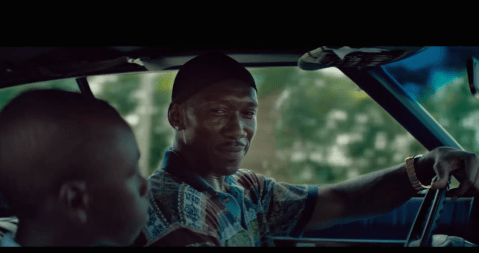
(l-r) Alex Hibbert as Little and Mahershala Ali as Juan, screen capture of Moonlight trailer by JS
Another layer to this, of course, is that the film makes these reach-outs to different parts of the Americas in the specific context of New World blackness, which automatically invokes the slavery which once covered the Americas and produced the enduringly racist economic and social structures from which Juan, Black, and entire communities like Liberty City are largely excluded.
CC: The film is definitely able to telescope some of most intimate and specific concerns into the widest transnational frames. It’s also interesting that we took different things from Jenkins’ use of that song. I didn’t recognize it during the film, but there was a familiarity to the subdued arrangement. My friend mentioned after that it was the same version by the Brazilian composer and singer Caetano Veloso that Wong Kar-Wai uses in Happy Together (1997) (Jenkins has elsewhere talked at length about the influence of Wong), a film about the fraught relationship between two gay Hong Kong Chinese men living in Argentina.
For Wong, the song, mixed with the sound of crashing water from Iguazu Falls in Argentina, signals characters in the midst of a crumbling relationship reaching back to happier times. In Moonlight, it works in a parallel manner, as an affective and sonic cue that envelops Black and Kevin in the very moment of living a future happy memory: the act of reuniting as adults and cruising around their hometown. The sonic touchstone of “Cucurrucucú Paloma” injects a sense of cosmopolitanism in Happy Together, which opens with shots of the lovers’ passports, but does so referentially in Moonlight through its gesture to global cinema.
SH: Precisely. The reach-outs, as we’re calling them, add such depth and such complex meaning to this film in so many different directions. They are in large measure directly responsible for this film’s richness and importance and intellectual and emotional heft. The film redounds with the boundary-shattering cosmopolitanism you mention because it is obsessed with the ways in which entities and forms which don’t typically speak to one another can be placed in conversation with one another and thus enabled to reach conversance with one of another.
Cinematically, as you mention, this U.S. film, overarching in its Americanness, speaks directly to those of Wong Kar-wai musically, visually, thematically, narratively. This thread of conversation and conversance, operative in so many ways and on so many levels, cannot be overstated.
Characterologically, this happens in all of the film’s main relationships but most significantly between Black and Kevin, whose relationship is always characterized by both speech and silence, which serve as conduits for the conversance, or intimacy, they share.
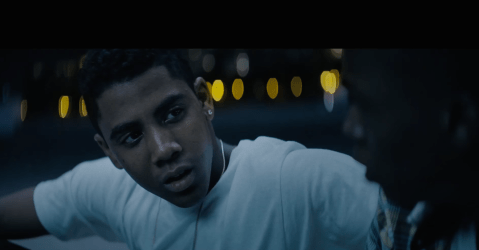
(l-r) Jharrel Jerome as Kevin and Ashton Sanders as Chiron, Screen capture from Moonlight trailer by SO! ed JS
CC: Yes! I love your reading of silence as a form of intimate conversance. It’s such a great way to think about how both people and cultures, putatively “worlds apart,” are in fact always talking to one another. I’ve also seen some writing on the prominent use of classical music, some of which suggested its “incongruousness” to the story, which I’m sure are based in part on problematic assumptions and associations.
SH: Right. There is a decidedly poignant conversation between this black, male, gay, urban narrative and orchestral music, which is a noteworthy choice. And yes, there are other musical genres represented in the film, but Jenkins seems especially to venerate orchestral music above the other genres. I mean, he did single it out for the live music screening, which necessarily raises its profile above the hip-hop, the R&B, the huapango.
In fact, in the wake of the special screening, those other genres, though important, might be interpreted as intervening on or interrupting the ongoing, and seemingly more important, conversation underway between the black, male, gay, urban narrative and orchestral music. In this context, we might see the prominence of the classical music as a rhetorical bid for the inclusion of this black, male, gay story in a distinctly white, Western cultural canon—not as a quest for whiteness per se but rather as a quest for the ontological normativity which whiteness has long enjoyed.
Perfectly supporting, perhaps even enabling, this conversation between this narrative and classical music is the very telling–quite political, really–application of the “chopped-and- screwed” mixing technique to the classical music in the score. That orchestral music, which is generally perceived as the music of the white elite classes–music, which, even when it is composed and produced in the US, still reads as distinctly European in origin and orientation–should be handled in the same way as the chopped-and-screwed masterpieces of people such as DJ Screw, OG Ron C, and Swishahouse, is more than just a little funny. It is deliciously subversive and, given the political moment, downright democratic and egalitarian.
In a piece for SO, Kemi Adeyemi discusses how the technique was created in Houston by the late DJ Screw in the latter years of the 20th century as a sonic representation of the “loosened, detached body-feeling” of the (black male) body under the influence of the substance lean. Adeyemi explains how lean, a mixture of codeine and sweet soda or juice, has become a chief coping mechanism especially of hip-hop-identified black males trapped in their unrelenting contention with aggressive racist assault that is usually directly responsible for their premature deaths via what Adeyemi identifies as the “discursive entanglements of race, labor, and drugs…in the neoliberal state.”
The “chop” part of chopping and screwing involves adding rhythmic breaks of repetition into a song, hearkening back to the turntable mixing of classic hip-hop. Playing off of Adeyemi’s analysis, I read this chopping as auditory representation of the inescapability of the pace of modern life, particularly the beat of life in a lethally racist context that will not be denied. The “screw” aspect involves the slowing of the song’s overall tempo, which transmogrifies the original track into a plea for more time just to be and for more space to be unmoored from all the dangers poised to assail the black body.
Dave Tomkins, in a piece for mtv.com, quotes composer Nicholas Britell who wonders at the seeming magic of chopping and screwing to “open up all these new harmonics and textures…[and also to] stretch and widen out” phrases and words, enabling the listener to “marinate in the words more.” Britell notes that chopping and screwing the orchestral music of Moonlight’s score produced similar effects, explaining, “The same thing happens for the music, when it goes into those lower-frequency ranges. The sound becomes a feeling.” Tomkins points out that the “feeling” is often one of dread or coming doom that is distinctly black, male and urban, which dovetails Adeyimi’s discussion of chopping and screwing’s origins and cultural context. The film, then, forces the Eurocentric elite into conversance with blackness that is also gay, urban, Southern, hip-hop-identified, and beset by a range of lethal pressures.
Moreover, the orchestral music, in its chopped-and-screwed state, becomes a critical conveyance of deep meaning of the narrative. In the January 10th post-screening discussion, Britell emphasized how chopping and screwing produced “those lower-frequency ranges” by dropping the pitches of each instrument so that each was made to sound like another, deeper, more resonant one. This sonic masking speaks directly to the film’s central issues of voice, true identity, and intimacy.
Discussion between director Barry Jenkins and composer Nicholas Britell discussing “chopping and screwing” the score of Moonlight (starts at 4:10).
CC: The selection and transformation of music in Moonlight is definitely doing something to challenge all sorts of normative assumptions. And not just cultural assumptions either but our understanding of the experience of music and film altogether. Jenkins said in a separate discussion that the insertion of silence/music reflects Chiron’s consciousness, what he calls the “cogno-dissonance” of being Chiron. The idea of turning inward in the face of trauma was important to Jenkins. He and the sound crew apparently used surround sound and played with mixing to unbalance the audience’s sonic perception as a way to simulate this experience of trauma, which I think may have been less apparent in this particular theater setup. The thoughtful play on the phenomenology of sound shows us that music, at least in the Moonlight universe, is the substance of life.
SH: Yes. Music in this film is of the utmost importance, making direct and often very strong comment on every aspect of modern life, even to the point of marking trauma by speaking the unspeakable. As we’ve discussed before, various musical genres are put to the task of translating, interpreting, expressing life and its traumas.
However, there is one genre that is quite noticeably absent from this film. The absolute avoidance of the black church and its music is striking and lands a deft blow to a site within African American culture that has been stridently anti-gay despite its own embrace of rich, abundant LGBTQ artistic and cultural contribution. The reproach is so fierce, the black church is not allowed to exist in the film even on the plane of the lamest obligatory church tropes with which we are all too familiar. There is no Sunday service, no booming, looming vestmented preacher, no hymn-humming, Scripture-quoting grandma—not even a religious crisis set to a chopped-and-screwed Mahalia Jackson or Clara Ward track. The closest we get to religion is the swimming lesson as Juan, the trans-American father of the African diaspora, baptizes Little in the waters of the Middle Passage and teaches him how to survive in them. The context here is much more cultural and historical than it is religious. This thoroughgoing circumvention of the black church and gospel music in a film that traffics in reach-outs connotes nothing less than obdurate, unreprievable censure.

Hibbert as Little and Ali as Juan, Screen capture from Moonlight trailer by SO! ed JS
CC: This avoidance is especially interesting in light of the long history of gospel influence in the artistry of founding Black queer artists like Little Richard and Sister Rosetta Tharpe. And the exclusion of the Black church and its sonic registers interacts provocatively with the foregrounding of hip hop in Black’s arc since that genre has been characterized in some quarters as homophobic (though that critique can be reductive and itself plagued by racialized stereotyping).
SH: And in some instances, it has been homophobic, though that seems to be changing with the times and their increasing embrace of both the black secularism and the openness towards diverse black sexualities which Moonlight celebrates.
CC: So, what do you think you will remember most about this night, and this singular performance?
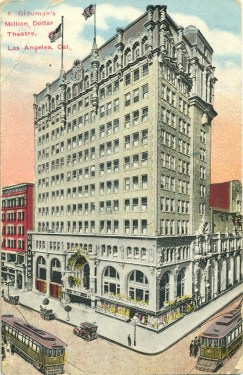
Vintage Postcard of Grauman’s Million Dollar Theatre, Downtown Los Angeles, which opened in 1918.
SH: This night is one that I think I’ll always love and remember for many reasons–the moody weather, the dinner beforehand with my old friend, Dr. Ruth Blandon, the buzzing excitement of the crowds, our spotting the amazing Mahershala Ali seated just across the aisle from us, the tour de force film, the panel discussion afterwards–but perhaps one of the greatest reasons will be that sense of overwhelming connection I felt that night. It was simply electric. I don’t know about you, but I felt deeply connected to the city itself that night, to Los Angeles–especially old, historic, LA, the LA that my grandmother moved to as a five-year old back in 1940. My grandmother will be 82 this coming September, so she’s still very much here in the flesh, but I felt especially close to her, or really, to what I imagine was her five-year old self. Thinking about her precipitated a connection to that old theatre. I wondered how many times she had been there, or knowing her penchant for mischief, how many times she had snuck in.
And then, in a more diffuse but not less important way, I felt a kinship with all the strangers in the theatre, gathered there that evening for a single purpose. So it is fitting to me that an event celebrating a film which devotes itself so thoroughly to “reach-outs,” as we’ve called them here, to these critical, radical conversations in pursuit of conversance, would have also so generously provided me an opportunity to experience my own, very personal reach-outs and connections. What about you?
CC: Absolutely agreed. I don’t have as much of a connection to this city as you, being part of the dreaded transplant-class, but it speaks to the power of events such as this that I feel it more. There’s something to our exchange, too, that speaks not only to the importance of the film, but also, in this time of threatened funding to the arts, the critical nature of collective enjoyment and, indeed, production of daring new art by queer people of color.
The film reaches out and touches folks who don’t often get that experience and there’s no better example of this than the closing sequence. The film ends with Black talking to Kevin about the absence of intimate touch in his life and then a moment of the beautiful silent conversance that you pointed out earlier. The parting shot is of the most tender contact, over which we hear the sound of crashing waves. This visual-sonic collage suggests that the act of gay black men touching is elemental, almost tectonic—at once basal but also a force of nature; at once deeply individual (the actual final image is a dive inward, of young Chiron looking back at us from a darkened beach), but also an image of ceaseless, living tenderness, like the rolling waves on the Liberty City shores. I think the two thousand people in the room that night, both of us included, however differently we may all have perceived it, felt that touch.

Miami Beach, Image by Flickr User Beaster 725, (CC BY-NC-ND 2.0)
—
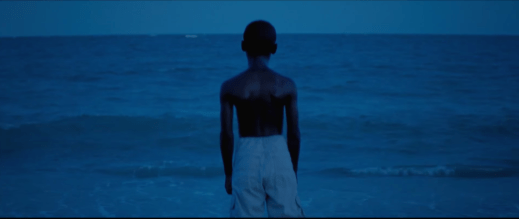
Featured Image: Screen capture of Alex Hibbert as Little from Moonlight Trailer by JS
—
 REWIND!…If you liked this post, you may also dig:
Fade to Black, Old Sport: How Hip Hop Amplifies Baz Luhrmann’s The Great Gatsby– Regina Bradley
Quiet on the Set?: The Artist and the Sound of a Silent Resurgence– April Miller
Sonic Connections: Listening for Indigenous Landscapes in Kent Mackenzie’s The Exiles–Laura Sachiko Fujikawa
Enacting Queer Listening, or When Anzaldúa Laughs–Maria Chaves Daza
Share this:

Sonic Connections: Listening for Indigenous Landscapes in Kent Mackenzie’s The Exiles

DOI: https://doi.org/10.59350/dxhjn-03j69
In April 2015, ten American Indian extras walked off the set of Adam Sandler’s new film The Ridiculous Six, a spoof on the classic Magnificent Seven (1960), in protest over the gross misrepresentation of Native cultures in general, and in particular over its insults to women and elders. Allison Young, a Navajo actress who participated in walking off, stated, “Nothing has changed. We are still just Hollywood Indians.” Young is referencing a long history of the film industries’ construction of stereotypical American Indians by non-natives created to entertain non-natives.
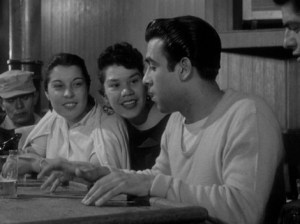
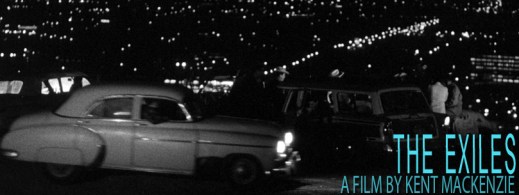
Within this long history exists a rare film, Kent Mackenzie’s 1961 The Exiles, re-restored and re-released in 2008 by Milestone Films. The Exiles is one of the few 20th century films that feature urban American Indians; it follows three main Native narrators from dusk to dawn as they experience the joys and struggles of urban life. Without an official score, this black and white docudrama places sound against haunting 35 millimeter black-and-white images of a downtown Los Angeles landscape. This mis-en-scène creates what Mackenzie (the white screenwriter, director and producer) asserts is “the authentic account of 12 hours.” The voiceovers of Homer Nish, a Hualipai from Valentine, Arizona who recently moved to Los Angeles after fighting in the Korean War; Yvonne Walker, originally from the White River Apache reservation in San Carlos, Arizona who first moved to the city to work as a domestic; and Tommy Reynolds, who is identified only as Mexican-Indian and is portrayed as a comedic playboy and the life of the party; narrate the intimate, day-to-day lives of urban American Indians.
In this post, I consider what we can hear if we pay close attention to how the director incorporates the narrators in a kind of Indigenous soundscape. Mackenzie’s soundscape bring together voices as well as music. The collage of sounds traces the journeys of American Indians to and from Los Angeles in the mid-twentieth century. The sonic connections in The Exiles provide a cacophony of histories of forced movement, transit, and re-making spaces as Indigenous at the same time that it perpetuates important historical silences. I borrow Chickasaw scholar Jodi A. Byrd’s term from The Transit of Empire: Indigenous Critiques of Colonialism (2011), cacophony—or “discordant and competing representations” and experiences— and apply it to the sounds that inform the indigenous space represented through the film.
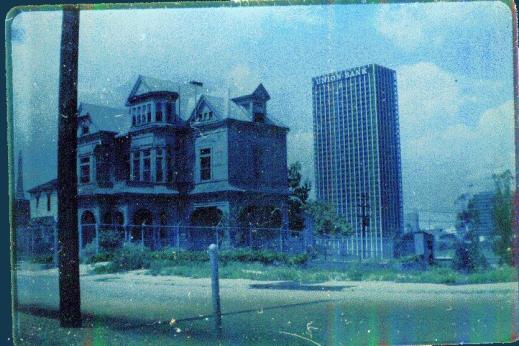
The narrators are part of a large population of American Indians who moved from rural reservations to urban centers after WWII. Due to the federal government’s mismanagement of Native tribes’ land and resources, and the genocidal abandonment of treaties made with tribes, the late 1950s and 1960s were times of dire economic and social conditions on reservations. The influx of Native Americans to cities also came because of assimilation campaigns in boarding schools, military service and the Bureau of Indian Affairs’ “Termination Era” policies (1940s –1960s) that intended to terminate the state’s bureaucratic relationships with Native tribes. Relocating Native populations from reservations into cities where work was available year-round was a key aspect of the Termination Era policies. According to Norman Klein (The History of Forgetting: Los Angeles and the Erasure of Memory), areas near downtown Los Angeles, including Bunker Hill where the film is primarily shot, were multi-racial neighborhoods in economic decline and therefore became relocation sites for American Indians. Importantly, both Klein and Mackenzie are silent about the prior forced removal of Tongva on that very same location that began in the 1840s.
The audio track of The Exiles contradicts the stereotypical American Indian sounds featured in Hollywood movies. The film’s contemporary mainstream Hollywood releases included sounds such as the whooping sounds of “hostile Indians” in John Ford’s The Searchers (1956), the broken English spoken by the “Apache” in Delmer Daves’ Broken Arrow (1950), and stereotypes played out in John Sturges’ Magnificent Seven (1960). In the soft Southwestern Native lilt of Yvonne’s voice, the way that Homer and others add “you know?” to the end of almost every sentence they utter, alongside the rhythm of the casual banter and tenor of the men’s laughter, I hear a potential sonic archive of American Indians that talks back. For example, in a short clip when Tommy and his friends enter Café Ritz, an Indian bar, Thomas calls out over the loud rock and roll music as he passes people at the bar. Tommy shifts easily between English (“What’s happening there, man?”), Spanish (“Gracias amigo, ¿cómo estas?”), and Dine (“Yá’át’ééh. E la na tte?”). Careful attention to the cinematic soundscape provides access to voices of discontent and resiliency, practices of building and maintaining multilingual multi-tribal Indian spaces, and the flow of American Indians between reservations and multiple cities.
Understanding the sounds and the silences of The Exiles as a cacophony offers a way to appreciate how the film both perpetuates stereotypes but also provides insights into the urban American Indian experience. Mackenzie’s construction of Homer Nish and American Indian men continues a myth that it is individualized behavior that keeps Indians from the American Dream. (In his 1964 masters thesis, “A Description and Examination of the Production of The Exiles: A Film of the Actual Lives of a Group of Young American Indians” Mackenzie states outright that he believes they are responsible for the mess they created). The Exiles portrays American Indian men reading comic books, listening to rock and roll, hanging out at bars instead of working, and taking rent money away from their suffering women and children to gamble. These formulaic images of Native Americans are informed by a long history of visual, literary and legal representations of American Indians that compose Indian men as either savage, infantile and emasculated. But if we listen to the banter and laughter in the bar scenes and at home, we also hear the caring intimacy of camaradrie. The cacophony of sound provides a counterbalance to the visual representations.
The Voiceover and Realism
Mackenzie uses dialogue to direct the visual and sonic narrative of the docudrama’s soundscape. Ironically, this collaborative low budget project that stretched on for three and a half years has minimal original dialogue. They could not afford sound techs on site, so the most obvious sonic evocation of realism Mackenzie explores is asynchronous sound performed in a studio months later. In Mackenzie’s master’s thesis he writes that, to construct dialogues (they often voiced their lines with a group of people around), “people would joke around a lot” while “everybody was drinking beer” (76). The filmmaker did not find that dialogue on larger budget feature films at the time were “lifelike” and believable. He writes that people
seldom spoke of important matters directly; they seldom spoke clearly or coherently when they did speak and their everyday language was full of overlaps interruption and communications through looks, gestures and shrugs. Many sentences made the end understood. …What a person said seemed less important than how he said it. (73)
Here, it becomes clear that the “realism” Mackenzie pursues is more about a style of filmmaking rather than about an authentic rendering of Native American everyday life. If he found the actors performing lines too dramatically Mackenzie states he “would blow the scene apart by asking for more casual and apparently pointless lines” (73). He created a specially mediated recording of the people, downtown Los Angeles and the time period. In other words, he pursued realism: he did not seek to fully capture real experiences.

Through interviews he guides the actors to talk about their everyday lives, their problems and their thoughts about life. Mackenzie used “improvised tracks” out of individual interviews in an attempt “to help preserve their point of view in the film.” He interviewed Homer, Tommy and Yvonne for several hours apiece, questioning and re-questioning them – not necessarily to document the subjects’ truths but “for emotional quality and general attitudes and feelings” (78). Despite his intentions, the voiceovers provide some context of the trials of everyday life and how the leads negotiated their belonging in a space far from home. Mackenzie’s realism builds a collage of soundscapes—voiceovers, background noise, music—to orchestrate a scene rather than simply document part of a 12-hour period of life.
Rock and Roll and Urban Indian Sounds
Mainstream “Hollywood Indians” are associated with a limited soundscape of drums and whoops, but Mackenzie’s use of contemporary rock and roll illustrates the complexity of the indigenous soundscape. Even though the film opens with the slow repetitive beating of the buckskin drums and a contextual opening monologue, after the drums stop it is the early surf music of Anthony Hilder and his five-piece band, The Revels, that drive many of the scenes. The music renders audible the many ways people tried to belong in new locations and within new cultures, juxtaposing the fast blast of the trumpet and guitar riffs of the Revels with the steady beat of the drum and shake of a turtle rattle.
Mackenzie continues this juxtaposition later in the film. Homer, alone on the street in front of a liquor store, opens a letter a bartender handed to him earlier in the evening. At the top of the letter is written “Peach Springs, Arizona” and tucked within the letter is a picture of an older man and woman. The camera focuses on the picture that dissolves and reemerges as a rural desert scene. The man from the picture sits beneath a tree with a girl and the woman, and rhythmically chants and shakes a rattle. There is no voice-over or dialogue; ceremonial singer Jacinto Valenzuela’s repeats a song multiple times without an English translation. The steady rattle of the dry seeds in the gourd are a sharp contrast to the pace of the Revels’ songs that saturates Homer’s earlier scenes.
Without guidance from a narrator, the scene is left to audience interpretation. The scene and its sounds could represent Homer’s sense of being displaced between times, or a homesick romanticized remembrance of family life: the moment quickly dissipates and Homer once again stands alone on a corner bathed in the streetlight. However, the music here could be a sonic connection that provides an alternative geography of indigenous space and place. Mackenzie’s collage of sound echoes the circuitous path of indigenous bodies and ideas of indigenous life in diasporas described in Winnebago Tribe of Nebraska scholar Renya Ramirez’s work in Native Hubs: Culture, Community, and Belonging in Silicon Valley and Beyond. The rattle and drum can instead signal a belonging to a community and people in a present that Homer carries within him. Through sound, Mackenzie connects Homer with his communities, traditions, and a sense of belonging regardless of spatial distance.
Mackenzie deepens this connection when he imbeds Homer in a place and community through the dancing and drumming on Hill X in the penultimate scene of the film sounds. When Homer talks about Hill X (formerly Chavez Ravine, then a site of the forced displacement of Mexican residents in Los Angeles in 1950-1952, now the site of Dodger Stadium) we hear his strategy for his own and his tribe’s collective survival. The shaking of the gourd in the desert and the dancing, singing and drumming of the 49 —lead by Mescalero singers Eddie Sunrise Gallerito and his twin cousins Frankie Red Elk and Chris Surefoot—shows a reclaiming of Los Angeles as indigenous land. Thus practices of sound and movement function as what Tonawanda Seneca scholar Mishuanna Goeman identifies as “remapping” of Indian space. Taken together with the beat of the drum, the bells and rock and roll compose the content of a Los Angeles indigenous soundscape.

The Exiles registers contemporary American Indians in motion. Homer and his comrades reclaim Hill X as Indian land with song and dance over a century after the City of Los Angeles displaced the Tongva out of that same location. At the time of the filming, American Indians were also forced to move within Los Angeles- their homes on Bunker Hill soon demolished and replaced by high rises. Paying attention and critically re-listening to the sounds of The Exiles offers an alternative soundscape of Indigenous life.
−
Featured image: “chavez ravine” by Flickr user Paul Narvaez, CC BY-NC 2.0
−
Laura Sachiko Fugikawa holds a doctoral degree in American Studies and Ethnicity with a certificate in Gender Studies from the University of Southern California. Currently she is working on her book, Displacements: The Cultural Politics of Relocation, and teaches Asian American Studies at Northwestern University.
−

REWIND! . . .If you liked this post, you may also dig:
Sounding Out! Podcast #40: Linguicide, Indigenous Community and the Search for Lost Sounds–Marcella Ernst
The “Tribal Drum” of Radio: Gathering Together the Archive of American Indian Radio–Josh Garrett Davis
Vocal Gender and the Gendered Soundscape: At the Intersection of Gender Studies and Sound Studies–Christine Ehrick
—
Share this:




Current Top Posts





April 2021

January 2020

November 2019

October 2019

August 2019

April 2014

November 2017

March 2015

December 2017

October 2015


Recent Comments