
Resounding Silence and Soundless Surveillance, From TMZ Elevator to Beyoncé and Back Again
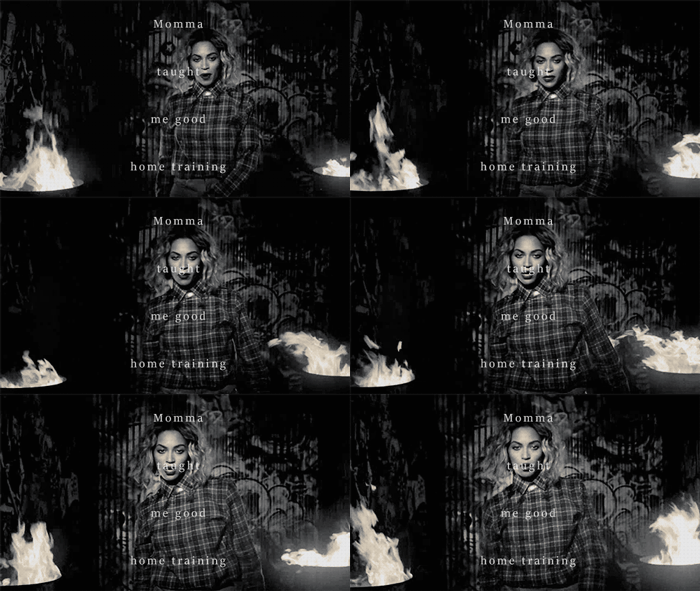
 This September, Sounding Out! challenged a #flawless group of scholars and critics to give Beyoncé Knowles-Carter a close listen, re-examining the complex relationship between her audio and visuals and amplifying what goes unheard, even as her every move–whether on MTV or in that damn elevator–faces intense scrutiny. Last Monday, you heard from Kevin Allred (Women and Gender Studies, Rutgers) who read Beyoncé’s track “No Angel” against the New York Times’ reference to Michael Brown as #noangel. You will also hear from Liana Silva (Editor, Women in Higher Education, Managing Editor, Sounding Out!), Regina Bradley (writer, scholar, and freelance researcher of African American Life and Culture), and Madison Moore (Research Associate in the Department of English at King’s College, University of London and author of How to Be Beyoncé). Today, Priscilla Peña Ovalle (English, University of Oregon) gives us full Beyoncé realness, from TMZ Elevator to Beyoncé and Back Again,–Editor-in-Chief Jennifer Stoever
—
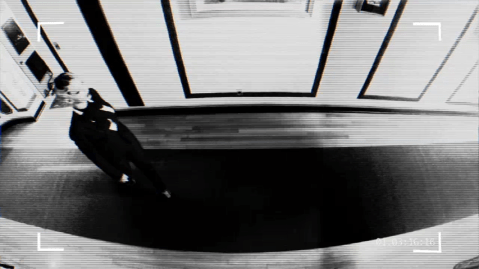
Less than six months after Beyoncé released Beyoncé, she was momentarily silenced on the small screen when the gossip site TMZ released silent elevator security footage of a fight between her famous husband and sister. Doubly framed by the black and white of a surveillance video screen surreptitiously captured on a security guard’s camera-phone, the video’s silence left plenty of room for speculation. But the footage also revealed a woman conscious that her life is on record: Beyoncé’s body seemed to elude the camera’s full view and she emerged from the elevator with a camera-ready smile.
Like Kevin Allred in his powerful reading of “No Angel,” I could not help but rethink Beyoncé in the wake of Michael Brown’s murder. I already read Beyoncé as a sophisticated response to the visual and aural policing of black female bodies, but the closed-circuit images of Beyoncé on TMZ (and in Beyoncé) made me reconsider silence as a damning convention of video surveillance; like Aaron Trammell in “Video Gaming and the Sonic Feedback of Surveillance,” I questioned (the lack of) sound as a technique of control. When the camera-phone recording of Kajieme Powell’s murder, photographed and narrated by a community member in real-time, was released with silent surveillance footage of the alleged theft, my appreciation of Beyoncé—as a response to those silent damnations—took a new turn.

“Resounding Silence and Surveillance” argues that Beyoncé returns the media’s visual-aural gaze. Because of its pop package, the album’s artistic composition and socio-cultural merit are often underestimated. Like the silence of surveillance footage, omitting any one sensory element from Beyoncé distorts the holistic meaning. To untangle this critically complex interplay of audio and video, I analyze the visualized song “Haunted” and briefly address the single “***Flawless” to show how the artist’s triple consciousness anchors Beyoncé. She is on to us: Beyoncé is the culmination of an artist who has spent her career watching us watch her. Temporarily silenced by footage that she could not control, Beyoncé resounds that “elevator incident”—and our sonic/optic perceptions of her feminism—with a flawless remix.
“I see music. It’s more than just what I hear,” declares Beyoncé. Her voiceover runs over the black screen that opens the promotional video “Self-Titled.” Released the same day Beyoncé premiered on iTunes, “Self-Titled” directs audiences to “see the whole vision of the album.” By design, Beyoncé is an immersive experience—like watching Michael Jackson’s “Thriller” as a television event on MTV.
Because Beyoncé was born the same year the cable music channel MTV premiered, she has never known a world without the ability to “see music.” In many ways, her visual album reinvigorates the early spirit of MTV: after Beyoncé, we will “never look at music the same way again.” Though music videos exacerbate the pop single obsession that Beyoncé explicitly resists with Beyoncé, they also produce a unique kinetic connection with the listener-viewer, whose experience of sound is visually registered by the body as it processes shots and edits. This is especially true when strong imagery, rhythmic editing, and dance movements are expertly employed, as in Beyoncé.
Beyoncé deftly critiques the beauty and music/media industries that have been central to her pop success. If taken piecemeal, these critiques can be easily dismissed: the sustained gloss of her image works all too well. There is much to say on a video-by-video basis, but I focus here on the specific aural elements of “Haunted” that articulate Beyoncé’s refusal of the music industry’s status quo. This visualized rejection reveals the layers of racism and sexism that nonwhite female artists (even Beyoncé, even today) must negotiate.
Because of my personal and professional interest in music videos, I consumed Beyoncé as she intended: a sequence of MPEG-4 videos rather than AAC audio files. But it was not until I solely listened to the album that I could discern Beyoncé’s maturation as a black female multimedia pop/culture artist. One refrain from “Haunted” was especially effective:
I know if I’m onto you, I’m onto you/ Onto you, you must be on to me
The song’s ethereal quality is amplified by Boots (Jordy Asher), one of Beyoncé’s (then-unknown) collaborators with whom she shares “Haunted”’s writing and producing credit. The track builds slowly, supporting Beyoncé’s “stream of consciousness” delivery with layers of reverberation and waves of synth sounds like “Soundtrack” or the Roland TR-808 kick drum. Punches of bass accelerate the beat until Beyoncé riffs her explicit desire to create something more than a product:
The music winds to a halt, but the song is not over. Breathy, reverberating vocals transition the track and a piano is delicately introduced:
It’s what you do, it’s what you see
I know if I’m haunting you, you must be haunting me
It’s where we go, it’s where we’ll be
I know if I’m onto you, I’m onto you
Onto you, you must be on to me
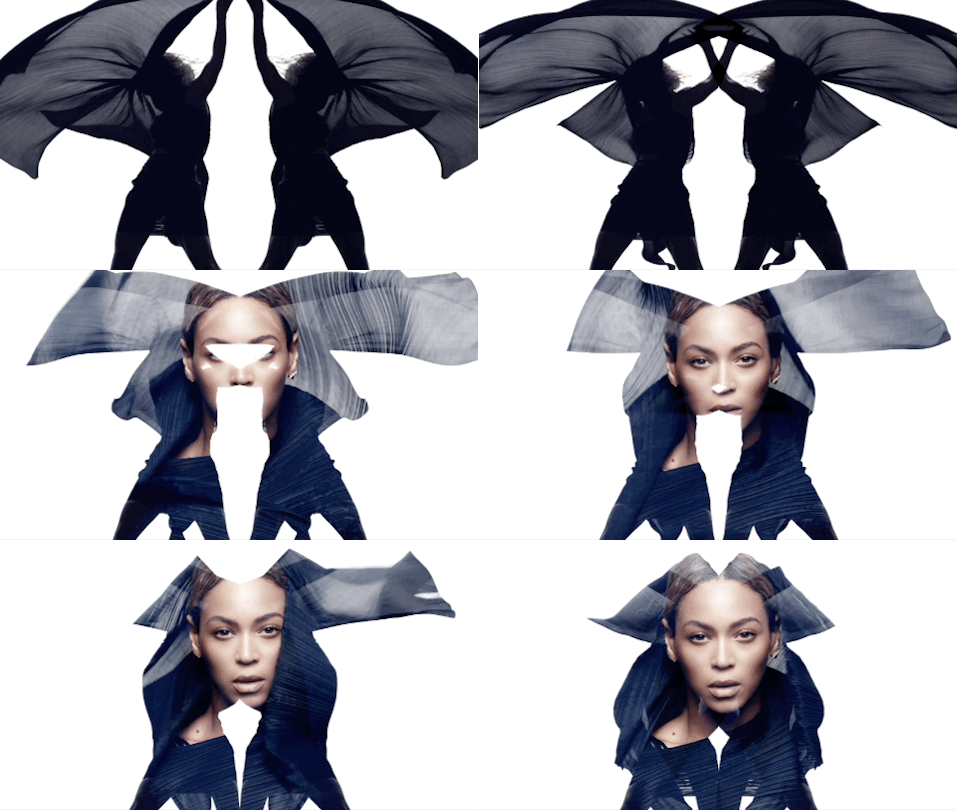
 At this point, the song “Haunted” is split into two videos: “Ghost” (directed by Pierre Debusschere) and “Haunted” (directed by Jonas Åkerlund). The videos’ visual differences exemplify the various points of view—from active subject to object of desire and back again—employed across Beyoncé. “Ghost”’s hypnotic visuals underscore the song’s sentiments: close-ups of Beyoncé’s immaculately lit visage soberly mouthing lyrics are intercut with medium shots of her still body swathed in floating fabric and wide shots of her athletic movements against sparse backgrounds. The ar/rhythmic cuts of “Ghost” enunciate an artistic dissatisfaction with the industry: visuals build against/with the synthetic beat, mixing Beyoncé’s kinetically intense movements with her deadpan delivery.
 The fiery agency of “Ghost” sets up the chill of “Haunted,” a voyeuristic tour in which Beyoncé watches and is watched. The “knowing-ness” of her breathy refrain (“I know if I’m haunting you”) is heightened when the tempo accelerates in the song’s second half. There is much to say about “Haunted”—from the interracial family of atomic bomb mannequins to Beyoncé’s writhing boudoir choreography. Most significantly, she is the video’s voyeur and object of surveillance: her face appears on multiple television screens and her voyeur-character is regularly captured on closed-circuit footage. The “Haunted” video soundtrack features the foley and stinger sounds of a horror film, but these surveillance shots feature the low whirr of a film projector rather than silence. The silence of a moving image is so jarring that it compels us to watch differently, so much so that “silent” film scenes utilize a recorded sound of “nothing” (“room tone”) to focus the audience.
When Beyoncé finally resounded the silence of the “elevator incident,” she chose to do it through “***Flawless,” her explicit response to anti-feminist accusations. While the multifaceted anthem gained attention because of Chimamanda Ngozi Adichie’s audio, the song is uniquely infused with a kind of docu-visuality thanks to Ed McMahon’s well-known voice and the Star Search jingle. These bookends cite a young Beyoncé losing to an all-male rock band, the kind heavily programmed during MTV’s early days. The clips reinforce the album’s critique of racial and gender hierarchies while questioning the double-edged “work ethic” required to surpass them. Of course, Beyoncé pre-emptively frames this discussion for us in “Self-Titled,” a necessary step that helps audiences appreciate the many moving parts of her tour de force, including her creative business mind.So when Beyoncé swapped the audio of Adichie and McMahon for Nicki Minaj, it was no less of a feminist move. Instead, Beyoncé silences TMZ gawkers:
Of course sometimes shit go down/
When it’s a billion dollars on an elevator
She then offers herself as a medium of empowerment. Beyoncé may be part of a billion-dollar empire, but she willingly shares that pleasure with us:
I wake up looking this good
And I wouldn’t change it if I could
(If I could, if I, if I, could)
And you can say what you want, I’m the shit
(What you want I’m the shit, I’m the shit)
(I’m the shit, I’m the shit, I’m the shit)
I want everyone to feel like this tonight
God damn, God damn, God damn!
Beyoncé’s last word is an image. She and her creative team remixed the visuals of the “elevator incident”: the remix single website features black and white photos of Beyoncé and Minaj, simultaneously evoking surveillance footage and the photo booth images of a girls’ night out. Beyoncé is the work of an artist who has spent her career watching us watch her: this minor moment exemplifies Beyoncé’s multimedia resonance as an artist whose power is visible and audible across iTunes and TMZ screens alike.

Beyoncé and Nicki Minaj mugging for the camera
Thanks to Elizabeth Peterson, Charise Cheney, Loren Kajikawa, André Sirois and Jennifer Stoever for providing research and intellectual support for this essay
Priscilla Peña Ovalle is the Associate Director of the Cinema Studies Program at the University of Oregon. After studying film and interactive media production at Emerson College, she received her PhD from the University of Southern California School of Cinema-Television while collaborating with the Labyrinth Project at the Annenberg Center for Communication. She has written on MTV, Jennifer Lopez, and Beyoncé. Her book, Dance and the Hollywood Latina: Race, Sex, and Stardom (Rutgers University Press, 2011), addresses the symbolic connection between dance and the racialized sexuality of Latinas in popular culture. Her next research project explores the historical, industrial, and cultural function of hair in mainstream film and television. You can find her work in American Quarterly, Theatre Journal, and Women & Performance.
—
 REWIND!…If you liked this post, check out:
Aurally Other: Rita Moreno and the Articulation of “Latina-ness”-Priscilla Peña Ovalle
Music Meant to Make You Move: Considering the Aural Kinesthetic–Imani Kai Johnson
Karaoke and Ventriloquism: Echoes and Divergences–Sarah Kessler and Karen Tongson
Share this:

New Wave Saved My Life*
*The title of this piece is inspired by the short story, “Minnie Riperton Saved My Life,” by the poet & playwright, Luis Alfaro.
(Shuffle)
I watch you breathe,
I cannot sleep,
I touch your hair,
I kiss your skin,
And hope the morning sun won’t wake you too soon.
For when you wake,
and look at me,
You never know,
you just might see,
Another boy who crept in your room…
Take your time…(that’s what you told me),
Take your time…
But I fell head first, and I just don’t know what to do—“Nothing Looks the Same in the Light,” Wham!
I was a teenager in the 80’s. I grew up in South East Los Angeles, Huntington Park, to be exact, H.P. for short—home of the Huntington Park Senior High Spartans and the local after game hangout, Spartan Burgers. In those years, almost everyone in my school was Mexican and most kids were either preppy or cholos or Florentine Gardens disco-types—almost no one was “alternative.” That is, until we caught our first glimpse of Boy George on Video One with Richard Blade – that MTV style video show that came before MTV. If you remember, or have YouTubed it recently, a key scene in the video for Culture Club’s “Do You Really Want to Hurt Me?” begins with Boy George stepping out of a swimming pool, fully clothed and dry (a lo-tech effect even by 80’s standards), wearing a flowing tunic, white-boy dreadlocks, and expertly applied makeup. I remember being instantly fascinated watching him dance to a reggae beat and hearing him sing so longingly about a mysterious “you.” I had never seen anyone who looked or sounded like that before, and I went from listening to my brothers’ heavy metal records, my mom’s cumbias, and my grandpa’s Beethovens to listening to Culture Club, Eurythmics, Wham!, and Bow Wow Wow almost overnight.
Soon after, I started noticing in my neighborhood sprinklings of pink, purple and green hair, spikey egg white mohawks, brown boys in skirts and makeup, and the girls from St. Mathias High wearing black chunky combat boots with their proper, pleated, Catholic school uniforms–my personal favorite look. And when I bought my very own first pair of 8-hole lace-up Doc Marten’s, I was forever transformed. I sensed that crossing fashion lines somehow meant crossing other lines too, although, I was perhaps I bit too young to really cross anything. As a questioning adolescent, I embraced the freedom that music, fashion, and expression represented. It’s strange to think about how such a global phenomenon took shape in my little eastside town. That time of 80’s new wave, the “Second British Invasion,” told me something about who I would become. I learned fearlessness from the bold and transgressive acts of fashion and wit my favorite gender bending pop stars regularly deployed on American network TV. And I learned to “tune in” to the sexually ambiguous language of songs like “Time Clock of the Heart” or “Nothing Looks the Same in the Light.” All of those blurred lines felt “normal” to me. And it meant later on that I didn’t have to have an identity crisis when I was coming out. And I really didn’t. I didn’t really think about “identity” in this way again until much later.
(Shuffle)
I’m only sad in a natural way
And I enjoy sometimes feeling this way
The gift you gave is desire
The match that started my fire—“The Paris Match,” The Style Council
As I copy and sometimes re-purchase 25-year old lost albums for my new e-music library, I’ve started to wonder about some of my musical choices. Why did I still like what I liked? How do I trace my musical habitus? Culture Club, George Michael, The Style Council – they’re all on my iPod right now. And I ask myself, is my musical taste really so wrapped up in what I perceived to be my pop idols’ alternative sexuality so long ago? In this post-gender, post-queer, post-race (rhetorically speaking), trans-border era, is there even such a thing as “alternative” anymore?
Because when I listen to those old songs now, part of me still “hears” the skillful crossing of gender lines in every ambiguously phrased lyric, like the Pet Shop Boys’ clever line, “Which do you choose, a hard of soft option?” And I recall vivid images of Annie Lennox at once crossing and keeping those lines in the video for “Who’s That Girl?” which ends with an impossibly queer kiss. (She queered the Lacanian mirror long before Black Swan!) I still sense how all of these wildly public expressions of queer desire, with all of its spectacle and taboo, flowed into my childhood home through the sturdy Zenith television set that brought us together to “listen” to music anew. And this kind of hearing has to do with a particular way of remembering my adolescence – the memory of how felt for the first time to hear those songs and see the images of Boy George winking his long painted lashes at the video camera, seriously putting pressure on the word “Boy”; or seeing George Michael dancing with Andrew Ridgley in the macho ditty “Wham Rap”, their two beautiful and stylish female band mates conspicuously superfluous in that dance. And also remembering how the combined effect put something like the question about boys on hold for me in a really powerful way. There were options out there, is what I understood, and that was all I needed to survive – to save my queer soul.
(Shuffle)
Don’t make me feel any colder
Time is like a clock in my heart
Touch we touch, was the heat too much?
I felt I lost you from the start
In time it could have been so much more
The time is precious I know
In time it could have been so much more
The time has nothing to show because
Time won’t give me time
And time makes lovers feel like they’ve got something real
But you and me we know they’ve got nothing but time–“Time Clock of the Heart,” Culture Club
But I also detect another kind of crossing, or rather, multiple crossings in those same songs. Somewhere between the funk inspired bass line of “Nothing Looks the Same in the Light” and the soulful oohs and ahs of Helen Terry’s backup vocals in “Time Clock of the Heart,” I sense this music also crossed a race and a class line, however precariously treaded. From the perspective of a young, working class Chicana, quickly interested in all things British and gay, it seemed to me that these young white British boys took up a mic and pen and left their own working class accents behind for the promise of America. Clearly raised on a diet of soul and R&B, their eventual collaborations with Luther Vandross, Stevie Wonder, and Mary J. Blige – American musical royalty – seemed only natural on the Grammy stage. And I wondered in my youthful, pop star fantasies, how did they feel when they learned they could sing like that? What did it mean to be queer and black at the same time? Musically speaking. What was the bigger transgression? Because the 80’s were deadly years for many of us, on both sides of the Atlantic, who were confronted with the authority of the lines drawn by Reagan, Thatcher, and AIDS. Maybe the transgression is to survive. And to remember.
Listening as an adult now to George Michael’s greatest hits collection Twenty Five, it is easy to see that there is no longer any doubt about his sexual orientation. In songs like “An Easier Affair,” he celebrates that he’s “dancing with the freaks now/I’m having so much fun/I do my dance with everyone.” So I wonder, when your pop idols sex lives stop being curiosities or taboo, what still fascinates? Even their notorious falls from grace, and their celebrated “come backs” didn’t really provoke the public imagination in the same way again. But I detect there are still clues in the music. In his brilliant cover of “Feeling Good,” George Michael pays humble homage to Nina Simone saying: “It’s a new day, it’s a new dawn, it’s a new life, it’s a new low/Oh we all know it’s too much to expect a man, a white man, to do it like Nina” (my emphasis). That simple musical gesture, a crossing of many sorts, tells me something about what she means to him. And I think that it has ever been and ever will be music that will save our collective souls… I was seventeen when I left HP for a much larger Los Angeles. In some ways I was too young to leave home and sometimes I thought that I didn’t survive some things that came my way. But I always had a song to guide me and show me something new–a different way. I know I’ll never fully rebuild my archive on something like iTunes. But as I contemplate my growing digital library, I really do believe that new wave saved my life.
(Shuffle)


Share this:


Current Top Posts





April 2021

January 2020

November 2019

October 2019

August 2019

April 2014

November 2017

March 2015

December 2017

October 2015
 Sounding Out!
Recent Comments