
Cardi B: Bringing the Cold and Sexy to Hip Hop
 In “Asesina,” Darell opens the track shouting “Everybody go to the discotek,” a call for listeners to respond to the catchy beat and come dance. In this series on rap in Spanish and Sound Studies, we’re calling you out to the dance floor…and we have plenty to say about it. Your playlist will not sound the same after we’re through.
Throughout January, we will explore what Spanish rap has to say on the dance floor, in our cars, and through our headsets. We’ll read about trap in Cuba and about Latinx identity in Australia. And because no forum on Spanish rap is complete without a mixtape, we’ll close out our forum on Thursday with a free playlist for our readers. Today we continue No Pare, Sigue Sigue: Spanish Rap & Sound Studies with Ashley Luthers’ essay on femme sexuality in Cardi B’s music.
Liana M. Silva, forum editor
—
“Ran down on that bitch twice” was all I heard in this tight, dark basement filled with black and brown bodies, sweat dripping everywhere from everyone. Girls danced all over, yelling and shouting lyrics as they clapped and pointed along to the fast, upbeat rhythm of the song, feeling their own sensations and pleasure from the vibe, and rapping with the catchiness of the repeated phrase, “Ran down on that bitch twice!” As everyone was jumping, the space around me shook because there was so much body movement and flow; it was lit. This wasn’t the first time I heard Cardi B, but dancing along to her song “Foreva” was definitely the first I remember hearing her. Since that dark basement party, I realized that the attitude and energy Cardi B invokes through her raps and lyrics is addicting.
Listening repeatedly to “Foreva,” and the rest of her debut mixtape Gangsta Bitch Music Vol.1, has attuned me to Cardi B as a stone cold, gangster bitch: someone who is fearless, tough on the outside and inside. She doesn’t hesitate; she doesn’t bluff. She gets straight to the point and lets you know that she will fuck you up if and when necessary. A ‘G’ she is, as some would say when describing a person who shows no fear and is always hustling—except that someone is imagined as a black male from the so-called ‘hood who affiliates with drugs, gangs, etc. The music itself reflects this gangster feel, through the hard trap sounds and beats in every track. Trap music as a style and subset of Hip-Hop, and arguably a genre on its own, originated in Atlanta, and has over time become mainstream all across the U.S. specifically within the Northeast region. Within Cardi’s performed, stone cold bitch lyrical persona, she embodies an aggressive femme sexuality, a racialized femme hunger for sex with black men, and an emotional depth that makes her endearing to listeners. Her embodiment of this multiplicity—stone cold attitude, femme sexual thirst, and emotional complexity—can be heard in her music, through the explosion of beats, rhythms, and lyrics that keep listeners hooked to the sound of her self-image. In other words, Cardi B’s sonic and lyrical movements work in tandem with her audio-visual construction of black, Caribbean, Bronx femme desire.
Nowadays this audio-visual construction is visible across her music and social media, but I want to focus on the image of her debut mixtape cover, Gangsta Bitch Music, Vol.1. This image hailed me and continues to hold me in thrall after lengthy meditations on it. In it, Cardi B sits in the backseat of a car, high-rise apartments peering through the back window, with her legs spread wide open. Between her legs, a big, black, faceless, tatted man gives her head as she casually drinks her Corona. The man’s back sprawls in the place where we might imagine Cardi B’s junk/pussy; he’s her bitch. The audacity of displaying her desire mid-sex-act intrigues me and does more than merely assert black femme sexual desire. The media blew up when Nicki Minaj did her lollipop photoshoot in which her legs are wide open, and her crotch is heavily exposed. But Cardi B’s mixtape cover has a different impact, because of the positioning of its vulgarity and audacity.

I’ve seen pictures of Nicki Minaj and Lil’ Kim where they’re half naked, open to giving men pleasure, and completely distorting the expectation of respectable black women to cover their bodies and assets. But what makes Cardi’s mixtape visual different even from Lil’ Kim’s and Minaj’s visual constructions is that it shouts power from the position often occupied by cis-male desire. Cardi B is seizing her own sexual power and gangster agency while she asserts her business hustle from the seated position of power that is often assumed by cis-male gangster rappers and performers. In the angle and composition of the mixtape image, we, as viewers, are positioned to look up at her as we witness her experiencing pleasure. She’s above us, and her chosen sexual object, who is a big black man, a figure whose masculinity is historically challenged by normative and respectability-obsessed society, and who is historically susceptible to being emasculated, is situated beneath her: there’s a troubling of power’s embodiment, specifically through sex, in this image. She’s visually insisting on getting play.

I connect Gangsta Bitch Mixtape Vol. 1’s cover image to the sounds, vibes, and lyrics of Cardi B’s tracks within the mixtape. In “Foreva,” for example, she raps, “Silly muthafucka who raised you/ a nigga with a pussy how disgraceful.” It’s at this point that we realize that the “bitch” that she “ran down on,” “twice,” is also a dude. In the lyrics, she alternates between beefing with trifling chicks and dudes; for Cardi, bitches breach a gender dyad. She raps from a masculine position as a femme, which ultimately illustrates her mixtape cover’s reversal of who is in the receptive and dominant position of sexual power. In “Foreva,” she’s talking down on black men the same way that most of these men speak on black women in the Hip-Hop industry. Cardi twists the normative misogyny and disrespect that is often demonstrated towards black women in Hip-Hop and instead uses that towards apostrophic black men. The lyrics of “Foreva” and the Gangsta Bitch mixtape cover both sustain this idea of Cardi B working within masculine tropes as a woman in the industry. On the mixtape cover, she is the one who is receiving pleasure, instead of giving it to a man. Lyrically and physically, she’s in a place where she’s on top, looking down on her subject/object of sexual desire, and inviting her audience to watch.
Sonically, “Foreva” and other tracks fits within the genre of trap music. Many of the songs in the mixtape have aggressive beats. The genre is characterized by a deep, hard mood created by the fast beat: Justin Burton describes it as “one of the most iconic sonic elements of trap is the rattling hihat, cruising through subdivisions of the beat at inhuman rates.” This is what we hear and feel from Cardi’s music itself. Specifically, the BPM for “Foreva” is 161 which fits into the range of typical Trap music. The way she sounds is what she embodies. The flow of “Foreva” tells us as listeners that Cardi B isn’t here to play and she damn sure won’t let anybody stop her from making her money. The rest of the music on the mixtape takes a similar route, in that these crisp rhythms speak to her power, her urban upbringing, coming from the Bronx, and her days as a stripper. She owns her sexuality and claims it through the music. The cover reflects this: she is poised and looking directly at us, her stone-cold persona manifested in how she also appears utterly unbothered by you, us, looking at her, looking at us.
Cardi B’s a freak. Clearly. (As if we didn’t know this.) But the way she visually and sonically expresses her sexual yearning is more complicated than the word freak can capture. The thing with Cardi B is, she’s not afraid. In fact, she doesn’t care about respectability. Even when she raps about making money or callin’ shots on someone, she never hesitates to slide in something sex-related because she knows she’s good at getting and giving play, both sexually and musically: “Fuck him so good he gonna want to spend all that/ Pussy got him on the jugg he gonna re-up and come right back.” If you read the lyrics from “With That,” you could think the lyrical subject is a male rapper, like trap’s Future or Gucci Mane. In fact, this song is a remake from Young Thug’s “With That,” which comes from his album Barter 6. Young Thug is one of the big faces in the Atlanta Trap music scene and his track “With That” reflects the life of a rapper like him. Poppin pills, stacking money tall, Thug knows he’s killing the game and shitting on these other rappers with his sounds–Cardi B echoes that bravado in her remake.
Drugs, sex, money, hustle: Cardi B, in a way, replicates the masculine attachment to these tropes. But we are not listening to an abstract, masculinist lyrical subject on her mixtape; we are listening to a black femme subject. So, this goes beyond ‘replication’, as we may wonder whether it has ever historically not been the case in the Americas that black women also had to hustle, grind, find stimulation to escape normative constraints, and take care of their sexual desires. Which is to say, black men are not the OG hustlers; arguably, black women are, and Cardi B channels that historical force in her audio-visual construction of a stone-cold bitch who knows how to get play, and still have feelings in a hatin’ ass world.
We’re introduced to this hard, stone cold Cardi B inside and outside of her music’s lyrics as she repeatedly performs that she is not at all ashamed of the fact that she used to be stripper, aka, someone who hustles hard. Her choice of the trap genre, as a black Latina, acknowledges the existence of that hustle theme within it—even honors it. Her refusal of shame and respectability affects that take a specific toll on black women in the Americas, circles me back to the welcoming aura she displays on the mixtape cover. She wants viewers to see her in her happy place; she wants us listeners to hear how good she is in bed; she wants the world to know she’s a freak. This is her way of fucking with the mythical construction of masculinity in Hip-Hop where cis-men are the most badass, aka, the “most political” subjects; she acts on her own urges and desires, which does a lot more than just show femme as “sexy.” She’s sexy and she’s cold and so is her music too: the kick drums, synth lines, and hihats make her sonically ominous and cold.

In one of Cardi B’s latest tracks, “Money,” I still hear echoes of “Foreva,” but I’m hearing so much more. I find myself paying as much attention to the audio as to the visual constructions that Cardi B’s generous yet cutting aesthetic offers: in the cover image for “Money,” we see her naked body, positioned in a way that shows off her peacock thigh tattoo, suggesting but keeping her junk from you. She’s wearing a plethora of gold watches, almost as if they’re long-sleeve gloves, and a gold hat, the shape of which channels both Beyoncé’s in “Formation” and Jeffery’s (aka, Young Thug) on the cover of Jeffery. Unlike the cover of the first mixtape, Cardi does not give us her hair in this image, and she does not give us her gaze; while she directs her face at the camera, the hat dripping with diamonds conceals her hair and her eyes from us—or, she is giving her gaze to herself, to the inward rewards of her hustle. The ice is cold, but the image is warm as a swarm of gold bling and golden light surrounds her.
Lyrically, on “Money,” she’s doing what she does best, rapping about her hustle, her money, and still managing to throw in a little something about her love for sex. Sonically, this is pure trap. We hear an orchestration of keyboards, brass, and drums. As for us, listening viewers, we not only consume her music, but also continue to take in everything Cardi B has to offer because it fascinates and pleases us. She returns our pleasure (in her pleasure) to us, and nothing less than that.
—
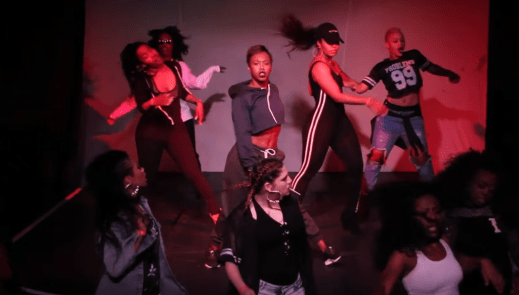
Featured Image: Still from “Cardi B ‘Foreva’ (Live) Choreography By- Hollywood”
—
Ashley Luthers is currently a Senior at Wesleyan University studying English and Economics. She has spent the past year researching and studying Cardi B inside and outside of the classroom. Her final senior essay revolves around Cardi B as a black femme artist in Hip-Hop through an analysis of different theories surrounding the black female body.
—
 REWIND! . . .If you liked this post, you may also dig:
“The (Magic) Upper Room: Sonic Pleasure Politics in Southern Hip Hop“–Regina Bradley
“What Feels Good to Me: Extra-Verbal Vocal Sounds and Sonic Pleasure in Black Femme Pop Music” -Robin James
“I Love to Praise His Name”: Shouting as Feminine Disruption, Public Ecstasy, and Audio-Visual Pleasure–Shakira Holt
Share this:

Ghosts in the Machine: Sampling Dr. King

Education is never politically neutral. Many of us advocate for social justice when we’re outside of the classroom but struggle to continue that work inside as well, especially with issues that appear on the surface largely unrelated to our disciplines. This inaction maintains the centering of the white experience, continuing to normalize and prioritize it at the expense of all others. Marginalized voices remain marginalized. We don’t need our own students to be directly impacted by policies to advocate on behalf of those who are. This is work we all must do.

“New Orleans Street Musicians …” by Flickr user sswj, CC BY-NC-ND 2.0
While social issues have made important inroads within musicology and ethnomusicology, they rarely make an appearance in music theory or composition, especially in a classroom setting. To begin these conversations, we must expand the scope beyond the purely technical and examine the ways in which music is a social and cultural phenomenon. Understanding how a triad functions, for example, is only part of the story. We must also recognize that any musical activity involves a network of people who might be engaged in any combination of producing, performing, buying, selling, listening, analyzing, teaching, institutionalizing, and so on. Discussing these networks means discussing their persistent systemic inequalities and power differentials, and understanding that these are social and not just musical issues. Cultivating this awareness is crucial in the development of our students as critical thinkers who can question the society in which they live, who can locate injustice and fight to advance social good. Abstract music theory is important, but music theory combined with a social awareness is vital.
Georgetown University hosts an annual Let Freedom Ring! initiative, a recurring project to honor the legacy of Dr. Martin Luther King. “Teach The Speech,” in particular, is a cross-campus curriculum project where interested faculty and staff incorporate that year’s selected work by Dr. King in our courses and workshops, sparking campus-wide conversations rooted in themes of social justice. The first time I joined the “Teach the Speech” efforts, I redesigned my basic theory class to include guiding principles from King’s entire body of work. In addition to covering the expected chords, scales, and other technical material, we discussed the disparity in representation faced by women and POC within music, viable modes of protest in music, and the possible roles of government sponsorship and censorship of artists. We rooted these issues in the real-life examples of the Grammy’s, the Women’s March, and the threats by the Trump administration to cut funding to the NEA and the NEH. Final projects based on these bigger-picture topics provided students further opportunity to reflect on the ways in which these and similar topics manifest in their own lives, transcending a preoccupation with “notes on a page.”

“Free at Last” by Flickr user Thomas Hawk, CC BY-NC 2.0
My second time participating in the “Teach the Speech” initiative, I used a recording of Dr. King delivering “I Have Been to The Mountaintop” as part of a module on sampling for my DJing and production class. Students had to create short tracks using this recording as the only permissible sound source. Anything resembling a kick, snare, hi-hat, melody, or harmony had to be constructed from a sample. Using something we don’t typically consider to be music as the sound source for creating music demonstrates the power of the studio and illustrates just how far creative slicing, dicing, and processing can take us. Beyond these important practical applications, though, the use of speech provides us with a framework for discussing why context matters. Do context and history always travel alongside the immediate acoustic phenomenon of sound? Can we identify something as “the music itself”? Through wrestling with these and related questions, students begin to understand sample-based composition as both a musical and a moral undertaking.
The process of sampling is largely a process of curation, involving a responsibility not just for the product but also for the source. If a student chooses to sample a large-enough portion of Dr. King’s speech, so that one can recognize words, phrases, even full sentences, then her choice includes the layers of extra-musical meaning attached to those words in addition to their musical qualities. “Violence,” for example, has a particular sonic profile and meaning that most listeners understand. How we actually interpret this word depends on many factors, including the context in which it is used in the original source, the identity of the speaker, and any audio processing that students might apply. The addition of distortion, for example, will influence the impact of that word on and its reception by the listener. The sampled word might be a fragment of a larger word, “violence” snipped from “nonviolence,” and never appear in its own right in the source. These and other complex issues involved in the process of sampling exist whether or not the student chooses to engage with them.
If the student samples an extremely small fragment of the Dr. King speech, obscuring the source and working with sound on an almost molecular level, then perhaps these questions go away. Can we still discuss the attendant connotations and denotations of indecipherable fractions of words or slices of the ambient hiss between the words? In this situation, is the origin of the sample still relevant for the work being done? When the ties connecting a heavily processed source to the finished product are untraceable, does it matter where we sampled from? Is white noise simply white noise?

“White noise on the Columbia” by Flickr user jaisril, CC BY-NC-ND 2.0
Arriving at these kinds of questions is largely the point of the exercise. With a little deliberation, students realize that there is a very clear distinction between sampling the word “violence” from a speech by Trump and from a speech by MLK. There is a context, a lineage, and a history to samples that lives outside the phenomenon of pure sound, and this holds true even at the molecular level. This is crucial for students to understand, and its implications extend far beyond a music class.

“Pride (In the Name of Love)” by Flickr user T, CC BY-NC-ND 2.0
We can, for example, ask students to consider the related question about whether or not it’s possible to separate art from the artist. Can we ever listen to pre-MAGA Kanye with the same ears? How do we interpret a post-MAGA Kanye song about uplift and resilience? What does it mean to watch a film where Harvey Weinstein had a major role in producing? A minor role? Moral dilemmas form a part of every media interaction we have, and similar questions comprise other aspects of our lives. Can we continue to allow the misappropriation of Dr. King’s “I have a dream that my four little children will one day live in a nation where they will not be judged by the color of their skin, but by the content of their character” without acknowledging the “radical” Dr. King? Can we reconcile a country built on expropriation, slavery, and genocide with one whose propaganda extolls the principles of equality and freedom? These are indeed crucial lines of moral inquiry, and our pretending otherwise enables current systems to remain in place. Sampling King’s speech enables my students to engage with those lines of inquiry from an angle they have not considered before: at the level of sound.
This is work we all must do. Within academia, we need to combat injustice inside the classroom as well as outside to bend the arc of the moral universe toward justice. One way we can engage is through careful attention both to the examples we choose and the way we contextualize them. Students and educators alike need to understand the political nature of education that is too often a means of upholding the power structures within society that position whites at the top, and white males at the very top. These largely invisible systems have very real impacts on our lives, and the only way we can evolve to a more just society is by questioning their seeming inevitability. We must foster dialogue that transcends the classroom. We must engage with social problems. We must look beyond the accumulation of knowledge as an end in itself. We must, in short, to do good. This is work we all must do.
—
Featured image: “Martin Luther King, Jr. Memorial” by Flickr user Cocoabiscuit, CC BY-NC-ND 2.0
—
Dave Molk teaches composition and theory at Georgetown University. He’s close friends with producer Olde Dirty Beathoven, a founding member of District New Music Coalition, and a board member of New Works for Percussion Project. Outside of music, Dave is a leader of CCON, an organization devoted to supporting undocumented communities in higher ed in the DMV. Find him online at https://www.molkmusic.com/ and @DaveMolkMusic.
—
REWIND!…If you liked this post, you may also dig:
A Listening Mind: Sound Learning in a Literature Classroom–Nicole Furlonge
Freedom Back: Sounding Black Feminist History, Courtesy the Artists– Tavia Nyong’o
My Music and My Message is Powerful: It Shouldn’t be Florence Price or “Nothing”–Samantha Ege
Share this:


Current Top Posts





April 2021

January 2020

November 2019

October 2019

August 2019

April 2014

November 2017

March 2015

December 2017

October 2015
 Sounding Out!
Recent Comments