
“I Love to Praise His Name”: Shouting as Feminine Disruption, Public Ecstasy, and Audio-Visual Pleasure
Well, if you don’t believe in shouting,
That’s alright with me
Some folk don’t believe in shouting,
That’s alright with me…
Doubt and ignore it,
But I belong to the Lord’s crew.
David said rejoice in the Lord,
And that’s the way we Christians do.
If you don’t believe in shouting,
That’s alright with me.
–Dorothy Love Coates & the Gospel Harmonettes, “That’s Alright with Me”
A handy catch-all term, “shouting” is actually a euphemism encompassing a range of ecstatic worship behaviors. These can include clapping, dancing, pacing, running, rocking, fainting, as well as using the voice in speaking, singing, laughing, weeping, yelling, and moaning. Certainly, there were men who shouted in the days of my childhood in church; there are men who shout today. The only shouts I can recall and even imitate to this day, however, are those of the women.
There is, in fact, a longstanding association between women and shouting. Perhaps because of the pronounced emotionality involved in the practice, the shouting sphere tends to be prefigured as feminine and in this bears great relevance to women. I am interested in the significances of shouting among black Christian women of struggling populations. In my view, shouting is not only a religious practice for these women, but is also a binary-breaking performance which confounds—if only fleetingly—the divisions which have so often oppressed, menaced, and harmed them. I argue that shouting has worked to codify the disruption of male-dominated services by women who have so often faced sharp sanctions by black church patriarchy. I also contend that shouting places its female practitioners and their observers within a sphere of public ecstasy and visual and auditory pleasure, which makes mischief for notions of what is proper for Christian women and for the entire church community.
.
The Shout, the Sound, and the Shriek: Black Feminine Disruption
In a 2011 post for Sounding Out! entitled “Pentecostal Song, Sound, and Authentic Voices,” Ashon Crawley posits the existence of a black church “public zone,” which serves as the conceptual, holy ground upon which “sound, song, and subject [function] as conduits for the exchange of ecstasy and ecstatics.” I’d like to track Crawley’s public zone into the shouting sphere, the very heart of ecstasy within the black worship experience.
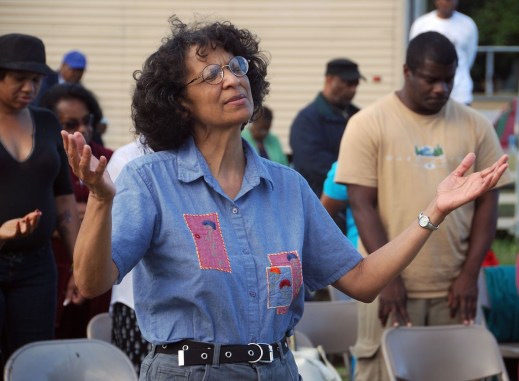
Although culturally codified—even expected and welcomed—within the church community, the shout functions primarily as a disruption. The faces, bodies, and voices of shouting black women disrupt the flow of the service. A shout takes time and has the power to alter the program. Regarding such moments, worshippers—most often women and gay men—often proclaim in retrospect, “Baby, there was no more order!” This disruption of order through the use of the body and the voice has a distinct place within the Christian black feminine tradition of resistance to oppression.

Image by Flickr User Steve Schwartz
In the essay, “The Restorative Power of Sound,” womanist Roxanne Reed has examined the function of gendered sound within black Christianity. For Reed, the feminine “wordless cry, holler, moan, or wail” achieves “primacy over the written text,” “suggests a historical time with relying on a defined chronology,” and is legitimated by an African “ancestral heritage” which presages black musical forms (2). This distinctly feminine worship sound claims space from “patriarchal privilege,” which has often extended to black folk preaching, a tradition which excluded most black women for decades after slavery.
The sound of the black feminine in worship is thus a symbol for black women’s triumph over historically masculine arenas of writing, history, and form. The shout and the gendered worship sound can be placed in critical triangulation with Fred Moten’s “shriek,” as theorized in In the Break (2003) An expression of the distinct suffering of the black female, the shriek is a primal “phono-photo-porno-graphic disruption” of spirit and matter, and other binaries (14). The shout, the feminine worship sound, and the shriek all take center stage as black female performances which disrupt oppressive categories and assert the black woman’s voice as triumphant.
Shouting as Public Ecstasy, Scopophilia, and Sonophilia
Many observers have noted the shout’s resemblance to sexual ecstasy. The shout is often expressed through the sounds, movements, and facial expressions commonly associated with sex. Some shouters close their eyes and moan. Some hug themselves around the waist or bend over the pew in front of them, rubbing their own shoulders, bellies, or thighs. Some roll about the floor, hollering or speaking in tongues. Some whisper His Name, as in closest intimacy to a lover. Some dance with abandon before the altar or in the aisles before collapsing, spent and panting. Some quiver quietly in deepest distraction.
Shouters in the throes of their ecstasy are closely observed by all within the church community. Members of church communities often mark shared remembrances by who shouted, when, and how. Even young children can be called upon to reproduce the shouts of various church members. The conspicuousness of the shout provides reason to consider it as spectacle containing pleasure for both the shouter and those who gaze upon her.
.
Laura Mulvey’s “Visual Pleasure and Narrative Cinema” discusses “scopophilia” as a phenomenon occurring in “circumstances in which looking itself is a source of pleasure, just as, in the reverse formation, there is pleasure in being looked at” (587). In the moment in which a shout goes forth, those shouters who are aware of being watched—not all are—and their gazers may be said to enter into mutual pleasure from being watched and from watching. For the observer, the pleasure arising from the sight-based stimulation is often compounded by the narcissism of the ego which seeks to identify with its source. This may explain why in highly charged church moments, shouts become highly communicable—“thriving in concert,” as Zora Neale Hurston once phrased it. Looking upon another in worship ecstasy can be understood to reinforce one’s own relation to the Holy and to stir desire to engage that relation through shouting.
There is sufficient cause to assign what I call a “sonophilic”aspect to shouting as well, as shouting never fails to take place but within a context of sound. This sonophilic component should be understood as the means by which the sounds of ecstasy coming from a shouter provide stimulation and identification in the listener, who may in turn become a shouter. It must be noted, however, that the sonophilia can emanate from sources other than the shouter. Shouts are often roused by a complex network of sounds. Within a service, preaching and verbal exhortations, prayers, congregational chants and songs, and instrumental music designed to buoy sermonic delivery or to capitalize on swells of emotion often work in tandem to provide the sound-based pleasure essential to shouting.

Image by Flickr User Steve Schwartz
A Final Shout-Out to Shouting
From West Africa to North America, from slavery to emancipation, from the eighteenth century into the present day, the black ecstatic in the form of shouting has served several important purposes for black women. Black women’s general and persistent preoccupation with the relationship between the spiritual and the sensual, the cornerstone of black female intellectualism in my view, was first and foremost expressed in the practice of shouting. The shout can be understood as the primary site upon which black women made the spiritual physical and rendered the sensual holy.
.
Furthermore, in eras in which black women were customarily denied the right to preach and were granted but limited authority within church communities, the shout communicated a woman’s ability to engage the Holy. This proven ability undoubtedly helped to open doors for the thousands of black women who now preach and pastor all over the country. Shouting has also provided much needed relief for the unique pressures of the black female in North America, absorbing and transforming her hurts and frustrations and replacing them, down through the centuries, with the hope and strength vital to her survival.
—
Featured Image Credit: Flickr User Steve Schwartz
—
Shakira Holt is a thirteen-year classroom veteran and currently teaches high school English in Los Angeles County. She earned a doctorate degree in English from the University of Southern California, and works primarily in the area of black women’s literature and culture. She is deeply concerned about the intersections of race, religion, gender, sexuality, class, and politics in the public sphere. She is a lazy poet, a latent novelist, an intermittent blogger, a retired songwriter, and a reluctant karaoke singer. A licensed Baptist minister, she is but slowly working her way back to the pulpit. “I Love to Praise His Name” is her first published piece.
Share this:

Sound and Curation; or, Cruisin’ through the galleries, posing as an audiophiliac

“L.A. Reimagined” by Dalila Paola Mendez (c), Mendez’ work will be featured in re:present LA, opening 5/3/12
But to love this turf is love hard and unrequited.
…
To love L.A. is to love more than a city
It’s to love a language.
–“L.A. Love Cry” (1996) by Wanda Coleman
Los Angeles, an enigmatic metropolis to many who arrive here with a dream in hand and hope for a better tomorrow, still challenges historians, artists, and troubadours on how to best represent it. Poet Wanda Coleman, born in Watts, captures the pain and wonder of loving this city in “L.A. Love Cry.” Because the city is “hard and unrequited” one must also be willing to love its nuances and see it as“more than a city.” To love this city, “it’s to love a language,” a cultural immersion that goes beyond the seeming ease of words into the complexities of sound and rhythm.
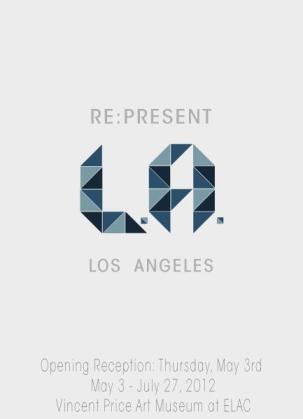
Through a Museum Studies course I teach at Claremont Graduate University entitled Welcome to L.A., I introduce students to varied texts in which scholars and artists challenge the imaginaries created by outsiders, boosters, and apocalyptic cinema. Instead, the course readings present how we in L.A. actively engage with one another by fostering communities of creative praxis. For the students’ final project, they curate and develop educational programming for an exhibition at a local museum or art center. On May 3, 2012, this semester’s project, re : present L.A., opens at the newly-renovated Vincent Price Art Museum (VPAM) located on the East Los Angeles College Campus. Showing works from over thirty artists from May 3-July 27, re : present L.A serves as an extension of the conversations we had in class, not only celebrating the interconnectedness of our communities but encouraging new associations and encounters within the visual and resonant space of VPAM’s Community Focus Gallery. For a look at the Virtual Exhibit Catalogue, click here.
In each exhibition for Welcome to L.A., I try to include something that challenges myself to think outside the white-box, per se, of the gallery. Given that we had read several texts that highlighted in the importance of music to build and uplift communities of color in Los Angeles, it was both important and necessary for me to include sonic elements in re: present LA that exhibits L.A.s vibrant musical legacy as intermingled with and fundamental to its visual culture. Among the challenges to document the cross-cultural connections between ethnic communities in Los Angeles is how to unpack what Anthony Macias calls “the cultural networks” that facilitated these exchanges through the music scenes at music halls, clubs, youth centers and record stores in Mexican American Mojo (10-11). Studies done by George Lipsitz, Macias, and Victor Viesca, provide readers a means to understand how the music in Los Angeles is much more than entertainment; it is political; it is a lifestyle; it defines spaces of multicultural interactions. In How Racism Takes Place, Lipsitz points out how integral the reclamation of space defined the political outlook and music in Horace Tapscott’s Arkestra based in South L.A. Viesca’s research documents the rise of an East L.A. rock sound, post-Los Lobos, that was defined by the activism of the Zapatista Movement and California’s Prop 187 through the work done at the Peace & Justice Center, Self-Help Graphics, and Regeneración.
Therefore, in order to engage both the history and the sound of Los Angeles’s musics with the city’s visual representations, I invited Rubén Funkhuatl Guevara from Ruben & The Jets, is a multi-threat musician, performer, writer, and producer, and Jennifer Stoever-Ackerman (of Binghamton University, Sounding Out!, and of course, Riverside, CA) to curate playlists for a “sound booth,” which will consist of a stationary iPod™ Nano that gallery visitors can use at their leisure. The classic circular wheel allows the viewer to advance tracks or play the playlists on shuffle. Headphones will be set up so that the viewer can either focus on their listening experience or, listen while viewing the artwork around them. Since the gallery is relatively small, the pieces on the opposite wall are recognizable though are distant. In addition, Maya Santos of Form Follows Function will screen their short documentary on Radiotron, a youth center that presented Hip-Hop shows during the 1980s.
Guevara’s playlist Los Angeles Chicano Rock & Roll is included in the exhibition thanks to the Museum of Latin American Art. Stoever-Ackerman’s playlist Off the 60, unites the two spaces of East L.A. and Riverside through a mix of intra- and trans-cultural musical experiences. Guevara’s rock & roll selections highlight many of the bands that emerged in East L.A. Both the musical listings and the liner notes for the sound presentations will be accessible on the re:present L.A website when the exhibit goes live on May 3rd, 2012.

Juan Capistran’s The Breaks (2000), Courtesy of the Artist
.
My sonic intervention in the white, often silent, spaces of the gallery was especially inspired by two recent precedents: the inclusion of the iPod™ in MEX/LA (2011) at the Museum of Latin American Art and Phantom Sightings (2008) at the Los Angeles County Art Museum. Both experiences invited me as a viewer to see the artwork through another sensory experience. The first time I saw music included in an exhibition not specifically about music (such as the Experience Music Project’s 2007 American Sabor: Latinos in U.S. Popular Music, or Marvette Peréz’s curation of ¡Azúzar! The Life and Music of Celia Cruz at the Smithsonian National Museum of American History) was LACMA’s Phantom Sightings, which garnered much critical acclaim and criticism due to the premise of presenting contemporary Chicano Art inspired ‘after’ the Chicano Movement. However, I want to focus on one aspect of the exhibition, a corner display with books that informed the curators’ conceptual approach and on the bookshelf was an iPod™. The iPod™ included playlists from some of the artists reflecting their inspiration for their artwork. I enjoyed listening and reminiscing while sitting in the gallery. However, I wanted the music to take more of a central role in the exhibition, especially because much of the artwork so obviously revealed traces of Los Angeles’ musical influences, partly due to the recent generation of artists who actively engaged in subcultural expressions and referenced it in their art. For example, as Ondine Chavoya describes in the Phantom Sightings catalogue, Juan Capistran’s The Breaks (2000) is a giclée print documenting the artist break-dancing on Carl Andre’s minimalist floor pieces. The guerilla performance then is presented through a series of twenty-five still images showing the various movements seen in how to break-dance books (125). Shizu Saldamando’s ink on fabric portraits of Siouxsie (2005) and Morrissey (2005) showcase how post-punk and new wave music from England is part of her life as an Angeleno (and that of her friends), yet the medium is reminiscent of pinto drawings. Saldamando also does portraits of her friends at clubs, backyard bbqs “documenting a world where identity is fluid” as Michele Urton describes in the catalog (197).

Shizu Saldamando’s Siouxsie (2005), Courtesy of the Artist
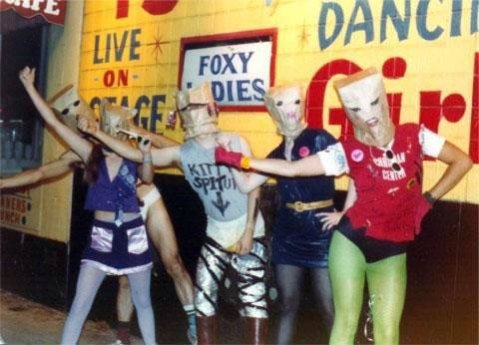
It would be another three years before MEX/LA would further marry music with art, now casting it in relation to the politics of Chicano and Mexican presence in Los Angeles. MEX/LA, among the many Pacific Standard Time exhibitions presented throughout Los Angeles, was among the best curated due to the range of artifacts representative of the city and the cultural production emerging in post-war L.A. Another striking element was the influence of Méxicano popular culture among Chicanos and vice-versa. As curator Rubén Ortiz-Torres, and associate curator Jesse Lerner write on the MoLAA website: “The purpose of the construction of a ‘Mexican’ identity in the South of California is not to consolidate the national unity of a post-revolutionary Mexico, but to recognize and be able to participate in an international reality, with all its contradictions and conflicts that this entails.” One of the ways this cultural exchange was embodied was in the playlists curated by Rubén Funkhuatl Guevara and Josh Kun that were prominently displayed alongside the artwork and heard in the interactive iPod™ “sound booths,” that invited viewers to sit on beanbags and listen. The music served to contextualize the art in relation to popular culture of the time. For example, Guevara presents a Chicano rock & roll genealogy that followed the chronology of the visual exhibit, 1930-1980, that begins with boogaloo and swing of the 1940s era culminating with the punk rock sounds of The Bags.
“Bag Parade,” 1977, Courtesy of Alice Bag
In both these exhibitions, the music served to complement the artistic elucidations of identity, race, and American popular culture seen in much of the artwork. The simplicity of the presentation was due to the inclusion of a familiar object like the iPod™. What is surprising is that more exhibitions have not incorporated more sonic elements to engage viewers’ other sensory experiences beyond the podcasts, or cell-phone audio listening tours set up at most major museums. While musical playlists can serve as another didactic component of an exhibition like the more established audio tours, I am arguing for a different use of sound in museum space, one that provides a wider sense of agency, connection, and encounter with the visual elements on display rather than a one-way transmission of information. In the cases of MEX/LA and Phantom Sightings, the inclusion of iPods™ provided a tool to understand the cultural production of a “post-Chicano movement” generation of artists while at the same time enabling an experience that recognized—and resonated with—my bicultural experience.

“Ancient Mexico in Ancient Mexico” by Yvonne Estrada (c), is featured in re:present LA, opening 5/3/12
Being that L.A. is a car culture moving to the rhythms of the radio waves, I’m always seeking to find synchronicity between music that feels me with joy and my work as a cultural worker. Part of my impetus to locate Los Angeles sonically in re : present L.A. was driven by the question: is it possible to capture my sonic landscape growing up in the city of Los Angeles that ranges from Hip-Hop – British Rock – Mexican Pop? The playlists curated by Guevara and Stoever-Ackerman are familiar to me personally. Stoever-Ackerman’s Off the 60, reminds me of the sounds of my youth, when KDAY and KROQ rocked the radio waves and my students banded together in my high school quad according to their favorite music – metal-heads, b-boys, alternative rock, and the cha-chas, who traveled across town every Friday night to Franklin High, where DJs spun L.A. disco. At home, the music was different. My mom and tías used to reminisce about their homeland every Sunday night through the variety show Siempre en Domingo, binding us to the t.v., religiously following the rising stars. Through the bi-lingual selections in Guevara’s Los Angeles Rock & Roll, there’s a familiarity of home and the music heard at backyard parties and quinceañeras.
By including my iPod™ nano, I bring together my lived experience as a cultural worker through the sounds of L.A. and activate the white walls of the museum. The playlists created by Guevara and Stoever-Ackerman serve to reflect the history of the community surrounding VPAM, as well capture the diversity of the city sonically re:presenting L.A. to our audiences. While the playlists can stand alone as audio curations in their own rights, I hope that they will engage audiences to rethink the relationship between music and art, and feel their lived experience inclusive within the museum.
—-
reina alejandra prado saldivar is an art historian, curator, and an adjunct lecturer in the Social Science Division of Glendale Community College in Glendale, California and in the Cultural Studies Program at Claremont Graduate School. As a cultural activist, she focused her earlier research on Chicano cultural production and the visual arts. Prado is also a poet and performance artist known for her interactive durational work Take a Piece of my Heart as the character Santa Perversa (www.santaperversa.com) and is currently working on her first solo performance entitled Whipped!
Share this:


Current Top Posts





April 2021

January 2020

November 2019

October 2019

August 2019

April 2014

November 2017

March 2015

December 2017

October 2015
 Sounding Out!
Recent Comments