
Mr. and Mrs. Talking Machine: The Euphonia, the Phonograph, and the Gendering of Nineteenth Century Mechanical Speech
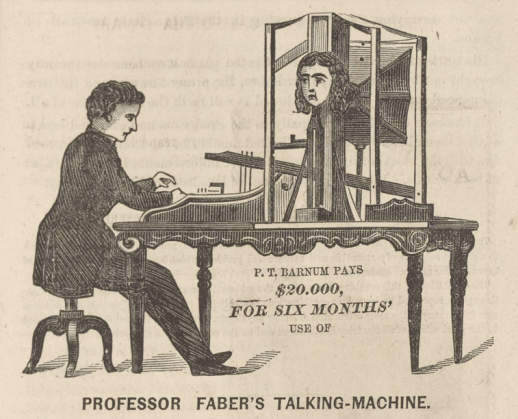
In the early 1870s a talking machine, contrived by the aptly-named Joseph Faber appeared before audiences in the United States. Dubbed the “euphonia” by its inventor, it did not merely record the spoken word and then reproduce it, but actually synthesized speech mechanically. It featured a fantastically complex pneumatic system in which air was pushed by a bellows through a replica of the human speech apparatus, which included a mouth cavity, tongue, palate, jaw and cheeks. To control the machine’s articulation, all of these components were hooked up to a keyboard with seventeen keys— sixteen for various phonemes and one to control the Euphonia’s artificial glottis. Interestingly, the machine’s handler had taken one more step in readying it for the stage, affixing to its front a mannequin. Its audiences in the 1870s found themselves in front of a machine disguised to look like a white European woman.

Unidentified image of Joseph Faber’s Euphonia, public domain. c. 1870
By the end of the decade, however, audiences in the United States and beyond crowded into auditoriums, churches and clubhouses to hear another kind of “talking machine” altogether. In late 1877 Thomas Edison announced his invention of the phonograph, a device capable of capturing the spoken words of subjects and then reproducing them at a later time. The next year the Edison Speaking Phonograph Company sent dozens of exhibitors out from their headquarters in New York to edify and amuse audiences with the new invention. Like Faber before them, the company and its exhibitors anthropomorphized their talking machines, and, while never giving their phonographs hair, clothing or faces, they did forge a remarkably concrete and unanimous understanding of “who” the phonograph was. It was “Mr. Phonograph.”
Why had the Euphonia become female and the phonograph male? In this post, I peel apart some of the entanglements of gender and speech that operated in the Faber Euphonia and the phonograph, paying particular attention to the technological and material circumstances of those entanglements. What I argue is that the materiality of these technologies must itself be taken into account in deciphering the gendered logics brought to bear on the problem of mechanical speech. Put another way, when Faber and Edison mechanically configured their talking machines, they also engineered their uses and their apparent relationships with users. By prescribing the types of relationships the machine would enact with users, they constructed its “ideal” gender in ways that also drew on and reinforced existing assumptions about race and class.
Of course, users could and did adapt talking machines to their own ends. They tinkered with its construction or simply disregarded manufacturers’ prescriptions. The physical design of talking machines as well as the weight of social-sanction threw up non-negligible obstacles to subversive tinkerers and imaginers.
Born in Freiburg, Germany around 1800, Joseph Faber worked as an astronomer at the Vienna Observatory until an infection damaged his eyesight. Forced to find other work, he settled on the unlikely occupation of “tinkerer” and sometime in the 1820s began his quest for perfected mechanical speech. The work was long and arduous, but by no later than 1843 Faber was exhibiting his talking machine on the continent. In 1844 he left Europe to exhibit it in the United States, but in 1846 headed back across the Atlantic for a run at London’s Egyptian Hall.
That Faber conceived of his invention in gendered terms from the outset is reflected in his name for it—“Euphonia”—a designation meaning “pleasant sounding” and whose Latin suffix conspicuously signals a female identity. Interestingly, however, the inventor had not originally designed the machine to look like a woman but, rather, as an exoticized male “Turk.”
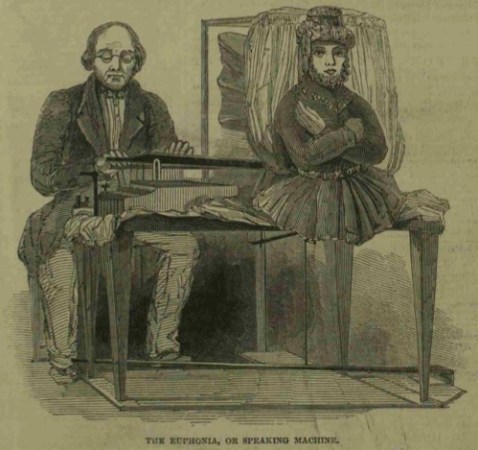
“The Euphonia,” August 8, 1846, Illustrated London News, 96.
A writer for Chambers Edinburgh Journal characterized the mannequin’s original appearance in September of 1846:
The half figure of a man, the size known to artists as kit kat, dressed in Turkish costume, is seen resting, upon the side of a table, surrounded by crimson drapery, with its arms crossed upon its bosom. The body of the figure is dressed in blue merino, its head is surmounted by a Turkish cap, and the lower part of the face is covered with a dense flowing beard, which hangs down so as to conceal some portion of the mechanism contained in the throat.
What to make of Faber’s decision to present his machine as a “Turk?” One answer, though an unsatisfying one is “convention.” One of the most famous automata in history had been the chess-playing Turk constructed by Wolfgang von Kempelen in the eighteenth century. A close student of von Kempelen’s work on talking machines, Faber would almost certainly have been aware of the precedent. In presenting their machines as “Turks,” however, both Faber and Von Kempelen likely sought to harness particular racialized tropes to generate public interest in their machines. Mystery. Magic. Exoticism. Europeans had long attributed these qualities to the lands and peoples of the Near East and it so happened that these racist representations were also highly appealing qualities in a staged spectacle—particularly ones that purported to push the boundaries of science and engineering.
Mysteriousness, however, constituted only one part of a much larger complex of racialized ideas. As Edward Said famously argued in Orientalism Westerners have generally mobilized representations of “the East” in the service of a very specific political-cultural project of self- and other-definition—one in which the exoticized orient invariably absorbs the undesirable second half of a litany of binaries: civilization/barbarism, modernity/backwardness, humanitarianism/cruelty, rationality/irrationality. Salient for present purposes, however is the west’s self-understanding as masculine, in contradistinction to—in Said’s words—the East’s “feminine penetrability, its supine malleability.”
One possible reading of the Faber machine and its mannequin “Turk,” then, would position it as an ersatz woman. A depiction of the Euphonia and its creator, which appeared in the August 8, 1846 Illustrated London News would appear to lend credence to this reading. In it, the Turk, though bearded, features stereotypically “feminine” traits, including soft facial features, smooth complexion and full lips. Similarly, his billowing blouse and turban lend to the Turk a decidedly “un-masculine” air from the standpoint of Victorian sartorial norms. The effect is heightened by the stereotypically “male” depiction of Faber himself in the same illustration. He sits at the Euphonia’s controls, eyes cast down in rapt attention to his task. His brow is wrinkled and his cheeks appear to be covered in stubble. He appears in shirt and jacket—the uniform of the respectable middle-class white European man.
Importantly, the Euphonia’s speech acts did not take place as part of a conversation, but might have been compared to another kind of vocalization altogether. Faber’s manipulation of the Euphonia entailed a strenuous set of activities behind the automaton (though, in truth, off to one side.) Its keyboard kept both of the inventor’s hands occupied at the machine’s “back,” while its foot-operated bellows had to steadily be pumped to produce airflow. Though requiring some imagination, one could imagine Faber and his creation having sex. At least one observer, it seems, did. In an article originally printed in the New York Paper, the author recounted how he “suggested to Mr. F[aber] that the costume and figure had better have been female.” This course of action offered practical mechanical-semiotic advantages “as the bustle would have given a well-placed and ample concealment for all the machinery now disenchantingly placed outside.” To the foregoing the writer added a clause: “—the performer sitting down naturally behind and playing her like a piano.”

Unidentified image of Faber’s Euphonia, public domain. c. 1870. The Euphonia was apparently sometimes exhibited with only the mannequin’s face in place, its body having been dispensed with.
Around 1870 the Euphonia was recast as a woman. By this time Herr Faber had been dead several years and his talking machine had passed on to a relative, also called Joseph, who outsourced the staged operation of the machine to his wife—Maria Faber. The transition from a male mannequin to a female mannequin (as well as the transition from a male operator to a female operator) throws into relief certain wrinkles in the gendered story of the Euphonia. Given that the Euphonia’s vocalizations could be read through the lens of sexualized domination, why had Faber himself not designed the mannequin as a woman in the first place? There are no pat answers. Perhaps the older, bookish, inventor believed the Turk could serve as an object of Western scientific domination without eliciting embarrassing and prurient commentary. Clearly, he underestimated the degree to which the idea of technological mastery already contained sexual overtones.
Little can be said about Joseph Faber’s life and work beyond 1846 though an entry for the inventor in the Biographisches Lexikon des Kaiserthums Österreich claimed that he took his life about 1850. Whatever the truth of Herr Faber’s fate, the Euphonia itself disappeared from public life around this same time and did not resurface for nearly two-and-a-half decades.
On the other hand, the idea of a female-presenting Euphonia, suggested by the New York Paper contributor in 1845, came to fruition as the machine was handed over to a female operator. If audiences imagined the spectacle of Euphonia-operation as a kind of erotic coupling, this new pairing would have been as troubling in its own way as Faber’s relationship to his Turk. What explains, then, the impulse to transition the Euphonia from androgyne to woman? Again, there are no pat answers. One solution to the enigma lies in the counter-factual: Whatever discomfiting sexual possibilities were broached in the Victorian mind by a woman’s mastery over a female automaton would have been greatly amplified by a woman’s mastery over a male one.
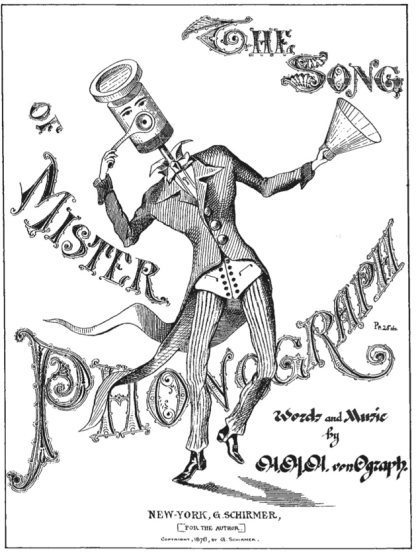
H.H.H. von Ograph “The Song of Mr. Phonograph” (New York: G Shirmer, 1878).
In these early exhibitions, the phonograph became “Mr. Phonograph.” In Chicago, for example, an exhibitor exclaimed “Halloa! Halloa!” into the apparatus before asking “Mr. Phonograph are you there?” “This salutation,” perspicaciously noted an attending Daily Tribune reporter “might have been addressed with great propriety to the ghosts at a spiritual seance…” In San Francisco, an exhibitor opened his demonstration by recording the message “Good morning, Mr. Phonograph.” Taking the bait, a Chronicle reporter described the subsequent playback: “‘Good morning, Mr. Phonograph,’ yelled Mr. Phonograph.”
In Atlanta, the phonograph was summoned “Mr. Phonograph, will you talk?” Mr. Phonograph obliged [“Wonder Agape!,” The Phonograph Puzzling Atlanta’s Citizens.” The Daily Constitution. June 22, 1878, 4]. At some point in 1878 the Edison Speaking Phonograph Company commissioned the printing of a piece of promotional sheet music “The Song of Mr. Phonograph.” The cover art for the song sheet featured a bizarrely anthropomorphized phonograph. The machine’s iron cylinder has been transformed into a head with eyes, while the mouthpiece and recording stylus have migrated outward and are grasped by two human hands. Mr. Phonograph’s attire, however, leaves no doubt as to his gender: He wears a collared shirt, vest, and jacket with long tails above; and stirrupped pants and dress boots below.
[Animal noises–cat, chicken, rooster, cow bird, followed by announcement by unidentified male voice, From UCSB Cylinder Archive]. Mr. Phonograph appealed not only to the professional exhibitors of the 1870s but to other members of the American public as well. One unnamed phonograph enthusiast recorded himself sometime before 1928 imitating the sounds of cats, hens, roosters and crows. Before signing off, he had his own conversation with “Mr. Phonograph.”
To understand the impulse to masculinize the phonograph, one must keep in mind the technology’s concrete mechanical capabilities. Unlike the Euphonia, the phonograph did not have a voice of its own, but could only repeat what was said to it. The men who exhibited the phonograph to a curious public were not able (like the Fabers before them) to sit in detached silence and manually prod their talking machines into talking. They were forced to speak to and with the phonograph. The machine faithfully addressed its handler with just as much (or as little) manly respect as that shown it, and the entire operation suggested to contemporaries the give-and-take of a conversation between equals. Not surprisingly, the phonograph became a man and a properly respectable one at that. Finally, the all-male contingent of exhibitors sent across the United States by the Edison Speaking Phonograph Company in 1878 invariably imparted to their phonographs their own male voices as they put the machine through its paces on stage. This, in itself, encouraged attribution of masculinity to the device.
The Euphonia and the phonograph both “talked.” The phonograph did so in a way mechanically-approximating the idealized bourgeois exchange of ideas and therefore “had” to be male. The Euphonia, on the other hand, spoke only as a function of its physical domination by its handler who wrung words from the instrument as if by torture. The Euphonia, then, “had” to be female.
The talking machines of the late nineteenth century as well as the media technologies that succeeded them emerged from a particular white, male, western and middle class culture.While changing in profound ways since the Victorian period, this culture has remained committed to the values of scientific mastery of nature; racial and gender hierarchies; and, especially, economic accumulation. But because the physical apparatus of talking machines has evolved so dramatically during this same period, it has been necessary to periodically renovate the ontology of mechanical speech in order to make it “safe” for the core values of the culture.
A fuller accounting of the politics of sound reproduction is possible but it depends on a more dynamic rendering of the interplay between practices, technologies and sonic understandings. It requires not only identifying speakers and listeners, but also placing them within the broader networks of people, things and ideas that impart to them moral content. It means attending—no less so than to texts and other representations—to the stories machines themselves tell when they enact the labor of speaking. We should listen to talking machines talking. But we should watch them as well.
—
Featured Image: from William C. Crum, ”Illustrated History of Wild Animals and Other Curiosities Contained in P.T. Barnum’s Great Travelling World’s Fair….” (New York: Wynkoop & Hallenbeck, 1874) 73. This image suggests that the later exhibitors of the Euphonia may have occasionally deviated from the gendered norms established by Joseph Faber, Sr. In image 4, a man—perhaps Joseph, Jr.— operates the Euphonia in its female form.
—
J. Martin Vest holds Bachelors and Masters degrees in History from Virginia Commonwealth University and a PhD in American History from the University of Michigan. His research interests range across the nineteenth and twentieth centuries, and are heavily influenced by the eclecticism and curiosity of working class storytelling. Past projects have explored Southside Virginia’s plank roads; the trope of insanity in American popular music; slavs in the American South; radical individualist “egoism;” twentieth century anarchists and modern “enchantment.” His dissertation, “Vox Machinae: Phonographs and the Birth of Sonic Modernity, 1870-1930,” charts the peculiar evolution of modern ideas about recorded sound, paying particular attention to the role of capitalism and mechanical technology in shaping the things said and believed about the stuff “in the grooves.”
 REWIND!…If you liked this post, you may also dig:
Only the Sound Itself?: Early Radio, Education, and Archives of “No-Sound”–Amanda Keeler
The Magical Post-Horn: A Trip to the BBC Archive Centre in Perivale–Leslie McMurtry
How Svengali Lost His Jewish Accent–Gayle Wald
Share this:

Black Joy: African Diasporic Religious Expression in Popular Culture

 Inspired by the recent Black Perspectives “W.E.B. Du Bois @ 150” Online Forum, SO!’s “W.E.B. Du Bois at 150” amplifies the commemoration of the occasion of the 150th anniversary of Du Bois’s birth in 2018 by examining his all-too-often and all-too-long unacknowledged role in developing, furthering, challenging, and shaping what we now know as “sound studies.”
It has been an abundant decade-plus (!!!) since Alexander Weheliye’s Phonographies “link[ed] the formal structure of W.E.B. Du Bois’s The Souls of Black Folk to the contemporary mixing practices of DJs” (13) and we want to know how folks have thought about and listened with Du Bois in their work in the intervening years. How does Du Bois as DJ remix both the historiography and the contemporary praxis of sound studies? How does attention to Du Bois’s theories of race and sound encourage us to challenge the ways in which white supremacy has historically shaped American institutions, sensory orientations, and fields of study? What new futures emerge when we listen to Du Bois as a thinker and agent of sound?
Over the last two months, we have shared work that reimagines sound studies with Du Bois at the center. Pieces by Phillip Luke Sinitiere, Kristin Moriah, Aaron Carter-Ényì, Austin Richey and Julie Beth Napolin move us toward a decolonized understanding and history of sound studies, showing us how has Du Bois been urging us to attune ourselves to it. To start the series from the beginning, click here.
Readers, today’s post by Vanessa Valdés closes our series: she explores the limits of Du Bois’ echo chamber metaphor within the context of a Black diaspora that looks past the white gaze and within its spiritual practices for recognition.
–Jennifer Lynn Stoever and Liana Silva, Eds.
In “The Concept of Race,” the fifth chapter of his autobiography Dawn of Dusk (1940), W. E. B. Du Bois theorizes the psychological damage of caste segregation using the metaphor of the echo chamber. He writes of being imprisoned within a mountain, looking out, speaking “courteously” and yet remaining unnoticed: “the passing throng does not even turn its head, or if it does, glances curiously and walks on” (66). As per Du Bois’s imagery, white supremacist segregation renders Black subjects ultimately unintelligible, even to themselves, as they “may scream and hurl themselves against the barriers, hardly realizing in their bewilderment that they are screaming in a vacuum unheard and that their antics may actually seem funny to those outside looking in” (66). Du Bois railed against the irreparable harm that results from legal and cultural separation of people on the basis of race; he focuses on the interactions between Black communities and a dominant white supremacist society, highlighting the damage inflicted by Black peoples upon Black peoples themselves when they continually attempt to prove their humanity to a white supremacist capitalist heteropatriarchal imperialist population in control of socioeconomic political systems within the United States and in fact throughout the Americas.
What then? Du Bois presents a vision in which there is no room, literal or figurative, for resistance to this seemingly pervasive surveillance that, in the words of Jennifer Stoever in The Sonic Color Line: Race and the Cultural Politics of Listening (2016), renders peoples of African descent “soundproofed yet hypervisible, constantly on display for the curiosity of the white gaze” (260). If there continues to be a search for acceptance, for recognition and acknowledgement of one’s humanity on behalf of “the white gaze,” what happens when it does not come? This essay presents a select history of musicians who, irrespective of a white audience, and in the face of a seemingly flattened definition of Blackness that is limited to an adherence to the Black (Christian) Church here in the United States, instead channel their multiple identities by invoking the orishas of the religion of Regla de Ocha. In it are aspects of Black culture that remain, in the words of E. Patrick Johnson in “Black Performance Studies: Genealogies, Politics, Futures,” “illegible and unintelligible to the undiscerning eyes and ears, and perhaps minds, of some scholars.” These artists resist the urge to explain, defying an unspoken dictate that their art must be completely comprehensible to all who interact with it. They draw from source material that for millions internationally is a viable source of inspiration on its own terms, without elucidation.

“Diasporic Genius Apprenticeship Program (D-GAP)” by Flickr user Diasporic Genius, CC BY-NC-ND 2.0
Known alternately as Santería, Yoruba, Lucumí, and Ifa, this religion, like others of the African diaspora in the Americas, call for their practitioners—formal initiates or simply those who show respect and affinity—to achieve balance on the paths to their destiny. According to Regla de Ocha, human beings, like the nature that surrounds us, are sparks of the divine made manifest; practitioners interact with the environment in order to reach said equilibrium through intoned supplications. While associated primarily with Black populations of the Hispanic Caribbean, those who are faithful are found throughout the hemisphere and in fact, throughout the world.
In the anglophone world of Black music here in the United States, critics have written about the multiple influences of gospel on the development of rhythm and blues and other musical genres, as made patently evident in Aretha Franklin’s homegoing services as well as Peter Guralnick’s Sweet Soul Music: Rhythm and Blues and the Southern Dream of Freedom (1986). Within the luso-hispanophone audiences in this hemisphere, there has been a similar inclusion of African diasporic religious music within popular genres. Prayers and chants within popular music and literature reflect systems of knowledge that have undergirded communities of African descent for centuries on both sides of the Atlantic and throughout this hemisphere. Those who know, who can see and hear those resonances, for them, there is no regard for the understanding of a dominant white audience; it is simply not for them. And it is here, in the knowledge that these works invoke systems of being that are inaudible and unappetizing to mass consumption, where one can wrestle out of the echo chamber.

“Gospel singers” by Flickr user Elin B, CC BY 2.0
In this series for Sounding Out!, Aaron Carter-Ényì has written about Du Bois’s theories on sound; on his musical transcriptions in The Souls of Black Folk (1903); the African retentions of the Gullah-Geechee population (1903); and the resonance of the drum within African music itself The World and Africa (1947). However, Du Bois did not look to a growing Spanish-speaking population that had migrated from the Hispanic Caribbean, particularly Cuba and Puerto Rico, that would also provide him evidence of the continued African heritage. As historian Nancy Raquel Mirabal writes in Suspect Freedoms: The Racial and Sexual Politics of Cubanidad in New York, 1823-1957 (2017), these men and women were working-class economic migrants, the majority of whom were of African descent: Black Cubans and Puerto Ricans arrived in the 1920s, 1930s, and 1940s, immediately impacted the musical scene. This would give way to the explosion of musical forms popularized here, including conga, mambo, rumba, cha-cha-cha, and later, salsa. (See César Miguel Rondón, The Book of Salsa: A Chronicle of Urban Music from the Caribbean to New York City, 2008.) All of these musical forms grow out of religious African music; the rhythms of religious ceremonies provide the literal foundation out of which these genres flourish. Practitioners can parse out these inflections; those without this knowledge simply engage. Those who know, know; those who make the music do so without consideration for exposition.
A 1950s U.S. audience witnessed Lucy Ricardo visit her husband Ricky at the club and sing “Babalu”; backed by his orchestra, it was originally a hit for Desi Arnaz in 1947 on RCA Victor records. In a later episode, Ricky would be backed by his young son, in an effort to demonstrate the continued influence of his Cuban heritage. Hector Lavoe’s “Aguanile” (1978) remains a classic both within his catalog as well as the larger genre of Salsa’s golden era of the 1970s; his labelmate Celia Cruz’s “A Santa Barbara” is a remake of Celina González and Reutilio Jr.’s 1949 hit of the same name. In this century, Carlinhos Brown released “Aganjú” in 2003, a year after his compatriot, Bebel Gilberto found success with her version in Brazil. In the United States, a remix of Gilberto’s adaptation was featured on the soundtrack of the HBO show Six Feet Under. In the last minute of their first hit, “River” (2015), the Ibeyi break their allegorical ode to the Oshun by making plain the entity to which they sing. On the same release, they sing to the entity associated with transformation in a song of her name, “Oya.” Daymé Arocena begins her 2017 release, Cubafonía, with “Eleggua,” he of the crossroads. Beginning with their 2015 debut “3 Mujeres” Ìlé have consistently brought together religious music with current soul and hip hop to larger audiences.
As these examples attest, there is at play an ethics of representation that is often misunderstood by non-practitioners of these religions; it is one that privileges confidentiality over explication. In a post-Enlightenment world that places emphasis on logic and reason, there exists a demand that everything be explained, be made legible. And yet, not everything is for everybody. Matters of spirit do not easily co-exist within Cartesian epistemological systems that demand bifurcation between the head and the heart. Within African diasporic religions – not only the ones mentioned here but also others including Palo Monte, Vodou, Obeah, Macumba, Candomblé – there is respect for the seemingly inexplicable. There is room for the miraculous, for that which can be found outside the realms of what has been deemed reasonable by systems of European thought. There is room for faith. And it is this kind of faith that practitioners of these Black religions – artists and scholars alike – respect when they refuse to explain the source of their joy, a joy I like to call “Black joy.”
Beyoncé’s Lemonade (2016) fits into this oeuvre; here, the world’s biggest pop star produced a work of art grounded in Black experiences of the Caribbean basin, including her family’s U.S. Southern Black heritage in Texas and Louisiana. While notable for a great many features, for some the most invigorating part was the incorporation of visual allusions to sacred entities well-known to and easily recognized by practitioners of West African and African diasporic religions throughout the Americas. (For a sample of the analyses that emerged, see here, here, and here.) The inclusion of these markers situated Beyoncé firmly within this long tradition of the ability of Black artists in this hemisphere to employ imagery, particularly that related to religious traditions outside of orthodox Christianity, as a means by which to invoke more full, three-dimensional expressions of racial, gendered, and sexual identities. In Oshun’s Daughters: The Search for Womanhood in the Americas (2014), I wrote about how women writers from United States, Cuba, and Brazil, writers such as Audre Lorde, Ntozake Shange, Cristina García, Nancy Morejón, and Conceição Evaristo, among others, all reference entities from these religions as a means by which to include complex portraits of womanhood in their work.

“Gospel” by Flickr user Geoffrey Froment, CC BY-NC-ND 2.0
To return to Du Bois’s echo chamber, the invocation of these entities allows practitioners to leave the mountain; there is no gazing to a mainstream culture for whom these prayers may be unintelligible. There is little consideration of explaining every element; again, those who know, know. They recognize a greater significance of the images, and are able to acknowledge allusions to whole systems of thought that are foundational to Black expressive cultures. These artists move forward accordingly. In 1926, The Nation published Langston Hughes’s “The Negro Artist and the Racial Mountain,” and his words continue to resonate: “We younger Negro artists who create now intend to express our individual dark-skinned selves without fear to shame. If white people are pleased we are glad. If they are not, it doesn’t matter. [..] We build our temples for tomorrow, strong as we know how, and we stand on top of the mountain, free within ourselves.” The white gaze of which Du Bois writes has no power in this formulation; instead, there is a turn away from the dominant white supremacist culture toward the richness that Black cultures offer. There is no flinging up against the metaphorical glass, no exhaustion in continued attempts to get them to acknowledge our humanity. They simply do not matter.
In her first novel, Sassafrass, Cypress & Indigo (1982), Ntozake Shange writes: “Drums and chanting ran thru the lush backwoods of Louisiana. Sassafras liked to think the slaves would have been singing like that, if the white folks hadn’t stolen our gods. Made our gods foreign to us […]” (214). The work of these artists suggests that These gods open up so many other possibilities for Black lives in the United States. These entities remain with those who choose to see, hear, and feel their presence, and even with those who don’t. They tried to make our gods foreign to us: they failed.
—
Featured image: “Woman dancing African dance in the street, São Paulo downtown” By The Photographer [CC BY-SA 4.0], from Wikimedia Commons
—
Vanessa K. Valdés is associate professor of Spanish and Portuguese at The City College of New York; she is the editor of Let Spirit Speak! Cultural Journeys through the African Diaspora (2012) and The Future Is Now: A New Look at African Diaspora Studies (2012) and the book review editor of sx salon. She is the author of Oshun’s Daughters: The Search for Womanhood in the Americas (2014).
—
 REWIND! . . .If you liked this post, you may also dig:
Spaces of Sounds: The Peoples of the African Diaspora and Protest in the United States–Vanessa Valdes
“I Love to Praise His Name”: Shouting as Feminine Disruption, Public Ecstasy, and Audio-Visual Pleasure–Shakira Holt
Share this:


Current Top Posts





April 2021

January 2020

November 2019

October 2019

August 2019

April 2014

November 2017

March 2015

December 2017

October 2015
 Sounding Out!

Recent Comments