
SO! Reads: Nicole Brittingham Furlonge’s Race Sounds: The Art of Listening in African American Literature

 Is literature truly a primarily visual entity? Do we only read books or are we actually actively “listening in print”(1)? These are the main questions that Nicole Brittingham Furlonge explores in Race Sounds: The Art of Listening in African American Literature (2018). As Black literature is often considered in terms of its attention to music, listening has therefore been limited to the musicality of stories, and many voices are left unheard. What Furlonge does in Race Sounds is go back to these unheard voices and focus our attention on them to see what we have been missing.
Furlonge wants to demonstrate how to “uncover the different ways of knowing that emerge from aural engagement” (3) such as exposed in Invisible Man, Their Eyes Were Watching God, and Sterling Brown’s “Ma Rainey.” She urges us to learn to “decode print differently” (4) by attuning the reader to the practice of listening, as well as to (black) sound(s) studies in more general terms, by referring to the essential scholars of the field: Tsitsi Jaji, Fred Moten, Kevin Quashie, Jennifer Stoever, and Alexander Weheliye – to name a few. Furlonge further “joins a collective effort to shift from a heavy emphasis on sounding to an attention to listening practices” (9). By redirecting the reader to listening practices, Furlonge leads us to reconsider our own “coexistence among humans.” (9)
 Furlonge, previously chair of the English Department at the Princeston Day School, and new Director of Teacher’s College’s Klingenstein for Independent School Leadership is not only an experienced scholar, but a teacher experiencing first hand what it means to listen: in a classroom and in society. Race Sounds is a five chapter book, moving from a consideration of “Literary Audiences” (chapter one), to the “Silence of Sound” (chapter two), to various forms of Listening (chapters three-five). Her fifth chapter, as well as her epilogue, have an especially interesting approach to Sound Studies through her lens as an educator. Not only does Furlonge have extensive classroom experience and administrative expertise in curriculum development, diversity issues, faculty development and issues regarding equity and access, but she is in a good position, as an independent scholar, to reflect on listening practices in and out of academia. It is quite exceptional to consider pedagogy in a critical text, as it observes education in the classroom and citizenship, in addition to her critical analysis.
By guiding her reader to listening in new modes throughout the book, Furlonge demonstrates how to “read in a multimodal way” (109) in order to learn to listen. This multimodal method includes an attention drawn beyond the book to “sonic literacy,” “aural pedagogies,” as well as the full sensory process of listening (from hearing, to vibrations, to sensory immersion of many kinds, and so on). She insists that, “while hearing is a physiological form of reception, listening is interpretive, situated, and reflective” (83), and this is ultimately what she presents in Race Sounds.
Furlonge aims at an audience of readers and listeners ready to deepen their understanding of the importance of sounds through the multisensory experiences that she proposes, especially as she describes her experience of “Aural Listening in the English Classroom.” She “aim[s] to amplify listening as a creative, aesthetic, and interpretative practice in ways that provoke robust motivations to develop our capacities to listen” (15) and manages to do just that by guiding her readers to consider sounds, voices, vibrations, silences, and historical listening, such as (re)reading Zora Neale Hurston’s Their Eyes Were Watching God in a new light, pointing to protagonist Phoebe’s listening throughout the novel.
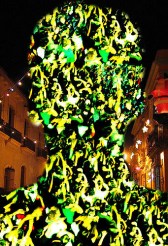
Image by Flickr User Adrian Sampson, from a series of three art pieces engaged with Ralph Ellison’s Invisible Man (CC BY 2.0)
By close reading, or listening, to many canonic texts such as Their Eyes Were Watching God, The Chaneysville Incident, and Invisible Man, Furlonge performs an in-depth understanding of sound and what it means to “unmute words in print” (109). She renews the ways to interpret the texts by teaching her readers how to hear sonic literature. After situating the texts in the literature, she depicts what sounds and silences in the narratives tell the reader. For instance, in the first chapter, “Our Literary Audience,” Furlonge distances herself from the often-times asked question of “whether or not Janie realizes her voice over the course of [Their Eyes Were Watching God]” and thinks about “Phoebe’s hungry listening” (25) and what it adds to the conversation. Rather than analysing the story’s narrator yet again, Furlonge turns the reader’s attention towards her friend, the listener. The reader is presented with the importance of listening with an analysis of the “storyhearer” (60) and the work that they accomplish by listening in proper ways, which allows the speaker to develop a voice they know is heard. In this sense, “storyhearers” are used to critique and bring the listening back into stories. As Furlonge considers the body a “living archive” (63), the intake of sounds and its use and reiterations transport the stories and transform the listener into an archive that will allow the story to live on and be transported.
Race Sounds, therefore, brings to the discussion ideas of what it means to listen and one’s responsibility of listening properly and carrying the story within one’s self. “Historical listening” (82) further defines the importance of the audiences in engaging with sounds. As one’s listening, in becoming knowledge, develops this importance, as well as a civic responsibility, to bring the story where it needs to be. Furlonge wonders about the same question Peter Szendy asks, “Can one make a listening listened to? Can I transmit my listening, as unique as it is?” (102). Through reading of The Chaneysville Incident, she demonstrates the carrying of such stories through sound, “a sound that contains memories” (117), and its historical as well as civic importance.
Furlonge also brings new insight to Ralph Ellison’s Invisible Man, a novel often studied in African American Sound Studies, such as in Weheliye’s Phonographies, because of its use of the phonographand its attention to the use of music. However, Furlonge diverges from the usual exploration of Ellison’s narrator with his phonograph and insists on vibrations and the experience of “tactile listening” (55), or the materiality that comes with the listening experience. In shifting the conversation, Furlonge presents the physicality of sound and voices, and does so throughout Race Sounds. Redirecting the reader’s attention to how listening practices affects the novel’s narration, Furlonge aims for the reader to rethink their own listening practices in turn.

Teagle F. Bourge in Oren Jacoby’s adaptation of Ralph Ellison’s INVISIBLE MAN. At the Huntington Theatre Company Jan. 4 – Feb. 3, 2013. Photo: Michael Brosilow (Court Theatre production), (CC BY 2.0)
By directly addressing our way of being in the world, Furlonge creates a text that speaks to the reader, and cannot leave one indifferent. In her last chapter, a walkthrough of her class on listening, Furlonge plunges with the reader into a sense of meaning; everything that one has just read comes together into her classroom. The result of Furlonge’s observations guide the reader into finding a new listener within themselves. Before concluding her book, she describes:
While I hoped students would grow as listeners, I did not anticipate that their perceptions of themselves as readers and writers would also shift. […] Helping students learn to listen, to be attentive to others, and to be discerning of all the talk that comes their way can lead to enduring understandings about themselves and the ways in which they want to engage with and change their world. (118)
As optimistic and ambitious as this statement is, I believe Furlonge manages to teach exactly this to the reader of Race Sounds. By concretely applying in her classroom what she presents in this book, not only does she prove how her work furthers the conversation of Sound Studies, she demonstrates how it belongs in larger conversations about our society’s listening practices and the role of every person in it.

“Students travel around the world with books” image by Flickr User Garrison Casey, (CC BY 2.0)
Furlonge’s book intends to speak to anyone interested in their own listening practices. By being conscious of one’s own body as a “living archive,” it may allow a story to live on by listening properly to it. Finally, “we are unaware of the conversations we miss when we speak” (120) concludes the book on a reflection unto the self to be a better listener, in order to allow our surroundings to teach us to listen differently, and maybe hear things we have not heard before.
—
Featured Image: Quinn Dombrowski,(CC BY-SA 2.0)
—
Alexandrine Lacelle is mainly interested in Modernist literature, women’s writing, and Sound Studies (especially silences). She is pursuing her Master’s degree in English Literature at Queen’s University, where she will be starting her PhD in the fall of 2019, with a focus on the use of wordlessness and sounds in early 20th century literature by women. Originally from Montreal, she completed her BA in English Literature at Concordia University, where she was able to practice her background in French, English, and German.
—
 REWIND!…If you liked this post, you may also dig:
SO! Reads: Dolores Inés Casillas’s ¡Sounds of Belonging!–Monica De La Torre
SO! Reads: Roshanak Khesti’s Modernity’s Ear–Shayna Silverstein
SO! Reads: Kirstie Dorr’s On Site, In Sound: Performance Geographies in América Latina–Benjamin Bean
Share this:

Sonic Contact Zones: An Interview with DJs MALT and Eat Paint in Koreatown, Los Angeles

On Sunday, February 21, Atlanta-based hip-hop photographer Gunner Stahl will be DJing at a raw space being built at 4317 Beverly Boulevard in Los Angeles’ Koreatown as part of the Red Bull Music Festival. Red Bull suggests that many of the photographer’s artistic subjects, such as Tyler the Creator, Playboi Carti, Lil Uzi Vert, Gucci Mane, and/or The Weeknd might make guest appearances during his set. This star-studded stage with financial backing from the drink that gives you wings will stand across the street from Vilma’s Thrift Store, DolEx Dollar Express, Gina’s Beauty Salon, and Botanica Y Joyeria El Milagro. Tickets are a modest $15. At first glance, the location choice might seem odd; why not the legendary Wiltern Theater just down the street on Western? Or why not set up a stage inside MacArthur Park? Those are definitely options, and many performers do grace the stage of The Wiltern for fans in Koreatown and the greater Los Angeles area. However, for those who know Los Angeles’ Koreatown gets down, discounted snacks and pedicures a stone skip away from millionaires sounds just about right.
Figuring out these connections between sound, capital, culture, ethnicity, and art in LA’s Koreatown has been a popular pursuit in recent years. The year was 2014. The place was The Park Plaza Hotel on the outskirts of Los Angeles’ Koreatown. The people performing were TOKiMONSTA (Jennifer Lee), Far East Movement (Kevin Nishimura, James Roh, Jae Choung, and Virman Coquia), Dumbfoundead (Jonathan Park), and others. The reporter was Erik Kristman for Vice Media’s Thump. In the article titled “SPAM N EGGS Festival Was a Window to LA’s Multiculturalist Underground Movement,” Kristman proclaims: “Koreatown’s spectrum of sound, a culture hidden beneath its mid-Wilshire scenery, is no doubt one of the few remaining jewels of the LA underground.”
In Club Cultures: Music, Media, and Subcultural Capital (1996), Sarah Thornton writes that DJs “play a key role in the enculturation of records for dancing, sometimes as an artist but always as a representative and respondent to the crowd. By orchestrating the event and anchoring the music in a particular place, the DJ became a guarantor of subcultural authenticity” (60). Asian American DJs performed in Koreatown, so the electronic music and hip hop they mixed was enculturated not only with a Los Angeles neighborhood flair but also with an ethnic twist.

Park Plaza Hotel, Taken by Flickr User Cathy Cole (CC BY-NC-SA 2.0)
The Park Plaza Hotel, now The MacArthur, has its own important history as a venue as well. Built in the 1920s by prominent Los Angeles-based architect Claud Beelman, the building has hosted the racially exclusive Benevolent and Protective Order of Elks, night clubs such as Power Tools with attendees such as Andy Warhol, and has been a site of numerous films and music videos such as Kendrick Lamar’s “Humble” (2017). It survived the demolishing of similar Art Deco buildings during the 1980s. It survived the 1992 Los Angeles riots following the acquittal of four police officers who beat Rodney King and the killing of 15-year-old Latasha Harlins by Soon Ja Du, the Korean-born convenience store owner of Empire Liquor on 91st Street and Figueroa Avenue. It survived, if not flourished, in the subsequent gentrification of the Wilshire Center area with eager real estate agents and endowed buyers who are made nostalgic by the building’s Art Deco façade. The right DJs playing in a prime spot such as The MacArthur could definitely guarantee a level of Los Angeles subcultural authenticity for attendees. But what kind of authentic? And was that something anyone was trying to go for?
Kristman’s caricaturization of Koreatown certainly reveals how this visage of authenticity affected him. In his words, Koreatown is a diamond waiting to be mined. Koreatown is hidden. Koreatown’s “spectrum of sound” takes the singular verb “is,” meaning it functions as a unified, indistinguishable whole. Kristman has “no doubt” about his analysis of his authentic trip to Koreatown.
The openers of Spam N Eggs that night were two techno DJs and producers named MALT (Andrew Seo) and Eat Paint (Vince Fierro). Together, they run the Los Angeles-based Leisure Sports Records. We met at the Seoul-based coffeehouse Caffé Bene in Los Angeles to share misugaru lattes and talk about Kristman’s statement.
“I definitely wouldn’t call ‘Koreatown’ very underground,” says Vince. “It’s certainly become a new social center to LA’s night life, and there was a time when there was a feeling of great potential for a solid underground movement. But sadly, there have not been any significantly artistic home-grown breakthroughs coming from K-Town.”
Vince continues: “Rather, it serves as a new landing pad for the very commercialized Korean hip-hop and EDM cultures in Los Angeles. These genres dominate the K-Town club landscape. Unfortunately [pause] to me, anyway [pause] it’s success not won with any kind of daring artistry or underground legitimacy but rather with familiar aesthetics and neon lights.”
“[Los Angeles] helps them, too,” adds Andrew. “They’ll close off streets and bring in vendors because it gets people out spending money. A lot of the Korean stars come out for these events, but the thing is [pause] what kinds of people are these events attracting? Obviously, Koreans, or people that are fans of Korean music. I think Korean people here have a lot of pride, and they see that there is a rise in the culture and the area’s popularity and they’re jumping on that. They’re trying to make it bigger and better. If you walk around Koreatown, you’ll see gentrification happening everywhere.” He references the Wilshire Grand Center, the Hanjin Group-owned skyscraper that stands taller than any other west of the Mississippi, and its surroundings as evidence.
Urban studies carried out by Kyonghwan Park and Youngmin Lee, Kyeyoung Park and Jessica Kim, and others on Koreatown’s fraught relationship with surges of capital have made similar acknowledgments in wonderful detail. These surges are not evenly distributed among clubs; there are many more “secret” dimly-lit rave spots that pop up throughout the district than there are widely advertised above-ground clubs in Koreatown. Even relatively established clubs such as Union at 4067 West Pico Boulevard or Feria at 682 Irolo Street were not glamorous (and both have closed since the time this recent interview was conducted); they are surrounded by predatory lending offices and abandoned shops. Andrew gave me the address of an upcoming rave spot in Koreatown; it was basically under an apartment complex.
“I think they just want to bring what they build in Korea over here because that’s how they do it over there,” adds Andrew. “They just have apartments and then clubs and restaurants underneath or underground. It’s kind of like how Tokyo is.”
If this “hidden, underground” Koreatown culture does exist, as Kristman suggests, then finding it requires ignoring the flashing lights of Spam N Eggs and seeking out the darker warehouse raves. It also requires a level of suspended disbelief that Koreatown is untouched by hipster gentrification and instead an embracing of a subcultural essence that goes beyond city architecture and real estate. The physical space of sections of Koreatown might not be as important as the potential for the production of space in terms of creating sonic contact zones.
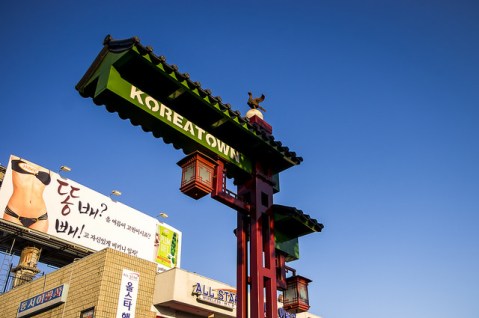
sign in Koreatown, Los Angeles by Flickr User vince Lammin (CC BY-NC-ND 2.0)
The zones created by artists such as Malt and Eat Paint are mobile and fleeting as they pop up whenever and wherever these DJs perform. Like Josh Kun famously put forward in his book Audiotopia: Music, Race, and America (2005), the music these musicians produce and mix has the ability to create audiotopias “of cultural counter that may not be physical places but nevertheless exist in their own auditory some-where” (2-3). Electronic music, and perhaps similarly this “jewel-like” spectrum of Koreatown sound, has the ability to implant identity into the buildings and surrounding neighborhoods. What once was a Mexican restaurant and is now abandoned becomes a pulsating techno club attracting those Angelenos who shy away from the more commercial scenes.
Perhaps Kristman was focusing more on the Asian American DJs themselves than the types of music they were spinning or The Park Plaza Hotel and its situation in Koreatown. As Asian Americans, these DJs represent and are representative of an authentic subculture to which Kristman bears witness. However, many artists shy away from or sometimes outright deny any racial or ethnic connections being made between their art and their identities. Andrew and Vince shared personal and well-known examples of ambivalent attitudes toward such labeling. Jason Chung, also known as Nosaj Thing, is one of the best-booked electronic performers today, flying around the world sponsored by Adidas or playing huge shows with Flying Lotus. Vince, who worked very closely with Jason just as his career was taking off, reflects on Nosaj’s rise: “Everyone here in K-Town thinks Nosaj Thing is a god. But if you ask him about his pride in being Korean, he won’t say anything.”
Andrew adds: “It’s just like how Qbert is for the Filipino community – that’s who Nosaj Thing is for Koreans today. When I went to South Korea to perform, they would ask me how I was affiliated with him, although I’m not really. South Koreans are amazed to see a Korean guy make it in the music industry in America with a sense of originality, not having to sell out.”
Both Andrew and Vince shift the conversation suddenly to Keith Ape and his debut as a trap music artist. Keith Ape’s success was due in part to spectacle (as the genre demands), to the power of hallyu promotion, but more so to simple respect from established artists such as Gucci Mane and Waka Flocka Flame. In a Noisey documentary about his first U.S. performance at South by Southwest (SXSW) in 2015, Keith Ape is translated as saying: “You know, I’m Asian. And I heard stories of how Asians are still looked at as outsiders in the States. And I heard it’s even worse when it comes down to hip-hop.”
While his successful Atlanta trap-style set at SXSW ultimately assuaged those fears of acceptance, for many beginning and working Asian American DJs and performers, this perceived and sometimes enforced musical barrier is daunting. While Andrew seemed to have his criticisms about how Korean promoters of Korean artists seem to be strictly focused on the commercial payoff of such events, he did not condemn their tapping into the United States market. Furthermore, he never mentioned that performing in the electronic music genre was either assisted or hindered by his ethnicity. Rather, much like Nosaj Thing, Malt lets the music do its work and create an audiotopia in which race and ethnicity are not under the spotlight. Literally, most of the shows Malt performs at do not feature the performer; the DJ is often in the dark, putting the focus almost exclusively on the music.

MALT, courtesy of Leisure Sports Records
Vince adds: “Korean American artists like Nosaj Thing and TOKiMONSTA and David Choe – all these people are doing their own thing. They’ve got these ‘don’t see me as Asian’ mottos, these ‘just think I’m dope’ vibes.”
Instead of searching for authenticity in the racial or ethnic identities of performers, Andrew is more interested in breaking stereotypes about the dangers associated with techno music, raves, and drug use. Andrew concludes: “I think first impressions are very, very important to Korean people. Looks are everything. South Korea is like the biggest plastic surgery country in the world. I went to Korea to visit my grandma, who I hadn’t seen in a long time, and all she would ask me was like, ‘Are you eating well? Look at your hair!’ Just purely about my looks. I was telling her, ‘Grandma! I run a label back in LA! I’m trying to be a musician!’ At our events, random Korean people walk by, they’ll come in for five seconds, listen to the music, and label it as ‘drug music,’ like something you listen to when you’re messed up. The same thing could be said about trap or EDM, right? But they don’t associate it with that. Hopefully, if the right timing comes, we can change that somehow.”
—
Featured Image: TOKiMONSTA by Twitter User Henry Faber, 2011 (CC BY-NC 2.0)
—
Shawn Higgins is the Academic Coordinator of the Undergraduate Bridge Program at Temple University’s Japan campus. His latest publication is “Orientalist Soundscapes, Barred Zones, and Irving Berlin’s China,” coming out in the 2018 volume of Chinese America: History and Perspectives.
—
REWIND!…If you liked this post, you may also dig:
 “How Many Latinos are in this Motherfucking House?”: DJ Irene, Sonic Interpellations of Dissent and Queer Latinidad in ’90s Los Angeles—Eddy Francisco Alvarez Jr.
Contra La Pared: Reggaetón and Dissonance in Naarm, Melbourne–Lucreccia Quintanilla
SO! Amplifies: The Women in L.A. Punk Archive— Alice Bag
Share this:


Current Top Posts





April 2021

January 2020

November 2019

October 2019

August 2019

April 2014

November 2017

March 2015

December 2017

October 2015
 Sounding Out!
Recent Comments