
On Donuts, Sandwiches and Beattapes: Listening for J Dilla Six Years On

DOI: https://doi.org/10.59350/yns4n-b5v12
It has been six years this week since the passing of James “J Dilla” Yancey, considered by many in hip-hop as the quintessential producer’s producer. Over the course of his career the Detroit-born beatmaker garnered production credits with artists ranging from The Pharcyde to Janet Jackson. Since his passing there has been a substantial amount of posthumous output, including a Yancey Boys album with his brother Illa J, Ruff Draft, The Shining and Jay Stay Paid. There have also been the tons of unofficial releases by artists using material from his beattapes without prior permission. An unofficial discography of projects ‘featuring’ Dilla’s work could eclipse his official one.
Dilla’s beattapes, which he shared amongst friends and associates via CDs, eventually traveled the globe via message boards years prior to his passing. His legacy became what it is, at least in part, due to the reach of these CDs, but unfortunately it has also made monetizing the work after his passing a difficult task. There were early issues between Dilla’s family and the legal estate, but for the last couple of years there has been a process established which allows for the use of tracks from his vaults. They are currently set to release The Rebirth of Detroit, which boasts unheard Dilla beats featuring the Detroit artists he came up with:
In addition to posthumous releases under Dilla’s name the estate also licenses tracks for projects by other artists. With over 4000 tracks in their possession, it stands to reason there will be plenty more Dilla in the future. Yet still there is a sense that ‘new Dilla’ will never be new again, as in the future we will only be able to look at Dilla’s past. How would his process as an artist have grown? Surely whatever he was doing before he passed sounds nothing like what he would be doing in 2012.
Fortunately, the creativity of Dilla lives on through his influence on others. In the years since his passing, that influence has gone beyond hip-hop into jazz, indie rock, classical, and electronic music; some might argue Dilla’s influence has spawned new styles or even genres of music . The LA beat scene was seemingly born in homage to him; with its off kilter drums and wild sample chops, it extends beyond the initial influence, projecting into the future a lineage which will forever trace back to Dilla. Another of those lineages takes Dilla to perhaps the least likely place for a hip-hop producer: late-night television, through the figure of Ahmir “?uestlove” Thompson of The Roots.
At the end of the 90s until around 2001, Dilla was a member of The Soulquarians creative team that produced albums for Erykah Badu, D’Angelo, Common, and Bilal:
During this time Dilla worked closely with drummer, producer, and founding member of The Roots ?uestlove. There was a musical bond established over countless studio hours which allowed for a fusion of styles between them that carried Yancey from his Jay Dee period into his J Dilla period, and which ?uestlove continues to carry to this day.
Since Dilla’s passing, ?uest has been an instrumental voice in keeping Dilla’s legacy alive. He regularly DJ’s events celebrating Dilla’s work. On all of The Roots albums except for the most recent one, there have been musical dedications to Dilla. It is when ?uest goes into the studio with The Roots, however, that the living continuation of their musical fusion can be found.
The studio is where ?uest spends a lot of his time, rehearsing The Roots for their role as the house band on the Late Night with Jimmy Fallon show; ?uest records the sessions to listen back before and after the show. On Late Night The Roots play new songs in front of a live audience five nights a week. These songs only air for ten to twenty seconds going in and out of commercials. If you run to grab something from the refrigerator you might miss them. Or, coming back you might find your head nodding to them. Not only are they original works (other than walk on music for show guests, and musical performances), they are an insight into the creative process which shaped both ?uest and Dilla.
?uest names the tracks Sandwiches, a nod to his former collaborator’s Donuts. Donuts was the last official project that Dilla worked on, quite literally on his death bed, and is considered his instrumental opus. It opened up the notion of the short-form instrumental hip-hop work, which traces its own lineage to the history of beattapes. Today, a beattape is a collection of hip-hop instrumentals released as a product through distribution channels (free or paid). In the beginning however, beattapes were physical cassette tapes (and later CD-Rs) passed around from hand to hand. Tracks from beattapes were snippets of beats often recorded right after they were made so the producer could listen to them again outside of the studio setting. They were passed amongst friends and eventually within the industry as a means of selling the producer’s beats.
Early beattapes were not meant for public consumption or as cohesive projects. It’s important to remember that at the time you didn’t finish productions in a home or project studio. Artists, labels, producers etc. would listen to a beattape and select tracks to be purchased for a project. If a beat was bought, the producer would meet the artist in a large studio with an engineer, which is where the beat went into production. The beattape at the time was not considered a final anything, but a sketch of what could become a production.
In addition, beattapes had a secondary purpose as a measure of skill and technique. They became a format for rehearsal and practice. Where a traditional instrumentalist may practice chord changes on their instrument, a beat maker makes beats and records them for easy playback later. For example, a producer could decide to sample the same record as another producer to show how they would use the sample differently. There would be no intent to turn such a track into a full fledged song (though it could happen), instead it would be recorded so they could play it back to a friend or even the producer who originally used the sample for bragging rights.
Dilla was an active participant in this trade. His beat CDs became his calling card particularly for the techniques displayed on them. Donuts was his expansion of that beattape format. Rather than a display of short rough sketches that serve as indications of productions to come, Dilla produced intricate and layered flaunts of technique compacted into short sketches.
The most recognized technique from Donuts is the chop. The chop comes out of the stab line of techniques. A stab is a single instrumental hit played on a sampler. On the MPC line of samplers (which Dilla was famous for using), stabs could be spread across trigger pads pitch shifted chromatically allowing melodic sequences to be played using a single stab. The chop takes that a step further by using multiple samples from the same source (chops) to replace the chromatic stabs, and play melodically. What Dilla displayed on Donuts however, is not merely the chop but the variety of techniques available by which a producer can chop. Working outside the limitations of loops and stabs, new techniques like drum and instrument isolation, de-quantization, vocal stabs and more come at you, one layered technique after the other.
Many of these techniques have been canonized today, but some quality has been lost with that normalization. With de-quantization by example, overuse has practically rendered the technique cliché because its depth was reduced by its definition. De-quantization translates to simply turning off the preference in software programs or hardware beat machines that align all sound triggers to the grid of the tempo and time signature. That definition speaks nothing to what Dilla actually did with that preference off, which was impose his own humanized sense of timing onto the de-quantized patterns of the machine.
Of those that followed Dilla, most got the de-quantization part but missed his sense of time. While de-quantization has shown influence, outside of the ‘stock Dilla’ pattern, his sense of timing has been continued by only a few. At the top of that list is ?uestlove, as he is as responsible for the development of that sense of timing as Dilla is his own. The root of that development can be found in the The Soulquarians period, which can be marked as the time both artists came into their own by working together. That they would come together at all was quite serendipitous, as no player has a better sense of timing than a drummer. It was the mutual sense of timing between Dilla and ?uest that worked to produce the amazing material that resulted.
In The Soulquarians studio sessions ?uest and Dilla created a feedback loop between the drum machine and the drums. This pushed their sense of time as they fused a sonic texture for their drums, which can be heard between their productions. There is a shuffling urgency with a tick of hats between pulses that lead one into the other; the snare or clap crisp, never aggressively cracking, the kick big but not over dominant. It is sequence-based music turned into grooves that maintain the variable constraints of the sequence. They each took these elements with them in their post Soulquarians work, and after Dilla’s passing, you can frequently hear ?uest calling back to those days through his music.
Take a Sandwich like “Gross Understatement.” At the onset a drum loop with a prominent clap is layered into the snare on alternate hits, while a keyboard moves through presets until an organ sound is found. The bass noodles patiently until, with a chord, they meet. When ?uest comes in it takes a couple of bars of him pushing the drums to get everyone else to fall in on his time, but once it hits he can’t control himself, letting out a holler, “something flew out the gate.” What follows is three minutes of magic as the band jams to a grove that is the perfect cross between Dilla and ?uest.
Gross Understatement (G minor) #Sandwich 1397
Up until November 2011, by ?uest’s count, The Roots had created almost 1800 Sandwiches. He has released a stream of Sandwiches through his Swift FM account (the page is currently down until the site relaunches). By his own admission though, all of the Sandwiches aren’t as good as “Gross Understatement.” Out of the 2 to 23 they record each day, he says only about 1 in 19 are bangers. At 94 out of 1800 it isn’t a bad count, enough for nine albums. The only format in these tracks exist however, is as they appear on Late Night, on ?uest’s harddrive and whatever Sandwiches he decides to share. What would a studio project of this material sound like? As big of an audience as they receive on Late Nite, Sandwiches are buried in the mix of television things where it’s not easy to give them the musical attention they deserve. Perhaps in the future an official release of a project from this line will emerge. In the meantime catch them on NBC when you can and stay tuned to ?uest’s social stream.
—
Primus Luta is a husband and father of two (maybe three by the time this goes up). He is a writer and an artist exploring the intersection of technology and art, and their philosophical implications. He is a regular guest contributor to the Create Digital Music website, and maintains his own AvantUrb site. Luta is a regular presenter for the Rhythm Incursions Podcast series with his monthly show RIPL. As an artist he is a founding member of the live electronic music collective Concrète Sound System, which spins off into a record label for the exploratory realms of sound in 2012. Luta is currently working on completing his first book, BeatGenealogy: A History of the Electronic Beat From WWII to Now.
—
Share this:

The Sound of Hippiesomething, or Drum Circles at #OccupyWallStreet
DOI: https://doi.org/10.59350/mkjxk-ckf41
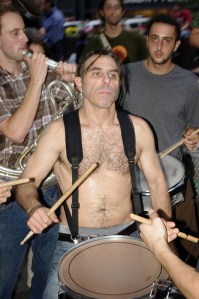
Last week’s news was been full of alarming stories of real and threatened violence at various #Occupy sites around America. But also disturbing were the reports that complaints about the continuous drumming at the Occupy Wall Street site in Lower Manhattan were threatening to shut the entire operation down. According to stories in N + 1, slate.com, Mother Jones, and New York, the ten hour marathon drum circles at Zuccotti Park have been a focal point of mounting tensions, both between the occupiers and the drummers, and between the occupiers and the community at large. Last week, community members asked that the drummers limit their drumming to 2 hours a day, a request backed by actual OWS protesters. The drummers, loosely organized in a group called PULSE, initially resisted the restriction, claiming that such requests mimicked those of the government they were protesting against. Since then, a compromise has been worked out, but the situation gives rise to a host of questions about race, sound, drums, and protest.
Community organizers both inside and outside OWS said they were distressed by the continuous noise that these protesters are making, and certainly they had reason: as Jon Stewart put it in his episode of talking points, “it’s a public space, it’s for everyone, including people who don’t consider drum circles to be sleepy time music.”
Writer and singer Henry Rollins agrees, telling LA Weekly that he dreams of an #Occupy Music festival, because “So far [he has] heard people playing drums and other percussion instruments” but still wonders “if there will be a band or bands who will be a musical voice to this rapidly growing gathering of citizens.” Rage Against the Machine guitarist and frequent #Occupier Tom Morello also seems to concur, telling Rolling Stone, “Normally protests of this nature are furtive things, It’ll be 12 people with a small drum circle and a couple of red flags. But this has become something that people feel part of.” Stewart, Rollins, and Morello all have a point: not everyone likes drum circles, in fact some people feel quite strongly about them, which has the potential to be divisive for a movement famously representing “the 99%.”
But over and above the questions of musical taste, the very audible presence of snare drums, cymbals, and entire drum sets at OWS—more often found in marching bands or suburban garage band practice spaces than the usual drum circle staple, the conga—raises a different set of questions, both sonic and social, around the interrelated issues of “noise,” public space, and privilege.
That a drum circle populated by a large number of bad, mostly white drummers is being touted as “the sound” of occupation isn’t that surprising, at least not for alumni of UC Berkeley.
In my day, a more conga-oriented drum circle sprouted up on Sproul Plaza every Sunday; today, a similar one occupies a green space in Golden Gate Park right across from Hippie Hill, pretty much 24/7. (I walk by it every Thursday on my way to the gourmet food trucks: happily, the delicious smell of garlic noodles and duck taco obliviates all other senses.)
These kinds of regular, yet impromptu, circles abound in California and elsewhere: indeed, the sound of drum circles à la OWS has characterized certain types of social spaces for the last forty years. But what exactly does the sound of drum circles characterize? What meaning is being made by them, and why?
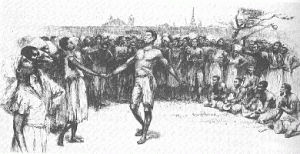
In the Americas, drum circles go back hundreds of years– many indigenous peoples have drumming traditions, for example, and, in Congo Square in New Orleans, slaves of African ancestry gathered weekly to dance to the rhythms they played on the bamboula, a bamboo drum with African origins, beginning in the early 1700s. The notion of the “circle” was a fundamental part of the dancing and music making at Congo Square—according to Gary Donaldson, the circles represented the memories of African nationalities and various reunited tribes people—and was echoed in various types of “ring shouts” across the West Indies and the Southern U.S. The contemporary drum circle stand-by, the conga, also came to the Americas via the forced migration of slaves; it is of Cuban origin but with antecedents in Africa, like the bamboula. The black power movements of the 1960s drew on this history—and sound—to good effect, reigniting semi-permanent drum circles in many U.S. neighborhoods– like the formal gathering that meets in Marcus Garvey Park in Harlem on Saturdays that is currently also under fire from a nearby condo association –audibly announcing their presence and enacting new community formations.
Given this history–and without erasing the presence of drummers of color at OWS--it can seem puzzling how the drum circle has come to occupy such a curiously whitened position in America’s cultural zeitgeist. Furthermore, one of the more problematic aspects of the OWS drum circle debate is the racialized implications of the instrumentation there—implications borne out by videos of OWS that show an overabundance of snares, some of the loudest drums available. According to percussionist Joe Taglieri, “no conga is louder than a fiberglass drum with a synthetic head.” If snares are louder than congas, then noise – actual decibel level — is probably not the sole issue when community groups attempt to control or oust drummers like those in Marcus Garvey Park. It does seem to be a key point of contention at OWS, however.
While there is also a history of African American marching bands, especially in the South, snare drums speak to a different set of American cultural traditions. Drum kits themselves evolved from Vaudeville, when theater space restrictions (and tight pay rolls) precluded inviting a large marching band inside. Mainstream associations with snares include but are not limited to army parades, high school marching bands, and of course hard rock music. Sometimes, like in the case of Tommy Lee, it is an unholy alliance of several of these contexts.
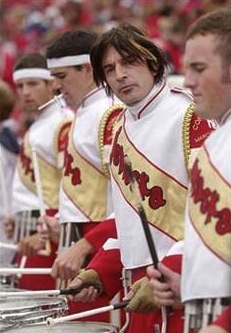
In other words, outside of OWS, snares are hardly the sound of social upheaval.
How the drum circle became associated with political protest in the first place is interesting. Although people sometimes associate drum circles with beatniks rather than hippies, a case could be made that they actually connect more strongly to an electrified Woodstock rather than an acoustic Bleecker Street, thanks in part to Michael Shrieve’s widely mediated turn during Santana’s performance of “Soul Sacrifice” at the 1969 festival.
It is important to note that Shrieve is playing the traps in this sequence, not the conga, which is one reason I’d like to suggest that something about that scene – the hands on the congas, the grins of the other guys, the ecstatic face of a 20-year-old as he slams his kit, and the fetishistic gaze of the camera on the sticks, the skins and the cymbals – caught the imagination of a particular segment of American society. Santana’s band – two Mexican Americans (Carlos Santana and Mike Carabello), a Nicaraguan (Chepito Areas), two whites (Shrieve and Gregg Rolie, who later plagued the world in Journey) and an African American (bassist David Brown)—was truly multi-racial, creating a “small world” visual that furthered Woodstock’s utopian rhetoric in ways that were surely not borne out by the demographics of its audience. More importantly perhaps, the Woodstock movie showed a white suburban hippie guy as an equal participant in a multi-ethnic rhythmic stew, a powerful image in the 1960s. Indeed, the Santana performance may be precisely the moment when the idea of the drum circle was lifted from the context of “black power” and moved into the hippie mainstream.

Woodstock made congas hip to the mass of America—not just in Santana’s set but also in the performances of Richie Havens and Jimi Hendrix—and Woodstock helped define what the drum circle meant, in part by encapsulating certain discursive tropes that were very particular to those times. For example, drum circles epitomize the ’60s idea that political action is simultaneously self-expressive and collective. If a crowd of people sing “We Shall Overcome” or chant “Ho Ho Ho Chi Minh/The NLF is going to win,” it is a a collective act. It’s collective even if the crowd is singing “Yellow Submarine” and it’s not overtly political. By contrast, drum circles are about improvisation, so each drummer can “do his own thing” while participating in the groupthink. (The “his” is implied: video of drum circles show few women participants. Apparently Janet Weiss, Meg White, and Sheila E.’s “own thing” can actually be done on their own.)
In terms of sound, drum circles also project well beyond their immediate location, compared to singing and chanting (in fact, OWS has had problems with the drum circles drowning out its “human microphone”). Plus, since the drummers can take breaks and change out, the actual drumming never stops, unlike a performing musician. Thus, drum circles are celebrations of self expression that are actively imposed on an audience that is well beyond eyesight. This summarizes a modern view of personality rooted in the 1960s: that it’s not enough to participate, you’ve also got to “be yourself.” I think these two notions account for the enduring idea of the drum circle as a supposedly political sound, even when it’s not. Drumming in a drum circle allows for a public display of self-expression that simultaneously allows the participant to belong to a group. The appeal of that is obvious, especially in our contemporary iCulture. However, the politicization of the sound of drum circles only makes sense when you add in the lingering sonic traces of black protest, modulated through a hippie lens. You can see this clearly in New York magazine’s “Bangin’: A Drum Circle Primer” (10.30.11), whose visual imagery prominently features a West African djembe drum and describes only the “hippie-era use of traditional African instruments” rather than their actual, snare-heavy configuration at OWS. Despite the snares and in spite of the oft-commented on lack of black faces at OWS—see Greg Tate’s piece in the Village Voice—drum circles still carry enough connotations of militant blackness to annoy the bourgeoisie.
One key thing differentiates OWS’s drummers from the demonstrations of yore, however: in the 60s and early 70s, there was a notion that drum circles were for drummers. Santana’s band, though young, was made up of world class musicians from the San Francisco scene. But to a certain type of viewer – young, white and male—the drum circle must have seemed so doable. Compared to the singular virtuosity of Jimi Hendrix or sheer talent of Pete Townshend, Santana’s music was the sonic equivalent of socialism. No wonder the drum circle scene has had more of a half-life in the hearts and minds of would-be Woodstockians than just about any other: it is a visceral depiction of music as communal, ecstatic, and accessible. Today, thanks to the far-reaching waves of the movie Woodstock: 3 Days of Peace & Music (1970), the percussive noise such a circle makes creates a particular sonic backdrop that clearly—and nostalgically—says hippiesomething.

And yet, politically speaking, nostalgia is, as theorists like Antonio Gramsci, Guy Debord, Jacques Attali and Theodor Adorno have frequently reminded us, invariably associated with Fascism. From Mussolini to Hitler to Reagan to Glenn Beck, it’s a tactic that has been explicitly invoked to thwart social progress. The nostalgia conundrum seems to have escaped both mainstream news media—which uses the drum circle to signify to viewers that OWS is a radical leftist plot—as well as the drummers themselves. For the drummers are hippies, and hippies young and old really believe in drum circles. Hippies take part in them, hippies enjoy them. It’s fair to say, however, that few others do, just as no one ever really enjoyed the 45- minute drum solos on live records by Cream, Led Zeppelin, and Iron Butterfly. (I’m thinking about Ginger Baker’s “Toad,” John Bonham’s “Moby Dick,” and “In-a-Gadda-Da-Vida,” respectively. Also about the time I went to the bathroom and bought popcorn at the LA Forum during a drum solo by some band I know forget, and still had to sit through ten more minutes.) .
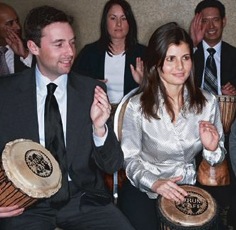
However, that fact does not seem to bother those involved in drum circles, and herein lies the great problem with the whole equation drum + hippie = activism. To any members of the mainstream media who hears and records them, a drum circle instantly conjures up a chaotic, possibly even violent, scene: Chicago ‘68, Seattle 2000, Oakland 2011. But the truth is that, outside Fox News, the noun “hippie” no longer means “liberal,” or possibly even politically engaged. The curious thing about drum circles, then, is that while they sound progressive, they can actually mean conservative. A 2006 piece from NPR, for example, describes how drum circles have been adapted as teambuilding exercises for corporations like Apple, Microsoft, and McDonald’s.
The OWS situation illustrates such conservatism in different ways. In another recent article in New York Magazine, a 19 year old drummer from New Jersey is quoted as saying, “Drumming is the heartbeat of this movement. Look around: This is dead, you need a pulse to keep something alive.” This is said in the face of opposition from the movement’s own management, who fear a shutdown due to severe problems with neighborhood groups and restrictions on the General Assembly’s call-and-response “mic checks” that have been so galvanizing. His words are instructive as well as ominous, illustrating that young hippies like him believe that the sound of drums is a suitable replacement for protest or action itself.
The idea that sound alone can energize a movement is not just wrong, it also showcases a willful misunderstanding within the ranks of OWS. In Oakland last week, a small band of anarchists threw bottles at the police, whose wrath rained down in the form of tear gas canisters and a fusillade of dowels: one protester, an Iraq veteran, has been seriously injured.
The incident highlights a kind of cognitive dissonance that is hindering the ability of OWS to achieve political progress. The drumming problems at Zuccotti Park highlight the way that history can repeat itself as farce, as the distance between nostalgia and action — and between sound and meaning — disturbs the peace in more ways than one. Just as drummers in Sproul Plaza refuse to acknowledge that UC Berkeley is now mainly host to computer science and business majors, and drummers in Golden Gate Park refuse to deal with a Haight Ashbury that is gentrifying in front of their eyes, so too do the drummers at OWS refuse to acknowledge that their sound is no longer the sound of social activism. Indeed, the sound of a drum circle is reminiscent of the ring of a telephone, the scratch of a needle dropped on a record, or the clip clop of horse hoofs on hay-covered streets. No wonder it sounds out of place at OWS.
—
Gina Arnold recently received her Ph.D. in the program of Modern Thought & Literature at Stanford University, where she is currently a post doctoral scholar. Prior to beginning graduate work, she was a rock critic. Her dissertation, which draws on historical archives, literature, and films about counter cultural rock festivals of the 1960s and 1970 as well as on her own experience covering the less counter cultural rock festivals of the 1990s, is called Rock Crowds & Power. It is about rock crowds and power.
—
Share this:




Current Top Posts





April 2021

January 2020

November 2019

October 2019

August 2019

April 2014

November 2017

March 2015

December 2017

October 2015


Recent Comments