
Reflective Sound Gathering via the New England Soundscape Project

Beyond the confines of recording studios, stages, and music classrooms, a vast and shifting sonic canvas exists for field recorders. This personal essay explores my awakening to a new creative recording process through the New England Soundscape Project , an ongoing sound-gathering mission whereupon I use small digital recorders—paired with various microphones, an iPhone, and a genuine sonic curiosity—to record brief moments throughout New England’s rich coastal, urban, and rural landscapes across six U.S. states. I received a modest seed grant from my University to pursue some creative work in field recording and sound studies. Over the next year, my travels will take me to the National Parks, cities, and historic landmarks in Connecticut, Vermont, Rhode Island, Maine, New Hampshire, and Massachusetts.
While near limitless possibilities on where and how to produce sonic and electroacoustic musical compositions endure, starting theNew England Soundscape Project challenged me to hone my listening skills while simultaneously dealing with nature’s unpredictability. Moreover, as a budding sound artist, I had to contend with the cognitive and emotional issues affecting a brand-new and unexplored creative practice. I came to believe that a holistic method of field recording offered me certain advantages—enabling an emerging sound artist to detach from rigidly defined agendas and instead focus on reflection, deep breathing, environmental awareness, gratitude, and an observational spirit. The listening exercises I detail in this post made me a newly introspective practitioner—one capable of a heightened sensitivity that improved my production and composition skills across multiple media.
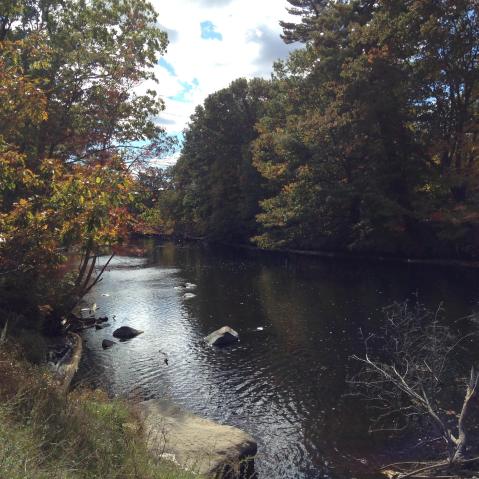
Merrimack River, New Hampshire, USA. All images by author.
Field Recording: An End Goal in Mind?
Field recording involves a delicate balance of technical skill, careful planning, and patience. Stepping away from a controlled environment, capturing audio on location presents many random and often erratic trials. From wind noise and poor site accessibility to recording malfunctions and user error—a host of issues arise once the recordist enters unfamiliar territory. Here, unfamiliar territory includes both new places and nascent approaches to research-based production and artistic data collection. Where do I situate a project like the New England Soundscape Project among new media production, sound studies, and music composition? Does that issue even matter?

Otter Brook Dam/Edward MacDowell Lake, Keene, New Hampshire, USA. All images by author.
The notion of practice-based work usually implies an end goal in mind. What if there is not an end goal in sight? What happens then? Would the New England Soundscape Project be “enough” of a contribution to creative scholarship when approached as a type of audio ethnography—much like the immersive storytelling recently curated by Leonardo Cardoso? The New England region is lush and robust, with many diverse landscapes. I hoped to document these in some way, but wondered how to continue. Truthfully, I had some hesitation on where to start.
Media artists and music composers learn the mechanics of their craft in colleges, universities, conservatories, at home, and on the job. Some of these techniques include audiovisual production, computer programming, coding, editing, and arranging using digital software. I am both self-taught and a product of an academic and Eurocentric, conservatory training system. This presents some tension, as I discuss below. Although traditional audio engineers and music composers often work towards completing a project without a predefined trajectory, how can budding sound artists develop and hone an inner acuity to find the “right” material during their creative processes?
While the process remains largely subjective, I found it helpful to begin by answering the following questions:
- What kind of project is this?
- How is the sound to be used?
- Where and how will the project be displayed?
- Who is the intended audience?
- What are the sound artist’s intentions?
- What tools are needed?
I draw inspiration from the Sound Studies Lab’s position that this type of work is diverse, fluid, and balances technical, artistic, and theoretical aims. The challenge is that the answers to the questions above are not immediately clear and require me to look inward at who I really am.

Boot Mill Threading Machine, Lowell, Massachusetts, USA. All images by author.
Following the Sonic Muse
Beyond the obvious technical and aesthetic factors affecting an expansive multisite recording project, we know little about how a nascent sound artist begins. Whom do they emulate? Should they take notes? pictures? What should they pay attention to onsite?
If the project is exploratory, the recordist may experience hesitation—as I did— and frustration that can block their creative process, especially because the pathways toward a finished sound project aren’t as established as those of a sound engineer, for example, or a songwriter. Nevertheless, my experiences have shown me that a nascent sound artist/recordist can also find intrinsic meaning and realize their mission—particularly by establishing a detached yet perceptive listening ethos, as I did to begin my work on the New England Soundscape Project.
For me, framing a detached and perceptive mindset involved:
- Remaining sensitive to my surroundings at each location;
- Focusing on stillness, deep breathing, and a quiet mind while recording;
- Adopting a respectful, unobtrusive manner at each site—taking care not to disrupt or distract others;
- Calmly monitoring my technology and its use;
- Trusting that I am intended to be in that exact moment at that exact time;
- Avoiding being overly concerned with the “end game” of their practice;
- Embracing the role of a sound gatherer and observer;
It is perhaps the final objective—adopting the philosophy of sound gatherer and observer—where truly sensitive listening begins. Here, the recordist aims to remove their personal goals and agenda from the field recording process. Before proceeding, the attentive recordist looks around them, focuses on quiet breathing, and views their microphones as lenses and without fear of what the result should be. To what or whom am I observing?
Here’s the problem. It dawned on me that I know little about who I am as a sound artist, and how my voice positively contributes to the world, if at all. I need to learn to listen—not just to the sounds in nature, but also to the sounds of the voices of the persons with whom I interact. Could solitude and introspective listening lead me to listen through a newly formed self, capable of deeper connections with my peers and environment? I found that my detachment involved investigating, acknowledging, and, whenever possible, setting aside my own biases, fears, and, importantly, my own agendas. By removing my ego and cluttered mind from the process, I could start to be an inclusive practitioner—one whom cultivates positive relationships daily and is capable of crafting a deeper sonic art that embraces rather than one that marginalizes.

Merrimack River, Lowell Massachusetts, USA. All images by author.
The Art of Meditative Listening
Rather than taking on a stringent approach with little flexibility, I practice observational recording by gathering audio as my muse and as environmental conditions dictate. By remaining attentive to my recording levels, I gather source materials up close, from afar, and for any length of time. Meanwhile, as this creative progression unfolds, I stay quiet—bringing almost meditative quality to my practice. Moreover, concentrating on deep breathing and stillness allows me to adopt a grateful mindset—one that is appreciative of my surroundings and for being present at that precise moment. It is then that the environment becomes the focus of sound gathering and not notions of a “final product.”

Scarborough State Beach, Newport, Rhode Island, USA. All images by author.
I found an artistic renewal—even healing—by adopting this meditative practice. As the New England Soundscape Project takes shape over the coming months and years, I hope to document the beauty of the Northeast through music, sound, and images. Yet, it is enough simply to be present in each location while aspiring to produce thoughtful and reflective sound art. Although there is no overarching method that best describes every aspect of a multisite field recording process, the “art” in the sound can truly emerge by striving to banish fear and doubt from the recording process. Addressing the “why” during each moment is just as important as addressing the “how” and the “why” in pre- and post-production. The recordist’s humanity plays a key role in determining how creative decisions are made, and the ability to remove the need for control determines how free—and freeing—the process can be.
This Thursday, SO! will feature my podcast on reflective listening with audio examples from the New England Soundscape Project thus far. I look forward to producing future episodes (and essays) on this project in the coming months. I hope you can tune in on Thursday and thank you for listening!
—
Featured Image: Scarborough State Beach, Newport, Rhode Island, USA. All images by author.
—
Acknowledgements
An Internal Seed Grant from the University of Massachusetts Lowell supports the New England Soundscape Project.
—
Daniel A. Walzer is an Assistant Professor of Composition for New Media at the University of Massachusetts Lowell. Walzer’s research and reviews appear in the Leonardo Music Journal, the Journal of Music, Technology & Education, the Journal of Radio & Audio Media and forthcoming articles in TOPICS for Music Education Praxis, and the Music Educators Journal. Walzer received his MFA in Music Production and Sound Design for Visual Media from Academy of Art University, his MM in Jazz Studies from the University of Cincinnati and his BM in Jazz Studies from Bowling Green State University. Walzer is currently pursuing doctoral studies in education at the University of the Cumberlands. Read more at http://www.danielwalzer.com
—
REWIND!…If you liked this post, you may also dig:
SO! Amplifies: Ian Rawes and the London Sound Survey–Ian Rawes
SO! L.A.: Sounding the California Story–Bridget Hoida
Sound-politics in São Paulo, Brazil–Leonardo Cardoso
Share this:

The Hysterical Alphabet

 To conclude our Hysterical Sound series, we are pleased to present an excerpt from John Corbett, Terri Kapsalis and Danny Thompson’s performance of The Hysterical Alphabet.
Through this series we have explored a history of fetishizing women’s hysterical vocalizations with Gordon Sullivan’s post on Clayton Cubitt’s video work, and my post on Sam Taylor-Johnson’s film Hysteria and it’s relation to the “silence” of hysteria in medical history.
Today, Kapsalis gives us a piece in which “the ABCs are seized in a convulsive fit,” each letter of the alphabet serving to introduce some episode of the history of hysteria. Accompanied by the sound design of Corbett and Thompson’s visual collage, this performance of The Hysterical Alphabet offers a multi-sensory engagement with the past to “disprove the theory that time heals all wombs.”
SO! is grateful to the artists for sharing their work with us.
— Guest Editor Karly-Lynne Scott
—
Inspired by primary medical writings and actual case histories, “The Hysterical Alphabet” tracks the 4,000 year history of hysteria starting with A in ancient Egypt. First published as a book with text by Terri Kapsalis and drawings by Gina Litherland, it subsequently assumed a different form as a performance featuring video and live soundtrack. Terri Kapsalis (voice), John Corbett (sound), and Danny Thompson (video) performed the feature length piece from 2007-2012 in many different venues, including the Art Institute of Chicago, Emory University, RISD, Bates College, Clark University, and the University of Chicago. The video documentation included here excerpts the letters S, T, U, and V, which focus on the 19th century, moving into the 20th century, and were drawn from the work of Charlotte Perkins Gilman, S. Weir Mitchell, Jean-Martin Charcot, and Sigmund Freud, among others.
—
John Corbett (sound) is a writer, sound-artist, and curator. He is the co-director of the art gallery Corbett vs. Dempsey. In 2002, Corbett served as Artistic Director of JazzFest Berlin, and he co-curated the Empty Bottle Festival of Jazz & Improvised Music for nine years. He is the producer of the Unheard Music Series, an archival program dedicated to creative music issues and re- issues, and he is the author of Extended Play: Sounding Off from John Cage to Dr. Funkenstein and Microgroove: Forays into Other Music. Corbett can be heard on a number of CDs including I’m Sick About My Hat and has brought his sound skills to two previous Theater Oobleck productions.
Terri Kapsalis’ (text/sound) writings have appeared in such publications as Short Fiction, The Baffler, Denver Quarterly, new formations, Public, and Lusitania. She is the author of Jane Addams’ Travel Medicine Kit, Hysterical Alphabet, and Public Privates: Performing Gynecology from Both Ends of the Speculum. Kapsalis is a founding member of Theater Oobleck, works as a health educator at Chicago Women’s Health Center, and teaches at the School of the Art Institute of Chicago.
Danny Thompson (video) is a founding member of Theater Oobleck, for which he has written (and performed in) 20 plays and solo performances, including Necessity, Big Tooth High-Tech Megatron vs. the Sockpuppet of Procrastination, and The Complete Lost Works of Samuel Beckett as Found in an Envelope (Partially Burned) in a Dustbin in Paris Labeled “Never to be Performed. Never. Ever. Ever. Or I’ll Sue! I’ll Sue from the Grave!!! The latter was given the “Comedy Excellence Award” at the 2000 New York Fringe Festival, “Top Ten of the Fest” at the Edinburgh Fringe Festival in Scotland, and extensively toured the U.K. and Ireland.
Share this:


Current Top Posts





April 2021

January 2020

November 2019

October 2019

August 2019

April 2014

November 2017

March 2015

December 2017

October 2015
 Sounding Out!
Recent Comments