
SO! Amplifies: An Interactive Map of Music as Ukrainian Resistance to the 2022 Russian Invasion
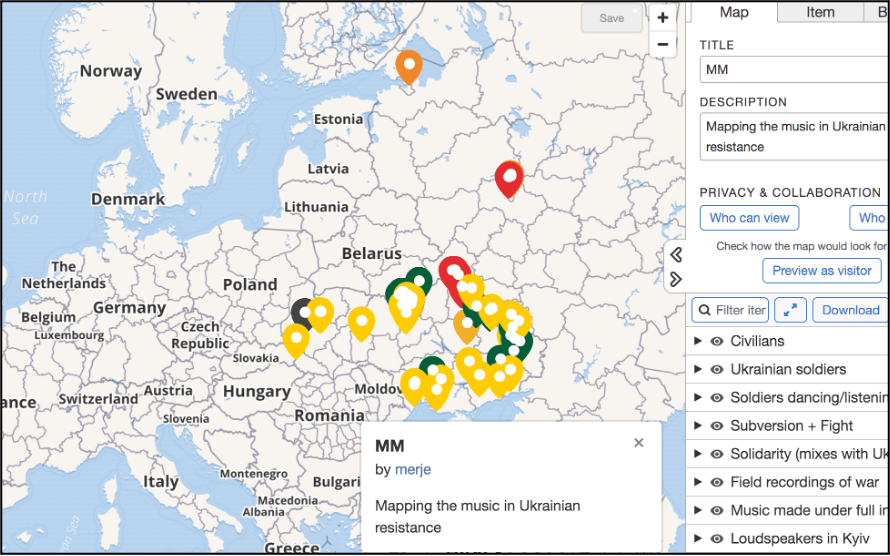
https://maphub.net/merje/mm

SO! Amplifies. . .a highly-curated, rolling mini-post series by which we editors hip you to cultural makers and organizations doing work we really really dig. You’re welcome!
—
BONUS POST: Directly following Merje’s introduction to her music mapping project, SO! has also published is her analysis of the observational research she conducted during the first 55 days of the 2022 Russian invasion of Ukraine, drawing from the collection of videographic material from online sources she embedded on this public interactive map. To go directly to that post, click here.
As an Estonian national, I have a regional interest in the relationship between music and cultural identity in Eastern Europe. Popular music has been foundational in building and sustaining Estonian national identity, through the Song Festival tradition which started in 1869, and the Singing Revolution at the end of the 1980s. In the Baltic states, Poland and Ukraine, there are similarities in how music has facilitated resistance to an oppressive regime or invasion.
While other cultural forms can articulate and show off shared values, only music can offer the immediate experience of collective identity (Frith 2007, 264). Looking into the sensitive representation of music in conflict, therefore, is about exercising hapticity with the precarity and suffering in the videos, and ultimately a work of not only academic, but affective labour.
The map format helps visualise the video evidence as it continues to appear in different parts of Ukraine. For accurate analysis, understanding the context, region, and the phase of war in which a musical event originates, is vital. In different parts of the country on the same date, one city can embody a collective feeling of resistance, while the other grief. The map is useful in analysing regional differences in the types of songs performed, and in ‘placing’ the international cases of solidarity. I decided to map the solidarity mixes that directly engage with the musical footage from Ukraine, and to exclude the high number of global fundraising concerts. All map entries depict in some way the role of music in Ukrainian resistance.
The map function is made redundant in posts where the location should not be disclosed for safety reasons, such as this video of soldier Yuriy Gorodetsky performing ‘How Can’t I Love You, My Kyiv’ in a military camp. Additionally, I decided not to embed posts that could inform the Russian military of civilian and humanitarian targets, for example a video from Lviv showing the Philharmonic concert space being used for humanitarian storage.
The focus has been on mapping songs and music, rather than the wider soundscape of war, although sounds such as air raid sirens do appear in some videos. The map includes sections on recorded music, such as this wartime ska track by Mandry, field recordings, and ways in which music has been used in online warfare. Most map entries fall under the civilian resistance category, exploring the following questions:
- What kind of music appears in this resistance? In terms of genre, is it folk, rock, hip hop, or national patriotic song? Is it Ukrainian or ‘Western’? How do the different examples embody national feeling and safeguarding of a culture?
- What is the power of these musical moments, for the artists, for Ukrainians, and for the world? What can music achieve in a conflict environment, and how does it evoke moments of solidarity?
- How does the music reflect the different phases and emotions of the war, from mobilisation, resistance, support, contemplation, to grief?
Similar research questions have been posed by Arve Hansen et al. in A War of Songs (2019) about the 2013-14 Euromaidan protests, in which music carried much of the revolutionary feeling. Adriana Helbig wrote about the Orange Revolution of 2004-05 in Hip Hop Ukraine: Music, Race, and African Migration when the Internet played a huge role in circulating political messages through music, especially as Ukraine’s media was controlled by president Yanukovich (2014). Maria Sonevytsky’s Wild Music (2019) looks at both revolutions and the vernacular Ukrainian discourses of ‘wildness’ as they manifested in popular music during this politically volatile decade.
When looking at Ukraine, we are studying a repeatedly colonised region, where, as part of the former Russian Empire, serfdom was abolished in 1861. Ethnographic research and promotion of a national culture in the decades that followed led to a brief window of independence for Ukraine in 1917, only to be occupied and incorporated into the Soviet Union as the Ukrainian Soviet Socialist Republic in the same year. Unlike Poland and the Baltic states, Ukraine was not independent between the two world wars, which adds depth to Soviet propaganda that permeated the region throughout the 20th century – important context to consider when analysing its struggle for autonomy.
Drawing from Parkes, the relationships of domination and subordination are particularly marked and articulated through music in colonised groups (Parkes 1994). Often, Ukraine is portrayed as a country of two opposing regions: the pro-European West and the pro-Russian East. While there have been two sides opposed to each other since the 2014 Crimean occupation, the linguistic, ethnic, historical and religious divisions in Ukraine cannot neatly fit into this East-West dichotomy. In addition to complicated ethnic boundaries that define and maintain the region’s cultural identities, Ukraine is dealing with a post-colonial struggle to protect its independence from imperialist Russia.
The ‘places’ constructed through Ukrainian music embody these complex issues, notions of difference and social boundaries – the very reason why music is socially meaningful: it provides means by which people recognise identities, places and the boundaries which separate them (Stokes 1994). In a war situation, beyond political and social alliances, we are also looking at music as survival (Stokes 2020).
—
Merje Laiapea is a curator, artistic programmer and writer working across sound, music and film. She is completing her Master’s in Global Creative and Cultural Industries in the Music Department at SOAS, University of London. Within the broad realm of music and cultural identity, her research interests include the expressive power of the sound-image relationship, forms of frequency, and multimodal approaches to research itself. She assists with event production and community engagement at SOAS Concert Series and works as Submissions Advisor for the 2022 Film Africa festival. Merje also broadcasts the occasional radio show and DJ mix. To find out more about Merje’s motivation behind the project, click here to read an interview by the University of London.
—

REWIND!…If you liked this post, you may also dig this:
Mapping the Music in Ukraine’s Resistance to the 2022 Russian Invasion–Merje Laiapea
SO! Amplifies: Wu Tsang’s Anthem (2021)—Freddie Cruz Nowell
SO! Amplifies: Marginalized Sound—Radio for All–J. Diaz
SO! Amplifies: Die Jim Crow Record Label
SO! Amplifies: Cities and Memory–Stuart Fowkes
Share this:

Listening to the Beautiful Game: The Sounds of the 2018 World Cup

DOI: https://doi.org/10.59350/d1hab-pjx27
I heard them before I saw them. Walking to my apartment in Moscow’s Tverskoy District, I noticed a pulsating mass of sound in the distance. Turning the corner, I found a huge swath of light blue and white and—no longer separated by tall Stalinist architecture—was able to clearly make out the sounds of Spanish. Flanked by the Izvestiia building (the former mouthpiece for the Soviet government), Argentinian soccer fans had taken over nearly an entire city block with their revelry. The police, who have thus far during the tournament been noticeably lax in enforcing traffic and pedestrian laws, formed a boundary to keep fans from spilling out into the street. Policing the urban space, the bodies of officers were able to contain the bodies of reveling fans, but the sounds and voices spread freely throughout the neighborhood.
Moscow is one of eleven host cities throughout Russia for the 2018 FIFA World Cup, which runs from June 14 to July 15. Over one million foreign fans are expected to enter the country over the course of the tournament, and it is an important moment in Vladimir Putin’s attempt to reassert Russia’s power on the global stage. Already, it has been called “the most political tournament ever,” and discussions of hooliganism, safety concerns, and corruption have occupied many foreign journalists in the months leading up to the start. So gloomy have these preambles been that writers are now releasing opinion pieces expressing their surprise at Moscow’s jubilant and exciting atmosphere. Indeed, it seems as though the whole world is not only watching the games, but also listening attentively to try to discern Russia’s place in the world.

Thus it comes as no surprise that the politics of sound surrounding the tournament have the potential to highlight the successes, pitfalls, and contradictions of the “beautiful game.” Be it vuvuzelas or corporate advertising, sound and music has shaped the lived experience of the World Cup in recent years. And this tournament is no exception: after their team’s 2-1 win over Tunisia on June 18, three England fans were filmed singing anti-semitic songs and making Nazi salutes in a bar in Volgograd. That their racist celebrations took place in Volgograd, formerly known as Stalingrad and the site of one of the bloodiest battles of World War II, added historical insult and even more political significance. The incident has shaped reception of England’s fans and their sounds across the country. As journalist Alec Luhn recently tweeted, police cordoned off singing England supporters in Nizhny Novgorod after their victory over Panama, ostensibly keeping the risk of hooliganism at bay. The incident stands in stark contrast with the police barrier around the Argentina fans, who were being protected not from supporters of other nationalities, but rather from oncoming traffic.
England fans in Russia sing songs…behind a line of police. Part of the reason there hasn’t been any hooligan violence pic.twitter.com/RwXz8XtLHf
— Alec Luhn (@ASLuhn) June 23, 2018
More than anything, however, sound has facilitated cultural exchange between fans and spectators. In recent years, historians and musicologists have paid more attention to the multivalent ways musical exchanges produce meaningful political and social understandings. Be it through festivals, diplomatic programs, or compositional techniques, music plays a powerful role in the soft power of nations and can cultivate relationships between individuals around the globe. More broadly, sound—be it organized or not—shapes our identity and is one of the ways by which we make meaning in the world. Sound, then, has the potential to vividly structure the experience of the World Cup—a moment at which sound, bodies, individuals, and symbolic nations collide.
At the epicenter of all of this has been Red Square, Moscow’s—and perhaps Russia’s—most iconic urban space. The site of many fan celebrations throughout the World Cup, Red Square’s soundscape brings together a wide variety of national identities, socio-economic considerations, and historical moments. To walk through Red Square in June 2018 is to walk through over five-hundred years of Russian history, emblematized by the ringing bells and rust-colored walls of the Kremlin; through nearly eighty years of Soviet rule, with the bustle and chatter of curious tourists waiting to enter Lenin’s tomb; and through Russia’s (at times precarious) global present, where fans from Poland join with those from Mexico in chants of “olé” and Moroccan supporters dance and sing with their South Korean counterparts. The past, present, and an uncertain future merge on Red Square, and the sonic community formed in this public space becomes a site for the negotiation of all three.

In the afternoon of June 19, I walked through Red Square to listen to the sounds of the World Cup outside the stadium. At the entrance to Red Square stands a monument to Grigory Zhukov, the Soviet General widely credited with victory over the Nazis in World War II. Mounted upon a rearing horse, Zhukov’s guise looms large over the square. In anticipation of that evening’s match between Poland and Senegal at Moscow’s Spartak Stadium, Polish fans were gathered at the base of Zhukov’s monument and tried to summon victory through chants and songs (Poland would end up losing the match 2-1.) Extolling the virtues of their star player, Robert Lewandowski, the fans played with dynamics and vocal timbres to assert their dominance. Led by a shirtless man wearing a police peaked cap, the group’s spirit juxtaposed with Zhukov’s figure reiterated the combative military symbolism of sporting events. Their performance also spoke to the highly gendered elements of World Cup spectatorship: male voices far outnumbered female, and the deeper frequencies traveled farther across space and architectural barriers. The chants and songs, especially those that were more militaristic like this one, reasserted the perception of soccer as a “man’s sport.” Their voices resonated with much broader social inequalities and organizational biases between the Women’s and Men’s World Cups.
From there, I walked through the gates onto Red Square and was greeted by a sea of colors and hundreds of bustling fans. Flanked by the tall walls of the Kremlin on one side and the imposing façade of GUM (a department store) on the other, the open square quickly became cacophonous. Traversing the crowds, however, the “white noise” of chatter ceded to pockets of organized sound and groups of fans. Making a lap of the square, I walked from the iconic onion domes of St. Basil’s cathedral past a group of chanting fans from Poland, who brought a man wearing a Brazil jersey and woman with a South Korean barrette into the fold. Unable to understand Polish, the newcomers were able to join in on the chant’s onomatopoeic chorus. Continuing on, I encountered a group of Morocco supporters who, armed with a hand drum, sang together in Arabic. Eventually, their song morphed into the quintessential cheer of “olé,” at which point the entire crowd joined in. I went from there past a group of Mexico fans, who were posing for an interview while nearby stragglers sang. The pattern continued for much of my journey, as white noise and chatter ceded to music and chants, which in turn dissipated either as I continued onward or fans became tired.
Despite their upcoming match, Senegalese fans were surprisingly absent. Compared to 2014 statistics, Poland had seen a modest growth of 1.5% in fans attending the 2018 World Cup—unsurprising, given the country’s proximity to Russia and shared (sometimes begrudgingly) history. Meanwhile, Senegal was not among the top fifty countries in spectator increases. That’s not to say, of course, that Senegalese supporters were not there; they were praised after the match for cleaning up garbage from the stands. Rather, geography and, perhaps, socio-economic barriers delimited the access fans have to attending matches live as opposed to watching them from home. With the day’s match looming large, their sounds were noticeably missing from the soundscape of Red Square.
Later that evening, I stopped to watch a trio of Mexico fans dancing to some inaudible music coming from an iPhone. Standing next to me was a man in a Poland jersey. I started chatting with him in (my admittedly not great) Polish to ask where he was from, if he was enjoying the World Cup so far, and so on. Curious, I asked what he thought of all the music and songs that fans were using in celebrations. “I don’t know,” he demurred. “They’re soccer songs. They’re good to sing together, good for the spirit.”
Nodding, I turned back toward the dancing trio.
“You are Russian, yes?” The man’s question surprised me.
“No,” I responded. “I’m from America.”
“Oh,” he paused. “You sound Russian. You don’t look Russian, but you sound Russian.”
I’d been told before that I speak Polish with a thick Russian accent, and it was not the first time I’d heard that I did not look Russian. In that moment, the visual and sonic elements of my identity, at least in the eyes and ears of this Polish man, collided with one another. At the World Cup, jerseys could be taken off and traded, sombreros and ushankas passed around, and flags draped around the shoulders of groups of people. Sounds—and voices in particular—however, seemed equal parts universal and unique. Emanating from the individual and resonating throughout the collective, voices bridged a sort of epistemological divide between truth and fiction, authenticity and cultural voyeurism. In that moment, as jubilant soccer fans and busy pedestrians mingled, sonic markers of identity fluctuated with every passerby.
I nodded a silent goodbye to my Polish acquaintance and, joining the crowd, set off into the Moscow evening.
—
Featured Image: “World Cup 2018” Taken by Flickr User Ded Pihto, taken on June 13, 2018.
—
Gabrielle Cornish is a PhD candidate in Musicology at the Eastman School of Music. Her research broadly considers music, sound, and everyday life in the Soviet Union. In particular, her dissertation traces the intersections between music, technology, and the politics of “socialist modernity” after Stalinism. Her research in Russia has been supported by the Fulbright Program, the Glenn Watkins Traveling Fellowship, and the Cohen-Tucker Dissertation Research Fellowship from the Association for Slavic, East European, and Eurasian Studies. Other projects include Russian-to-English translation as well as a digital project that maps the sounds and music of the Space Race.
—

REWIND! . . .If you liked this post, you may also dig:
Cauldrons of Noise: Stadium Cheers and Boos at the 2012 London Olympics–David Hendy
Goalball: Sport, Silence, and Spectatorship— Melissa Helquist
Sounding Out! Podcast #20: The Sound of Rio’s Favelas: Echoes of Social Inequality in an Olympic City–Andrea Medrado
—
Share this:




Current Top Posts





April 2021

January 2020

November 2019

October 2019

August 2019

April 2014

November 2017

March 2015

December 2017

October 2015
 Sounding Out!
Recent Comments