
SO! Reads: Kirstie Dorr’s On Site, In Sound: Performance Geographies in América Latina
 “World Music,” both as a concept and as a convenient marketing label for the global music industry, has received a fair deal of deserved criticism over the last two decades, from scholars and musicians alike. In his famous 1999 op-ed, David Byrne wrote that the term is “a none too subtle way of reasserting the hegemony of Western pop culture. It ghettoizes most of the world’s music.” Ethnomusicologists have aldo challenged the othering power of this term, inviting us to listen to “worlds of music” and “soundscapes” as the culture of particular places and times, suggesting that these sonic encounters with difference might teach “us” (in “the West”) to consider how our own musical worlds are situated in social and historical processes.
While this has been an important move toward recognizing the multiplicity of musicking practices (rather than reinforcing a monolithic “Other” genre), the study of “musical cultures” runs the risk of territorializing musical “traditions.” Linking them to geographically delineated points of origin, nations or homelands that are made to seem natural, fixed, or timeless often overlooks the heterogeneity of places, essentializing the people who make and listen to music within, across, and in relation to their ever-changing borders. The challenge for music critics and scholars has been–and still is–to delegitimize the alienating broad brush of the “world music” label without resorting to a classification system that reifies music production and circulation into exotic genres or fetishized “local” traditions.
 In her 2018 book, On Site, In Sound: Performance Geographies in América Latina(Duke University Press), Kirstie A. Dorr demonstrates a method for conceptualizing relations between music and space while avoiding the pitfalls of colonial and capitalist definitions of “culture” and “identity.” She takes the term “performance geography” from Sonjah Stanley Niaah, whose discussion of Jamaican dancehall employs this analytic as “a mapping of the material and spatial conditions of performance: entertainment and ritual in specific sites/venues, types and systems of use, politics of their location in relations to other sites and other practices, the character of events/rituals in particular locations, and the manner in which different performances/performers relate to each other within and across different cultures” (Stanley Niaah 2008: 344). Dorr looks at “musical transits” rather than musical cultures, focusing on the politics and relations within sound and performance across South America and its diasporas; one particular relation serves as the central argument of the book: “that sonic production and spatial formation are mutually animating processes” (3).
Three conceptual frames help Dorr follow the musical flows that push against national and regional boundaries sounded by the global music industry: listening, a form of attention toward the interplay of sensory content, form, and context; musicking, or conceptualizations of music-making in terms of relationships and creative practices, rather than the musical “works” they produce and commodify; and performance as “a technique of action/embodiment that. . .potentially reshapes social texts, relationships, and environments” (14-16). Through close listenings to performances in Peru, San Francisco, and less emplaced sites such as YouTube and the “Andean Music Industry,” Dorr makes a strong case for performance geographies as creative decolonial strategies, both for participants in musical transits and for scholars who imagine and invent the boundaries and trajectories of musicking practices.
***
Nearly a century after Peru won its independence from Spain, limeño playwright Julio Baudouin debuted El Cóndor Pasa, a two-act play promoting national unity through a tale of indigenous miners in a struggle against their foreign bosses. The play’s score, composed by musician and folklorist Daniel Alomía Robles, weaves Peruvian highland music into Western-style arrangements and instrumentation, and was widely received by its 1913 audience as the sound of what Peru was to become: a modern nation firmly rooted in the cultures of its indigenous peoples.
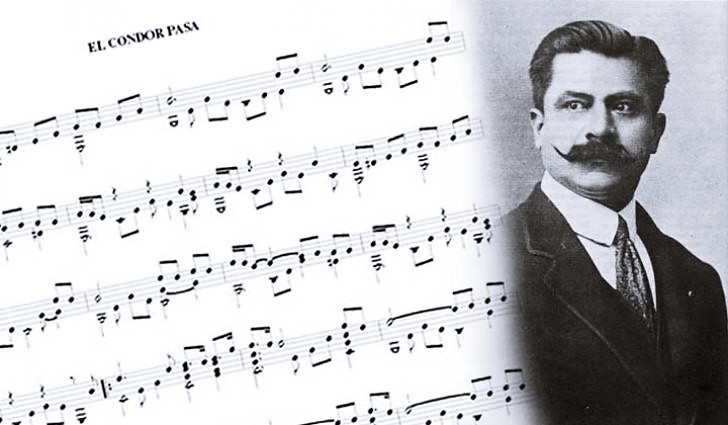
Daniel Alomía Robles
In the century that followed, the score’s homonymous ballad has been interpreted and recorded by countless artists around the world. Easily the most well-known rendition of this famous melody is Simon and Garfunkel’s “El Cóndor Pasa (If I Could),” (1970) which Dorr credits with catalyzing a Latin American music revival as well as spurring on a wave of Euro-American musicians and producers who collaborated with and brought into the international spotlight a number of groups who otherwise would have remained in relative obscurity. The tendency to see these projects as the work of (typically white) Westerners “discovering” and “saving” or paternalistically “curating” the dying musical cultures of the world, Dorr suggests, is part and parcel of a World Music concept that frames “primitive” traditions as fair game for extraction and appropriation into innovative sonic hybrids.
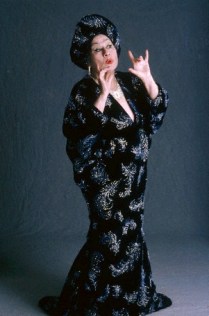
15 Nov 1991, Paris, France — Peruvian singer Yma Sumac
The “exotica” category follows the same logic, as the case of Yma Sumac illustrates. From the beginning of her career in the early 1940s with el Conjunto Folklórico Peruano to her 1971 psychedelic version of “El Cóndor Pasa,” Sumac’s vocal versatility and stylistic experimentations map out an experience of Andean indigeneity that Dorr hears in stark contrast to the narratives of the global music industry. While Capitol Records performed their own geography via their marketing of this sexualized “Incan princess,” the singer strategically composed her own sonic-spatial imaginary, not rejecting the difference suggested by “exotica,” but by synthesizing a “space-age” modern aesthetic with traditional songs. Dorr challenges us to listen to Sumac’s “El Cóndor Pasa” against Simon’s arrangement, thinking of her performative dissonances as disruptions of “the static geotemporal imaginaries of ‘authentic indigeneity’ that have most often informed the ballad’s deployment” (59).
If Chapter One makes a case for performance’s potential to shape notions of place and time, Chapter Two explores “spatial(ized) relations of musicking” (68) through a broader consideration of market strategies and the politics of sound in public space. Putumayo serves as another classic example of the global music industry’s pandering to multicultural idealism, promoting itself as “lifestyle company” that brings conscious capitalism into the curation of musical worlds. Dorr keeps her critique of Putumayo rather brief, but uses it as a convincing contrast for the focus of this chapter: the informal streams of economic activity and performance that she calls the “Andean music industry” (AMI). Among other examples from transnational and virtual “sites,” the Andean bands that performed in San Francisco’s Union Square throughout the 1990s demonstrate how performance geographies can challenge state and capitalist power while simultaneously running parallel to the marketing and distribution practices of the world music industry.
The AMI story is one of migration and the formation of a pan-Andean diaspora, of busking and bootlegging tactics that tested the boundaries of zoning and noise regulations as well as California’s immigration and labor policies, and of transposing music networks onto the internet when public performance became too precarious. It is also another case of dissonance, in which musicians willfully use their own cultural difference to their advantage, but not without consequences for poor musicians in South America; a telling example is the “Music of the Andes” CD, a mass-produced compilation used by various groups who, instead of having to record and press their own albums, could simply print their own covers for the Putumayoesque compilation and sell them to their none-the-wiser U.S. audiences (84).
But if the diasporic politics of the AMI came up short in challenging a monolithic representation of “Andean culture” or in highlighting the dynamic transits of Andean fusions such as chicha and Nueva Canción, the daily performances of street musicians in the race- and class-ordered Union Square support Dorr’s argument about the co-constitutive relationship between sound and space: “This unmediated display of embodied and sonic ‘otherness’ threatened the coherence of the square’s representational function by converting it into a spectacle of work and play for a population upon whose concealed labor the economic foundations of California’s wealth largely depend: undocumented migrant workers from the global South” (81).
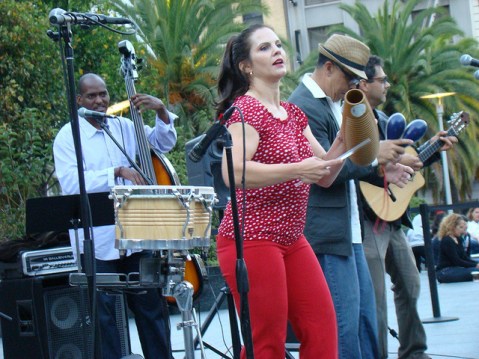
Busking in Union Square, 2013, Image by Flickr User Dr. Bob Hall
Elsewhere in 1990s San Francisco, musicians, artists, and activists formed a collective that, like the busking Andean groups, challenged dominant notions of public and private space while performing its own transnational and migratory experiences of Latinidad. In Chapter 4, Dorr relates the story of La Peña del Sur, a grassroots organization in the Mission District and, like the many anti-imperialist peñas popular throughout Latin America since the 1960s, a space for artists to perform or display their work for local audiences. While this peña provided a community for undocumented immigrants and local residents threatened by gentrification, it also served as an unsettling force against the sort of geographies that separate “queer space” from “heterosexual space” without regard for how these neighborhoods are also classed and racialized.
The founder and director of La Peña del Sur, Chilean exile Alejandro Stuart, was among several queer community members whose efforts constituted their shared space as a challenge to normative boundaries, a site for musicking that engendered dialogue among a wide range of people with divergent visions and motivations. Community organizers and students of cultural sustainability would do well to read Dorr’s account of this decade-long experiment that “enabled the exploration of sound-based solidarities rooted in the identification of common historical and political ground through improvisation and participatory performance” (168).

Victoria Santa Cruz, Image courtesy of Flickr User “Traveling Man”
Between these two compelling tales of the dynamic relationship of sound and space in San Francisco, Chapter 3 explores the significance of race, nation, gender, and sexuality within the performance geographies of several Afro-Peruvian artists. Dorr traces the movements of performers and activists who challenged the colonial boundaries that framed blackness as “antithetical to the emergent nation” (111); unlike the indigenous traditions that could be appropriated for an imagining of Peru as modern yet firmly rooted in history, Afro-Peruvian bodies and sounds were treated as contaminants within the postcolonial order.
Listening to Black feminist performance geographies, from Peru’s Black Arts Revival in the ’60s and ’70s to the recent hemispheric collaborations of “global diva” Susana Baca, one can hear the formation of not only such racially imagined communities as “the coastal” and the “Afro-Latinx diaspora,” but also of “the body.” A powerful case of this latter sort of performance is heard in the lyrics and experiences of Victoria Santa Cruz, who, in her choreographed, cajón- and chorus-accompanied poem, “Me Gritaron Negra,” contests the ways in which “[t]he physical contours of her body – her lips and skin and hair – become a geography inscribed with social meaning, an ideological imposition intended to enact and legitimate her ongoing displacement” (121).
Santa Cruz’s pedagogical and performative practices, in particular, reveal why Dorr has chosen sound – and not only broader analytics of performance and musicking – as a central theme to explore in terms of its relation to places and bodies. While this book might leave a few sound studies scholars wanting more elaborate description of particular sonic phenomena or ethnographic consideration of how sound is imagined among Dorr’s interlocutors, a few examples in particular are keys to thinking about how sound signifies, and is signified by, racially mapped bodies and places.
Most intriguing here is a discussion of Santa Cruz’s 1971 book, Discovery and Development of a Sense of Rhythm, which outlines the artist’s approach to “listen[ing] with the body” and tuning in to “rhythm’s Afro-diasporic logics” (116). A pedagogy and practice developed well in advance of Henri Lefebvre’s theory of rhythmanalysis, Santa Cruz’s concept of ritmo–internal rhythm— deserves consideration alongside the work of Amiri Baraka, Jon Michael Spencer, Fred Moten, and Daphne Brooks as crucial for thinking about how Black aesthetics and diasporic sensibilities are cultivated through sound and capable of mobilizing new mappings of bodies and their worlds.

Victoria Santa Cruz, still from el programa de La Chola Chabuca. (Video: América TV)
On Site, In Sound also calls for renewed thinking on sonic-spatial relations and the meanings that emerge from within them – how the sounds of particular Latin American voices and instruments come to be understood as masculine or feminine, indigenous or modern, exotic or local. Although “sound” as a specific performative or sensory medium might seem, at times, only one among many phenomena examined within the book’s threefold conceptual framing – listening, musicking, and performance – Dorr weaves it throughout her own performance geography where it takes on multiple forms and scales, challenging even the very boundaries defining what sound “is.” More importantly, this is a geography that scholars of “the sonic” or “music worlds” should read (and hear) as a reminder of sound’s unique ability to create and transcend boundaries – but rarely without a great deal of dissonance.
—
Featured Image: “Gabriel Angelo, Union Square,” by Flickr User Brandon Doran
—
Benjamin Bean is a PhD student in sociocultural anthropology at The University of California, Davis. His research interests include Afro-Caribbean music and sound, food and the senses, Puerto Rico, religion and secularism, and the Rastafari movement. During his undergraduate studies at Penn State Brandywine and graduate studies in cultural sustainability at Goucher College, Ben’s fieldwork focused on reggae music, the performativity of Blackness, and the Rastafari concepts of Word, Sound, and Power and I-an-I. His current fieldwork in Puerto Rico examines flavor, taste, and marketing in the island’s growing craft beer movement. Ben was formerly a vocalist and bass guitarist with the Philadelphia-based roots reggae band, Steppin’ Razor.
—
 REWIND!…If you liked this post, you may also dig:
SO! Reads: Dolores Inés Casillas’s ¡Sounds of Belonging!–Monica De La Torre
SO! Reads: Roshanak Khesti’s Modernity’s Ear–Shayna Silverstein
SO! Reads: Licia Fiol-Matta’s The Great Woman Singer: Gender and Voice in Puerto Rican Music–Iván Ramos
Share this:

Playin’ Native and Other Iterations of Sonic Brownface in Hollywood Representations of Dolores Del Río
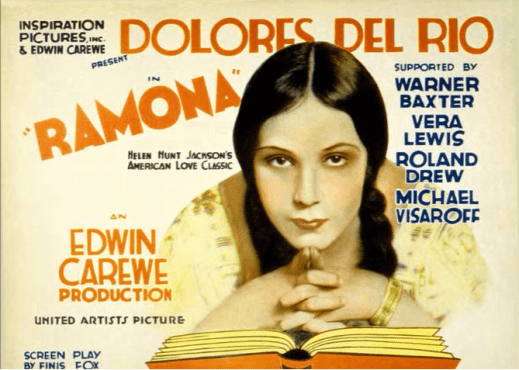
Mexican actress Dolores Del Río is admired for her ability to break ground; her dance skills allowed her to portray roles not offered to many women of color early in the 20th Century. One of her most popular roles was in the movie Ramona (1928), directed by Edwin Carewe. Her presence in the movie made me think about sonic representations of mestizaje and indigeneity through the characters portrayed by Del Río. According to Priscilla Ovalle, in Dance and the Hollywood Latina: Race, Sex and Stardom (2010), Dolores del Río was representative of Mexican nationhood while she was a rising star in Hollywood. Did her portrayals reinforce ways of hearing and viewing mestizos and First Nation people in the American imaginary? Is it sacrilegious to examine the Mexican starlet through sonic brownface? I explore these questions through two films, Ramona and Bird of Paradise (1932, directed by King Vidor), where Dolores del Río plays a mestiza and a Polynesian princess, respectively, to understand the deeper impact she had in Hollywood through expressions of sonic brownface.
Before I delve into analysis of these films and the importance of Ramona the novel and film adaptions, I wish to revisit the concept of sonic brownface I introduced here in SO! in 2013. Back then, I argued that the movie Nacho Libre and Jack Black’s characterization of “Nacho” is sonic brownface: an aural performativity of Mexicanness as imagined by non-Mexicans. Jennifer Stoever, in The Sonic Color Line (2017), postulates that how we listen to particular body(ies) are influenced by how we see them. The notion of sonic brownface facilitates a deeper examination of how ethnic and racialized bodies are not just seen but heard.
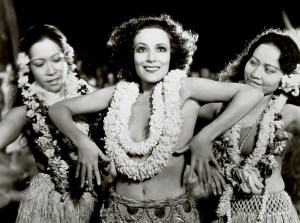
Picture of Del Rio as Luana in BIRDS OF PARADISE, available in the public domain.
Through my class lectures this past year, I realized there is more happening in the case of Dolores del Río, in that sonic brownface can also be heard in the impersonation of ethnic roles she portrayed. In the case of Dolores del Río, though Mexicana, her whiteness helps Hollywood directors to continue portraying mestizos and native people in ways that they already hear them while asserting that her portrayal helps lend authenticity due to her nationality. In the two films I discuss here, Dolores del Río helps facilitate these sonic imaginings by non-Mexicans, in this case the directors and agent who encouraged her to take on such roles. Although a case can be made that she had no choice, I imagine that she was quite astute and savvy to promote her Spanish heritage, which she credits for her alabaster skin. This also opens up other discussions about colorism prevalent within Latin America.
 First, let us focus on the appeal of Helen Hunt Jackson’s Ramona (1884), as it is here that the cohabitation of Scots, Spanish, Mestizos, and Native people are first introduced to the American public in the late 19th century. According to Evelyn I. Banning, in 1973’s Helen Hunt Jackson, the author wanted to write a novel that brought attention to the plight of Native Americans. The novel highlights the new frontier of California shortly after the Mexican American War. Though the novel was critically acclaimed, many folks were more intrigued with “… the charm of the southern California setting and the romance between a half-breed girl raised by an aristocratic Spanish family and an Indian forced off his tribal lands by white encroachers.” A year after Ramona was published, Jackson died and a variety of Ramona inspired projects that further romanticized Southern California history and its “Spanish” past surged. For example, currently in Hemet, California there is the longest running outdoor “Ramona” play performed since 1923. Hollywood was not far behind as it produced two silent-era films, starring Mary Pickford and Dolores del Río.
The charm of the novel Ramona is that it reinforces a familiar narrative of conquest with the possibility of all people co-existing together. As Philip Deloria reminds us in Playing Indian (1999), “The nineteenth-century quest for a self-identifying national literature … [spoke] the simultaneous languages of cultural fusion and violent appropriation” (5). The nation’s westward expansion and Jackson’s own life reflected the mobility and encounters settlers experienced in these territories. Though Helen Hunt Jackson had intended to bring more attention to the mistreatment of native people in the West, particularly the abuse of indigenous people by the California Missions, the fascination of the Spanish speaking people also predominated the American imaginary. To this day we still see in Southern California the preference of celebrating the regions Spanish past and subduing the native presence of the Chumash and Tongva. Underlying Jackson’s novel and other works like Maria Amparo Ruiz De Burton The Squatter and the Don (1885) is their critique of the U.S. and their involvement with the Mexican American War. An outcome of that war is that people of Mexican descent were classified as white due to the signing of Treaty of Guadalupe Hidalgo and were treated as a class apart. (See Michael Olivas’ anthology, Colored Men and Hombres Aqui from 2006 and Ignacio M. García, White but not Equal from 2008). These novels and films reflect the larger dominant narrative of whiteness and its relationship to nation building. Through Pickford’s and del Río’s portrayals of Ramona they reinforce the whiteness of mestizaje.

Screenshot from RAMONA (1910). Here, Ramona (played by Mary Pickford) finds out that she has “Indian blood.”
In 1910, Mary Pickford starred in D.W. Griffith’s short film adaptation of Ramona as the titular orphan of Spanish heritage. Henry B. Walthall played Alessandro, the Native American, in brownface to mimic physical attributes of the native Chumash of Southern California. Griffith also wanted to add authenticity by filming in Camulas, Ventura County, the land of the Chumash and where Jackson based her novel. The short is a sixteen-minute film that takes viewers through the encounter between Alessandro and Ramona and their forbidden love, as she was to be wedded to Felipe, a Californio. There is a moment in the movie when Ramona is told she has “Indian blood”. Exalted, Mary Pickford says “I’m so happy” (6:44-6:58). Their short union celebrates love of self and indigeneity that reiterates Jackson’s compassionate plea of the plight of native people. In the end, Alessandro dies fighting for his homeland, and Ramona ends up with Felipe. Alessandro, Ramona, and Felipe represent the archetypes in the Westward expansion. None had truly the power but if mestizaje is to survive best it serve whiteness.
.jpg#filelinks)
Poster of 1928’s RAMONA, under fair use
Edwin Carewe’s rendition of Ramona in 1928 was United Artists’ first film release with synchronized sound and score. Similar to the Jazz Singer in 1927, are pivotal in our understanding of sonic brownface. Through the use of synchronized scored music, Hollywood’s foray into sound allowed itself creative license to people of color and sonically match it to their imaginary of whiteness. As I mentioned in my 2013 post, the era of silent cinema allowed Mexicans in particular, to be “desirable and allowed audiences to fantasize about the man or woman on the screen because they could not hear them speak.” Ramona was also the first feature film for a 23-year-old Dolores del Río, whose beauty captivated audiences. There was much as stake for her and Carewe. Curiously, both are mestizos, and yet the Press Releases do not make mention of this, inadvertently reinforcing the whiteness of mestizaje: Del Río was lauded for her Spanish heritage (not for being Mexican), and Carewe’s Chickasaw ancestry was not highlighted. Nevertheless, the film was critically acclaimed with favorable reviews such as Mordaunt Hall’s piece in the New York Times published May 15, 1928. He writes, “This current offering is an extraordinarily beautiful production, intelligently directed and, with the exception of a few instances, splendidly acted.” The film had been lost and was found in Prague in 2005. The Library of Congress has restored it and is now celebrated as a historic film, which is celebrating its 90th anniversary on May 20th.
In Ramona, Dolores del Río shows her versatility as an actor, which garners her critical acclaim as the first Mexicana to play a starring role in Hollywood. Though Ramona is not considered a talkie, the synchronized sound comes through in the music. Carewe commissioned a song written by L. Wolfe Gillbert with music by Mabel Wayne, that was also produced as an album. The song itself was recorded as an instrumental ballad by two other musicians, topping the charts in 1928.
In the movie, Ramona sings to Allessandro. As you will read in the lyrics, it is odd that it is not her co-star Warner Baxter who sings, as the song calls out to Ramona. Del Río sounds angelic as the music creates high falsettos. The lyrics emphasize English vernacular with the use of “o’er” and “yonder” in the opening verse. There are moments in the song where it is audible that Del Río is not yet fluent speaking, let alone singing in English. This is due to the high notes, particularly in the third verse, which is repeated again after the instrumental interlude.
I dread the dawn
When I awake to find you gone
Ramona, I need you, my own
Each time she sings “Ramona” and other areas of the song where there is an “r”, she adds emphasis with a rolling “r,” as would be the case when speaking Spanish. Through the song it reinforces aspects of sonic brownface with the inaudible English words, and emphasis on the rolling “rrrr.” In some ways, the song attempts to highlight the mestiza aspects of the character. The new language of English spoken now in the region that was once a Spanish territory lends authenticity through Dolores del Río’s portrayal. Though Ramona is to be Scottish and Native, she was raised by a Spanish family named Moreno, which translates to brown or darker skin. Yes, you see the irony too.

United Artists Studio Film Still, under Fair Use
Following Del Río’s career, she plays characters from different parts of the world, usually native or Latin American. As Dolores del Río gained more popularity in Hollywood she co-starred in several movies such as Bird of Paradise (1932), directed by King Vidor, in which she plays a Polynesian Princess. Bird of Paradise focuses on the love affair between the sailor, played by Joel McCrea, and herself. The movie was controversial as it was the first time we see a kiss between a white male protagonist with a non-Anglo female, and some more skin, which caught the eye of The Motion Picture Code commission. Though I believe the writers attempted to write in Samoan, or some other language of the Polynesian islands, I find that her speech may be another articulation of sonic brownface. Beginning with the “talkies,” Hollywood continued to reiterate stereotypical representations though inaccurate music or spoken languages.
In the first encounter between the protagonists, Johnny and Luana, she greets him as if inviting him to dance. He understands her. He is so taken by her beauty that he “rescues” her to live a life together on a remote island. Though they do not speak the same language at first it does not matter because their love is enough. This begins with the first kiss. When she points to her lips emphasizing kisses, which he gives her more of. The movie follows their journey to create a life together but cannot be fully realized as she knows the sacrifice she must pay to Pele.
I do not negate the ground breaking work that Dolores del Río accomplished while in Hollywood. It led her to be an even greater star when she returned to Mexico. However, even her star role as Maria Candelaria bares some examination through sonic brownface. It is vital to examine how the media reinforces the imaginary of native people as not well spoken or inarticulate, and call out the whiteness of mestizaje as it inadvertently eliminates the presence of indigeneity and leaves us listening to sonic brownface.
—
reina alejandra prado saldivar is an art historian, curator, and adjunct lecturer in the Women, Gender and Sexuality Studies Program and Liberal Studies Department at CSULA and in the Critical Studies Program at CALArts. As a cultural activist, she focused her earlier research on Chicano cultural production and the visual arts. Prado is also a poet and performance artist known for her interactive durational work Take a Piece of my Heart as the character Santa Perversa (www.santaperversa.com) and is currently working on her first solo performance entitled Whipped!
—
Featured image: Screenshot from “Ramona (1928) – Brunswick Hour Orchestra”
—
 REWIND!…If you liked this post, you may also dig:
Afecto Caribeño / Caribbean Affect in Desi Arnaz’s “Babalú Aye” – reina alejandra prado saldivar
SO! Amplifies: Shizu Saldamando’s OUROBOROS–Jennifer Stoever
SO! Reads: Dolores Inés Casillas’s ¡Sounds of Belonging! – Monica de la Torre
Share this:




Current Top Posts





April 2021

January 2020

November 2019

October 2019

August 2019

April 2014

November 2017

March 2015

December 2017

October 2015
 Sounding Out!
Recent Comments