
Radical Listening and the People’s Microphony: A Conversation with Elana Mann
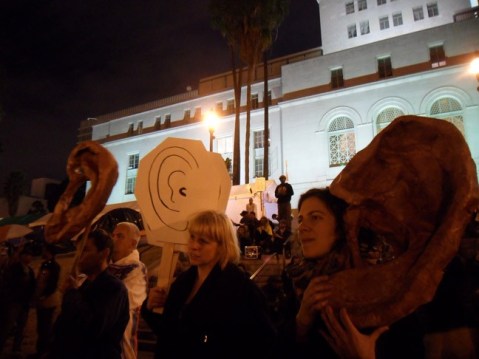
Members and collaborators of ARLA (Paula Cronan, Juliana Snapper, and Elana Mann) participating in a General Assembly at Occupy LA City Hall, November 11, 2011
Listen to everything all the time and remind yourself when you are not listening–Pauline Oliveros
“CAN YOU HEAR ME?!” “I CAN HEAR YOU!!” “IT’S A VAN GOGH PARADE!!” . . .were some of the enthusiastic replies when artist Elana Mann, musician Juliana Snapper, and other members of ARLA (Audile Receptives Los Angeles) arrived on the scene at Occupy LA with giant hand-made ears. Mann co-founded ARLA in the Spring of 2011 with Snapper, filmmaker Vera Brunner-Sung, and choreographer Kristen Smiarowski. After studying scores and techniques on listening developed by composer Pauline Oliveros, ARLA developed a workshop geared toward Occupy LA that included a listening parade in which they held up the giant ears and protest signs with ears on them. Snapper recalls, “The simple physical presence of people carrying large paper-mache ears was met with a kind of hungry recognition…recognition of what it meant that we were holding the symbols (giant ears).” They led workshops, listening sessions, and discussion groups. They performed Oliveros’ sonic meditation “Teach Yourself to Fly” and a composition written by Mann and Snapper entitled “People’s Microphony.” And a project was born. Through personal interviews and audio-visual examples, I document, contextualize, and analyze its work. 
Mp3=The People’s Microphony Camerata performing “Teach Yourself to Fly” Pauline Oliveros
I am happy that Elana Mann chose to use my Sonic Meditations for the People’s Microphony project. These pieces are meant for anyone that wants to perform them regardless of musical training.” –Pauline Oliveros
For Mann, active listening is “a process of tuning in simultaneously inward and outward. Active listening allows for an awareness of and an opening up to sounds around me and also a digestion of what is happening inside of me in relation to these sounds.” Much of the recent focus on this practice comes from the music and sound art worlds, as well as acoustic ecology, a field formed from the overlapping area between science and art that concentrates on the importance of experiencing and investigating our sonic surroundings with detailed care and respect to understand its importance on our world and our place within it. Mann’s work addresses a unique angle at the intersection of these fields: listening’s empathetic effect on those whom you are listening to, a consideration arising from a project she worked on between 2007-2010 with Iraq war veteran Captain Dylan Alexander Mack, called “Can’t Afford the Freeway.”
. “Can’t Afford the Freeway” highlights how her collaborations emerge as conversations between involved artists as well as the audience. Speaking to Mann about the project, she stated,Alex created some recordings for me and I kept listening to them over and over again trying to figure them out. I eventually produced more interviews with him and realized that he needed his story to be heard and I needed to try and understand his story. So I created a project in which I attempted to listen as best I could. Listening to his recordings made me feel close to him, but I also recognized that no matter how many times I heard his words they were still foreign to me. Still the very act of me struggling to listen was important for both of us, and I think this is true of many interpersonal/political and social situations. You can never experience what it is like to be someone else, but active listening opens up a space of empathy and connection. I also think we can see how a lack of active listening is affecting the political landscape in the United States so negatively, by producing a highly polarized and vitriolic environment.
And what about at Occupy LA?
At Occupy LA I was hopeful that there would be a place for listening to voices that had not been heard before and sometimes that happened. Other times people used the space for projecting, not receiving. I think that there needs to be strong voices making themselves heard, but I don’t want to lose the other part of that equation, which is those voices being quiet and listening to others, and themselves.

ARLA Ear Strengthening Workshop, Occupy LA site, November 11, 2011, Photo by Carol Cheh
Mann, thinking and researching about social, aesthetic, and political points of listening and voicing, felt there was something to be considered about the “radical receptivity and the core message of the OWS movement” and its global amplification of voices struggling to be heard. In the Spring of 2012, she formed The People’s Microphony Camerata with Snapper, a radical experimental choir based in Los Angeles exploring the process of the People’s Microphone. The exact history of the “People’s Microphone,” or “People’s Mic” is unclear, but its use in the Occupy Movement has already become iconic. Ted Sammons discusses the implications of the People’s Mic for communication in his October 2011 post, “‘I didn’t say look; I said listen’: The People’s Microphone, #OWS, and Beyond.” The human microphone is a way to deliver one person’s message to a large group of people in situations where amplification tools, such as bullhorns, are either not allowed or unavailable, or if the acoustics of a space distort amplification. The speaker calls, “mic check!” to alert their intentions. Those around them call back, “mic check!”, until the gathering understands something will be said. The speaker breaks their statement into short sentences, pausing to allow those around them, or the “first wave,” to repeat them in unison. They then pause for those further away, or the “second wave,” to repeat again…and so on until those in the back of the gathering have heard the statement.
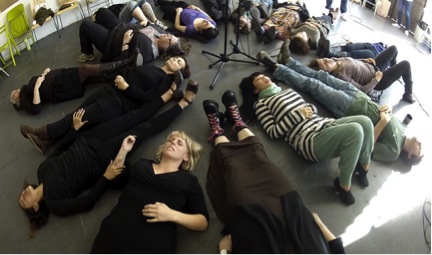
Members of People’s Microphony Camerata rehearsing in Los Angeles, April 15, 2012, Photo by Jean-Paul Leonard
The group’s trademark intensity sometimes carried over to the audience. Mann discovered such transference often had to do with prior associations with a location or context. Mann recalled a particular performance at the Occupy movement called “Chalkupy” that was formed in response to a protest running simultaneously with the LA Art Walk, in which activists had handed out chalk and told stories of police repression while chalk drawings were created on the walkways. The police shut down the art walk and a violent struggle ensued. The Occupy LA movement called for people globally to take to the street with chalk in protest, and the day was called “Chalkupy”. The audience of protestors was mixed and tense, and when the PMC began their performance of a highly emotive score called “Sob-Laugh” by Daniel Goode, people were either drawn to or repelled by the performance.
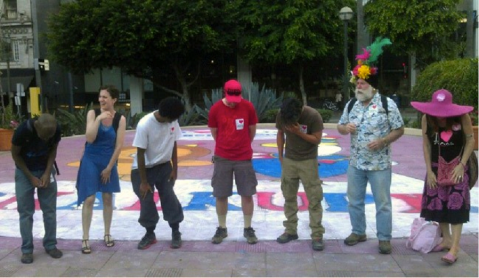
The PMC performing “Sob Laugh” at the “Chalkupy” protest in downtown Los Angeles, Image by Daniel Goode
I think there was some fear about the vulnerable revelation of emotions in the space of the protest. Many of the Occupy LA protests were so risky that everyone had to be extremely tough to exist in that activist space. I respect that. Still I think there are other things that can happen in a space of protest that bring out different feelings. Some activists wanted us to be more musically conventional, “why can’t you just sing some folk songs like normal protest choirs,” we were asked. But we really were not into that kind of thing. . .
In most protest situations, the audiences welcomed their activities. Many shared that it opened up a new space where people could meet each other as humans rather than adversaries or collaborators. Mann edited and published a monochromatic grassroots songbook with the various scores the PMC received for performance, opening up the circle for anyone and everyone to perform and feel that closeness.
Sometimes it was hard to translate a piece that worked during a group rehearsal to something for an audienceperformer situation. . .The PMC never fully developed how to deal with audience participation, but this is something I have been developing on my own in working with students on PMC materials. The scores from the People’s Microphony Songbook and the techniques Juliana and I developed when we first formed the PMC create an immediate closeness within a group, which is remarkable.

From the “People’s Microphony Songbook”: Many voices that were once silenced are now resonating through large crowds, not only of activists, but ordinary people all over the world, assisted by internet networks, and a simple technology called the People’s Microphone. The People’s Mic expressed the interrelated desires of collective and individual voices to speak and be heard, to hear one’s words spoken back through different mouths, and to digest someone else’s words through one’s own body. Beyond projecting an individual’s voice further then it can resonate on its own, the People’s Mic has implications for all of the bodies in its vicinity. It energizes listeners in ways the microphone or megaphone cannot by making listening active, vocal, and embodied. The project, like the Occupy movement, holds all the complexity, beauty, and drive of being human, whether you consider it “working” or not. When I asked Mann about how changes within and towards the Occupy Movement affected the choir, and whether they were winding down or taking a new form, she answered:
I think more than anything else, our group faced a lot of the same challenges that the Occupy Movement faced challenges in horizontality, in the push and pull between interior and exterior exploration, in the sometimes painful vulnerability of investigating the intimate personal and political space with others. I think the project is still developing. The choir still communicates, and some members are currently collaborating with composer Daniel Corral, but the PMC does not meet and rehearse like we used to I think it will continue to wax and wane. In the meantime, I am still working on ideas of active listening. I am currently creating a project called “Listening as (a) movement” within an under-served neighborhood in Pasadena, CA, exploring ideas of radical listening within a specific neighborhood.
In an age of constant bombardment of stimuli, our heads scream with thoughts, opinions, arguments, and expressions. With our current technology, our input and output can be a constant rush of snap reactions and impulses, which has a profound effect, of course, on our day-to-day lives, on our culture(s), on our politics. But these circles cannot be affectively complete without the other side. We need someone to hear us, and, more then that, we need someone to listen to us. And we, in turn, need to listen to them.
—
Maile Colbert is a multi-media artist with a concentration on sound and video who relocated from Los Angeles, US to Lisbon, Portugal. She is a regular writer for Sounding Out!
—
 REWIND! . . .If you liked this post, you may also dig:
“Sensing Voice”–Nina Sun Eidsheim
“Within a Grain of Sand: Our Sonic Environment and Some of Its Shapers”–Maile Colbert
“Listening to #Occupy in the Classroom”–Travers Scott
Share this:

Listening to Disaster: Our Relationship to Sound in Danger
 Editor’s Note: Welcome to Sounding Out!‘s World Listening Day Extravaganza! Enjoy this special bonus “soundtracked” post by multimedia artist (and new Sounding Out! regular) Maile Colbert –full of field interviews with artists and acoustic ecologists such as Marc Behrens, Andrea Polli, Bernie Krause, and Peter Cusack–as well as a podcast produced by Eric Leonardson, Director of the World Listening Project. (Click HERE to go to the podcast). For the full introduction to the World Listening Month! series click here. To peep the previous posts, click here. And remember, here at Sounding Out! every day is for listening. . .so meet us here for the 364 days between WLDs for more aural treasures and sonic thought.–JSA
—-
Even the surrounding hills were hushed, as if brought low by language. –from Grendel by John Gardner
Under good weather conditions in 2007, six artists, two curators, and two guides set out towards the Brenndalsbreen glacier in Vestlandet, Norway. An arm of the largest glacier in continental Europe, the Brenndalsbreen is maintained by high snowfall rates rather than cold temperatures, so the glacier has high melting rates. Since 2000, Brenndalsbreen has retreated 276 meters (820 feet). The group was the first to venture there that spring, the winter being too dangerous. Marc Behrens, one of the artists present, received permission to follow a guide down a crevice in a tongue of the glacier. There, surrounded by walls of ice, he began to record the melting drops that feed the glacial river flowing underneath. It was in this moment that Marc heard a change in the sound that signaled to him he may be in life-threatening danger, but due to the focus of the equipment he was using, he had no way to perceive how dangerous that threat may be.
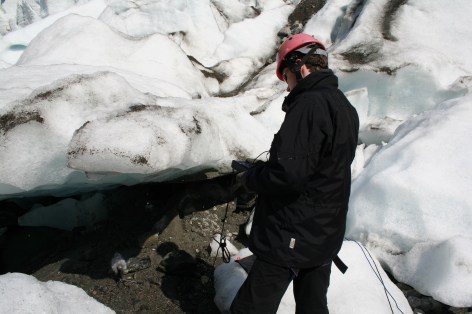
Photo of Marc Behrens by Jørgen Larsson.
A question to Marc Behrens: “Can you describe your process of perception between thought and hearing within your personal story of disaster?”
When the crashing ice announced itself by the little crunch, I assumed it was merely a modulation in the noises the glacier made anyway – I was very calm listening to the beautifully trickling melt water drops – basically a stream of the same minuscule sounds over a long period of time. I appreciated this and it did not occur to me that it could have been the start of a more dramatic and quick development.
Then, as a surprise I heard that loud crash, which, as I had (bad) headphones on and listened to the microphone input which was directional, I could not relate the spatialization in the headphones to the physical surrounding. In the recording it seems smaller than it was – but it seemed as if the whole glacier just came down on me – sonically. I could not localize the sound, so I could not escape in any direction as I did not know where to. So I decided to stay where I was and just raise my hands/arms to protect my head as much as possible. I perceived a rush of adrenalin but remained lucid, especially as there was nothing else to do, and hence no possibility to fail. I mean: I could just wait and hope I would not be injured. And so, I waited for a moment more after the crash, then stopped the recorder and went out from the protruding ice to signal the others that I was okay.
In 2011, the disastrous 2011 Tohoku earthquake and tsunami devastated Japan. Within its horrific footprint, a number of nuclear accidents affected hundreds of thousands of residents with radiation levels up to eight times what are considered normal. Many other radioactive hot spots were also found outside the evacuated radius, including within Tokyo. All over social networks, people posted photos, videos, and sound clips of their Geiger counters reading the radioactivity in their homes and neighborhoods. The process a Geiger counter uses is called sonification, a form of auditory display that uses non-speech audio to convey information. As I played a sound file from a friend of the above-normal readings in his kitchen in Tokyo, I was unnerved by the ominous, staticky click, like the chirping of some robotic insect.
In fact, the entire event was sonically terrifying. Some of the most chilling recordings I heard from the underwater earthquake and the birth of the tsunami were picked up by the hydrophones of the National Oceanic Atmospheric Administration’s VENTS Program. The Tohoku earthquake was the largest sound they had ever picked up.
Using the seismic data from this same quake, audio programmer and artist Micah Frank used his creation Tectonic, a real-time seismic analysis and sound synthesis system, to sonify the sounds of the earth shifting and opening that fateful day. With Tectonic, sound is created in real-time by seismic activities as they occur across the globe. Using magnitude, elevation, time of day, and geographical coordinates, the data is mapped to synthetic spectrums and processed by granular, aggregate and subtractive synthesis.
Tectonic: Earthquakes Generate Music in Realtime from Micah Frank on Vimeo.
But is this more artistic and emotive approach effective in conveying the disaster, if that is even the point? Most comments on his Soundcloud track range from “cool sounds” to “I’ll send you the remix when it’s done.” When compared to the hydrophonic recordings from the VENTS program, perhaps the use of data to sonify is too abstracted from the event itself.
Digital media artist Andrea Polli takes a different approach to sonification. During the 2007/2008 season Polli was on site in Antarctica conducting work through the National Science Foundation residency, working with scientists gathering weather and climate data. Here she created the project 90 Degrees South, which “aims to communicate both the aesthetic beauty and the scientific importance of Antarctica to global climate.” This project gave birth to the audio album, Sonic Antarctica, which uses field recordings, sonifications, and audifications of the collected data.
.
To Andrea Polli: “How can sonification help us understand climate change?”
One thing that comes to mind is that sound and music can provoke an emotional (or at least affective) response that is not always possible through graphs and images. For example I have used low, almost sub-aural sounds in data sonifications to promote a visceral response in the listener to various atmospheric events. . .
I have worked with weather and air quality data in real time, both using on-site data or remote data. To become attuned to the remote data takes some time and quiet listening, to me it is like being in two places at once, for example in a gallery or on-line and at a remote site near the North Pole.
Often we associate catastrophes with massive and sudden sounds. We give animalistic descriptions to the sounds made by what we call natural disasters, such as growling tornado, roaring avalanche, shrieking cyclone, groaning earth. This practice speaks to our complex relationship with nature, connecting us to it and taking us out of it at the same time. But what of the slow silencing that happens to our soundscapes when certain species die out? Such quiet disasters affect everything, sadly in ways we don’t (and won’t) notice until too late.

Dr. Bernie Krause in the field
In The Great Animal Orchestra, author, musician, soundscape recordist, bio-acoustician and naturalist Bernie Krause coins the term, biophony, to help ecologists, biologists, acoustic scientists, and others to understand the long-term impact of disasters, particularly silent ones. Biophony refers to the collective sound vocal non-human animals create in each given environment. We face many compounding problems with the silencing of certain species and the quieting of a whole biophony, not the least of which is our connection with the world.
Krause provides some powerful examples of silenced biophonies in his book, such as the story of the Wy-am tribe in the Northwestern United States, whose history has been intertwined with the Celilo Falls, a waterfall just west of the Columbia River’s midway point, for thousands of years. Wy-am means “the echo of falling water.” Krause writes: “so central were the falls to the tribe that the Celilo was considered a sacred voice through which divine messages were conveyed.” It was also their yearly source for fish. In 1957, when the Dalles Dam gates were ordered shut by the U.S. Army Corps of Engineers, the waterfall and fishing site were completely submerged, sending the Wy-am into a state of mourning that continued to subsequent generations.
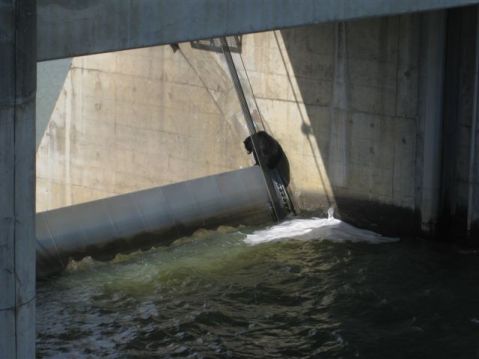
Black Bear at the Dalles Dam and Lock, Image by the Army Core of Engineers
Krause cites several similar “silencings” in his book using spectrographs. Similar to sonification, Krause’s spectrograms give form and shape to “silent” disasters. A particularly sad example for me, coming as I do from a family from the Hawaiian Islands, is the recorded comparisons of the coral reef in Vanua Levu, Fiji, that has been devastated by warming waters, shifts in pH, and pollution.
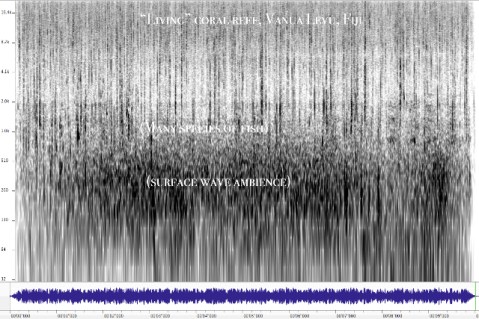
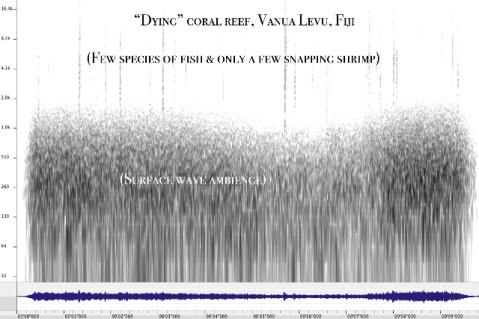
courtesy of Bernie Krause from The Great Animal Orchestra (72-73)
Krause also recorded twice at the Lincoln Meadow “forest management area” in the Sierra Nevadas, once before mass logging went into effect, and once after, a year later on the same date, time, and same weather conditions. While visually it seemed that little had changed, Aurally it was a different story:
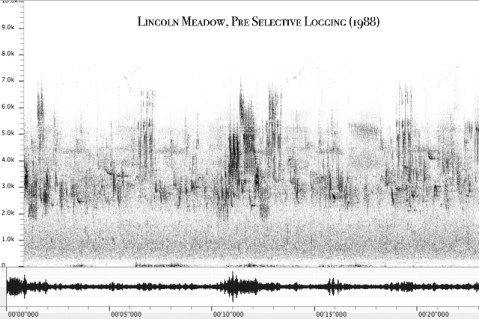
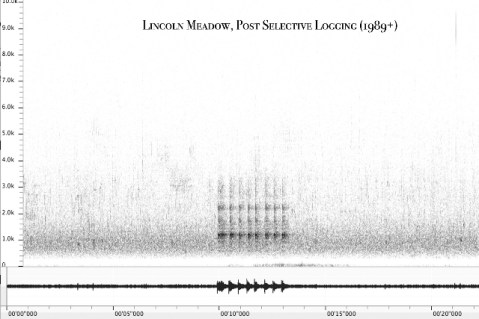
courtesy of Bernie Krause from The Great Animal Orchestra (69-71)
To Bernie Krause: “We have a tendency to attribute ‘loud’ to the perspective of a disastrous event. Can you discuss the relationship of silence to disaster?”
In the natural world there are so many events that, to the “rational” human mind, appear to be contradictions. For instance, after the 11 September 01 disaster, which resulted in cancellation of all domestic and private aircraft flights and a reduction of automobile traffic around our house in the far western United States, the natural soundscape (biophony) returned in a way that we had never heard it before…even in September…late summer when almost all of the birds have fledged and gone elsewhere. And then there’s the reference in the book to the return of the biophony around Chernobyl, recorded by Peter Cusack from the UK. On the other hand, after some types of disasters, the immediate silence appears to happen because all of the vocal creatures have to reassess their acoustic territory, and, depending on the biome, takes anywhere from minutes to years, to recover a stable biophonic expression.
UK artist Peter Cusack’s Sounds from Dangerous Places, sought recordings from disaster sites like the Chernobyl exclusion zone in the Ukraine, the Caspian oil fields in Azerbaijan, the Chernobyl-fallout affected farmlands of Northern Wales, and the rivers of Eastern Turkey with their extensive, local climate altering dams. What is surprising and moving about these works is the strong human element, especially the lack of human presence and the evolving relationship of humans to these post-disaster soundscapes.
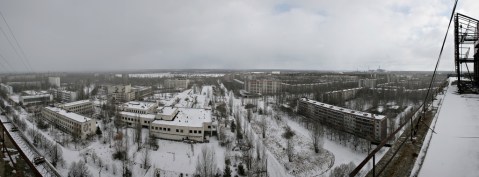
Chernobyl Exclusion Zone Panorama by Pedro Moura Pinheiro
Listening to some of Cusack’s recordings from Chernobyl, one might feel surprised to hear that iconic name attached to such rich and pastoral soundscapes. When we consider the massive industrial accident that killed thousands and created an exclusion zone of 30 kilometers (19 miles), some of us are compelled to imagine a wasteland…not a living creature in sight. But those like Cusack who have visited the area are met with quite a different experience, one we can share when listening to the recordings. Cusack says Chernobyl held the richest dawn bird choruses he has ever recorded; haunting full choruses of frogs and nightingales sound throughout the night. And again we hear that iconic sound of the Geiger counter increasing its metallic chirp as Cusack walks toward an infamous radioactive hotspot, at one point it makes an eerie duet with a calling cuckoo.
To Peter Cusack: “How has the sound of dangerous places surprised you?”
Dangerous places can be both sonically and visually compelling, even beautiful and atmospheric. There is, often, an extreme dichotomy between an aesthetic response and knowledge of the ‘danger,’ whether it is pollution, social injustice, military or geopolitical.
In the context of the Sounds from Dangerous Places project ‘dangerous places’ are mostly areas of major environmental damage, but also include nuclear sites or the edges of military zones. The danger is not usually to short-term visitors, but to local people who have no option but to stay or more widely through the location’s role in global power politics.
Many aspects of dangerous places are a surprise, mostly because ones expectations are often wide of the mark, especially in the smaller details. However different places surprise one very differently. For example the name ‘Chernobyl exclusion zone’ implies no one is there. Not so. Thousands still work at the site, some live there and some commute in every day (by rail, so trains are part of the soundscape). That many people also require restaurants, bars, administration and all the infrastructure of a small town. So people and work sounds of all kinds are still to be heard around Chernobyl town and the nuclear sites. Some of the villagers, originally evacuated out, have returned bringing their sounds too – horses, chickens, carts, hand farming, traditional songs, modern day TV. The zone is also now a wildlife haven and the sounds of the dawn and evening chorus of spring are intense. The vibrant recordings of wildlife show that many species, at least, are doing fine in the exclusion zone. . .
In other places, though, sounds gives no indication of the danger. In the borough of Uttlesford, also just outside London, one hears church bell, over flying aircraft, cats mewing, cars passing, lawn mowing and common birds singing. It’s exactly as expected for one of the wealthiest areas in South East England. It also produces the greatest amount of domestic greenhouse gas of anywhere in the country.
I want to leave you with the example of the elephant seal, not as a “success story” but as an example of the great responsibility that humans have to know and be aware of our impact on a whole biophony, a whole ecosystem, a whole planet. When we think to such scales, there can be the tendency to look at the dying out of a single species as not so catastrophic. But we forget the interconnectivity of things, and how one species affects another, as well as its surroundings and its future. Sound can herald disaster, but it can also signal the potential for renewal, too.
The northern elephant seals once boasted colonies of hundreds of thousands in the Pacific Ocean. By 1892 only 50 to 100 individual seals were left, until in 1922 the Mexican government gave protective status, pressuring the U.S. government into following suit, and today their numbers are up to approximately 160,000. Known for their distinct vocalization, especially in the males, the large proboscis of the elephant seal is used to emit a loud roaring sound. From chortles to growls to screams to melodic sighs, their frequency range and detailed expression is amazing to listen to.

Elephant Seals in Año Nuevo, Image by the author
With growing numbers, the seals started populating Año Nuevo in California in 1955, now dominating the biophony against the waves with various sea birds, sea lions from an offshore island, frogs, and the occasional bark towards the evening and night hours from coyotes and foxes. It is one of the most vibrant and unique soundscapes I have ever experienced, weighted with the thought of how close it came to me never hearing their calls in the wild.
There is a moment upon hiking into the park where you can hear the seals’ voices being carried on the ocean wind, but only sand dunes lay in front of your eyes. Skin pricks up at such a strange sound; my companion admitted excitement and a little fear upon hearing it. The look on her child’s face, however, was priceless wonder. Thousands of tourists come every year to see these magnificent beast, but mostly to listen to these calls, that were, once upon a time not too long ago, almost silenced forever.
—
This post is dedicated to Dr. Donald Allen Colbert, who sparked wonder in the world beyond what I could see…
__
Featured Image Credit: Air Raid Siren by Flickr User Wader
__
Maile Colbert is an intermedia artist with a concentration in sound and video, living and working between New York and Portugal. She is an associated artist at Binaural/Nodar and director of Cross the Pond, an organization based on arts exchange between the U.S. and Portugal. She holds a BFA in Studio for Integrated Media at Massart, and a MFA in Integrated Media/Film and Video from Calarts. She has had multiple screenings, exhibits, and shows, including The New York Film Festival, Ear to Earth Festival, LACE, MOMA, LACMA, the REDCAT Theater in Los Angeles, The PDX Film Festival, Future Places Festival Oporto, HOERENSEHEN 2.0 Berlin, Störung Festival Barcelona, Teatra Municipal in Guarda, Observitori Festival Valencia, and has performed and screened widely in Japan, Europe, Mexico, and North America, and co-composed for a featured installation at the 2009 UN Climate Conference. She was a visiting lecturer teaching at UCSD and Escola Superior de Teatro e Cinema, and guest artist and lecturer at NYU, MassArt, Calarts, SUNY Buffalo, SUNY Binghamton, Muhlenburg College, and Universidade Nova de Lisboa. She is currently in production on an interdisciplinary experimental opera based on Portuguese Maritime history, and will release two albums this year. You can find her at www.mailecolbert.com.
Share this:


Current Top Posts





April 2021

January 2020

November 2019

October 2019

August 2019

April 2014

November 2017

March 2015

December 2017

October 2015
 Sounding Out!
Recent Comments