
Sound at MLA 2014

 Happy new year, dear Sounding Out! readers! Early January brings about New Year’s resolutions, specials on bins for holiday ornaments, Three Kings’ Day, and our yearly MLA sound studies panel round-up. This year, MLA 2014 attendees will get another blast of cold temperatures because this year’s convention is in Chicago—not much of a difference weather-wise from Boston but just as exciting! If you’re undecided about what panels to check out or if you’re not sure about where to start with the MLA Program, you’re in the right place: I combed the MLA Program page by page and condensed it just for our sound studies aficionados. If you’re sitting this MLA out or if you’re just curious about what the following panels are all about, it’s easy to follow the conference from home if you have access to Twitter. MLA is one of the most active academic conferences on social media: there’s the lively twitter hashtag #MLA14, the individual hashtags for each session (#s–followed by the session number), and an attentive twitter account (@MLAConvention), so even if you’re not in Chi-town you can still see what’s going on at your favorite panels this week.
Whereas last year some of the sound-oriented panels had a particular digital angle, this year there are several panels look at the intersection of sound and literary studies. The titles may not suggest sound, but the presentations do. For example, panel #s384 Literary Crossroads: African American Literature and Christianity includes presentations on representations of gospel and spirituality in different African American books. Another panel of interest is #s414, Literature and Media in the Nineteenth-Century United States arranged by the Division on Nineteenth-Century American Literature. (This panel resonates nicely with Sounding Out!’s Sound in the Nineteenth Century forum which just ended last Monday.) The focus on literature may come from the fact that the MLA brings many literary scholars together, but it is encouraging that the study of sound is also overlapping with the study of literature.
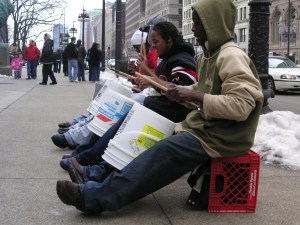
“Street Musicians, Chicago” by Flickr user Diana Schnuth, CC-BY-NC-2.0
Despite that the convention brings literature scholars from across the United States together, some of the more intriguing sound-oriented panels are not focused on literature at all. In fact, several panels address sound from the angle of music. Panel #s131, The Musics of Chicago brings together High Fidelity and Lupe Fiasco, and panel #s162 on the HBO series Girls includes Chloe H. Johnson’s paper “Dancing on My Own: Popular Music and Issues of Identity in Girls.“ Although the fields of literary studies and cultural studies are sometimes in tension with each other, some MLA presenters are approaching popular culture particularly from an aural angle.
Music is not the only presence of sound in the MLA Program. Several panels bring up sound in conjunction with pedagogy. Some of our readers may remember the forum Sounding Out! hosted last year on sound and pedagogy—a forum of which I was a part. I’m glad to see other language, composition, and literature teachers are thinking about sound too. Panel #s114, Dialects of English Worldwide: Issues in English Language Studies includes several papers that think about spoken English nowadays. For those who are interested in how the sound of students’ speech are intersected by structural racism and public policy will find lots to think about with this panel. If you’re looking for concrete suggestions on using sound as a pedagogical approach, panel #s213 has some answers. Twenty-First-Century Pedagogies, arranged by the Discussion Group on the Two-Year College includes a presentation on sound essays by Kathryn O’Donoghue from the Graduate Center at City Univ. of New York.
Where will Team SO! be at MLA 2014? Editor-in-Chief Jennifer Stoever-Ackerman can be found at the DH Commons pre-conference workshop on Thursday, January 9, 2014; she will be presenting Friday, January 10 at 8:30 am on her research on Lead belly and Richard Wright as part of panel #s221, Singing Out in the American Literary Experience. Regular writer Regina Bradley will be presenting Friday at 5:15 pm on panel #s403 Words, Works, and New Archives: Studying African American Literature in the Twenty-First Century. Guest blogger Scott Poulson-Bryant will be at panel #s447, The Seventies in Black and White: A Soundtrack on Saturday at 8:30 am. I will be presenting on Friday morning at panel #s218, a roundtable on the graduate seminar paper and will be leading panel #s788, Back Up Your Work: Conceptualizing Writing Support for Graduate Students on Sunday at 1:45 pm. You can catch us on Twitter: @lianamsilvaford and @soundingoutblog where we’ll be live-tweeting panels and keeping followers up to date on convention chatter. Who knows, maybe there’ll be an impromptu SO! tweet-up? Stay tuned to our social media feeds!
Before I go, a shameless plug: As of this month I am the new editor of the newsletter Women in Higher Education, so if you want to meet up and talk about the newsletter please let me know!
Did I miss something? Maybe I somehow missed you or your panel in this round up? Please let me know either via email, via tweet, or post on the Sounding Out! Facebook page.
–
Liana Silva-Ford is co-founder and Managing Editor of Sounding Out!.
–
Featured image: “Mississippi North” by Flickr user John W. Iwanski, CC-BY-NC-2.0
–
Jump to THURSDAY, JANUARY 9, 2014
Jump to FRIDAY, JANUARY 10, 2014
Jump to SATURDAY, JANUARY 11, 2014
Jump to SUNDAY, JANUARY 12, 2014
“Television Sam (I’m Your Main Man)” by Flickr user the justified sinner, CC-BY-NC-SA-2.0
THURSDAY, JANUARY 9, 2014
8:30 am-11:30 am
3. Get Started in the Digital Humanities with Help from DHCommons
Chicago A–B, Chicago Marriott
PRESIDING: Ryan Cordell, Northeastern Univ.; Josh Honn, Northwestern Univ.; Katherine A. Rowe, Bryn Mawr Coll.
The workshop welcomes language and literature scholars who wish to learn about, pursue, or join digital humanities (DH) projects but do not have the institutional infrastructure to support them. Representatives of DH projects and initiatives will share their expertise on project design, outline available resources and opportunities, and lead small-group training sessions on DH technologies and skills. Preregistration required.
12:00 pm-1:15 pm
31. Radical Curators, Vulnerable Genres: Lost Histories of Collecting, Editing, Bibliography
Michigan–Michigan State, Chicago Marriott
PRESIDING: Meredith L. McGill, Rutgers Univ., New Brunswick
SPEAKERS:
Jessica J. Beard, Univ. of California, Santa Cruz;
Alex Black, Cornell Univ.;
Jane Greenway Carr, New York Univ.;
Ellen Gruber Garvey, New Jersey City Univ.
Laura Helton, Univ. of Virginia
Courtney Thorsson, Univ. of Oregon
33. Sir Walter Scott and Music
Sheffield, Chicago Marriott
Program arranged by the Lyrica Society for Word-Music Relations
PRESIDING: Jeff Dailey, Five Towns Coll.
1. “Cutting Out the Castle Quicksand: Scott’s Bride, Donizetti’s Lucia, and the ‘Personally Furious’ Ayn Rand,” Shoshana Milgram Knapp, Virginia Polytechnic Inst. and State Univ.
2. “‘Drifting through the Intellectual Atmosphere’ from Scott’s Old Morality to Liszt’s Hexameron,” Catherine Ludlow, Western Illinois Univ.
3. “Walter Scott, British Identity, and International Grand Opera: Isidore de Lara’s Amy Robsart(1893),” Tommaso Sabbatini, Univ. of Chicago
For abstracts, visit lyricasociety.org.
1:45-3:00 pm
75. Voice and Silence
Mississippi, Sheraton Chicago
Program arranged by the Division on French Medieval Language and Literature
PRESIDING: Matilda Tomaryn Bruckner, Boston Coll.
1. “Gut Feelings,” Jason D. Jacobs, Roger Williams Univ.
2. “Tomboy Silence,” Wan-Chuan Kao, Washington and Lee Univ.
3. “Giving Voice to the Word of God; or, Bernard of Clairvaux Sings the Song of Songs,” Kris Trujillo, Univ. of California, Berkeley
3:30-4:45
114. Dialects of English Worldwide: Issues in English Language Studies
Illinois, Chicago Marriott
Program arranged by the Discussion Group on Present-Day English Language
PRESIDING: Elizabeth Bell Canon, Emory Univ.
1. “‘Speak the Language of Your Flag’: American Policy Responses to Nonanglophone Immigrants,” Dennis E. Baron, Univ. of Illinois, Urbana
2. “The Sounds of Silence: Standard and Nonstandard Englishes in Contemporary Ethnic American Writing,” Melissa Dennihy, Queensborough Community Coll., City Univ. of New York
3. “Star Spanglish Banter: Harnessing Students’ Linguistic Expertise,” Jill Hallett, Northeastern Illinois Univ.
4. “Emerging Attitudes toward New Media within the Discourses of Poetics and Literature,” April Pierce, Univ. of Oxford
5:15-6:30
131. The Musics of Chicago
Chicago H, Chicago Marriott
PRESIDING: Shawn Higgins, Univ. of Connecticut, Storrs
1. “Sweet Home Chicago? (Dis)Locating the American ‘Race Record’ in High Fidelity,” Jürgen E. Grandt, Univ. of North Georgia
2. “Experiment and Exodus in the Music of Chicago,” Toshiyuki Ohwada, Keio Univ.
3. “Fly Girls or Blackface? The Racial and Gender Politics of Lupe Fiasco,” Jorge Santos, Univ. of Connecticut, Storrs
141. Enduring Noise: Sound and Sexual Difference
Illinois, Chicago Marriott
PRESIDING: Rizvana Bradley, Emory Univ.
1. “Listening to Gertrude Stein’s Repeating: Sonorous Temporality in The Making of Americans,” Erin McNellis, Univ. of California, Irvine
2. “Queer Extensities: Pauline Oliveros and Disco,” Amalle Dublon, Duke Univ.
3. “Metal, Reproduction, and the Politics of Doom,” Aliza Shvarts, New York Univ.
RESPONDING: Rizvana Bradley
7:00-8:15 pm
162. Girls and the F Word: Twenty-First-Century Representations of Women’s Lives
Los Angeles–Miami, Chicago Marriott
PRESIDING : Tahneer Oksman, Marymount Manhattan Coll.
1. “‘My Shoes Match My Dress . . . Kind Of!’: The Politics of Dressing and Nakedness in Girls,” Laura Scroggs, Univ. of Minnesota, Twin Cities
2. “She’s Just Not That into You: Girls, Dating, and Damage,” Jennifer Mitchell, Weber State Univ.
3. “Dancing on My Own: Popular Music and Issues of Identity in Girls,” Chloe H. Johnson, York Univ., Keele
RESPONDING: Nancy K. Miller, Graduate Center, City Univ. of New York
“Untitled” by Flickr user d76, CC-BY-NC-2.0
FRIDAY, JANUARY 10, 2014
8:30 am-9:45 am
207. Diversifying the Victorian Verse Archives
Chicago A–B, Chicago Marriott
PRESIDING : Meredith Martin, Princeton Univ.
1. “Recovering Tennyson’s ‘Melody in Poetry’: Salon Recitations and Musical Settings,” Phyllis Weliver, Saint Louis Univ.
2. “Morris Metrics: The Work of Meter in the Age of Mechanical Reproduction,” Yopie Prins, Univ. of Michigan, Ann Arbor
3. “Digital Archives and the Music of Victorian Poetry,” Joanna Swafford, Univ. of Virginia
For abstracts, visit https://sites.google.com/a/slu.edu/diversifying-the-victorian-verse-archives/
213. Twenty-First-Century Pedagogies
Michigan–Michigan State, Chicago Marriott
Program arranged by the Discussion Group on the Two-Year College
PRESIDING: Stacey Lee Donohue, Central Oregon Community Coll.
1. “Not on Wikipedia: Making the Local Visible,” Laurel Harris, Queensborough Community Coll., City Univ. of New York
2. “Survival Spanish Online: Designing a Community College Course That Bridges Culture and Authentic Connections,” Cecilia McGinniss Kennedy, Clark State Community Coll., OH
3. “Sound Essays: A Cure for the Common Core,” Kathryn O’Donoghue, Graduate Center, City Univ. of New York
4. “Leveling Up! Gamifying the Literature Classroom,” Jessica Lewis-Turner, Temple Univ., Philadelphia
For abstracts, visit commons.mla.org/groups/the-two-year-college/announcements/ after 15 Dec.
217. Cuba on Stage
Arkansas, Sheraton Chicago
Program arranged by the Discussion Group on Cuban and Cuban Diaspora Cultural Production
PRESIDING: Vicky Unruh, Univ. of Kansas
1. “José Triana, Virgilio Piñera, and the Racial Erotics of Cuban Tragedy,” Armando Garcia, Univ. of Pittsburgh
2. “Estorino’s Gray Ghosts,” David Lisenby, Univ. at Albany, State Univ. of New York
3. “Musical Trangressions on the Cuban Stage: Rap, Rock, and Reggaeton,” Elena Valdez, Swarthmore Coll.
4. “Locating the Malecón,” Bretton White, Colby Coll.
221. Singing Out in the American Literary Experience
Old Town, Chicago Marriott
Program arranged by the Discussion Group on Folklore and Literature
PRESIDING: Mark Allan Jackson, Middle Tennessee State Univ.
1. “Re-sounding Folk Voice, Remaking the Ballad: Alan Lomax, Margaret Walker, and the New Criticism,” Derek Furr, Bard Coll.
2. “‘A Voice to Match All That’: Lead Belly, Richard Wright, and Lynching’s Sound Track,” Jennifer Stoever-Ackerman, Binghamton Univ., State Univ. of New York
3. “Stunting Gualinto: The Limits of Corrido Heroism in Americo Paredes’s George Washington Gomez,” Melanie Hernandez, Univ. of Washington, Seattle
For abstracts, write to majackso@mtsu.edu.
10:15-11:30
261. Applying Linguistics to the Learning of Middle Eastern Languages
Huron, Sheraton Chicago
Program arranged by the Discussion Group on General Linguistics
PRESIDING: Terrence Potter, Georgetown Univ.
1. “How Strategic Can They Be? Differences between Student and Instructor Attitudes toward Language Learning Strategies,” Gregory Ebner, United States Military Acad.
2. “Needs-Analysis Informed Task Design in Arabic Foreign Language Programs in the United States: Insights from Learner Perceptions and Production,” Maimoonah Al Khalil, King Saud Univ., Riyadh
3. “Linguistic Advantages and Constraints in the Classroom: Judeo-Spanish as an L2,” Bryan Kirschen, Univ. of California, Los Angeles
For abstracts, write to tmp28@georgetown.edu.
263. John Clare: The Voices of Nature
Chicago C, Chicago Marriott
Program arranged by the John Clare Society of North America
PRESIDING: Rochelle Johnson, Coll. of Idaho
1. “Speaking for the Trees: Margaret Cavendish, John Clare, and Voicing Nature,” Bridget Mary Keegan, Creighton Univ.
2. “Clare’s Air: Sound in Motion,” Paul Chirico, Univ. of Cambridge, Fitzwilliam Coll.
3. “John Clare: The Unusual and Challenging Natural Historian,” Eric H. Robinson, Univ. of Massachusetts, Boston
12:00 pm-1:15 pm
269A. Chicago Latina/o Writing: A Creative Conversation
Sheraton I, Sheraton Chicago
Program arranged by the Office of the Executive Director
PRESIDING: Ariana Ruiz, Univ. of Illinois, Urbana
SPEAKERS: Rey Andújar, Centro de Estudios Avanzados de Puerto Rico y el Caribe
Brenda Cárdenas, Univ. of Wisconsin, Milwaukee
Paul Martínez Pompa, Triton Coll.
Achy Obejas, Chicago, IL
270. Women’s Education in Third World Countries
Parlor G, Sheraton Chicago
Program arranged by the Discussion Group on Interdisciplinary Approaches to Culture and Society
PRESIDING : Shirin E. Edwin, Sam Houston State Univ.
1. “Narrative Approaches to Transmitting Regional Oral and Instrumental Literary Traditions in the Works of Aminata Sow Fall,” Julie Ann Huntington, Marymount Manhattan Coll.
2. “Gender, Class, and Education: Intersections in South Asian Literature,” Maryse Jayasuriya, Univ. of Texas, El Paso
3. “Women’s Schooling in Clarice Lispector’s Narrative: A Brazilian Education,” Alejandro E. Latinez, Sam Houston State Univ.
279. Dadaphone: Indeterminacy in Words and Music
Huron, Chicago Marriott
Program arranged by the Lyrica Society for Word-Music Relations and the Association for the Study of Dada and Surrealism
PRESIDING : Jeff Dailey, Five Towns Coll.
1. “Black Dada,” Kathy Lou Schultz, Univ. of Memphis
2. “Aleatory Adaptation and Indeterminate Interpretation: Radiohead’s In Rainbows as Faustian Rock Opera,” Meg Tarquinio Roche, Northeastern Univ.
3. “Game Changer: Cage’s Word-Music Combination in ‘Renunion’ and ‘Solo 23,'” Sydney Boyd, Rice Univ.
4. “Graphic Notation in Contemporary Music and Its Debt to Dada,” Laura Prichard, Univ. of Massachusetts, Lowell
For abstracts, visit lyricasociety.org.
5:15 pm-6:30 pm
384. Literary Crossroads: African American Literature and Christianity
Addison, Chicago Marriott
Program arranged by the Conference on Christianity and Literature and the Division on Literature and Religion
PRESIDING: Katherine Clay Bassard, Virginia Commonwealth Univ.
1. “God’s Trombones, the Social Gospel, and the Harlem Renaissance,” Jonathan Fedors, Univ. of Pennsylvania
2. “When the Gospel Sings the Blues in Ralph Ellison’s Invisible Man,” Claudia Rosemary May, Univ. of California, Berkeley
3. “Faith Moves: Belief and the Body in Bill T. Jones’s Chapel/Chapter and Toni Morrison’sParadise,” Leslie Elizabeth Wingard, Coll. of Wooster
For abstracts, write to kcbassar@vcu.edu.
403. Words, Works, and New Archives: Studying African American Literature in the Twenty-First Century
Michigan–Michigan State, Chicago Marriott
Program arranged by the College Language Association
PRESIDING : Warren Carson, Univ. of South Carolina, Spartanburg
1. “The Field and Function of African American Literary Scholarship: A Memorial and a Challenge,” Dana A. Williams, Howard Univ.
2. “The Black Book: Creating an Interactive Research Environment,” Kenton Rambsy, Univ. of Kansas
3. “Keepin’ It Interactive: Hip-Hop in the Age of Digital Reproduction,” Regina Bradley, Kennesaw State Univ.; Jeremy Dean, Rap Genius, Inc.
414. Literature and Media in the Nineteenth-Century United States
Chicago A–B, Chicago Marriott
Program arranged by the Division on Nineteenth-Century American Literature
PRESIDING : Meredith L. McGill, Rutgers Univ., New Brunswick
SPEAKERS: Jonathan Elmer, Indiana Univ., Bloomington
Teresa Alice Goddu, Vanderbilt Univ.
Naomi Greyser, Univ. of Iowa
Brian Hochman, Georgetown Univ.
Christopher J. Lukasik, Purdue Univ., West Lafayette
Lauren A. Neefe, Stony Brook Univ., State Univ. of New York
For project statements, panelist biographies, and description of roundtable format, visit19thcamlitdiv.wordpress.com after 1 Dec.

“Cubs Stomp” by Flickr user John W. Iwanski, CC-BY-NC-2.0
SATURDAY, JANUARY 11, 2014
8:30 am-9:45 am
441. Socialist Senses
Ohio, Sheraton Chicago
Program arranged by the Discussion Group on Slavic Literatures and Cultures
PRESIDING : Nancy Condee, Univ. of Pittsburgh
1. “The Materiality of Sound: Esfir Shub’s Haptic Cinema,” Lilya Kaganovsky, Univ. of Illinois, Urbana
2. “From the Cinema of Attractions to the Cinema of Affect in Early Socialist Realism,” R. J. D. Bird, Univ. of Chicago
3. “Ineluctable Modality of the Visible: Gorky’s Return and the Onset of Clarity,” Petre M. Petrov, Princeton Univ.
For abstracts, visit mlaslavic.blogspot.com/ after 30 Dec.
447. The Seventies in Black and White: A Soundtrack
Purdue-Wisconsin, Chicago Marriott
PRESIDING : Jack Hamilton, Harvard Univ.
1. “Mutts of the Planet: Joni Mitchell Channels Charles Mingus,” David Yaffe, Syracuse Univ.
2. “Righteous Minstrels: Race, Writing, and the Clash,” Jack Hamilton
3. “Broken Masculinities: Black Sound, White Men, and New York City,” Scott Poulson-Bryant, Harvard Univ.
10:15 am-11:30 am
474. African American Voices from the Civil War
Michigan–Michigan State, Chicago Marriott
PRESIDING : Timothy Sweet, West Virginia Univ., Morgantown
1. “The Color of Quaintness: Thomas Wentworth Higginson, Black Song, and American Union,”Jeremy Wells, Indiana Univ. Southeast
2. “‘If We Ever Expect to Be a Pepple’: The Literary Culture of African American Soldiers,” Christopher A. Hager, Trinity Coll., CT
3. “‘And Terrors Broke from Hill to Hill’: The Civil War Poems of George Moses Horton,” Faith Barrett, Duquesne Univ.
4. “The Negro in the American Rebellion: William Wells Brown and the Design of African American History,” John Ernest, Univ. of Delaware, Newark
485. Digital Practice: Social Networks across Borders
Missouri, Sheraton Chicago
Program arranged by the Division on Twentieth-Century German Literature
PRESIDING : Stefanie Harris, Texas A&M Univ., College Station
1. “Kafka and the Kafkaesques: Close Reading Online Fan Fiction,” Bonnie Ruberg, Univ. of California, Berkeley
2. “Network Politics, Wireless Protocols, and Public Space,” Erik Born, Univ. of California, Berkeley
3. “Intersections of Music, Politics, and Digital Media: Bandista,” Ela Gezen, Univ. of Massachusetts, Amherst
Responding: Yasemin Yildiz, Univ. of Illinois, Urbana
For abstracts, visit german.berkeley.edu/transit.
12:00 pm-1:15 pm
508. Performing Blackness in the Nineteenth Century
Chicago A–B, Chicago Marriott
Program arranged by the Division on Nineteenth-Century American Literature
PRESIDING : Harvey Young, Northwestern Univ.
1. “Being Touched: Sojourner Truth’s ‘Spiritual Theatre’ and the Genealogy of Radical Black Activism,” Jayna Brown, Univ. of California, Riverside
2. “Frederick Douglass and the ‘Claims’ of Democratic Individuality in Antebellum Political Theory,” Douglas Jones, Princeton Univ.
3. “’Dey Make Me Say Dat All De Time: Performance Art, Objecthood, and Joice Heth’s Sonic of Dissent,” Uri McMillan, Univ. of California, Los Angeles
509. Becoming Chroniclers: Latin American Women Writers and the Press, 1920–73
Parlor F, Sheraton Chicago
PRESIDING : Vicky Unruh, Univ. of Kansas
1. “The Opportunities of Technology: Cube Bonifant’s Radiophonic Chronicles in El universal ilustrado,” Viviane A. Mahieux, Univ. of California, Irvine
2. “Key Moments in the Subversion of a Genre: Alfonsina Storni and Clarice Lispector Redefine Womanhood,” Mariela Méndez, Univ. of Richmond
3. “Issues of Gender and Genre: Isabel Allende and Clarice Lispector Writing Chronicles, 1968–73,” Claudia Mariana Darrigrandi, Universidad Adolfo Ibáñez
1:45 pm-3:00pm
572. Illness and Disability Memoir as Embodied Knowledge
Los Angeles–Miami, Chicago Marriott
Program arranged by the MLA Committee on Disability Issues in the Profession
PRESIDING : Rachel Adams, Columbia Univ.
1. “Recoding Silence: Teresa de Cartagena, Medieval Sign Lexicons, and Deaf Life Writing,” Jonathan H. Hsy, George Washington Univ.
2. “‘Twisted and Deformed’: Virginia Woolf, Alison Bechdel, and Crip-Feminist Autobiography,” Cynthia Barounis, Washington Univ. in St. Louis
3. “‘My Worry Now Accumulates’: Sensorial and Emotional Contagion in Autistic Life Writing,” Ralph James Savarese, Grinnell Coll.
For papers or abstracts, write to rea15@columbia.edu after 1 Jan.
3:30 pm-4:45 pm
586. Early Modern Media Ecologies
Great America, Chicago Marriott
PRESIDING: Jen Boyle, Coastal Carolina Univ.
1. “Needlework Networks: Paper, Prints, and Female Authorship,” Whitney Trettien, Duke Univ.
2. “Sidney Circularities: Music and Script in the Contrafactum Lyric,” Scott A. Trudell, Univ. of Maryland, College Park
3. “Stage, Stall, Street, Sheet: Multimedia Shakespeare,” Adam G. Hooks, Univ. of Iowa
For abstracts, visit www.scotttrudell.com.
591. Multilingualism in Native American and Aboriginal Texts
Kane, Chicago Marriott
Program arranged by the Division on American Indian Literatures
PRESIDING : Beth H. Piatote, Univ. of California, Berkeley
1. “Reading Resistance and Resisting Readings in a Bilingual Text,” Laura J. Beard, Univ. of Alberta
2. “Narrative and Orthography in Cree Oral Histories,” Stephanie J. Fitzgerald, Univ. of Kansas
3. “Ongwe Onwe Languages in the Fourth Epoch of Iroquois History,” Penelope M. Kelsey, Univ. of Colorado, Boulder
4. “Poetics of ka ‘āina and na ‘ōiwi: Language(s) of Land, Earth, and the Hawaiian People in Haunani-Kay Trask’s Night Is a Sharkskin Drum,” Nicole Tabor, Moravian Coll.
5:15 pm-6:30 pm
624. Boethius’s Consolation of Philosophy in Medieval and Early Modern England: Form and History
Old Town, Chicago Marriott
PRESIDING : Ian Cornelius, Yale Univ.
1. “Singing and Speaking Boethius in Anglo-Saxon England,” Anne Schindel, Yale Univ.
2. “Sensible Prose and the Sense of Meter: Ethics and the Mixed Form in Boethius and After,” Eleanor Johnson, Columbia Univ.
3. “Boethius’s Consolation of Philosophy and an Expansive Theology in the Late Sixteenth Century: Queen Elizabeth’s Translation in Context,” Linda Suzanne Shenk, Iowa State Univ.
For abstracts, write to ian.cornelius@yale.edu.
625. Verbal and Visual Satire in the Nineteenth Century
Chicago F, Chicago Marriott
PRESIDING : Joseph Litvak, Tufts Univ.
1. “Organizing Anarchy: Class, Intellectual Property, and Graphic Satire,” Jason Kolkey, Loyola Univ., Chicago
2. “The Reemergence of Radical Satire in the Late Nineteenth Century,” Frank A. Palmeri, Univ. of Miami
3. “Turn-of-the-Century Satirical Plots of Fenian and Anarchist Terrorism,” Jennifer Malia, Norfolk State Univ
645. Current Issues in Romance Linguistics
Parlor F, Sheraton Chicago
Program arranged by the Discussion Group on Comparative Romance Linguistics
PRESIDING : Andrea Perez Mukdsi, Univ. at Buffalo, State Univ. of New York
1. “Attribution in Romance: Reconstructing the Oral and Written Tradition,” Martin Hummel, Karl-Franzens-Universität Graz
2. “Pronouns and the Author-Reader Relationship in Academic Portuguese,” Karina Veronica Molsing, Pontifícia Universidade Católica do Rio Grande do Sul; Cristina Perna, Pontifícia Universidade Católica do Rio Grande do Sul
3. “The Semantic Feature [+INFLUENCE] and the Spanish Subjunctive,” M. Emma Ticio Quesada, Syracuse Univ.
4. “Palatalization in Chilean Spanish and Proto-romance,” Carolina Gonzalez, Florida State Univ.
For abstracts, write to perezmukdsi@gmail.com.
“Mayb Your New Year Be Merry and Bright…” by Flickr user Jason Mrachina, CC-BY-NC-ND-2.0
SUNDAY, JANUARY 12, 2014
12:00 pm-1:15 pm
742. Socialist Culture in the Age of Disco: East European Popular Pleasures
Parlor F, Sheraton Chicago
Program arranged by the American Association of Teachers of Slavic and East European Languages
PRESIDING: Jessie M. Labov, Ohio State Univ., Columbus
1. “Imperial Disco: Czeslaw Milosz and Science Fiction,” Mikolaj Golubiewski, Free Univ.
2. “The ‘Movement of Writing Workers’ and State Stability in the 1970s German Democratic Republic,” William Waltz, Univ. of Wisconsin, Madison
3. “Flaming Socialist Creatures: Hippies as Auteurs in Soviet Latvia,” Mark Svede, Ohio State Univ., Columbus
For abstracts, visit mlaslavic.blogspot.com/.
744. Mass versus Coterie: The Audiobook
Missouri, Sheraton Chicago
Program arranged by the Division on Prose Fiction
PRESIDING : Rebecca L. Walkowitz, Rutgers Univ., New Brunswick
1. “‘Fully Fleshed Out and Filled with Emotion’: Accent, Region, and Identification in the Reception of The Help,” Sydney Bufkin, Univ. of Texas, Austin
2. “Joyce, LibriVox, and the Recording Coterie,” Brandon Walsh, Univ. of Virginia
3. “Alien Stereo: China Mieville’s Embassytown,” Christopher Pizzino, Univ. of Georgia
1:45 pm-3:00 pm
788. Back Up Your Work: Conceptualizing Writing Support for Graduate Students
Grace, Chicago Marriott
PRESIDING : Liana Silva-Ford, Houston, TX
SPEAKERS:
Tara Betts, Binghamton Univ., State Univ. of New York;
Lee Ann Glowzenski, Duquesne Univ.;
Annemarie Pérez, Loyola Marymount Univ.
Abigail Scheg, Elizabeth City State Univ.
792. Old Materials, New Materialisms
Missouri, Sheraton Chicago
Program arranged by the Division on Methods of Literary Research
1. “Objects, Authors, and Other Matter(s) in the Gloria Anzaldúa Archive,” Suzanne M. Bost, Loyola Univ., Chicago
2. “Writing Histories of Listening: Acoustemology as Literary Practice,” Ely Rosenblum, Univ. of Cambridge
3. “Even the Stones Cry Out: Archival Research and the Inhuman Turn,” Andrew Ferguson, Univ. of Virginia
4. “A Life of Its Own: A Vital Materialist Look at the Medieval Manuscript as an Agentic Assemblage,” Angela Bennett Segler, New York Univ.

“my kind of razzmatazz” by Flickr user David D’Agostino, CC-BY-NC-SA-2.0
Share this:

The Acoustics of Passing: Harriet Beecher Stowe’s Uncle Tom’s Cabin as Supremacist Remix
 Editor’s Note: Sound Studies is often accused of being a presentist enterprise, too fascinated with digital technologies and altogether too wed to the history of sound recording. Sounding Out!‘s last forum of 2013, “Sound in the Nineteenth Century,” addresses this critique by showcasing the cutting edge work of three scholars whose diverse, interdisciplinary research is located soundly in the era just before the advent of sound recording: Mary Caton Lingold (Duke), Caitlin Marshall (Berkeley), and Daniel Cavicchi (Rhode Island School of Design). In examining nineteenth century America’s musical practices, listening habits, and auditory desires through SO!‘s digital platform, Lingold, Marshall, and Cavicchi perform the rare task of showcasing how history’s sonics had a striking resonance long past their contemporary vibrations while performing the power of the digital medium as a tool through which to, as Early Modern scholar Bruce R. Smith dubs it, “unair” past auditory phenomena –all the while sharing unique methodologies that neither rely on recording nor bemoan their lack. Last week, the series began with Mary Caton Lingold‘s exploration of the materialities of Solomon Northup’s fiddling as self-represented in 12 Years a Slave. This week, Caitlin Marshall treats us to a fascinating new take on Harriet Beecher Stowe’s listening practice and dubious rhetorical remixing of black sonic resistance with white conceptions of revolutionary independence. —Jennifer Stoever-Ackerman, Editor-in-Chief
—
Harriet Beecher Stowe. Courtesy of Flickr Creative Commons
Harriet Beecher Stowe: novelist, anti-slavery agitator, antebellum DJ? In 1852, Stowe penned one of the most famous works of fiction in American history: Uncle Tom’s Cabin. A sentimental work, the novel dramatized the lives of fictional slaves searching for freedom. Eager to achieve a national hearing of her anti-slavery agenda, Stowe’s novel required a voice that could “speak” in morally efficacious tones against slavery. To stage this voice, one that hinged on a sonic appeal to inter-racial sympathy, Stowe sampled and mixed two powerfully persuasive, if diametrically opposed, cultures of speaking and listening in the United States.
The first of these cultures revolved around revolutionary American understandings of political rhetoric. According to Jay Fliegelman, this tradition of republican oratory drew upon 18th century philosophical principles to recast Declaring Independence as a speech act. In his Declaration, Jefferson announced the ‘self-evidence’ of an American people by performing a nationally specific common sense in two important ways. First, he displayed a breed of American moral feeling in direct contrast to that of the colonial British; second, he did so through an oratorical style that inaugurated a common, American modality for articulating and hearing truth. The felt and sounded show of a common ‘self’ evidenced Americans’ natural rights to independence, and installed a markedly white revolutionary acoustics of freedom.
Stowe’s second sample was a misappropriation of a new mode of hearing in the 1845 Narrative of the Life of Frederick Douglass, An American Slave. As Sounding Out! Editor in Chief Jennifer Stoever-Ackerman has argued in “The Word and the Sound: Listening to the Sonic Colour-line in Frederick Douglass’s 1845 Narrative,” Douglass’s narrative was a direct attempt to bend and subvert what she terms “the sonic colour-line” (21). An acoustic schema that racialized sound and recruited the ear in black subjection, the sonic color line was epitomized by the republican oratorical tradition wherein meaning was linked to white articulation, and meaninglessness to black utterance, heard simply as ‘noise.’
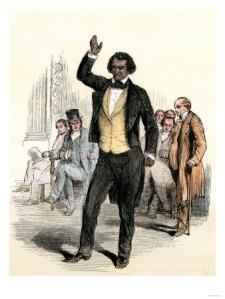
Image of Fredrick Douglass speaking in England regarding his experiences as an American slave
Contrastingly, the reformed sonic model presented in the Narrative sought to position black sound as a site of meaning and resistance, and challenged Northern readers to question and remap both their hearing of such sounds and their ethical relationship to black meaning. Jonathan Cruz, in Culture on the Margins, terms this new mode of hearing “ethnosympathy” and defines it as an “interpretive ethos of pathos” (3). Importantly, Stoever-Ackerman highlights that Douglass did not seek to cast black sound as “a sentimental appeal to truth,” but “rather [as] a challenge to dominant notions of truth produced and disseminated through the ear” (31). Stowe however, did not hear Douglass’s message so subtlety, and like many Abolitionists, was quick to commandeer black sound for a white social justice platform wherein it served as the innately moral (and romantically racialized) sound of sentimental suffering. Thus, it was this mishearing of the strains of black resistance that Stowe remixed with the white tones of revolutionary independence to spin a brand new soundtrack for the antebellum era. I term this soundtrack the acoustics of passing.
A vocal melodrama (a literal speech act) in black and white, the acoustics of passing was an amalgamated grid of sonic intelligibility invested in the political power of voice that encapsulated the seemingly antithetical (to white America) tones of republican virtue and black experience, and was deployed by Stowe to narrate the fantastical passage of African Americans from bondage to freedom. Composed first through Uncle Tom’s Cabin, and propagated later in her paternalistic relationships with black female artists, Stowe’s acoustics was ostensibly a powerful tool in the fight against slavery, but was ultimately used by the author to recapitulate her whitewashed vision of America.
Stowe’s acoustics appear in Uncle Tom’s Cabin in novel’s first passing scene: George Harris’s Spanish masquerade. Stowe frames this scene prominently with the fugitive slave advertisement that George’s master, Mr. Harris, has posted. Many scholars have pointed to the way in which the visual organizes the practice of passing, but it is important to note that in this scene, the oral/aural is equally emphasized as key to a passing performance; Mr. Harris, for one, notes in his advertisement that George’s keen eloquence and literacy are the fugitive’s distinguishing features. Moreover, the advertisement seems to warn, in combination with George’s European complexion, he is rendered seemingly indistinguishable from a white man. Mr. Harris expects George to attempt such a passing ruse, and therefore clearly identifies the marks that will testify to George’s slave status. George
is deeply scarred on his back and shoulders; has been branded in his right hand with the letter H (95).
Contrary to Mr. Harris’ predictions, however, George enters the roadhouse disguised as a Spanish gentleman. To pull off this guise George darkens his skin and hair. In the essay, “Spanish Masquerade and the Drama of Racial Identity in Uncle Tom’s Cabin,” Julia Stern argues that George’s third term identity, “nonblack, nonwhite,” is radical because it upsets the logic of the antebellum racial dichotomy. However, we should note that this dark masquerade allows Stowe to symbolically align George, a mixed race man, with both his black and white parentage. In darkening his skin George pays tribute to his slave mother, while by adopting a well-known Anglican slaveholding surname, Henry Butler, George references his absentee father. Thus, the Spanish disguise is Stowe’s reminder that George is passing for who he claims to be.

Tailpiece illustration by Hammat Billings for Uncle Tom’s Cabin; or, Life Among the Lowly, by Harriet Beecher Stowe. Illustrated Edition. Original Designs by Billings; Engraved by Baker and Smith. (Boston: John P. Jewett and Company, 1853). George Harris, Mr. Wilson. Clifton Waller Barrett Collection, University of Virginia.
Yet before George can break from the tavern on his way towards Canada, he must reveal himself to his former employer, Mr. Wilson, who, George believes, has recognized him. In the long speech that follows, George must convince Mr. Wilson to discard a juridical sense of right in favor of an ethical one. Carefully arranged through Stowe’s acoustics of passing, George’s oratory presents equal parts white republican sentiment and black pathos, sentimentally persuading Wilson (and a listening America) of the moral justice in permitting him to pass to freedom.
Well aware that her readers at home would have been reciting the text of Uncle Tom’s Cabin aloud, Stowe is careful score George’s speech for both sonic whiteness and blackness–leaving intertextual clues that act like dynamic musical notation to indicate how George’s performance should sound. To begin, Stowe spells out her source material for George’s speech by directly citing Jefferson’s “Declaration” in a footnote to George’s opening salvo. Stowe wants readers to hear George’s speech as the realization of the American Republican promise. Americans, Stowe argues, are in a state no better than the British of the 1770’s: like the tyrannical father/monarch King George, Americans are “deaf to the voice of justice & of consanguinity.” A lengthy address, George’s monologue is an account of the domestic crimes of slavery, and, like the Declaration, is a complaint of personal injury at the hands of a nation that has been as negligent in looking after its blood kin as has George Harris’s father. Concluding with the passionate exclamation, “I’ll fight for my liberty to the last breath I breathe! You say your fathers did it; if it was right for them, it is right for me!” (102), George’s Declaration claims the rhetorical, and therefore natural, rights that are his white, paternal inheritance.
The sonic difference in George’s speech however, is the pathos of it, the “tears, and flashing eyes, and despairing gesture,” here meant to index the orator’s audible black suffering. Though setup as racially inscrutable in this scene, Stowe takes great pains to ‘out’ George’s hidden blackness. Not only does Stowe symbolically darken George to cite his mother’s race, but she draws attention to the black body through repeated citation of his scars. This figuration of speaking wounds was prevalent in the popular imagination of Stowe’s day, and represented the white fantasy that black speech was the ‘playback’ of slave experience as recorded in the grooves of the traumatized and marked black body. Frederick Douglass, for example, recounts in My Bondage and My Freedom that he was first introduced as a speaker to the Abolitionist lecture circuit as a “graduate from the peculiar institution…with my diploma written on my back!” (359).
Miraculously, at the climax of George’s sonically mixed oration, Mr. Wilson is overcome with a revised sense of justice, one consonant with George’s bid for freedom. In this overdetermined acoustic schema, Stowe aligns progressive white ethos and republican sentiment with the distinct sounds of black pathos, and positions any mode of hearing contrary to this inter-racial sonic sympathy as un-Christian, un-patriotic, and detrimental to the future of the Union.
Yet Stowe’s acoustics of passing is decidedly supremacist. To begin, George’s mixed sound is haunted by the specter of forced conception and familial alienation ubiquitous to slavery. Additionally, while Stowe deploys the acoustics of passing towards an anti-slavery platform, her sonic schema ultimately preserves the social and political function of whiteness. Thus, while George’s sonic blackness is essential for playing out the moral justice of Stowe’s cause, it is this same audible blackness that permits Stowe to ultimately write the political problem of inter-racial integration off to Liberia with the entire Harris family.

Freedom to Africa. Headpiece illustration by Hammat Billings for Uncle Tom’s Cabin; or, Life Among the Lowly, by Harriet Beecher Stowe. Illustrated Edition. Original Designs by Billings; Engraved by Baker and Smith. (Boston: John P. Jewett and Company, 1853). Courtsey of Clifton Waller Barrett Collection, University of Virginia
Herein is the problem of Stowe’s acoustics: its sonic inter-racial sympathy at once promised speakers of color the agency of a sounded path to freedom (that which George performs and narrates) while ultimately deploying white practices of containment. And Stowe indeed dramaturged the lives of several mixed race artists through these acoustics, most notably the Dramatic Reader, Mary Elizabeth Webb and the concert vocalist Elizabeth Taylor Greenfield.

Elizabeth Taylor Greenfield, Courtesy of the New York Historical Society
As I continue to investigate the careers of women of color like Greenfield and Webb, I think about how Stowe’s acoustics could have empowered and constrained their bids for resistance, rights and recognition.
—
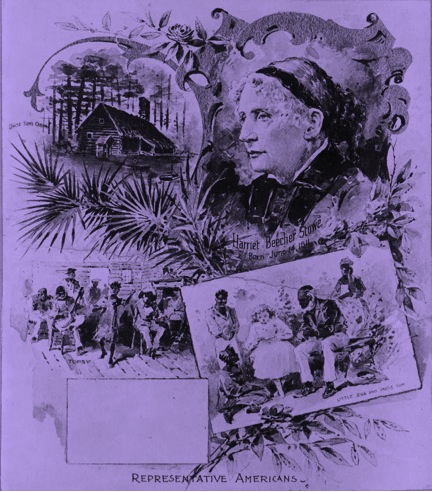
Featured Image: “Representative Americans” Image of Harriet Beecher Stowe surrounded by characters from Uncle Tom’s Cabin, 1893, Remixed by Jennifer Stoever-Ackerman
—
Caitlin Marshall is a PhD Candidate in Performance Studies at UC Berkeley. A vocalist herself, Caitlin applies her practice-based knowledge of voice towards the study of what it meant to ‘sound American’ during the nation’s first independent century. Focusing on ‘Othered’ American vernaculars at the intersections of race, disability, gender, and ethnicity, her dissertation, ‘Power in the Tongue’: Crippled Speech & Vocal Culture in Antebellum America, takes seriously the metaphor of voice in American democracy, and works at the confluence of Performance, Sound, and Disability Studies to mobilize speech impairment as a broad material and theoretical category for investigating how American citizenship was established as an exclusionary vocal limit in the antebellum era.
—
 REWIND! . . .If you liked this post, you may also dig:
“Como Now?: Marketing ‘Authentic’ Black Music,” –J. Stoever-Ackerman
Hearing the Tenor of the Vendler/Dove Conversation: Race, Listening, and the “Noise” of Texts –Christina Sharpe
How Svengali Lost His Jewish Accent––Gayle Wald
Share this:


Current Top Posts





April 2021

January 2020

November 2019

October 2019

August 2019

April 2014

November 2017

March 2015

December 2017

October 2015
 Sounding Out!
Recent Comments