
Enacting Queer Listening, or When Anzaldúa Laughs

 Marginalized bodies produce marginalized sounds to communicate things that escape language. The queer body is the site of sounds that engage pleasure, repression, rage, isolation, always somehow outside of dominant language. Sound Studies tells us that we should trust our ears as much as our eyes, justifying our trust in sound, and of the resonating body. Affect Theory goes further, saying that all senses play into a body that processes input through levels of response, experience, and anticipation. Affect is the vibrational space that is both bodily memory and anticipation. So where do sound and affect meet in queer bodies? How do marginalized peoples use sound and the body to express liberation, objectification, joy, and struggle?
Our writers in Sound and Affect tackle these questions across a spectrum of the marginalized experience. I opened the series by offering the concept of the tremble, a sonic form of affect that is necessarily queer in its affective reach. Last week, Kemi Adeyemi, sloooooooowed thingggggggggs doooooooooownnnnn so to hear the capitalist connections between the work expected of black bodies and the struggle for escape from this reality through the sonic affects, temporal shifts, and corporeal elsewhere of purple drank. Next week, Justyna Stasiowska brings the noise in a discussion of the trans body and the performance work of Tara Transitory. Today, Maria P. Chaves Daza explores the connection between voice, listening, and queer Chicana community formation: through space, across time, and with laughter. —Guest Editor Airek Beauchamp
—
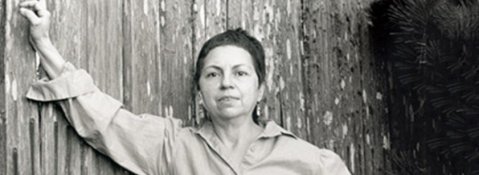
In October 1991 at the University of Arizona fall reading series, Gloria Anzaldúa read several poems and short stories–work now held at the UT-Austin Collection. Recently, I sat in my living room listening to the recording, feeling the buzz of her presence, the audible excitement in the Modern Languages Auditorium that Gloria Anzaldúa is about to speak. After some welcoming statements and a poem by Rita Magdaleno, inspired by Magdaleno’s reading of Borderlands, Anzaldúa takes the stage.
As part of her praxis, Anzaldúa makes space for queer people, both through her words and vocal tone. She begins with a joke about her relationship with mics and takes the time to thank the organizers, especially for her cozy writer’s cottage. Anzaldúa dedicates the reading to Yolanda Leyva, her old roommate, telling Leyva she hasn’t forgotten her. Then, she announces her involvement in Sinister Wisdom and encourages women of color in the audience to contribute to this all-lesbian journal. She proceeds to laugh as she says, “lesbians of color only, sorry. [laughs]” Similarly, as she announces a collection she is editing with Francisco Alarcon about Chicana dykes and Chicano gay men, she says, “so if anybody is a Chicana dyke or a Chicano gay man, sorry about the rest of you” [laughs]. In the future she will also edit a book called Chicana Theory “Chicanas only (laughs), sorry.” Last, she acknowledges Chuck Tatum for changing the title of his annual from “New Chicano Writings” to “New Chicana/o Writings” and for allowing for Spanish and Spanglish Tex-Mex when he first wanted pieces in English. Anzaldúa takes the opportunity to recognize and promote the work of Chicana/o lesbian and gay writers by demarcating several publications exclusive to their work. This exclusivity is softened with giggles and laughs, affects, which help work through the tension(s) of recognition and exclusion caused by this explicit circumscription.
Her nervous, silly laugh–echoed in the laughs of her audience–reaches out to bring me into that space, that time. Her smooth, slow and raspy voice–her vocalic body–touches me as I listen.

Gloria Andzaldúa Image from the Tumblr of BiRadical
In their introduction to The Affect Reader, Gregory J. Seigworth and Melissa Gregg assert affect’s “immanent capacity for extending […] both into and out of the interstices of the inorganic and non-living, intracellular divulgences of sinew, tissue and gut economies and the vaporous evanescenses of the incorporeal (events, atmospheres, feeling-tones)” (2).This sound recording of Anzaldúa’s poetry reading is an example of the immanent capacity this “incorporeal” event has to resonate and “sometimes stick to bodies and worlds” for listening audiences (1). Affect in its simplest form is “the name we give to those forces […] that serve to drive us to movement, towards thought and extension” and is “synonymous with force or forces of encounter (2).” My encounter with Anzaldúa’s (incorporeal) recording and the affect created through listening to her work lead me to ponder an answer to Seigworth and Gregg’s question:
How does a body marked in its duration by these various encounters with mixed forces, come to shift its affections (its being affected) into action (capacity to affect)? (2)
Toward an answer to this question, this post explores my relationship between Anzaldúa’s voice and my pedagogy, both her speaking voice as well as the interior voice she offers her audience, the way in which she opens spaces for queer women of color, and the resonances I find in both. As a queer woman of color who once felt isolated, Anzaldúa’s work has in many ways liberated me as a scholar, providing me with access to a voice for my own experiences. But Anzaldúa’s voice–its tactile material aspects and the way its sound builds affective connections between myself and other queers of color–strikes a chord in me that resonates without the need for language, across space and time. Her voice in the recording and in her writing sparks a recognition and validation of my being.

“Viva Gloria Anzaldúa,” acrylic on canvas, by Jake Prendez
Yvon Bonenfant’s theorization of “queer listening” highlights a practice of visibility and exclusivity that enables Anzaldúa’s vocalic body to reach out to the queer community, and for us to “listen out” in return. In “Queer Listening to Queer Vocal Timbres,” Bonenfant identifies the vocalic body as central to listening experience. He defines the vocalic body as an instrument producing vibrations that touch others, and a socially produced body positioned by environmental factors in a set of relations of power that produce identity. From these constitutive power relations the queer body listens for other queer bodies since “queer is a doing, not a being;” and listening is an active process of identifying the elements reaching out to queer people (78). Thus, Bonenfant, elaborates queer listening as
a listening out for, reach[ing] towards, the disoriented or differently oriented other […] listening out through the static produced by not-queer emanations of vocalic bodies. […] since hearing is feeling touch, this act of finding requires attunement to the touch of the vocalic bodies that caress queer. Sometimes, one has to listen very carefully to find them (78).
Queer listening then, takes seriously the power that bodies have to make sounds that reach out of the body to touch queer people and queer people’s ability to feel them.
***

CLICK on image of Gloria Andzaldúa to hear the recording I discuss from the University of Arizona, 10/23/91
On the University of Arizona’s recording, I can hear in Anzaldúa’s laugh a relish in her ability to take up space, to have before her an audience of more lesbian, gay and queer writers to contribute to her several anthology projects. Her voice is filled with a nervous excitement; after all, there is always a danger in being queer. Her laugh resonates as a physical instantiation of the risk of her own existence and of the other queers in the room. It is also a soothing mechanism; her laugh momentarily takes the edge off of some of her words as it reaches out, touches, and brings together queer people of color.
It is in this same way, that Anzaldúa’s work creates the space to speak and listen to queer people of color in many contexts. I was first introduced to Anzaldúa in the classroom, specifically a feminist theory class. It was the first time I had heard a Chicana speak about being queer (or anyone who was mestiza for that matter); the classroom can be fraught with danger for students like me. Cindy Cruz, in “Notes on Immigration, Youth and Ethnographic Silence,” argues that the classroom needs to be a space aware of the political climate that silences LGBTQ immigrant students (68). In the classroom, writers such as Anzaldúa, Cherrie Moraga, Audre Lorde, and bell hooks all contribute to the growing canon of “politically undesired” identities (68). Without these writers, the queer-identified person may never be given a reason or a chance to speak about their experience as brown/black transgressive sexual subject. For this reason, when I teach I always read Anzaldúa aloud or ask members of the class to do so. Her powerful language, when vocalized, creates what Bonenfant would call a somatic bond that inhabits the students themselves, the classroom, and demands that we discuss homophobia, sexism, misogyny, and racism from the perspective of the atravesadx: the immigrant queer person of color. Reading Anzaldúa aloud creates what Karen Tongson calls “remote intimacy: a way of imagining our own spaces in connection to others.” This is almost a pirate bond, a way of connecting the undesired and marginalized.
I have experienced this affective bond on multiple occasions, but one instance stands out.
In a Critical Race Theory class during my fifth year grad school, a fellow student, an immigrant woman of color, came out to the class by way of a seminar paper. As she read the paper she was shaking, her voice cracked, and tears rolled down her face. She was terrified of the consequences of “coming out,” however she found the courage to write and share her experiences. I remember how this reading touched me, the student’s voice interlaced with quotes explaining Anzaldúa’s concept of “homophobia”—the fear of going home– moved through the classroom and classmates: people leaned in, shifted in their seats, began doodling, some shook their heads in agreement in relation to coming out. I don’t think the student would have felt this was possible or appropriate if we hadn’t read Anzaldúa; the only lesbian writer on the syllabus.
The sound of Anzaldúa’s text creates a vocalic body for queer listening available to people who yearn for its touch. Bonenfant posits this idea of yearning as inherently queer. Queer, as a form of doing, requires performative activity, always looking to find our own likenesses in others. Recognizing sound as touching the vocalic body, “queer listeners can perhaps catch some of the subtle variations in timbre that indicate a resonant ‘identity’ that wants to touch someone like us” (78). Anzaldúa’s various texts speak of concrete experience but the timbre of her voice–and the voice(s) reading her work–speaks to much more, a certain trembling that I feel in my own experience and that I wish to not only receive but to share with other queers of color also reaching out while also always receptive to the timbre of likeness.
Affective phenomena do not rely on textual or linguistic acts to communicate but instead are networked intensities of impulse that connect the individual body-mind to the bodies-minds of others. As Gregg and Seigworth explain,
Affect arises in the midst of in-between-ness: in the capacities to act and be acted upon. […] That is, affect is found in the intensities that pass body to body. In fact, it is quite likely that affect more often transpires within and across the subtlest of shuttling intensities: all the minuscule or molecular events of the unnoticed (2).
Anzaldúa incites in me a sense of intensity as the unnamable but unmistakable realities of my own experience resonate when I listen, while also lighting in me a force, an exertion of a “politically undesirable” self that I must assert in the world and in the classroom as a space of in- between-ness. Anzaldúa’s writing and the timbre of her voice are, to me, intensities and forces that go unnoticed, except by those who are yearning for them. Listening to Anzaldúa in the classroom proliferates the possibility of queer listening encounters; listening to Anzaldúa at home, in my living room, regenerates my belief in the impossible, in our ability to be in intimate spaces without homophobia: the fear of going home.
—
Featured Image: Used with the generous permissions of artist Alma Lopez. See more of her work at: http://almalopez.net/
—
JS and AB are grateful for the the editorial work of Tara Betts on early drafts.
—
Maria P. Chaves Daza is a doctoral candidate in the English Department at SUNY Binghamton University studying testimonios of undocumented women. They are a McNair Scholar and a Clifford D. Clark Fellow. They hold a B.A in Women’s Studies form NEIU in Chicago and a Master’s in Philosophy from the Philosophy, Interpretation and Culture (PIC) Program (SUNY Binghamton).
 REWIND!…If you liked this post, check out:
“Music to Grieve and Music to Celebrate: A Dirge for Muñoz”-Johannes Brandis
On Sound and Pleasure: Meditations on the Human Voice-Yvon Bonenfant
“Hearing Queerly: NBC’s ‘The Voice’”-Karen Tongson
Could I Be Chicana Without Carlos Santana?-Wanda Alarcón
Óyeme Voz: U.S. Latin@ & Immigrant Communities Re-Sound Citizenship and Belonging-Nancy Morales
Share this:

Workshopping the Derry Soundscape: Mobile technologies as Creative Tools for Third Age Adults
 This April forum, Acts of Sonic Intervention, explores what we over here at Sounding Out! are calling “Sound Studies 2.0”–the movement of the field beyond the initial excitement for and indexing of sound toward new applications and challenges to the status quo.
Two years ago at the first meeting of the European Sound Studies Association, I was inspired by the work of scholar and sound artist Linda O’Keeffe and her compelling application of the theories and methodologies of sound studies to immediate community issues. In what would later become a post for SO!, “(Sound)Walking Through Smithfield Square in Dublin,” O’Keeffe discussed her Smithfield Square project and how she taught local Dublin high school students field recording methodologies and then tasked them with documenting how they heard the space of the recently “refurbished” square and the displacement of their lives within it. For me, O’Keeffe’s ideas were electrifying, and I worked to enact a public praxis of my own via ReSounding Binghamton and the Binghamton Historical Soundwalk Project. Both are still in their initial stages; the work has been fascinating and rewarding, but arduous, slow, and uncharted. Acts of Sonic Intervention stems from my own hunger to hear more from scholars, artists, theorists, and/or practicioners to guide my efforts and to inspire others to take up this challenge. Given the exciting knowledge that the field has produced regarding sound and power (a good amount of it published here), can sound studies actually be a site for civic intervention, disruption, and resistance?
Acts of Sonic Intervention began with “Listening to and Through Need” by Assistant Director at Binghamton University’s Center for Civic Engagement, Christie Zwahlen, who argues that any act of intervention must necessarily begin with self-reflexivity and examination of how one listens. Last week, artist/scholar Luz María Sánchez gives us the privilege of a behind-the-scenes discussion of her latest work, detritus.2/ V.F(i)n_1–1st prize winner at the 2015 Biennial of the Frontiers in Matamoros, Mexico —which uses found recordings and images to break the deleterious silence created by narco violence in Mexico. Next week, we will close with from artist, theorist, and writer Salomé Voegelin, who will treat us to a multimedia re-sonification of the keynote she gave at 2014’s Invisible Places, Sounding Cities conference in Viseu, Portugal, “Sound Art as Public Art,” which revivified the idea of the “civic” as a social responsibility enacted through sound and listening. Today, Linda O’Keeffe catches us up with her newest public project, a pilot workshop with older people at the U3A (University of the Third Age) centre in Foyle, Derry, “grounded in an examination of the digital divide, social inclusion and the formation of artists collectives.”
–JS, Editor-in-Chief
—
In 2014, the Irish Research Council funded a project that looked to increase the access of older people to creative opportunities while at the same time generating interest in research examining the social implications of sound, music, and performance produced by older people. The project ran over a 9-month period and included a two-week workshop with a group of third age adults based in Derry, Northern Ireland. This fulltime workshop consisted of training three people aged between 65-70 in the area of gesture based audio technologies on iOS devices.
My initial impetus behind the project was to find different ways to engage older adults with technologies outside of the typical education programs which focus on internet training and learning how to use communication applications like email and VOIP software. I designed the workshop to introduce the participants to a range of audio-based applications designed specifically for an iPad. They learned how to use digital audio recorders, including the different file types associated with sound quality, such as compressed audio mp3 and mostly uncompressed audio WAV (windows audio video format). For clarity, I organized the audio applications into three distinct types: audio editing apps, gesture based performance apps and sound synthesis apps.

Participants working with Auria and Dropbox // Photo by author
Learning sound production, I felt, would offer elder people a different kind of value than basic workplace digital skills, something perhaps even more important for third age adults, what Fisher and Specht describe as a “positive sense of future” in “Successful Aging And Creativity In Later Life” (459). Training in digital activities such as multi-track editing, performance and synthesis applications, the use of digital audio recorders, soundscape recording, using cloud based applications for sound sharing, and mastering finished works of sound offered more than just a “skill” for workshop participants, it also held out a new sense of purpose, a means to continue engaging with community, continued intellectual stimulation, and the possibility of a new period of productivity in their lives.
Work Shopping Sound
One of the key components to the workshop involved talking about sound and sound art, and discussing the kinds of art made from sound, including work made for radio. Such conversation presented difficulties for people who were largely unfamiliar with fine art, a problem compounded by the fact that, as an emerging art form, sound is not always visible in mainstream cultural spaces.
To ease the transition, I centered our early discussions on important sounds in the participants’ lives: sounds remembered and now lost, the difference between rural and urban soundscapes, and unique perhaps for this particular group, the sounds of civil war. All of the participants had lived in Derry most of their lives and experienced some aspect of the violence within Northern Ireland; through our conversations, sound became an interesting way to memorialize and process this event. We then discussed how these soundscapes could be documented, changed and presented as works of art. Later, workshop conversation consisted of listening to sound art pieces. This helped the group get a sense of the potential of sound as an expressive art form.
Sound as Process
During the workshop, I emphasized the process and practice of sound making over the technology required to undertake the production of their art works. In this way, by focusing on an artistic concept, the technology just became the means in which they could be creative. Each participant was given a digital audio recorder (Zoom), which they brought home to record sounds they found interesting. Every meeting, the group discussed how–through the act of recording and listening–their perception of familiar sounds was being altered. They began also to experiment when recording, using their voices – singing – reading poetry etc. in different spaces, getting close up to sounds – exhaust pipes in cars, for example—and placing the microphone in unusual places such as a neighbours pig shed. Gradually, participants began to think of the sounds they collected as being part of a larger project and they became much more selective about what they would record. In addition, the group began to critique the sounds they recorded as well as sharing their sounds using Dropbox folders. These recordings became the basis for their final works; even if their sounds were eventually altered beyond recognition, the sounds inspired their artistic concepts.
The first Saturday of the two-week workshop included a soundscape recording day in Derry city. Each participant was asked to walk the city, recording sounds they found interesting. What emerged during the sound walks was unexpected. Members of the group began to engage with spaces and people, interviewing some, asking others to make sounds. For example, two participants went into a music store and asked the staff to sing or play an instrument so that they could record these sounds. They also went to the main cathedral in Derry and had the bells rung especially for them and a trainee organist play some traditional organ music. One participant, a poet, had different people read lines from a selection of his poems. He stated later that he was hoping to collect the sounds of women, children and men, as well as the multiple accents of Derry people, because his poetry was about Derry and therefore Derry should be its voice. I had not anticipated this engagement with community and space when I designed the workshop.

Participants recording water feature, Photo by author
During the focus group discussion after the sound walk, each participant talked primarily about how the recorder allowed them access to sounds and people. The technology acted as an interface between them and a sound that they wanted; it gave them the confidence to approach strangers, because they felt they were working on something important.
Gesture Based Performance Applications

Still from Auria, a gesture based performance app
In addition to conversation and artistic process, the first week of the workshop introduced participants to three applications: Auria audio editor, TC11 gesture based performance app and Animoog (a music synth app designed for iPad). A number of papers argue that it is the complexity of software applications, including the internet, which proves difficult to older users. Overlapping and contrasting colours are defined as difficult to engage with and can be distracting to users whose vision is in any way impaired through ageing. The Auria editor is as complex visually as most computer DAW’s, with one key difference: all interactions are gestural. This simple difference meant that each of the users found engaging with the application less difficult than if they had to deal with a mouse, keyboard, shortcuts and OS’s (see figure).  None of the participants felt that the screen and its multiple windows were so difficult that they could not engage. In fact, we had initially worked with a much simpler audio editing app, Hokusai, which they felt was too simple in its design and usability. By the end of the two-week workshop, the participants had produced at least one complete work of sound, with some creating up to 4. Selected works were compiled in a CD that was launched in November 2014 at the U3A in Derry. Listen to a sampling below.
.
Track Two: “Made in Belfast” by Sam Burnside, read by John Dunlop
Track Four: “The Haunted Valley,” by Florence Forbes
.
In a final focus group discussion, the participants all responded very positively to the experience while offering suggestions about future workshops. Most agreed that the digital audio recorders allowed them to open their ears to the possibility of working with sound, but from an ethnographic perspective. The recorders allowed the participants engage actively with people and spaces in a way that had not been anticipated, empowering them with a sense of purpose, and allowed them give voice to both their creative ideas and the voices and soundscapes of Derry. In addition, the iPADs and audio recorders allowed them a sense of technological and creative mobility; they could access sounds on the move, place and share them in the cloud, perform/compose and edit in different spaces.

Participants working with their iPads, Photo by the author
Working on this project altered a number of preconceptions I had inadvertently brought with me about older peoples’ capabilities, even though my proposed project challenged other assumptions about aging. For example, I chose some of the audio applications for their simple design, mostly because previous research had highlighted older adults’ limitations in regards to the digital, based on principles of design, where technology is often shaped for a younger, often male, user. The participants in this workshop proved they could learn and even be creative with complicated applications such for synthesis and sophisticated editing. Even though I have written about older peoples use of audio technologies dating back to the 1940s–and how they developed sophisticated hacked mechanisms in order to broaden their sound/media sphere (O’Keeffe 2015)–I failed to consider that my participants would also have a contemporary relationship to mobile technologies. Yet all three participants, in varying degrees, used some form of mobile technology, from tablets to android phones. But what was evidenced through our conversations was the limited way in which they used their tech. After the workshop, most talked about buying and using audio applications or recording technology for creative or documentary use.

The author, recording sounds in the workshop
Prior to the workshop, I myself rarely used iPad audio apps; for me, it required thinking differently about mobility and sound design, and it was only on seeing the very creative ways in which the participants used the iPad that I started to rethink how IOS apps could support my sound practice. Following from this project, I am now in the process of developing a performance collective with third age adults. We will examine ways in which sounds can be assigned meaning and then used in a performance setting. The project will take about a year to complete and the hope is that, when finished, the performance collective will continue, with a tool kit to sustain their practice.
—
Featured Image: “Workshop participant interviewing poetry readers,” photo by Author
—
Linda O Keeffe isis a lecturer in sound at Lancaster Institute of Contemporary Art. She is also secretary to the Irish Sound Science and Technology Association and editor of the Interference Journal. She has several papers and book chapters published and due for release in the fields of sound studies. Her practice is concerned with an exploration, both academic and creative, of the ways in which sound alters our experience of different spaces. Her art training was within the sculpture department of IADT under the tutelage of Finola Jones. She completed a Masters in Virtual Reality in NCAD with Kevin Atherton, and just finished a PhD in sociology in NUIM. Her research examined the urban of Dublin city soundscape as socially and technologically co-constructed. She has composed for dance, theatre, quartets, and new instrument performers, installed sound installations for commissions in Ireland, China and Holland, and has had radio works performed both nationally and internationally. In 2008 she was mentored under Eric Leonardson in Chicago, a sound artist and performer. More recently, she was commissioned by Resonance FM to create a work for radio for the 2013 Derry city of culture event. In November 2014 Linda had a solo exhibition called “Spaces of Sound and Radio Spaces” for the Limerick Sculpture Centre, a creative realization of her PhD research.She will be releasing an album next year with the composer Tony Doyle on spatialisation and sonified memories with Farpoint Recordings, her third album. You can find her at www.lindaokeeffe.com.
—
REWIND! . . .If you liked this post, you may also dig:
Of Sound Machines and Recording, Sharing that Transcends Time and Space–Maile Colbert
Audio Culture Studies: Scaffolding a Sequence of Assignments–Jentery Seyers
“We wanted to tell stories about sound”: Opening Ears Through the “Everything Sounds” Podcast–Craig Shank and George Drake Jr.
Share this:


Current Top Posts





April 2021

January 2020

November 2019

October 2019

August 2019

April 2014

November 2017

March 2015

December 2017

October 2015
 Sounding Out!
Recent Comments