
“How Many Latinos are in this Motherfucking House?”: DJ Irene, Sonic Interpellations of Dissent and Queer Latinidad in ’90s Los Angeles

How Many Latinos are in this Motherfucking House? –DJ Irene
At the Arena Nightclub in Hollywood, California, the sounds of DJ Irene could be heard on any given Friday in the 1990s. Arena, a 4000-foot former ice factory, was a haven for club kids, ravers, rebels, kids from LA exurbs, youth of color, and drag queens throughout the 1990s and 2000s. The now-defunct nightclub was one of my hang outs when I was coming of age. Like other Latinx youth who came into their own at Arena, I remember fondly the fashion, the music, the drama, and the freedom. It was a home away from home. Many of us were underage, and this was one of the only clubs that would let us in.
Arena was a cacophony of sounds that were part of the multi-sensorial experience of going to the club. There would be deep house or hip-hop music blasting from the cars in the parking lot, and then, once inside: the stomping of feet, the sirens, the whistles, the Arena clap—when dancers would clap fast and in unison—and of course the remixes and the shout outs and laughter of DJ Irene, particularly her trademark call and response: “How Many Motherfucking Latinos are in this Motherfucking House?,” immortalized now on CDs and You-Tube videos.
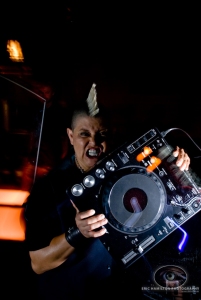
DJ Irene
Irene M. Gutierrez, famously known as DJ Irene, is one of the most successful queer Latina DJs and she was a staple at Arena. Growing up in Montebello, a city in the southeast region of LA county, Irene overcame a difficult childhood, homelessness, and addiction to break through a male-dominated industry and become an award-winning, internationally-known DJ. A single mother who started her career at Circus and then Arena, Irene was named as one of the “twenty greatest gay DJs of all time” by THUMP in 2014, along with Chicago house music godfather, Frankie Knuckles. Since her Arena days, DJ Irene has performed all over the world and has returned to school and received a master’s degree. In addition to continuing to DJ festivals and clubs, she is currently a music instructor at various colleges in Los Angeles. Speaking to her relevance, Nightclub&Bar music industry website reports, “her DJ and life dramas played out publicly on the dance floor and through her performing. This only made people love her more and helped her to see how she could give back by leading a positive life through music.”
DJ Irene’s shout-out– one of the most recognizable sounds from Arena–was a familiar Friday night hailing that interpellated us, a shout out that rallied the crowd, and a rhetorical question. The club-goers were usually and regularly predominately Latin@, although other kids of color and white kids also attended. We were celebrating queer brown life, desire, love in the midst of much suffering outside the walls of the club like anti-immigrant sentiment, conservative backlash against Latinos, HIV and AIDS, intertwined with teen depression and substance abuse.
From my vantage today, I hear the traces of Arena’s sounds as embodied forms of knowledge about a queer past which has become trivialized or erased in both mainstream narratives of Los Angeles and queer histories of the city. I argue that the sonic memories of Arena–in particular Irene’s sets and shout outs–provide a rich archive of queer Latinx life. After the physical site of memories are torn down (Arena was demolished in 2016), our senses serve as a conduit for memories.
As one former patron of Arena recalls, “I remember the lights, the smell, the loud music, and the most interesting people I had ever seen.” As her comment reveals, senses are archival, and they activate memories of transitory and liminal moments in queer LA Latinx histories. DJ Irene’s recognizable shout-out at the beginning of her sets– “How Many Latinos are in this House?”–allowed queer Latinx dancers to be seen and heard in an otherwise hostile historical moment of exclusion and demonization outside the walls of the club. The songs of Arena, in particular, function as a sonic epistemology, inviting readers (and dancers) into a specific world of memories and providing entry into corporeal sites of knowledge.
Both my recollections and the memories of Arena goers whom I have interviewed allow us to register the cultural and political relevance of these sonic epistemologies. Irene’s shout-outs function as what I call “dissident sonic interpolations”: sounds enabling us to be seen, heard, and celebrated in opposition to official narratives of queerness and Latinidad in the 1990s. Following José Anguiano, Dolores Inés Casillas, Yessica García Hernandez, Marci McMahon, Jennifer L. Stoever, Karen Tongson, Deborah R. Vargas, Yvon Bonenfant, and other sound and cultural studies scholars, I argue that the sounds surrounding youth at Arena shaped them as they “listened queerly” to race, gender and sexuality. Maria Chaves-Daza reminds us that “queer listening, takes seriously the power that bodies have to make sounds that reach out of the body to touch queer people and queer people’s ability to feel them.” At Arena, DJ Irene’s vocalic sounds reached us, touching our souls as we danced the night away.
Before you could even see the parade of styles in the parking lot, you could hear Arena and/or feel its pulse. The rhythmic stomping of feet, for example, an influence from African-American stepping, was a popular club movement that brought people together in a collective choreography of Latin@ comunitas and dissent. We felt, heard, and saw these embodied sounds in unison. The sounds of profanity–“motherfucking house”–from a Latina empowered us. Irene’s reference to “the house,” of course, makes spatial and cultural reference to Black culture, house music and drag ball scenes where “houses” were sites of community formation. Some songs that called out to “the house” that DJ Irene, or other DJs might have played were Frank Ski’s “There’s Some Whores in this House,” “In My House” by the Mary Jane Girls, and “In the House” by the LA Dream Team.
Then, the bold and profane language hit our ears and we felt pride hearing a “bad woman” (Alicia Gaspar de Alba) and one of “the girls our mothers warned us about” (Carla Trujillo). By being “bad” “like bad ass bitch,” DJ Irene through her language and corporeality, was refusing to cooperate with patriarchal dictates about what constitutes a “good woman.” Through her DJing and weekly performances at Arena, Irene contested heteronormative histories and “unframed” herself from patriarchal structures. Through her shout outs we too felt “unframed” (Gaspar de Alba).
Dissident sonic interpellation summons queer brown Latinx youth–demonized and made invisible and inaudible in the spatial and cultural politics of 1990s Los Angeles—and ensures they are seen and heard. Adopting Marie “Keta” Miranda’s use of the Althusserian concept of interpellation in her analysis of Chicana youth and mod culture of the 60s, I go beyond the notion that interpellation offers only subjugation through ideological state apparatus, arguing that DJ Irene’s shout-outs politicized the Latinx dancers or “bailadorxs” (Micaela Diaz-Sanchez) at Arena and offered them a collective identity, reassuring the Latinxs she is calling on of their visibility, audibility, and their community cohesiveness.
Perhaps this was the only time these communities heard themselves be named. As Casillas reminds us “sound has power to shape the lived experiences of Latina/o communities” and that for Latinos listening to the radio in Spanish for example, and talking about their situation, was critical. While DJ Irene’s hailing did not take place on the radio but in a club, a similar process was taking place. In my reading, supported by the memories of many who attended, the hailing was a “dissident interpolation” that served as recognition of community cohesiveness and perhaps was the only time these youth heard themselves publicly affirmed, especially due to the racial and political climate of 1990s Los Angeles.
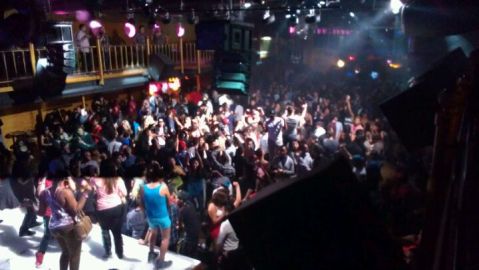
Vintage photo of Arena, 1990s, Image by Julio Z
The 1990s were racially and politically tense time in Los Angeles and in California which were under conservative Republican leadership. At the start of the nineties George Deukmejian was finishing his last term from 1990-1991; Pete Wilson’s tenure was from 1991-1999. Richard Riordan was mayor of Los Angeles for the majority of the decade, from 1993- 2001. The riots that erupted in 1992 after the not guilty verdict for the police officers indicted in the Rodney King beating case and the polarizing effect of the OJ Simpson trial in 1995 were indicative of anti-black and anti-Latinx racism and its impacts across the city. In addition to these tensions, gang warfare and the 1994 earthquake brought on its own set of economic and political circumstances. Anti-immigrant sentiment had been building since the 1980s when economic and political refugees from Mexico and Central American entered the US in large numbers and with the passing of the Immigration Reform and Control Act in 1986, what is known as Reagan’s “Amnesty program.” On a national level, Bill Clinton ushered in the implementation of the “Don’t Ask, Don’t Tell” policy in the military, which barred openly LGB people from service. In 1991, Anita Hill testified against Clarence Thomas’s nomination to the United States Supreme Court due to his ongoing sexual harassment of her at work; the U.S. Senate ultimately browbeat Hill and ignored her testimony, confirming Thomas anyway.
In the midst of all this, queer and minoritized youth in LA tried to find a place for themselves, finding particular solace in “the motherfucking house”: musical and artistic scenes. The club served a “house” or home to many of us and the lyrical references to houses were invitations into temporary and ephemeral sonic homes. Counting mattered. Who did the counting mattered. How many of us were there mattered. An ongoing unofficial census was unfolding in the club through Irene’s question/shout-out, answered by our collective cheers, whistles, and claps in response. In this case, as Marci McMahon reminds us, “Sound demarcates whose lives matter” (2017, 211) or as the Depeche Mode song goes, “everything counts in large amounts.”
Numbers mattered at a time when anti-immigrant sentiment was rampant, spawning white conservative sponsored legislation such as Prop 187 the so-called “Save Our State” initiative (which banned “undocumented Immigrant Public Benefits”), Prop 209 (the ban on Affirmative Action), and Prop 227 “English in Public Schools” (the Bilingual Education ban). Through these propositions, legislators, business people, and politicians such as Pete Wilson and his ilk demonized our parents and our families. Many can remember Wilson’s virulently anti-immigrant 1994 re-election campaign advertisement depicting people running across the freeway as the voiceover says “They keep coming” and then Wilson saying “enough is enough.” This ad is an example of the images used to represent immigrants as animals, invaders and as dangerous (Otto Santa Ana). As Daniel Martinez HoSang reminds us, these “racial propositions” were a manifestation of race-based hierarchies and reinforced segregation and inequity (2010, 8).
While all of this was happening— attempts to make us invisible, state-sponsored refusals of the humanity of our families—the space of the club, Irene’s interpellation, and the sounds of Arena offered a way to be visible. To be seen and heard was, and remains, political. As Casillas, Stoever, and Anguiano and remind us in their work on the sounds of Spanish language radio, SB 1070 in Arizona, and janitorial laborers in Los Angeles, respectively, to be heard is a sign of being human and to listen collectively is powerful.
Listening collectively to Irene’s shout out was powerful as a proclamation of life and a celebratory interpellation into the space of community, a space where as one participant in my project remembers, “friendships were built.” For DJ Irene to ask how many Latinos were in the house mattered also because the AIDS prevalence among Latinos increased by 130% from 1993 to 2001. This meant our community was experiencing social and physical death. Who stood up, who showed up, and who danced at the club mattered; even though we were very young, some of us and some of the older folks around us were dying. Like the ball culture scene discussed in Marlon M. Bailey’s scholarship or represented in the new FX hit show Pose, the corporeal attendance at these sites was testament to survival but also to the possibility for fabulosity. While invisibility, stigma and death loomed outside of the club, Arena became a space where we mattered.
For Black, brown and other minoritized groups, the space of the queer nightclub provided solace and was an experiment in self-making and self-discovery despite the odds. Madison Moore reminds us that “Fabulousness is an embrace of yourself through style when the world around you is saying you don’t deserve to be here” (New York Times). As Louis Campos–club kid extraordinaire and one half of Arena’s fixtures the Fabulous Wonder Twins–remembers,
besides from the great exposure to dance music, it [Arena] allowed the real-life exposure to several others whom, sadly, became casualties of the AIDS epidemic. The very first people we knew who died of AIDS happened to be some of the people we socialized with at Arena. Those who made it a goal to survive the incurable epidemic continued dancing.
The Fabulous Wonder Twins
Collectively, scholarship by queer of color scholars on queer nightlife allows us entryway into gaps in these queer histories that have been erased or whitewashed by mainstream gay and lesbian historiography. Whether queering reggaetón (Ramón Rivera-Servera), the multi-Latin@ genders and dance moves at San Francisco’s Pan Dulce (Horacio Roque-Ramirez), Kemi Adeyemi’s research on Chicago nightlife and the “mobilization of black sound as a theory and method” in gentrifying neighborhoods, or Luis-Manuel García’s work on the tactility and embodied intimacy of electronic dance music events, these works provide context for Louis’ remark above about the knowledges and affective ties and kinships produced in these spaces, and the importance of nightlife for queer communities of color.
When I interview people about their memories, other Arena clubgoers from this time period recall a certain type of collective listening and response—as in “that’s us! Irene is talking about us! We are being seen and heard!” At Arena, we heard DJ Irene as making subversive aesthetic moves through fashion, sound and gestures; Irene was “misbehaving” unlike the respectable woman she was supposed to be. Another queer Latinx dancer asserts: “I could fuck with gender, wear whatever I wanted, be a puta and I didn’t feel judged.”
DJ Irene’s “How many motherfucking Latinos in the motherfucking house,” or other versions of it, is a sonic accompaniment to and a sign of, queer brown youth misbehaving, and the response of the crowd was an affirmation that we were being recognized as queer and Latin@ youth. For example, J, one queer Chicano whom I interviewed says:
We would be so excited when she would say “How Many Latinos in the Motherfucking House?” Latinidad wasn’t what it is now, you know? There was still shame around our identities. I came from a family and a generation that was shamed for speaking Spanish. We weren’t yet having the conversation about being the majority. Arena spoke to our identities.
For J, Arena was a place that spoke to first generation youth coming of age in LA, whose experiences were different than our parents and to the experiences of queer Latinxs before us. In her shout-outs, DJ Irene was calling into the house those like J and myself, people who felt deviant outside of Arena and/or were then able to more freely perform deviance or defiance within the walls of the club.
Our responses are dissident sonic interpellations in that they refuse the mainstream narrative. If to be a dissident is to be against official policy, then to be sonically dissident is to protest or refuse through the sounds we make or via our response to sounds. In my reading, dissident sonic interpellation is both about Irene’s shout out and about how it moved us towards and through visibility and resistance and about how we, the interpellated, responded kinetically through our dance moves and our own shout outs: screaming, enthusiastic “yeahhhhs,” clapping, and stomping. We were celebrating queer brown life, desire, love in the midst of much suffering outside the walls of the club. Arena enabled us to make sounds of resistance against these violences, sounds that not everyone hears, but as Stoever reminds us, even sounds we cannot all hear are essential, and how we hear them, even more so.
Even though many of us didn’t know Irene personally (although many of the club kids did!) we knew and felt her music and her laughter and the way she interpellated us sonically in all our complexity every Friday. Irene’s laughter and her interpellation of dissent were sounds of celebration and recognition, particularly in a city bent on our erasure, in a state trying to legislate us out of existence, on indigenous land that was first our ancestors.
In the present, listening to these sounds and remembering the way they interpellated us is urgent at a time when gentrification is eliminating physical traces of this queer history, when face-to face personal encounters and community building are being replaced by social media “likes,” and when we are engaging in a historical project that is “lacking in archival footage” to quote Juan Fernandez, who has also written about Arena. When lacking the evidence Fernandez writes, the sonic archive whether as audio recording or as a memory, importantly, becomes a form of footage. When queer life is dependent on what David Eng calls “queer liberalism” or “the empowerment of certain gay and lesbian U.S. citizens economically through an increasingly visible and mass-mediated consumer lifestyle, and politically through the legal protection of rights to privacy and intimacy,” spaces like Arena–accessed via the memories and the sonic archive that remains– becomes ever so critical.
Voice recordings can be echoes of a past that announce and heralds a future of possibility. In their Sounding Out! essay Chaves-Daza writes about her experience listening to a 1991 recording of Gloria Anzaldúa speaking at the University of Arizona, which they encountered in the archives at UT Austin. Reflecting on the impact of Anzaldúa’s recorded voice and laughter as she spoke to a room full of queer folks, Chaves-Daza notes the timbre and tone, the ways Anzaldúa’s voice makes space for queer brown possibility. “Listening to Anzaldúa at home, regenerates my belief in the impossible, in our ability to be in intimate spaces without homophobia,” they write.
Queer Latinxs coming across or queerly listening to Irene’s shout out is similar to Chaves-Daza’s affective connection to Anzaldúa’s recording. Such listening similarly invites us into the memory of the possibility, comfort, complexity we felt at Arena in the nineties, but also a collective futurity gestured in Chaves-Daza’s words:. “Her nervous, silly laugh–echoed in the laughs of her audience–reaches out to bring me into that space, that time. Her smooth, slow and raspy voice–her vocalic body–touches me as I listen.” She writes, “Her voice in the recording and in her writing sparks a recognition and validation of my being.” Here, Anzaldúa’s laughter, like Irene’s shout-out, is a vocal choreography and creates a “somatic bond,” one I also see in other aspects of dancers, bailadorxs, remembering about and through sound and listening to each other’s memories of Arena. Chaves-Daza writes, “sound builds affective connections between myself and other queers of color- strikes a chord in me that resonates without the need for language, across space and time.”
In unearthing these queer Latin@ sonic histories of the city, my hopes are that others listen intently before these spaces disappear but also that we collectively unearth others. At Arena we weren’t just dancing and stomping through history, but we were making history, our bodies sweaty and styled up and our feet in unison with the beats and the music of DJ Irene.“ How Many Latinos in the Mutherfucking House?”, then, as a practice of cultural citizenship, is about affective connections (and what Karen Tongson calls “remote intimacies”), “across, space and time.” The musics and sounds in the archive of Arena activates the refusals, connections, world-making, and embodied knowledge in our somatic archives, powerful fugitive affects that continue to call Latinx divas to the dancefloor, to cheer, stomp and be counted in the motherfucking house: right here, right now.
—
—
Featured Image: DJ Irene, Image by Flickr User Eric Hamilton (CC BY-NC 2.0)
—
Eddy Francisco Alvarez Jr. came of age in the 1990s, raised in North Hollywood, California by his Mexican mother and Cuban father. A a first generation college student, he received his a BA and MA in Spanish from California State University, Northridge and his PhD in Chicana and Chicano Studies from University of California, Santa Barbara. A former grade school teacher, after graduate school, he spent three years teaching Latinx Studies in upstate New York before moving to Oregon where he is an Assistant Professor in the Departments of Women, Gender, and Sexuality Studies and University Studies at Portland State University. His scholarly and creative works have been published in TSQ: Transgender Studies Quarterly, Aztlan: A Journal of Chicano Studies, Revista Bilingue/Bilingual Review, and Pedagogy Notebook among other journals, edited books, and blogs. Currently, he is working on a book manuscript titled Finding Sequins in the Rubble: Mapping Queer Latinx Los Angeles. He is on the board of the Association for Jotería Arts, Activism, and Scholarship (AJAAS) and Friends of AfroChicano Press.
—
 REWIND!…If you liked this post, check out:
“Music to Grieve and Music to Celebrate: A Dirge for Muñoz”-Johannes Brandis
On Sound and Pleasure: Meditations on the Human Voice-Yvon Bonenfant
Music Meant to Make You Move: Considering the Aural Kinesthetic– Imani Kai Johnson
Black Joy: African Diasporic Religious Expression in Popular Culture–Vanessa Valdés
Unapologetic Paisa Chingona-ness: Listening to Fans’ Sonic Identities–Yessica Garcia Hernandez
Share this:

Mr. and Mrs. Talking Machine: The Euphonia, the Phonograph, and the Gendering of Nineteenth Century Mechanical Speech
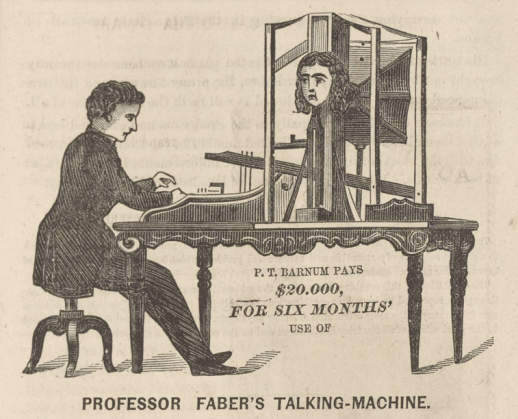
In the early 1870s a talking machine, contrived by the aptly-named Joseph Faber appeared before audiences in the United States. Dubbed the “euphonia” by its inventor, it did not merely record the spoken word and then reproduce it, but actually synthesized speech mechanically. It featured a fantastically complex pneumatic system in which air was pushed by a bellows through a replica of the human speech apparatus, which included a mouth cavity, tongue, palate, jaw and cheeks. To control the machine’s articulation, all of these components were hooked up to a keyboard with seventeen keys— sixteen for various phonemes and one to control the Euphonia’s artificial glottis. Interestingly, the machine’s handler had taken one more step in readying it for the stage, affixing to its front a mannequin. Its audiences in the 1870s found themselves in front of a machine disguised to look like a white European woman.

Unidentified image of Joseph Faber’s Euphonia, public domain. c. 1870
By the end of the decade, however, audiences in the United States and beyond crowded into auditoriums, churches and clubhouses to hear another kind of “talking machine” altogether. In late 1877 Thomas Edison announced his invention of the phonograph, a device capable of capturing the spoken words of subjects and then reproducing them at a later time. The next year the Edison Speaking Phonograph Company sent dozens of exhibitors out from their headquarters in New York to edify and amuse audiences with the new invention. Like Faber before them, the company and its exhibitors anthropomorphized their talking machines, and, while never giving their phonographs hair, clothing or faces, they did forge a remarkably concrete and unanimous understanding of “who” the phonograph was. It was “Mr. Phonograph.”
Why had the Euphonia become female and the phonograph male? In this post, I peel apart some of the entanglements of gender and speech that operated in the Faber Euphonia and the phonograph, paying particular attention to the technological and material circumstances of those entanglements. What I argue is that the materiality of these technologies must itself be taken into account in deciphering the gendered logics brought to bear on the problem of mechanical speech. Put another way, when Faber and Edison mechanically configured their talking machines, they also engineered their uses and their apparent relationships with users. By prescribing the types of relationships the machine would enact with users, they constructed its “ideal” gender in ways that also drew on and reinforced existing assumptions about race and class.
Of course, users could and did adapt talking machines to their own ends. They tinkered with its construction or simply disregarded manufacturers’ prescriptions. The physical design of talking machines as well as the weight of social-sanction threw up non-negligible obstacles to subversive tinkerers and imaginers.
Born in Freiburg, Germany around 1800, Joseph Faber worked as an astronomer at the Vienna Observatory until an infection damaged his eyesight. Forced to find other work, he settled on the unlikely occupation of “tinkerer” and sometime in the 1820s began his quest for perfected mechanical speech. The work was long and arduous, but by no later than 1843 Faber was exhibiting his talking machine on the continent. In 1844 he left Europe to exhibit it in the United States, but in 1846 headed back across the Atlantic for a run at London’s Egyptian Hall.
That Faber conceived of his invention in gendered terms from the outset is reflected in his name for it—“Euphonia”—a designation meaning “pleasant sounding” and whose Latin suffix conspicuously signals a female identity. Interestingly, however, the inventor had not originally designed the machine to look like a woman but, rather, as an exoticized male “Turk.”
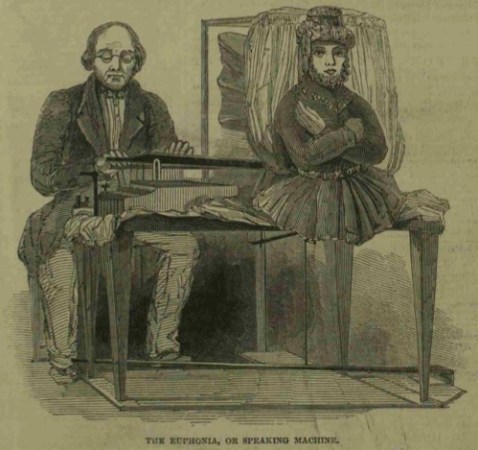
“The Euphonia,” August 8, 1846, Illustrated London News, 96.
A writer for Chambers Edinburgh Journal characterized the mannequin’s original appearance in September of 1846:
The half figure of a man, the size known to artists as kit kat, dressed in Turkish costume, is seen resting, upon the side of a table, surrounded by crimson drapery, with its arms crossed upon its bosom. The body of the figure is dressed in blue merino, its head is surmounted by a Turkish cap, and the lower part of the face is covered with a dense flowing beard, which hangs down so as to conceal some portion of the mechanism contained in the throat.
What to make of Faber’s decision to present his machine as a “Turk?” One answer, though an unsatisfying one is “convention.” One of the most famous automata in history had been the chess-playing Turk constructed by Wolfgang von Kempelen in the eighteenth century. A close student of von Kempelen’s work on talking machines, Faber would almost certainly have been aware of the precedent. In presenting their machines as “Turks,” however, both Faber and Von Kempelen likely sought to harness particular racialized tropes to generate public interest in their machines. Mystery. Magic. Exoticism. Europeans had long attributed these qualities to the lands and peoples of the Near East and it so happened that these racist representations were also highly appealing qualities in a staged spectacle—particularly ones that purported to push the boundaries of science and engineering.
Mysteriousness, however, constituted only one part of a much larger complex of racialized ideas. As Edward Said famously argued in Orientalism Westerners have generally mobilized representations of “the East” in the service of a very specific political-cultural project of self- and other-definition—one in which the exoticized orient invariably absorbs the undesirable second half of a litany of binaries: civilization/barbarism, modernity/backwardness, humanitarianism/cruelty, rationality/irrationality. Salient for present purposes, however is the west’s self-understanding as masculine, in contradistinction to—in Said’s words—the East’s “feminine penetrability, its supine malleability.”
One possible reading of the Faber machine and its mannequin “Turk,” then, would position it as an ersatz woman. A depiction of the Euphonia and its creator, which appeared in the August 8, 1846 Illustrated London News would appear to lend credence to this reading. In it, the Turk, though bearded, features stereotypically “feminine” traits, including soft facial features, smooth complexion and full lips. Similarly, his billowing blouse and turban lend to the Turk a decidedly “un-masculine” air from the standpoint of Victorian sartorial norms. The effect is heightened by the stereotypically “male” depiction of Faber himself in the same illustration. He sits at the Euphonia’s controls, eyes cast down in rapt attention to his task. His brow is wrinkled and his cheeks appear to be covered in stubble. He appears in shirt and jacket—the uniform of the respectable middle-class white European man.
Importantly, the Euphonia’s speech acts did not take place as part of a conversation, but might have been compared to another kind of vocalization altogether. Faber’s manipulation of the Euphonia entailed a strenuous set of activities behind the automaton (though, in truth, off to one side.) Its keyboard kept both of the inventor’s hands occupied at the machine’s “back,” while its foot-operated bellows had to steadily be pumped to produce airflow. Though requiring some imagination, one could imagine Faber and his creation having sex. At least one observer, it seems, did. In an article originally printed in the New York Paper, the author recounted how he “suggested to Mr. F[aber] that the costume and figure had better have been female.” This course of action offered practical mechanical-semiotic advantages “as the bustle would have given a well-placed and ample concealment for all the machinery now disenchantingly placed outside.” To the foregoing the writer added a clause: “—the performer sitting down naturally behind and playing her like a piano.”

Unidentified image of Faber’s Euphonia, public domain. c. 1870. The Euphonia was apparently sometimes exhibited with only the mannequin’s face in place, its body having been dispensed with.
Around 1870 the Euphonia was recast as a woman. By this time Herr Faber had been dead several years and his talking machine had passed on to a relative, also called Joseph, who outsourced the staged operation of the machine to his wife—Maria Faber. The transition from a male mannequin to a female mannequin (as well as the transition from a male operator to a female operator) throws into relief certain wrinkles in the gendered story of the Euphonia. Given that the Euphonia’s vocalizations could be read through the lens of sexualized domination, why had Faber himself not designed the mannequin as a woman in the first place? There are no pat answers. Perhaps the older, bookish, inventor believed the Turk could serve as an object of Western scientific domination without eliciting embarrassing and prurient commentary. Clearly, he underestimated the degree to which the idea of technological mastery already contained sexual overtones.
Little can be said about Joseph Faber’s life and work beyond 1846 though an entry for the inventor in the Biographisches Lexikon des Kaiserthums Österreich claimed that he took his life about 1850. Whatever the truth of Herr Faber’s fate, the Euphonia itself disappeared from public life around this same time and did not resurface for nearly two-and-a-half decades.
On the other hand, the idea of a female-presenting Euphonia, suggested by the New York Paper contributor in 1845, came to fruition as the machine was handed over to a female operator. If audiences imagined the spectacle of Euphonia-operation as a kind of erotic coupling, this new pairing would have been as troubling in its own way as Faber’s relationship to his Turk. What explains, then, the impulse to transition the Euphonia from androgyne to woman? Again, there are no pat answers. One solution to the enigma lies in the counter-factual: Whatever discomfiting sexual possibilities were broached in the Victorian mind by a woman’s mastery over a female automaton would have been greatly amplified by a woman’s mastery over a male one.
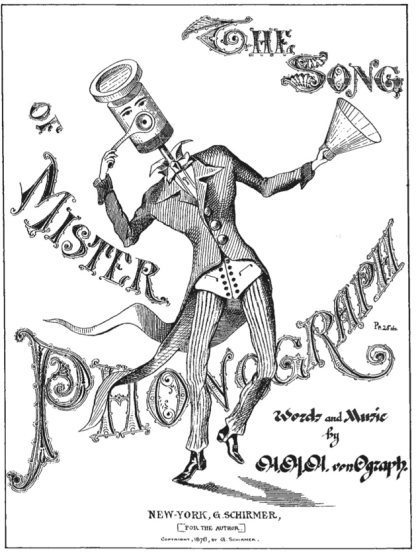
H.H.H. von Ograph “The Song of Mr. Phonograph” (New York: G Shirmer, 1878).
In these early exhibitions, the phonograph became “Mr. Phonograph.” In Chicago, for example, an exhibitor exclaimed “Halloa! Halloa!” into the apparatus before asking “Mr. Phonograph are you there?” “This salutation,” perspicaciously noted an attending Daily Tribune reporter “might have been addressed with great propriety to the ghosts at a spiritual seance…” In San Francisco, an exhibitor opened his demonstration by recording the message “Good morning, Mr. Phonograph.” Taking the bait, a Chronicle reporter described the subsequent playback: “‘Good morning, Mr. Phonograph,’ yelled Mr. Phonograph.”
In Atlanta, the phonograph was summoned “Mr. Phonograph, will you talk?” Mr. Phonograph obliged [“Wonder Agape!,” The Phonograph Puzzling Atlanta’s Citizens.” The Daily Constitution. June 22, 1878, 4]. At some point in 1878 the Edison Speaking Phonograph Company commissioned the printing of a piece of promotional sheet music “The Song of Mr. Phonograph.” The cover art for the song sheet featured a bizarrely anthropomorphized phonograph. The machine’s iron cylinder has been transformed into a head with eyes, while the mouthpiece and recording stylus have migrated outward and are grasped by two human hands. Mr. Phonograph’s attire, however, leaves no doubt as to his gender: He wears a collared shirt, vest, and jacket with long tails above; and stirrupped pants and dress boots below.
[Animal noises–cat, chicken, rooster, cow bird, followed by announcement by unidentified male voice, From UCSB Cylinder Archive]. Mr. Phonograph appealed not only to the professional exhibitors of the 1870s but to other members of the American public as well. One unnamed phonograph enthusiast recorded himself sometime before 1928 imitating the sounds of cats, hens, roosters and crows. Before signing off, he had his own conversation with “Mr. Phonograph.”
To understand the impulse to masculinize the phonograph, one must keep in mind the technology’s concrete mechanical capabilities. Unlike the Euphonia, the phonograph did not have a voice of its own, but could only repeat what was said to it. The men who exhibited the phonograph to a curious public were not able (like the Fabers before them) to sit in detached silence and manually prod their talking machines into talking. They were forced to speak to and with the phonograph. The machine faithfully addressed its handler with just as much (or as little) manly respect as that shown it, and the entire operation suggested to contemporaries the give-and-take of a conversation between equals. Not surprisingly, the phonograph became a man and a properly respectable one at that. Finally, the all-male contingent of exhibitors sent across the United States by the Edison Speaking Phonograph Company in 1878 invariably imparted to their phonographs their own male voices as they put the machine through its paces on stage. This, in itself, encouraged attribution of masculinity to the device.
The Euphonia and the phonograph both “talked.” The phonograph did so in a way mechanically-approximating the idealized bourgeois exchange of ideas and therefore “had” to be male. The Euphonia, on the other hand, spoke only as a function of its physical domination by its handler who wrung words from the instrument as if by torture. The Euphonia, then, “had” to be female.
The talking machines of the late nineteenth century as well as the media technologies that succeeded them emerged from a particular white, male, western and middle class culture.While changing in profound ways since the Victorian period, this culture has remained committed to the values of scientific mastery of nature; racial and gender hierarchies; and, especially, economic accumulation. But because the physical apparatus of talking machines has evolved so dramatically during this same period, it has been necessary to periodically renovate the ontology of mechanical speech in order to make it “safe” for the core values of the culture.
A fuller accounting of the politics of sound reproduction is possible but it depends on a more dynamic rendering of the interplay between practices, technologies and sonic understandings. It requires not only identifying speakers and listeners, but also placing them within the broader networks of people, things and ideas that impart to them moral content. It means attending—no less so than to texts and other representations—to the stories machines themselves tell when they enact the labor of speaking. We should listen to talking machines talking. But we should watch them as well.
—
Featured Image: from William C. Crum, ”Illustrated History of Wild Animals and Other Curiosities Contained in P.T. Barnum’s Great Travelling World’s Fair….” (New York: Wynkoop & Hallenbeck, 1874) 73. This image suggests that the later exhibitors of the Euphonia may have occasionally deviated from the gendered norms established by Joseph Faber, Sr. In image 4, a man—perhaps Joseph, Jr.— operates the Euphonia in its female form.
—
J. Martin Vest holds Bachelors and Masters degrees in History from Virginia Commonwealth University and a PhD in American History from the University of Michigan. His research interests range across the nineteenth and twentieth centuries, and are heavily influenced by the eclecticism and curiosity of working class storytelling. Past projects have explored Southside Virginia’s plank roads; the trope of insanity in American popular music; slavs in the American South; radical individualist “egoism;” twentieth century anarchists and modern “enchantment.” His dissertation, “Vox Machinae: Phonographs and the Birth of Sonic Modernity, 1870-1930,” charts the peculiar evolution of modern ideas about recorded sound, paying particular attention to the role of capitalism and mechanical technology in shaping the things said and believed about the stuff “in the grooves.”
 REWIND!…If you liked this post, you may also dig:
Only the Sound Itself?: Early Radio, Education, and Archives of “No-Sound”–Amanda Keeler
The Magical Post-Horn: A Trip to the BBC Archive Centre in Perivale–Leslie McMurtry
How Svengali Lost His Jewish Accent–Gayle Wald
Share this:


Current Top Posts





April 2021

January 2020

November 2019

October 2019

August 2019

April 2014

November 2017

March 2015

December 2017

October 2015
 Sounding Out!
Recent Comments