
Enacting Queer Listening, or When Anzaldúa Laughs

 Marginalized bodies produce marginalized sounds to communicate things that escape language. The queer body is the site of sounds that engage pleasure, repression, rage, isolation, always somehow outside of dominant language. Sound Studies tells us that we should trust our ears as much as our eyes, justifying our trust in sound, and of the resonating body. Affect Theory goes further, saying that all senses play into a body that processes input through levels of response, experience, and anticipation. Affect is the vibrational space that is both bodily memory and anticipation. So where do sound and affect meet in queer bodies? How do marginalized peoples use sound and the body to express liberation, objectification, joy, and struggle?
Our writers in Sound and Affect tackle these questions across a spectrum of the marginalized experience. I opened the series by offering the concept of the tremble, a sonic form of affect that is necessarily queer in its affective reach. Last week, Kemi Adeyemi, sloooooooowed thingggggggggs doooooooooownnnnn so to hear the capitalist connections between the work expected of black bodies and the struggle for escape from this reality through the sonic affects, temporal shifts, and corporeal elsewhere of purple drank. Next week, Justyna Stasiowska brings the noise in a discussion of the trans body and the performance work of Tara Transitory. Today, Maria P. Chaves Daza explores the connection between voice, listening, and queer Chicana community formation: through space, across time, and with laughter. —Guest Editor Airek Beauchamp
—
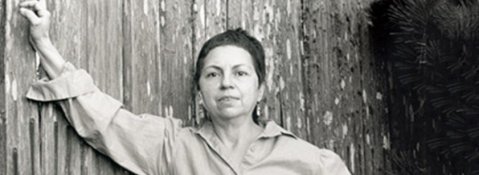
In October 1991 at the University of Arizona fall reading series, Gloria Anzaldúa read several poems and short stories–work now held at the UT-Austin Collection. Recently, I sat in my living room listening to the recording, feeling the buzz of her presence, the audible excitement in the Modern Languages Auditorium that Gloria Anzaldúa is about to speak. After some welcoming statements and a poem by Rita Magdaleno, inspired by Magdaleno’s reading of Borderlands, Anzaldúa takes the stage.
As part of her praxis, Anzaldúa makes space for queer people, both through her words and vocal tone. She begins with a joke about her relationship with mics and takes the time to thank the organizers, especially for her cozy writer’s cottage. Anzaldúa dedicates the reading to Yolanda Leyva, her old roommate, telling Leyva she hasn’t forgotten her. Then, she announces her involvement in Sinister Wisdom and encourages women of color in the audience to contribute to this all-lesbian journal. She proceeds to laugh as she says, “lesbians of color only, sorry. [laughs]” Similarly, as she announces a collection she is editing with Francisco Alarcon about Chicana dykes and Chicano gay men, she says, “so if anybody is a Chicana dyke or a Chicano gay man, sorry about the rest of you” [laughs]. In the future she will also edit a book called Chicana Theory “Chicanas only (laughs), sorry.” Last, she acknowledges Chuck Tatum for changing the title of his annual from “New Chicano Writings” to “New Chicana/o Writings” and for allowing for Spanish and Spanglish Tex-Mex when he first wanted pieces in English. Anzaldúa takes the opportunity to recognize and promote the work of Chicana/o lesbian and gay writers by demarcating several publications exclusive to their work. This exclusivity is softened with giggles and laughs, affects, which help work through the tension(s) of recognition and exclusion caused by this explicit circumscription.
Her nervous, silly laugh–echoed in the laughs of her audience–reaches out to bring me into that space, that time. Her smooth, slow and raspy voice–her vocalic body–touches me as I listen.

Gloria Andzaldúa Image from the Tumblr of BiRadical
In their introduction to The Affect Reader, Gregory J. Seigworth and Melissa Gregg assert affect’s “immanent capacity for extending […] both into and out of the interstices of the inorganic and non-living, intracellular divulgences of sinew, tissue and gut economies and the vaporous evanescenses of the incorporeal (events, atmospheres, feeling-tones)” (2).This sound recording of Anzaldúa’s poetry reading is an example of the immanent capacity this “incorporeal” event has to resonate and “sometimes stick to bodies and worlds” for listening audiences (1). Affect in its simplest form is “the name we give to those forces […] that serve to drive us to movement, towards thought and extension” and is “synonymous with force or forces of encounter (2).” My encounter with Anzaldúa’s (incorporeal) recording and the affect created through listening to her work lead me to ponder an answer to Seigworth and Gregg’s question:
How does a body marked in its duration by these various encounters with mixed forces, come to shift its affections (its being affected) into action (capacity to affect)? (2)
Toward an answer to this question, this post explores my relationship between Anzaldúa’s voice and my pedagogy, both her speaking voice as well as the interior voice she offers her audience, the way in which she opens spaces for queer women of color, and the resonances I find in both. As a queer woman of color who once felt isolated, Anzaldúa’s work has in many ways liberated me as a scholar, providing me with access to a voice for my own experiences. But Anzaldúa’s voice–its tactile material aspects and the way its sound builds affective connections between myself and other queers of color–strikes a chord in me that resonates without the need for language, across space and time. Her voice in the recording and in her writing sparks a recognition and validation of my being.

“Viva Gloria Anzaldúa,” acrylic on canvas, by Jake Prendez
Yvon Bonenfant’s theorization of “queer listening” highlights a practice of visibility and exclusivity that enables Anzaldúa’s vocalic body to reach out to the queer community, and for us to “listen out” in return. In “Queer Listening to Queer Vocal Timbres,” Bonenfant identifies the vocalic body as central to listening experience. He defines the vocalic body as an instrument producing vibrations that touch others, and a socially produced body positioned by environmental factors in a set of relations of power that produce identity. From these constitutive power relations the queer body listens for other queer bodies since “queer is a doing, not a being;” and listening is an active process of identifying the elements reaching out to queer people (78). Thus, Bonenfant, elaborates queer listening as
a listening out for, reach[ing] towards, the disoriented or differently oriented other […] listening out through the static produced by not-queer emanations of vocalic bodies. […] since hearing is feeling touch, this act of finding requires attunement to the touch of the vocalic bodies that caress queer. Sometimes, one has to listen very carefully to find them (78).
Queer listening then, takes seriously the power that bodies have to make sounds that reach out of the body to touch queer people and queer people’s ability to feel them.
***

CLICK on image of Gloria Andzaldúa to hear the recording I discuss from the University of Arizona, 10/23/91
On the University of Arizona’s recording, I can hear in Anzaldúa’s laugh a relish in her ability to take up space, to have before her an audience of more lesbian, gay and queer writers to contribute to her several anthology projects. Her voice is filled with a nervous excitement; after all, there is always a danger in being queer. Her laugh resonates as a physical instantiation of the risk of her own existence and of the other queers in the room. It is also a soothing mechanism; her laugh momentarily takes the edge off of some of her words as it reaches out, touches, and brings together queer people of color.
It is in this same way, that Anzaldúa’s work creates the space to speak and listen to queer people of color in many contexts. I was first introduced to Anzaldúa in the classroom, specifically a feminist theory class. It was the first time I had heard a Chicana speak about being queer (or anyone who was mestiza for that matter); the classroom can be fraught with danger for students like me. Cindy Cruz, in “Notes on Immigration, Youth and Ethnographic Silence,” argues that the classroom needs to be a space aware of the political climate that silences LGBTQ immigrant students (68). In the classroom, writers such as Anzaldúa, Cherrie Moraga, Audre Lorde, and bell hooks all contribute to the growing canon of “politically undesired” identities (68). Without these writers, the queer-identified person may never be given a reason or a chance to speak about their experience as brown/black transgressive sexual subject. For this reason, when I teach I always read Anzaldúa aloud or ask members of the class to do so. Her powerful language, when vocalized, creates what Bonenfant would call a somatic bond that inhabits the students themselves, the classroom, and demands that we discuss homophobia, sexism, misogyny, and racism from the perspective of the atravesadx: the immigrant queer person of color. Reading Anzaldúa aloud creates what Karen Tongson calls “remote intimacy: a way of imagining our own spaces in connection to others.” This is almost a pirate bond, a way of connecting the undesired and marginalized.
I have experienced this affective bond on multiple occasions, but one instance stands out.
In a Critical Race Theory class during my fifth year grad school, a fellow student, an immigrant woman of color, came out to the class by way of a seminar paper. As she read the paper she was shaking, her voice cracked, and tears rolled down her face. She was terrified of the consequences of “coming out,” however she found the courage to write and share her experiences. I remember how this reading touched me, the student’s voice interlaced with quotes explaining Anzaldúa’s concept of “homophobia”—the fear of going home– moved through the classroom and classmates: people leaned in, shifted in their seats, began doodling, some shook their heads in agreement in relation to coming out. I don’t think the student would have felt this was possible or appropriate if we hadn’t read Anzaldúa; the only lesbian writer on the syllabus.
The sound of Anzaldúa’s text creates a vocalic body for queer listening available to people who yearn for its touch. Bonenfant posits this idea of yearning as inherently queer. Queer, as a form of doing, requires performative activity, always looking to find our own likenesses in others. Recognizing sound as touching the vocalic body, “queer listeners can perhaps catch some of the subtle variations in timbre that indicate a resonant ‘identity’ that wants to touch someone like us” (78). Anzaldúa’s various texts speak of concrete experience but the timbre of her voice–and the voice(s) reading her work–speaks to much more, a certain trembling that I feel in my own experience and that I wish to not only receive but to share with other queers of color also reaching out while also always receptive to the timbre of likeness.
Affective phenomena do not rely on textual or linguistic acts to communicate but instead are networked intensities of impulse that connect the individual body-mind to the bodies-minds of others. As Gregg and Seigworth explain,
Affect arises in the midst of in-between-ness: in the capacities to act and be acted upon. […] That is, affect is found in the intensities that pass body to body. In fact, it is quite likely that affect more often transpires within and across the subtlest of shuttling intensities: all the minuscule or molecular events of the unnoticed (2).
Anzaldúa incites in me a sense of intensity as the unnamable but unmistakable realities of my own experience resonate when I listen, while also lighting in me a force, an exertion of a “politically undesirable” self that I must assert in the world and in the classroom as a space of in- between-ness. Anzaldúa’s writing and the timbre of her voice are, to me, intensities and forces that go unnoticed, except by those who are yearning for them. Listening to Anzaldúa in the classroom proliferates the possibility of queer listening encounters; listening to Anzaldúa at home, in my living room, regenerates my belief in the impossible, in our ability to be in intimate spaces without homophobia: the fear of going home.
—
Featured Image: Used with the generous permissions of artist Alma Lopez. See more of her work at: http://almalopez.net/
—
JS and AB are grateful for the the editorial work of Tara Betts on early drafts.
—
Maria P. Chaves Daza is a doctoral candidate in the English Department at SUNY Binghamton University studying testimonios of undocumented women. They are a McNair Scholar and a Clifford D. Clark Fellow. They hold a B.A in Women’s Studies form NEIU in Chicago and a Master’s in Philosophy from the Philosophy, Interpretation and Culture (PIC) Program (SUNY Binghamton).
 REWIND!…If you liked this post, check out:
“Music to Grieve and Music to Celebrate: A Dirge for Muñoz”-Johannes Brandis
On Sound and Pleasure: Meditations on the Human Voice-Yvon Bonenfant
“Hearing Queerly: NBC’s ‘The Voice’”-Karen Tongson
Could I Be Chicana Without Carlos Santana?-Wanda Alarcón
Óyeme Voz: U.S. Latin@ & Immigrant Communities Re-Sound Citizenship and Belonging-Nancy Morales
Share this:

The Sweet Sounds of Havana: Space, Listening, and the Making of Sonic Citizenship

 Welcome to the third and final installment of Unsettling the World Soundscape Project, a series in which we critically investigate the output of early acoustic ecology and assess its continuing value for today’s sound studies. In our first post, Mitchell Akiyama addressed the WSP’s ten-hour Soundscapes of Canada radio series from 1974 to situate the broadcast’s innovative work historically and explore how it attempted to represent a diverse nation by way of sound. In my follow-up post, I focused on the WSP’s Vancouver research, their only output since returning from Europe in 1975, assessing shifts in the ideologies and practices over its two official releases and arguing for the best path that future iterations of the project might follow.
In this final entry, Vincent Andrisani puts the “world” back into the World Soundscape Project by carrying his experience as the recordist for the WSP’s last archiving mission in Vancouver out into his solo doctoral research in Havana, Cuba. Andrisani lends an unsettled ear to one of the city’s most beloved sounds, the tune of the ice cream vendor, unpacking its social and historical significance to make an argument about the role that sound plays in local self-definitions of citizenship. Inspired by the WSP’s continuing quest to discover how people’s relationship to places can be defined through sound, Andrisani’s work offers an example of what contemporary soundscape research can be while demonstrating how to deal with many of the concerns raised about the WSP’s output over the course of this series.
It has been a great pleasure acting as editor for this series over the past few weeks and it is our hope that these posts will provide further fuel for celebrating, expanding, critiquing and rethinking the work of acoustic ecology in the broader context of contemporary sonic research.
— Guest Editor Randolph Jordan
—
To conceive of Havana in sound is to think not of the material spaces of the city, but rather, across them. From inside the home, residents participate in conversations taking place in the streets, while those in the streets often call for the attention of their friends or family indoors. Through windows, open doors, and porticoes, residents engage in interpersonal exchanges that bring neighbourhood communities to life. To listen across these spaces is to listen trans-liminally from the threshold through which sounds must pass as they animate the vibrant social life of the city. Such an act is made most apparent by the voices of vendedores ambulantes, or, mobile street vendors. “¡El buen paquete de galleta!” (“The good packs of cookies!”), “¡Se compran y se vendan libros!” (“I’m buying and selling books!”), and most famously, “¡Mani! ¡Mani!” (“Peanuts! Peanuts!”) are some of the pregones—the musical cries—heard through the streets and into the home.
But not all vendors are pregoneros. El heladero, the ice cream vendor, uses the jangly melodies of the electronic music box to make ears perk up, mouths water, and children’s shoes hit the ground running. The sound signals a respite from the sweltering Caribbean heat and is symbolic of a novelty food item for which Cubans have a strong cultural affinity. But most of all, the ice cream vendor’s melodic tunes bring people out of their homes and into the street, giving life to a moment that is as social, participatory, and convivial as it is savory.
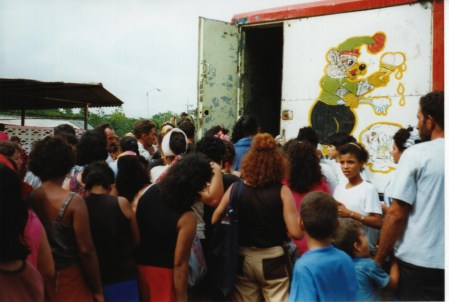
Ice Cream Vendor in Cuba, 2008, Courtesy of Flickr User berg_chabot
For over a century, ice cream vendors have been heard on the streets of Havana. Throughout this time, the city’s spaces have been contested by external regimes of power that include the Spanish Crown, U.S. business interests, Cuba’s own socialist government, the Soviet Union, and since the 1990s, Cuba’s resurgent tourist economy. Yet, in spite of the exclusionary logic imposed by each of these systems of power, the sound of the ice cream vendor still remains. To listen to it is to listen to Havana according not to the agenda of outside interests, but rather, according to the collective interests of residents themselves.
Borrowing from the work of Saskia Sassen (2006) who maintains that “citizenship practices have to do with the production of ‘presence’ of those without power and a politics that claims rights to the city” (315), I regard the tacit, communicative, trans-liminal act of listening as a means through which residents assert their embodied presence amidst both the spatial and political landscapes of the city. Listening to the sound of the ice cream vendor, I argue, constitutes an act of citizenship—an act of sonic citizenship—that momentarily claims Havana’s spaces according to the aims, aspirations, and desires of those who live there.
Citizenship, in this sense, is conceived of not as an institution bound to the political-juridical architecture of the nation-state, but rather, as a place-based “practice and project” (Sassen, p281) that, over time, has the potential to condition changes in the formalized institution itself. It emerges in the everyday, rather ordinary moments during which the city’s spaces are produced and given meaning by those with unequal access to political power. Just as Jennifer Stoever (2011) and Michael Francis O’Toole (2014) have discussed elsewhere, I too contend that citizenship is articulated in sound, but in order to hear it, we must listen historically to—and through—the spaces of Havana’s built environment.
The above clip, which I captured while conducting fieldwork in Havana, represents a moment of everyday life in the municipality of Centro Habana. While speaking about it with friends, colleagues, and acquaintances, I came to realize that only recently had the ice cream vendor’s heralding music become part of the local soundscapes. “Where was it before that?”, I asked. “Before that,” they all said, “it was gone.” In 1990, the Soviet Union collapsed and brought Cuba’s economy along with it. Shortages of food, petrol, and material resources were so severe that satisfying basic needs took precedence over the delivery of frozen novelties. The result was the loss of the ice cream vendor—and its corresponding sound—which, for decades, was part of the ongoing, everyday life of the city.
Fittingly, the collective sentiment surrounding that loss is captured in song. “Helado Sobre Ruedas,” or “Ice Cream on Wheels” by Gema y Pavel was released in 1994, during the height of Cuba’s economic crisis. In it, the duo lament the disappearance of the ice cream vendor from the streets of Havana and reflect on what it meant not only to them, but to all residents of the city. They speak about the presence of the ice cream vendor as a ‘refreshing’ event on hot days; as a source of joy, pleasure, and happiness that offered much more than a simple respite from the heat, but as one that “made family problems disappear.” The “sweet melody” of the vendor was the cause for celebration in neighbourhoods across the city, and is a sound that the duo recalls with both warmth and affection.
Throughout most of the twentieth century, ice cream sales in Havana looked and sounded much like it did in the United States. Minnesota-based Nichols Electronics developed the technology of the electronic music box in the mid-1950s, and within a few years, its chime-y sounds were heard on the streets of Havana. The frozen novelty itself can be traced back to 1920 in Youngstown, Ohio. Harry Burt, the eventual founder of the Good Humor brand paired, first, the lollipop’s wooden stick with chocolate covered vanilla ice cream, and subsequently, ice cream sales and automobility. In Havana, brands such as Hatuey, Guarina, and El Gallito borrowed Burt’s developments, and by the time the city underwent its westward suburbanization in the 1940s and ’50s, mobile ice cream sales were booming.
But if we listen further still into Havana’s past, we can discern the ways in which the ice cream vendor’s music echoes the complex history of the city. During Cuba’s struggle for independence in the late 1800s, American traditions and customs such as baseball, Protestantism, and new habits of hygiene began emerging in Havana. At once a rejection of the perceived backwardness of Spanish culture and an appeal to modernizing the island, this cultural appropriation was, as both Louis A. Pérez Jr. (1999) and Marial Iglesias-Utset (2011) have carefully observed, a way for residents to perform acts of citizenship with the intent of defining the customs of the impending nation.
It is perhaps no coincidence, then, that the practice of street side ice cream vending arrived in Havana at this very moment following its proliferation in cities such as Barcelona, London, and notably New York. These vendors performed a series of decisive functions amidst the city’s political geography, the most discernible of which was that they offered an opportunity for the working class to indulge in what historically was a bourgeois delight. Of equal importance however, was that ice cream vendors were also participants in Havana’s project of cultural modernization, and their street side presence enabled locals to inhabit the acoustic spaces of the city on their own terms and not those of the Spanish Crown.

Ice cream vendor on the streets of Havana between 1890 and 1910. Courtesy of the Library of Congress Archives.
This photograph, taken in Havana some time between 1890 and 1910, can be read not only as a silent image, but as an audiovisual text. Without any visible technology with which to herald his presence, it’s likely that this vendor relied on his own voice in the form of a pregón. We might imagine the slow rumble of the cart’s wooden wheels as they rolled over the unpaved road, glass cups jangling as the cart bounced along, and enthusiastic voices congregating in the street to buy what was known as a “penny lick.” Each of these sounds moved across the liminal spaces of the built environment, each marking a moment of savory indulgence and neighborly dialogue in the life of the city—as they do again today.
Listening to, documenting, and as historian Bruce R. Smith (2004) terms it, “un-airing” the history of Havana’s ice cream vendors offers a means through which to cultivate unexplored encounters with the city. It animates a narrative grounded not in political rupture, but in historical continuity; it locates a geography characterized not by unequivocal exclusion, but one that, quite simply, belongs to those who live there; and in so doing, it develops an account of the city not from the top-down, but rather, from the bottom-up. Such an approach renders audible the enactment of citizenship by listening for the sounds that firmly ground citizens in the very spaces that, time and again, have been destabilized by forces imposed from above.
To hear the ways in which citizens inhabit the city of Havana, we must simultaneously listen trans-liminally, across the open spaces of the built environment, and into the city’s history, which resonates through the sounds of neighbourhood communities, interpersonal dialogue, and social interaction. The heralding music of the ice cream vendor is one sound that does precisely that: for some, it offers a sense of childhood nostalgia, for others, it conjures the taste of a delicious frozen snack. But in every case, to listen to it is to enact a form of civic memory that orients residents according to both the spaces they inhabit, and the social and cultural history to which they belong. It comprises a moment, liminal as it may be, during which the city is lived, experienced, and imagined according to the interests of no one other than citizens themselves.
Acknowledgements: A sincere thanks to my extended family in Havana, to the academic community at Fundación Fernando Ortiz, and in particular, to Dr. Aurelio Francos Lauredo for his time, guidance, and for his attentive and compassionate ear.
—
Vincent Andrisani is a PhD Candidate and an instructor in the School of Communication at Simon Fraser University. He has written and lectured on the topics of popular music, broadcast media, and the politics of audio documentation in the context of Soundscape Studies, and has presented his research in a number of artistic and academic venues; the most recent of which was at the Pan-American Mobilities Conference in Santiago, Chile in 2014. Intersecting the areas of Sound Studies, Urban Geography, and Cuban Studies, Vincent’s doctoral research explores the relationship between sound, space, and citizenship in the city of Havana. In addition to the ice cream vendor, the sounds of water pipes, international travelers, and street musicians performing “Guantanamera” and other likely tunes form the basis of the study. http://www.vincentandrisani.com.
—
Featured image:Ice cream vendor in Havana, courtesy of University of Miami Libraries, Cuban Heritage Collection.
—
 REWIND! . . .If you liked this post, you may also dig:
Radio de Acción: Violent Circuits, Contentious Voices: Caribbean Radio Histories — Alejandra Bronfman
Snap, Crackle, Pop: The Sonic Pleasures of Food — Steph Ceraso
Listening (Loudly) to Spanish-Language Radio — Doloris Inés Casillas
Share this:


Current Top Posts





April 2021

January 2020

November 2019

October 2019

August 2019

April 2014

November 2017

March 2015

December 2017

October 2015
 Sounding Out!
Recent Comments