
The Sounds of Equality: Reciting Resilience, Singing Revolutions

.

SO! Amplifies. . .a highly-curated, rolling mini-post series by which we editors hip you to cultural makers and organizations doing work we really really dig. You’re welcome!
When the pandemic hit the world in late 2019, the concept of lockdown ceased the social life of the people and their communities. In these unprecedented circumstances, a video from Italy took the internet. People in Italian towns such as Siena, Benevento, Turin, and Rome were singing from their windows and balconies, which raised morale. The song “Bella Ciao,” an old partisan Italian song, became an anthem of hope against adversity. This anti-fascist song was popularized during the mid-20th century across the globe as a part of progressive movements. Following this, people in many countries around the world created their renditions of “Bella Ciao” in Turkish, Arabic, Kurdish, Persian, French, Spanish, Armenian, German, Portuguese, Russian, and within India in languages such as Punjabi, Marathi, Bangla, and even in sign language renditions. It was such an apt moment that captured the idea of empathy, solidarity, and the human need for community. This moment was still resonating with me when I was approached by Goethe Institut, New Delhi, to work on music and protest, and create The Music Library. I knew what I needed to do.
Embed from Getty ImagesThe Music Library was conceptualized as a weekly playlist of protest songs. I believe protests are not just demands but are aspirations, unfulfilled promises that truly represent the resilience of people. I could not imagine anything more beautiful than protest music to represent the world, as it amplifies human desires for connection and better days ahead. I designed it as a weekly music bulletin that people could dwell in for half an hour, and it would be like a short musical insight to that country or theme. Although the project had to be cut short due to institutional limitations, The Music Library creted 36 weekly playlists focused on liberation movements, anti-colonial struggles, people’s uprisings, and popular expressions of dissent.

The Music Library hosts two types of playlists: issue-based and country- or region-specific. This approach curates and classifies music for a broader audience attuned to these categories. When I prepare a playlist, the first thing I seek is to incorporate marginalized and diverse voices. Diversity can be based on caste, gender, language, region, and more. I typically favor field recordings, amateur productions, and emerging artists. Occasionally, the featured artists have as few as 50 views on their videos. After listening to numerous songs and consulting individuals with greater expertise, I select 5-8 songs and then write a blurb to introduce the playlist. Sometimes, I also seek help for language assistance. In that sense, it’s a very collaborative effort. The Music Library’s mission resonates with Merje Laiapea’s mapping of Ukrainian resistance to the Russian invasion through music. The Music Library similarly engages protest music, but with a wider array of areas and themes.
After the first few weeks, I decided to transition from Indian protest music to global and I wanted to foster a gradual introduction instead of a snap transition. I realized that inviting guest curators would enable the transition to linger on for a bit before settling in, and the guest curators would have a much better idea of the protest culture in their respective country and/or area of research. For example, Sara Kazmi, a scholar-activist-singer from Pakistan, curated a playlist on protest music of Pakistan; Yueng, who is researching Hong Kong music for his Ph.D, curated a playlist on The Umbrella Movement in Hong Kong. So their expertise and knowledge of respective countries give us a better sense of what protest music is for people there than I could provide on my own. Like Sara and Yueng, many of the guest curators have either been part of protest movements or have written, observed, or researched closely. Likewise, there are guest playlists by musicologist Lucas Avidan that emphasize the prominence of hip-hop music, or as some call it “Bonga flava” in Tanzanian protest music, and a playlist on MC Todfod, an emerging rapper from Mumbai Hip-Hop collective Swadesi who passed away at the age of 24. Protests themselves are essentially about bringing people together and working together. In this sense, the co-curatorial process resonated with the idea of protest music itself as a collective action.
The idea of protest is essentially an act, attitude, orientation, and assertion against the dominant conservative system. So, in that sense, its definition is as varied as the kinds of conservatism existing in societies. It could be based on class, caste, gender, race, nation, region, language, food, and culture. In short, protest music means speaking up against power. Protest music plays multiple roles for the people practicing it or whom it represents. In a highly unequal power relationship, it is like a crack or a rupture against hegemony. In others, it asserts power. For many, protest music symbolizes an idea, utopia, like one world or Begumpura, i.e., land without sorrow, in 15th-century saint-poet Ravidas from India. With old social issues such as casteism, patriarchy, feudalism still lingering around and consolidating, and capitalism and nationalism getting strongholds across the globe, the world is more fragmented and hostile. In this situation, the protest music from around the world raises some particular issues but also many universal ones, such as equality, recognition, dignity, food, housing, healthcare, education, and above all, the right to live as an equal citizen. The Music Library brings all of this protest music under a single umbrella, as all this music has one thing in common: Resilience! At times, The Music Library is a music room that soothes, and other times a war cry for equality!
Bangladesh’s playlist, for example, curated by Dhaka-based artist, Emdadul Hoque Topu, is based on Liberation War songs. The Liberation War was a unique liberation movement based on linguistic identity. So, language, a mode of expression like music, was at the heart of the movement. Interestingly, when the recent popular uprising occurred, I was in Dhaka and saw the popular resentment against the Liberation War and its icons. It shows that protest music is as evolving and contemporary as any other expressive form, one age’s protest song could later turn into a voice of the oppressor or used to oppress any dissent. For instance, Rajakars, a term that till recently had very negative connotation due to its association with the detractors of anti-liberation, has been employed and repurposed in a chant or slogan ami ke, tumi ke, Rajakar, Rajakar (who am I, who are you, Rajakar, Rajakar) for the current uprising that led to the overthrow of the Sheikh Hasina-led government.
In another instance, the historic Farmer’s Protest of 2020-21 in India–termed the biggest movement in recorded history– has led to a proliferation of music to bolster it. Though the protest started in the north Indian state of Punjab, it spread across India and drew global support. Punjab is a musically unique place; it is one of India’s most popular and prolific independent music industries. Due to early migration history, Punjabi music has spread globally and has been adaptive of derived from various musical cultures such as rap, pop, etc, while maintaining its distinct linguistic identity. This made the Punjabi music popular and relevant beyond its linguistic boundaries. The movement has been chronicled by a newsletter called the Trolley Times, where I worked as a co-editor. Numerous Punjabi singers have contributed immensely by producing music and being part of the movement. After a long time, a strong impulse in the popular cultural sphere evolved in solidarity with the mass movement.
The Music Library was under construction when the world was going through a pandemic, and unprecedented isolation, a hallmark of oppression. In the pandemic, when people were dying, this quote became popular: Corona is the virus, Capitalism is the pandemic. People could see the havoc of capitalism playing out in full public display from the first world to the third world. Someone who is cornered, pushed against the wall, with no recourse to grievance redressal, cries out to make themselves count, and find solidarity and rise. I designed The Music Library to show how music can break a slumber and bring people to march together, similarly to what “Bella Ciao” did during COVID-19.
It began as a hum that was joined by neighbors, and then it spread, loudly, across the world as an expression of solidarity and resilience. “Bella Ciao” is such a marvellous testimony of what music can do and has been doing! I hope The Music Library serves as a humble repository of this resilience.
—
Featured Image: Image of “Bella Ciao” being sung in Santiago, Chile during the ‘estallido social’ (2019) by AbarcaVasti, CC BY-SA 4.0 https://creativecommons.org/licenses/by-sa/4.0, via Wikimedia Commons
—
Mukesh Kulriya is a Ph.D. scholar in Ethnomusicology at The Herb Alpert School of Music, University of California, Los Angeles, USA. His research focuses on the intersection of music and religion in South Asia in the context of gender and caste. His Ph.D. research examines bhakti, or devotion practices within the ambit of popular religion in Rajasthan, India. Since 2010, he has collaborated on India-based projects centered around the craft, culture, folk music, and oral traditions as an organizer, archivist, translator, and researcher. He also works on global protest music and currently working on a podcast on Music and Hate.
—

REWIND!…If you liked this post, you may also dig:
Twitchy Ears: A Document of Protest Sound at a Distance–Ben Tausig
The Sounds of Anti-Anti-Essentialism: Listening to Black Consciousness in the Classroom – Carter Mathes
#MMLPQTP Politics: Soccer Chants, Viral Memes, and Argentina’s 2018 “Hit of the Summer”–Michael S. O’Brien
A Tradition of Free and Odious Utterance: Free Speech & Sacred Noise in Steve Waters’s Temple–Gabriel Salomon Mindel and Alexander J. Ullman
Singing The Resistance: January 2017’s Anti-Trump Music Videos–Holger Schulze
Share this:

SO! Amplifies: An Interactive Map of Music as Ukrainian Resistance to the 2022 Russian Invasion
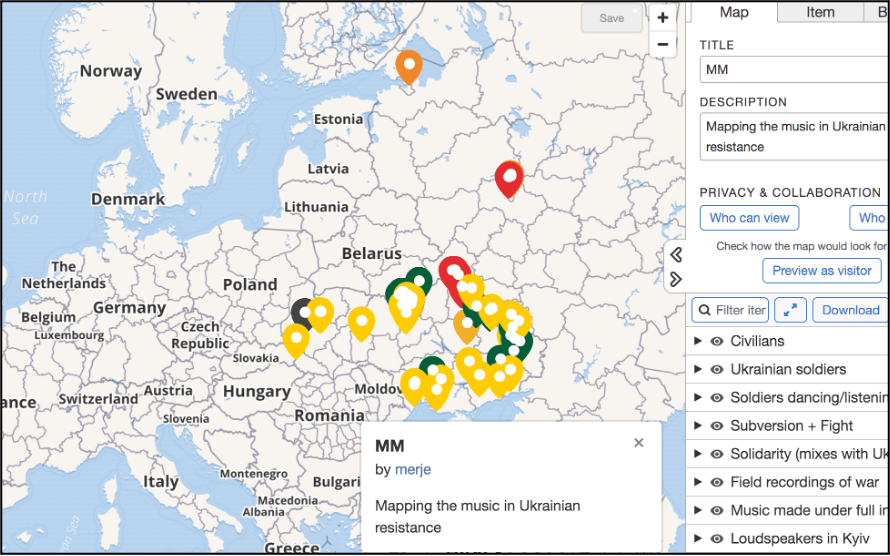
https://maphub.net/merje/mm

SO! Amplifies. . .a highly-curated, rolling mini-post series by which we editors hip you to cultural makers and organizations doing work we really really dig. You’re welcome!
—
BONUS POST: Directly following Merje’s introduction to her music mapping project, SO! has also published is her analysis of the observational research she conducted during the first 55 days of the 2022 Russian invasion of Ukraine, drawing from the collection of videographic material from online sources she embedded on this public interactive map. To go directly to that post, click here.
As an Estonian national, I have a regional interest in the relationship between music and cultural identity in Eastern Europe. Popular music has been foundational in building and sustaining Estonian national identity, through the Song Festival tradition which started in 1869, and the Singing Revolution at the end of the 1980s. In the Baltic states, Poland and Ukraine, there are similarities in how music has facilitated resistance to an oppressive regime or invasion.
While other cultural forms can articulate and show off shared values, only music can offer the immediate experience of collective identity (Frith 2007, 264). Looking into the sensitive representation of music in conflict, therefore, is about exercising hapticity with the precarity and suffering in the videos, and ultimately a work of not only academic, but affective labour.
The map format helps visualise the video evidence as it continues to appear in different parts of Ukraine. For accurate analysis, understanding the context, region, and the phase of war in which a musical event originates, is vital. In different parts of the country on the same date, one city can embody a collective feeling of resistance, while the other grief. The map is useful in analysing regional differences in the types of songs performed, and in ‘placing’ the international cases of solidarity. I decided to map the solidarity mixes that directly engage with the musical footage from Ukraine, and to exclude the high number of global fundraising concerts. All map entries depict in some way the role of music in Ukrainian resistance.
The map function is made redundant in posts where the location should not be disclosed for safety reasons, such as this video of soldier Yuriy Gorodetsky performing ‘How Can’t I Love You, My Kyiv’ in a military camp. Additionally, I decided not to embed posts that could inform the Russian military of civilian and humanitarian targets, for example a video from Lviv showing the Philharmonic concert space being used for humanitarian storage.
The focus has been on mapping songs and music, rather than the wider soundscape of war, although sounds such as air raid sirens do appear in some videos. The map includes sections on recorded music, such as this wartime ska track by Mandry, field recordings, and ways in which music has been used in online warfare. Most map entries fall under the civilian resistance category, exploring the following questions:
- What kind of music appears in this resistance? In terms of genre, is it folk, rock, hip hop, or national patriotic song? Is it Ukrainian or ‘Western’? How do the different examples embody national feeling and safeguarding of a culture?
- What is the power of these musical moments, for the artists, for Ukrainians, and for the world? What can music achieve in a conflict environment, and how does it evoke moments of solidarity?
- How does the music reflect the different phases and emotions of the war, from mobilisation, resistance, support, contemplation, to grief?
Similar research questions have been posed by Arve Hansen et al. in A War of Songs (2019) about the 2013-14 Euromaidan protests, in which music carried much of the revolutionary feeling. Adriana Helbig wrote about the Orange Revolution of 2004-05 in Hip Hop Ukraine: Music, Race, and African Migration when the Internet played a huge role in circulating political messages through music, especially as Ukraine’s media was controlled by president Yanukovich (2014). Maria Sonevytsky’s Wild Music (2019) looks at both revolutions and the vernacular Ukrainian discourses of ‘wildness’ as they manifested in popular music during this politically volatile decade.
When looking at Ukraine, we are studying a repeatedly colonised region, where, as part of the former Russian Empire, serfdom was abolished in 1861. Ethnographic research and promotion of a national culture in the decades that followed led to a brief window of independence for Ukraine in 1917, only to be occupied and incorporated into the Soviet Union as the Ukrainian Soviet Socialist Republic in the same year. Unlike Poland and the Baltic states, Ukraine was not independent between the two world wars, which adds depth to Soviet propaganda that permeated the region throughout the 20th century – important context to consider when analysing its struggle for autonomy.
Drawing from Parkes, the relationships of domination and subordination are particularly marked and articulated through music in colonised groups (Parkes 1994). Often, Ukraine is portrayed as a country of two opposing regions: the pro-European West and the pro-Russian East. While there have been two sides opposed to each other since the 2014 Crimean occupation, the linguistic, ethnic, historical and religious divisions in Ukraine cannot neatly fit into this East-West dichotomy. In addition to complicated ethnic boundaries that define and maintain the region’s cultural identities, Ukraine is dealing with a post-colonial struggle to protect its independence from imperialist Russia.
The ‘places’ constructed through Ukrainian music embody these complex issues, notions of difference and social boundaries – the very reason why music is socially meaningful: it provides means by which people recognise identities, places and the boundaries which separate them (Stokes 1994). In a war situation, beyond political and social alliances, we are also looking at music as survival (Stokes 2020).
—
Merje Laiapea is a curator, artistic programmer and writer working across sound, music and film. She is completing her Master’s in Global Creative and Cultural Industries in the Music Department at SOAS, University of London. Within the broad realm of music and cultural identity, her research interests include the expressive power of the sound-image relationship, forms of frequency, and multimodal approaches to research itself. She assists with event production and community engagement at SOAS Concert Series and works as Submissions Advisor for the 2022 Film Africa festival. Merje also broadcasts the occasional radio show and DJ mix. To find out more about Merje’s motivation behind the project, click here to read an interview by the University of London.
—

REWIND!…If you liked this post, you may also dig this:
Mapping the Music in Ukraine’s Resistance to the 2022 Russian Invasion–Merje Laiapea
SO! Amplifies: Wu Tsang’s Anthem (2021)—Freddie Cruz Nowell
SO! Amplifies: Marginalized Sound—Radio for All–J. Diaz
SO! Amplifies: Die Jim Crow Record Label
SO! Amplifies: Cities and Memory–Stuart Fowkes
Share this:


Current Top Posts





April 2021

January 2020

November 2019

October 2019

August 2019

April 2014

November 2017

March 2015

December 2017

October 2015
 Sounding Out!
Recent Comments