
À qui la rue?: On Mégaphone and Montreal’s Noisy Public Sphere
DOI: https://doi.org/10.59350/axd37-bme35
Editor’s Note: This month Sounding Out! is thrilled to bring you a collection of posts that will change the way you hear cities. The Sounds of the City series will prompt readers to think through ideas about urban space and sound. Are cities as noisy as we think they are? Why are cities described as “loud”? Who makes these decisions about nomenclature and why?
We kicked things off three weeks ago with my critical reading of sound in Lorraine Hansberry’s A Raisin in the Sun, a play about African Americans in Chicago that still rings/stings true today. Two weeks ago, guest writer Linda O’ Keeffe took readers on a soundwalk of Smithfield Square in Dublin, Ireland and specifically of the Smithfield Horse Fair, in order to illustrate how urban renewal disrupts city soundscapes and how sound reclaims those spaces. Last week, regular SO! writer Regina Bradley discussed the dichotomy of urban and suburban in the context of sound (noisy versus quiet) and hip hop.
Today’s post comes from CFP winner Lilian Radovac, who shares with us a critical photoessay on the sound installation Megaphóne in Montreal.–Managing Editor Liana M. Silva
Updated with edits as of 12:28 pm EST
***
October, 2013. I’m waiting for the 80. It’s already dark and bitterly cold for fall, and the bus is predictably late. As the line of people waiting lengthens, traffic rushes past on President-Kennedy and north along Jeanne-Mance, punctuating the larger roar of rush hour in Montreal.
Suddenly, a woman’s voice lifts up out of the din. It’s hard to make out what she’s saying at first, but then a single phrase escapes from the thrum of traffic: “…freedom and democracy…” I look around, trying to place the sound. It’s gone. Several minutes later, the voice rises again: “Tell us again about freedom and democracy!” This time, my ears get a lock on the words and I leave my place in the line to follow them to their source.
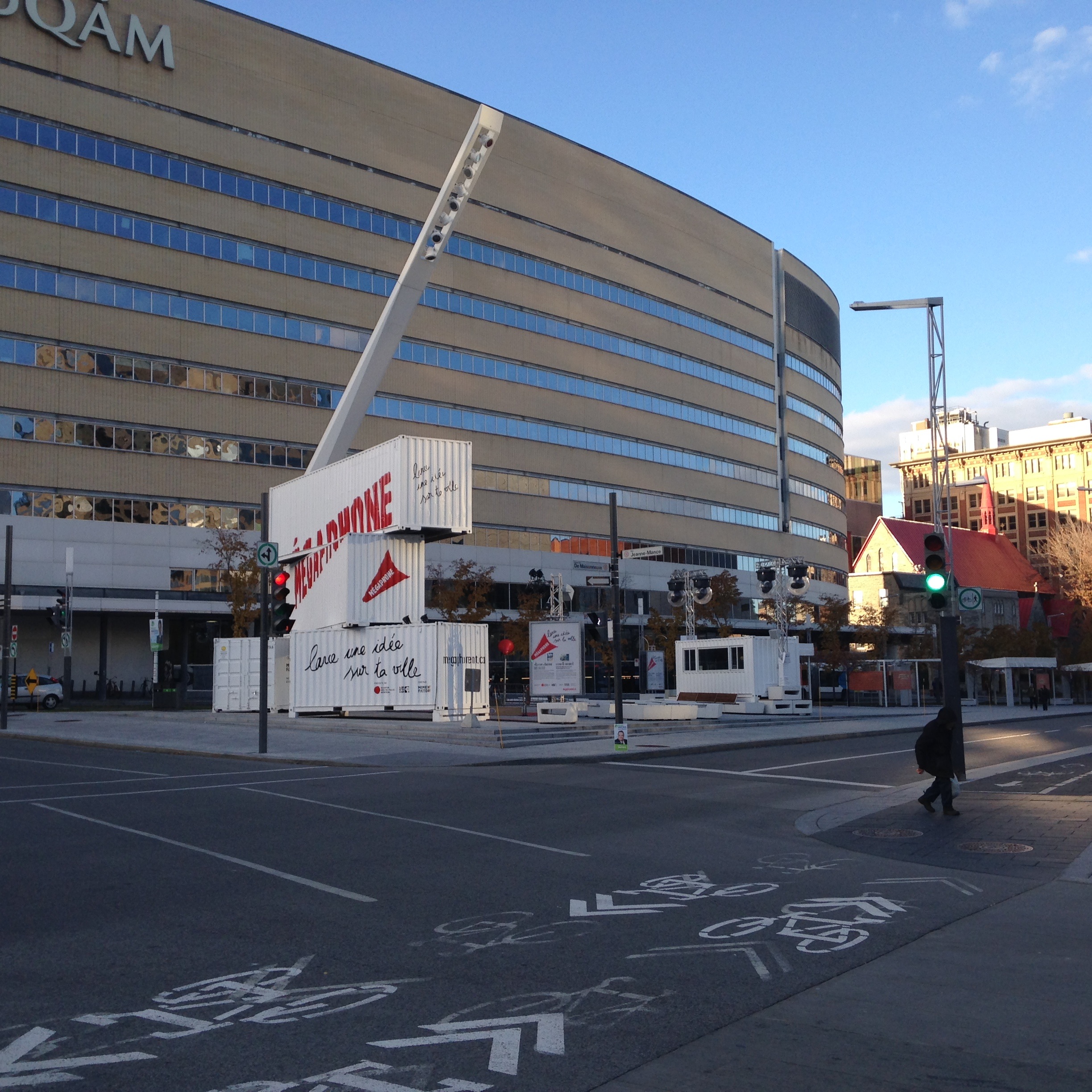
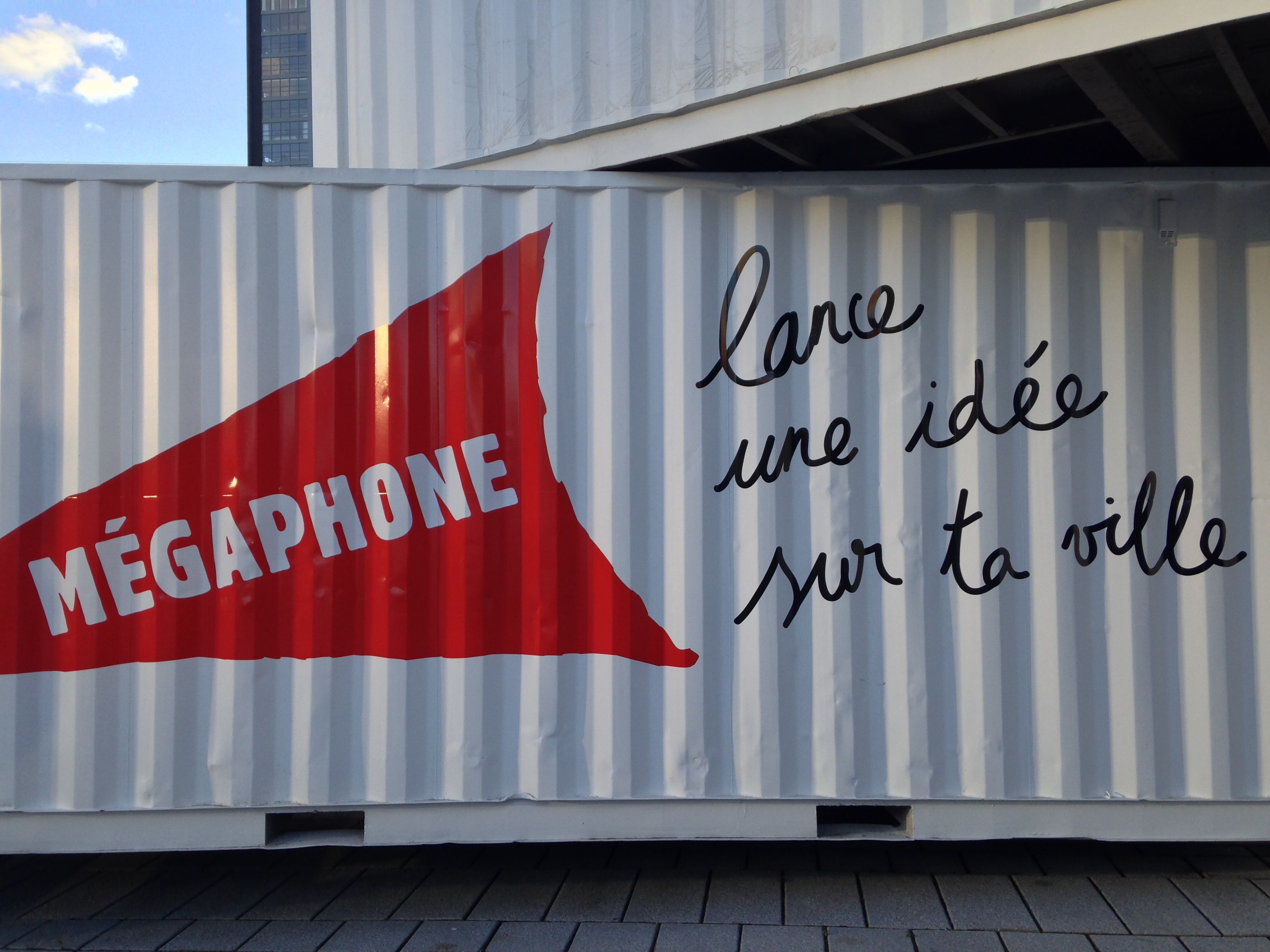
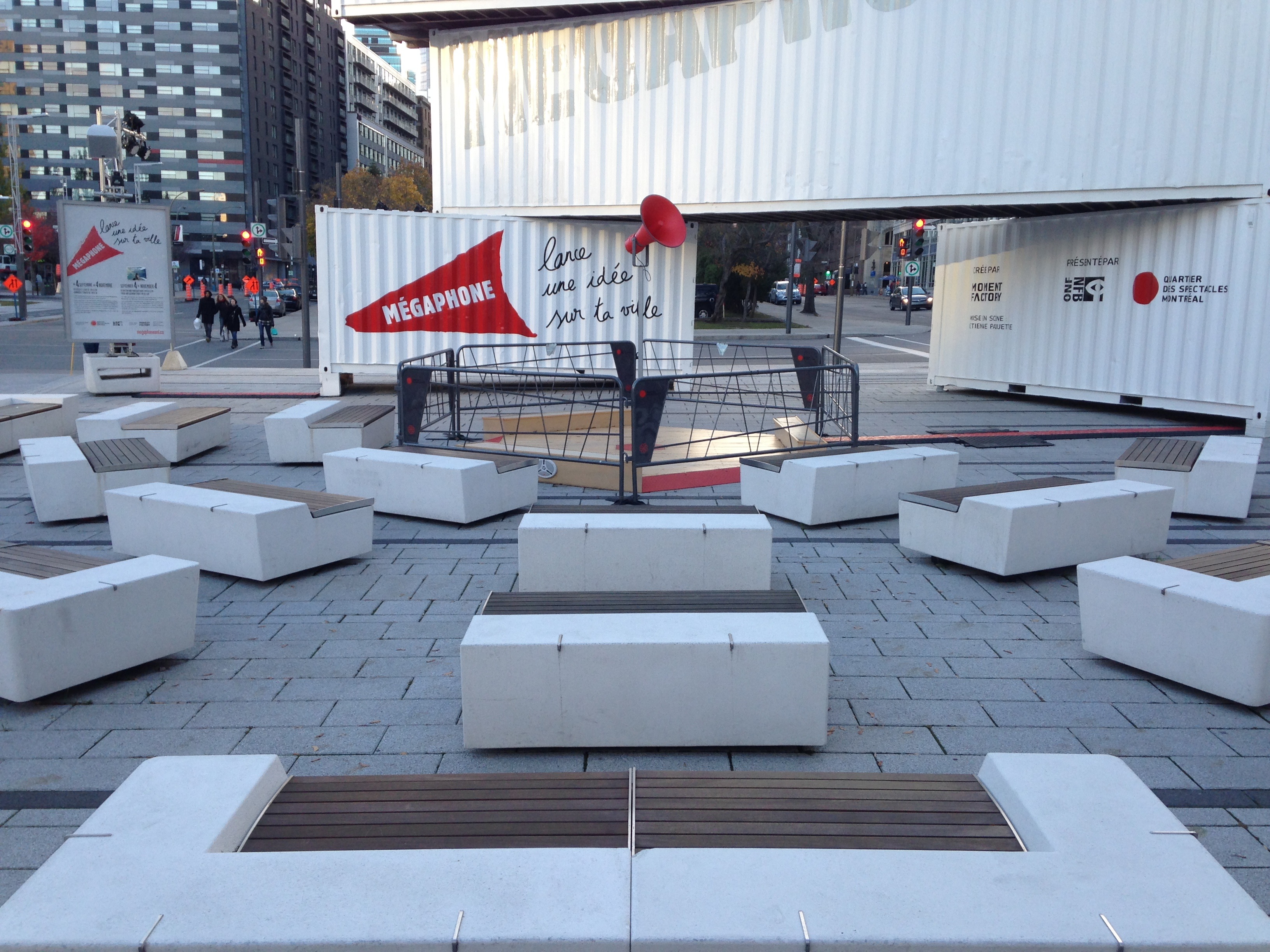
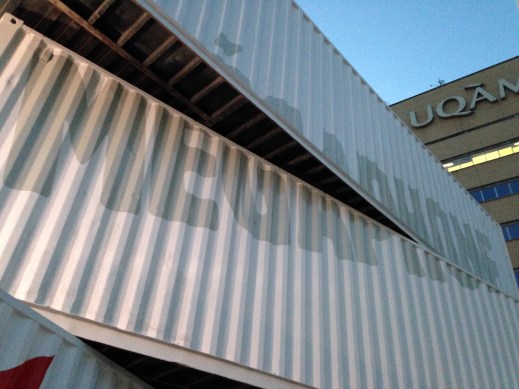
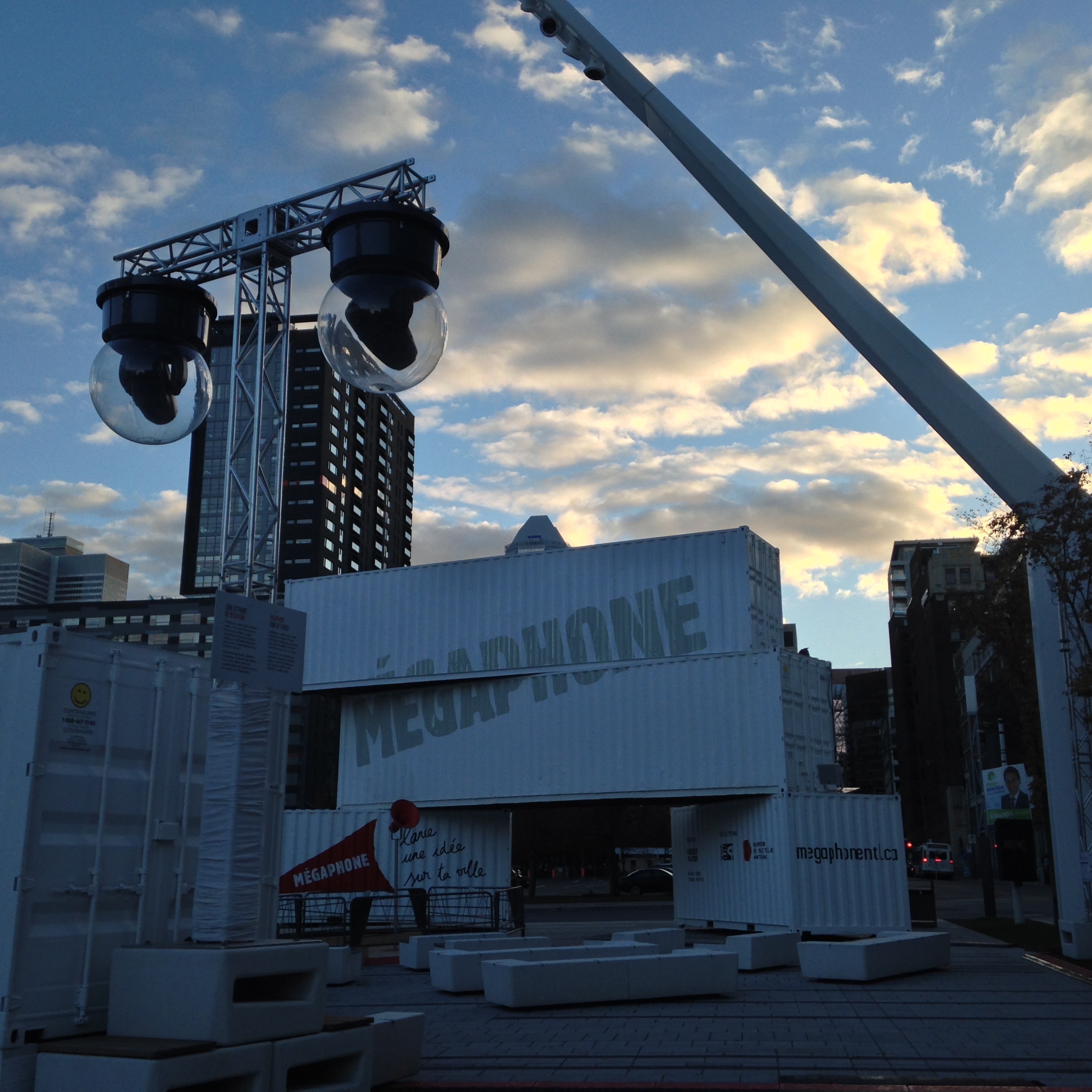
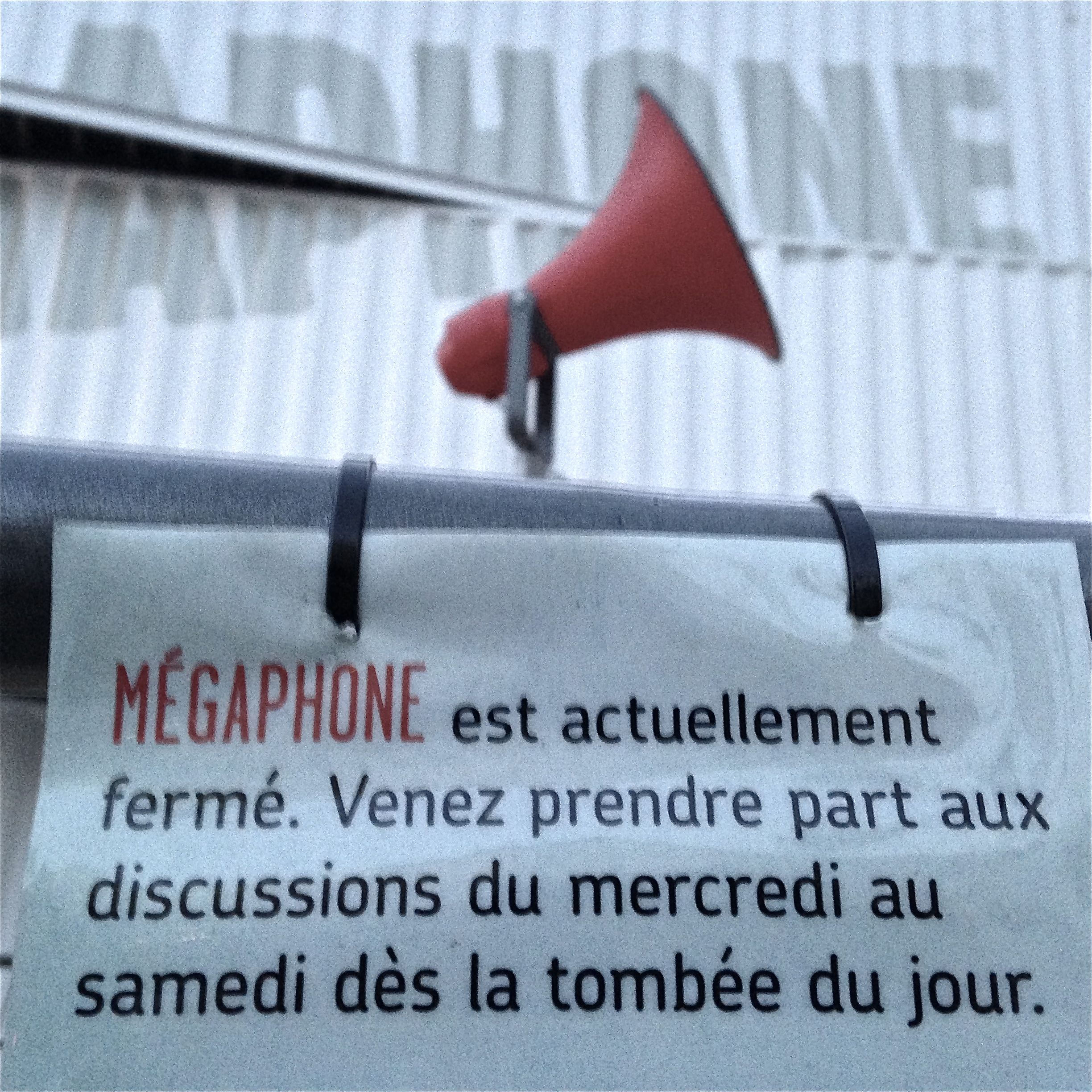
My feet bring me to the Promenade des artistes, a slim triangle of concrete that separates President Kennedy Avenue from De Maisonneuve Boulevard, and the sounds of Mégaphone. The promenade is the temporary home of the audiovisual installation produced by the multimedia studio Moment Factory, co-sponsored by the National Film Board of Canada and the Quartier des spectacles partnership. The installation is composed of three zones: to the west, a small outdoor amphitheater arranged around a large red megaphone; across the street, the University of Quebec at Montreal’s science pavilion, which doubles as a projection screen; and to the east, housed in a series of “event vitrines,” an audio exhibition of recordings by notable Quebec speakers who have “shaped public space in Montreal with their words.”
According to the accompanying press kit, Mégaphone is inspired by London’s Speaker’s Corner and Montreal’s interwar tradition of popular assemblies. Its stated goal is to “bring the art of public speaking back into the city.” It’s designed as an interactive experience, which encourages visitors to take to the stage during designated open mic periods and, by speaking into the megaphone, to “light up the city” with their ideas. Their speeches are first acoustically amplified, then processed by voice recognition software and projected onto the façade of the science building, which becomes a canvas for randomly generated keywords. Mégaphone is also timed to coincide with the run-up to Montreal’s November 4th municipal election, and features a program of scheduled speakers that includes an appearance by the city’s mayoral candidates.
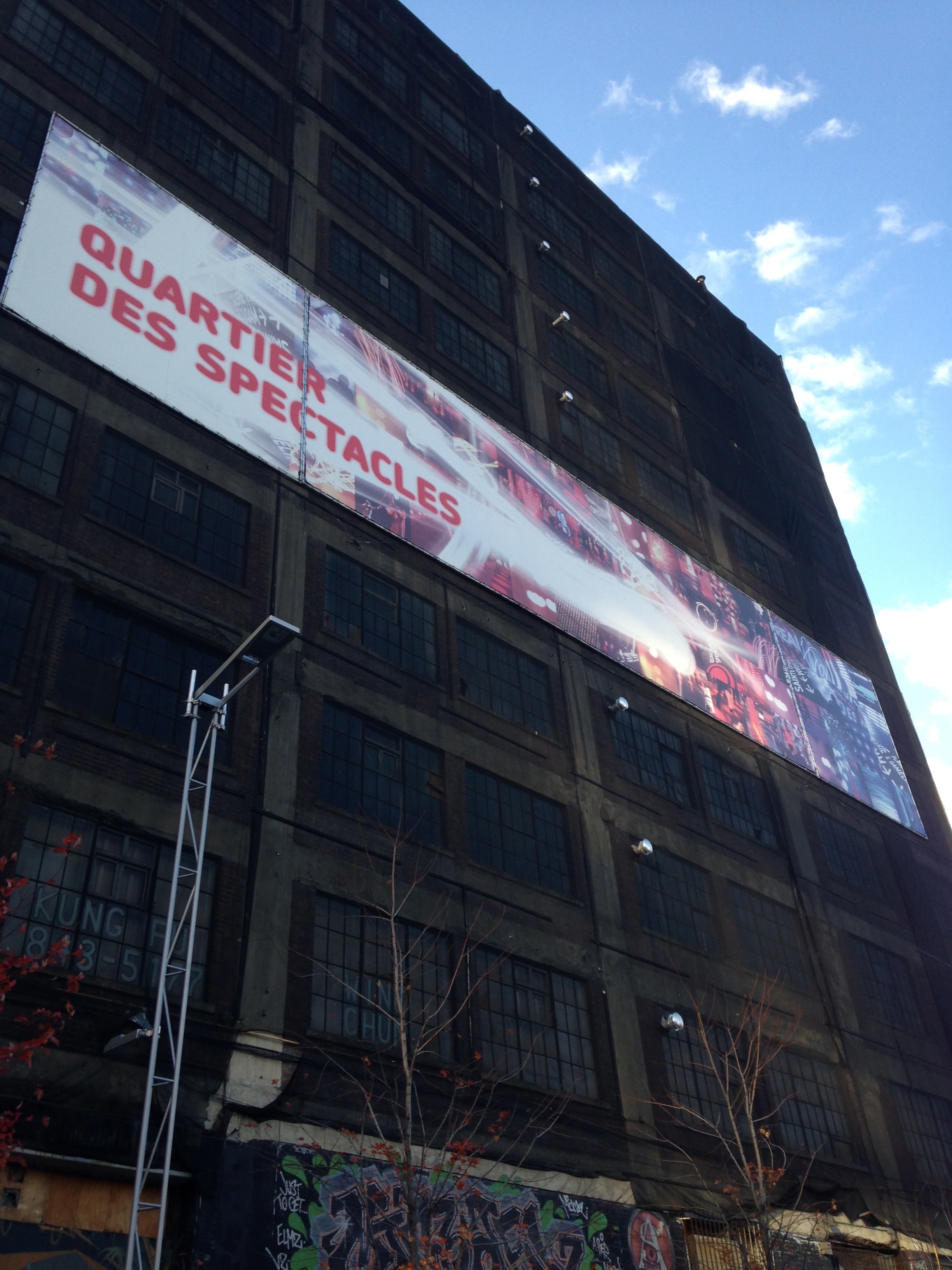
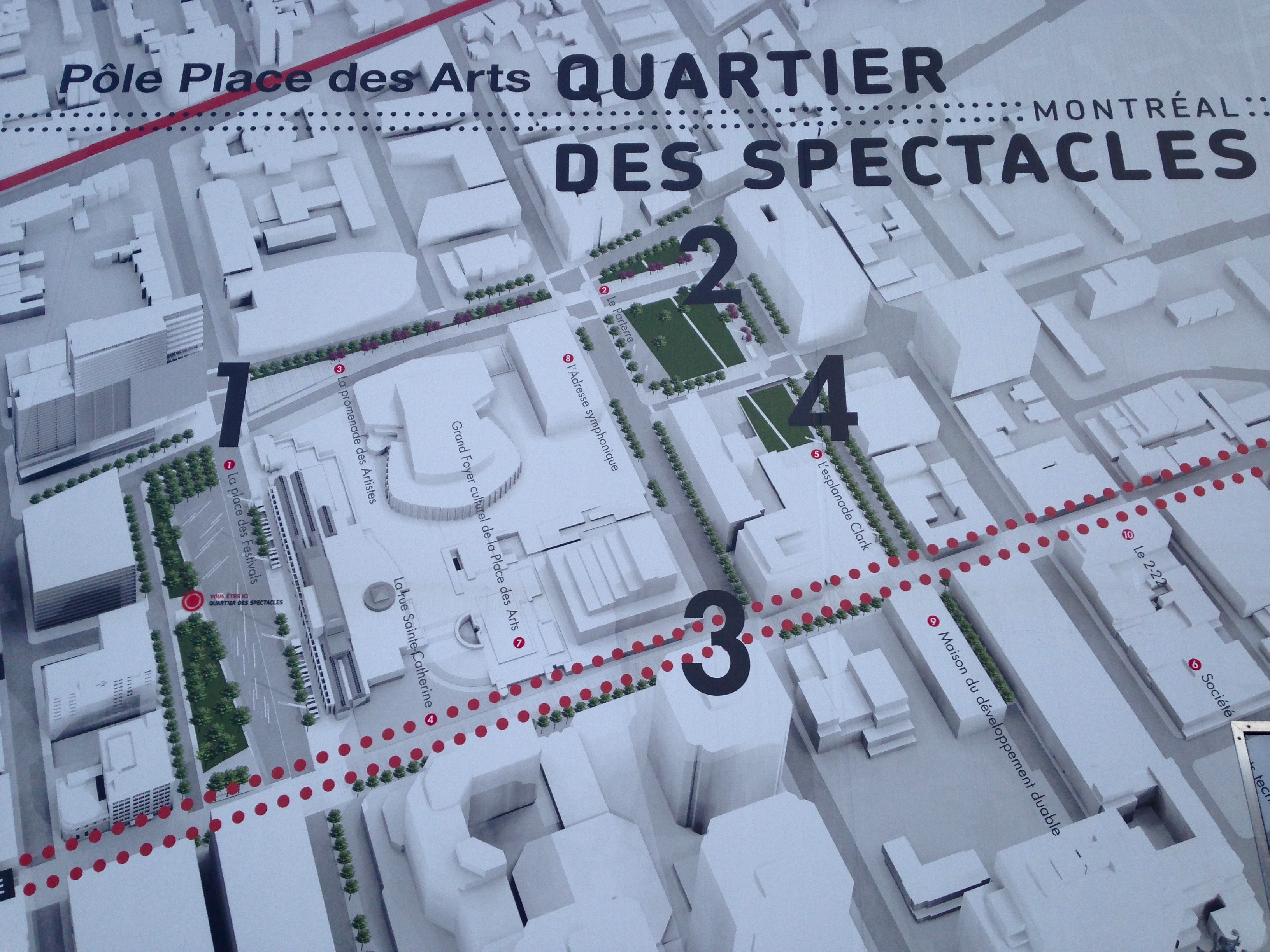
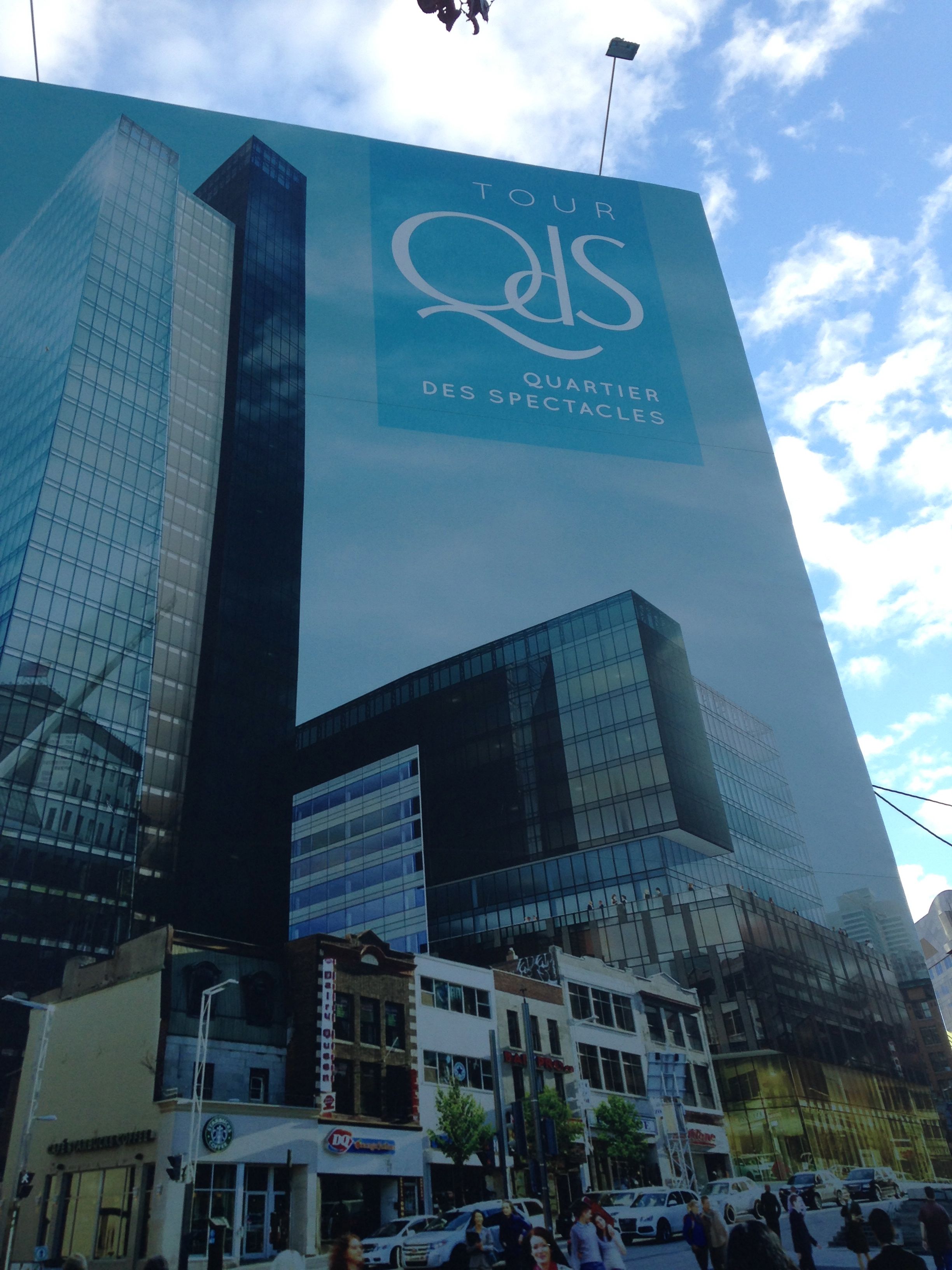
As I wander through the empty amphitheater, I find myself thinking that it’s a strange place for a sound installation. The Promenade des artistes is sandwiched between UQAM’s science campus and the northern border of Place des Arts, a Lincoln Center-style performing arts complex that occupies several city blocks. Jane Jacobs would have called this a “dead place,” lost as it is between a set of bicycle lanes and the science building’s indoor food court, which draws pedestrian traffic away from the open space of the street. On the day of my visit, I’m the only person there. Beyond the Promenade des artistes lies the larger Quartier des spectacles, an ongoing culture-led regeneration project which, in an effort to cement the city’s “brand” as a creative city, has concentrated Montreal’s outdoor cultural activities into a single, sprawling site. Traces of the working-class neighborhood it displaced peek out from behind construction fences, quietly attesting to the area’s industrial past.
Still following the voice, I walk towards the line of event vitrines, where seven audio exhibits map the aural contours of an imagined community made real. The speeches on display tell a story of Quebec’s emergence from its colonial past, when the province’s French-speaking majority was dominated by the Catholic church and a minority Anglophone elite. Each voice, in its way, speaks to a period of enormous social transformation fuelled by the dream of Quebec’s independence: Irving Layton delivers a lecture from an amplified podium; Gilles Vigneault sings “Gen du pays” from a stage at Parc Mont-Royal; Pierre Bourgault gives a firebrand speech at the Third Congress of the Parti Québécois. Only the seventeenth century Wendat Chief Kondiaronk remains eerily mute, his voice buried in the memoirs of his colonial French counterparts.
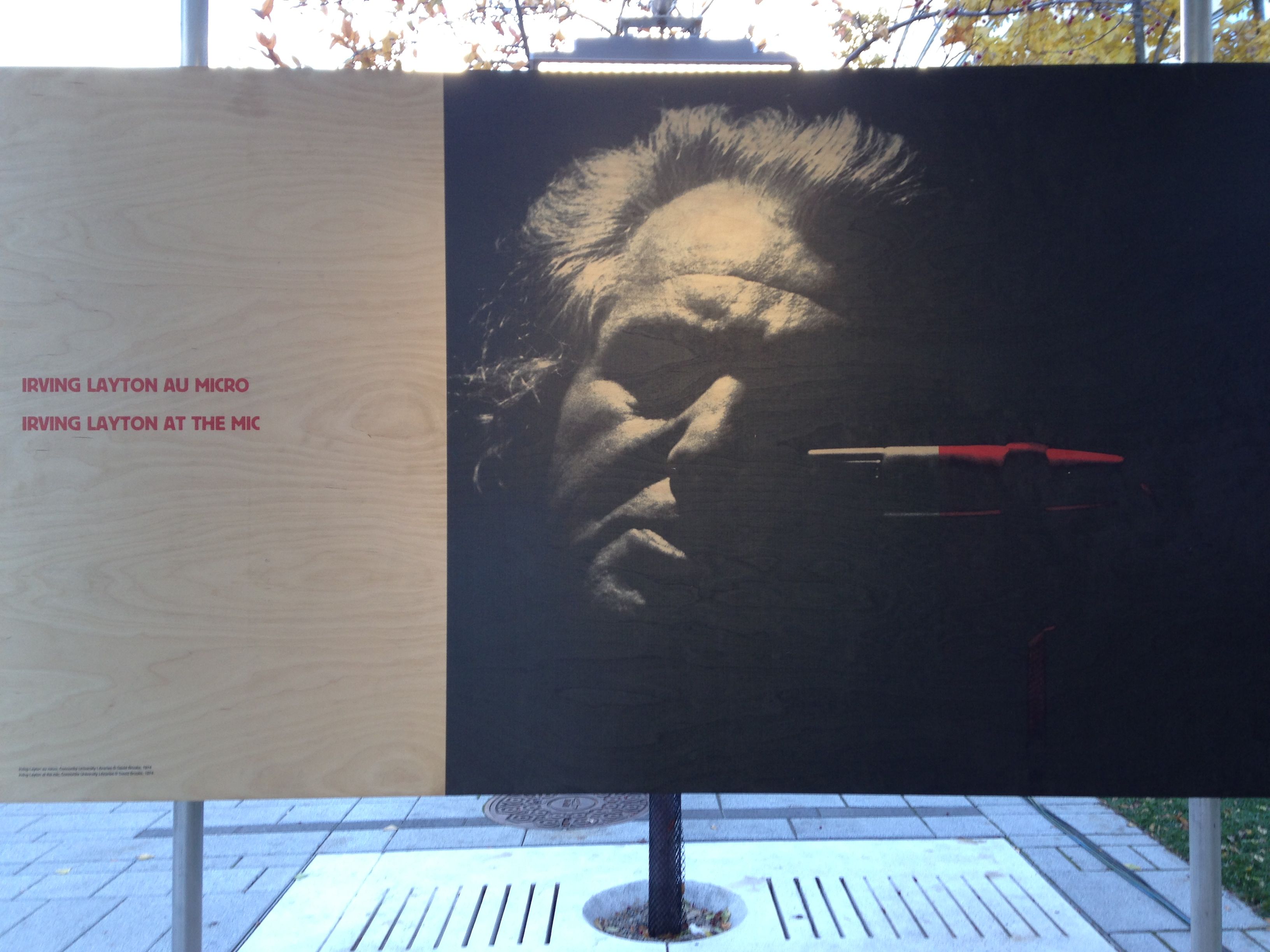
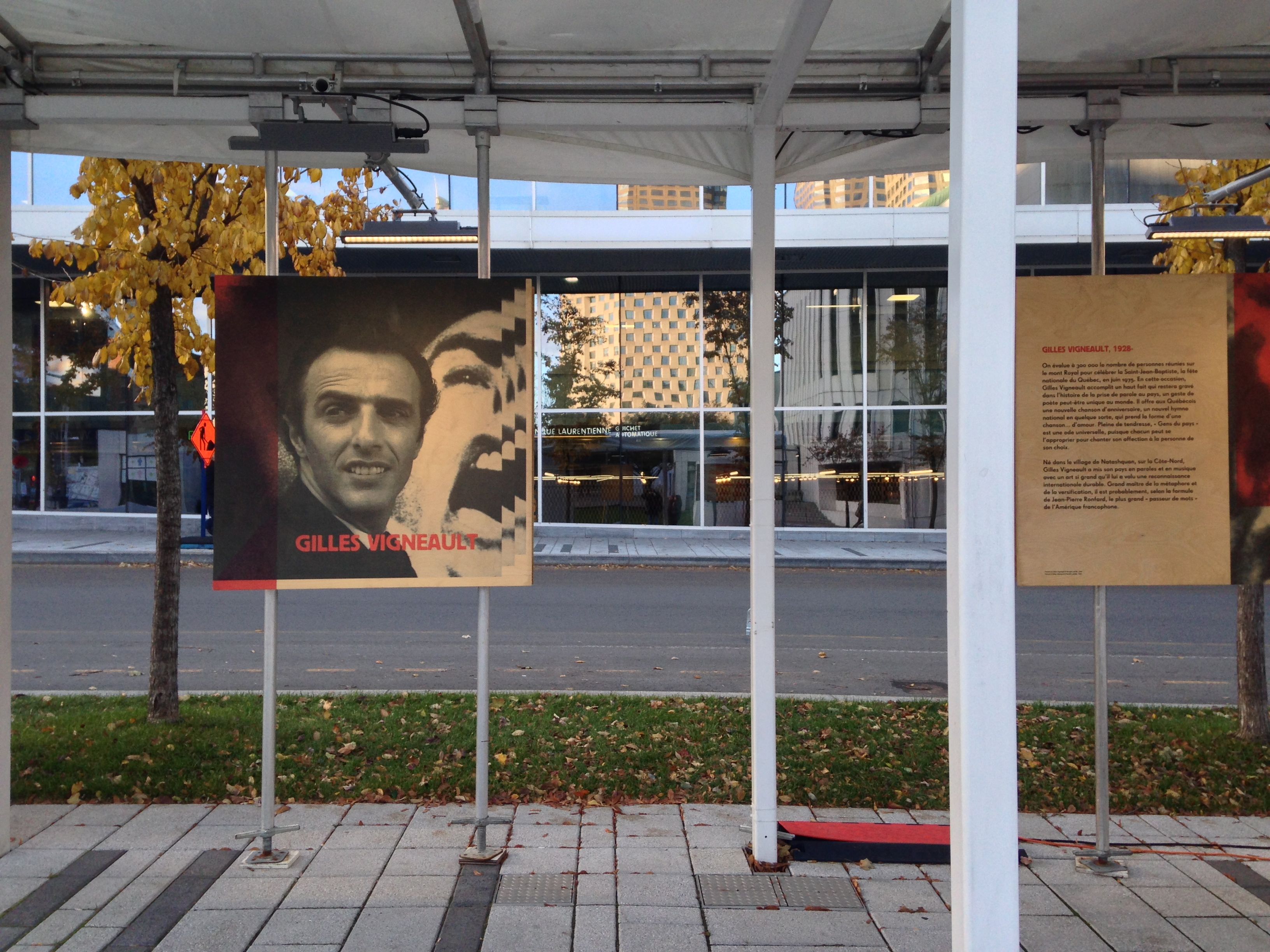
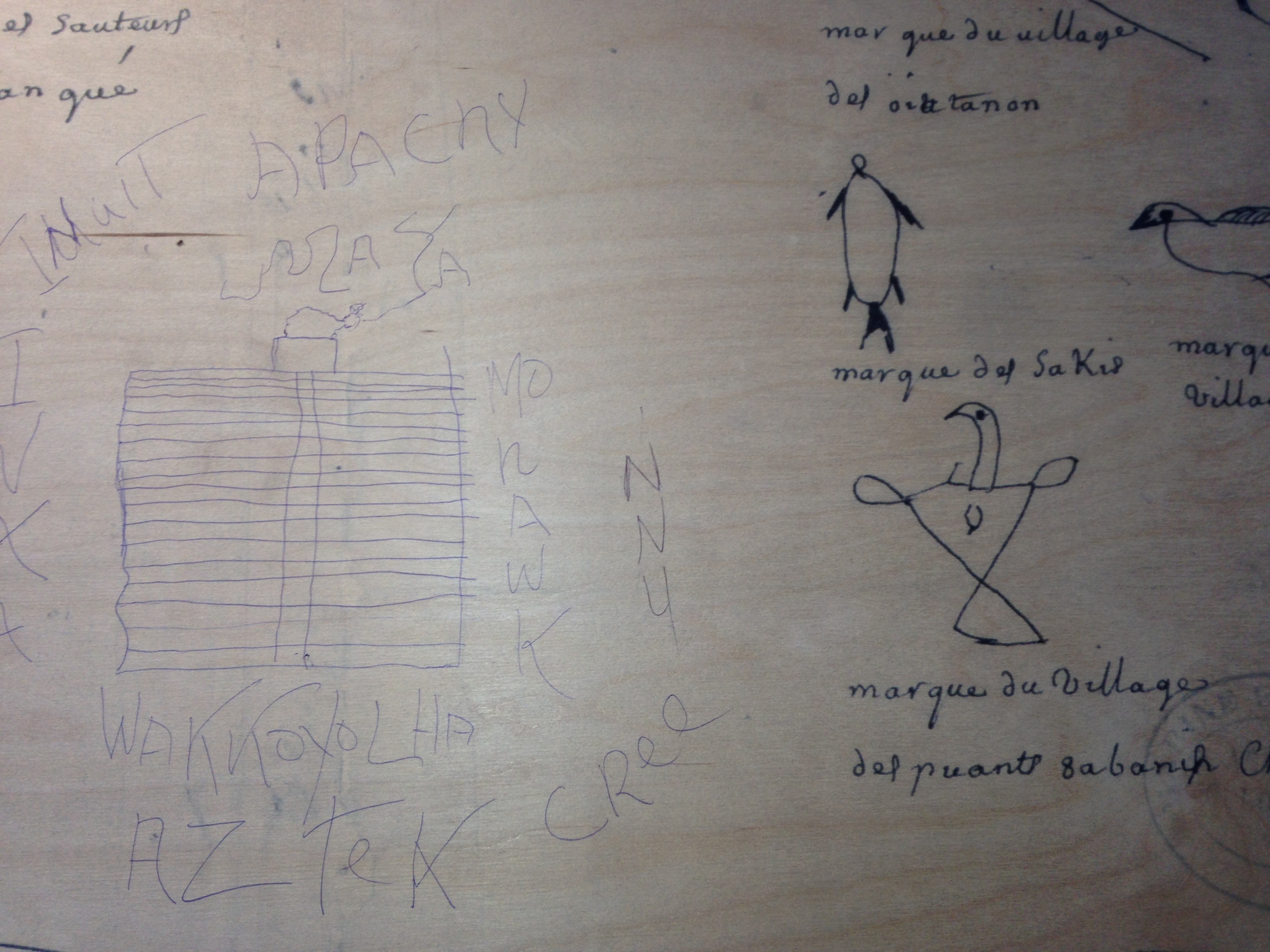
Poet Michèle Lalonde’s voice, however, dominates the space of the exhibit. It’s noticeably higher in pitch than the drone of traffic, and when it rises to meet the words “freedom and democracy” it pierces the low rumble of passing buses and trucks, filling the husk of the surrounding streets. The poem she reads is well known in Quebec, and the version on display here is central to the province’s history and identity as a nation. Recorded at La nuit de la poésie in 1970, the poem was first read at a 1968 benefit performance to support imprisoned members of the Front de libération du Québec, one of whom was Pierre Vallières, the author of Nègres blancs d’Amérique.
Inspired by Vallières’ memoir, “Speak White” is a double appropriation: of the English admonition to Francophones to abandon their mother tongue and, simultaneously, of the revolutionary potential of the Black Power movement of the 1960s, with which the most militant factions of the Quebec independence movement aligned themselves. It is, as Sean Mills has observed, an uncomfortable alliance in a province that struggles to recognize its own racism and status as a settler colony, but in the poetic space of Lalonde’s recitation the words still shudder with subaltern rage.
[Read English translation]
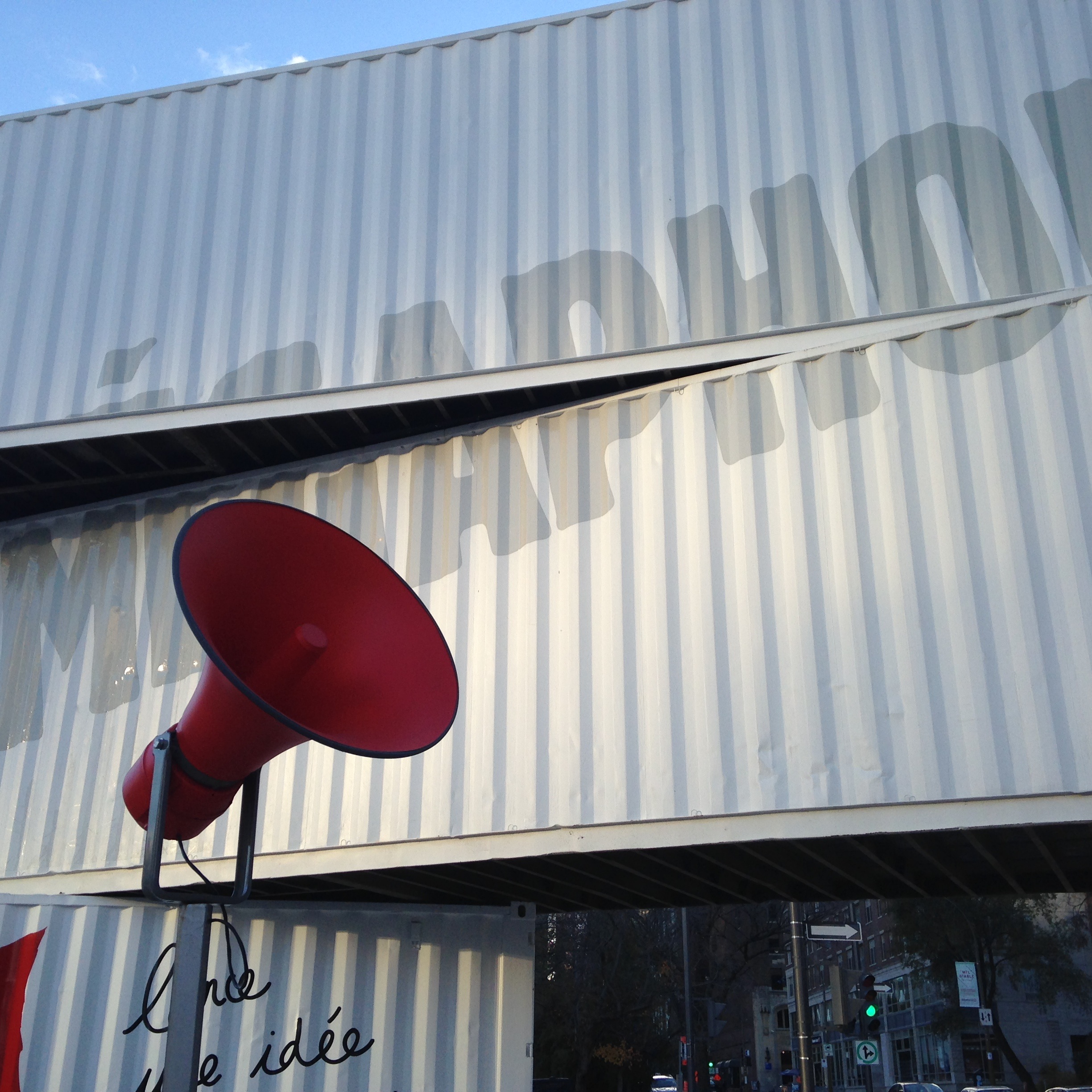
The term “megaphone” is something of a misnomer. The voices of participating speakers are amplified using a hand-held microphone that is connected to a stationary loudspeaker, which actually makes the megaphone more of a rudimentary public address system. It’s an important distinction, since the aural uses of the megaphone are shaped above all by its portability. Megaphones are a mobile audio technology and therefore a nomadic one; like boomboxes and iPods, they’re designed to be easy to carry and to be used while moving from place to place. The public address system, by contrast, is rooted in space: the speaking subject is anchored to the microphone and to the apparatus of amplification, which is composed not only of cables and loudspeakers but also the architectural elements (podium, stage, seating) of the auditorium.
More importantly, the portable megaphone is intended to be used outdoors and in crowds. Thomas Edison’s acoustic megaphone, which he patented in 1878, was soon used at sporting events and to magnify the voices of political leaders at outdoor public events. By 1900, street hawkers began selling makeshift megaphones to the politicians’ audiences, and their wares contributed to a new and noisy public sphere. When the megaphone was married to the transistor and to battery power in the 1950s, the technology was seized by social movements around the world, which used it to appropriate and disperse the power of the individual public speaker. Among them were the student and labor unions that flourished in the wake of Quebec’s Quiet Revolution, which had opened up a space for the province’s democratization.
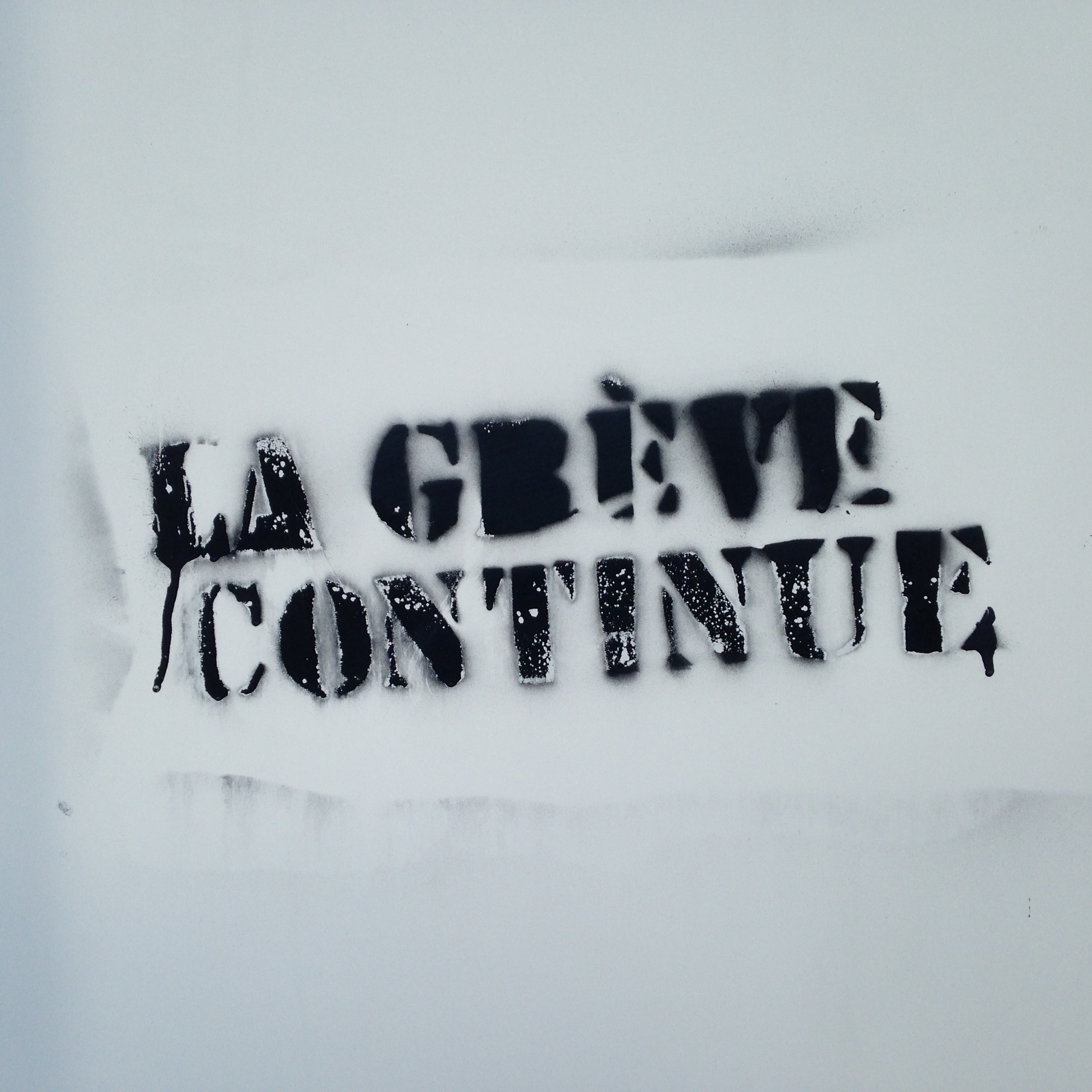
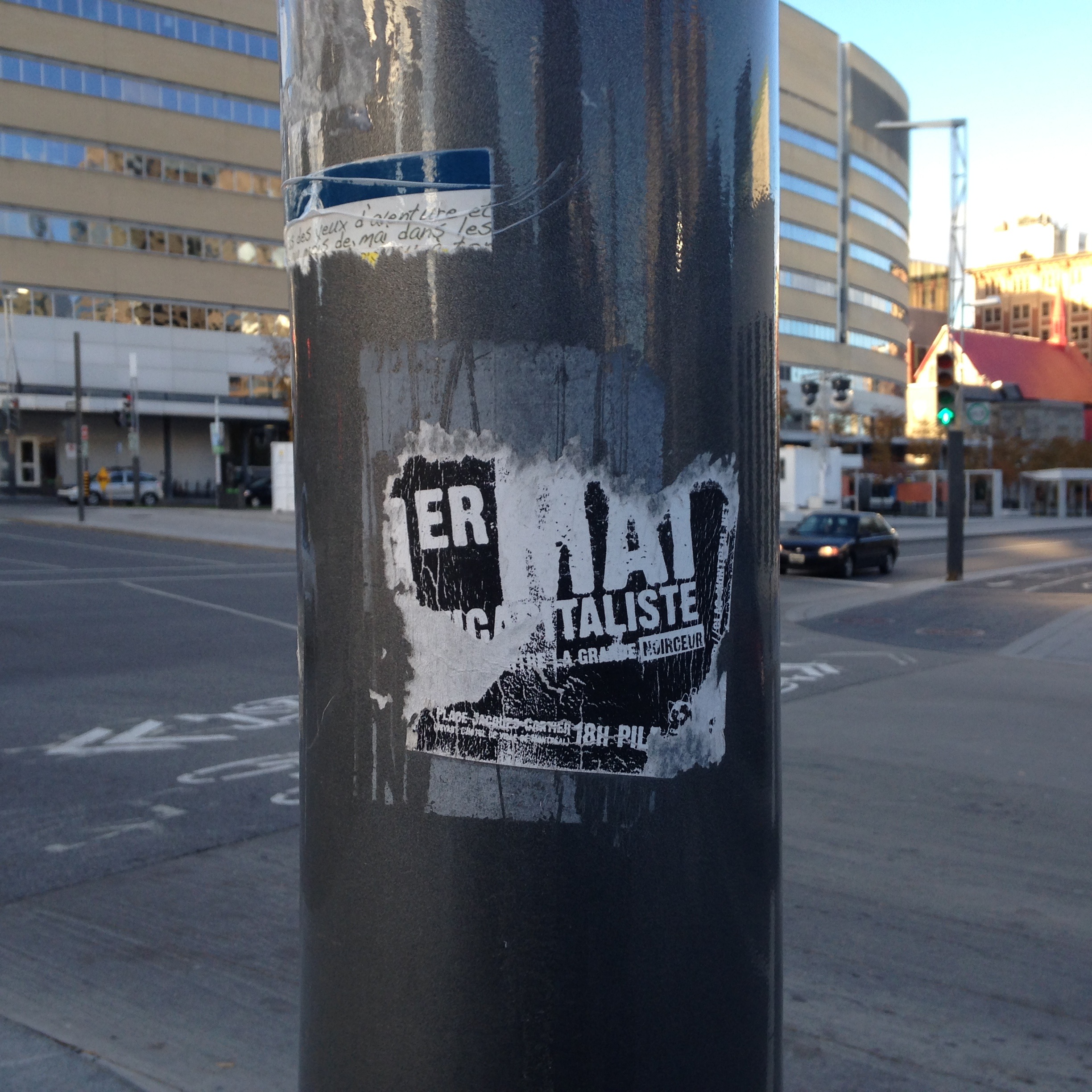
The year before Mégaphone opened, the promenades of the Quartiers des spectacles were crossed by hundreds and sometimes thousands of bodies that spilled out of Parc Émilie-Gamelin, where students and their supporters gathered for the nighttime demonstrations that became a hallmark of the Quebec student strike, or printemps érable. Each night at about 8:30 pm, we set off on marches that had no planned route and no final destination, walking for hours along streets that we claimed with nothing but our voices and the feet that carried them along. If you arrived late you could find the #manifencours on Twitter, or you could listen for the sounds of the crowd’s chants and the police helicopters that hovered constantly overhead, keeping large swaths of the downtown core awake until the early morning hours.
When the Liberal government attempted to break the strike with the reviled Bill 78, which required protest organizers to submit itineraries to the authorities in advance, the night marches dovetailed with a sudden explosion of casserole protests, which coalesced around autonomous popular assemblies organized at the neighborhood level. Within days, demonstrators fanned out across the city as roving bands of casserolières set off from Villeray, Mile End, Hochelaga, St-Henri and even staid, sleepy Outremont, erupting into cacophonous clangs and cheers as we found each other at the borders of our quartiers and merged into ever larger assemblages. If a city can light up with sound, then that is what happened here in Montreal.
These echoes of the printemp érable form the acoustic backdrop of Mégaphone, and the sounds of the installation are designed to bleed into listeners’ memories of the strike. But Mégaphone is as much about the management of acoustic space as a celebration of its potential. Walking through the Promenade des artistes, I’m struck by a palpable but unintended theme: containment. The voices on display, already tethered to their microphones, are further limited by a series of overlapping spatial and temporal boundaries. The stage is accessible only on certain days and during designated hours, and then only when not reserved for previously scheduled speakers. Like the Quartier des spectacles that surrounds it, the installation is segregated from the lived spaces of the city, out of earshot of most residents and removed from the rhythms of their everyday. As if to belabor the point, speakers are bound by the Mégaphone “code of ethics,” which permits “no tolerance for aggressive, obscene or hateful speech, or for any behavior that is not consistent with respect for public order [emphasis mine].” Presumably, the code does not apply to the Quebeckers whose commitment to radical politics earned them a place in Mégaphone’s pantheon of speakers.
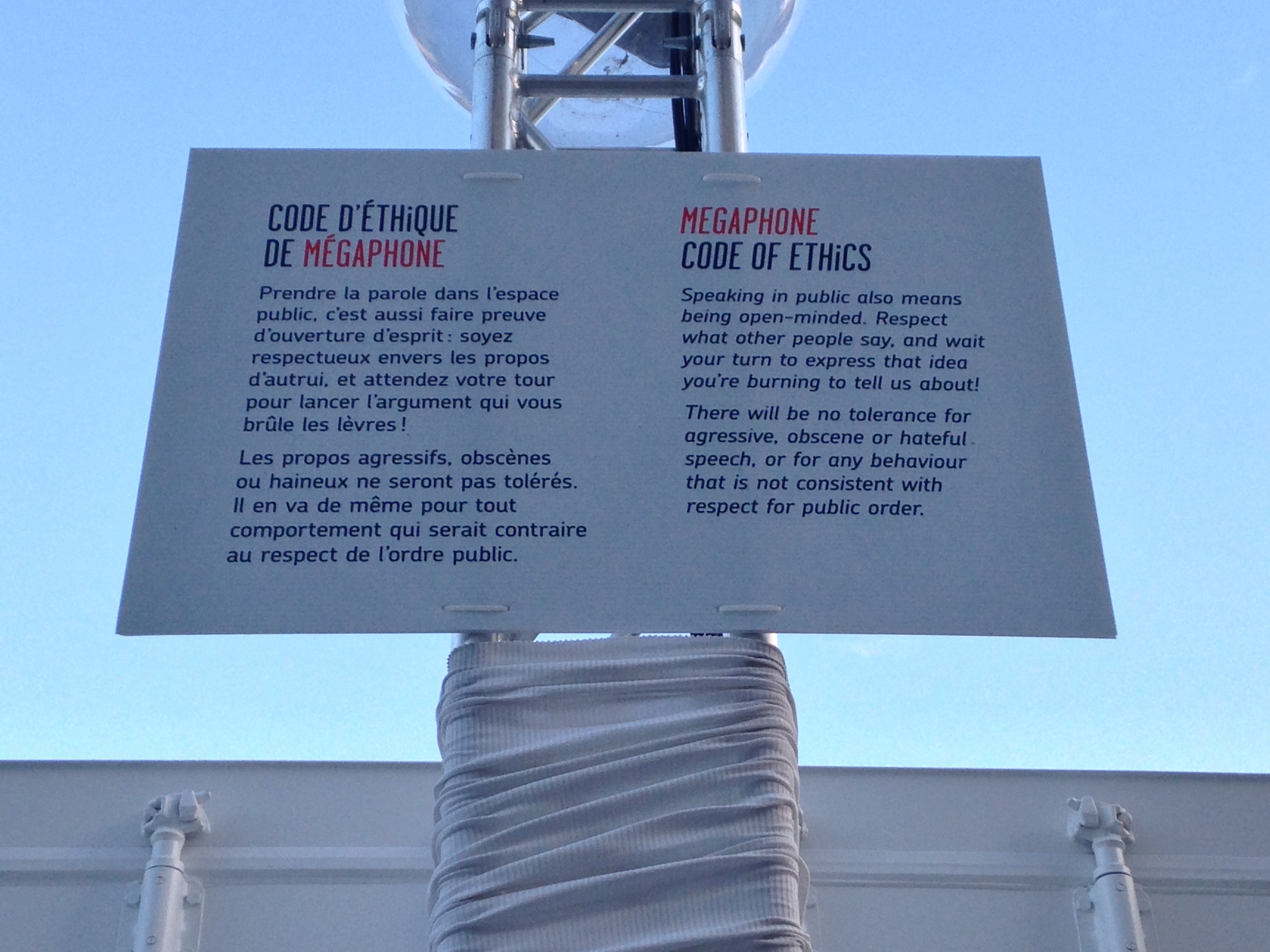
With its endlessly wandering marches and casseroles, the printemps érables was willfully inconsistent with respect for public order and its tactics reflected the anti-authoritarian impulses of the Quebec student movement. Simply by walking together, noisily and spontaneously, we recreated our city as a utopian space in which citizens, not governments, would chart their own course. By contrast, Mégaphone constrains the mobility of political speech, fencing it off in time and space and stripping it of its collective character. In doing so, it subjects the auditory space of the public sphere to what Don Mitchell terms a process of liberalization, drawing it away from the field of autonomous action and back under the stewardship of the state.
Philosophy professor Julien Villeneuve (better known as Anarchopanda) made this connection explicit when he and a group of fellow activists took to the Mégaphone stage to denounce municipal bylaw P-6, which, like Bill 78, requires protesters to inform the police of their activities under threat of arrest and massive fines. While Bill 78 (later Law 12) was repealed after a national outcry, P-6 remains in effect and its enforcement is in large part responsible for ending the strike and for the continuing suppression of public protest in Montreal.
As I walk back towards the bus stop, my fingers numb inside my mittens, I consider how much Mégaphone feels like a memorial to the city’s noisy public sphere, which, for the moment at least, is safely confined to the past.
—
Acknowledgements:
Sincere thanks to Jonathan Sterne, Erika Biddle, Magdalena Olszanowski, Ted Rutland, Liz Miller and the Tapas Gals for the conversations that contributed to this post.
—
Featured image: by Lilian Radovac
—
Lilian Radovac is a writer, organizer and doctoral candidate in communication studies at McGill University. She is currently finishing her dissertation on the cultural history of noise control in New York City, a chapter of which, “The ‘War on Noise’: Sound and Space in La Guardia’s New York,” was published in Sound Clash: Listening to American Studies (John Hopkins, 2012). Her work has also appeared in Times Higher Education, The Chronicle of Higher Education, TOPIA: Canadian Journal of Cultural Studies, and Communication and Critical/Cultural Studies.
—

REWIND!…If you liked this post, you may also dig:
“Quebec’s #casseroles: on participation, percussion and protest”-Jonathan Sterne
“Deejaying her Listening: Learning through Life Stories of Human Rights Violations”-Emmanuelle Sonntag and Bronwen Low
“Listening to the Border: ‘”2487″: Giving Voice in Diaspora’ and the Sound Art of Luz María Sánchez”-D. Ines Casillas
—
Share this:

“HOW YOU SOUND??”: The Poet’s Voice, Aura, and the Challenge of Listening to Poetry
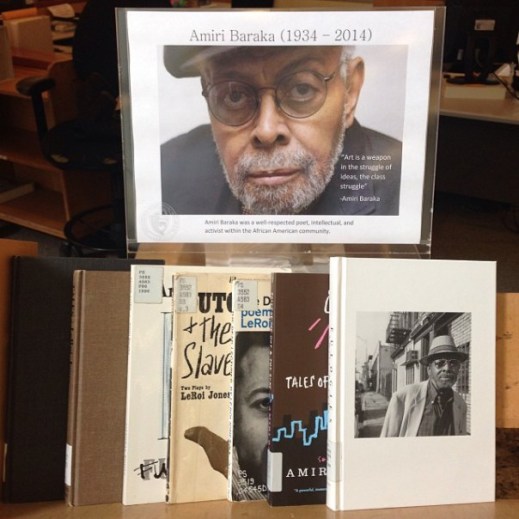
This post is dedicated to the memory of Amiri Baraka, who passed away on January 9, 2014 in Newark, New Jersey.
DOI: https://doi.org/10.59350/89g4m-6zm59
I began writing this post while my wife, Sarah, was at a conference on writing curriculum for high school literature. Over the phone one night she asked how to help students better understand the language of Shakespeare, and at a loss for suggestions (not only because I don’t study early modern drama), I recalled my own adolescent struggles with Macbeth, Hamlet, and Julius Caesar. I recalled well-intentioned teachers who gave me recordings, telling me that they would help me get an “ear” for Shakespeare’s language—yet all I remember, maybe all I learned, while listening to the Caedmon recording of Macbeth on vinyl, was that, to my mid-1990s ear, Shakespeare (anachronistically) sounded like Star Wars (which appeared 15 years after the 1960 Caedmon album).
My high school confusion has not completely faded when it comes to the sound of recorded poetic language, even more so when the notion of the poet’s voice is thrown into the mix. As opposed to verse recited by actors (the Caedmon Macbeth featured Anthony Quayle), or the sound of the syllables when we read a poem silently to ourselves, I find it tough to parse the idea of the sound of the poem in terms of the poet’s voice because “voice” is a slippery category—a constructed one, contingent upon the given historical moment of inscription and reception. It is tough because this idea of the sound of the poem, located in the voice of the poet, gets complicated with sonic technologies where voice is subject to the shifting conditions of fidelity.
The act of listening to recorded poetry thus poses particular analytic challenges, which become more complex when the politics of identity are brought to bear on these questions of voice and poetry. As a site for identity production, the recorded poetry performance projects a mediated voice that is a potential self. The “sound” of this poetic subjectivity is different from recording to recording, even of the same poem. In an effort to work through these complexities, this post takes up three different recordings of Amiri Baraka’s poem “Black Dada Nihilismus,” which offer variations in delivery and performance that each depend upon the social, political, and aesthetic dimensions of the soundscape that each recording is embedded within.
“Black Dada Nihilismus” is an excellent opportunity to consider the overlapping challenges of voice, performance and the politics of identity in recorded poetry. Published in the early 1960s, this poem was written before Baraka’s shift in politics, which was precipitated by the assassination of Malcolm X in 1965, yet the poem anticipates the intersection of aesthetics and politics during the Black Arts Movement in the late 1960s into the 70s. This shift can be tracked in the sonic details of the first two recordings, made in 1964 and 1965. In the third version, a 1993 remix by DJ Spooky, we can hear how this shift reverberates beyond its historical moment.
In a statement of poetics included in Donald Allen’s classic 1959 anthology The New American Poetry, Baraka (then Leroi Jones) asked: “HOW YOU SOUND??” How a poet’s poem sounded mattered most for him: “you have to start and finish there … your own voice … how you sound” (425). Primarily referencing the poem on the page, he wasn’t whistling in the dark: often thought of as a vocal performance of language, poetry has a long history with sound. One thread of this history is the Homeric tradition of an “oral poetics,” a tradition where, as Albert Lord notes in The Singer of Tales, socialized performances of poetry were simultaneously modes of composition. The feel of language in the body remained inseparable from the poetry that relayed the heroic tales of the ancient world. In The Sounds of Poetry, Robert Pinsky offers a similar account of sound and voice, suggesting that the “sound” of language, the sensuous play of speech, is the material for poetic composition. Or as Charles Bernstein has it in Close Listening, “poetry needs to be sounded” because it is a way to understand it better (7).
Poetry is often said to be difficult—but how would a poet’s “sounding” of a poem help a listener better understand it, as Bernstein suggests? How is the recorded voice resonating in air different from inert marks on a page? What is the status of that difference? Why or how would the sound recording signify differently than the poem on the silent page? In short, is listening easier than reading? My answer to the final question is a resounding “no.” For me, the challenge is how to consider the recorded poetry performance in both formal and aural terms so as to remain tuned in to the aesthetic and the poetic as well as the social and historical dimensions of a particular poet’s work. This is not easily done.
“Black Dada Nihilismus” was first published in The Dead Lecturer (1964) and later included in Transbluesency (1995). Written in two parts, it asserts a black aesthetic by critiquing the dominance of (white) light in Western art and suggesting a connection between this light, ethnic violence, and religious ideology. This is how the poem opens:
.Against what light
is false what breath
sucked, for deadness.
Murder, the cleansed
purpose, frail, against
God, if they bring him
Bleeding, I would not
forgive, or even call him
black dada nihilismus.
The protestant love, wide windows,
color blocked to Modrian, and the
ugly silent deaths of jews […]
(Transbluesency 97)
Through critique the poem develops the connections between aesthetics and racial dominance and violence. These connections take on different inflections in each recorded version of the poem, and with each inflection another aspect of them is amplified.
The first version is a bootleg of a reading at the Asilomar Negro Writers Conference that was held in Pacific Grove, California, in early August, 1964.
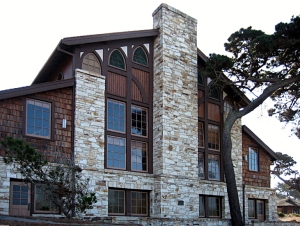
In addition to the preamble, where Baraka explains some of the poem’s key terms such as Dada, which he describes as a movement in France (rather than Germany or Switzerland), another sonic detail that marks this as “live” is at the 2:59 minute mark when we hear the flap of a turning page, reminding us that Baraka is treating the poem as a script in these recordings. In this version, the opening lines are sharply delivered, the voice fully pausing at the linebreaks and acutely pronouncing the hard vowels (e.g. “sucked”). Against the continuous background hush of the original reel-to-reel recording, Baraka punches his words into the air, as if trying to find a rhythm between these harder vowels and the softer ones that often denote the poem’s object of critique (e.g. “light”).
The next version is off the A side of New York Art Quartet and Imamu Amiri Baraka (ESP Disk 1965), where the poem’s rhythm is immediately established by the musical accompaniment.
Between the first recording and this one a shift began in Baraka’s development as a poet. The assassination of Malcolm X pushed him to think even more about race, politics, and art. In this version the opening lines, delivered with punch and pause in the bootleg, take on a different register when juxtaposed with the smooth coolness of the quartet. Overall, though, the poem is delivered more militantly here. In the first version the opening lines are delivered forcefully, but ultimately this forcefulness subsides over the course of the reading. The opposite is the case in this studio version that slowly builds to the apex of the poem, the point of most force, this stanza:
Black scream
and chant, scream,
and dull, un
earthly
hollering.
(Transbluesency 99)
In the bootleg, the turn of the page—between “earthly” and “hollering”—interrupts this stanza, and Baraka hesitates and slowly finds his way toward the poem’s close, while in the studio version, the musical accompaniment reaches a fevered pitch here, making it feel as if it is at the edge of the scream that it names. This prepares us for the closing litany of names of black figures of “black dada nihilismus,” which goes like this:
For tambo, willie best, dubois, patrice, mantan, the
bronze buckaroos.
For Jack Johnson, asbestos, tonto, buckwheat,
billie holiday.
(Ibid.)
In the final version, which is DJ Spooky’s remix of the second one, included on the CD Offbeat: A Red Hot Soundtrip (TVT Records 1996), this litany feels more like the outro (that is meant as) against Spooky’s beats and moody reverb.
An aspect of the poem amplified in the remix is the stanzas leading up to the apex stanza of the “black scream.” In a series of tercets that open the second section, the speaker addresses the experience of racial oppression and a growing need to strike back:
The razor. Our flail against them, why
you carry knives? Or brutaled lumps of
heart? Why you stay, where they can
reach? Why you sit, or stand, or walk
in this place, a window on a dark
warehouse […]
(Transbluesency 98)
The “why” is significantly amplified in the remix, forcing us to hear the ironic indictment of the oppressive “light,” not as audible in the other two tracks, explicit in Baraka’s tercets.
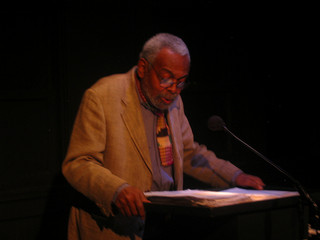
The original recordings of these versions of “Black Dada Nihilismus” are each in a different format: vinyl LP, tape-to-tape reel, and CD. I have been working with digitized versions, so the way I am hearing these recordings—through a smooth digitized MP3 file or Youtube clip—is not the same as the crackle of a needle running an LP’s groove or a nearly noiseless laser tracing a CD. These variations in format mean that the different ways these versions individual signify—their respective “sounds”—are flattened out by compression. Despite this loss of material context, Baraka still sounds different in each of these tracks. Each version of Baraka’s poem offers us another iteration of his “voice,” and the poem, but listening to each of them does not necessarily provide a better understanding of it. We are, though, given different sonic experiences that depend upon the purpose of Baraka’s performance, the listener imagined during the reading, and the voice enunciated through the mediated environment.
Some of the voice details do remain consistent across these recordings. For example, the delivery of one of the poem’s most memorable phrase—“Hermes, the/the blacker art”—that occurs toward the close of the poem’s first section is steadily delivered in a lower register, in the hush of an aside, and might be taken as the motif of each of these variations.
A vast archive of recorded poetry exists. Mid-century recording projects by Caedmon and Folkways made “voices” of well-known poets, such as Robert Frost and Dylan Thomas, available for mainstream consumption. More recent anthologies and series like Poetry Speaks and The Voice of the Poet suggest that the “voice of the poet” still holds appeal. The proliferation of online sound archives such as Penn Sound and From the Fishouse further attest to an ongoing investment in recording, storing, and making available sound files of poets reading their work. And this fascination with the “sound” of poetry is not limited to mainstream cultural spheres or web-based archives. Several scholarly collections on this convergence of sound, voice, and poetry such as Bernstein’s already-mentioned Close Listening, Adelaide Morris’s Sound States, and Marjorie Perloff’s and Craig Dworkin’s The Sound of Poetry/The Poetry of Sound have appeared over the last decade.
The idea of the sound of the poem, located in the mediated voice of the poet, therefore remains relevant today. In many of these instances, however, the poet’s voice falsely takes on an authoritative “aura,” as Walter Benjamin used that word in his (recently re-translated) “The Work of Art in the Age of Its Technological Reproducibility.” Benjamin uses “aura” to talk about authenticity in art and how that is lost when images (or sounds) can be reproduced and widely distributed, and this is not a bad thing: “technological reproducibility emancipates the work of art from its parasitic subservience to ritual. To an ever-increasing degree, the work produced becomes the reproduction of work designed to be reproduced” (24). When Benjamin’s concept is applied to recorded poetry, two key points emerge. First, the “sound” of a poet’s voice is the product of technological conditions. Second, just as a book editor makes aesthetic judgments based on a perceived audience, a listener is imagined when a poetry performance is recorded. Too bad I didn’t know this in high school.
—
Featured image: “Paula Varjack” by Flickr user Very Quiet, CC-BY-SA-2.0
—
John Hyland recently completed his dissertation on sound, poetics, and the Black diaspora, titled “Atlantic Reverberations: The Sonic Performances of Black Diasporic Poetries,” at the University at Buffalo, SUNY. His poems, essays, and reviews have appeared (or are forthcoming) in a range of journals, such as The Journal of Postcolonial Writing, College Literature, and Borderlands. Recently, he has enjoyed performing with the Buffalo Poets Theater and co-edited a special issue of the poetry journal kadar koli on the relationship between violence and the expressive arts.
—

REWIND! . . .If you liked this post, you may also dig:
Hearing the Tenor of the Vendler/Dove Conversation: Race, Listening, and the “Noise” of Texts-Christina Sharpe
Pretty, Fast, and Loud: The Audible Ali–Tara Betts
The Sounds of Anti-Anti-Essentialism: Listening to Black Consciousness in the Classroom-Carter Mathes
Share this:




Current Top Posts





April 2021

January 2020

November 2019

October 2019

August 2019

April 2014

November 2017

March 2015

December 2017

October 2015


Recent Comments