
SO! Reads: Deborah R. Vargas’s Dissonant Divas in Chicana Music: The Limits of La Onda


Deborah R. Vargas’s Dissonant Divas in Chicana Music: The Limits of La Onda (2012) presents an alternate story of Chicana music through a collection of case studies in Chicana/o music history centering on Chicana/Tejana musicians active between the early decades of the 20th century to the present. Vargas assembles a mix of archival documents, interviews, images, songs, recordings, performances, ephemera, fragments, memories and engages intersectional feminist theory and queer of color critique to trace the music scenes her subjects inhabit.
A feminist oral historian, Chicano/Latino cultural studies scholar, and Associate Professor of Ethnic Studies at UC Riverside, Vargas’s research overlaps these disciplines and facilitates a conversation between popular music and sound studies that significantly considers gender, sexuality, and racialization in the construction of borderlands imaginaries. With Dissonant Divas Vargas makes an intervention both theoretical and methodological that greatly expands the Chicana/o musical archive and as well as the audiences for sound studies research. Furthermore, Vargas’s reflective writing voice locates her own Tejana/Chicana story in relation to her project and offers helpful insights into her research process at key moments. [The brief essay titled “Selena, Jenni Rivera, Eva Garza—meditations on an author’s soundtrack” published on the Minnesota Press webpages for Dissonant Divas is a generous methodology piece that should be read along with this comprehensive, satisfying, highly readable and often riveting text.]

“Dissonant Divas in Chicana Music” copyright University of Minnesota Press, all rights reserved
Vargas defines the term, la onda, in a general sense as “an umbrella term for Mexican American/Chicano/Tejano music (x).” More critically, la onda also “operates to represent musics that have been prominent in academic and cultural sites that have produced dominant discourses of sexuality, gender, class, race, geography, and language in the constructions of Chicano music.” “Dissonance” can be understood variously as “chaos, cacophany, disharmony, static” and “out-of-tuneness” that draws attention to “the power of music with regard to Chicana gender and sexuality (xiv).” Vargas’s main critique notes how the “limits of la onda” reveals the heteronormative and patriarchal underpinnings that construct dominant narratives of Chicano music historiography. She argues that the force of these narratives have naturalized a way of thinking about Chicano music in terms of the various “fathers” of Chicano rock, conjunto music, and of the field of borderland studies itself. The distortions produced by the assimilating cultural nationalist logic of “la onda” have not only suppressed Chicana music histories and/or enabled their mishearing, but they also hide the complex ways that race, class, gender, and sexuality converge to produce Chicana subjectivities within and against the Chicano musical canon. In theorizing “dissonance,” Vargas thus productively sounds the Chicana histories in Dissonant Divas as alternatively gendered and/or queered against the heteromasculine concord of la onda.
The chapter “Borders, Bullets, Besos: The Ballad of Chelo Silva” contains perhaps the most provocative pages, detailing Chelo Silva, a bolero singer with a distinct repertoire of songs that are still performed and kept alive by a diverse lineage of performers and audiences, yet whose renown is seemingly inseparable with her former marriage to Américo Paredes. Ubiquitous in borderlands studies, Paredes’s name and legacy are defined largely by his study of the corrido, With His Pistol in His Hand: A Border Ballad and Its Hero (1970). Vargas strategically positions Silva and Paredes as “embodied representations” of the bolero and the border ballad, respectively, taking up Sonia Salídvar-Hull’s proposal to “imagine new corridos” by proposing Silva’s boleros as “feminist border ballads.” Vargas parses the constructions, aesthetics, and values carried in each song form, exploring how the border ballad has been the primary counter-site for narrating the injustice of Tejano/Anglo conflict (bullets) while the bolero, whose constant subject is love, luxuriates in all its jouissance (besos). Vargas reveals that the border ballad “has allowed its authors, singers, and scholars to sound the borderlands imaginary into being,” illuminating how the contest over historical representation is tied to musical representation. Silva’s story cannot be found within this articulation of la onda without, in part, redefining the border ballad (54).
Vargas innovates and meticulously crafts an alternative archive better suited to narrating and hearing Silva’s fragmented story, what Vargas felicitously calls her archisme of knowledge. Engaging the silences in Silva’s story, the archisme sounds her presence in the recorded memories of her fans which include testaments to her unique vocal qualities, her powerful and evocative performances, her improvisations in music and in life,,along with a healthy amount of the chisme or gossip surrounding Silva. Proposing the archisme as a “feminist project for historicizing nonnormative Chicana/o genders and desires” Vargas extends both Sonia Saldivar-Hull’s directive for Chicana scholars to look in nontraditional places for theory and Lisa Lowe’s theorization of gossip as a destructuring site of knowledge production (Saldivar-Hull, 1998; Lowe, 1996).
As I read through the first three chapters, a question that kept coming up concerned why we should not consider this study on more specific regional terms, or why this book isn’t titled, “Tejana Divas”? Vargas finds the overdetermination of these Chicana/Tejana musicians as “regional” subjects a problem not typically encountered by musicians from a city like Los Angeles, for example, because of its construction as a global metropolis. I cannot dispute Los Angeles’s status as a world center and I wondered how to earnestly engage Vargas on this point. What are the stakes of locating this study of Tejana/Chicana musicians within a broader Chicano/a musical context?
The final two chapters make the case for remapping Chicana music, advanced in part by the capacious notion of queer “diva-scapes.” In “Sonido de las Americas: Crossing South-South Borders with Eva Garza,” Vargas employs what she calls a “transfrontera musical compass,” a feminist methodology deftly juxtaposing the notion of a “musical scale” with the concept of “geographic scale.” Eva Garza’s career begins in her San Antonio hometown but she eventually came to embody the “la vóz de las Américas” in a hemispheric sense via her participation in early Spanish language radio, recordings, and live performances in nightclubs and films that took her to Mexico City and Havana for significant periods; her genre-crossing repertoire mirrored her travels. Garza began as a singer of the appropriately feminine bolero, but through her contact with Cuban musicians, the Afro-Caribbean guaracha song–decidedly phallocentric and risqué in its subject matter–also became part of her repertoire. The song she was most known for, “Sabor de Engaño” adds a sensual register to her transfrontera compass, a lingering sabor or taste exceeding regional, national, formal, and gendered limits. This is most evident in the repeated examples of impromptu performances of a song verse or refrain of “Sabor de Engaño” by many Cubanos Vargas encountered in her research travels. Vargas employs the transfrontera musical compass as a “listening instrument” to trace Garza’s musical trajectory through spatial-temporal moments disrupting rigid and normative notions of community, nation, and Chicano music (147).

“Selena Live” by Flickr user hellboy_93, CC BY-ND 2.0
In “Giving Us That Brown Soul: Selena’s Departures and Arrivals,” Vargas addresses the multiple problems in the mainstream media’s designation of “crossover star” to narrate Selena’s story as a spectacular rise in fame marked by her violent death in 1995. Vargas seeks to correct the assimilationist narratives of Selena’s musical history that, in addition to figuring her as a marginalized Latina on the verge of “legitimate” status, problematically narrates a south-north trajectory “devoid of blackness and queerness.” Vargas both critiques how “brown soul” has been musically deployed to stand in for cultural nationalist “brown power” and extends previous work focusing on blackness in Chicano/Latino music that includes R&B and Afro-Caribbean influences but not necessarily the Afro-diasporic. Cumbia, an Afro-Columbian dance form popularized in Mexico in the 1940’s – 50’s is central to Selena’s Tejano sound as are 70’s era disco and 80’s freestyle, particularly in the cultivation of her iconic diva look which together resonate a queer of color musical legacy on the sonic and visual planes.
Selena’s “brown soul” and style moves Tex-Mex cumbias in what Vargas calls “queer misdirections” by traveling north-south, for example, while sounding counterhegemonic femininities that continue to reverberate in the many tribute drag performances to Selena in and beyond the borderlands of Tejas. In these ways, Vargas traces the “topography of Selena’s transformations and remappings of Chicano music (205). Just as audio technologies have been key in circulating Eva Garza’s and Selena’s music in multiple directions, so are the memories, repeated performances, and queer embodiments of their music by their diverse audiences. For both of the these artists, sound expands Vargas’s engagement with spatialization theories so that we may hear these productive dissonances and in these ways begin to imagine alternative borderlands imaginaries.
Upon finishing, a question that remains in considering “diva dissonance” is the implied consonance of Vargas’s theorization of “la onda.” At times, the term becomes too totalizing, and I would argue for the presence of heterogeneity and other musical diversities even within what Vargas denotes as la onda. We must both make and leave room to imagine the possibility of many unrecorded, captured, or yet unsounded transgressions for Chicanas whose paths may appear to follow a heteronormative logic. For this reason I found the reiteration of such rich findings against la onda asomewhat repetitive distraction from the richer tales Vargas’s archival work tells. What would these histories sound like if they weren’t always positioned against la onda—if they were sounded instead more toward each other?
What Deborah R. Vargas richly accomplishes in Dissonant Divas responds to Alejandro Madrid’s call for musicologists to establish critical conversations beyond “the conservatory” and to engage larger intellectual dialogues (AMS Vol. 64, No. 3, 2011).Vargas’s intersectional feminist-of-color argument extends the body of feminist Chicana/o cultural studies scholarship and equally extends Chicano music histories that may engage gender to some degree but do not fully interrogate those categorical constructions. Her theorization of the title’s key term “dissonance” as “both a methodological and analytic device” and her construction of a differential archive combine to create “alternative sonic imaginaries of the borderlands (xii).” More broadly, Dissonant Divas is an intervention to the problems of conducting research in marginalized communities and the racialized subjects often left out of official archives, institutional records, and studies of sound (Trouillot, 1995; Taylor, 2003). Each chapter reveals and addresses various barriers to conducting research on Chicana musicians whose uneven historical representation lead Vargas to turn to other sites, methodologies, and embodied practices where Chicana voices resound across temporal and spatial lines. In these ways, Vargas’s sustained engagement of race, class, gender, and sexuality with Chicana/o borderlands music is thoroughly new.
—
Featured Image: Pauline Oliveros by Flickr user Horacio González Diéguez, CC BY-NC-SA 2.0
—
Wanda Alarcón is a doctoral candidate of Comparative Ethnic Studies with a Designated Emphasis in Women, Gender, and Sexuality at the University of California, Berkeley where she is writing a dissertation titled: “Sounding Aztlán: Music, Literature, and the Chicana/o Sonic Imaginary”. Her research interests include Chicana/o cultural studies, U.S. ethnic literatures, popular music, sound studies, queer of color theory, and decolonial feminism. At Berkeley she has facilitated the working groups, “Decolonial Feminisms” and “Popular Music in Chicana/o Cultural Studies” at the Center for Race and Gender (CRG). Wanda is originally from Los Angeles and before starting graduate school she created the poetry zine, JOTA (2002 – 2006) and is updating that project by creating an archive for queer Chicana writing in cyberspace. She is a fan of radio genres and podcasts and writes micro radio plays while on the road. She is suspicious of the MP3 format yet enjoys curating party, tribute, and mood themed playlists on Spotify immensely. You can find her on Twitter depending on writing deadlines @esawanda.
—
 REWIND! . . .If you liked this post, you may also dig:
Chicana Radio Activists and the Sounds of Chicana Feminisms— Monica De La Torre
Could I Be Chicana Without Carlos Santana?— Wanda Alarcon
Listening to the Border: “‘2487’: Giving Voice in Diaspora” and the Sound Art of Luz María Sánchezˆ— Dolores Inés Casillas
Share this:

Radio Ambulante: A Radio that Listens

 Welcome back to the final article in our three-part series, Radio de Acción. Special thanks to you, our readers, and to editors Jennifer Stoever and Neil Verma at Sounding Out! for hosting this addition to a burgeoning field of Latin American critics and producers who are changing the way we hear radio as history, as theory, and in practice.
Over the past several weeks we have tried to bring you into the multiple worlds made possible by radio in Latin America. If you missed our previous posts, please find Alejandra Bronfman’s stunning history of radio in the Caribbean here, and Karl Swinehart’s fascinating study of Aymaran-Spanish radio here.
Both of these critical approaches set the stage for Carolina Guerrero’s extraordinary work with radio in the Americas. An executive director and co-founder of Radio Ambulante—a program that fellow co-founder and novelist Daniel Alarcón calls “This American Life, but in Spanish, and transnational”—Guerrero’s post takes us behind the scenes of her show to consider how the sounds on radio come to life for us as listeners, and the significance of hearing someone’s words in her or his own voice and language. For more Radio Ambulante after you finish reading and listening to Carolina’s post, please visit their website and download their podcasts.
–Guest editor Tom McEnaney
—
In late 2007, novelist Daniel Alarcón was hired by the BBC to produce a radio documentary about Andean migration in his native Peru. He spent 10 days traveling around the country, from the highlands to Lima, conducting interviews in both English and Spanish, talking to a wide range of people with very personal stories about migration. But when Daniel received the final mix from London, he was disappointed to find that the editor had privileged the English language voices, and left out many of the most compelling Spanish language storytellers. Daniel was left with a question: what if there was a space for those voices on the radio waves? What would it sound like?
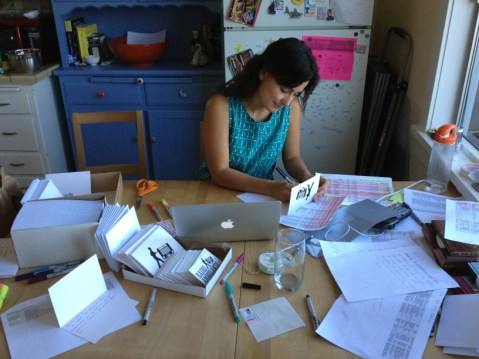
Over coffee in San Francisco in January 2011, Alarcón and I decided to create that space, inspired by US public radio shows like This American Life and Radiolab, which had no Spanish counterpart. We knew that poignant, fun, surprising, unique, sometimes sordid, sometimes romantic, absurd and incredible stories we often heard in Latin America were out there, just waiting to be reported. We knew that they would make great radio. And we knew there was an audience—in Latin America and the US—that wanted to hear it. The result became Radio Ambulante.
 .
.
FIRST STEPS
We began by asking many of our print journalist friends in Latin America to share stories with us. We sent them links to stories from some of our favorite American radio programs, and then contacted a few bilingual independent radio producers here in the US, and asked them for advice on the basics of radio production. Many directed us to Transom.org, which was an absolutely essential resource.
In March of 2012, we launched a Kickstarter campaign. All we had was an idea and a sampler with less than 45 minutes of audio—and still, we managed to raise $46,000 with the support of 600 backers. The success of this campaign was a huge confidence boost, and we knew we were on to something. We used this money to produce our pilot season.
.
Since then, we’ve worked with more than twenty different producers in more than a dozen countries. These are the characters that emerge from Radio Ambulante stories: a transgender Nicaraguan woman living with her Mexican wife in San Francisco’s Mission District; a Peruvian stowaway telling his harrowing tale of coming to New York in 1959, hidden in the hold of a tanker ship; the Chilean soccer player who dared challenge the authority of General Pinochet; a young Argentine immigrant to North Carolina, trying to find his way through the racially charged environment of an American high school. Taken together these voices create a nuanced portrait of Latino and Latin American life:
.
PERSONAL STORIES FOR ALL EARS
Now in our third season, we’ve been working hard to create a group of trusted producers and editors across Latin America; people we can turn to with an idea, people we know we can trust with our limited time and resources; reporters we can send to Cuba, send to Honduras, send to Venezuela, and be certain they’ll come back with usable tape, and a good story. We want these first time producers to become long-term contributors.
That’s the case of Camila Segura, Radio Ambulante’s current Senior Editor. She had no prior experience as a radio producer when she reported her first story for us in 2012. That piece, El otro, el mismo (The Other, The Same) is about two men, one Colombian, one Argentinian, who not only share the same name, but who look almost identical. From this coincidence, the story becomes something much stranger, funnier, more subtle, and ultimately quite moving:
.
We want the listener to be able to relate and identify with the characters, to feel what they feel. A good Radio Ambulante story should be universal and shouldn’t have an expiration date.
One story from our first season captures this universal quality. In 2011, River Plate, one of the most famous soccer clubs in South America, was relegated to the Argentine Second Division. This event shook the entire nation, and anyone who listens to this story could relate to the sadness and pain that the protagonist is feeling. Two years later, the story still has that raw power:
 .
.
HOW WE SOUND
Martina Castro, Senior Producer, has designed most of Radio Ambulante’s sound, finding the balance between music and sound effects in order to support the voice of the main characters. As she explains,
There are many kinds of pieces that make it to Radio Ambulante. Sometimes the story is focused on one person and their experience: something that happened long ago. Like with Mayer Olórtegui in Polizones (The Stowaways), and the story of how he and his friend Mario jumped aboard a ship headed to the United States. There is no substitute for a dynamic storyteller like Mayer. He not only recreates moments, sometimes even imitating the sounds of what he heard, but he remembers the emotion of what happened, and really feels deeply what he is talking about, like when his voice breaks up at the mention of saying goodbye to his friend Mario.
.
Other, more symphonic, multi-voiced pieces provide a different kind of production challenge. The script must showcase the many characters, while giving the listener enough grounding so as not to get lost. A particularly successful example is our award-winning piece “N.N.”, about Puerto Berrio, Colombia, by reporter Nadja Drost. Nadja gathered recordings of this river town, and conducted interviews with many locals, always focused on the issue of the floating, anonymous dead and the town’s strange relationship with these bodies. The music in a piece like this is only meant to support those real-life sounds and characters, and a repeated melody serves as a ghost-like echo of the dead, those voices we never hear.
We use music carefully to shift the mood, to mark the end of a section, and to alert the listener that something new is coming. The music is also meant to break up chapters of a story, give us a moment to reflect on what we just heard, or to indicate when something is about to change. There are examples in Yuri Herrera’s “Postcard from Juárez,” produced by Daniel Alarcón. It tells the story of Diana la Cazadora, or Diana the Hunter, a vigilante who set about killing bus drivers in one of the world’s most violent cities, allegedly as revenge for years of misogyny and sexism.
.
In this particular story, we were able to do something that the English version (produced for This American Life) could not: read in the original Spanish the letter that the supposed killer sent the local Ciudad Juárez newspaper explaining her actions. We had this read by Lizzy Cantú, a Mexican journalist who’d worked with us before, and then distorted her voice, to give it that dark ambience. The listener is supposed to feel the grim violence in those words: the desperation.
 THE STORY IS KEY
In three seasons producing the show, we’ve learned that the craft of radio comes from listening, and that the most challenging aspect of producing radio is not in the technical details of recording those voices or sounds, but in the story itself.
The most basic building block of a good radio story is a good interview. The technical aspects of gathering sound are less important than phrasing the questions to get vivid, almost filmic answers, full of details that set the scene.. As Executive Producer Daniel Alarcón explains,
We ask our reporters to push interviewees to describe scenes in great detail, to unpack moments. Our interviews can last two hours or more, and many are surprised that we go so in depth. We like our reporters to circle back, and then circle back again, so that we’re sure we’re getting the most vivid version possible of a given story’s crucial moments.
We ask our reporters to write colloquially, to imagine they’re telling the story to a friend at a bar. It’s important to have immediacy in the language, an expressive tone that can seem almost improvised, even when it isn’t. The emotional impact of radio is that it feels as though a secret is being shared. The script and the production should always be in service of this intimacy.
Before a script is final, it’s shared with other editors on the team around the globe (California, Colombia, Puerto Rico, Chile), mixed, edited, soundtracked, and refined through hours of collective work online.
 .
.
ONWARD
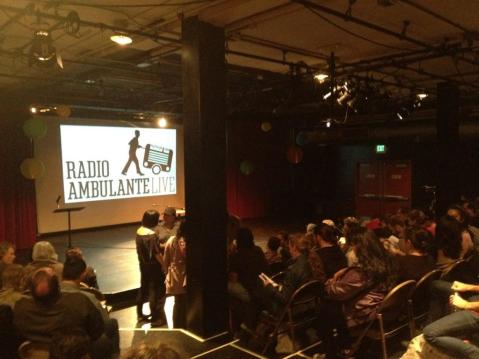
While creating our own sound and storytelling style, Radio Ambulante is constantly experiment with different formats and looking for new ways to interact with our listeners. We’ve done three live radio shows, in Los Angeles, San Francisco, and New York. In addition, we’ve produced two English Language specials, and partnered with writers and animators on hybrid multimedia storytelling. With our partners at PRI, we’re developing a new interview series, and are working with Latin American universities and media outlets to teach more journalists to use radio. Our hope is that Radio Ambulante’s success will mean more innovative radio work in Spanish, and more experiments in the possibilities of bilingual radio.
—
Carolina Guerrero is the Executive Director of Radio Ambulante. Before getting into journalism, she was a promoter for cultural and social projects, creating a bridge between organizations in three different continents. She has worked with public and private institutions in several countries, for which she has designed and overseen festivals, art exhibits, teaching workshops and fundraising events. Carolina is a John S. Knight Journalism Fellow at Stanford University 2014-15. She is the proud mother of León and Eliseo. (@nuncaduermo)
All images courtesy @radioambulante on Twitter
—
 REWIND!…If you liked this post, you may also dig:
“We wanted to tell stories about sound: Opening Ears Through the Everything Sounds Podcast”-Craig Shank
“Chicana Radio Activists and the Sounds of Chicana Feminisms”-Monica De La Torre
“Óyeme Voz: U.S. Latin@ & Immigrant Communities Re-Sound Citizenship and Belonging”-Nancy Morales
Share this:


Current Top Posts





April 2021

January 2020

November 2019

October 2019

August 2019

April 2014

November 2017

March 2015

December 2017

October 2015
 Sounding Out!
Recent Comments