
Listening to Disaster: Our Relationship to Sound in Danger

Editor’s Note: Welcome to Sounding Out!‘s World Listening Day Extravaganza! Enjoy this special bonus “soundtracked” post by multimedia artist (and new Sounding Out! regular) Maile Colbert –full of field interviews with artists and acoustic ecologists such as Marc Behrens, Andrea Polli, Bernie Krause, and Peter Cusack–as well as a podcast produced by Eric Leonardson, Director of the World Listening Project. (Click HERE to go to the podcast). For the full introduction to the World Listening Month! series click here. To peep the previous posts, click here. And remember, here at Sounding Out! every day is for listening. . .so meet us here for the 364 days between WLDs for more aural treasures and sonic thought.–JS
—-
Even the surrounding hills were hushed, as if brought low by language. –from Grendel by John Gardner
DOI: https://doi.org/10.59350/92zh7-08e33
Under good weather conditions in 2007, six artists, two curators, and two guides set out towards the Brenndalsbreen glacier in Vestlandet, Norway. An arm of the largest glacier in continental Europe, the Brenndalsbreen is maintained by high snowfall rates rather than cold temperatures, so the glacier has high melting rates. Since 2000, Brenndalsbreen has retreated 276 meters (820 feet). The group was the first to venture there that spring, the winter being too dangerous. Marc Behrens, one of the artists present, received permission to follow a guide down a crevice in a tongue of the glacier. There, surrounded by walls of ice, he began to record the melting drops that feed the glacial river flowing underneath. It was in this moment that Marc heard a change in the sound that signaled to him he may be in life-threatening danger, but due to the focus of the equipment he was using, he had no way to perceive how dangerous that threat may be.
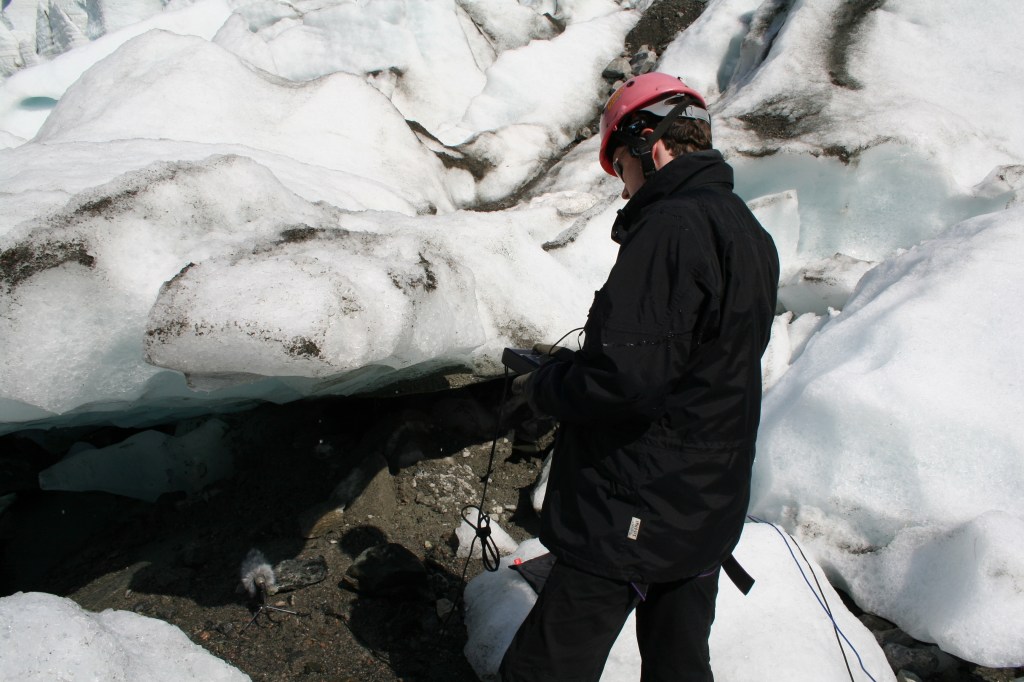
A question to Marc Behrens: “Can you describe your process of perception between thought and hearing within your personal story of disaster?”
When the crashing ice announced itself by the little crunch, I assumed it was merely a modulation in the noises the glacier made anyway – I was very calm listening to the beautifully trickling melt water drops – basically a stream of the same minuscule sounds over a long period of time. I appreciated this and it did not occur to me that it could have been the start of a more dramatic and quick development.
Then, as a surprise I heard that loud crash, which, as I had (bad) headphones on and listened to the microphone input which was directional, I could not relate the spatialization in the headphones to the physical surrounding. In the recording it seems smaller than it was – but it seemed as if the whole glacier just came down on me – sonically. I could not localize the sound, so I could not escape in any direction as I did not know where to. So I decided to stay where I was and just raise my hands/arms to protect my head as much as possible. I perceived a rush of adrenalin but remained lucid, especially as there was nothing else to do, and hence no possibility to fail. I mean: I could just wait and hope I would not be injured. And so, I waited for a moment more after the crash, then stopped the recorder and went out from the protruding ice to signal the others that I was okay.
In 2011, the disastrous 2011 Tohoku earthquake and tsunami devastated Japan. Within its horrific footprint, a number of nuclear accidents affected hundreds of thousands of residents with radiation levels up to eight times what are considered normal. Many other radioactive hot spots were also found outside the evacuated radius, including within Tokyo. All over social networks, people posted photos, videos, and sound clips of their Geiger counters reading the radioactivity in their homes and neighborhoods. The process a Geiger counter uses is called sonification, a form of auditory display that uses non-speech audio to convey information. As I played a sound file from a friend of the above-normal readings in his kitchen in Tokyo, I was unnerved by the ominous, staticky click, like the chirping of some robotic insect.
In fact, the entire event was sonically terrifying. Some of the most chilling recordings I heard from the underwater earthquake and the birth of the tsunami were picked up by the hydrophones of the National Oceanic Atmospheric Administration’s VENTS Program. The Tohoku earthquake was the largest sound they had ever picked up.
Using the seismic data from this same quake, audio programmer and artist Micah Frank used his creation Tectonic, a real-time seismic analysis and sound synthesis system, to sonify the sounds of the earth shifting and opening that fateful day. With Tectonic, sound is created in real-time by seismic activities as they occur across the globe. Using magnitude, elevation, time of day, and geographical coordinates, the data is mapped to synthetic spectrums and processed by granular, aggregate and subtractive synthesis.
Tectonic: Earthquakes Generate Music in Realtime from Micah Frank on Vimeo.
But is this more artistic and emotive approach effective in conveying the disaster, if that is even the point? Most comments on his Soundcloud track range from “cool sounds” to “I’ll send you the remix when it’s done.” When compared to the hydrophonic recordings from the VENTS program, perhaps the use of data to sonify is too abstracted from the event itself.
Digital media artist Andrea Polli takes a different approach to sonification. During the 2007/2008 season Polli was on site in Antarctica conducting work through the National Science Foundation residency, working with scientists gathering weather and climate data. Here she created the project 90 Degrees South, which “aims to communicate both the aesthetic beauty and the scientific importance of Antarctica to global climate.” This project gave birth to the audio album, Sonic Antarctica, which uses field recordings, sonifications, and audifications of the collected data.
.
To Andrea Polli: “How can sonification help us understand climate change?”
One thing that comes to mind is that sound and music can provoke an emotional (or at least affective) response that is not always possible through graphs and images. For example I have used low, almost sub-aural sounds in data sonifications to promote a visceral response in the listener to various atmospheric events. . .
I have worked with weather and air quality data in real time, both using on-site data or remote data. To become attuned to the remote data takes some time and quiet listening, to me it is like being in two places at once, for example in a gallery or on-line and at a remote site near the North Pole.
Often we associate catastrophes with massive and sudden sounds. We give animalistic descriptions to the sounds made by what we call natural disasters, such as growling tornado, roaring avalanche, shrieking cyclone, groaning earth. This practice speaks to our complex relationship with nature, connecting us to it and taking us out of it at the same time. But what of the slow silencing that happens to our soundscapes when certain species die out? Such quiet disasters affect everything, sadly in ways we don’t (and won’t) notice until too late.
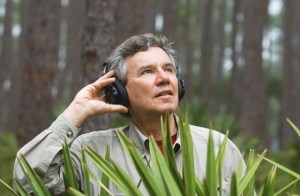
In The Great Animal Orchestra, author, musician, soundscape recordist, bio-acoustician and naturalist Bernie Krause coins the term, biophony, to help ecologists, biologists, acoustic scientists, and others to understand the long-term impact of disasters, particularly silent ones. Biophony refers to the collective sound vocal non-human animals create in each given environment. We face many compounding problems with the silencing of certain species and the quieting of a whole biophony, not the least of which is our connection with the world.
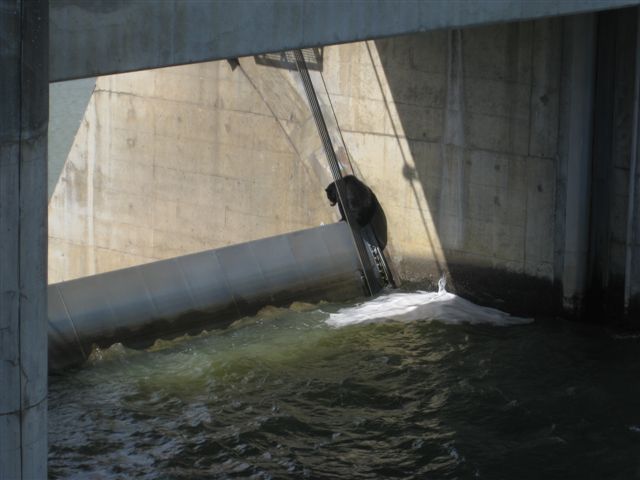
Krause provides some powerful examples of silenced biophonies in his book, such as the story of the Wy-am tribe in the Northwestern United States, whose history has been intertwined with the Celilo Falls, a waterfall just west of the Columbia River’s midway point, for thousands of years. Wy-am means “the echo of falling water.” Krause writes: “so central were the falls to the tribe that the Celilo was considered a sacred voice through which divine messages were conveyed.” It was also their yearly source for fish. In 1957, when the Dalles Dam gates were ordered shut by the U.S. Army Corps of Engineers, the waterfall and fishing site were completely submerged, sending the Wy-am into a state of mourning that continued to subsequent generations.
Krause cites several similar “silencings” in his book using spectrographs. Similar to sonification, Krause’s spectrograms give form and shape to “silent” disasters. A particularly sad example for me, coming as I do from a family from the Hawaiian Islands, is the recorded comparisons of the coral reef in Vanua Levu, Fiji, that has been devastated by warming waters, shifts in pH, and pollution.
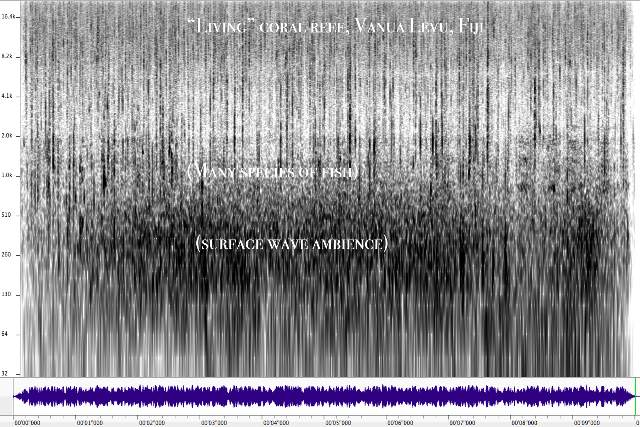
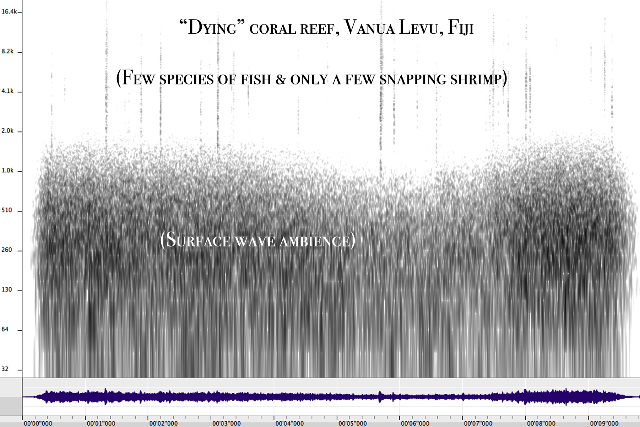
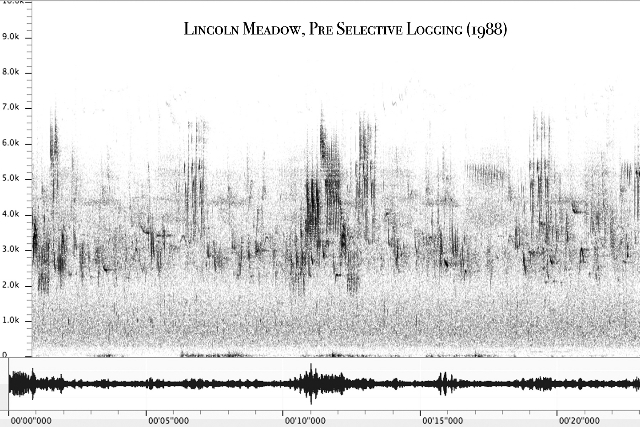
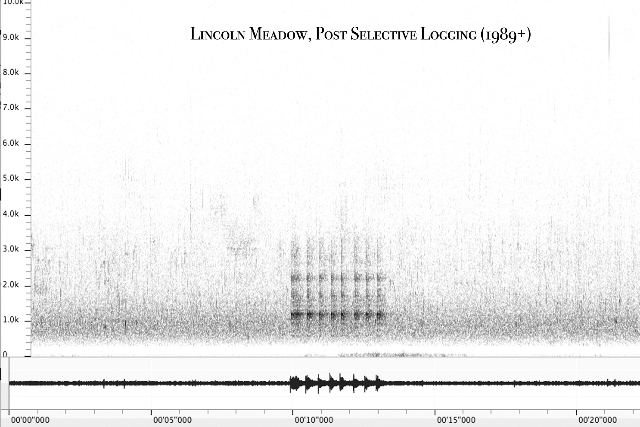
Krause also recorded twice at the Lincoln Meadow “forest management area” in the Sierra Nevadas, once before mass logging went into effect, and once after, a year later on the same date, time, and same weather conditions. While visually it seemed that little had changed, Aurally it was a different story:
To Bernie Krause: “We have a tendency to attribute ‘loud’ to the perspective of a disastrous event. Can you discuss the relationship of silence to disaster?”
In the natural world there are so many events that, to the “rational” human mind, appear to be contradictions. For instance, after the 11 September 01 disaster, which resulted in cancellation of all domestic and private aircraft flights and a reduction of automobile traffic around our house in the far western United States, the natural soundscape (biophony) returned in a way that we had never heard it before…even in September…late summer when almost all of the birds have fledged and gone elsewhere. And then there’s the reference in the book to the return of the biophony around Chernobyl, recorded by Peter Cusack from the UK. On the other hand, after some types of disasters, the immediate silence appears to happen because all of the vocal creatures have to reassess their acoustic territory, and, depending on the biome, takes anywhere from minutes to years, to recover a stable biophonic expression.
UK artist Peter Cusack’s Sounds from Dangerous Places, sought recordings from disaster sites like the Chernobyl exclusion zone in the Ukraine, the Caspian oil fields in Azerbaijan, the Chernobyl-fallout affected farmlands of Northern Wales, and the rivers of Eastern Turkey with their extensive, local climate altering dams. What is surprising and moving about these works is the strong human element, especially the lack of human presence and the evolving relationship of humans to these post-disaster soundscapes.
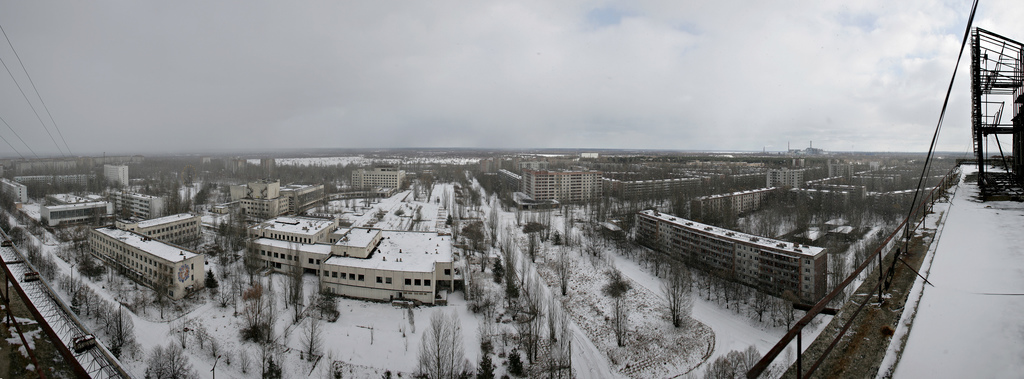
Listening to some of Cusack’s recordings from Chernobyl, one might feel surprised to hear that iconic name attached to such rich and pastoral soundscapes. When we consider the massive industrial accident that killed thousands and created an exclusion zone of 30 kilometers (19 miles), some of us are compelled to imagine a wasteland…not a living creature in sight. But those like Cusack who have visited the area are met with quite a different experience, one we can share when listening to the recordings. Cusack says Chernobyl held the richest dawn bird choruses he has ever recorded; haunting full choruses of frogs and nightingales sound throughout the night. And again we hear that iconic sound of the Geiger counter increasing its metallic chirp as Cusack walks toward an infamous radioactive hotspot, at one point it makes an eerie duet with a calling cuckoo.
To Peter Cusack: “How has the sound of dangerous places surprised you?”
Dangerous places can be both sonically and visually compelling, even beautiful and atmospheric. There is, often, an extreme dichotomy between an aesthetic response and knowledge of the ‘danger,’ whether it is pollution, social injustice, military or geopolitical.
In the context of the Sounds from Dangerous Places project ‘dangerous places’ are mostly areas of major environmental damage, but also include nuclear sites or the edges of military zones. The danger is not usually to short-term visitors, but to local people who have no option but to stay or more widely through the location’s role in global power politics.
Many aspects of dangerous places are a surprise, mostly because ones expectations are often wide of the mark, especially in the smaller details. However different places surprise one very differently. For example the name ‘Chernobyl exclusion zone’ implies no one is there. Not so. Thousands still work at the site, some live there and some commute in every day (by rail, so trains are part of the soundscape). That many people also require restaurants, bars, administration and all the infrastructure of a small town. So people and work sounds of all kinds are still to be heard around Chernobyl town and the nuclear sites. Some of the villagers, originally evacuated out, have returned bringing their sounds too – horses, chickens, carts, hand farming, traditional songs, modern day TV. The zone is also now a wildlife haven and the sounds of the dawn and evening chorus of spring are intense. The vibrant recordings of wildlife show that many species, at least, are doing fine in the exclusion zone. . .
In other places, though, sounds gives no indication of the danger. In the borough of Uttlesford, also just outside London, one hears church bell, over flying aircraft, cats mewing, cars passing, lawn mowing and common birds singing. It’s exactly as expected for one of the wealthiest areas in South East England. It also produces the greatest amount of domestic greenhouse gas of anywhere in the country.
I want to leave you with the example of the elephant seal, not as a “success story” but as an example of the great responsibility that humans have to know and be aware of our impact on a whole biophony, a whole ecosystem, a whole planet. When we think to such scales, there can be the tendency to look at the dying out of a single species as not so catastrophic. But we forget the interconnectivity of things, and how one species affects another, as well as its surroundings and its future. Sound can herald disaster, but it can also signal the potential for renewal, too.
The northern elephant seals once boasted colonies of hundreds of thousands in the Pacific Ocean. By 1892 only 50 to 100 individual seals were left, until in 1922 the Mexican government gave protective status, pressuring the U.S. government into following suit, and today their numbers are up to approximately 160,000. Known for their distinct vocalization, especially in the males, the large proboscis of the elephant seal is used to emit a loud roaring sound. From chortles to growls to screams to melodic sighs, their frequency range and detailed expression is amazing to listen to.
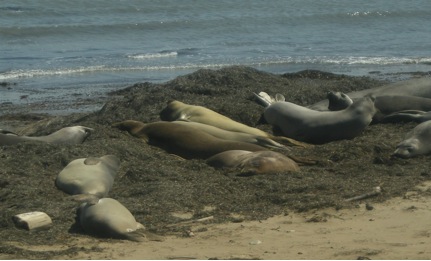
With growing numbers, the seals started populating Año Nuevo in California in 1955, now dominating the biophony against the waves with various sea birds, sea lions from an offshore island, frogs, and the occasional bark towards the evening and night hours from coyotes and foxes. It is one of the most vibrant and unique soundscapes I have ever experienced, weighted with the thought of how close it came to me never hearing their calls in the wild.
There is a moment upon hiking into the park where you can hear the seals’ voices being carried on the ocean wind, but only sand dunes lay in front of your eyes. Skin pricks up at such a strange sound; my companion admitted excitement and a little fear upon hearing it. The look on her child’s face, however, was priceless wonder. Thousands of tourists come every year to see these magnificent beast, but mostly to listen to these calls, that were, once upon a time not too long ago, almost silenced forever.
—
This post is dedicated to Dr. Donald Allen Colbert, who sparked wonder in the world beyond what I could see…
__
Featured Image Credit: Air Raid Siren by Flickr User Wader
__
Maile Colbert is an intermedia artist with a concentration in sound and video, living and working between New York and Portugal. She is an associated artist at Binaural/Nodar and director of Cross the Pond, an organization based on arts exchange between the U.S. and Portugal. She holds a BFA in Studio for Integrated Media at Massart, and a MFA in Integrated Media/Film and Video from Calarts. She has had multiple screenings, exhibits, and shows, including The New York Film Festival, Ear to Earth Festival, LACE, MOMA, LACMA, the REDCAT Theater in Los Angeles, The PDX Film Festival, Future Places Festival Oporto, HOERENSEHEN 2.0 Berlin, Störung Festival Barcelona, Teatra Municipal in Guarda, Observitori Festival Valencia, and has performed and screened widely in Japan, Europe, Mexico, and North America, and co-composed for a featured installation at the 2009 UN Climate Conference. She was a visiting lecturer teaching at UCSD and Escola Superior de Teatro e Cinema, and guest artist and lecturer at NYU, MassArt, Calarts, SUNY Buffalo, SUNY Binghamton, Muhlenburg College, and Universidade Nova de Lisboa. She is currently in production on an interdisciplinary experimental opera based on Portuguese Maritime history, and will release two albums this year. You can find her at www.mailecolbert.com.
—
Share this:

Sound and Curation; or, Cruisin’ through the galleries, posing as an audiophiliac
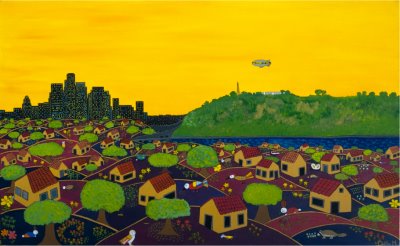
But to love this turf is love hard and unrequited.
…
To love L.A. is to love more than a city
It’s to love a language.
–“L.A. Love Cry” (1996) by Wanda Coleman
DOI: https://doi.org/10.59350/by0pt-98444
Los Angeles, an enigmatic metropolis to many who arrive here with a dream in hand and hope for a better tomorrow, still challenges historians, artists, and troubadours on how to best represent it. Poet Wanda Coleman, born in Watts, captures the pain and wonder of loving this city in “L.A. Love Cry.” Because the city is “hard and unrequited” one must also be willing to love its nuances and see it as“more than a city.” To love this city, “it’s to love a language,” a cultural immersion that goes beyond the seeming ease of words into the complexities of sound and rhythm.
Through a Museum Studies course I teach at Claremont Graduate University entitled Welcome to L.A., I introduce students to varied texts in which scholars and artists challenge the imaginaries created by outsiders, boosters, and apocalyptic cinema. Instead, the course readings present how we in L.A. actively engage with one another by fostering communities of creative praxis. For the students’ final project, they curate and develop educational programming for an exhibition at a local museum or art center. On May 3, 2012, this semester’s project, re : present L.A., opens at the newly-renovated Vincent Price Art Museum (VPAM) located on the East Los Angeles College Campus. Showing works from over thirty artists from May 3-July 27, re : present L.A serves as an extension of the conversations we had in class, not only celebrating the interconnectedness of our communities but encouraging new associations and encounters within the visual and resonant space of VPAM’s Community Focus Gallery. For a look at the Virtual Exhibit Catalogue, click here.
In each exhibition for Welcome to L.A., I try to include something that challenges myself to think outside the white-box, per se, of the gallery. Given that we had read several texts that highlighted in the importance of music to build and uplift communities of color in Los Angeles, it was both important and necessary for me to include sonic elements in re: present LA that exhibits L.A.s vibrant musical legacy as intermingled with and fundamental to its visual culture. Among the challenges to document the cross-cultural connections between ethnic communities in Los Angeles is how to unpack what Anthony Macias calls “the cultural networks” that facilitated these exchanges through the music scenes at music halls, clubs, youth centers and record stores in Mexican American Mojo (10-11). Studies done by George Lipsitz, Macias, and Victor Viesca, provide readers a means to understand how the music in Los Angeles is much more than entertainment; it is political; it is a lifestyle; it defines spaces of multicultural interactions. In How Racism Takes Place, Lipsitz points out how integral the reclamation of space defined the political outlook and music in Horace Tapscott’s Arkestra based in South L.A. Viesca’s research documents the rise of an East L.A. rock sound, post-Los Lobos, that was defined by the activism of the Zapatista Movement and California’s Prop 187 through the work done at the Peace & Justice Center, Self-Help Graphics, and Regeneración.
Therefore, in order to engage both the history and the sound of Los Angeles’s musics with the city’s visual representations, I invited Rubén Funkhuatl Guevara from Ruben & The Jets, is a multi-threat musician, performer, writer, and producer, and Jennifer Stoever-Ackerman (of Binghamton University, Sounding Out!, and of course, Riverside, CA) to curate playlists for a “sound booth,” which will consist of a stationary iPod™ Nano that gallery visitors can use at their leisure. The classic circular wheel allows the viewer to advance tracks or play the playlists on shuffle. Headphones will be set up so that the viewer can either focus on their listening experience or, listen while viewing the artwork around them. Since the gallery is relatively small, the pieces on the opposite wall are recognizable though are distant. In addition, Maya Santos of Form Follows Function will screen their short documentary on Radiotron, a youth center that presented Hip-Hop shows during the 1980s.
Guevara’s playlist Los Angeles Chicano Rock & Roll is included in the exhibition thanks to the Museum of Latin American Art. Stoever-Ackerman’s playlist Off the 60, unites the two spaces of East L.A. and Riverside through a mix of intra- and trans-cultural musical experiences. Guevara’s rock & roll selections highlight many of the bands that emerged in East L.A. Both the musical listings and the liner notes for the sound presentations will be accessible on the re:present L.A website when the exhibit goes live on May 3rd, 2012.
.
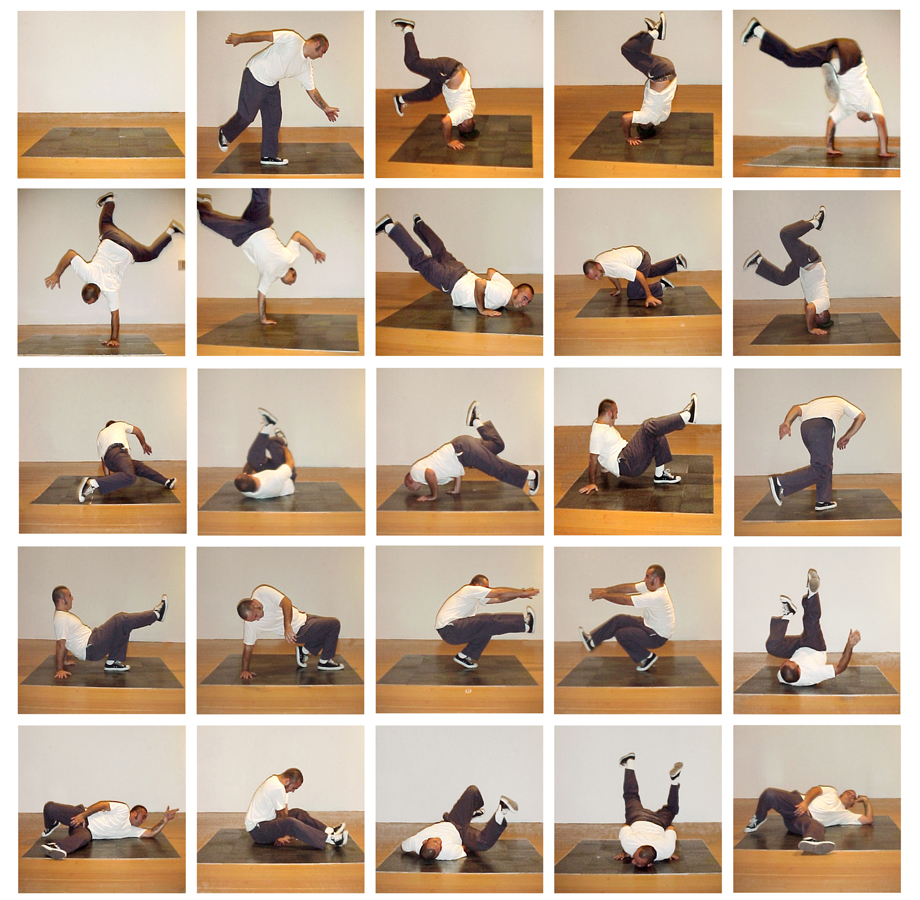
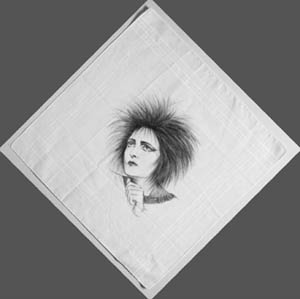
My sonic intervention in the white, often silent, spaces of the gallery was especially inspired by two recent precedents: the inclusion of the iPod™ in MEX/LA (2011) at the Museum of Latin American Art and Phantom Sightings (2008) at the Los Angeles County Art Museum. Both experiences invited me as a viewer to see the artwork through another sensory experience. The first time I saw music included in an exhibition not specifically about music (such as the Experience Music Project’s 2007 American Sabor: Latinos in U.S. Popular Music, or Marvette Peréz’s curation of ¡Azúzar! The Life and Music of Celia Cruz at the Smithsonian National Museum of American History) was LACMA’s Phantom Sightings, which garnered much critical acclaim and criticism due to the premise of presenting contemporary Chicano Art inspired ‘after’ the Chicano Movement. However, I want to focus on one aspect of the exhibition, a corner display with books that informed the curators’ conceptual approach and on the bookshelf was an iPod™. The iPod™ included playlists from some of the artists reflecting their inspiration for their artwork. I enjoyed listening and reminiscing while sitting in the gallery. However, I wanted the music to take more of a central role in the exhibition, especially because much of the artwork so obviously revealed traces of Los Angeles’ musical influences, partly due to the recent generation of artists who actively engaged in subcultural expressions and referenced it in their art. For example, as Ondine Chavoya describes in the Phantom Sightings catalogue, Juan Capistran’s The Breaks (2000) is a giclée print documenting the artist break-dancing on Carl Andre’s minimalist floor pieces. The guerilla performance then is presented through a series of twenty-five still images showing the various movements seen in how to break-dance books (125). Shizu Saldamando’s ink on fabric portraits of Siouxsie (2005) and Morrissey (2005) showcase how post-punk and new wave music from England is part of her life as an Angeleno (and that of her friends), yet the medium is reminiscent of pinto drawings. Saldamando also does portraits of her friends at clubs, backyard bbqs “documenting a world where identity is fluid” as Michele Urton describes in the catalog (197).
It would be another three years before MEX/LA would further marry music with art, now casting it in relation to the politics of Chicano and Mexican presence in Los Angeles. MEX/LA, among the many Pacific Standard Time exhibitions presented throughout Los Angeles, was among the best curated due to the range of artifacts representative of the city and the cultural production emerging in post-war L.A. Another striking element was the influence of Méxicano popular culture among Chicanos and vice-versa. As curator Rubén Ortiz-Torres, and associate curator Jesse Lerner write on the MoLAA website: “The purpose of the construction of a ‘Mexican’ identity in the South of California is not to consolidate the national unity of a post-revolutionary Mexico, but to recognize and be able to participate in an international reality, with all its contradictions and conflicts that this entails.” One of the ways this cultural exchange was embodied was in the playlists curated by Rubén Funkhuatl Guevara and Josh Kun that were prominently displayed alongside the artwork and heard in the interactive iPod™ “sound booths,” that invited viewers to sit on beanbags and listen. The music served to contextualize the art in relation to popular culture of the time. For example, Guevara presents a Chicano rock & roll genealogy that followed the chronology of the visual exhibit, 1930-1980, that begins with boogaloo and swing of the 1940s era culminating with the punk rock sounds of The Bags.

In both these exhibitions, the music served to complement the artistic elucidations of identity, race, and American popular culture seen in much of the artwork. The simplicity of the presentation was due to the inclusion of a familiar object like the iPod™. What is surprising is that more exhibitions have not incorporated more sonic elements to engage viewers’ other sensory experiences beyond the podcasts, or cell-phone audio listening tours set up at most major museums. While musical playlists can serve as another didactic component of an exhibition like the more established audio tours, I am arguing for a different use of sound in museum space, one that provides a wider sense of agency, connection, and encounter with the visual elements on display rather than a one-way transmission of information. In the cases of MEX/LA and Phantom Sightings, the inclusion of iPods™ provided a tool to understand the cultural production of a “post-Chicano movement” generation of artists while at the same time enabling an experience that recognized—and resonated with—my bicultural experience.
Being that L.A. is a car culture moving to the rhythms of the radio waves, I’m always seeking to find synchronicity between music that feels me with joy and my work as a cultural worker. Part of my impetus to locate Los Angeles sonically in re : present L.A. was driven by the question: is it possible to capture my sonic landscape growing up in the city of Los Angeles that ranges from Hip-Hop – British Rock – Mexican Pop? The playlists curated by Guevara and Stoever-Ackerman are familiar to me personally. Stoever-Ackerman’s Off the 60, reminds me of the sounds of my youth, when KDAY and KROQ rocked the radio waves and my students banded together in my high school quad according to their favorite music – metal-heads, b-boys, alternative rock, and the cha-chas, who traveled across town every Friday night to Franklin High, where DJs spun L.A. disco. At home, the music was different. My mom and tías used to reminisce about their homeland every Sunday night through the variety show Siempre en Domingo, binding us to the t.v., religiously following the rising stars. Through the bi-lingual selections in Guevara’s Los Angeles Rock & Roll, there’s a familiarity of home and the music heard at backyard parties and quinceañeras.
By including my iPod™ nano, I bring together my lived experience as a cultural worker through the sounds of L.A. and activate the white walls of the museum. The playlists created by Guevara and Stoever-Ackerman serve to reflect the history of the community surrounding VPAM, as well capture the diversity of the city sonically re:presenting L.A. to our audiences. While the playlists can stand alone as audio curations in their own rights, I hope that they will engage audiences to rethink the relationship between music and art, and feel their lived experience inclusive within the museum.
—-
reina alejandra prado saldivar is an art historian, curator, and an adjunct lecturer in the Social Science Division of Glendale Community College in Glendale, California and in the Cultural Studies Program at Claremont Graduate School. As a cultural activist, she focused her earlier research on Chicano cultural production and the visual arts. Prado is also a poet and performance artist known for her interactive durational work Take a Piece of my Heart as the character Santa Perversa (www.santaperversa.com) and is currently working on her first solo performance entitled Whipped!
—
Share this:




Current Top Posts





April 2021

January 2020

November 2019

October 2019

August 2019

April 2014

November 2017

March 2015

December 2017

October 2015


Recent Comments