
Beat-ification: British Muslim Hip Hop and Ethical Listening Practices


As the beat drops for our latest Live from the SHC post, Cornell’s Society for the Humanities Fellow Jeanette Jouili hits us with some (social) science, sharing her ethnographic research on Muslim Hip Hop in pious communities in Britain. To give earlier installments by Damien Keane, Tom McEnaney, Jonathan Skinner, and Eric Lott another spin, click here. Next week, the needle comes to the end of the groove for the “Sound: Culture, Theory, Practice, Politics” crew as Society Director Tim Murray takes us on home. Good thing Sounding Out! can’t stop, won’t stop. . . –JSA, Editor in Chief (and 2011-2012 SHC Fellow)
—
Can Hip Hop sound Islamic? And conversely, can one listen to Hip Hop in a Muslim way? What is at stake when a contemporary musical form like Hip hop (or rock or punk) is introduced into the catalogue of recognized Islamic music genres? What impact do these genres have on longstanding Islamic traditions of ethical listening? In the process of creating new genres of Islamic music, which have not been previously connected to Muslim music traditions, norms are negotiated, border zones are walked upon, limits explored. At the same time, these Islamic music practitioners, even those who push established artistic limits within the Islamic movement, nevertheless intend to uphold the initial ethical project.
Considering music as producing sensual pleasure or extreme emotional excitement, Muslim scholars throughout the ages have been concerned with its capacity to hinder the exercise of reason and self-mastery as well as with its promises for spiritual benefit. Roughly, one can say that those who have opposed the practice of listening to music feared that music’s force arouses worldly passions which distract from the remembrance of God, whereas those who were favourable toward this practice – generally speaking these voices came from thinkers and practitioners of the Islamic mystical traditions –highlighted music’s capacity to impel the believer to seek the spiritual world while simultaneously being attentive to its potential dangers. Among these two sides, there is a wide range of theological opinions, from those that prohibit any kind of musical singing (considering Qu’ran recitation and poetry recitation not in terms of the category music) as well as all musical instruments, to those that allow for singing and certain musical instruments (i.e. drums permitted, stroke instruments not), and those who allow for all the array of musical expressions (given that specific moral conditions are fulfilled).
If the evolution of Islamic music toward the incorporation of modern music traditions has already been controversial within many Islamic revival contexts, it is not exaggerated to claim that Hip hop, at least in the UK, is probably the most contested and is until now the most marginalized of the different music genres within the Islamic popular culture scene. Today’s British Muslim Hip Hop is an occasion to think about the struggles of young Muslims to incorporate a music tradition that epitomizes black music culture like no other contemporary genre into the larger frame of Islamic music in Britain, which has been largely associated with South Asian and Middle Eastern music traditions.

Rakin and Ismael of Hip Hop Duo Mecca 2 Medina, Image Courtesy of M2M
Muslim Hip Hop takes many different sonic and stylistic directions in the UK. Some artists advance their Muslim identity in the context of religion and others take a more political standpoint; many blend both to varying degrees. What connects these diverse orientations is the critique of contemporary mainstream commercial Hip Hop. Many Muslim Hip Hop fans and artists see this music as little more than a glorification of materialism and sexism. The thriving Muslim Hip Hop scene in the UK, which is deeply influenced by Afro-Caribbean converts to Islam, clearly situates itself in continuity with early Hip Hop, as defined by black awareness, political messages, and an underlying Islamic identity. Their own engagement in Islamic Hip hop is thus seen as holding true to the ‘authentic’ Hip hop traditions by purifying a corrupted Hip hop and renewing and reconnecting it to its Islamic identity.
While Aki Nawaz’ FUN-DA-MENTAL were Muslim Hip Hop pioneers in early nineties British hip hop, it was notably Mecca 2 Medina which opened the doors for Muslim rappers in the reticent U.K. Muslim community. Currently, the Mozambique-born rapper Mohammed Yahya, the female rap duo Poetic Pilgrimage, the sisters from Pearls of Islam, Muslim Belal, and Rakin Niass (formerly of Mecca 2 Medina) headline many urban Muslim cultural events in Britain. Lowkey and Jaja Soze are two well-established names in the UK Hip hop scene who are also present within the more subcultural Muslim scene.

Lowkey, Image by Flickr User The Girl 78
The Islamic Hip hop scene in Great Britain struggles to find a way to bring the tradition of Hip Hop in line with Islamic traditions, molding it to conform to Islam’s ethics of listening and sonic practices. Hip Hop can be especially problematic (from a certain Islamic point of view) because danceability is usually one of its prime objectives. The sensual dance style instigated by Hip Hop is notably achieved through amplified bass and repetitive beats that often drown the vocals. British Muslim Hip hop artists emphasize, however, that it is not so much the beats, but the spoken word art that connects Hip Hop to the sonic-linguistic practices of Islam’s pronounced oral tradition. A minority of rappers (for instance, Muslim Belal) adhere to a specific Islamic interpretation according to which music instruments are forbidden, and therefore use no instrumentals, only human voices as background music. But the large majority of Muslim artists, including those who are outspokenly religious, do use instrumentation. Yet, a fine line seems to exist where beats begin transmuting into “nightclub” sounds. While neither clearly defined, nor necessarily articulated by the artists themselves, Muslim artists nonetheless avoid this musical point of no return so as not to marginalize the spoken word. Jaja Soze’s “Just Like Me” is a good example of such sonic practice. Soze plans to do exclusively spoken word in the future.
.
Notably, according many Muslim Hip Hop artists in the UK, Hip Hop invokes important similarities with forms of recited or sung poetry, practices which were so cherished in the early Islamic community. For all these artists, reconciling Islam with Hip hop means recentering the spoken art form by sonically emphasizing the voice and the words. Thus, Islamic Hip hop is stylistically related to spoken word poetry, which frequently critiques the camouflaging of Hip hop lyrics behind beats. The lyrical content is also reflective of an Islamic ethic, often weaving explicitly pious Islamic themes with politically and socially conscious lyrics. Racism, Islamophobia, Neo-Liberalism and Imperialism in the age of the Global War on Terror are constant themes, as are critiques of the gang violence faced by minority communities in England’s major cities and cultural practices connected to the countries of origins of Muslim immigrants. “Silence is Consent,” from Poetic Pilgrimage, a female Hip Hop and Spoken Word duo and one of the few Muslim female Hip Hop artists in the UK highlights such socially conscious lyrics.
.
Lowkey’s lyrics in “Terrorist?” are an especially strident critique of the War on Terror:
.
Far from constituting a vital unit with the lyrics (as is otherwise commonly assumed for Hip hop), beats and musical instrumentation are often treated as dispensable in Muslim Hip Hop. Even the artists who use instrumentation regularly perform their pieces a cappella on events that do not allow music instruments; many artists even offer their CDs in two versions: one with and one without instrumentation. Also, many artists switch easily from spoken poetry to Hip hop (the same lyrics can be performed, depending on the demands, as a spoken word or a Hip hop/rap piece), as they consider spoken poetry to be an intrinsic part of the broader Hip hop culture.
Such considerations are in line with Islamic traditions of listening, with their strong concern for listening to the voice and to the word. Listening to voices and words that carry spiritual and sacred contents or disseminate more broadly positive messages is reasoned through the paradigmatic experience of Qur’an recitation. The invocation of “beautification” (translated literally from the Arabic term tajweed, which refers to Qur’an recitation) has become a common trope among the British Muslim Hip Hop artists I have interviewed in order to defend their artistic activity (whether pertaining to voice and instruments or only to their vocal skills). As in Quran recitation, “beautification” is employed here as a tool to facilitate the reception and to reinforce the affective impact of the word. “Clarity” by Rakin Niass, who started rapping with the British rap group Cash Crew and is one of the founding members of Mecca 2 Medina, clearly promotes a moral life style.
.
Hip hop, if it wants to be considered legitimate within an Islamic context, must enable an ethical listening. Charles Hirschkind’s The Ethical Soundscape (2006) argues that listening in Islamic traditions, is “not a spontaneous and passive receptivity but a particular kind of action itself, a listening that is a doing” (34). It represents a form of active listening that involves both the intellect and the senses, promoting a specific way of being in the world. Consequently, I consider contemporary genres like Muslim Hip Hop, however modernized it might sound, does still bear the imprint of earlier da’wa traditions, encouraging an virtuous life for listeners, and cultivating necessary ethical and political sensibilities through the ear.
These new musical styles are not only reflective of new sensibilities and subjectivities, they are, as notes Jean-Luc Nancy in Listening (2007), productive of subjectivity. It is for this reasoning that one should not underestimate the significance of the evolving music genres within the Islamic revival movement. Listening carefully to them will therefore provide crucial keys for understanding the possibilities for the development of specific ethical projects within a global mass culture.
__
Featured Image Credit: Poetic Pilgrimage, B Supreme 2011 © 2011 Paul Hampartsoumian
__
Jeanette S. Jouili is a 2011-2012 fellow at Cornell’s Society for the Humanities. She has also held a Postdoctoral position at the Amsterdam Institute for Social Science Research at Amsterdam University where she did research on the (pious) Islamic cultural and artistic scene in France and the UK. In 2007, she received her PhD jointly from the Ecole des Hautes Etudes en Sciences Sociales in Paris (France) and the European University Viadrina in Frankfurt/Oder (Germany). Jeanette has published in various journals including Feminist Review, Social Anthropology, and Muslim World. She is currently completing a book manuscript based on the material of her PhD dissertation provisionally titled Pious Practice and Secular Constraints: Women in the Islamic Revival in France and Germany. Jeanette’s research and teaching interests include Islam in Europe, Islamic revivalism, secularism, pluralism, popular culture, moral and aesthetic practices, and gender.
Share this:

Sound and Curation; or, Cruisin’ through the galleries, posing as an audiophiliac
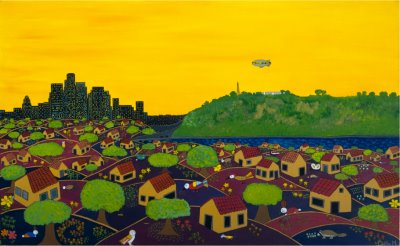
“L.A. Reimagined” by Dalila Paola Mendez (c), Mendez’ work will be featured in re:present LA, opening 5/3/12
But to love this turf is love hard and unrequited.
…
To love L.A. is to love more than a city
It’s to love a language.
–“L.A. Love Cry” (1996) by Wanda Coleman
Los Angeles, an enigmatic metropolis to many who arrive here with a dream in hand and hope for a better tomorrow, still challenges historians, artists, and troubadours on how to best represent it. Poet Wanda Coleman, born in Watts, captures the pain and wonder of loving this city in “L.A. Love Cry.” Because the city is “hard and unrequited” one must also be willing to love its nuances and see it as“more than a city.” To love this city, “it’s to love a language,” a cultural immersion that goes beyond the seeming ease of words into the complexities of sound and rhythm.
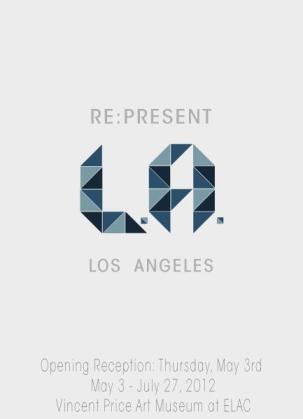
Through a Museum Studies course I teach at Claremont Graduate University entitled Welcome to L.A., I introduce students to varied texts in which scholars and artists challenge the imaginaries created by outsiders, boosters, and apocalyptic cinema. Instead, the course readings present how we in L.A. actively engage with one another by fostering communities of creative praxis. For the students’ final project, they curate and develop educational programming for an exhibition at a local museum or art center. On May 3, 2012, this semester’s project, re : present L.A., opens at the newly-renovated Vincent Price Art Museum (VPAM) located on the East Los Angeles College Campus. Showing works from over thirty artists from May 3-July 27, re : present L.A serves as an extension of the conversations we had in class, not only celebrating the interconnectedness of our communities but encouraging new associations and encounters within the visual and resonant space of VPAM’s Community Focus Gallery. For a look at the Virtual Exhibit Catalogue, click here.
In each exhibition for Welcome to L.A., I try to include something that challenges myself to think outside the white-box, per se, of the gallery. Given that we had read several texts that highlighted in the importance of music to build and uplift communities of color in Los Angeles, it was both important and necessary for me to include sonic elements in re: present LA that exhibits L.A.s vibrant musical legacy as intermingled with and fundamental to its visual culture. Among the challenges to document the cross-cultural connections between ethnic communities in Los Angeles is how to unpack what Anthony Macias calls “the cultural networks” that facilitated these exchanges through the music scenes at music halls, clubs, youth centers and record stores in Mexican American Mojo (10-11). Studies done by George Lipsitz, Macias, and Victor Viesca, provide readers a means to understand how the music in Los Angeles is much more than entertainment; it is political; it is a lifestyle; it defines spaces of multicultural interactions. In How Racism Takes Place, Lipsitz points out how integral the reclamation of space defined the political outlook and music in Horace Tapscott’s Arkestra based in South L.A. Viesca’s research documents the rise of an East L.A. rock sound, post-Los Lobos, that was defined by the activism of the Zapatista Movement and California’s Prop 187 through the work done at the Peace & Justice Center, Self-Help Graphics, and Regeneración.
Therefore, in order to engage both the history and the sound of Los Angeles’s musics with the city’s visual representations, I invited Rubén Funkhuatl Guevara from Ruben & The Jets, is a multi-threat musician, performer, writer, and producer, and Jennifer Stoever-Ackerman (of Binghamton University, Sounding Out!, and of course, Riverside, CA) to curate playlists for a “sound booth,” which will consist of a stationary iPod™ Nano that gallery visitors can use at their leisure. The classic circular wheel allows the viewer to advance tracks or play the playlists on shuffle. Headphones will be set up so that the viewer can either focus on their listening experience or, listen while viewing the artwork around them. Since the gallery is relatively small, the pieces on the opposite wall are recognizable though are distant. In addition, Maya Santos of Form Follows Function will screen their short documentary on Radiotron, a youth center that presented Hip-Hop shows during the 1980s.
Guevara’s playlist Los Angeles Chicano Rock & Roll is included in the exhibition thanks to the Museum of Latin American Art. Stoever-Ackerman’s playlist Off the 60, unites the two spaces of East L.A. and Riverside through a mix of intra- and trans-cultural musical experiences. Guevara’s rock & roll selections highlight many of the bands that emerged in East L.A. Both the musical listings and the liner notes for the sound presentations will be accessible on the re:present L.A website when the exhibit goes live on May 3rd, 2012.

Juan Capistran’s The Breaks (2000), Courtesy of the Artist
.
My sonic intervention in the white, often silent, spaces of the gallery was especially inspired by two recent precedents: the inclusion of the iPod™ in MEX/LA (2011) at the Museum of Latin American Art and Phantom Sightings (2008) at the Los Angeles County Art Museum. Both experiences invited me as a viewer to see the artwork through another sensory experience. The first time I saw music included in an exhibition not specifically about music (such as the Experience Music Project’s 2007 American Sabor: Latinos in U.S. Popular Music, or Marvette Peréz’s curation of ¡Azúzar! The Life and Music of Celia Cruz at the Smithsonian National Museum of American History) was LACMA’s Phantom Sightings, which garnered much critical acclaim and criticism due to the premise of presenting contemporary Chicano Art inspired ‘after’ the Chicano Movement. However, I want to focus on one aspect of the exhibition, a corner display with books that informed the curators’ conceptual approach and on the bookshelf was an iPod™. The iPod™ included playlists from some of the artists reflecting their inspiration for their artwork. I enjoyed listening and reminiscing while sitting in the gallery. However, I wanted the music to take more of a central role in the exhibition, especially because much of the artwork so obviously revealed traces of Los Angeles’ musical influences, partly due to the recent generation of artists who actively engaged in subcultural expressions and referenced it in their art. For example, as Ondine Chavoya describes in the Phantom Sightings catalogue, Juan Capistran’s The Breaks (2000) is a giclée print documenting the artist break-dancing on Carl Andre’s minimalist floor pieces. The guerilla performance then is presented through a series of twenty-five still images showing the various movements seen in how to break-dance books (125). Shizu Saldamando’s ink on fabric portraits of Siouxsie (2005) and Morrissey (2005) showcase how post-punk and new wave music from England is part of her life as an Angeleno (and that of her friends), yet the medium is reminiscent of pinto drawings. Saldamando also does portraits of her friends at clubs, backyard bbqs “documenting a world where identity is fluid” as Michele Urton describes in the catalog (197).

Shizu Saldamando’s Siouxsie (2005), Courtesy of the Artist
It would be another three years before MEX/LA would further marry music with art, now casting it in relation to the politics of Chicano and Mexican presence in Los Angeles. MEX/LA, among the many Pacific Standard Time exhibitions presented throughout Los Angeles, was among the best curated due to the range of artifacts representative of the city and the cultural production emerging in post-war L.A. Another striking element was the influence of Méxicano popular culture among Chicanos and vice-versa. As curator Rubén Ortiz-Torres, and associate curator Jesse Lerner write on the MoLAA website: “The purpose of the construction of a ‘Mexican’ identity in the South of California is not to consolidate the national unity of a post-revolutionary Mexico, but to recognize and be able to participate in an international reality, with all its contradictions and conflicts that this entails.” One of the ways this cultural exchange was embodied was in the playlists curated by Rubén Funkhuatl Guevara and Josh Kun that were prominently displayed alongside the artwork and heard in the interactive iPod™ “sound booths,” that invited viewers to sit on beanbags and listen. The music served to contextualize the art in relation to popular culture of the time. For example, Guevara presents a Chicano rock & roll genealogy that followed the chronology of the visual exhibit, 1930-1980, that begins with boogaloo and swing of the 1940s era culminating with the punk rock sounds of The Bags.
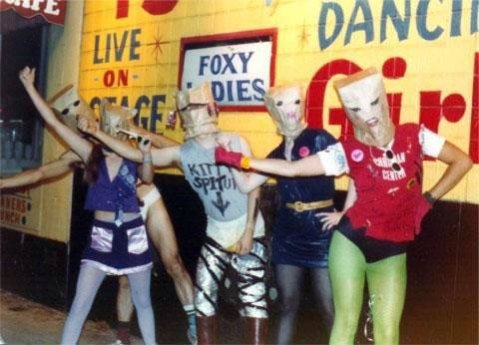
“Bag Parade,” 1977, Courtesy of Alice Bag
In both these exhibitions, the music served to complement the artistic elucidations of identity, race, and American popular culture seen in much of the artwork. The simplicity of the presentation was due to the inclusion of a familiar object like the iPod™. What is surprising is that more exhibitions have not incorporated more sonic elements to engage viewers’ other sensory experiences beyond the podcasts, or cell-phone audio listening tours set up at most major museums. While musical playlists can serve as another didactic component of an exhibition like the more established audio tours, I am arguing for a different use of sound in museum space, one that provides a wider sense of agency, connection, and encounter with the visual elements on display rather than a one-way transmission of information. In the cases of MEX/LA and Phantom Sightings, the inclusion of iPods™ provided a tool to understand the cultural production of a “post-Chicano movement” generation of artists while at the same time enabling an experience that recognized—and resonated with—my bicultural experience.

“Ancient Mexico in Ancient Mexico” by Yvonne Estrada (c), is featured in re:present LA, opening 5/3/12
Being that L.A. is a car culture moving to the rhythms of the radio waves, I’m always seeking to find synchronicity between music that feels me with joy and my work as a cultural worker. Part of my impetus to locate Los Angeles sonically in re : present L.A. was driven by the question: is it possible to capture my sonic landscape growing up in the city of Los Angeles that ranges from Hip-Hop – British Rock – Mexican Pop? The playlists curated by Guevara and Stoever-Ackerman are familiar to me personally. Stoever-Ackerman’s Off the 60, reminds me of the sounds of my youth, when KDAY and KROQ rocked the radio waves and my students banded together in my high school quad according to their favorite music – metal-heads, b-boys, alternative rock, and the cha-chas, who traveled across town every Friday night to Franklin High, where DJs spun L.A. disco. At home, the music was different. My mom and tías used to reminisce about their homeland every Sunday night through the variety show Siempre en Domingo, binding us to the t.v., religiously following the rising stars. Through the bi-lingual selections in Guevara’s Los Angeles Rock & Roll, there’s a familiarity of home and the music heard at backyard parties and quinceañeras.
By including my iPod™ nano, I bring together my lived experience as a cultural worker through the sounds of L.A. and activate the white walls of the museum. The playlists created by Guevara and Stoever-Ackerman serve to reflect the history of the community surrounding VPAM, as well capture the diversity of the city sonically re:presenting L.A. to our audiences. While the playlists can stand alone as audio curations in their own rights, I hope that they will engage audiences to rethink the relationship between music and art, and feel their lived experience inclusive within the museum.
—-
reina alejandra prado saldivar is an art historian, curator, and an adjunct lecturer in the Social Science Division of Glendale Community College in Glendale, California and in the Cultural Studies Program at Claremont Graduate School. As a cultural activist, she focused her earlier research on Chicano cultural production and the visual arts. Prado is also a poet and performance artist known for her interactive durational work Take a Piece of my Heart as the character Santa Perversa (www.santaperversa.com) and is currently working on her first solo performance entitled Whipped!
Share this:


Current Top Posts





April 2021

January 2020

November 2019

October 2019

August 2019

April 2014

November 2017

March 2015

December 2017

October 2015
 Sounding Out!
Recent Comments