
The Sonic Rhetoric of Quincy Jones (feat. Nasir Jones)

.
The passing of Quincy Jones has left a silence that feels almost impossible to fill. Every time I play Thriller at home now, it’s no longer just a celebration of his unparalleled artistry. It’s a ritual to sit with his legacy, listen more closely, and honor how his music shaped the sound of memory itself. With each spin of the record, my family and I find ourselves inside his arrangements, held by their richness, precision, and sense of story as though the music is breathing with us, speaking back across time. Jones’s work was never just production; it was communication. A language of sound connected us to melody and beat and the fuller spectrum of emotion, culture, and memory that lives in Black music.
This piece joins a tradition of Black sonic remembrance that Sounding Out! has previously offered in moments of profound cultural loss, from Regina Bradley’s remembrances of listening to Whitney Houston on the radio with her mother to Ben Tausig’s reflection on Prince’s passing to Kristin Moriah’s meditation on Savion Glover’s tap dance tribute to Amiri Baraka. Such pieces remind us that mourning Black artists is not only about personal grief; it’s about listening to the soundscapes they left behind, tracing how their artistry shaped how we collectively move, mourn, and remember. Houston’s voice, much like Jones’s production, was a vessel of Black sonic innovation, shaping how we collectively move, mourn, and remember. Like Prince, Jones’s catalog is a vast archive of Black sonic innovation, where every horn line, bass groove, and percussive hit tells part of a larger story about Black life, joy, survival, and creativity. Jones, like Baraka, understood the radical potential of sound to entertain and agitate, educate, and summon history into the present. Writing about Jones now in the quiet left by his absence is a mourning and a celebration, an offering of flowers in the form of careful attention, deep gratitude, and collective remembrance. This is a way of honoring him as a producer or composer and as a practitioner of sonic rhetoric, a storyteller who spoke through sound and whose language of rhythm and harmony shaped how we feel, remember, and belong.
Two new books published in 2024, Matthew D. Morrison’s Black Sound and Earl H. Brooks’s On Rhetoric and Black Music, arrived at a particularly poignant moment, offering critical frameworks for understanding sonic rhetoric as a vital Black cultural practice. Morrison positions Black music as a vessel for cultural identity and history, emphasizing how it carries narratives that transcend mere auditory pleasure. Brooks extends this argument, demonstrating how Black music functions as a living, breathing rhetorical form, shaping and reshaping cultural identity and narrative with each performance, each recording, and each arrangement. That these books emerged in the same year the world lost Quincy Jones feels deeply significant, a reminder that his life’s work embodies precisely what they describe. Jones mastered using rhythm, melody, and arrangement to shape cultural memory and invite reflection. His genius does not reside solely in his ability to create captivating music but rather in his ability to layer each note with history, emotion, and meaning, sound as storytelling, sound as cultural conversation.
As I reflect on Quincy Jones’s legacy, I realize that his production and compositional skills have profoundly changed my understanding of sound. My admiration for Jones’s mastery of sound and his unique way of using music to communicate drove me to explore sound rhetoric more profoundly, especially how his work became the foundation of new sonic storytelling. His work allows me to imagine myself as a young Black boy, playing with sound and allowing it to communicate in ways that speak to the world. I am grateful for his inspiration, enabling us to envision the possibilities of sound and its power to connect us all. To honor Quincy Jones in rhetoric and sound, we must recognize his pioneering contributions to music as a form of communication. By studying his innovative approaches and the sonic landscapes he crafted, we can deepen our understanding of how sound shapes cultural narratives and personal identities. Engaging with his work encourages us to appreciate music’s profound impact on our lives and the stories it tells, ensuring that his legacy continues to inspire future generations of artists and listeners alike.

For readers who may not be as familiar with his legacy, Quincy Jones is one of the most influential and celebrated figures in music history. His career spans more than seven decades, marked by numerous Grammy Awards, groundbreaking collaborations, and an ability to shape the sound of entire musical eras. Jones’s journey into music began with a chance discovery that would define the course of his life. As a young boy, he broke into an armory and found an upright piano, sparking his lifelong passion for music. This serendipitous moment led him to explore various instruments, from percussion to trombone, sousaphone, and eventually the trumpet, which would become his instrument of choice. These formative experiences gave Jones a diverse and rich understanding of sound that he would later weave into his compositions. His journey through different musical styles, be it jazz, R&B, or orchestral arrangements, allowed him to develop a unique ability to merge genres and cultures, creating works that resonated on a global scale. Jones’s work as a producer, composer, and arranger redefined what it meant to be a producer in the music industry, elevating the role to that of a creative force, an artist in their own right. Most famously known for his work with Michael Jackson, Jones’s sonic contributions to Thriller transformed pop music and how producers and artists interact to create timeless music. His groundbreaking approach to music production changed how the world listens to music, showing how sound can transcend entertainment and become a powerful form of cultural communication.

For example, celebrating the Thriller album with my children has been an ongoing discovery. I am captivated by their responses to the music. They quickly catch specific sounds, anticipate instrumental flourishes, and react to subtle details, proving the immersive quality of Quincy Jones’s work. His production goes beyond entertainment; it engages listeners, inviting even young ears to feel part of the experience. The power of sonic storytelling is the ability to craft a narrative or evoke emotion purely through sound without relying on visuals or lyrics alone. Quincy Jones’s genius lies in how he layers instruments, sound effects, and vocal textures to create mood and atmosphere, building stories that listeners can feel unfolding around them. Sonic storytelling turns production into a cinematic experience, where a sudden bassline shift, a carefully placed synth, or an eerie silence all contribute to the larger emotional arc of a song. Jones doesn’t just produce songs. He builds immersive worlds through sound, showing how music, at its best, can tell stories as vividly as any film or novel. Songs such as “Thriller,” “Beat It,” and “Billie Jean” epitomize Jones’s mastery of this craft. Thriller is a prime example of his brilliance, each track meticulously balancing complex soundscapes with universal appeal.
With eerie beats, haunting synths, and Vincent Price’s chilling monologue, “Thriller” has become synonymous with Halloween, transforming it into an auditory icon that reshapes how we experience the holiday. It has a layered, cinematic arrangement, where Jones fuses a creeping synthesizer line with lush orchestral swells and Vincent Price’s velvety horror monologue. Each sonic element functions as a narrative device, placing the listener inside a haunted space where sound, the creak of a door, and the hiss of wind become part of the story. Brooks’s On Rhetoric and Black Music reminds us that sound arrangements can evoke emotion and memory, and Jones’s work exemplifies that power.
Then, consider the storytelling pulsing in the bassline of “Billie Jean,” a throbbing heartbeat grounding the song’s tale of obsession, fame, and denial in something bodily, felt in the chest and gut before the mind catches up. With every layered texture, from the crisp snap of the drum machine to the soaring, wordless vocal harmonies, Jones does not simply produce music; he scripts sonic stories where Black creativity and cultural history converge in every beat.
Jones’s approach to production embodies this idea, transforming how we listen and engage with music. Take “Wanna Be Startin’ Somethin’,” where layered percussion, call and response vocals, and a pulsing bassline create a sonic landscape that feels alive, constantly shifting and evolving. The song’s now iconic “Mama say mama sa mama coo sa” chant reaches back to the Cameroonian makossa tradition, embedding a diasporic history within a global pop hit (listen to the opening seconds of Manu Dijbango’s 1972 “Soul Makossa” to hear the resonance).
Then, in “Human Nature,” Jones works in the opposite direction, crafting an atmospheric, dreamlike arrangement where gentle synth pads and delicate electric guitar melodies wrap around Michael Jackson’s voice like mist, evoking a sense of vulnerability and wonder. These tracks, like so many in Jones’s catalog, do not merely present melodies and rhythms. They create spaces where memory, emotion, and history converge.
Jones’s ability to craft soundscapes has long extended beyond Thriller, both backward and forward in time. His track “Soul Bossa Nova” (1962), famously featured in the Austin Powers films, evokes nostalgia and joy, transporting listeners to memories of sunny beach days and family vacations. But there’s a deeper story behind this piece that’s often overlooked that spoke volumes in its original context. Originally released on Jones’s album Big Band Bossa Nova, the track arrived when the genre and the term “bossa nova” were being culturally sanitized and marketed to white audiences, particularly in the U.S. As scholars have noted, Black Brazilian musicians whose innovative work laid the foundation for bossa nova, were often erased from the story as the genre’s global fame became linked to lighter-skinned artists palatable to international audiences.
Jones’s decision to title the track “Soul Bossa Nova” at the height of the Civil Rights Movement and during the global rise of Bossa Nova was not merely clever branding. It bridged the emerging coolness of Bossa Nova with the distinct sensibilities and innovations of African American music, at a time when both the U.S. and Brazil were grappling with deep racial segregation and the commodification of Black art. It was also a subtle reclamation, insisting on Black presence in a genre already experiencing the erasure of Black Brazilian pioneers such as Johnny Alf. In “Soul Bossa Nova,” Jones fused the light bounce of Brazilian rhythms with a brassy, big-band jazz sensibility, centering Black sonic playfulness and cultural hybridity at a time when both were under threat from the forces of segregation and global anti-Blackness. The track’s instantly recognizable piccolo flute riff, playful, mischievous, and a little sly, becomes, in this light, not only catchy but also defiant, a declaration that Black sound is limitless, able to traverse continents and contexts while carrying the weight of memory, history, and joy.
And the story did not end there. Decades later, Ludacris and various hip-hop artists paid homage to Jones’s legacy in Jones’s last album, the 2010 project Q: Soul Bossa Nostra. This playful yet reverent tribute sampled and reimagined Jones’s catalog for a new generation. Soul Bossa Nostra is a clever play on “Cosa Nostra,” merging the sonic underworld of Jones’s orchestrations with the familial pride and intergenerational respect that defines hip hop’s tribute culture.
This interweaving of “Soul Bossa Nova”‘s history, from its quiet defiance in 1962 to its unexpected resurgence through Austin Powers to its embrace by Ludacris, exemplifies the lasting power of Jones’s compositions to connect across eras and genres, all while telling a much larger story about race, ownership, and the endurance of Black sonic innovation.
In Thriller and “Soul Bossa Nova,” Jones’s compositions offer listeners an immersive experience that connects personal and cultural narratives, proving that his work is more than entertainment. It is a powerful form of artistic communication that resonates across generations. I have experienced this firsthand, listening to these songs with my children, not just once or twice, but as an ongoing, evolving family ritual. Their responses, the way they anticipate certain flourishes, react to subtle shifts, or sing along with total abandon, remind me that Jones’s work does not sit still in time. It moves through us, binding my children’s joy to my own memories of discovery, just as it ties us all to the larger, unfolding story of Black sonic creativity. Through Jones’s soundscapes, we are not only hearing songs. We are participating in cultural memory, shaping it anew with every listen.
***
Being known as an unparalleled intergenerational sonic storyteller is already a feat, but Quincy Jones’s influence is embedded in the DNA of contemporary music production in other important ways. From the way producers are now seen as creative equals to artists to the expectation that producers bring their signature sound to every project they touch, every time a contemporary music producer is celebrated as a vital voice in shaping a record, they stand on the foundation Quincy Jones laid. Long before the term “producer” carried the weight and cultural significance it does today, Jones redefined what it meant to hold that title.
In today’s music landscape, the constructive collaboration between an artist and producer can be a defining force, shaping careers and setting entire musical eras into motion. This reality exists in large part because of Jones, who was not just arranging instruments or overseeing technical sessions but building entire sonic worlds, shaping the emotional architecture of songs, and helping artists translate their most personal visions into soundscapes that could speak to the world. His work with Michael Jackson epitomizes the collaborative alchemy possible when a producer steps into the role of creative partner, cultural interpreter, and sonic architect all at once. With Thriller Jones did not merely produce an album, he co-authored a cultural phenomenon. Jones and Jackson’s collaboration not only redefined pop music but also set a lasting standard for artist-producer dynamics, showcasing the brilliance that can arise when two creative minds align. Jones’s legacy as a producer is one of vision, trust, and translation, helping artists hear possibilities in their work they could not fully imagine and giving the listening public music that defined moments and movements.
Hip Hop, in particular, has carved out a prominent role for music producers in the style of Quincy Jones, something that Nas pays homage to in his track “Michael and Quincy” from King’s Disease III (2022). In doing so, Nas directly parallels the collaborative genius between Quincy Jones and Michael Jackson with his recent creative collaboration with producer Hit-Boy, now running 6 albums strong.
This is not just a passing reference. It is part of Nas’s more prominent, ongoing project of honoring hip hop creators and the artistic lineages that shaped his career. Across the King’s Disease trilogy and in his The Bridge podcast (which he co-hosts with Miss Info), Nas has taken deliberate care to uplift the cultural architects of hip hop, weaving their stories into his narrative and preserving their legacies for future generations. On “Michael and Quincy,” Nas celebrates the power of collaboration, positioning the artist-producer relationship as a crucible for innovation and cultural impact. The track’s lyrics paint vivid images of creative combustion, with Nas rapping, “Smoke steaming off the microphone,” evoking the almost supernatural energy that fueled Michael and Quincy’s sessions. This imagery extends to Nas and Hit-Boy, capturing the intensity and urgency they bring to their creative process.
Sonically, “Michael and Quincy” also mirrors this spirit of collaborative innovation. Hit-Boy’s production constantly shifts, blending classic boom-bap drums with more atmospheric textures, creating a soundscape that feels both reverent and forward-thinking. The beat morphs beneath Nas’s verses, never settling into predictability, much like how Quincy Jones infused “Thriller” with unexpected sonic twists. Nas and Hit-Boy’s sonic interplay echoes the Jackson-Jones dynamic, where the producer’s vision expands and amplifies the artist’s voice. In its lyrics and production, “Michael and Quincy” serves as a sonic tribute, not just to a legendary duo, but to the transformative power of artist-producer partnerships, a lineage Quincy Jones helped define and one Nas is determined to carry forward. The era-defining success of Thriller still ripples through music today.

 “
“Nas’s tribute serves as a powerful reminder of these partnerships’ enduring impact, bridging genres and generations. The image of “smoke steaming off of the microphone” is one I carry with me, embodying the intense, creative spirit that Michael and Quincy brought to their collaborations, a legacy now celebrated and extended through Nas’s words and music. Nas draws from their example to remind us that great partnerships, whether in music or other creative endeavors, are often the spark that ignites monumental cultural shifts. Their combined energy was undeniable as they pushed each other to new artistic heights. The success of their work was not only about the music; it was also about the more profound connection to culture, identity, and collective memory. Like the tracks he produced, his music lives on, inspiring us to reflect on how we listen to and engage with the world around us. By revisiting the breadth and depth of his work and the many sonic creations it has inspired, we continue to discover new layers of meaning and artistry, ensuring that Jones’s influence will be felt for generations to come.
—
Featured Image: SO! Screencap from Nas’s performance at Rolling Loud, November 11, 2024
—
Jaquial Durham is a multi-hyphenate social justice champion. The South Carolina native has spent over a decade actively engaged in various outreach initiatives to uplift and empower marginalized communities. He is also a passionate cultural enthusiast dedicated to exploring the rich tapestry of African American history, which drives him to continue making a meaningful impact in the lives of those around him. His advocacy for social-political issues that encompass race, prison culture and gender have been at the forefront of his work.
As the CEO of Public Culture Entertainment Group, an entity focused on raising public awareness about the myriad of components that influence culture, Durham spearheads the company’s TV/film projects and cultivates unique apparel capsules that showcase prominent African American figures, organizations and landmarks often absent from historical dialogue. The ambitious, young go-getter prolifically uses creative activism to amplify the voices, stories and experiences of those often overlooked. His
visionary brilliance can be seen in the groundbreaking documentary Southern Prison Culture, a cinematic film highlighting the challenges individuals face within the system and fiercely advocating for much-needed reforms. As a result of the film’s success, Durham has received prestigious awards like the Milan Gold Award, the Austin Lift-Off Film Festival Award and the London International Film Festival Award.
Durham has been a driving force behind various social justice reforms, calling for equitable and inclusive policies and practices. His unwavering dedication to helping others earned him widespread recognition that included opportunities to lecture at colleges such as American University, Benedict College, Claflin University, Clemson University and Texas State University. Durham was honored by Grammy-Award Winning rapper Killer Mike, who has respect and credibility within the culture. His dedication to the development of higher education institutions in America has led him to refine his intellectual and creative genius relentlessly. While Durham received a bachelor’s in African and African American Studies with a minor in Women and Gender Studies from Winston-Salem State University, he is pursuing a Ph.D.from Clemson University in Rhetorics, Communication and Information Design.
—

REWIND! . . .If you liked this post, you may also dig:
On Donuts, Sandwiches and Beattapes: Listening for J Dilla Six Years On–DJ Primus Luta
Unlearning Black Sound in Black Artistry: Examining the Quiet in Solange’s A Seat At the Table–Kimberly Williams
Deep Listening as Philogynoir: Playlists, Black Girl Idiom, and Love–Shakira Holt
“Heavy Airplay, All Day with No Chorus”: Classroom Sonic Consciousness in the Playlist Project–Todd Craig
Mingus Ah Um (1959) and An Ethics of Care in Jazz–Brittany Proctor
Share this:

Echoes of the Latent Present: Listening to Lags, Delays, and Other Temporal Disjunctions

Listen:
Billy Pilgrim has come unstuck in time.
–Kurt Vonnegut, Slaughterhouse Five
On an almost visceral level, we may likewise remark that states of “latency” involve downward movement, as in the case of something falling by the wayside and lying unnoticed until its presence is felt.
— Hans Gumbrecht, After 1945: Latency as Origin of the Present
Sometime last year, during a recent deep clean of the apartment, I pulled out a wooden chest that my father built for me when I was ten, a pine-scented time capsule of that period of my life, full of assorted construction-paper projects and faded movie tickets. Buried underneath all this loose paper, set apart by a shiny laminated cover, is the first “novel” I ever wrote, our final project in fourth grade, which was really just a few typed pages folded and stapled together, held between a cardstock cover. In this book, I write about a mall janitor with magic powers, who uses his mop handle to transform villains into piles of fabric, and who time travels throughout history by way of a magic corvette (clearly, I had just seen a certain Robert Zemeckis film).
Having rediscovered this story, I am struck by the realization that my writerly voice has hardly changed. I am still drawn to the same hokey surrealism, the same comic book sensibilities, the same spirit of hand-stapled publishing projects. This is to say: I could not help but to identify in this proto-novel traces of my work to come, early impulses that echo throughout my present practice. As Lisa Robertson puts it in an interview: “Defunct forms resurface after years of latency. New work speaks with old work, as well as with the future.”
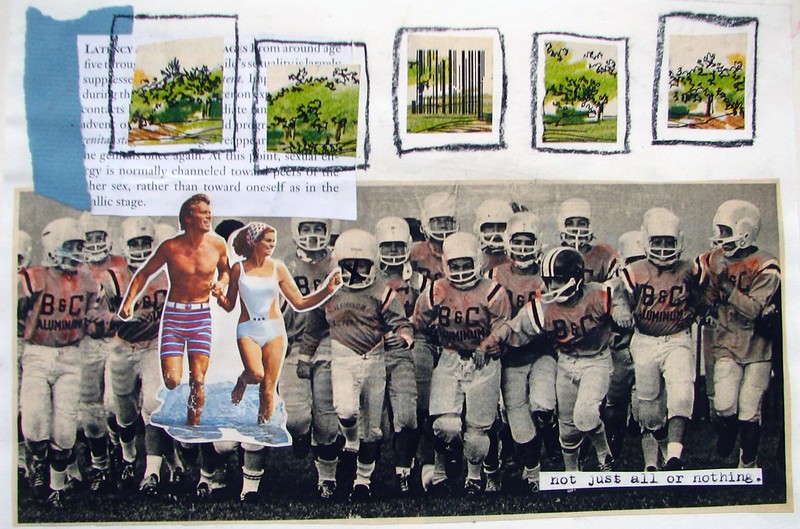
This work speaks to a recurrent theme in my life: namely, my pervasive sense of feeling out-of-sync with the world, or as Vonnegut puts it, “unstuck in time.” In this essay, I want to think about latency—essentially, the time it takes for data to transfer between two points—as a poignant extended metaphor for the temporal disjunctures of the present moment. Indeed, the frantic mantra of “being present,” as popularized among Western spiritualists by Eckhart Tolle’s The Power of Now (1997), is a kind of antiphrasis, a phrase which evokes precisely the opposite thought. In this case, the power of now simultaneously diagnoses the perils of asynchronicity. And yet, perhaps there are some counterintuitive reasons why latency might be politically productive at times, as I will discuss in the sections that follow.
Fittingly, the concept of “echoic memory” suggests that the brain acts as a kind of temporary holding tank for sounds, not unlike an old wooden chest full of memorabilia. The difference, in this case, is that echoic memory is a short-term storage system. One example of this memory structure at work is when someone asks “What did you say?” only to answer their own question after a half-second, since they are somehow able to retrieve this latent information, one might say unconsciously, from the holding tank.
As a sound artist, I am interested in multiple facets of latency, from its aesthetics to its politics, and especially its psychoacoustics, the way that sound acts tangibly upon bodies and minds. This post will examine how audio latency encapsulates the paradoxical tension between the desire for sonic immanence—in the sense of longing for an immediate experience—and the frustrations of technology, its delays and disruptions. A prime example of this tension is that you and I could be seated right beside each other and still experience a laggy phone call. The paradoxical element starts to emerge when one tries to achieve zero latency, since any signal must travel through space and time, just like Achilles and the tortoise, and thus subject itself to delay.
(Latency Commercial)
Latency, as such, is a shifty concept. By one definition, it refers to any length of interval between impulse and response, including the time it takes to respond to a handwritten letter, or, in my case, the rediscovery of an old book after twenty-something years. By another definition, latency refers to all manner of system delays, including the quality of a network connection, the time it takes for data to transfer between two points. The term might also be familiar from biology or psychology, where it refers to anything hidden or dormant that has not yet manifested, like a disease or an unconscious desire. Another context in which the term frequently shows up is laboratory studies, measuring the delay between some kind of sensory stimulus and reaction, such as a honeybee’s conditioned response to a scent. Lastly, and most importantly for the purposes of this discussion, “audio latency” refers to a very short period of delay that causes sound to lag behind imagery, or, ultimately, behind itself.
(Latency Test)
The latency test video above provides a helpful listening exercise. Though such small intervals of time, measured in milliseconds, are hard to conceptualize in the abstract, they are jarringly comprehensible as sound. With just five milliseconds of latency, a chorus effect is applied to the experimenter’s finger snap, which now sounds as though it has been placed inside a drainpipe. At ten milliseconds of latency, one can already hear two distinct transients, otherwise known as amplitude spikes, where the sound of the snap abruptly begins. By fifty milliseconds, a more dramatic delay effect emerges, and it sounds as though the finger snap is being pulled apart. This bifurcation process culminates at three hundred milliseconds, when the concept of “latency” begins to overlap with that of “delay,” such that there are now two distinct snaps.
(Network Audio Latency)
Latency, then, can be both a problem and an intentional effect. If you have ever tried to record an acoustic guitar, or a vocal track, on an outdated computer, you may have encountered this phenomenon in the form of a technological issue. Everything is plugged in and ready to go, the active track in your audio workstation is armed, headphone monitoring is turned on, and you begin to strum or sing. To your dismay, the sound you hear from the computer starts to fall behind the sounds you are making in the real world. Not only does the recording sound off, and out of time, but it becomes physically impossible to play an instrument when your fingers and ears are thrown out of alignment, like attempting to ride the backwards brain bicycle.
(Guitar Latency)
Diagnosing and solving latency issues is another game entirely: lowering the buffer size, enabling delay compensation, or simply going rogue and recording without monitoring playback, with the hope of nudging the recording back into alignment after the fact. In a home studio, sometimes a full half of the day’s recording session will get swallowed up by these technological battles, trying to shrink latency down to smaller and smaller increments. Given the sheer number of YouTube tutorials dedicated to reducing latency, it is clear how pervasive this issue is for musicians and audio engineers.
(Singing)
As Mitch Gallagher suggests in the video above, some singers can detect latency as short as three milliseconds, which can significantly throw off their performance. If you have ever been in a Zoom call where you can hear yourself through the other person’s speaker, this feeling will be all too familiar. This is not unlike a less aggressive form of speech jamming, which refers to a kind of crowd-control tactic employed by the military in order to break someone’s concentration using delayed audio. Known as “acoustic hailing and disruption” (AHAD), this process makes it very difficult to speak consistently, because a live recording of one’s voice is beamed instantaneously back at the speaker with a certain length of delay, in milliseconds, as demonstrated in a 1974 piece by Richard Serra and Nancy Holt, called Boomerang. As with the backwards brain bicycle, but perhaps far less benign, latency can take the form of weaponized confusion. The same principle, however, is used for positive ends in the case of Delayed Auditory Feedback (DAF) devices which people who stutter use as an assistive technology.
Being out of sync with the present moment, in other words, can be both disorienting and orienting. Latency can mean one thing for a musician trying to lay down a vocal track, but something else entirely for a political protestor attempting to address a crowd, or someone consciously manipulating their own speech patterns.
As a form of sonic violence, weaponized latency has an ancient Greek precedent in the myth of Echo, a nymph who is cursed with repeating the last words spoken to her, such that she can no longer express herself. This archetypal figure, both gendered and pathologized, embodies a form of perpetual exclusion from discourse. Speaking to this subject, Katie Kadue underlines a pertinent quote in literary critic Barbara Johnson’s essay, “Muteness Envy”: Feminist criticism has been pointing this out for at least thirty years. But why is female muteness a repository of aesthetic value? And what does that muteness signify?” At the same time as Echo’s curse represents a metaphorical silencing, it also signifies something else in its insistence on rhetorical conformity, denying and dislocating her from the present of her own thoughts—a “living death,” in the words of Rebecca Solnit.

If patriarchy loves the sound of its own voice, then capitalism loves the beat of its own drum, which speeds up or slows down depending on competing urgencies. Ultimately, this manufactured present moves much faster than the embodied present, moving at such a rate that one cannot even decipher the words that one is meant to repeat.
To operate outside of this temporal structure then, is to move and make sound at a tempo that does not match the dominant rhythms of hypercapitalism. To this end, Fred Moten quotes the following passage from Ralph Ellison’s Invisible Man (1952): “Invisibility, let me explain, gives one a slightly different sense of time, you’re never quite on the beat. Sometimes you’re ahead, sometimes behind.” Moten calls this “improvisational immanence,” characterized by “disruptive surprise.” Bringing these concepts together, Fiamma Montezemolo’s Echo (2014) is a work of video art that “disrupts and dissents from the ways that race and gender are produced and experienced through sound and listening,” to quote Lois Klassen and Gabriela Aceves Sepúlveda. It does so by assembling an archive of earlier artworks in which women share their personal testimonies of discrimination and inequality, along with hopes for the future. Through this archive, Montezemolo helps these voices to reverberate, latently, in the present. With this in mind, one begins to hear how latency can function both as a barrier, as well as a boon, to expressivity. Especially in those cases where the original sound might have gone unheard, or was actively obstructed, there is always the possibility of a disruptive re-sounding.
In practice, audio latency can often feel like a curse, and it is difficult to see the upsides. In the recording studio, it can turn even the most fluid riff into a halting mess, interrupting creative flow with high-tech tedium. As Rebekah Wilson points out in her study of networked music performances, these technological failures have “aesthetic implications” beyond a mere computer glitch, insofar as rhythmic music is much harder to coordinate over long distances; more than anything, latency “affects time keeping and human-level rhythms” (Wilson 2020).

Must audio latency always be met with resistance, however? No doubt, such glitches could be treated as opportunities for creative misuse. What might happen, for example, were someone to treat these rhythmic glitches as an intentional musical element or a compositional technique reminiscent of a musical canon? As discussed in a previous post, Eleni Ikoniadou presents such thought experiments in The Rhythmic Event (2014), where the author asks what alternative modes of expression might arise when we are able to “twist chronology and rethink the latent tendencies of the event, outside the tyranny of the ticking clock” (68). Latency takes us off the grid and into the abstract, unquantized space of the timeline, where notes are free-floating, and other temporalities become possible, as in Ellison’s description of the jazz musician who plays behind or ahead of the beat, while still remaining “in time,” moving within a loose present that is spacious enough for jazz artists to name it “the pocket.”
(Latency Sucks)
Pondering the relationship of “latency” to the present moment, I am reminded of Boris Groys’ definition of the contemporary: “To be con-temporary does not necessarily mean to be present, to be here-and-now; it means to be ‘with time’ rather than ‘in time.’” For the percussionist whose dexterity has been scrambled by latency issues, to be a “comrade of time,” in the words of Groys, would mean “collaborating with time, helping time when it has problems, when it has difficulties.” This is a counterintuitive approach, however, which does not call for latency to be fixed, necessarily, but rather to be adopted as a political and aesthetic strategy.
The laggy outbursts of latency belong to the anti-capitalist “ritual of wasting time,” in resistance to “contemporary product-oriented civilization,” which would have us chase ultra-low latency for the sake of faster sports betting and stock trading. This ritualistic rejection of capitalist time resonates with Kemi Adeyemi’s description of “strategic pattern interruptions,” in a previous article, where the author shows how “lean” (a narcotic drink consumed by some rappers) is absorbed into the slowed-down aesthetics of their music, in objection to “the demands the neoliberal state places on the black body.” In this way, Adeyemi underscores the racial politics of latencies, particularly in the way that the “dissociative pleasures controlled substances offer to black people have been historically criminalized, and radically different sentencing guidelines continue to be handed down,” depending on the drug.
Where the cocaine-fuelled algorithmic traders of Wall Street chase a asymptotic present in their attempt to reach zero latency (transfers are now measured in picoseconds), contemporary sound artists might explore more audaciously the latent present, wherein one moment, one sound, is always imbricated in the next. To quote Groys once more: “we are familiar with the critique of presence, especially as formulated by Jacques Derrida, who has shown—convincingly enough—that the present is originally corrupted by past and future, that there is always absence at the heart of presence.”

Such absent presences are reflected in one of the secondary definitions of latency (as concealment). For instance, Alan Licht references Alvin Lucier’s famous sound art piece, I Am Sitting in a Room, as an example of a room’s latent resonant frequencies, which are amplified via a feedback loop. Aptly, room tone is also referred to as “presence” in the film industry. Lucier’s piece resonates with Groys’ model for the prototypical time-based artist: Sisyphus. Like the happy boulder-roller, Lucier commits to a process of absurd repetition, and reveals the present to be, in Groys’ words, “a site of the permanent rewriting of both past and future.” In the case of Serres and Holt’s experiment in Boomerang, this rewriting is also an overwriting of thought, with latency preventing the speaker from formulating her next sentence. As if to evoke the dislocation of a time traveler, at one point Holt says, “I am not where I am.” With the undercurrent of cruelty running throughout this performance piece, the artists demonstrate the disembodying effects of latency and its potency as a metaphor for systemic threats to women’s self-expression.
Groys also mentions Francis Alÿs’ animated film, Song For Lupita (1998) in which a woman pours water back and forth between two glasses, in a gesture of anti-capitalist counterproductivity. Here, it is worth noting the discrepancy in attitudes between the tragic male heroism of Sisyphus and the cursed mimicry of Echo, whereby one is celebrated for his resistance in the face of futility, whereas the other is not often mythologized in the same way, though women working in contemporary sound art have begun to redress this representational imbalance by mobilizing the concept of subversive difference. The Alÿs animation linked above takes a similar but slightly different approach, of subversive indifference, where pointless repetition pushes back against capitalism’s intolerance of delay (unless it serves the status quo, e.g., climate inaction). Underscored by lyrics which repeat the phrase “mañana, mañana,” the score reflects this theme of deferral while also indicating that actions taken (or not taken) today might have a delayed effect tomorrow.
(Phone Latency)
As I work through the second draft of this essay, I can hear the boomerang of latency returning to me, offering another chance to rethink, reformulate, reword, and re-listen. Much like how latency has the potential to alienate performers from the flow of a recording session, it can often feel to me as though I am permanently trailing behind the sonic present, caught in its slipstream, an exasperated Achilles chasing after the tortoise of time. As I type these words, I can just barely sense the time it takes the letters to leave my fingers through the keyboard and appear on screen. I think about the illusion of instantaneity, and how the typewriter was a constant reminder of this delay between the exciter of the key and the resonator of the page. Suddenly I can hear the letters smacking the screen. I feel anxiously attuned to the basic math of my estrangement, knowing that sound travels at just over a thousand feet per second.

As a matter of fact, this means that my sonic present and yours are subject to a proximity effect, depending on who is closer to the megaphone. Sometimes it can feel like one is always trying to make sense of a belated reality. And yet, old books are often showing up just when they are needed most, and it is in this way that “intense collective potentials hover as forms in the present,” in the words of Lisa Robertson. The poet reminds us that not only is every historical moment charged with the latent potential to act, but that such political actions are latent in language, surviving as poems and essays “across long durations,” ready to reach someone in a new instant.
—
Featured Image: “Minema Maxima” by Laurence Chan (2015) CC BY-NC-ND 2.0 DEED
—
Matthew Tomkinson is a writer, composer, and postdoctoral research fellow based in Vancouver. He holds a PhD in Theatre Studies from the University of British Columbia, where he studied sound within the Deaf, Disability, and Mad arts. His current book project, Sound and Sense in Contemporary Theatre: Mad Auralities (Palgrave Macmillan, 2024), examines auditory simulations of mental health differences. As a composer and sound designer, he has presented his work widely throughout the US, Canada, Germany, Austria, Ireland, Portugal, Bosnia, Kosovo, and the UK, collaborating with companies such as Ballet BC, Company 605, Magazinist, and the All Bodies Dance Project. Matthew lives on the unceded territories of the Coast Salish peoples, including the qʼʷa:n̓ƛʼən̓ (Kwantlen), q̓ic̓əy̓ (Katzie), SEMYOME (Semiahmoo), and sc̓əwaθən məsteyəx (Tsawwassen) Nations.
—

REWIND! . . .If you liked this post, you may also dig:
TiK ToK: Post-Crash Party Pop, Compulsory Presentism and the 2008 Financial Collapse–Dan DiPiero
Straight Leanin’: Sounding Black Life at the Intersection of Hip-hop and Big Pharma–Kemi Adeyemi
My Time in the Bush of Drones: or, 24 Hours at Basilica Hudson–Robert Ryan
“Music More Ancient than Words”: W.E.B. Du Bois’s Theories on Africana Aurality— Aaron Carter-Ényì
The Noises of Finance–Adriana Knouf
Share this:


Current Top Posts





April 2021

January 2020

November 2019

October 2019

August 2019

April 2014

November 2017

March 2015

December 2017

October 2015
 Sounding Out!
Recent Comments