
Straight Outta Compton . . .Via New York

Sounding Race in Rap Songs explores the production of musical identity in hip hop’s first two decades as a commercial genre. Although I don’t ignore lyrics or visual imagery, my main purpose is to analyze rap music as music, to understand how specific artistic decisions contribute to racial meaning in particular songs. My methods revolve around the study of how producers manipulate breakbeats, also commonly known as “breaks.” Initially understood as short, percussion-heavy passages that appear in many songs recorded in the 1960s and 1970s, breaks have been central to hip hop from the music’s earliest days in the South Bronx when DJs began isolating and looping them on their turntables to the delight of dancers. Since then, producers have tried out new approaches to working with breakbeats: hiring studio musicians to re-record them; programming drum machines to imitate them; and using sampling-sequencing technology to capture and rearrange them.
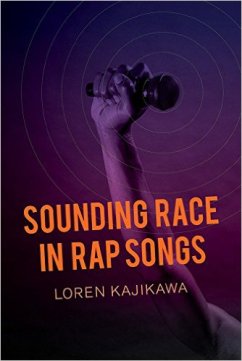 Throughout the book, I describe how producers use breaks and give rise to musical-racial codes that can be manipulated to project a variety of identities and attitudes. The following excerpt from the third chapter of Sounding Race, explains how the style of beat making popularized by the New York-based Bomb Squad (Public Enemy’s production team) provided a blueprint for pioneering west coast gangsta rap group N.W.A’s depiction of Compton, California. By layering multiple loops into a dense, cacophonous mix, N.W.A transposed Public Enemy’s “too black, too strong” sound onto the world of Los Angeles’s postindustrial streets.
N.W.A and its former members have been in the news recently thanks to the biopic Straight Outta Compton. Yet one aspect of the group’s development downplayed in the film is the way that its members formulated their identities in relation to east coast rap. In the mid-1980s, New York was the undisputed center of the industry, and its influence on L.A.-based acts is easy to see and hear. Ice Cube’s first group C.I.A. ( Cru’ In Action) used a nasal, hocket style approach to rapping cribbed directly from the Beastie Boys 1986 album License to Ill. And the cover of N.W.A’s first album N.W.A and the Posse, features numerous group members posing with the giant clock necklaces made famous by Public Enemy’s Flavor Flav. In similar fashion, the beat Dr. Dre produced for “Straight Outta Compton” (the title track to their breakout 1988 album) followed the Bomb Squad’s potent formula for signifying militant blackness. —Loren Kajikawa
—
The following is an excerpt from Chapter Three “‘Let Me Ride’: Gangsta Rap’s Drive Into The Popular Mainstream,” of Loren’s Kajikawa’s Sounding Race in Rap Songs, with thanks to The University of California Press. Any notes have been included in the text to conform to Sounding Out!‘s style sheet.
We [Public Enemy] were in Vegas and they [N.W.A.] were on tour with us, and I had just got the vinyl in. That’s what this is all about. Because Run-DMC and LL Cool J gave me energy. And if our energy happened to be transferred to N.W.A., then that’s what this whole thing is for.” Chuck D as quoted in Brian Coleman, Check The Technique: Liner Notes For Hip-Hop Junkies (New York: Villard Books, 2007), 354.
According to Chuck D, Public Enemy’s musical style directly influenced Dre, and he recalls giving the first two copies of It Takes a Nation of Millions To Hold Us Back to Dr. Dre and Eazy-E prior to the album’s official release. The recorded evidence supports Chuck D’s recollection. For many of the tracks on Straight Outta Compton, Dr. Dre seems to have borrowed from the “loops on top of loops” style of Public Enemy’s Bomb Squad.
In fact, when Ice Cube left N.W.A. in 1989, he hoped that Dre would continue to make beats for his solo project. When this proved impossible due to Dre’s contractual obligations to N.W.A., Ice Cube began collaborating with the Public Enemy’s Bomb Squad, which served as the production unit for his album Amerikkka’s Most Wanted (1990). N.W.A.’s breakthrough was finding a way to put a distinctive spin on these influences, and the artistic strategy that they arrived at for their first Ruthless Records release was designed to put themselves on the map—both literally and figuratively.
Rather than shout out the multiplicity of neighborhoods where their members were actually from (as they had done in “Panic Zone”), N.W.A. chose to center their identity around Dr. Dre and Eazy-E’s hometown of Compton, California. The sound of Compton as Dr. Dre imagined it, however, drew on musical practices and artistic decisions similar to those found in Public Enemy’s “Rebel Without a Pause.” To construct the rhythmic foundation of “Straight Outta Compton,” Dre looped the breakbeat from The Winstons’ “Amen Brother” (1969), one of the most sampled beats in hip hop, that also served as the foundation for dozens of songs in the UK’s “jungle” (aka “drum and bass”) genre.

Like other heavily sampled breaks from this era, the one-measure loop features a syncopated interlocking of snare and bass hits that is reminiscent of James Brown’s “Funky Drummer (featuring Clyde Stubblefield’s famous beat). As if he were following the Bomb Squad’s exact formula, Dr. Dre layered a drum machine (Roland TR-808) over this break.

The 808 was programmed to add its characteristic bass boom to the first two drum kicks of the “Amen” loop, and to tick off a 16-count hi-hat pulse with a closing hi-hat clasp on the downbeat of every other measure. The “Amen” break and the two hi-hat parts, provide the rhythmic foundation around which Dr. Dre places numerous other repeating sounds. Two other ingredients stand out in this beat: a guitar ostinato and a low drone on what sounds like a baritone sax or trombone (or perhaps a downwardly pitched sample of another instrument). The guitar ostinato, which plays straight eighth-notes on E-flat except for a one step descent to D-flat on the “and” of every fourth beat, churns out tight 1-measure units of sound.

The horn drone (also on E-flat) has a raw, muddled quality, and casts an ominous cloud over the track.
By combining these layers with the dense percussion track, Dre created a tightly packed funk groove with many sonic similarities to Public Enemy’s Bomb Squad. Like “Rebel Without a Pause,” the track to “Straight Outta Compton” features tight 1-measure loops stacked on top of one another to create a thick and intense groove.

Comparison of layers of looped sound in Public Enemy’s “Rebel Without a Pause” and N.W.A.’s “Straight Outta Compton”
Except for the drone, most of the elements in the track have a punchy feel, full of rhythmic stabs and staccato attacks, including the automatic gunfire that Dre samples to follow Ice Cube’s reference to an AK-47 assault rifle. Due to the “noisiness” of the beat, the way sonic space seems filled to maximum capacity, the members of N.W.A.—similar to Public Enemy’s Chuck D and Flavor Flav—practically yell their verses, as if they must raise their voices in order to be heard over the cacophony. Even before the actual words to “Straight Outta Compton” are digested, the sound of the track and the group’s vocals evoke the palpable tension of imminent conflict, which reinforces the theme of violent confrontation in the song’s lyrics. For the chorus of “Straight Outta Compton,” Dr. Dre strings together a series of samples with rapid-fire precision. The sound of screeching car tires from Davy DMX’s “One for the Treble” is followed by turntable scratching; the scratching leads directly to a choppy sample of the words “City of Compton” from Ronnie Hudson’s “Westcoast Poplock,” which is then followed by more scratching. The whole chain of musical events is deployed over the breakbeat from Funkadelic’s “You’ll Like It Too,” which Dr. Dre splices into the beat just for the chorus. The rapid cutting from one sample to the next exemplifies the “rupture” Tricia Rose identifies as fundamental to hip hop’s post-industrial aesthetic in Black Noise: Rap Music and Black Culture in Contemporary America (39).
Thus, the music and lyrics for “Straight Outta Compton” depict the city as a place of extremes, where things happen fast and change is sudden and complete. It is a place where one is either equipped to deal or left behind. In this way, Dr. Dre exploited the spatial characteristics encoded in Public Enemy’s music to depict Compton as place. The sonic characteristics that animated Public Enemy’s militant blackness were rerouted and effectively transposed onto N.W.A.’s depiction of Los Angeles gangstas.
—
Loren Kajikawa has served on the faculty at the University of Oregon’s School of Music and Dance since 2009. His main area of research and teaching is American music of the twentieth and twenty-first centuries, and he offers a variety of courses in music history, ethnomusicology, and musicology. Kajikawa’s writings have appeared in American Music, Black Music Research Journal, ECHO: a music-centered journal, Journal of the Society for American Music,and Popular Music and Society, among others. His recent book Sounding Race in Rap Songs (University of California, 2015) explores the relationship between rap music’s backing tracks and racial representation.
—
 REWIND! . . .If you liked this post, you may also dig:
“‘I’m on my New York s**t’: Jean Grae’s Sonic Claims on the City”––Liana Silva
Love and Hip Hop: (Re)Gendering The Debate Over Hip Hop Studies–Travis Gosa
Caterpillars and Concrete Roses in a Mad City: Kendrick Lamar’s “Mortal Man” Interview with Tupac Shakur–Regina Bradley
Share this:

SO! Amplifies: Feminatronic

SO! Amplifies. . .a highly-curated, rolling mini-post series by which we editors hip you to cultural makers and organizations doing work we really really dig. You’re welcome!
—
FEMINATRONIC began with a simple idea : link with other women who were–and are–creating electronic music, particularly in the Ambient / Space community and then spur each other on by being part of an all-female electronic artist podcast.
I quickly realised that there were more women creating electronic music out in the aether than I had known—and I was shocked by the lack of visibility on my part. If I didn’t know these artists—someone who follows the scene closely–how was our music getting to listeners? especially with the lack of wider publicity?
After a short while, I quickly concluded that this perceived invisibility occurred in all genres of electronic music creation by women. At best, the electronic music scene is fractured and comprised of a myriad of genres. Across the Internet, playlists are heavily geared towards male artists. As an electronic musician myself, who just happens to be female, working in isolation from many other artists and genres meant I wasn’t really aware of the great female electronic artists out in the world. I had a feeling that there were others like me quietly creating music, soundscapes and sonic art, beavering away using a huge plethora of electronic means to create music, a sound, installations and a voice for themselves but they were unknowns to me and to a wider audience. Provoked by my sense of isolation and invisibility, I set up the website Feminatronic to get word out that there were and are, women from all genres of electronic music making, creating music in a variety of interesting ways.
.
The site’s main aim is to highlight and promote women who create music and sound via electronic processes. My definition of “electronic music” has evolved from the original synth studio based electronic music to include sound art, installations, field recordings, noise, classical, electroacoustic and everything in-between. I designed Feminatronic as an inclusive site that would appeal to those interested in a huge range of genres, from Ambient and Space to Field Recording, DJing and EDM to Sound Installation and Experimental. The site features an A-Z catalogue of electronic artists who identify as female, as well as women behind the scenes, the producers, sound designers, and engineers who help make music possible.
In addition to keeping up the catalogue, Feminatronic shines a spotlight on as much electronic music, artists, news, events and sites as possible, via the website and social media (Twitter handle: @feminatronic; Feminatronic is also on Soundcloud, Facebook, and 8tracks). I believe strongly in collaboration through curation; therefore Feminatronic frequently reblogs articles and reviews from other sites, creating a chain reaction of posts and tweets that increases visibility and widens the audience for artists and the forums that feature them.
.
Despite all the creativity that I have uncovered since beginning my work, only a fraction of female electronic artists ever get their heads above the parapet and get huge coverage, or even minimal props. Since beginning this site in 2013, I have discovered for myself so much talent and much of it remains well under the radar. Such continued omission gave me the idea to begin an ongoing series of posts called “Today’s Discovery,” a very effective way to give publicity to new releases, back catalogues, and artists both new and established. This series also creates more space for genres that don’t often get a wider audience and to challenge the perception of so-called “women’s music.”
One of Feminatronic’s most popular features is our “Sunday Mixes.” These are monthly playlists based on a theme that intertwine poetry and electronic music. This project allowed me to combine two things that I love and to explore the music of poetry and the poetics of sound, while introducing new listeners to electronic music and new readers to poetry. Past mixes explored themes such as “Voices,” “Forests,” and “The Moon.”
Alongside sites such as Pink Noises, Female Pressure, Her Noise, and Her Beats, Feminatronic is a small but vital cog in a growing movement to shed light on artists who create music and sound via electronic processes, artists who just happen to be women and who deserve to be seen and heard. My work is a voyage of discovery and as such, the site remains an on-going evolving project perennially under construction.

—
 REWIND!…If you liked this post, you may also dig:
Aural Guidings: The Scores of Ana Carvalho and Live Video’s Relation to Sound–Maile Colbert
SO! Amplifies: Mega Ran and Sammus, The Rappers With Arm Cannons Tour–Enongo Lumumba-Kasongo
SO! Amplifies: Mendi+Keith Obadike and Sounding Race in America–Mendi + Keith Obadike
Share this:


Current Top Posts





April 2021

January 2020

November 2019

October 2019

August 2019

April 2014

November 2017

March 2015

December 2017

October 2015
 Sounding Out!
Recent Comments