
The Sonic Rhetoric of Quincy Jones (feat. Nasir Jones)

.
The passing of Quincy Jones has left a silence that feels almost impossible to fill. Every time I play Thriller at home now, it’s no longer just a celebration of his unparalleled artistry. It’s a ritual to sit with his legacy, listen more closely, and honor how his music shaped the sound of memory itself. With each spin of the record, my family and I find ourselves inside his arrangements, held by their richness, precision, and sense of story as though the music is breathing with us, speaking back across time. Jones’s work was never just production; it was communication. A language of sound connected us to melody and beat and the fuller spectrum of emotion, culture, and memory that lives in Black music.
This piece joins a tradition of Black sonic remembrance that Sounding Out! has previously offered in moments of profound cultural loss, from Regina Bradley’s remembrances of listening to Whitney Houston on the radio with her mother to Ben Tausig’s reflection on Prince’s passing to Kristin Moriah’s meditation on Savion Glover’s tap dance tribute to Amiri Baraka. Such pieces remind us that mourning Black artists is not only about personal grief; it’s about listening to the soundscapes they left behind, tracing how their artistry shaped how we collectively move, mourn, and remember. Houston’s voice, much like Jones’s production, was a vessel of Black sonic innovation, shaping how we collectively move, mourn, and remember. Like Prince, Jones’s catalog is a vast archive of Black sonic innovation, where every horn line, bass groove, and percussive hit tells part of a larger story about Black life, joy, survival, and creativity. Jones, like Baraka, understood the radical potential of sound to entertain and agitate, educate, and summon history into the present. Writing about Jones now in the quiet left by his absence is a mourning and a celebration, an offering of flowers in the form of careful attention, deep gratitude, and collective remembrance. This is a way of honoring him as a producer or composer and as a practitioner of sonic rhetoric, a storyteller who spoke through sound and whose language of rhythm and harmony shaped how we feel, remember, and belong.
Two new books published in 2024, Matthew D. Morrison’s Black Sound and Earl H. Brooks’s On Rhetoric and Black Music, arrived at a particularly poignant moment, offering critical frameworks for understanding sonic rhetoric as a vital Black cultural practice. Morrison positions Black music as a vessel for cultural identity and history, emphasizing how it carries narratives that transcend mere auditory pleasure. Brooks extends this argument, demonstrating how Black music functions as a living, breathing rhetorical form, shaping and reshaping cultural identity and narrative with each performance, each recording, and each arrangement. That these books emerged in the same year the world lost Quincy Jones feels deeply significant, a reminder that his life’s work embodies precisely what they describe. Jones mastered using rhythm, melody, and arrangement to shape cultural memory and invite reflection. His genius does not reside solely in his ability to create captivating music but rather in his ability to layer each note with history, emotion, and meaning, sound as storytelling, sound as cultural conversation.
As I reflect on Quincy Jones’s legacy, I realize that his production and compositional skills have profoundly changed my understanding of sound. My admiration for Jones’s mastery of sound and his unique way of using music to communicate drove me to explore sound rhetoric more profoundly, especially how his work became the foundation of new sonic storytelling. His work allows me to imagine myself as a young Black boy, playing with sound and allowing it to communicate in ways that speak to the world. I am grateful for his inspiration, enabling us to envision the possibilities of sound and its power to connect us all. To honor Quincy Jones in rhetoric and sound, we must recognize his pioneering contributions to music as a form of communication. By studying his innovative approaches and the sonic landscapes he crafted, we can deepen our understanding of how sound shapes cultural narratives and personal identities. Engaging with his work encourages us to appreciate music’s profound impact on our lives and the stories it tells, ensuring that his legacy continues to inspire future generations of artists and listeners alike.

For readers who may not be as familiar with his legacy, Quincy Jones is one of the most influential and celebrated figures in music history. His career spans more than seven decades, marked by numerous Grammy Awards, groundbreaking collaborations, and an ability to shape the sound of entire musical eras. Jones’s journey into music began with a chance discovery that would define the course of his life. As a young boy, he broke into an armory and found an upright piano, sparking his lifelong passion for music. This serendipitous moment led him to explore various instruments, from percussion to trombone, sousaphone, and eventually the trumpet, which would become his instrument of choice. These formative experiences gave Jones a diverse and rich understanding of sound that he would later weave into his compositions. His journey through different musical styles, be it jazz, R&B, or orchestral arrangements, allowed him to develop a unique ability to merge genres and cultures, creating works that resonated on a global scale. Jones’s work as a producer, composer, and arranger redefined what it meant to be a producer in the music industry, elevating the role to that of a creative force, an artist in their own right. Most famously known for his work with Michael Jackson, Jones’s sonic contributions to Thriller transformed pop music and how producers and artists interact to create timeless music. His groundbreaking approach to music production changed how the world listens to music, showing how sound can transcend entertainment and become a powerful form of cultural communication.

For example, celebrating the Thriller album with my children has been an ongoing discovery. I am captivated by their responses to the music. They quickly catch specific sounds, anticipate instrumental flourishes, and react to subtle details, proving the immersive quality of Quincy Jones’s work. His production goes beyond entertainment; it engages listeners, inviting even young ears to feel part of the experience. The power of sonic storytelling is the ability to craft a narrative or evoke emotion purely through sound without relying on visuals or lyrics alone. Quincy Jones’s genius lies in how he layers instruments, sound effects, and vocal textures to create mood and atmosphere, building stories that listeners can feel unfolding around them. Sonic storytelling turns production into a cinematic experience, where a sudden bassline shift, a carefully placed synth, or an eerie silence all contribute to the larger emotional arc of a song. Jones doesn’t just produce songs. He builds immersive worlds through sound, showing how music, at its best, can tell stories as vividly as any film or novel. Songs such as “Thriller,” “Beat It,” and “Billie Jean” epitomize Jones’s mastery of this craft. Thriller is a prime example of his brilliance, each track meticulously balancing complex soundscapes with universal appeal.
With eerie beats, haunting synths, and Vincent Price’s chilling monologue, “Thriller” has become synonymous with Halloween, transforming it into an auditory icon that reshapes how we experience the holiday. It has a layered, cinematic arrangement, where Jones fuses a creeping synthesizer line with lush orchestral swells and Vincent Price’s velvety horror monologue. Each sonic element functions as a narrative device, placing the listener inside a haunted space where sound, the creak of a door, and the hiss of wind become part of the story. Brooks’s On Rhetoric and Black Music reminds us that sound arrangements can evoke emotion and memory, and Jones’s work exemplifies that power.
Then, consider the storytelling pulsing in the bassline of “Billie Jean,” a throbbing heartbeat grounding the song’s tale of obsession, fame, and denial in something bodily, felt in the chest and gut before the mind catches up. With every layered texture, from the crisp snap of the drum machine to the soaring, wordless vocal harmonies, Jones does not simply produce music; he scripts sonic stories where Black creativity and cultural history converge in every beat.
Jones’s approach to production embodies this idea, transforming how we listen and engage with music. Take “Wanna Be Startin’ Somethin’,” where layered percussion, call and response vocals, and a pulsing bassline create a sonic landscape that feels alive, constantly shifting and evolving. The song’s now iconic “Mama say mama sa mama coo sa” chant reaches back to the Cameroonian makossa tradition, embedding a diasporic history within a global pop hit (listen to the opening seconds of Manu Dijbango’s 1972 “Soul Makossa” to hear the resonance).
Then, in “Human Nature,” Jones works in the opposite direction, crafting an atmospheric, dreamlike arrangement where gentle synth pads and delicate electric guitar melodies wrap around Michael Jackson’s voice like mist, evoking a sense of vulnerability and wonder. These tracks, like so many in Jones’s catalog, do not merely present melodies and rhythms. They create spaces where memory, emotion, and history converge.
Jones’s ability to craft soundscapes has long extended beyond Thriller, both backward and forward in time. His track “Soul Bossa Nova” (1962), famously featured in the Austin Powers films, evokes nostalgia and joy, transporting listeners to memories of sunny beach days and family vacations. But there’s a deeper story behind this piece that’s often overlooked that spoke volumes in its original context. Originally released on Jones’s album Big Band Bossa Nova, the track arrived when the genre and the term “bossa nova” were being culturally sanitized and marketed to white audiences, particularly in the U.S. As scholars have noted, Black Brazilian musicians whose innovative work laid the foundation for bossa nova, were often erased from the story as the genre’s global fame became linked to lighter-skinned artists palatable to international audiences.
Jones’s decision to title the track “Soul Bossa Nova” at the height of the Civil Rights Movement and during the global rise of Bossa Nova was not merely clever branding. It bridged the emerging coolness of Bossa Nova with the distinct sensibilities and innovations of African American music, at a time when both the U.S. and Brazil were grappling with deep racial segregation and the commodification of Black art. It was also a subtle reclamation, insisting on Black presence in a genre already experiencing the erasure of Black Brazilian pioneers such as Johnny Alf. In “Soul Bossa Nova,” Jones fused the light bounce of Brazilian rhythms with a brassy, big-band jazz sensibility, centering Black sonic playfulness and cultural hybridity at a time when both were under threat from the forces of segregation and global anti-Blackness. The track’s instantly recognizable piccolo flute riff, playful, mischievous, and a little sly, becomes, in this light, not only catchy but also defiant, a declaration that Black sound is limitless, able to traverse continents and contexts while carrying the weight of memory, history, and joy.
And the story did not end there. Decades later, Ludacris and various hip-hop artists paid homage to Jones’s legacy in Jones’s last album, the 2010 project Q: Soul Bossa Nostra. This playful yet reverent tribute sampled and reimagined Jones’s catalog for a new generation. Soul Bossa Nostra is a clever play on “Cosa Nostra,” merging the sonic underworld of Jones’s orchestrations with the familial pride and intergenerational respect that defines hip hop’s tribute culture.
This interweaving of “Soul Bossa Nova”‘s history, from its quiet defiance in 1962 to its unexpected resurgence through Austin Powers to its embrace by Ludacris, exemplifies the lasting power of Jones’s compositions to connect across eras and genres, all while telling a much larger story about race, ownership, and the endurance of Black sonic innovation.
In Thriller and “Soul Bossa Nova,” Jones’s compositions offer listeners an immersive experience that connects personal and cultural narratives, proving that his work is more than entertainment. It is a powerful form of artistic communication that resonates across generations. I have experienced this firsthand, listening to these songs with my children, not just once or twice, but as an ongoing, evolving family ritual. Their responses, the way they anticipate certain flourishes, react to subtle shifts, or sing along with total abandon, remind me that Jones’s work does not sit still in time. It moves through us, binding my children’s joy to my own memories of discovery, just as it ties us all to the larger, unfolding story of Black sonic creativity. Through Jones’s soundscapes, we are not only hearing songs. We are participating in cultural memory, shaping it anew with every listen.
***
Being known as an unparalleled intergenerational sonic storyteller is already a feat, but Quincy Jones’s influence is embedded in the DNA of contemporary music production in other important ways. From the way producers are now seen as creative equals to artists to the expectation that producers bring their signature sound to every project they touch, every time a contemporary music producer is celebrated as a vital voice in shaping a record, they stand on the foundation Quincy Jones laid. Long before the term “producer” carried the weight and cultural significance it does today, Jones redefined what it meant to hold that title.
In today’s music landscape, the constructive collaboration between an artist and producer can be a defining force, shaping careers and setting entire musical eras into motion. This reality exists in large part because of Jones, who was not just arranging instruments or overseeing technical sessions but building entire sonic worlds, shaping the emotional architecture of songs, and helping artists translate their most personal visions into soundscapes that could speak to the world. His work with Michael Jackson epitomizes the collaborative alchemy possible when a producer steps into the role of creative partner, cultural interpreter, and sonic architect all at once. With Thriller Jones did not merely produce an album, he co-authored a cultural phenomenon. Jones and Jackson’s collaboration not only redefined pop music but also set a lasting standard for artist-producer dynamics, showcasing the brilliance that can arise when two creative minds align. Jones’s legacy as a producer is one of vision, trust, and translation, helping artists hear possibilities in their work they could not fully imagine and giving the listening public music that defined moments and movements.
Hip Hop, in particular, has carved out a prominent role for music producers in the style of Quincy Jones, something that Nas pays homage to in his track “Michael and Quincy” from King’s Disease III (2022). In doing so, Nas directly parallels the collaborative genius between Quincy Jones and Michael Jackson with his recent creative collaboration with producer Hit-Boy, now running 6 albums strong.
This is not just a passing reference. It is part of Nas’s more prominent, ongoing project of honoring hip hop creators and the artistic lineages that shaped his career. Across the King’s Disease trilogy and in his The Bridge podcast (which he co-hosts with Miss Info), Nas has taken deliberate care to uplift the cultural architects of hip hop, weaving their stories into his narrative and preserving their legacies for future generations. On “Michael and Quincy,” Nas celebrates the power of collaboration, positioning the artist-producer relationship as a crucible for innovation and cultural impact. The track’s lyrics paint vivid images of creative combustion, with Nas rapping, “Smoke steaming off the microphone,” evoking the almost supernatural energy that fueled Michael and Quincy’s sessions. This imagery extends to Nas and Hit-Boy, capturing the intensity and urgency they bring to their creative process.
Sonically, “Michael and Quincy” also mirrors this spirit of collaborative innovation. Hit-Boy’s production constantly shifts, blending classic boom-bap drums with more atmospheric textures, creating a soundscape that feels both reverent and forward-thinking. The beat morphs beneath Nas’s verses, never settling into predictability, much like how Quincy Jones infused “Thriller” with unexpected sonic twists. Nas and Hit-Boy’s sonic interplay echoes the Jackson-Jones dynamic, where the producer’s vision expands and amplifies the artist’s voice. In its lyrics and production, “Michael and Quincy” serves as a sonic tribute, not just to a legendary duo, but to the transformative power of artist-producer partnerships, a lineage Quincy Jones helped define and one Nas is determined to carry forward. The era-defining success of Thriller still ripples through music today.

 “
“Nas’s tribute serves as a powerful reminder of these partnerships’ enduring impact, bridging genres and generations. The image of “smoke steaming off of the microphone” is one I carry with me, embodying the intense, creative spirit that Michael and Quincy brought to their collaborations, a legacy now celebrated and extended through Nas’s words and music. Nas draws from their example to remind us that great partnerships, whether in music or other creative endeavors, are often the spark that ignites monumental cultural shifts. Their combined energy was undeniable as they pushed each other to new artistic heights. The success of their work was not only about the music; it was also about the more profound connection to culture, identity, and collective memory. Like the tracks he produced, his music lives on, inspiring us to reflect on how we listen to and engage with the world around us. By revisiting the breadth and depth of his work and the many sonic creations it has inspired, we continue to discover new layers of meaning and artistry, ensuring that Jones’s influence will be felt for generations to come.
—
Featured Image: SO! Screencap from Nas’s performance at Rolling Loud, November 11, 2024
—
Jaquial Durham is a multi-hyphenate social justice champion. The South Carolina native has spent over a decade actively engaged in various outreach initiatives to uplift and empower marginalized communities. He is also a passionate cultural enthusiast dedicated to exploring the rich tapestry of African American history, which drives him to continue making a meaningful impact in the lives of those around him. His advocacy for social-political issues that encompass race, prison culture and gender have been at the forefront of his work.
As the CEO of Public Culture Entertainment Group, an entity focused on raising public awareness about the myriad of components that influence culture, Durham spearheads the company’s TV/film projects and cultivates unique apparel capsules that showcase prominent African American figures, organizations and landmarks often absent from historical dialogue. The ambitious, young go-getter prolifically uses creative activism to amplify the voices, stories and experiences of those often overlooked. His
visionary brilliance can be seen in the groundbreaking documentary Southern Prison Culture, a cinematic film highlighting the challenges individuals face within the system and fiercely advocating for much-needed reforms. As a result of the film’s success, Durham has received prestigious awards like the Milan Gold Award, the Austin Lift-Off Film Festival Award and the London International Film Festival Award.
Durham has been a driving force behind various social justice reforms, calling for equitable and inclusive policies and practices. His unwavering dedication to helping others earned him widespread recognition that included opportunities to lecture at colleges such as American University, Benedict College, Claflin University, Clemson University and Texas State University. Durham was honored by Grammy-Award Winning rapper Killer Mike, who has respect and credibility within the culture. His dedication to the development of higher education institutions in America has led him to refine his intellectual and creative genius relentlessly. While Durham received a bachelor’s in African and African American Studies with a minor in Women and Gender Studies from Winston-Salem State University, he is pursuing a Ph.D.from Clemson University in Rhetorics, Communication and Information Design.
—

REWIND! . . .If you liked this post, you may also dig:
On Donuts, Sandwiches and Beattapes: Listening for J Dilla Six Years On–DJ Primus Luta
Unlearning Black Sound in Black Artistry: Examining the Quiet in Solange’s A Seat At the Table–Kimberly Williams
Deep Listening as Philogynoir: Playlists, Black Girl Idiom, and Love–Shakira Holt
“Heavy Airplay, All Day with No Chorus”: Classroom Sonic Consciousness in the Playlist Project–Todd Craig
Mingus Ah Um (1959) and An Ethics of Care in Jazz–Brittany Proctor
Share this:

What Feels Good to Me: Extra-Verbal Vocal Sounds and Sonic Pleasure in Black Femme Pop Music

The lyrics to Beyoncé’s 2008 song “Radio” treats listening pleasure as a thinly-veiled metaphor for sexual pleasure. For example, they describe how turning up a car stereo transforms it into a sex toy: “And the bassline be rattlin’ through my see-eat, ee-eats/Then that crazy feeling starts happeni-ing- i-ing OH!” Earlier in the song, the lyrics suggest that this is a way for the narrator to get off without arousing any attempts to police her sexuality: “You’re the only one that Papa allowed to hang out in my room/…And mama never freaked out when she heard it go boom.” Because her parents wouldn’t let her be alone in her bedroom with anyone or anything that they recognized as sexual, “Radio”’s narrator finds sexual pleasure in a practice that isn’t usually legible as sex. In her iconic essay “On A Lesbian Relationship With Music,” musicologist Suzanne Cusick argues that if we “suppose that sexuality isn’t necessarily linked to genital pleasure” and instead “a way of expressing and/or enacting relationships of intimacy through physical pleasure shared, accepted, or given” (70), we can understand the physical pleasures of listening to music, music making, and music performance as kinds of sexual pleasure.
Though Cusick’s piece overlooks the fact that sexual deviance has been, since the invention of the idea of sexuality in the late 19th century, thoroughly racialized, her argument can be a good jumping-off point for thinking about black women’s negotiations of post-feminist ideas of sexual respectability; it focuses our attention on musical sound as a technique for producing queer pleasures that bend the circuits connecting whiteness, cispatriarchal gender, and hetero/homonormative sexuality. In an earlier SO! Piece on post-feminism and post-feminist pop, I defined post-feminism as the view that “the problems liberal feminism identified are things in…our past.” Such problems include silencing, passivity, poor body image, and sexual objectification. I also argued that post-feminist pop used sonic markers of black sexuality as representations of the “past” that (mostly) white post-feminists and their allies have overcome. It does this, for example, by “tak[ing] a “ratchet” sound and translat[ing] it into very respectable, traditional R&B rhythmic terms.” In this two-part post, I want to approach this issue from another angle. I argue that black femme musicians use sounds to negotiate post-feminist norms about sexual respectability, norms that consistently present black sexuality as regressive and pre-feminist.
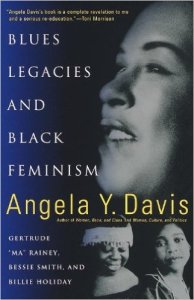 Black women musicians’ use of sound to negotiate gender norms and respectability politics is a centuries-old tradition. Angela Davis discusses the negotiations of Blues women in Blues Legacies & Black Feminism (1998), and Shana Redmond’s recent article “This Safer Space: Janelle Monae’s ‘Cold War’” reviews these traditions as they are relevant for black women pop musicians in the US. While there are many black femme musicians doing this work in queer subcultures and subgenres, I want to focus here on how this work appears within the Top 40, right alongside all these white post-feminist pop songs I talked about in my earlier post because such musical performances illustrate how black women negotiate hegemonic femininities in mainstream spaces.
As America’s post-identity white supremacist patriarchy conditionally and instrumentally includes people of color in privileged spaces, it demands “normal” gender and sexuality performances for the most legibly feminine women of color as the price of admission. As long as black women don’t express or evoke any ratchetness–any potential for blackness to destabilize cisbinary gender and hetero/homonormativity, to make gender and sexuality transitional–their expressions of sexuality and sexual agency fit with multi-racial white supremacist patriarchy.
It is in this complicated context that I situate Nicki Minaj’s (and in my next post Beyoncé’s and Missy Elliott’s) recent uses of sound and their bodies as instruments to generate sounds. If, as I argued in my previous post, the verbal and visual content of post-feminist pop songs and videos is thought to “politically” (i.e., formally, before the law) emancipate women while the sounds perform the ongoing work of white supremacist patriarchy, the songs I will discuss use sounds to perform alternative practices of emancipation. I’m arguing that white bourgeois post-feminism presents black women musicians with new variations on well-worn ideas and practices designed to oppress black women by placing them in racialized, gendered double-binds.
 For example, post-feminism transforms the well-worn virgin/whore dichotomy, which traditionally frames sexual respectability as a matter of chastity and purity (which, as Richard Dyer and others have argued, connotes racial whiteness), into a subject/object dichotomy. This dichotomy frames sexual respectability as a matter of agency and self-ownership (“good” women have agency over their sexuality; “bad” women are mere objects for others). As Cheryl Harris argues, ownership both discursively connotes and legally denotes racial whiteness. Combine the whiteness of self-ownership with well-established stereotypes about black women’s hypersexuality, and the post-feminist demand for sexual self-ownership puts black women in a catch-22: meeting the new post-feminist gender norm for femininity also means embodying old derogatory stereotypes.
I think of the three songs (“Anaconda,” “WTF,” and “Drunk in Love”) as adapting performance traditions to contemporary contexts. First, they are part of what both Ashton Crawley and Shakira Holt identify as the shouting tradition, which, as Holt explains, is a worship practice that “can include clapping, dancing, pacing, running, rocking, fainting, as well as using the voice in speaking, singing, laughing, weeping, yelling, and moaning.” She continues, arguing that “shouting…is also a binary-breaking performance which confounds—if only fleetingly—the divisions which have so often oppressed, menaced, and harmed them.” These vocal performances apply the shouting tradition’s combination of the choreographic and the sonic and binary-confounding tactics to queer listening and vocal performance strategies.
Francesca Royster identifies such strategies in both Michael Jackson’s work and her audition of it. According to Royster, Jackson’s use of non-verbal sounds produces an erotics that exceeds the cisheteronormative bounds of his songs’ lyrics. They were what allowed her, as a queer teenager, to identify with a love song that otherwise excluded her:
in the moments when he didn’t use words, ‘ch ch huhs,’ the ‘oohs,’ and the ‘hee hee hee hee hees’…I ignored the romantic stories of the lyrics and focused on the sounds, the timbre of his voice and the pauses in between. listening to those nonverbal moments–the murmured opening of “Don’t Stop Till You Get Enough,” or his sobbed breakdown at the end of “She’s Out of My Life,’ I discovered the erotic (117).
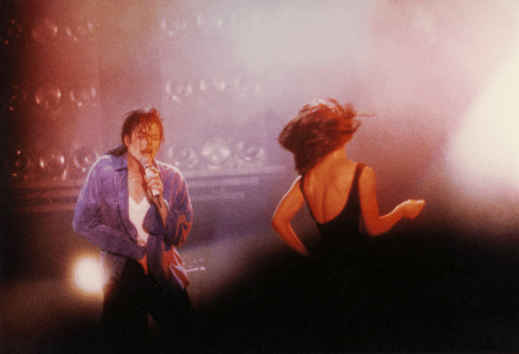
“Michael Jackson” by Flickr user Daniele Dalledonne, CC BY-SA 2.0
Royster references a black sexual politics in line with Audre Lorde’s notion of the erotic in “The Uses of the Erotic,” which is bodily pleasure informed by the implicit and explicit knowledges learned through lived experience on the margins of the “European-American male tradition” (54), and best expressed in the phrase “it feels right to me” (54). Lorde’s erotic is a script for knowing and feeling that doesn’t require us to adopt white supremacist gender and sexual identities to play along. Royster calls on this idea when she argues that Jackson’s non-verbal sounds–his use of timbre, rhythm, articulation, pitch–impart erotic experiences and gendered performances that can veer off the trite boy-meets-girl-boy-loses-girl stories in his lyrics. “Through his cries, whispers, groans, whines, and grunts, Jackson occupies a third space of gender, one that often undercuts his audience’s expectations of erotic identification” (119). Like shouting, “erotic” self-listening confounds several binaries designed specifically to oppress black women, including subject/object binaries and binary cisheterogender categories.
Nicki Minaj uses extra-verbal sounds as opportunities to feel her singing, rapping, vocalizing body as a source of what Holt calls “sonophilic” pleasure, pleasure that “provide[s] stimulation and identification in the listener” and invites the listener to sing (or shout) along. Minaj is praised for her self-possession when it comes to business or artistry, but such self-possession is condemned or erased entirely when discussing her performances of sexuality. As Treva B. Lindsey argues, “the frequency that Nicki works on is not the easiest frequency for us to wrestle with, because it’s about…whether we can actually tell the difference between self-objectification and self-gratification.’’ Though this frequency may be difficult to parse for ears tempered to rationalize post-feminist assumptions about subjectivity and gender, Minaj uses her signature wide sonic pallette to shift the conversation about subjectivity and gender to frequencies that rationalize alternative assumptions.
In her 2014 hit “Anaconda,” she makes a lot of noises: she laughs, snorts, trills her tongue, inhales with a low creaky sound in the back of her throat, percussively “chyeah”s from her diaphragm,among other sounds. The song’s coda finds her making most of the extraverbal sounds. This segment kicks off with her quasi-sarcastic cackle, which goes from her throat and chest up to resonate in her nasal and sinus cavities. She then ends her verse with a trademark “chyeah,” followed by another cackle. Then Minaj gives a gristly, creaky exhale and inhale, trilling her tongue and then finishing with a few more “chyeah”s. While these sounds do percussive and musical work within the song, we can’t discount the fact that they’re also, well…fun to make. They feel good, freeing even. And given the prominent role the enjoyment of one’s own and other women’s bodies plays in “Anaconda” and throughout Minaj’s ouevre, it makes sense that these sounds are, well, ways that she can go about feelin herself.
Listening to and feeling sonophilic pleasure in sounds she performs, Minaj both complicates post-feminism’s subject/object binaries and rescripts cishetero narratives about sexual pleasure. “Anaconda” flips the script on the misogyny of Sir Mix-a-Lot’s hit “Baby Got Back” by sampling the track and rearticulating cishertero male desire as Nicki’s own erotic. First, instead of accompanying a video about the male gaze, that bass hook now accompanies a video of Nicki’s pleasure in her femme body and the bodies of other black femmes, playing as she touches and admires other women working out with her. Second, Nicki re-scripts the bass line as a syllabification: “dun-da-da-dun-da-dun-da-dun-dun,” which keeps the pattern of accents on 1 and 4, while altering the melody’s pitch and rhythm.
Just as “Anaconda”’s lyrics re-script Mix-A-Lot’s male gaze, so do her sounds. If the original hook sonically orients listeners as cishetero “men” and “women,” Nicki’s vocal performance reorients listeners to create and experience bodily pleasure beyond the “legible” and the scripted. Though the lyrics are clearly about sexual pleasure, the sonic expression or representation of that pleasure–i.e., the performer’s pleasure in hearing/feeling herself make all these extraverbal sounds–makes it physically manifest in ways that aren’t conventionally understood as sexual or gendered. Because it veers off white ciseterogendered scripts about both gender and agency, Minaj’s performance of sonophilia is an instance of what L.H. Stallings calls hip hop’s “ratchet imagination.” This imagination is ignited by black women’s dance aesthetics, wherein “black women with various gender performances and sexual identities within the club, on stage and off, whose bodies and actions elicit new performances of black masculinity” renders both gender and subject/object binaries “transitional” (138).
Nicki isn’t the only black woman rapper to use extra-verbal vocal sounds to re-script gendered bodily pleasure. In my next post, I’ll look at Beyoncé and Missy Elliot’s use of extra-vocal sounds to stretch beyond post-feminism pop’s boundaries.
—
Featured image: screenshot from “Anaconda” music video
—
Robin James is Associate Professor of Philosophy at UNC Charlotte. She is author of two books: Resilience & Melancholy: pop music, feminism, and neoliberalism, published by Zer0 books last year, and The Conjectural Body: gender, race and the philosophy of music was published by Lexington Books in 2010. Her work on feminism, race, contemporary continental philosophy, pop music, and sound studies has appeared in The New Inquiry, Hypatia, differences, Contemporary Aesthetics, and the Journal of Popular Music Studies. She is also a digital sound artist and musician. She blogs at its-her-factory.com and is a regular contributor to Cyborgology.
—
 REWIND! . . .If you liked this post, you may also dig:
“I Love to Praise His Name”: Shouting as Feminine Disruption, Public Ecstasy, and Audio-Visual Pleasure–Shakira Holt
Music Meant to Make You Move: Considering the Aural Kinesthetic–Imani Kai Johnson
Something’s Got a Hold on Me: ‘Lingering Whispers’ of the Atlantic Slave Trade in Ghana–Sionne Neely
Share this:


Current Top Posts





April 2021

January 2020

November 2019

October 2019

August 2019

April 2014

November 2017

March 2015

December 2017

October 2015
 Sounding Out!
Recent Comments