
Resounding Silence and Soundless Surveillance, From TMZ Elevator to Beyoncé and Back Again

DOI: https://doi.org/10.59350/hj7kw-n2666

This September, Sounding Out! challenged a #flawless group of scholars and critics to give Beyoncé Knowles-Carter a close listen, re-examining the complex relationship between her audio and visuals and amplifying what goes unheard, even as her every move–whether on MTV or in that damn elevator–faces intense scrutiny. Last Monday, you heard from Kevin Allred (Women and Gender Studies, Rutgers) who read Beyoncé’s track “No Angel” against the New York Times’ reference to Michael Brown as #noangel. You will also hear from Liana Silva (Editor, Women in Higher Education, Managing Editor, Sounding Out!), Regina Bradley (writer, scholar, and freelance researcher of African American Life and Culture), and Madison Moore (Research Associate in the Department of English at King’s College, University of London and author of How to Be Beyoncé). Today, Priscilla Peña Ovalle (English, University of Oregon) gives us full Beyoncé realness, from TMZ Elevator to Beyoncé and Back Again,–Editor-in-Chief Jennifer Stoever
—
Less than six months after Beyoncé released Beyoncé, she was momentarily silenced on the small screen when the gossip site TMZ released silent elevator security footage of a fight between her famous husband and sister. Doubly framed by the black and white of a surveillance video screen surreptitiously captured on a security guard’s camera-phone, the video’s silence left plenty of room for speculation. But the footage also revealed a woman conscious that her life is on record: Beyoncé’s body seemed to elude the camera’s full view and she emerged from the elevator with a camera-ready smile.
Like Kevin Allred in his powerful reading of “No Angel,” I could not help but rethink Beyoncé in the wake of Michael Brown’s murder. I already read Beyoncé as a sophisticated response to the visual and aural policing of black female bodies, but the closed-circuit images of Beyoncé on TMZ (and in Beyoncé) made me reconsider silence as a damning convention of video surveillance; like Aaron Trammell in “Video Gaming and the Sonic Feedback of Surveillance,” I questioned (the lack of) sound as a technique of control. When the camera-phone recording of Kajieme Powell’s murder, photographed and narrated by a community member in real-time, was released with silent surveillance footage of the alleged theft, my appreciation of Beyoncé—as a response to those silent damnations—took a new turn.

“Resounding Silence and Surveillance” argues that Beyoncé returns the media’s visual-aural gaze. Because of its pop package, the album’s artistic composition and socio-cultural merit are often underestimated. Like the silence of surveillance footage, omitting any one sensory element from Beyoncé distorts the holistic meaning. To untangle this critically complex interplay of audio and video, I analyze the visualized song “Haunted” and briefly address the single “***Flawless” to show how the artist’s triple consciousness anchors Beyoncé. She is on to us: Beyoncé is the culmination of an artist who has spent her career watching us watch her. Temporarily silenced by footage that she could not control, Beyoncé resounds that “elevator incident”—and our sonic/optic perceptions of her feminism—with a flawless remix.
“I see music. It’s more than just what I hear,” declares Beyoncé. Her voiceover runs over the black screen that opens the promotional video “Self-Titled.” Released the same day Beyoncé premiered on iTunes, “Self-Titled” directs audiences to “see the whole vision of the album.” By design, Beyoncé is an immersive experience—like watching Michael Jackson’s “Thriller” as a television event on MTV.
Because Beyoncé was born the same year the cable music channel MTV premiered, she has never known a world without the ability to “see music.” In many ways, her visual album reinvigorates the early spirit of MTV: after Beyoncé, we will “never look at music the same way again.” Though music videos exacerbate the pop single obsession that Beyoncé explicitly resists with Beyoncé, they also produce a unique kinetic connection with the listener-viewer, whose experience of sound is visually registered by the body as it processes shots and edits. This is especially true when strong imagery, rhythmic editing, and dance movements are expertly employed, as in Beyoncé.
Beyoncé deftly critiques the beauty and music/media industries that have been central to her pop success. If taken piecemeal, these critiques can be easily dismissed: the sustained gloss of her image works all too well. There is much to say on a video-by-video basis, but I focus here on the specific aural elements of “Haunted” that articulate Beyoncé’s refusal of the music industry’s status quo. This visualized rejection reveals the layers of racism and sexism that nonwhite female artists (even Beyoncé, even today) must negotiate.
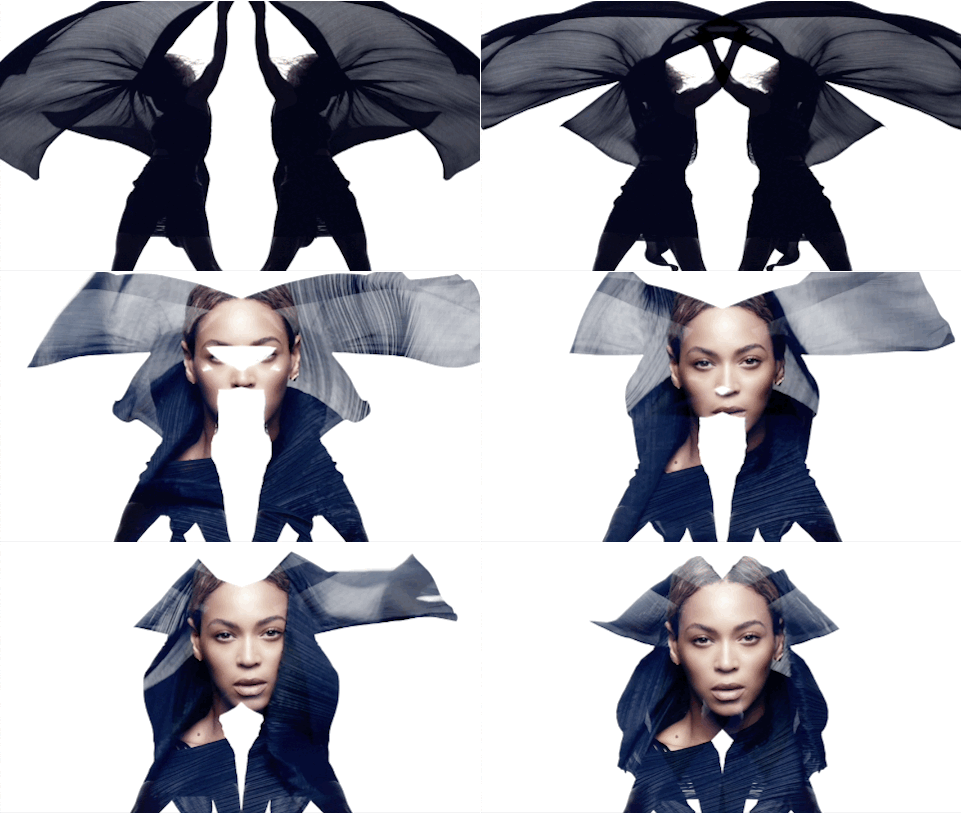
Because of my personal and professional interest in music videos, I consumed Beyoncé as she intended: a sequence of MPEG-4 videos rather than AAC audio files. But it was not until I solely listened to the album that I could discern Beyoncé’s maturation as a black female multimedia pop/culture artist. One refrain from “Haunted” was especially effective:
I know if I’m onto you, I’m onto you/ Onto you, you must be on to me
The song’s ethereal quality is amplified by Boots (Jordy Asher), one of Beyoncé’s (then-unknown) collaborators with whom she shares “Haunted”’s writing and producing credit. The track builds slowly, supporting Beyoncé’s “stream of consciousness” delivery with layers of reverberation and waves of synth sounds like “Soundtrack” or the Roland TR-808 kick drum. Punches of bass accelerate the beat until Beyoncé riffs her explicit desire to create something more than a product:
The music winds to a halt, but the song is not over. Breathy, reverberating vocals transition the track and a piano is delicately introduced:
It’s what you do, it’s what you see
I know if I’m haunting you, you must be haunting me
It’s where we go, it’s where we’ll be
I know if I’m onto you, I’m onto you
Onto you, you must be on to me

At this point, the song “Haunted” is split into two videos: “Ghost” (directed by Pierre Debusschere) and “Haunted” (directed by Jonas Åkerlund). The videos’ visual differences exemplify the various points of view—from active subject to object of desire and back again—employed across Beyoncé. “Ghost”’s hypnotic visuals underscore the song’s sentiments: close-ups of Beyoncé’s immaculately lit visage soberly mouthing lyrics are intercut with medium shots of her still body swathed in floating fabric and wide shots of her athletic movements against sparse backgrounds. The ar/rhythmic cuts of “Ghost” enunciate an artistic dissatisfaction with the industry: visuals build against/with the synthetic beat, mixing Beyoncé’s kinetically intense movements with her deadpan delivery.

The fiery agency of “Ghost” sets up the chill of “Haunted,” a voyeuristic tour in which Beyoncé watches and is watched. The “knowing-ness” of her breathy refrain (“I know if I’m haunting you”) is heightened when the tempo accelerates in the song’s second half. There is much to say about “Haunted”—from the interracial family of atomic bomb mannequins to Beyoncé’s writhing boudoir choreography. Most significantly, she is the video’s voyeur and object of surveillance: her face appears on multiple television screens and her voyeur-character is regularly captured on closed-circuit footage. The “Haunted” video soundtrack features the foley and stinger sounds of a horror film, but these surveillance shots feature the low whirr of a film projector rather than silence. The silence of a moving image is so jarring that it compels us to watch differently, so much so that “silent” film scenes utilize a recorded sound of “nothing” (“room tone”) to focus the audience.
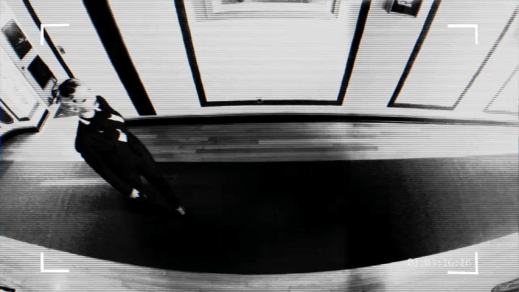
When Beyoncé finally resounded the silence of the “elevator incident,” she chose to do it through “***Flawless,” her explicit response to anti-feminist accusations. While the multifaceted anthem gained attention because of Chimamanda Ngozi Adichie’s audio, the song is uniquely infused with a kind of docu-visuality thanks to Ed McMahon’s well-known voice and the Star Search jingle. These bookends cite a young Beyoncé losing to an all-male rock band, the kind heavily programmed during MTV’s early days. The clips reinforce the album’s critique of racial and gender hierarchies while questioning the double-edged “work ethic” required to surpass them. Of course, Beyoncé pre-emptively frames this discussion for us in “Self-Titled,” a necessary step that helps audiences appreciate the many moving parts of her tour de force, including her creative business mind.So when Beyoncé swapped the audio of Adichie and McMahon for Nicki Minaj, it was no less of a feminist move. Instead, Beyoncé silences TMZ gawkers:
Of course sometimes shit go down/
When it’s a billion dollars on an elevator
She then offers herself as a medium of empowerment. Beyoncé may be part of a billion-dollar empire, but she willingly shares that pleasure with us:
I wake up looking this good
And I wouldn’t change it if I could
(If I could, if I, if I, could)
And you can say what you want, I’m the shit
(What you want I’m the shit, I’m the shit)
(I’m the shit, I’m the shit, I’m the shit)
I want everyone to feel like this tonight
God damn, God damn, God damn!
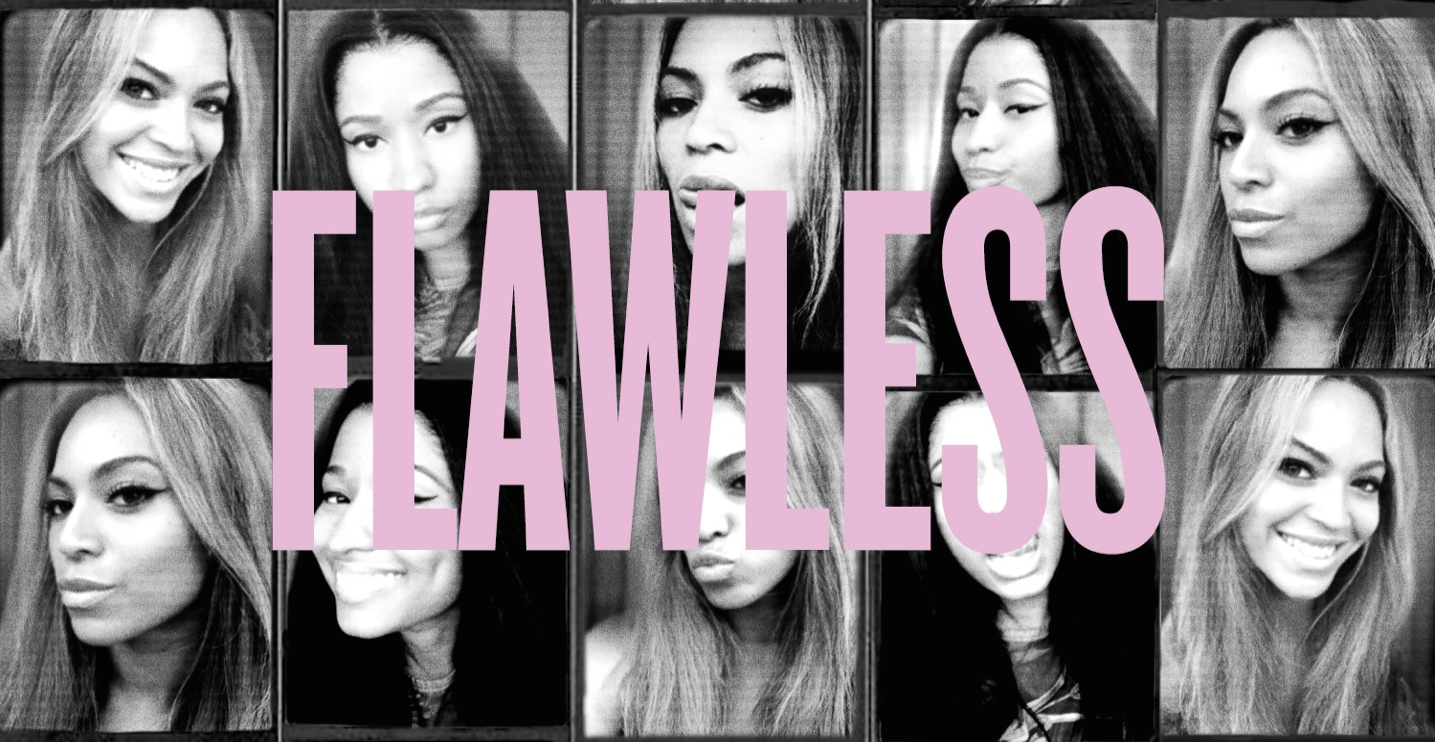
Beyoncé’s last word is an image. She and her creative team remixed the visuals of the “elevator incident”: the remix single website features black and white photos of Beyoncé and Minaj, simultaneously evoking surveillance footage and the photo booth images of a girls’ night out. Beyoncé is the work of an artist who has spent her career watching us watch her: this minor moment exemplifies Beyoncé’s multimedia resonance as an artist whose power is visible and audible across iTunes and TMZ screens alike.
Thanks to Elizabeth Peterson, Charise Cheney, Loren Kajikawa, André Sirois and Jennifer Stoever for providing research and intellectual support for this essay
Priscilla Peña Ovalle is the Associate Director of the Cinema Studies Program at the University of Oregon. After studying film and interactive media production at Emerson College, she received her PhD from the University of Southern California School of Cinema-Television while collaborating with the Labyrinth Project at the Annenberg Center for Communication. She has written on MTV, Jennifer Lopez, and Beyoncé. Her book, Dance and the Hollywood Latina: Race, Sex, and Stardom (Rutgers University Press, 2011), addresses the symbolic connection between dance and the racialized sexuality of Latinas in popular culture. Her next research project explores the historical, industrial, and cultural function of hair in mainstream film and television. You can find her work in American Quarterly, Theatre Journal, and Women & Performance.
—

REWIND!…If you liked this post, check out:
Aurally Other: Rita Moreno and the Articulation of “Latina-ness”-Priscilla Peña Ovalle
Music Meant to Make You Move: Considering the Aural Kinesthetic–Imani Kai Johnson
Karaoke and Ventriloquism: Echoes and Divergences–Sarah Kessler and Karen Tongson
—
Share this:

SO! Reads: Deborah R. Vargas’s Dissonant Divas in Chicana Music: The Limits of La Onda


DOI: https://doi.org/10.59350/q7q6x-gc538
Deborah R. Vargas’s Dissonant Divas in Chicana Music: The Limits of La Onda (2012) presents an alternate story of Chicana music through a collection of case studies in Chicana/o music history centering on Chicana/Tejana musicians active between the early decades of the 20th century to the present. Vargas assembles a mix of archival documents, interviews, images, songs, recordings, performances, ephemera, fragments, memories and engages intersectional feminist theory and queer of color critique to trace the music scenes her subjects inhabit.
A feminist oral historian, Chicano/Latino cultural studies scholar, and Associate Professor of Ethnic Studies at UC Riverside, Vargas’s research overlaps these disciplines and facilitates a conversation between popular music and sound studies that significantly considers gender, sexuality, and racialization in the construction of borderlands imaginaries. With Dissonant Divas Vargas makes an intervention both theoretical and methodological that greatly expands the Chicana/o musical archive and as well as the audiences for sound studies research. Furthermore, Vargas’s reflective writing voice locates her own Tejana/Chicana story in relation to her project and offers helpful insights into her research process at key moments. [The brief essay titled “Selena, Jenni Rivera, Eva Garza—meditations on an author’s soundtrack” published on the Minnesota Press webpages for Dissonant Divas is a generous methodology piece that should be read along with this comprehensive, satisfying, highly readable and often riveting text.]

Vargas defines the term, la onda, in a general sense as “an umbrella term for Mexican American/Chicano/Tejano music (x).” More critically, la onda also “operates to represent musics that have been prominent in academic and cultural sites that have produced dominant discourses of sexuality, gender, class, race, geography, and language in the constructions of Chicano music.” “Dissonance” can be understood variously as “chaos, cacophany, disharmony, static” and “out-of-tuneness” that draws attention to “the power of music with regard to Chicana gender and sexuality (xiv).” Vargas’s main critique notes how the “limits of la onda” reveals the heteronormative and patriarchal underpinnings that construct dominant narratives of Chicano music historiography. She argues that the force of these narratives have naturalized a way of thinking about Chicano music in terms of the various “fathers” of Chicano rock, conjunto music, and of the field of borderland studies itself. The distortions produced by the assimilating cultural nationalist logic of “la onda” have not only suppressed Chicana music histories and/or enabled their mishearing, but they also hide the complex ways that race, class, gender, and sexuality converge to produce Chicana subjectivities within and against the Chicano musical canon. In theorizing “dissonance,” Vargas thus productively sounds the Chicana histories in Dissonant Divas as alternatively gendered and/or queered against the heteromasculine concord of la onda.
The chapter “Borders, Bullets, Besos: The Ballad of Chelo Silva” contains perhaps the most provocative pages, detailing Chelo Silva, a bolero singer with a distinct repertoire of songs that are still performed and kept alive by a diverse lineage of performers and audiences, yet whose renown is seemingly inseparable with her former marriage to Américo Paredes. Ubiquitous in borderlands studies, Paredes’s name and legacy are defined largely by his study of the corrido, With His Pistol in His Hand: A Border Ballad and Its Hero (1970). Vargas strategically positions Silva and Paredes as “embodied representations” of the bolero and the border ballad, respectively, taking up Sonia Salídvar-Hull’s proposal to “imagine new corridos” by proposing Silva’s boleros as “feminist border ballads.” Vargas parses the constructions, aesthetics, and values carried in each song form, exploring how the border ballad has been the primary counter-site for narrating the injustice of Tejano/Anglo conflict (bullets) while the bolero, whose constant subject is love, luxuriates in all its jouissance (besos). Vargas reveals that the border ballad “has allowed its authors, singers, and scholars to sound the borderlands imaginary into being,” illuminating how the contest over historical representation is tied to musical representation. Silva’s story cannot be found within this articulation of la onda without, in part, redefining the border ballad (54).
Vargas innovates and meticulously crafts an alternative archive better suited to narrating and hearing Silva’s fragmented story, what Vargas felicitously calls her archisme of knowledge. Engaging the silences in Silva’s story, the archisme sounds her presence in the recorded memories of her fans which include testaments to her unique vocal qualities, her powerful and evocative performances, her improvisations in music and in life,,along with a healthy amount of the chisme or gossip surrounding Silva. Proposing the archisme as a “feminist project for historicizing nonnormative Chicana/o genders and desires” Vargas extends both Sonia Saldivar-Hull’s directive for Chicana scholars to look in nontraditional places for theory and Lisa Lowe’s theorization of gossip as a destructuring site of knowledge production (Saldivar-Hull, 1998; Lowe, 1996).
As I read through the first three chapters, a question that kept coming up concerned why we should not consider this study on more specific regional terms, or why this book isn’t titled, “Tejana Divas”? Vargas finds the overdetermination of these Chicana/Tejana musicians as “regional” subjects a problem not typically encountered by musicians from a city like Los Angeles, for example, because of its construction as a global metropolis. I cannot dispute Los Angeles’s status as a world center and I wondered how to earnestly engage Vargas on this point. What are the stakes of locating this study of Tejana/Chicana musicians within a broader Chicano/a musical context?
The final two chapters make the case for remapping Chicana music, advanced in part by the capacious notion of queer “diva-scapes.” In “Sonido de las Americas: Crossing South-South Borders with Eva Garza,” Vargas employs what she calls a “transfrontera musical compass,” a feminist methodology deftly juxtaposing the notion of a “musical scale” with the concept of “geographic scale.” Eva Garza’s career begins in her San Antonio hometown but she eventually came to embody the “la vóz de las Américas” in a hemispheric sense via her participation in early Spanish language radio, recordings, and live performances in nightclubs and films that took her to Mexico City and Havana for significant periods; her genre-crossing repertoire mirrored her travels. Garza began as a singer of the appropriately feminine bolero, but through her contact with Cuban musicians, the Afro-Caribbean guaracha song–decidedly phallocentric and risqué in its subject matter–also became part of her repertoire. The song she was most known for, “Sabor de Engaño” adds a sensual register to her transfrontera compass, a lingering sabor or taste exceeding regional, national, formal, and gendered limits. This is most evident in the repeated examples of impromptu performances of a song verse or refrain of “Sabor de Engaño” by many Cubanos Vargas encountered in her research travels. Vargas employs the transfrontera musical compass as a “listening instrument” to trace Garza’s musical trajectory through spatial-temporal moments disrupting rigid and normative notions of community, nation, and Chicano music (147).
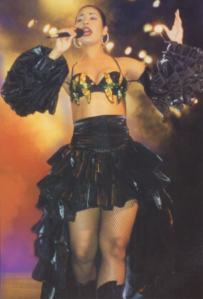
In “Giving Us That Brown Soul: Selena’s Departures and Arrivals,” Vargas addresses the multiple problems in the mainstream media’s designation of “crossover star” to narrate Selena’s story as a spectacular rise in fame marked by her violent death in 1995. Vargas seeks to correct the assimilationist narratives of Selena’s musical history that, in addition to figuring her as a marginalized Latina on the verge of “legitimate” status, problematically narrates a south-north trajectory “devoid of blackness and queerness.” Vargas both critiques how “brown soul” has been musically deployed to stand in for cultural nationalist “brown power” and extends previous work focusing on blackness in Chicano/Latino music that includes R&B and Afro-Caribbean influences but not necessarily the Afro-diasporic. Cumbia, an Afro-Columbian dance form popularized in Mexico in the 1940’s – 50’s is central to Selena’s Tejano sound as are 70’s era disco and 80’s freestyle, particularly in the cultivation of her iconic diva look which together resonate a queer of color musical legacy on the sonic and visual planes.
Selena’s “brown soul” and style moves Tex-Mex cumbias in what Vargas calls “queer misdirections” by traveling north-south, for example, while sounding counterhegemonic femininities that continue to reverberate in the many tribute drag performances to Selena in and beyond the borderlands of Tejas. In these ways, Vargas traces the “topography of Selena’s transformations and remappings of Chicano music (205). Just as audio technologies have been key in circulating Eva Garza’s and Selena’s music in multiple directions, so are the memories, repeated performances, and queer embodiments of their music by their diverse audiences. For both of the these artists, sound expands Vargas’s engagement with spatialization theories so that we may hear these productive dissonances and in these ways begin to imagine alternative borderlands imaginaries.
Upon finishing, a question that remains in considering “diva dissonance” is the implied consonance of Vargas’s theorization of “la onda.” At times, the term becomes too totalizing, and I would argue for the presence of heterogeneity and other musical diversities even within what Vargas denotes as la onda. We must both make and leave room to imagine the possibility of many unrecorded, captured, or yet unsounded transgressions for Chicanas whose paths may appear to follow a heteronormative logic. For this reason I found the reiteration of such rich findings against la onda asomewhat repetitive distraction from the richer tales Vargas’s archival work tells. What would these histories sound like if they weren’t always positioned against la onda—if they were sounded instead more toward each other?
What Deborah R. Vargas richly accomplishes in Dissonant Divas responds to Alejandro Madrid’s call for musicologists to establish critical conversations beyond “the conservatory” and to engage larger intellectual dialogues (AMS Vol. 64, No. 3, 2011).Vargas’s intersectional feminist-of-color argument extends the body of feminist Chicana/o cultural studies scholarship and equally extends Chicano music histories that may engage gender to some degree but do not fully interrogate those categorical constructions. Her theorization of the title’s key term “dissonance” as “both a methodological and analytic device” and her construction of a differential archive combine to create “alternative sonic imaginaries of the borderlands (xii).” More broadly, Dissonant Divas is an intervention to the problems of conducting research in marginalized communities and the racialized subjects often left out of official archives, institutional records, and studies of sound (Trouillot, 1995; Taylor, 2003). Each chapter reveals and addresses various barriers to conducting research on Chicana musicians whose uneven historical representation lead Vargas to turn to other sites, methodologies, and embodied practices where Chicana voices resound across temporal and spatial lines. In these ways, Vargas’s sustained engagement of race, class, gender, and sexuality with Chicana/o borderlands music is thoroughly new.
—
Featured Image: Pauline Oliveros by Flickr user Horacio González Diéguez, CC BY-NC-SA 2.0
—
Wanda Alarcón is a doctoral candidate of Comparative Ethnic Studies with a Designated Emphasis in Women, Gender, and Sexuality at the University of California, Berkeley where she is writing a dissertation titled: “Sounding Aztlán: Music, Literature, and the Chicana/o Sonic Imaginary”. Her research interests include Chicana/o cultural studies, U.S. ethnic literatures, popular music, sound studies, queer of color theory, and decolonial feminism. At Berkeley she has facilitated the working groups, “Decolonial Feminisms” and “Popular Music in Chicana/o Cultural Studies” at the Center for Race and Gender (CRG). Wanda is originally from Los Angeles and before starting graduate school she created the poetry zine, JOTA (2002 – 2006) and is updating that project by creating an archive for queer Chicana writing in cyberspace. She is a fan of radio genres and podcasts and writes micro radio plays while on the road. She is suspicious of the MP3 format yet enjoys curating party, tribute, and mood themed playlists on Spotify immensely. You can find her on Twitter depending on writing deadlines @esawanda.
—

REWIND! . . .If you liked this post, you may also dig:
Chicana Radio Activists and the Sounds of Chicana Feminisms— Monica De La Torre
Could I Be Chicana Without Carlos Santana?— Wanda Alarcon
Listening to the Border: “‘2487’: Giving Voice in Diaspora” and the Sound Art of Luz María Sánchezˆ— Dolores Inés Casillas
—
Share this:




Current Top Posts





April 2021

January 2020

November 2019

October 2019

August 2019

April 2014

November 2017

March 2015

December 2017

October 2015


Recent Comments