
Evoking the Object: Physicality in the Digital Age of Music

In our current relationship with technology, we bring our bodies, but our minds rule–Linda Stone, “Conscious Computing”
DOI: https://doi.org/10.59350/52w8z-60015
I begin with an epigraph from Linda Stone, who coined the phrase ‘continuous partial attention’ to describe our mental state in the digital age. The passive cousin of multi-tasking, continuous partial attention is a reaction to our constantly connected lifestyles in which everything is happening right now and where value is increasingly equated with our ability to digest it all. Almost everything we do has the potential to be interrupted, be it by an email, a text or a tweet; often we will give only partial attention to any one thing in anticipation of the next thing that will require our attention. In this internal fight for mental attention, listening to music has been seriously impacted.
The digital era has seen more music releases than ever before. Unfortunately, the massive influx of quantity is by no means a measure of how we are engaging with said music. iPhones and similar devices, for which music players have become mere features, enable listening to become a thing of partial attention. From allowing the shuffle or random modes to choose music selections for you, or even streaming music algorithms to calculate things you might like, to listening while playing Angry Birds or reading your Twitter stream, less commitment is made to the act of listening, and as such only a portion of our working memory is committed to the experience. Without working memory actively processing musical information, it is less likely to be stored for the long term, particularly if other information is continuously vying for space and attention.

These days video games sell better than music. Despite being a digital product, games are able to instill memories (even of the music) into one’s consciousness, because the game interface allows our sensory memories to work together in an active manner with the medium. Iconic memory stores visual cues from the game, echoic memory takes the audible cues from the game and the haptic memory is engaged in controlling game play. There is only so much more which can be done while playing a video game. If something were to interrupt game play, the game would be paused to address the new information rather than giving it partial attention. This is quite different from music which plays a background role in so much of our lives even when we are actively putting music on we tend to only engage it with partial attention.
When I began thinking about turning Concrète Sound System into a record label, one of my main goals was to create works that could engage the audience in active musical experiences that could create long term memories. I felt that as important as the music would be, it would take something material to create these memories, a physical product more evocative of earlier moments in recording history than the CD, its most recent gasp. I wondered if, by creatively evoking the physical object, the listener could be engaged in an active manner that would enable the memory of music and its power to persist through the everyday waves of digital noise.
The first mass duplicated audio medium was the Gold Moulded Edison Cylinder at the turn of the twentieth century. Imagine two cylinder copies of one of these recording today, as musical objects. Each of them would have over a hundred years of physical history. From the wear of the cases to the condition of the wax based on the temperature in which they were stored, each of these cylinders would be unique musical objects, with completely different histories, despite having the same origin. It is reasonable to assume that if the cylinders were played today on the same playback device, despite the fact that the compositions and performances are exactly the same, the differences between the recordings would be audible.

Even without a century of history, there would likely be audible differences between the cylinders. If one cylinder was the first copy made, and another the 150th –master cylinders of Gold Moulded Edison Cylinders could only produce 150 copies reliably–the physical wear in the process of reproduction would leave its own imprint, making each of those copies distinct musical objects. In the analog world, as the technology improved the differences between copies decreased substantially. Cassettes were manufactured in batches of ten to hundreds of thousands without audible differences. But even in circulations so high, over time each of those analog copies took on their own identity and collected their own memories.
The listener as an active agent contributed to the development of these unique musical objects. After a purchase, any number of variables played into the ritual of the first experience of the music. Was there a way to listen upon walking out of the store? Were there liner notes or lyric sheets inside? Would you read those prior to listening or as you listen? Where would you listen? Through headphones? The listening chair in front of the hi-fi stereo? Or on the boombox with some friends? All of these possibilities shaped memories as musical objects that defined the music consumption culture of the past.
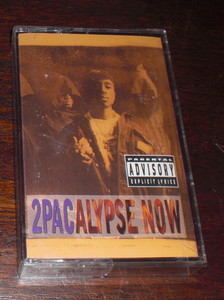
For example, I bought the debut 2Pac album 2Pacalypse Now on cassette the day it was released. I loved the album so much I kept it in regular rotation in my Walkman for months until finally the tape popped. Rather than go out and buy a new copy I decided to perform a surgery. It was in a screwless reel case which meant I couldn’t just open it up to retrieve the ends of the tape trapped inside, but rather had to crack the reel case open and transplant the reels into a new body. So, my copy of the 2Pacalypse Now cassette is now inside of a clear reel holder with no visual markings. It also has a piece of tape that was used to splice it back together, which makes an audible warp when played back. I can pretty much be sure that there is no other copy of 2Pacalypse which sounds exactly like mine. While this probably detracts from the resale value of the cassette (not that I’d sell it), it is imbued with a personal history that is priceless.
Cassettes, in particular, played a significant role in the attachment of physical memories to music beyond the recordings they held. They gave birth to the mixtape. The taper community was born from personal tape recorders that allowed concert-goers to record performances they attended, and, prior to the rise of peer to peer sharing online, these communities were trading tapes internationally via regular postal mail. European jazz and rock concerts were finding their way back to the states and South Bronx hip-hop performances were traveling with the military in Asia. All of these instances required a physical commitment with which came memories that inherently became their own musical objects.
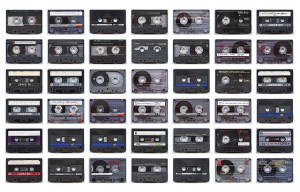
Needless to say the nature of musical exchange has changed with the rise of the digital age of music. This is not to say that memories as musical objects have gone away, but they are being taken for granted as the objects lose their physicality. I remember going to The Wiz on 96th Street with $10 to spend on music. I spent at least ten minutes trying to decide between Sid and B-Tonn and Arabian Prince. I ended up with Arabian Prince and have regretted it since I got home and listened that day, as I never found Sid and B-Tonn for sale again. Today I could download both in the time it took me to walk to the train station. After skimming through the first few songs of Arabian Prince I could decide it was not for me and drag drop it in the trash where the memory of it would disappear with the files. No matter how I felt about the music then, the memory of it is a permanent fixture in my mind because of the physical actions it took to listen.
The first release for Concrète Sound System, Schrödinger’s Cassette, tackled this issue head on by presenting the audience with its own paradox, an update of physicist Erwin Schrödinger’s famous Thought Experiment, where the ultimate fate of the cassette inside is left up to the individual. Schrödinger’s Cassette sought to take listeners out of digital modes of consumption by using an analog medium to evoke the physical. The cassette release trend has been growing over the last few years, almost in parallel to the rise of the digital music and speaking to the need to separate music from our digital lives and to a desire to work harder for it. At the minimum, listening to a cassette requires having a cassette player, and acquiring one these days takes commitment. Unlike digital media, listeners cannot instantly skip a song on a cassette or put a favorite on repeat. It takes physical manipulation of the medium to move through its songs and doing so is a time investment. All these limitations make the cassette a medium that is best for linear listening, from beginning to end (unless you physically cut, rearrange, and splice it yourself).

Schrödinger’s Cassette took the required commitment a step further by encasing the cassette itself in industrial grade concrete. This required the user to actively crack the concrete (or the french concrète meaning ‘real’, from which the label derives its name) in order to listen to the music. The paradox is that, depending on the listener’s method for cracking, harm could be done to the cassette that might render it ‘unlistenable’. Upon receiving one of these pieces, the listener holds in their hands a musical object which they must physically act upon in order to create an unrepeatable musical event. Schrödinger’s Cassette has a look, a sound (if shaken you can hear the cassette reels), a feel, a smell, and a taste as well (though I wouldn’t advise it). All of the senses can be actively focused on the object and, as such, the whole of one’s working memory is engaged in the discernment of the object’s musical contents.

For many, Schrödinger’s Cassette was taken as a work of art and left uncracked. The Wire magazine successfully cracked one edition open, revealing a portion of the musical contents on their regular radio program. For those that decided not to crack it, digital versions were made available so that they could listen, though this option was only made available after the listener spent some time with their physical object. In this way, the music from the project, a compilation called Between the Cracks, was directly connected to physical memories spurred by a material presence.
Triggering active memory during the consumption of music through physical objects need not be this complex. Old medium such as vinyl and cassette releases inherently have the physical properties required without the concrete or much else. Perhaps for this reason they show new signs of life despite the rise of digital. No matter how much our reality is augmented by our digital lives, we still inhabit those bodies that we bring with us, and, as far as the memories those bodies carry with them go, physicality rules.
—
Featured Image: Wax Cylinders in the Library of Congress, Image by Flickr User Photo Phiend
—
Primus Luta is a husband and father of three. He is a writer and an artist exploring the intersection of technology and art, and their philosophical implications. He is a regular guest contributor to theCreate Digital Music website, and maintains his own AvantUrb site. Luta is a regular presenter for the Rhythm Incursions Podcast series with his monthly showRIPL. As an artist, he is a founding member of the live electronic music collectiveConcrète Sound System, which spun off into a record label for the exploratory realms of sound in 2012.
—
Share this:

Sound + Vision: Andy’s Mick
Hello Internet! It’s great to be here in cyberspace! Are you ready to rock? Today’s dispatch from our Spring Series, Live from the SHC, finds Cornell’s Society for the Humanities Fellow Eric Lott jamming it out on the relationship between the early 70s sound and vision of one Sir Mick Jagger. If you happen to be thinking that Monday morning at 9:00 a.m. is the least rock and roll time slot possible, just remember that’s when Jimi Hendrix gave “The Star Spangled Banner” the business at Woodstock. To give earlier installments by Damien Keane, Tom McEnaney, and Jonathan Skinner a listen, click here. As May comes to a close and the “Sound: Culture, Theory, Practice, Politics” fellows reluctantly break up the A.D. White House house band, look for our final two dispatches from Jeanette Jouili and Society Director Tim Murray. Until then, we’ll keep turning it up to 11 here at Sounding Out! –JS, Editor in Chief (and 2011-2012 SHC Fellow)
—
DOI: https://doi.org/10.59350/qtpg6-4b336
After we left the Carlyle I told Jerry I thought Mick had ruined the Love You Live cover I did for them by writing all over it—it’s his handwriting, and he wrote so big. The kids who buy the album would have a good piece of art if he hadn’t spoiled it. –Andy Warhol
Andy Warhol’s complaint in his Diaries captures the almost cartoonish play for artistic control between himself and Jagger in the 1970s—between painter and singer, portrait artist and subject (Jagger and the other Stones biting each other), the visual and the verbal (“he wrote so big”!): between sight and sound in the realm of popular music. Warhol was no stranger to sound artistry, of course, from his work with the Velvet Underground to the everyday taping he did with his portable cassette recorder, the machine he called his “wife.” But Warhol as visual conceptualist returns us to a moment when, through album art and other commercial iconography, the visual domain shaped our sonic experiences perhaps more immediately than it does in these digital days. At the recent EMP conference in New York, I raised the question of the visual/conceptual from the perspective of sound, looking and listening to how the modalities were conjoined during an excellent and rather brief (and nowadays mostly scorned) passage of Jagger time in the middle 1970s: Jagger in his thirties.
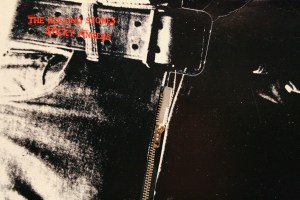
A funny thing happened after Exile on Main St. in the early 1970s: the Rolling Stones became a New York band instead of a London and L.A.-based one, and their frontman Mick Jagger, always an outlandish presence, became a swishier one. The manner in which this happened owes a lot to their encounter with Andy Warhol. From his cover designs for Sticky Fingers (1971) and Love You Live (1977) to the Stones’ renting of his Montauk house to rehearse for their 1975 tour to conspicuous late-70s hanging out together at Studio 54 and New York dinner parties of the rich and not so fabulous, it’s clear the Stones, or at least Jagger (and for sure his wives, Bianca and Jerry Hall), steered ever closer to Warhol’s orbit.
Good writing about the Stones’ New York phase has recently begun to appear, including Cyrus Patel’s 33 1/3 book on Some Girls (2011) and Anthony DeCurtis’s liner notes to that record’s 2011 deluxe re-release; Ron Wood’s Ronnie: The Autobiography (2008) opens with the band’s famous promo stunt playing on the back of a flatbed truck rolling down lower Fifth Avenue on 1 May 1975 to advertise their upcoming tour.
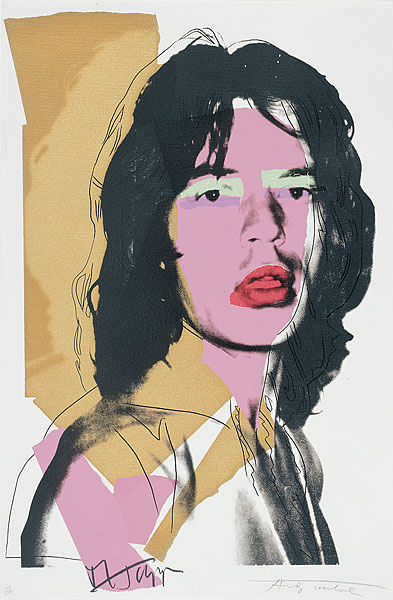
.But the influence on them of the Andy aesthetic has gotten far less attention, at least in pop music criticism (the Warhol Museum mounted a show, Starfucker: Andy Warhol and the Rolling Stones, in 2005, full of great stuff). In particular, Warhol’s 1975 Ladies and Gentlemen black drag queen series, and the draggy portrait series of Jagger done at the same time and in the same way, attest to their mutual influence on each other. The gain for the Stones was exponential: a new persona for a new decade and indeed a new town.
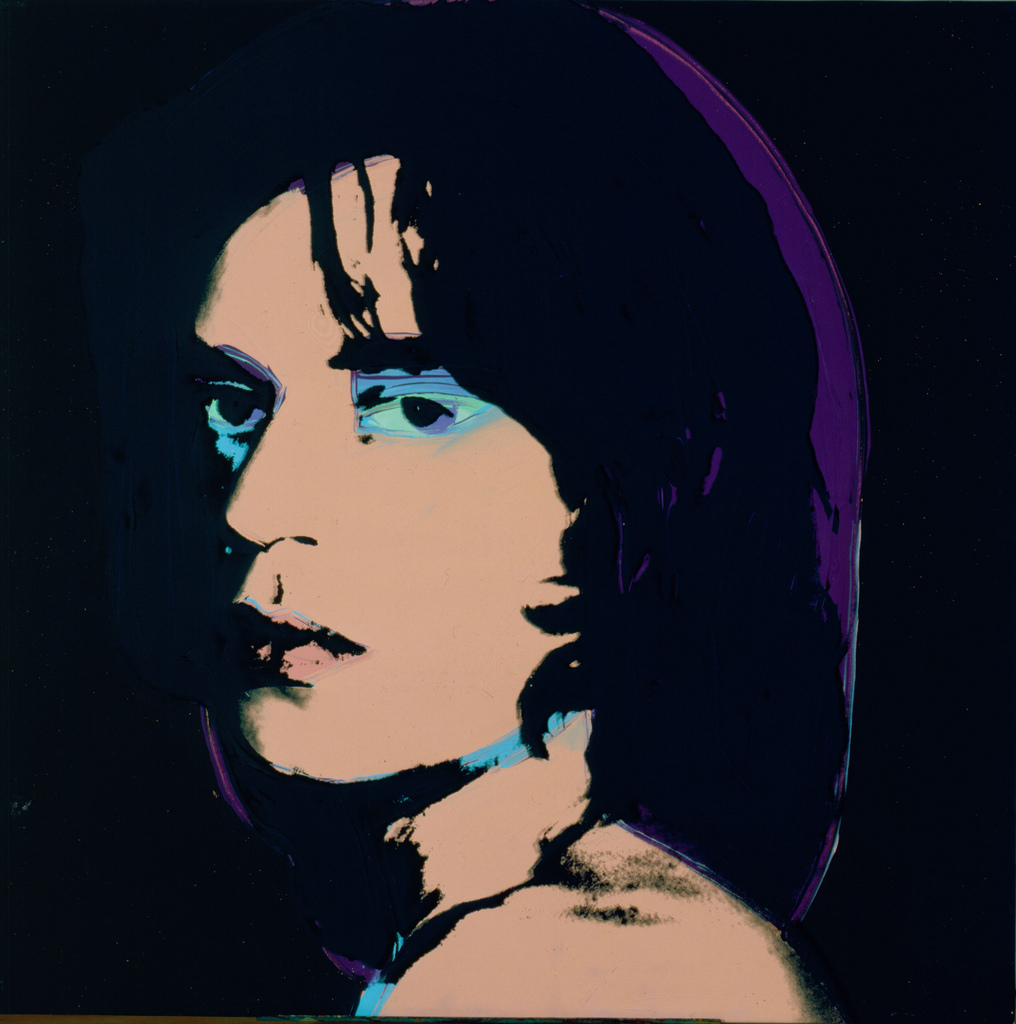
The persona as influenced by Warhol arrives at the nexus of drag, hustling, and stardom, and Jagger in the 70s can be seen to be addressing and/or capitalizing on all three. Warhol’s Ladies and Gentlemen was originally referred to as simply the Drag Queen series. As Bob Colacello tells the story in Holy Terror: Andy Warhol Close Up, some Factory workers were sent to the Times Square gay bar The Gilded Grape to hire several hustlers there to sit for some Warhol Polaroids for fifty dollars a pop. (They later quipped that they were used to doing a lot more than that for fifty bucks.) As was his practice at the time, Warhol transferred these images to silkscreen for mechanical reproduction, over (or under) which he painted in unusually expressive fashion, at times applying collages of torn paper as well. Geometries of color in these pictures war with the photographic image; they signify on race as well as the drag queen’s everyday glamour and its defensive-aggressive thrust-and-parry. In any case, Times Square hustlers of color became stars in Andy’s hands. At this point the title was changed to Ladies and Gentlemen—perfect, since his subjects in the works can be thought of as both—and it may be that the title was taken from the 1974 Stones film of their celebrated 1972 tour, Ladies and Gentlemen, the Rolling Stones (it’s worth recalling lest we be tempted to discount such a film that almost everyone in a broad swath of the New York milieu saw it—in Just Kids (2010), for example, Patti Smith writes of seeing the film with Lenny Kaye and then going off to CBGB to catch a set by Television). What is certain is that Warhol at this same moment was giving Polaroids he had taken of Jagger in Montauk the exact treatment he gives the drag queens in Ladies and Gentlemen.
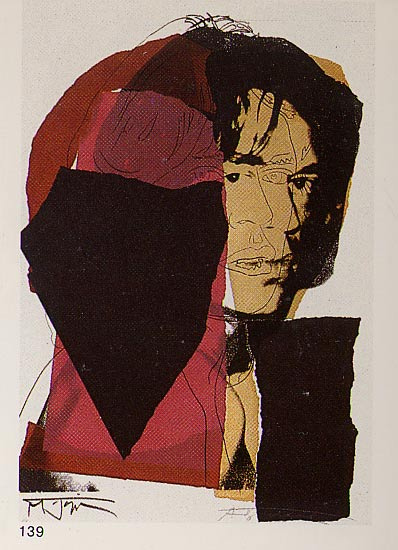
Being a drag queen is really hard work, Warhol famously wrote in The Philosophy of Andy Warhol (1975), and it is in part the connections between hard work, its celebrity remuneration, drag, and prostitution that link the Ladies and Gentlemen series with the portraits—paintings and then prints—of Jagger. These connections link this output with Warhol himself, making the portraits a sort of displaced self-portraiture. Their mechanics, if you will, seem homologous with drag, in fact. Starting with the Warhol-snapped Polaroid—not, say, with newspaper photos or commercial iconography as in Warhol’s 60s silkscreens—the works depend on Warhol’s presence, which then puts the images through the silkscreening process, after which (or before it) an uncharacteristically painterly (or collagist) procedure is applied, the latter akin to make-up itself. Where in some of the series the paint obscures the face, acting as a kind of negation or comment on the negation behind black queer hustling, in most of it the faces rise to a new form of presence or fabulousness, as if by repeating the act of drag the portraits affirm its “success.” Warhol’s make-over of Jagger, meanwhile, both drags the singer and makes him Warhol’s: Andy’s Mick.
According to a scheme worked out by Warhol and Jagger, the latter signed the portraits so that they could promote both artists. Which, if it doesn’t exactly make Jagger a co-author of the works, does signal his endorsement of Warhol’s vision of him. (Indeed the Warhol Museum has a facsimile of a 1983 letter from Jagger to Warhol asking for his assistance with Mick’s autobiography—a collaboration that boggles the mind.) As John Ashbery had it in Self-Portrait In a Convex Mirror, his multiple-prize-winning long poem of 1975:
Your [the artist Parmigianino’s] eyes proclaim
That everything is surface. The surface is what’s there
And nothing can exist except what’s there;
It [the surface] is not
Superficial but a visible core. . .
Your [Parmigianino’s] gesture . . . is neither embrace nor warning
But . . . holds something of both in pure
Affirmation that doesn’t affirm anything.
Not a bad definition of the Warholian image, this, and in the 1970s, as the Rolling Stones entered their second decade of performance and stardom, Jagger took the lesson and ran with it. A new self-consciousness about his own stardom enters Jagger’s (underrated) lyrics in the 70s; while self-reference is not unknown in the band’s 60s work (cf. 1968’s “Street Fighting Man”), and while one of their first hits takes on the culture industry itself (“Satisfaction”), in the 70s a new kind of meditation on rock-star celebrity enters the picture—I have seen the culture industry, and it is me: Jagger begins to write about himself as the culture industry. And this under the sign of Warhol, I think, which is to say, with a queerly knowing intimacy informed by a sense of the artist-star as a hustler for money in what we might call image-drag. Everything is surface, the surface is what’s there and nothing can exist except what’s there, and it’s not superficial but a visible core.
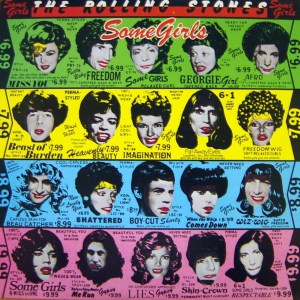
From 1973 forward, in the music from Goat’s Head Soup to Tattoo You (with It’s Only Rock n Roll, Black and Blue, Some Girls, and Emotional Rescue in between), and even more on the covers of these albums, culminating in the one for Some Girls with the Stones in drag—Andy in the Warhol Diaries: “[Mick] showed me their new album and the cover looked good, pull-out, die-cut, but they were back in drag again! Isn’t that something?”; the Some Girls cover, though Warhol didn’t do it, really does recall his drag queens, right down to the double drag of the inner-sleeve pull-out—to say nothing of the made-up glam of the 1975 and 1978 tour performances: in all this one sees a flouncier, queerer Mick, one that Jagger nodded to in various lyrics (for that demonstration you’ll have to wait for the longer version of this piece!). What this means in part is that the cliche we have of Jagger strutting like a neo-blackface soul man is due for revision: it’s much more precise to think of his aura as proximate to black femininity (icons like Tina Turner, say, who of course opened for the Stones), which he (re-)crafted through the adoption of a persona right out of Warhol’s colored drag queen sensibility.
.
So why the now-canonical assumption of the Stones’ decline at just this moment? Is their 70s sound discounted because of the queer reinvigoration of their visual/conceptual appeal? (One counter to this hegemony is Ellen Willis’s fine 1974 review of It’s Only Rock n Roll, included in her Out of the Vinyl Deeps.) Did the Stones’ sound change all that much, beyond new acquisitions of this reggae vibe or that funk riff or the other disco groove, or does the insistence on their fall come from a sense of their queening around? Is it this—not only this, I know, I know, Mick’s such an asshole, but still—that lies in part behind the (particularly post-Life) cult of Keith?
—
Eric Lott teaches American Studies at the University of Virginia. He has written and lectured widely on the politics of U.S. cultural history, and his work has appeared in a range of periodicals including The Village Voice, The Nation, New York Newsday, The Chronicle of Higher Ed, Transition, Social Text, African American Review, PMLA, Representations, American Literary History, and American Quarterly. He is the author of the award-winning Love and Theft: Blackface Minstrelsy and the American Working Class (Oxford UP, 1993), from which Bob Dylan took the title for his 2001 album “Love and Theft.” Lott is also the author of The Disappearing Liberal Intellectual (Basic Books, 2006). He is currently finishing a study of race and culture in the twentieth century entitled Tangled Up in Blue: The Cultural Contradictions of American Racism. This post is adapted from a talk Eric gave at the 2012 EMP POP Conference in New York City entitled “Andy’s Mick: Warhol Builds a Better Jagger.”
—
Share this:




Current Top Posts





April 2021

January 2020

November 2019

October 2019

August 2019

April 2014

November 2017

March 2015

December 2017

October 2015


Recent Comments