
“You’re. . .#noangel. . . either”: Uneasy Politics and Dissonant Sonics in Beyoncé’s “No Angel”

DOI: https://doi.org/10.59350/f068n-0zw14
This September, Sounding Out! challenged a #flawless group of scholars and critics to give Beyoncé Knowles-Carter a close listen, re-examining the complex relationship between her audio and visuals and amplifying what goes unheard, even as her every move–whether on MTV or in that damn elevator–faces intense scrutiny. In the coming Mondays, you will hear from Priscilla Peña Ovalle (English, University of Oregon), Liana Silva (Editor, Women in Higher Education, Managing Editor, Sounding Out!), Regina Bradley (writer, scholar, and freelance researcher of African American Life and Culture), and Madison Moore (Research Associate in the Department of English at King’s College, University of London and author of How to Be Beyoncé). Today, we #wakeuplikethis with Kevin Allred (Women and Gender Studies, Rutgers), who refuses to let us fast forward past the understated and discomfiting video track “No Angel.”–Editor-in-Chief Jennifer Stoever
—
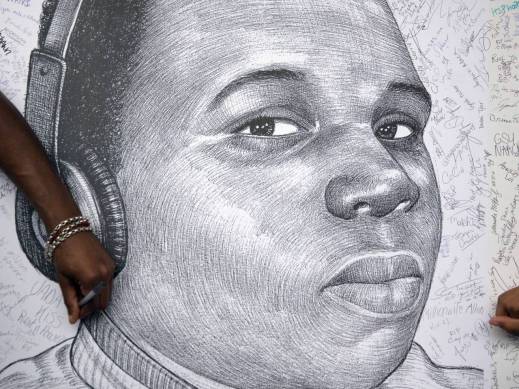
Michael Brown, an unarmed black teenager, was shot to death by white police officer Darren Wilson in Ferguson, Missouri on August 9, 2014, for no apparent reason [see author’s note below]. While the fact that the death of unarmed black men (and women and trans people) at the hands of those in power is, sadly, no unique occurrence, as Melissa Harris-Perry – among countless others – have pointed out, Brown’s death has sparked nation-wide outrage and protests about police brutality, racial injustice, and severely decreased resources for impoverished communities.
In the New York Times’ reportage on Brown’s death, reporter John Eligon found it appropriate to characterize the teenager as “no angel,” as if any amount of alleged wrongdoing or possible character flaws on Brown’s part somehow justified his murder. Both Eligon and the Times were called out on social media and in traditional publications such as the Atlantic, and, while the press quickly apologized, the phrase’s familiar interpellation of victims – especially when they are people of color – as “no angels” lingered: a journalistic gaze born of sympathy with white authority that invalidates an individual’s life, tarnishes their memory, and even rewrites histories.

A powerful counter discourse challenges these racist narratives, however; one we can hear in the dissonant sonics of Beyoncé Knowles-Carter’s “No Angel,” a song that anticipates–and adamantly refutes–the racist notion that people who live, and quite possibly die as Michael Brown did, are anything but valuable.
Released almost 9 months before Brown was killed, Beyoncé’s “No Angel” cannot explicitly be called a response, but the ghosts of black men–living and dead, unfairly judged and mistreated–haunt the entire song. “No Angel” begins with a slow-burning 4-count beat; a low, synthesized, slightly off-kilter kick drum sets the tone for the song while an eerily-lilting high-pitched synthetic warbling noise simultaneously pours out of the speakers. The sound, reminiscent of feedback, drifts between pitches for four painstakingly slow measures before Beyoncé’s vocals kick in. When they do, what we hear is unusual. Her voice reverberates in a breathy, almost too-high falsetto that sounds nothing like the soaring powerhouse vocals of “Halo” or “I Was Here;” nothing like the precise, punctuated staccato of “Single Ladies” or “Run The World (Girls);” and certainly nothing like any of the other songs on BEYONCÉ. Sonic and musical contradictions abound. Neither the kind of impressive falsetto showing a wide range, nor necessarily immediately pleasing to the ear, Beyoncé’s voice is forced. . .and it haunts. Further, the vocals seem to cut the time signature of the song in half, effectively doubling its pace. Its tempo, cadence and vocal dynamics signal “No Angel” as a very different kind of Beyoncé song, one forwarding a sonic and political statement over radio-readiness.
Admittedly, “No Angel” was not initially one of my favorite songs on Beyoncé’s new album. In fact, when teaching this song, most of my students – even the hardcore Beyoncé fans – admit sheepishly to skipping through it because of a feeling of discomfort mainly related to Beyoncé’s vocal delivery. But after a few listens, something clicks: “No Angel” is not supposed to be pleasant, easy listening, but rather it jars and unsettles, just like the impact of news of another unarmed black person killed by white police. We are neither supposed to immediately identify with the audio of “No Angel,” nor possibly even like it.
All about dissonance, the song’s innovation fuels itself with inconsistency and contradiction. Vocally speaking, there are incongruities between the highs and the lows (the bass and the treble or the bass and the soprano), and the abrupt shifts in pacing—the slow pace both in opposition to and contained within the faster pace of the song. Even the stretched and breathy falsetto Beyoncé puts on for most of the song strikes a dissonant chord. Simply put, dissonance is tension, and neither the sonic nor the political tension ends here.
.
Here’s the thing: we know Beyoncé’s voice doesn’t usually sound like it does on “No Angel.” It is a conscious manipulation. And when coupled with the refrain:
You’re no angel either baby
her voice even becomes a kind of accusation. If Michael Brown is “no angel;” if Beyoncé herself, as the singer and also as a black woman in a racist U.S. society, is also initially “no angel” then, Eligon in the NYT as Brown’s accuser and, by extension, we as the listeners, become “no angel either.” What’s more, Beyoncé ‘s delivery is so deliberately overdone that she can be heard taking deep breaths in between each word of the chorus – something most singers would attempt to hide. Beyoncé chooses instead to push it to the forefront of the recording, audibly projecting each word toward the listener; in effect, slapping us in the face with each syllable, driving that message/accusation straight home.
However, while this forum may be dedicated to the sonic qualities of Beyoncé’s work, I don’t believe we can completely divorce the sonic from the visual for “No Angel,” or anything on BEYONCÉ, as it was specifically marketed and publicized as audio and visual album. BEYONCÉ visual music experience is nothing knew to Beyoncé herself. As far back as Dangerously In Love, Beyoncé forwarded her belief “that harmonies are colors” on an interlude toward the end of the album. For her latest album, she went so far as to strike an exclusive deal with iTunes in which the album was only available as a complete package for the first week of its release – singles could not be purchased separately nor without videos (and vice versa). It would be a disservice to ignore the visual depiction of “No Angel,” directed by @LilInternet and its synaesthetic fusion of sound and sight.
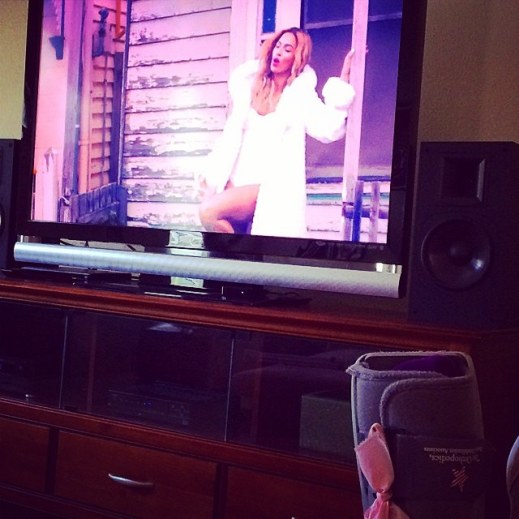
Just as the sonic qualities of the song provoke discomfort, unexpected imagery confronts the eye. First, the video is quite simply not about Beyoncé. She is rarely shown. Instead, Houston street culture and its struggles and poverty, represented largely through the faces of people of color, takes center stage. The video features mainly black men, although there are some images of black women throughout; a stark moment showing black women– raced and sexualized as “no angels”–working as strippers reveals an industry driven not by the agency/desire of the strippers themselves, but rather by the failures of capitalism that often offer few profitable choices to poor women other than sex work (as evidenced in the highlighting money shots/literal shots of money). But the video celebrates the lives of all theses alleged non-angels by showing small moments of happiness – a father smiling with his son; young boys flashing the peace sign with their fingers; sweet glances between lovers, community members proud to show off their jewelry and cars for the camera–redirecting the viewer’s attention to the structural inequality framing many of the images, provoking more voyeuristic viewers to reflect on their own responsibility and complicity in the systems that create poverty and segregation in the first place. Simultaneously, members of the Houston community–as well as diasporic Houstonians–can see themselves represented, even celebrated in the video, as opposed to the usual cinematic vilification and denigration of these very same bodies as “no angels.” Many Houston hop-hop legends appear in the video as well: Bun B, Scarface, Willie D, Z-Ro, and of course Beyoncé herself.
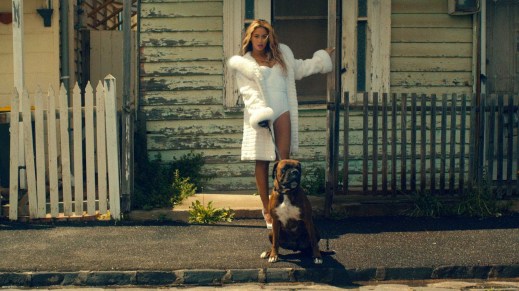
When the camera does linger on Beyoncé, it juxtaposes her iconic image–associated with the wealth and power of her celebrity status–with everyday people of her Houston hometown, including its most impoverished. Beyoncé, the residents, and the city itself stare the viewer down – actively challenging us to see both life and death, both living people and memorials to those, such as Michael Brown, who have died too young. The dissonant tension between life and death, encapsulated in Beyoncé’s voice and the video’s mirroring visuals: the high and the low; the rich and the poor; and the fraught gap in between.
Beyoncé tries to bridge this gap, both visually, through her self-representation in Houston, and sonically, particularly the moment when the refrain “you’re no angel, either. . .baby” finishes and she swings her voice down out of falsetto, into her more powerful full-out throat voice. It is assuredly no coincidence that during those moments she repeats the word “no,” over and over again. With that “no,” she objects to mainstream news vilification, anticipating and objecting to Michael Brown’s characterization as “no angel.” Her voice shifts from the high-falsetto – a sound serving the dual purpose of exposing the above dissonance AND acting as a caress to black communities in Houston, and Ferguson, and on and on – and moves into the heavy throat-voiced complaint and objection. “No, you will not treat my people this way. No, you will not treat ANY people this way,” her sound testifies. And, for viewers not represented in the video, that “you” is them–and she means that realization to feel uncomfortable. Beyoncé’s vocal dissonance and visual images force a confrontation with this accusation: it is not Michael Brown and those represented and celebrated in the video who are “no angels,” but the rest of us who fall short.
So, if we are “no angels, either” what do we do about it? Do we skip the track? Do we sit in front of our computer with the visual evidence of the failure of the American Dream staring us down as we groove to Beyoncé’s vocals? Do we turn off the news coverage in Ferguson, MO and pretend it’s not happening? Beyoncé’s voice provokes these uncomfortable questions and more: What does inequality sound like? What does hope and/or resolution/reparation sound like? Are they the same sound? This is a Beyoncé more in line with artists such as Nina Simone, who famously used her voice to express political critique, and not always in the most “pleasant” ways. “No Angel” is Beyoncé’s audio-visual “Strange Fruit,” positioning her alongside some of the most political and innovative protest singers of our time.
—
Author’s Note: At the time of Brown’s death, I had already been submitted this article. Due to the eerie coincidence between Beyoncé’s song “No Angel” and Eligon’s characterization of Michael Brown in the New York Times noted during the review process, I reworked the article to bring the two into conversation – which, in fact, they always were, even though I didn’t know it at the time.
—
Kevin Allred is a musician, activist, and teacher, currently at Rutgers University, where he teaches a signature course he created: “Politicizing Beyoncé.” He lives in Brooklyn, NY with his boyfriend and two elderly dachshunds. Join the Politicizing Beyoncé community at www.facebook.com/politicizingbeyonce. You can also find Kevin at www.kevinallredmusic.com and www.politicizingbeyonce.com.
—

REWIND!…If you liked this post, check out:
The (Magic) Upper Room: Sonic Pleasure Politics in Southern Hip Hop–Regina Bradley
Freedom Back: Sounding Black Feminist History, Courtesy the Artists–Tavia Nyong’o
“HOW YOU SOUND??”: The Poet’s Voice, Aura, and the Challenge of Listening to Poetry— John Hyland
—
Share this:

SO! Reads: Deborah R. Vargas’s Dissonant Divas in Chicana Music: The Limits of La Onda


DOI: https://doi.org/10.59350/q7q6x-gc538
Deborah R. Vargas’s Dissonant Divas in Chicana Music: The Limits of La Onda (2012) presents an alternate story of Chicana music through a collection of case studies in Chicana/o music history centering on Chicana/Tejana musicians active between the early decades of the 20th century to the present. Vargas assembles a mix of archival documents, interviews, images, songs, recordings, performances, ephemera, fragments, memories and engages intersectional feminist theory and queer of color critique to trace the music scenes her subjects inhabit.
A feminist oral historian, Chicano/Latino cultural studies scholar, and Associate Professor of Ethnic Studies at UC Riverside, Vargas’s research overlaps these disciplines and facilitates a conversation between popular music and sound studies that significantly considers gender, sexuality, and racialization in the construction of borderlands imaginaries. With Dissonant Divas Vargas makes an intervention both theoretical and methodological that greatly expands the Chicana/o musical archive and as well as the audiences for sound studies research. Furthermore, Vargas’s reflective writing voice locates her own Tejana/Chicana story in relation to her project and offers helpful insights into her research process at key moments. [The brief essay titled “Selena, Jenni Rivera, Eva Garza—meditations on an author’s soundtrack” published on the Minnesota Press webpages for Dissonant Divas is a generous methodology piece that should be read along with this comprehensive, satisfying, highly readable and often riveting text.]
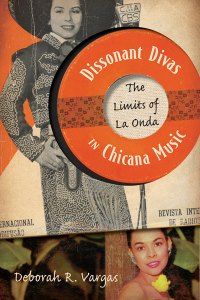
Vargas defines the term, la onda, in a general sense as “an umbrella term for Mexican American/Chicano/Tejano music (x).” More critically, la onda also “operates to represent musics that have been prominent in academic and cultural sites that have produced dominant discourses of sexuality, gender, class, race, geography, and language in the constructions of Chicano music.” “Dissonance” can be understood variously as “chaos, cacophany, disharmony, static” and “out-of-tuneness” that draws attention to “the power of music with regard to Chicana gender and sexuality (xiv).” Vargas’s main critique notes how the “limits of la onda” reveals the heteronormative and patriarchal underpinnings that construct dominant narratives of Chicano music historiography. She argues that the force of these narratives have naturalized a way of thinking about Chicano music in terms of the various “fathers” of Chicano rock, conjunto music, and of the field of borderland studies itself. The distortions produced by the assimilating cultural nationalist logic of “la onda” have not only suppressed Chicana music histories and/or enabled their mishearing, but they also hide the complex ways that race, class, gender, and sexuality converge to produce Chicana subjectivities within and against the Chicano musical canon. In theorizing “dissonance,” Vargas thus productively sounds the Chicana histories in Dissonant Divas as alternatively gendered and/or queered against the heteromasculine concord of la onda.
The chapter “Borders, Bullets, Besos: The Ballad of Chelo Silva” contains perhaps the most provocative pages, detailing Chelo Silva, a bolero singer with a distinct repertoire of songs that are still performed and kept alive by a diverse lineage of performers and audiences, yet whose renown is seemingly inseparable with her former marriage to Américo Paredes. Ubiquitous in borderlands studies, Paredes’s name and legacy are defined largely by his study of the corrido, With His Pistol in His Hand: A Border Ballad and Its Hero (1970). Vargas strategically positions Silva and Paredes as “embodied representations” of the bolero and the border ballad, respectively, taking up Sonia Salídvar-Hull’s proposal to “imagine new corridos” by proposing Silva’s boleros as “feminist border ballads.” Vargas parses the constructions, aesthetics, and values carried in each song form, exploring how the border ballad has been the primary counter-site for narrating the injustice of Tejano/Anglo conflict (bullets) while the bolero, whose constant subject is love, luxuriates in all its jouissance (besos). Vargas reveals that the border ballad “has allowed its authors, singers, and scholars to sound the borderlands imaginary into being,” illuminating how the contest over historical representation is tied to musical representation. Silva’s story cannot be found within this articulation of la onda without, in part, redefining the border ballad (54).
Vargas innovates and meticulously crafts an alternative archive better suited to narrating and hearing Silva’s fragmented story, what Vargas felicitously calls her archisme of knowledge. Engaging the silences in Silva’s story, the archisme sounds her presence in the recorded memories of her fans which include testaments to her unique vocal qualities, her powerful and evocative performances, her improvisations in music and in life,,along with a healthy amount of the chisme or gossip surrounding Silva. Proposing the archisme as a “feminist project for historicizing nonnormative Chicana/o genders and desires” Vargas extends both Sonia Saldivar-Hull’s directive for Chicana scholars to look in nontraditional places for theory and Lisa Lowe’s theorization of gossip as a destructuring site of knowledge production (Saldivar-Hull, 1998; Lowe, 1996).
As I read through the first three chapters, a question that kept coming up concerned why we should not consider this study on more specific regional terms, or why this book isn’t titled, “Tejana Divas”? Vargas finds the overdetermination of these Chicana/Tejana musicians as “regional” subjects a problem not typically encountered by musicians from a city like Los Angeles, for example, because of its construction as a global metropolis. I cannot dispute Los Angeles’s status as a world center and I wondered how to earnestly engage Vargas on this point. What are the stakes of locating this study of Tejana/Chicana musicians within a broader Chicano/a musical context?
The final two chapters make the case for remapping Chicana music, advanced in part by the capacious notion of queer “diva-scapes.” In “Sonido de las Americas: Crossing South-South Borders with Eva Garza,” Vargas employs what she calls a “transfrontera musical compass,” a feminist methodology deftly juxtaposing the notion of a “musical scale” with the concept of “geographic scale.” Eva Garza’s career begins in her San Antonio hometown but she eventually came to embody the “la vóz de las Américas” in a hemispheric sense via her participation in early Spanish language radio, recordings, and live performances in nightclubs and films that took her to Mexico City and Havana for significant periods; her genre-crossing repertoire mirrored her travels. Garza began as a singer of the appropriately feminine bolero, but through her contact with Cuban musicians, the Afro-Caribbean guaracha song–decidedly phallocentric and risqué in its subject matter–also became part of her repertoire. The song she was most known for, “Sabor de Engaño” adds a sensual register to her transfrontera compass, a lingering sabor or taste exceeding regional, national, formal, and gendered limits. This is most evident in the repeated examples of impromptu performances of a song verse or refrain of “Sabor de Engaño” by many Cubanos Vargas encountered in her research travels. Vargas employs the transfrontera musical compass as a “listening instrument” to trace Garza’s musical trajectory through spatial-temporal moments disrupting rigid and normative notions of community, nation, and Chicano music (147).
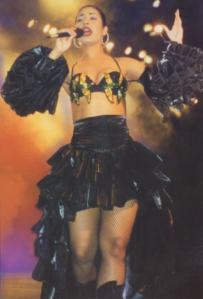
In “Giving Us That Brown Soul: Selena’s Departures and Arrivals,” Vargas addresses the multiple problems in the mainstream media’s designation of “crossover star” to narrate Selena’s story as a spectacular rise in fame marked by her violent death in 1995. Vargas seeks to correct the assimilationist narratives of Selena’s musical history that, in addition to figuring her as a marginalized Latina on the verge of “legitimate” status, problematically narrates a south-north trajectory “devoid of blackness and queerness.” Vargas both critiques how “brown soul” has been musically deployed to stand in for cultural nationalist “brown power” and extends previous work focusing on blackness in Chicano/Latino music that includes R&B and Afro-Caribbean influences but not necessarily the Afro-diasporic. Cumbia, an Afro-Columbian dance form popularized in Mexico in the 1940’s – 50’s is central to Selena’s Tejano sound as are 70’s era disco and 80’s freestyle, particularly in the cultivation of her iconic diva look which together resonate a queer of color musical legacy on the sonic and visual planes.
Selena’s “brown soul” and style moves Tex-Mex cumbias in what Vargas calls “queer misdirections” by traveling north-south, for example, while sounding counterhegemonic femininities that continue to reverberate in the many tribute drag performances to Selena in and beyond the borderlands of Tejas. In these ways, Vargas traces the “topography of Selena’s transformations and remappings of Chicano music (205). Just as audio technologies have been key in circulating Eva Garza’s and Selena’s music in multiple directions, so are the memories, repeated performances, and queer embodiments of their music by their diverse audiences. For both of the these artists, sound expands Vargas’s engagement with spatialization theories so that we may hear these productive dissonances and in these ways begin to imagine alternative borderlands imaginaries.
Upon finishing, a question that remains in considering “diva dissonance” is the implied consonance of Vargas’s theorization of “la onda.” At times, the term becomes too totalizing, and I would argue for the presence of heterogeneity and other musical diversities even within what Vargas denotes as la onda. We must both make and leave room to imagine the possibility of many unrecorded, captured, or yet unsounded transgressions for Chicanas whose paths may appear to follow a heteronormative logic. For this reason I found the reiteration of such rich findings against la onda asomewhat repetitive distraction from the richer tales Vargas’s archival work tells. What would these histories sound like if they weren’t always positioned against la onda—if they were sounded instead more toward each other?
What Deborah R. Vargas richly accomplishes in Dissonant Divas responds to Alejandro Madrid’s call for musicologists to establish critical conversations beyond “the conservatory” and to engage larger intellectual dialogues (AMS Vol. 64, No. 3, 2011).Vargas’s intersectional feminist-of-color argument extends the body of feminist Chicana/o cultural studies scholarship and equally extends Chicano music histories that may engage gender to some degree but do not fully interrogate those categorical constructions. Her theorization of the title’s key term “dissonance” as “both a methodological and analytic device” and her construction of a differential archive combine to create “alternative sonic imaginaries of the borderlands (xii).” More broadly, Dissonant Divas is an intervention to the problems of conducting research in marginalized communities and the racialized subjects often left out of official archives, institutional records, and studies of sound (Trouillot, 1995; Taylor, 2003). Each chapter reveals and addresses various barriers to conducting research on Chicana musicians whose uneven historical representation lead Vargas to turn to other sites, methodologies, and embodied practices where Chicana voices resound across temporal and spatial lines. In these ways, Vargas’s sustained engagement of race, class, gender, and sexuality with Chicana/o borderlands music is thoroughly new.
—
Featured Image: Pauline Oliveros by Flickr user Horacio González Diéguez, CC BY-NC-SA 2.0
—
Wanda Alarcón is a doctoral candidate of Comparative Ethnic Studies with a Designated Emphasis in Women, Gender, and Sexuality at the University of California, Berkeley where she is writing a dissertation titled: “Sounding Aztlán: Music, Literature, and the Chicana/o Sonic Imaginary”. Her research interests include Chicana/o cultural studies, U.S. ethnic literatures, popular music, sound studies, queer of color theory, and decolonial feminism. At Berkeley she has facilitated the working groups, “Decolonial Feminisms” and “Popular Music in Chicana/o Cultural Studies” at the Center for Race and Gender (CRG). Wanda is originally from Los Angeles and before starting graduate school she created the poetry zine, JOTA (2002 – 2006) and is updating that project by creating an archive for queer Chicana writing in cyberspace. She is a fan of radio genres and podcasts and writes micro radio plays while on the road. She is suspicious of the MP3 format yet enjoys curating party, tribute, and mood themed playlists on Spotify immensely. You can find her on Twitter depending on writing deadlines @esawanda.
—

REWIND! . . .If you liked this post, you may also dig:
Chicana Radio Activists and the Sounds of Chicana Feminisms— Monica De La Torre
Could I Be Chicana Without Carlos Santana?— Wanda Alarcon
Listening to the Border: “‘2487’: Giving Voice in Diaspora” and the Sound Art of Luz María Sánchezˆ— Dolores Inés Casillas
—
Share this:




Current Top Posts





April 2021

January 2020

November 2019

October 2019

August 2019

April 2014

November 2017

March 2015

December 2017

October 2015


Recent Comments