
SO! Amplifies: Cities and Memory
 SO! Amplifies. . .a highly-curated, rolling mini-post series by which we editors hip you to cultural makers and organizations doing work we really really dig. You’re welcome!
—
Inspired by how sound and memory interact, Cities and Memory is a sound program with the aim of “remixing the world, one sound at a time,” existing on the (already quite blurred) line between documentary field recording and sound art.
Its primary manifestation is an online global sound map, on which every location boasts two sounds, the “city” and the “memory.” The “city” sound is the faithful, documentary field recording capturing that place at that time, as it existed and was heard. The “memory” sound is a reimagined, remixed, reinterpreted version of that sound: everything from oral reconstructions, full-on techno tracks built around a field recording, ambient reimaginings, and all the points in between, as summarized in this roundup of creative approaches from the site. The reimagined sounds represent how sound is remembered and experienced differently by each individual, and explore what happens in that magical period between sounds being physically experienced and their being mentally processed, interpreted, and above all felt.
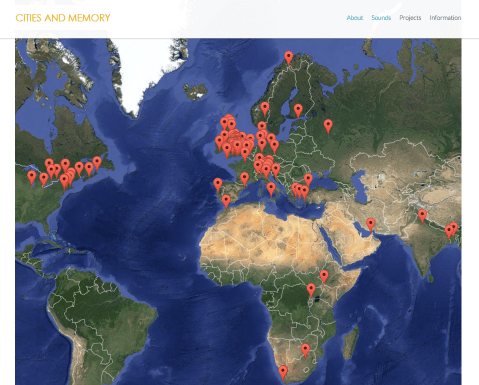
Starting from that basic premise, Cities and Memory has collected more than 600 sounds from around the world in just over a year, with more than 100 artists, musicians, field recordists and sound enthusiasts contributing anything from a field recording snatched on a mobile phone through to a complete musical reconstruction.
Over recent months, Cities and Memory has expanded with a series of projects each exploring a different avenue or window onto sound that has been opened up. For instance, last November saw #HamburgSounds, an ambitious project to sound map the vast city of Hamburg, Germany and to reimagine its sounds. A four-day recording session garnered enough recordings for forty sound artists each to give their take on a different aspect of Hamburg’s sounds and what they meant to them. The results were symbolically released over a 24-hour period, representing a day in the city’s life, and in the memories and imagination of its citizens. For more sounds from Hamburg, click here.

This year also saw a project using Brian Eno and Peter Schmidt’s Oblique Strategies cards as creative direction for reimagining field recordings. The reimagined sounds that came from more than 100 different creative strategies employed in the project were even more diverse than its locations, which covered everything from jungle in Thailand and Shanghai temples to the urban centres of Chicago, New York and London. Spectrum analysis, musical cryptograms, working simultaneously with artists in different countries, even TripAdvisor reviews(!) – every creative sonic technique in the book seems to have been used in one way or another.
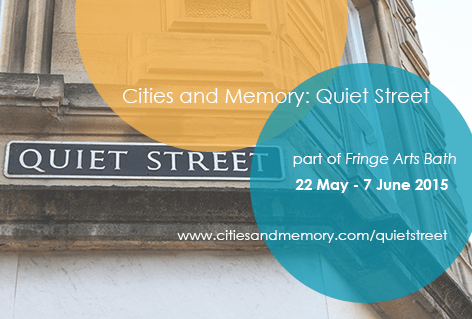
The latest project, called Quiet Street, takes the form of a simultaneous digital and physical exhibition, reimagining the sounds of the city of Bath as part of its Fringe Arts Bath Festival. The physical installation presents two sides of sonic memory – first, the documentary field recording of a location in Bath, and second the reimagined, or ‘memory’ version of the sound. The audience can navigate between two sonic ‘versions’ of Bath simultaneously on different sides of the space. One side broadcasts the “city” sound from a location, the other the matching “memory” sound, a remix or reinterpretation of the field recording, time-synced so that the sets of sounds shift in and out of one another in unison. The listener chooses – by his or her own physical proximity – to experience freely the two sound worlds.
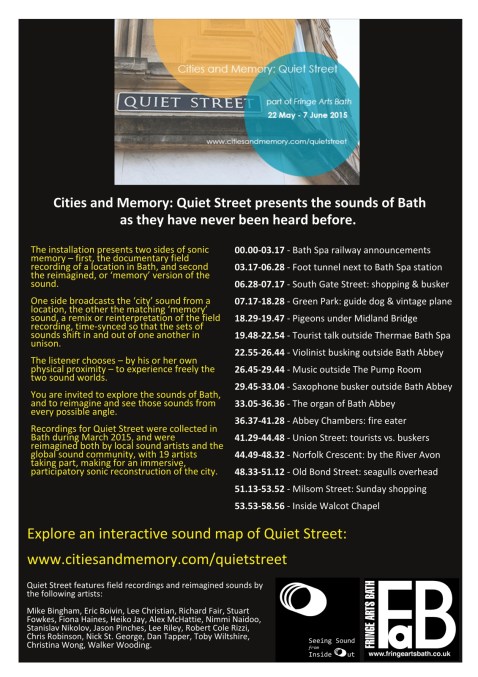
Visit the physical installation of Quiet Street at Fringe Arts Bath Festival, 22 May 2015 – 7 June 2015 at 8/9 New Bond Street Place, Bath
As the “city” and “memory” sounds are precisely time-synced in the installation, an additional creative challenge for the artists was to create reimagined version the same length as the source field recording. More importantly, they also needed consider not just how the reimagined sound stood on its own, but how it would live simultaneously in the same space as the field recording, creating a direct tension between “real” documentary sounds and the memory of those sounds in the same space.
The digital exhibition of Quiet Street allows the sounds to be explored through a map interface. It also allows listeners to simulate the installation experience with a series of installation mixes, presenting the field recording and reimagined sound on opposite sides of the stereo field. You can access playlists here and here as well as download the album documenting the event here.
As a curator, the most exciting thing to me is that the central idea behind Cities and Memory is so open; there are almost infinite possibilities for its application. A new angle on sound, place or memory can bring up a new project at any point, and every contributor brings their own experience and interpretation.
In the course of exploring hundreds of field recordings, examining them in detail and finding a creative angle from which to reinterpret them, I’ve developed a new appreciation not just of field recording as a practice, but of how to listen to whichever environment I find myself in. It’s given me a new perspective on sound and on music, and how utterly blurred the lines are between the two. I listen very differently to the world now. As Cities and Memory continues to grow, I hope many others will too.

—
Stuart Fowkes is the creator and curator of Cities and Memory, producing a large number of the source field recordings and reimagined ‘memory’ versions himself, as well as curating the project as a whole. Quiet Street runs from 22 May to 7 June at 8/9 New Bond Street Place, Bath, as part of Fringe Arts Bath, and digitally at www.citiesandmemory.com/quietstreet. Find out more about Cities and Memory and how to contribute: http://citiesandmemory.com/what-is-cities-and-memory-about/
—
 REWIND!…If you liked this post, you may also dig:
Toward A Civically Engaged Sound Studies, or ReSounding Binghamton–Jennifer Stoever
SO! Amplifies: Ian Rawes and the London Sound Survey–Ian Rawes
SO! Amplifies: Carleton Gholz and the Detroit Sound Conservancy–Carleton Gholz
Share this:

Black Mourning, Black Movement(s): Savion Glover’s Dance for Amiri Baraka
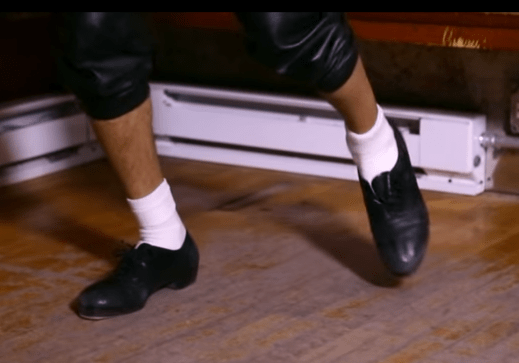
I don’t worry about the look of it so much. Choreography comes later, when I’m putting together a piece. I’m into the sound; for me, when I’m hittin’, layin’ it down, it’s all about the sound. –Savion Glover, My Life in Tap
It has been a little over a year since Amiri Baraka passed, and still I hear the echoes of his presence. I am especially attentive to the ways his work has been carried on by those involved in recent black uprisings in Ferguson, New York City, and Baltimore. Powerful political poetics that have emerged from these events include work by Danez Smith, Claudia Rankine and the many contributors to blackpoetsspeakouttumblr.com.
And yet, part of what I’ve witnessed in the streets, actual physical spaces of public protest against police violence and systemic racial oppression, is an example of what Thomas DeFrantz has termed “corporeal orature,” or the ability of bodies to resonate throughout public space and shift political discourse. In these moments, the body talk of protesters is not simply the sound of clattering feet through city streets, but a commitment to the ways in which physical gestures can speak truth to power. I am especially interested in connecting Baraka’s legacy to the larger conversation about the aural kinesthetic that Imani Kai Johnson has proposed, and in teasing out the various dimensions and potentials embedded in that category.
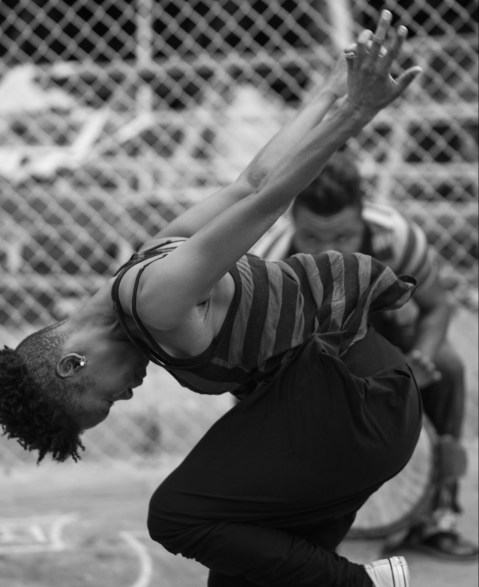
Dance at Ferguson Protests, 2014, Image by Shawn Semmler
For me, Savion Glover exemplified the lingering sound of Baraka’s spirit in his tap dance at his memorial service. Whenever I listen to the recording—which still brings tears to my eyes—I am reminded of the abundant sense of joy, sadness, and love that characterized Baraka’s service. Listening to Glover’s dance is an aural kinesthetic experience, like watching a comet pass across the night’s sky. I am reminded, too, of the way I clamored to record that moment, to keep a piece of the poet alive on my iPhone even after his public passing. And indeed, that performative sound of feet tapping, that measured excess of the body produced through movement, has kept Baraka alive for me; like his groundbreaking work, it is powerfully resistant to the proper rubrics of any one discipline except, perhaps for the study of sound itself.
So, this post then, is about tap dance and its ability to sound out Baraka’s name and life. But in a larger context, the intricate vibrations of Glover’s performance facilitate a deeper understanding of the relationship between sound and mourning, and a kind of mourning that is particularly African American, that is to say, American. It is a mourning that exists beyond the word, written text, or image and a sound practice that enables the bereaved to make a joyful noise and a mournful one at the very same time. So I ask, how do you write a eulogy with the body? How do you perform an embodied love? What does Black love and a reverence for Black life sound like? Sometimes, the answer is tap.
Audio Clip of Savion Glover’s Dance at Amiri Baraka’s Funeral, 18 Jan 2014
The dance explodes on stage like a burst of light. It begins with something approximating a drum roll – and then hard slow taps, hammering away like someone at a typewriter, I imagine, or a train gaining steam.
It is coming.
Slow, insistent and strong, with a little riff now and then, a little picking up of speed here and there. It is coming on louder now, that explosive thing, the tension you are noticing. He is doing the thing. And then there is that skillful, smooth, strong tap. Glover is at work, y’all.

Savion Glover at Work, Image by Flickr Users Raquel and Soren
As a tribute to Baraka, Glover’s dance bears numerous stylistic implications. Among them, I understand the rhythm of Glover’s tap as the rhythm of writing, an aesthetic that complicates the way his dance can be understood as a manifestation of the black vernacular. Sketching out the early connections between her son’s artistry and the percussive taps of the keyboard, Yvette Glover says. “‘I was working for a judge, as an assistant, when I was pregnant with Savion…And when I would type, and the carriage would automatically return, he’d walk, he’d follow it, in my stomach. You could see him move” (39). He does it still. In the audio clip, Glover’s footwork evokes the dexterity of Baraka’s language, all the while telling a story of its own.
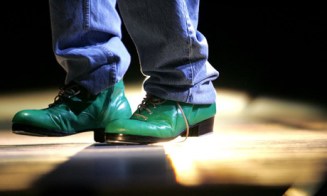
Savion Glover’s Shoes, Sadler’s Wells, 2007, Image by Tristram Kenton
But what about the intensity of the dance, its crescendo toward the end of the service, a flurry of percussive steps beside Baraka’s coffin? Baraka himself reminds us this particular musicality is so necessary here. In his discussion of “Afro-Christian Music and Religion” in Blues People, Baraka notes that in Black diasporic religious services, “the spirit will not descend without a song” (41). Glover’s dance takes place at a moment in the service when emotion exceeds the power of language, but not sound. He uses his body as an instrument of sound in its fullest sense. His performance is a choreography of embodied sound: full-on and at-once body poetry, mourning and tribute.
Elucidating the use of his body as an instrument of sound, Glover declares:
It’s like my feet are the drums and my shoes are the sticks[…]My left heel is stronger, for some reason, than my right; it’s my bass drum. My right heel is like the floor tom-tom. I can get a snare out of my right toe, a whip sound, not putting it down on the floor hard, but kind of whipping the floor with it. It get the sounds of a top tom-tom from the balls of my feet. The hi-hat is a sneaky one. I do it with a slight toe lift, either foot, so like a drummer, I can slip it in there anytime. And if I want cymbals, crash crash, that’s landing flat, both feet, full strength on the floor, full weight on both feet. That’s the cymbals. So I’ve got a whole drum set down there (19).
Combining his body’s drumbeat with the tic of Baraka’s keystrokes, Glover embeds the pattern of Baraka’s life in this tap dance, communicating it with the kind of deep and reverential love you are taught to have for your elders when you are young, appropriate and deep.
 But as powerful as his body-poetry is, Glover’s silences are also key. In those inaudible spaces, Glover spreads out his arms, offering up the dance in a gesture of expansive love; the immensity of the silent gestures mirroring the immensity of Baraka’s life. He holds it out as a gift towards the audience, bows his head, too.
In moments of sound and silence, the audience calls out to Glover the way they would a preacher. At these moments, the dance becomes a call and response akin to the way Baraka’s life’s work was a call and response. A call to respond. A call to take what was given to you and make it mean. Listeners to the dance are called up out of themselves. We are changed by the dance and by the listening.
Tap tap tap.
Glover’s performance shows us how his specific blend of African and European dance traditions exists in a spiritual and artistic dimension. There is a religious explanation for this, too. In African Dance, Kariamu Welsh-Asante explains the function of the African funeral dance in definite terms:
All African dances can be used for transcendence and transformational purposes. Transcendence is the term usually associated with possession and trance. Dance is the conduit for transcendent activities. Dance enables an initiate or practitioner to progress or travel through several altered states, thereby achieving communication with an ancestor to deity and receiving valuable information that he/she can relate back to the community. Repetition is key to this process as it guides the initiates, or dancers, through the process of the ceremony. The more a movement is repeated, the greater the level of intensity and the closer a dancer gets to the designated deity or ancestor. Transformation means to change from one state, or phase, to another (16).
Glover certainly brought us close to Baraka. And yet, I would go a step further to suggest that this is, above all, blues dance. As such, it reveals continuing relevance of social dance and movement to Baraka’s political legacy. Baraka and Glover work directs us towards the propulsive nature of black social/percussive dance forms. These sonic gestures clarify the ways black life matters, impacts the public sphere and policy. The politicized nature of Black Arts Movement performances and the performative elements of contemporary Black protest are still linked through sound. Politicized Black aesthetics continue to offer us multiple opportunities to witness the convergence of sound and movement. Ras Baraka, affirms this in his own eulogy for his father:
Have you seen black fire it burns deep it never goes out you can try and extinguish it but it never goes out it never goes out it never goes out only up or out as in broad as in multiply as in blues black base of the fire dancing flickering at times but never all the way gone dancing flickering at times but never all the way gone…
The power of the dance, of the Black Movement to move is still with us.

Protestors dance to a community band, Baltimore, MD, 28 April 2015, Photo by Adrees Latif/Reuters
—
Featured Image, Screen Capture of Savion Glover dancing by JS
—
Kristin Moriah is the editor of Black Writers and the Left (Cambridge Scholars Press, 2013) and the co-editor of Adrienne Rich: Teaching at CUNY, 1968-1974 (Lost & Found: The CUNY Poetics Document Initiative, 2014). Her critical work can be found in Callaloo, Theater Journal, TDR and Understanding Blackness Through Performance (Palgrave Macmillan, 2013). Moriah is completing a dissertation on African American literature and performance in transnational contexts at the CUNY Graduate Center. Her research has been funded through grants from the Social Science and Humanities Council of Canada, the Freie Universität Berlin and the Graduate Center’s Advanced Research Collaborative. She is a 2014-15 @IRADAC_GC Archival Dissertation Fellow and spring 2015 Scholar-in-Residence at the NYPL Schomburg Center for Research in Black Culture. Sometimes she tweets via @moriahgirl.
—
REWIND! . . .If you liked this post, you may also dig:
“HOW YOU SOUND??”: The Poet’s Voice, Aura, and the Challenge of Listening to Poetry-John Hyland
Pretty, Fast, and Loud: The Audible Ali–Tara Betts
The Sounds of Anti-Anti-Essentialism: Listening to Black Consciousness in the Classroom-Carter Mathes
Share this:


Current Top Posts





April 2021

January 2020

November 2019

October 2019

August 2019

April 2014

November 2017

March 2015

December 2017

October 2015
 Sounding Out!
Recent Comments